
Most of my readers find this blog looking for INFJ posts, so I’m sure many of you know I have a keen interest in personality types. Until very recently, my whole focus has been on the Myers-Briggs typing system. But someone finally convinced me to give the Enneagram a try. I was suspicious at first. It seemed strange, vague, largely negative, and not all that verifiable. Then I thought perhaps I hadn’t picked a good book to start with as my introduction and started prowling around online for recommendations.
And that’s how I found Discovering Your Personality Type: The Essential Introduction to the Enneagram by Don Richard Riso and Russ Hudson. These guys know how to write a personality type book. This particular one is a short little book that packs a whole lot of information in its 224 pages, including their type indicator questionnaire (you can either purchase the test online or get this book and do the paper version). They’ve also written other, more in-depth, books including one that I’m reading now.
What On Earth Is The Enneagram?
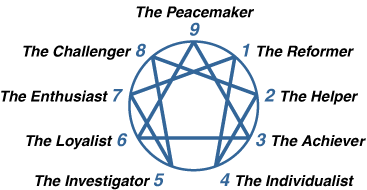 The Enneagram of Personality Types is “a modern synthesis of a number of ancient wisdom traditions” originally put together by Oscar Ichazo (click here to read more). There are nine basic personality types and everyone is born with one type that dominates their personality.
Though your basic type doesn’t change, the Enneagram contains the possibility for quite a bit of variation within each type. For example, most people aren’t a “pure” version of their base type. They’ll also have some traits from one of their “wings,” the the type adjacent their type on the Enneagram (e.g. a 1 type can have a 9 or a 2 wing). Having two wings or no wings is fairly rare, but can happen.
The Enneagram also describes healthy, average, and unhealthy variations for each type. What Enneagram teachers call directions of integration and disintegration describe the ways each type responds when in a growth state or when under stress. The nine types are also grouped into three “centers” — the instinctive/gut types (8, 9, 1), the feeling/heart types (2, 3, 4), and the thinking/head types (5, 6, 7). And that’s just a super-brief overview of how deep you can go with the Enneagram (click here for a more complete introduction).
So What Type Are You?
If you want to discover your Enneagram type, you can find some tests online or get a copy of Discovering Your Personality Type (I’d recommend the book; you can probably find it in the library). I’d taken a few Enneagram tests online several years ago just for fun, but didn’t quite know what to do with the results. Interestingly, the more thorough test in this book gave me the same results as those tests: 4w5. I also score very high on 9 traits, for some reason, though I’m sure from reading the descriptions that it’s not my type.
Type 4 goes by the nickname “The Individualist” or “The Romantic” (depending which teacher you read). Riso and Hudson briefly describe them as “The Expressive, Dramatic, Self-Absorbed, Temperamental Person” (ouch — are any of those supposed to be positive traits?). My 5 wing means I also have some characteristics of “The Investigator” or “The Perfectionist.” They’re described as “The Perceptive, Innovative, Secretive, Isolated Person.”
It’s been interesting to compare 4 traits with my INFJ personality type (4w5 seems to be one of the more common Enneagram types for INFJs and INFPs, though certainly not the only option). I’m realizing some of my traits might not have nearly as much to do with being INFJ as they do with being a type 4. For example, most INFJs report having a rich inner world and many will say that they can become preoccupied with fantasy. But there’s really nothing in an INFJ’s mental wiring that would send this type and only this type into a daydreaming spiral that makes it difficult for them to interact with the outer world. Withdrawing to fantasy and losing oneself in imagination is, however, a trait of Enneagram 4s. In fact, Riso and Hudson describe it as their “characteristic temptation.”
How Does It Compare To Myers-Briggs?
Myers-Briggs describes how our minds work — the primary ways we make decisions and gather and process information. The Enneagram, on the other hand, seems more focused on getting to the core of an individual’s passions, fears, motivations, obsessions, and virtues. Here are some articles I found that discuss and compare the two systems:
- Enneagram vs. Myers-Briggs/MBTI: Key Differences
- Enneagram, Myers-Briggs & the Inferior Function: Healthy Type Correlations
- Understanding The Enneagram (From A Myers-Briggs Expert)
- Here Are The Most Common Enneagram Types For Each Myers-Briggs Personality Type
- “Debunking” the Myers-Briggs: Enneagram Implications
The two systems describe different aspects of personality and it seems they complement each other quite well to get a more in-depth look at yourself and other people. One key difference I’ve noticed is how it feels when you initially discover your type. Since Myers-Briggs describes how your mind works, the initial response to learning your type is often, “Wow — someone understands me! That’s so cool.” Myers-Briggs can help you discover some of the weaknesses of your type and act as a tool for personal growth, but the basic descriptions are largely positive.
The Enneagram also looks at healthy and unhealthy versions of each type, but learning your Enneagram isn’t always as validating as learning your Myers-Briggs type. My reaction to reading the type 4 description was more like, “Oh. They know my deepest weaknesses, fears, and temptations. I don’t like myself.” Further reading brings out that the Enneagram also talks about healthy versions of the type, growth opportunities, and things like that, but that initial reaction wasn’t as comfortable as learning I was an INFJ. I think it’s going to be very helpful, though, for personal growth.
What do you think, Dear Reader? Have you looked into both personality type systems, or do you just stick with one? If you’ve studied both, what do you think of them?


Leave a Reply