Disney Villains Myers-Briggs Chart – Part Two

Last week I posted my chart with Disney villains Myers-Briggs types. It turned into such a big post that I finally split it in half — Sensing types in Part One and Intuitive types today in part two (some of you probably saw the whole post last week. It was live for a few hours before I decided splitting it up would be more manageable). To re-cap, here’s my criteria for which villains are included in this chart:

  • All Primary Members of the Disney Villains franchise show up here, except Chernabog.
  • I then added a few other popular villains, paying special attention to the villains from films where I’ve already typed a Disney heroine.
  • To keep the number of villains manageable, I decided not to type any of their side-kicks or secondary villains.
  • I’m only typing the animated versions. This is mostly to maintain consistency, since sometimes the type changes in live-action reboots (such as Maleficent becoming more INFJ when she got her own film).

Disney Villains Myers-Briggs Chart | marissabaker.wordpress.com

As I mentioned last week, if you compare this chart to the ones I made for Disney Princesses, you’ll see they’re almost opposite each other. The spots on the chart that stood empty for the Princesses (ENFJ, INTJ, INTP) now have at least one occupant and some of the spots bursting with princesses don’t have any villains at all. The biggest trend seems to be Feeling types equal “good” and Thinking types equal “evil” (which really bugs me, but that’s a rant for another time).

There’s not much to go on for typing some of the villains. They’re often caricatures of personality types rather than fully-fleshed out characters. By necessity, associating a villain with a certain types means looking at the most negative stereotypes of that type. But Disney typing is fun, so even when we don’t have much to work, I’m going to take a guess at the character. You’re welcome to shout-out in the comments about what you do and don’t like! Have fun 🙂

Hans — ENFJ

Hans - ENFJ. Visit marissabaker.wordpress.com for more Disney villain typesI love NF type villains. They’re not the typical choice for a fictional bad guy and their motives aren’t always immediately understandable, which is part of makes them an unexpected and unpredictable character.

  • Fe: Types that lead with Fe often have the easiest time connecting with people. Which means they can be the most charming, manipulative villains you’ll ever see. Hans’ entire plan is based on charming one of the sisters into marrying him (which he does easily by creating an instant connection with Anna). He’s also writing a narrative that makes him “the hero that’s going to save Arandel” as he manipulates all Elsa’s advisors until they’re begging him to be king.
  • Ni: This shows up in his long-term thinking. As the youngest of 13 brothers, he decided that taking over a different kingdom was better than the life he could see continuing on in the future at home.
  • Se: Typically a fun-loving and risk-taking aspect of personality, which helps him charm Anna initially and also shows up in his physical skills like dancing and swordfighting.
  • Ti: Logic is not an ENFJ’s strongest suit. Hans’ entire plan rests on getting people to feel the way he wants them to rather than not on something concrete and he doesn’t have a backup plan.

Hades — ENFP
Hades - ENFP. Visit marissabaker.wordpress.com for more Disney villain typesThere’s little disagreement that Disney’s Hades is an NP type and none at all that he’s an extrovert. People just can’t agree on Thinking or Feeling. Both ENxP types lead with Ne, so it comes down to whether he uses Fi/Te (ENFP) or Ti/Fe (ENTP) to make decisions. Read more

A Closer Look At The Beatitudes

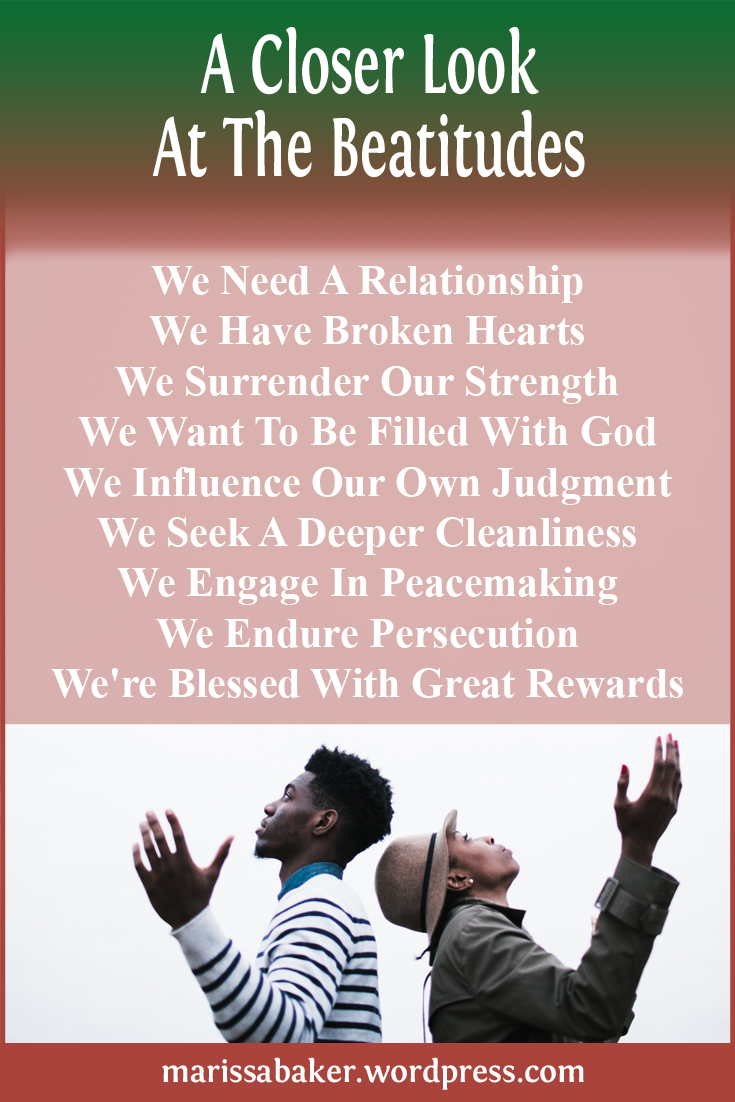
When Jesus delivered the Sermon on the Mount, He began at what we now call the Beatitudes. He says, “Blessed are” the sort of people who probably don’t feel all that blessed — those who are poor, mourning, meek, hungry and thirsty for righteousness, merciful, pure in heart, peacemakers, persecuted, and reviled. We don’t like being poor, or in grief, or humble enough to put others first, or attacked by the people around us. It’s hard work being a peacemaker, or showing mercy, or staying pure of heart, or constantly yearning to get closer to God’s righteousness.

It’s interesting that two of the beatitudes mention righteousness: “Blessed are they which do hunger and thirst after righteousness” and “Blessed are they which are persecuted for righteousness’ sake” (Matt. 5:6, 10, KJV). This word refers to “the condition acceptable to God” and/or “the doctrine concerning the way which man may attain a state of approval by God” (Thayer’s G1343, dikaiosune). It relates to our state of being and the way we live. In fact, when you think about it, all the beatitudes relate to something we do and/or become as we follow God.

A Closer Look At The Beatitudes | marissabaker.wordpress.com
Photo credit: Temi Coker via Lightstock

We Need A Relationship

Blessed are the poor in spirit: for theirs is the kingdom of heaven. (Matt. 5:3, KJV)

There’s more than one word that could be translated from Greek as “poor.” This one means “reduced to beggary” and “lacking anything” (Thayer’s G4434, ptochos). When we’re like that in our spirits, we’re really in a place to recognize how much we need a relationship with the Father and Jesus. We become the sort of person the Lord is talking about when He says, “to this man will I look, even to he who is poor and of a contrite spirit, and who trembles at my word” (Is. 66:2, WEB).

We Have Broken Hearts

Blessed are they that mourn: for they shall be comforted. (Matt. 5:4, KJV)

We all experience grief. The death of a parent, child, or dear friend. The loss of a hope held close to our hearts. The decay of a relationship. Betrayal from a friend. And even in the midst of that mourning, we’re blessed because God promises comfort (John 14:16-18; 2 Cor. 1:3-7). He can respond to our tears as powerfully as He did for David in the situation recorded in Psalm 6. Read more

Disney Villains Myers-Briggs Chart – Part One

It’s finally here! The baddest evildoers to ever oppose animated Disney heroism — now with Myers-Briggs types. There are a lot of villains that show up in Disney stories so I had to whittle it down to a fairly short list. Here’s my criteria:

  • All Primary Members of the Disney Villains franchise show up here, except Chernabog.
  • I then added a few other popular villains, paying special attention to the villains from films where I’ve already typed a Disney heroine.
  • To keep the number of villains manageable, I decided not to type any of their side-kicks or secondary villains.
  • I’m only typing the animated versions. This is mostly to maintain consistency, since sometimes the type changes in live-action reboots (such as Maleficent becoming more INFJ when she got her own film).

Disney Villains Myers-Briggs Chart | marissabaker.wordpress.com

If you compare this chart to the ones I made for Disney Princesses, you’ll see they’re almost opposite each other. The spots on the chart that stood empty for the Princesses (ENFJ, INTJ, INTP) now have at least one occupant and some of the spots bursting with princesses don’t have any villains at all. The biggest trend seems to be Feeling types equal “good” and Thinking types equal “evil” (which really bugs me, but that’s a rant for another time).

There’s not much to go on for typing some of the villains. They’re often caricatures of personality types rather than fully-fleshed out characters. By necessity, associating a villain with a certain types means looking at the most negative stereotypes of that type. But Disney typing is fun, so even when we don’t have much to work, I’m going to take a guess at the character. You’re welcome to shout-out in the comments about what you do and don’t like! Have fun 🙂

  • Please note: there were so many villains to type that I split them up into two blog posts. Part One covers the Sensing Type villains and Part Two will cover the Intuitive types.
  • One more note: I mostly type by function stacks, so if you’re not familiar with that part of Myers-Briggs theory you can click here to read The Simplest Guide To Myers-Briggs Functions Ever.

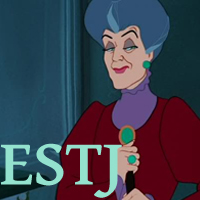
Lady Tremaine — ESTJ

Lady Tremaine - ESTJ. Visit marissabaker.wordpress.com for more Disney villain typesMost people type her as a TJ type (at least in the animated version), but beyond that there isn’t any agreement about her I/E or S/N preference. I’m pretty sure she’s a Sensor, but I’ve gone back and forth between introvert and extrovert. I’ve gone with extrovert because she’s very inclined to take-charge in the outer world and we don’t really see her spending any time alone.

  • Te: The opening narration describes her as “cold, cruel, and bitterly jealous of Cinderella’s charm and beauty.” While not a fair representation of TJ types, “heartless” is an accusation stereotypically leveled against them, especially women. She’s very outwardly judgemental and her communication consists of authoritative orders.
  • Si: My guess is that Lady Tremaine married Cinderella’s father for security. She already had a “good family” so she wasn’t social climbing. While we do see her trying to forward her daughters’ interests, it’s not really as part of a N-type’s long-term planning. She’s working within traditional roles to control and manipulate people.
  • Ne: A pattern-recognition function, Extroverted Intuition helps Lady Tremain put the pieces together and realize Cinderella was the mystery woman at the ball.
  • Fi: As an inferior function, Introverted Feeling can show up as outbursts of emotion and a fear of feeling. Lady Tremain is a very detached character, never showing her feelings for the people around her unless it’s in an angry outburst.

Queen of Hearts — ESTJ

Queen of Hearts - ESTJ. Visit marissabaker.wordpress.com for more Disney villain typesThe Queen of Hearts is one of the more exaggerated Disney villains. ESTJ nicknames include Supervisor, Executive, Overseer, and Enforcer. Take that to a villainous extreme and you just might get someone who lops off subordinates’ heads when things don’t go as they ordered. Read more

In The Secret Place: The Promises of Psalm 91

Last week we talked about claiming promises from God. But we didn’t talk about the verses that got me started on that study. Psalm 91 is packed full of promises that are clearly meant to include the reader. There isn’t even a writer credited, so there’s no clear historical context, and the psalm is addressed to all who make the Lord their God. There’s nothing to distract from the fact that this psalm was written for everyone who’s in a relationship with God, including you as a Christian today.In The Secret Place: The Promises of Psalm 91 | marissabaker.wordpress.com

Claiming Relationship With God

He who dwells in the secret place of the Most High will rest in the shadow of the Almighty. I will say of Yahweh, “He is my refuge and my fortress; my God, in whom I trust.” (Ps. 91:1-2, WEB)

The psalm begins with a promise to those who remain, inhabit, and abide (H3427, yashab) in the hiding place or shelter (H5643 sether) of the Most High God. They will “stay permanently” (Strong’s H3885 lun) in the shadowing protection (H6738 tsel) of El Shaddai.

Because of that promise, we get the only “I” statement from this psalm’s writer. They claim the Lord as “my God” and say they will have confidence in Him (H982 baach). And they demonstrate that trust by making Him their refuge, shelter (H4268 machaseh) and defensive stronghold (H4684 matsud). That’s something we can do as well.

Stripping Fear of Power

This psalm contains truly incredible promises of protection in the midst of trials. We’d probably prefer it if God’s protection meant we didn’t have to go through trials. But to be delivered “from the snare of the fowler, and from the deadly pestilence,” there must be someone trying to trap you or a pestilence threatening your life (Ps. 91:3, WEB). And if “A thousand may fall at your side, and ten thousand at your right hand,” then you must be in a location where people are perishing right and left (Ps. 91:7, KJV). Read more

Let’s Get Real About Fantasy

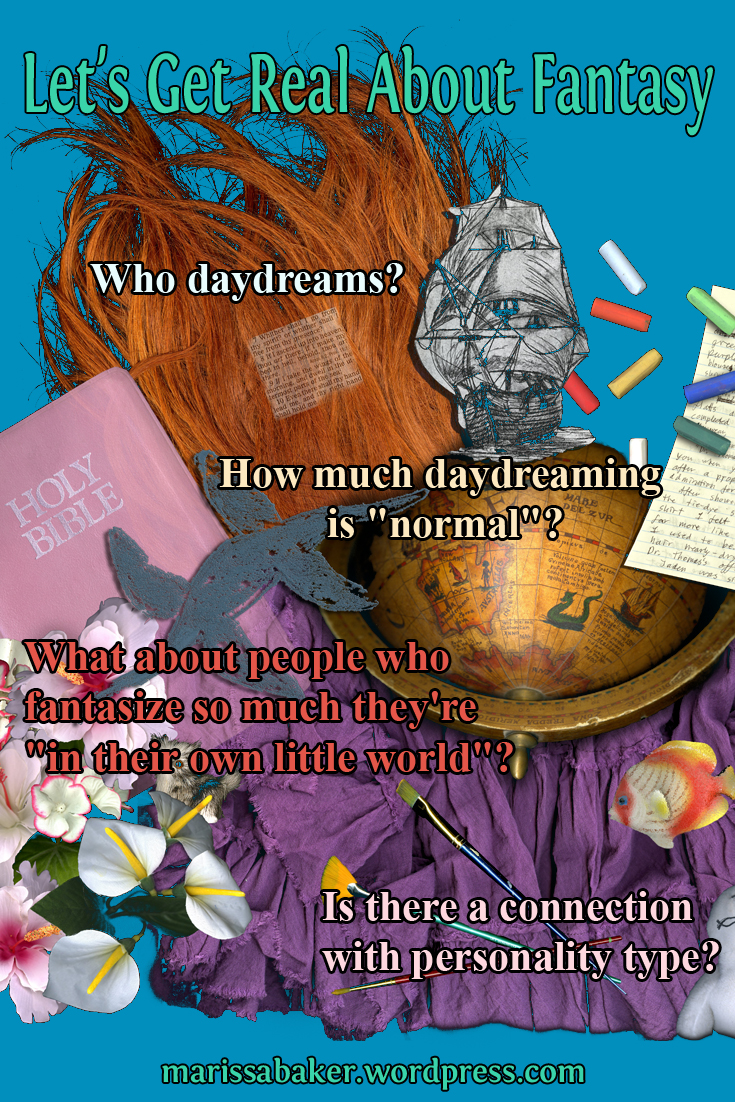
Daydreaming is often considered a childish activity. So it might come as a surprise that studies indicate at least 96% of adults engage in daydreams and/or fantasizing on a daily basis. These daydreams typically last for just a few minutes while the mind wanders, but they can also be more involved, frequent, and lengthy. And getting caught up in daydreams is not, as previously thought, as sign of tending toward mental illness.

According to an article in the Dartmouth Undergraduate Journal of Science, we’re learning that daydreaming is “a normal part of our cognitive processes.” In fact, it’s pretty normal to “spend one-third to one-half of our waking hours daydreaming, although that amount can vary significantly from person to person.” I was honestly pretty surprised to learn this. I mean, I know I do that, but I wasn’t expecting such a large percentage of the population to also daydream so much.

But while reading different articles about daydreams, I realized something else. They’re talking about people’s minds drifting into fantasies about their real lives. For example, it’s considered healthy for someone approaching a job interview to daydream about getting the job or for someone in a high-stress job to spend time fantasizing about how all their conversations for the upcoming day could go well. Other studies asked people to daydream about taking vacations or their childhood home. These daydreams are about things that could happen or have happened. I have those types of daydreams, too, but that’s not what most of mine are.

Let's Get Real About Fantasy | marissabaker.wordpress.com
this picture is part of a psychological self-portrait I made in a college art class

Extreme Fantasizers

While studying hypnotic suggestibility in 1981, psychologists Theodore X. Barber and Sheryl Wilson discovered that the 27 women they identified “as extremely good hypnotic subjects … all had a fantasy life so intense that it seemed ‘as real as real.'”‘ After more research, people in this group are now described as having a “fantasy prone personality” (FPP). On the more extreme side, where fantasies start to take over reality, it’s called “maladaptive daydreaming” (click here to read an interview with a maladaptive daydreamer).

According to researchers, about 4 percent of people spend half or more of their waking hours absorbed in reverie. The fantasies are not mere fleeting daydreams but something of a cross between a dream and a movie, where an elaborate scenario unfolds once a theme is set. (from a New York Times article)

Reading about this group is where I start to recognize myself. Read more

Claiming God’s Promises

Not every single word in the Bible applies directly to each person reading it. It’s all inspired by God and we can learn from it, of course, but not everything applies to everyone directly. For example, some cleanliness laws in the Old Testament were gender specific and some prophecies were delivered to a specific person or group (like the dream warning Nebuchadnezzar he would become like an animal for 7 years).

But we can take this observation too far. We might make the mistake of thinking that because warnings to follow God alone were delivered to ancient Israel they don’t apply to us today. Yet the New Testament confirms we still need to make a choice between darkness and light (Deut. 30:15-20; 1 John 1:5-2:6). This type of thinking can also block us from accepting encouraging promises as well.

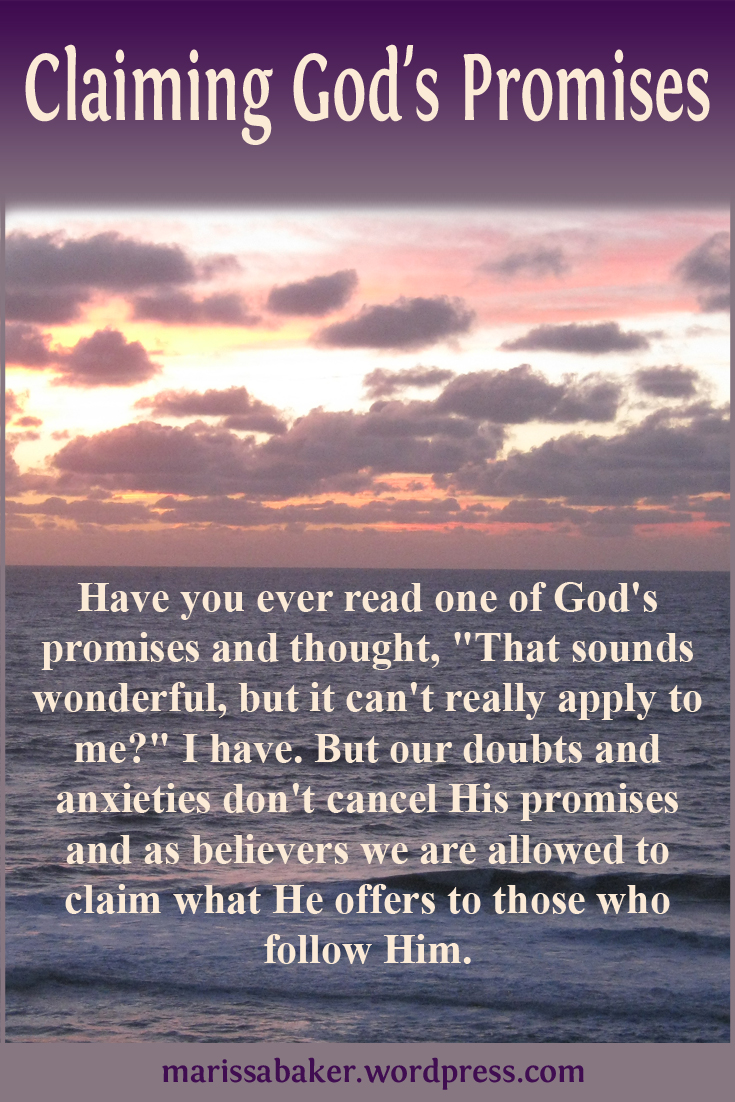
Have you ever read one of God’s promises and thought, “That sounds wonderful, but it can’t really apply to me?” I’m sure many of us have. For me personally, I struggle with believing God will answer my prayers the way He promises too (mostly I feel like my prayers for other people aren’t effective). But does that mean God’s promise to hear when we call doesn’t apply to me? Of course not. And I’ve even seen some examples of His direct responses to my prayers. My doubts and anxieties don’t cancel His promises. But they can block me from recognizing or accepting His work with, in, and for me.Claiming God's Promises | marissabaker.wordpress.com

God’s Presence In You

The Holy Spirit is one thing God promises to new believers. Jesus told His disciples the Father would give them the Holy Spirit after He left and we see that promise fulfilled quite spectacularly in Acts 2. As the narrative continues, a pattern emerges where believers receive the gift of the Holy Spirit when they covenant with God at baptism. And it’s made clear that this promise isn’t just for the people of that time. Read more