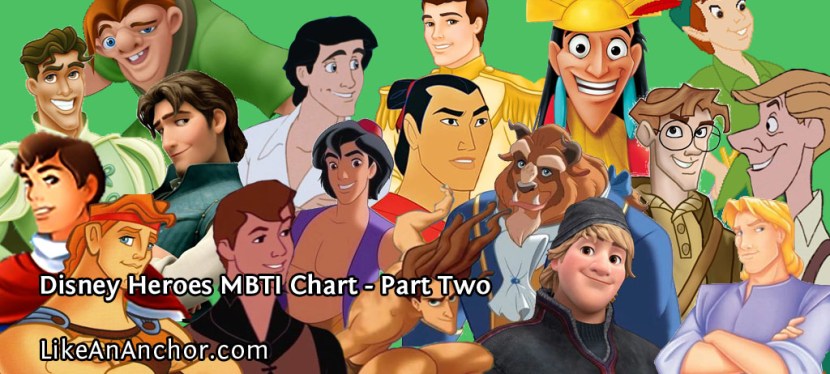
Disney Heroes MBTI Chart – Part Two

I like typing fictional characters because they offer good examples for how the different types can show up in “real life.” This project, though, is mostly for fun. I’ve written posts typing Disney princesses and heroines, and I also have  a two part post on this blog typing Disney villains. Seemed like it’s about time for the Disney princes and heroes to get their own posts as well.

There are so many Disney princes and heroes who could go on this list that I had to make some tough choices about who to include. The characters I picked: appear in an animated Disney film, they’re human, they’re fairly popular/well-known, and I’ve seen the movie they’re in. I’ve put half in this post and half in Part One (click here to read that).Disney Heroes MBTI Chart - Part Two | LikeAnAnchor.com

I don’t like using stereotypes as a basis for typing characters, but I’m afraid that’s what I’ve done in some of these descriptions. When the characters development doesn’t go really deep (some of these princes don’t even have names!), we just have a few key characteristics to base our typing on and you have to try and match them with defining traits of a personality type. Unfortunately, sometimes that means relying on an overly simplistic view of each type. Just wanted to make that disclaimer before we dive into talking about Milo, Prince Naveen, Rodger Radcliff, Prince Philip, Peter Pan, Prince Charming, Snow White’s Prince, Quasimodo, and Tarzan. Read more

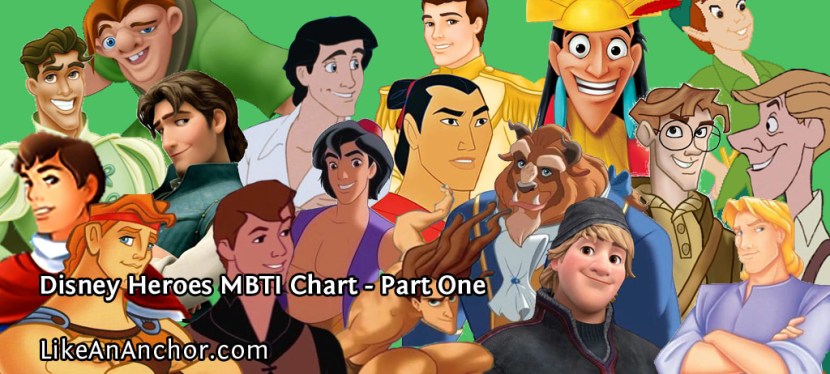
Disney Heroes MBTI Chart – Part One

I like typing fictional characters because they offer good examples for how the different types can show up in “real life.” This project, though, is mostly for fun. I’ve written posts typing Disney princesses and heroines. I’ve got a two part post on this blog typing Disney villains. Seems like it’s about time for the Disney princes and heroes to get their own posts as well.

There are so many Disney princes and heroes who could go on this list that I had to make some tough choices about who to include. My criteria are as follows: the characters appear in an animated Disney film, they’re human (sorry Simba, Tramp, and Pongo), they’re fairly popular/well-known, and I’ve seen the movie they star in. I’ve organized them alphabetically, then put half in this post and half in a second post that will come out on Wednesday.Disney Heroes MBTI Chart - Part One | LikeAnAnchor.com

I don’t like using stereotypes of any Myers-Briggs type as a basis for typing characters, but I’m afraid that’s what I’ve done in some of these descriptions. When the characters development doesn’t go really deep and we have just a few key characteristics to base our typing on, you have to try and match them with defining traits of a personality type. Unfortunately, sometimes that means relying on an overly simplistic view of each type. Just wanted to make that disclaimer before we dive into talking about Aladdin, the Beast, Prince Eric, Flynn Rider, Hercules, John Smith, Kristoff, Kuzco, and Li Shang. Read more

How Do I Convince People They’re Wrong and God Is Right?

The world seems like it’s going crazy. Looking around at what’s going on brings to mind Bible verses like “everyone did what was right in his own eyes” and “there is no fear of God before his eyes” (Jud. 17:6; Ps. 36:1). Not only do people reject God, but they reject the entire idea of absolute morality as well, opting for a subjective, situational version that can change moment-to-moment and person-to-person.

In the midst of this, many Christians want to fight for and defend the truth of our faith. We want to show the world they’re wrong and prove that God is right. We think that to “contend earnestly for the faith once delivered,” we need to offer logical, scientifically supported, convincing arguments to counter the lies running rampant in our culture.

But I don’t think we’re going to convince many people that God’s word is the truth (rather than just one of many truths) by arguing with them. There’s definitely a place for apologetics, and people with the knowledge and expertise to enter debates and stand up for truth are invaluable. In general, though, I question whether telling people how wrong they are and what they need to change is a good first step for introducing them to the faith.

If we start out by lecturing people about how much God hates their sin or how wrong they are about ideas they hold dear, why would they react any way other than defensively? And if they don’t acknowledge God as real yet, why would we expect them to care what we say He wants them to do?

Keeping Your Audience In Mind

God’s truth doesn’t change with the times. But those who are wise keep their audiences in mind when they speak the truth. When Paul spoke to Jews in Antioch, he knew his already religious audience could best be reached by using scriptures to prove Jesus is the long-awaited Messiah (Acts 13:14-41). When he preached to people in Athens without any Biblical background, however, he started by talking about who God is and why we should care. He even quoted one of their own philosophers as part of his argument (Acts 17:18-31). Tailoring the message to fit his audience was a deliberate, conscious choice that Paul made. Read more

Personality Type Myth-Busting: Is The Myers-Briggs® Test Only Useful For Entertainment?

Critics of the Myers-Briggs® test have a whole host of complaints to bring against it. The test isn’t valid because you can get different results if you retake it, it uses false/limited binaries, it doesn’t predict work performance — the list goes on and one. And at the end of these sorts of articles, the writers say, “The Myers-Briggs is useful for one thing: entertainment. … like a BuzzFeed quiz.”

Some of the criticisms are true, at least at face value (e.g. you can get different results from retaking the test). But others betray a fundamental misunderstanding of Myers-Briggs® theory (e.g. the idea that it relies on limited binaries/dichotomies). And still others arise from expecting Myers-Briggs® types to tell us something they were never designed to measure (e.g. whether or not you’ll do well in a certain job).

Clearly, I think personality types are useful for more than just entertainment or I wouldn’t be writing about them as much as I do. But do I have a good reason for thinking this? Is the Myers-Briggs® test and theory useful? The answer depends what you’re using it for. Read more

7 Fictional Characters That You’ll Relate To If You’re An ESTP

What fictional characters do you relate to as an ESTP?

Just as we can describe real people using the Myers-Briggs® typology system, we can also type well-written fictional characters. Some of fiction’s most iconic and intriguing characters are ESTPs and today we’re going to talk about seven that I think real-life ESTPs will find relatable.

One great thing about looking at character personality types is that it helps us better understand people who have different types than we do. Fictional ESTPs can serve as examples for what real-life ESTPs might be like, and also show how much variation can exist between individuals with the same type.

Much like ISTPs, ESTP characters make fantastic action heroes. But they’re also far more than that. You’ll find ESTPs in fiction (and in real life) using their natural strengths in a variety of ways as they lead others, solve problems, and adapt to life moment by moment. The way their minds work make them compelling, dynamic characters that often capture our hearts and imaginations.

James T. Kirk

Lenore Thomson types Jim Kirk as an Intuitive type in her otherwise excellent book Personality Types, but I’m more inclined to agree with Susan Storm that he’s an ESTP. To quote her article about The Greatest Movie Heroes of Every Myers-Briggs® Personality Type, “Jim Kirk embodies the impulsive, opportunistic nature of the ESTP personality type. He lives fully in the moment and is quick to react to changes in his environment. He loves a fast-moving, daring lifestyle and loves to experience new and novel things.”

Kirk is every bit as charming as you’d expect from ETP types with tertiary Extroverted Feeling. This function also gives him an edge in understanding people (though as a tertiary function it isn’t his strongest suit) and lends an easy carelessness to the way he presents himself to the world. People may initially misinterpret him as shallow and/or “boyish,” but he continually demonstrates that he thinks deeply about things. He’s quick to come up with clever plans, to understand what’s going on in unexpected situations, and often shares deep insights about complex ethical questions he’s working to make sense of. Read more

There’s Only One Sovereign, And It Isn’t Me

One of the things I’ve discovered as I’ve confronted and worked through my anxiety is that (for me at least) much of it is connected to control. I fear being controlled, losing control, and not having control. Not being able to predict, plan, and prepare for things can leave me shivering, sweating, and struggling to breathe.

I know part of this goes along with anxiety as a mental health condition. But there’s also a layer that’s something human beings — no matter how their brains function — have struggled with for years. We don’t want to accept “that control is an illusion. There is only one Sovereign … and it isn’t me” (What Does Your Soul Love?).

Now, by saying this I don’t mean for us to think, “Great, one more thing I need to ‘fix’ about myself. As if there wasn’t enough on the list already.” That kind of response is still trying to cling to our own control over the situation. Not only that, it leads to self-condemnation which (as a friend recently reminded me) is not a good place to be. Instead, the solution to grasping for control we can’t really have is to surrender everything to God and trust Him to be God.

Let Go, and Let God

I’ve been reading a new book, which will be out in September, called What Does Your Soul Love? by Alan and Gem Fadling. Chapter 8’s title is “Control: What Are You Clinging To?” Reading it has been a challenging, but it’s one that I’ve found both convicting and helpful.

“Much of the anxiety we carry is actually brought on by our own fear and a desire for control. We want to put our fears to rest, so we try to control people and situations …

“Letting go is one of the greatest gifts you can give yourself … [It] is a process, and the loving arms of God are a good place to start” (What Does Your Soul Love?)

Of course, my first response to this was trying to come up with a plan for how I can get better at letting go. Then the book hit me with the line, “We want to get control of our transformation and cling to personal strategies of how to make it happen.” I do that. Even reading this book is another step in trying to get reliable, controllable strategies for fixing myself.

“Sometimes, my implicit prayer when it comes to change has ended up as something like, ‘Lord, change me … as long as I can be in control of how it happens.'” (What Does Your Soul Love?)

Ouch. I do that, too. The unknown is scary, but “I’m afraid” isn’t a good excuse for not putting yourself in God’s hands. Attempting to control things ourselves certainly isn’t safer than trusting the only all-powerful and all-loving Beings in the universe. The Father and Jesus are perfectly capable of handling anything we face and They want us to let Them help. Also, They’re not going to condemn us for struggling. God is love, and filling us with His love is how He transforms us. Read more