Falling in Love With the God Who Plans to Marry Us

If you’re reading this blog post the weekend it was published, then Yom Teruah (Day of Trumpets, also called Rosh Hoshanna) is about to happen. This year, the first day of the seventh Hebrew month falls on Monday, Sept. 26. All around the world, people will blow shofars and gather to celebrate this day God calls holy to Him.

Last year, I wrote about the many different theories for what this day pictures. God simply calls it “a solemn rest for you, a memorial of blowing of trumpets, a holy convocation” (Lev. 23:24, WEB). There are several ideas about what this day pictures in the New Covenant now that Jesus has filled the Law up to its fullest extent (Matt 5:17-20; see Thayer’s definition of pleroo). I think the strongest argument links this day with Jesus’s return to claim His bride.

I’ve been thinking about love and marriage a lot lately. I recently started dating a man I’ve been friends with for years and I’m kind of in awe of how wonderful this relationship is; I thought we’d be good together but I hadn’t realized exactly how good. This giddy, happy, can’t-wait-to-see-him feeling is how we should feel as we wait for Jesus to come back to earth. We should be longing to see Him, eager to have our Bridegroom give us His new name (Rev. 3:12).

Promised in Marriage

I know the idea of being romantically in love with God and having Him in love with us makes some people uncomfortable. For some, thinking of Jesus as lover as well as Lord is a struggle; the in-love emotion seems a strange thing to try and balance with the respect due God. I suspect it’s a particularly weird analogy for men in the church, who are asked to picture themselves as a bride for their spiritual relationship to Christ while also modeling His role as Husband in their relationship with their own wives if they get married (Eph. 5:25-33). Still, church as bride and Jesus as Groom is one of the most common analogies for our relationship used in scripture, so it’s worthwhile to try and wrap our minds around it.

Usually at this point in a study about Jesus as our Bridegroom, I’d start talking about Jewish wedding traditions. Today, though, I want to focus just on how scripture talks about this relationship. For more on the Jewish background and historical context, check out my posts “The Bridegroom’s Pledge” and “The Bridegroom Cometh!

I wish that you would be patient with me in a little foolishness, but indeed you are being patient with me! For I am jealous for you with godly jealousy, because I promised you in marriage to one husband, to present you as a pure virgin to Christ. But I am afraid that just as the serpent deceived Eve by his treachery, your minds may be led astray from a sincere and pure devotion to Christ.

2 Corinthians 11:1-3, NET

There isn’t much room to argue with this verse. If we’re following Jesus, then we’re promised to Him in marriage. Our goal is to be pure for Him at that marriage; in other words, wholly faithful to Him now whatever our past was like. The “foolishness” Paul talks about here involves defending his apostolic mission from naysayers, moderate boasting about the mission God sent him on, and the shocking idea that his readers might listen to someone preaching “another Jesus” (2 Cor. 10-11). It isn’t foolish to think of Jesus as our future Husband. It’s foolish to let anything distract from our focus on being faithful to Him.
Image of a man reading a book, with text from Rev. 19:7-8, NET version: "“Hallelujah! For the Lord our God, the All-Powerful, reigns! Let us rejoice and exult and give him glory, because the wedding celebration of the Lamb has come, and his bride has made herself ready.”
Image by Creative Clicks Photography from Lightstock

The Marriage Covenant

If you followed along with my recent Isaiah study, you might remember that the topic of God’s marriage covenant with Israel came up in Isaiah 40-66. When God established His covenant with Israel at Mount Sinai (often called the Mosaic covenant), He was setting up a marriage relationship (see Is 54:5-8). They would be His people and He would be their God. When they stopped worshiping Him or brought foreign gods into their hearts, He took that as adultery. Ezekiel 16 summarizes this well.

“Yes, I swore to you, and entered into a covenant with you,” says the Lord Yahweh, “and you became mine. … You were exceedingly beautiful, and you prospered to royal estate. Your renown went out among the nations for your beauty; for it was perfect, through my majesty which I had put on you,” says the Lord Yahweh.

“But you trusted in your beauty, and played the prostitute because of your renown, and poured out your prostitution on everyone who passed by. … Moreover you have taken your sons and your daughters, whom you have borne to me, and you have sacrificed these to them to be devoured. …

“I will judge you, as women who break wedlock and shed blood are judged; and I will bring on you the blood of wrath and jealousy.” …

For the Lord Yahweh says: “I will also deal with you as you have done, who have despised the oath in breaking the covenant. Nevertheless I will remember my covenant with you in the days of your youth, and I will establish an everlasting covenant with you. … Then you will know that I am Yahweh; that you may remember, and be confounded, and never open your mouth any more, because of your shame, when I have forgiven you all that you have done,” says the Lord Yahweh.

Ezekiel 16:8, 13-15, 20, 38, 59-60, 62-63, WEB

Love story” is my favorite metanarrative the Bible gives us to describe the big, important story God is creating. When we pull back and look at God’s plan as revealed in the whole Bible, we see a story of romance where God married a people who were then unfaithful to Him, and whom He died for in order to bring back to Him. You’re simply never going to find a better love story than that. Even the most beautifully romantic fairy tales are pale reflections of God’s love for His bride. He’s passionate about us and He wants us in a faithful, lasting covenant relationship with Him.
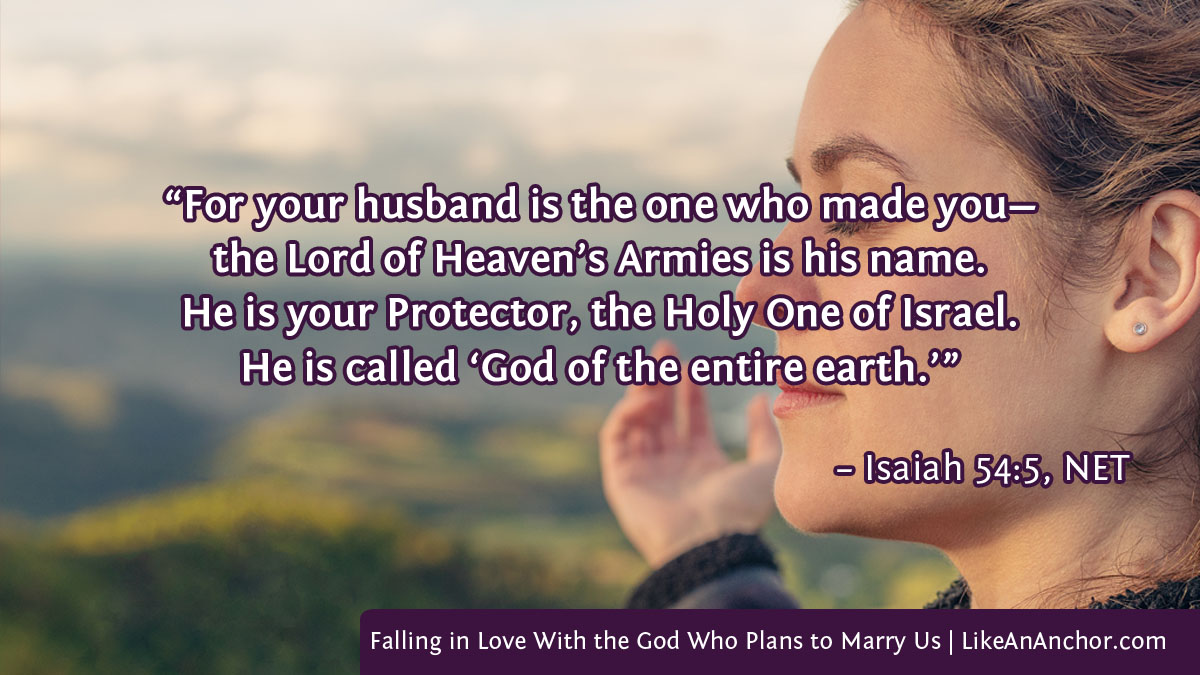
Image of a woman with rolling hills in the background, with text from Isaiah 54:5, NET version: “For your husband is the one who made you—
the Lord of Heaven’s Armies is his name. He is your Protector, the Holy One of Israel. He is called ‘God of the entire earth.’”
Image by PhotoGranary from Lightstock

Falling in Love With God

There’s a really interesting connection between love and obedience in the Bible. The greatest commandment is to “love the Lord your God with all your heart, and with all your soul, and with all your mind, and with all your strength” (Mark 12:28-34, WEB). All the other commandments depend on loving God and loving your neighbor (Matt. 22:36-40). Love is the basis for our obedience; the foundation for following God’s other laws. It’s also a lot easier to enjoy being obedient if you’re in love with God and trust that His commands are good for us.

But what if you don’t feel “in-love” with God? Real love is as much an action as it is a feeling, so we can (and ought to) do the things that people who love God do regardless of how we feel. As much as I enjoy relating to God’s word academically, though, I also think it’s appropriate to get excited about God and our relationship with Him. There’s likely more than one way to do this, but one of the things that helps me connect with my love for God is reading about His love for me.

Image of a smiling woman worshipping with the blog's title text and the words "As wonderful as it is to be in love with God now, how much more wonderful will it be after He comes back for us, marries His church, and establishes His 
kingdom here on earth?"
Image by Pearl from Lightstock

Yahweh appeared of old to me, saying,
“Yes, I have loved you with an everlasting love.
Therefore I have drawn you with loving kindness.”

Jeremiah 31:3, WEB

“I will betroth you to me forever.
Yes, I will betroth you to me in righteousness, in justice, in loving kindness, and in compassion.
I will even betroth you to me in faithfulness;
and you shall know Yahweh.”

Hosea 2:19-20, WEB

God, being rich in mercy, because of his great love with which he loved us, even though we were dead in offenses, made us alive together with Christ—by grace you are saved!

Ephesians 2:4-5, NET

In just those three verses, we see God passionately declaring His love for His people, and one of those people reminding us of the “great love with which He loved us.” The reality of God’s love is awesome. We were dead and His love brought us back to life. We made mistakes and He still wants to keep us with Him forever. He treats us with loving kindness and calls His love faithful and everlasting.

We are recipients of God’s love now, which is an incredible thing. We’re still waiting, though, for a time when things will be even better. When Jesus returns, we’ll “be like Him” and we’ll get to “see him just as he is” (1 John 3:2, NET). Make no mistake, Jesus is present with us now. We don’t get to see Him, though. Our conversations don’t happen face-to-face. As wonderful as it is to be in love with Him now, how much more wonderful will it be after He comes back for us, marries us, and establishes His kingdom here on earth? That’s the sort of wonderful, exciting thing we can look forward to as we begin this fall holy day season.

The Spirit and the bride say, “Come!” He who hears, let him say, “Come!” He who is thirsty, let him come. He who desires, let him take the water of life freely. … He who testifies these things says, “Yes, I come quickly.”

Amen! Yes, come, Lord Jesus.

Revelation 22:17, 20, WEB

Featured image Jess Bailey from Pixabay

Song Recommendation: “Even So Come” by Chris Tomlin

Covenant Relationship: Our Inheritance in God’s Family

As Christians, we often talk about the importance of a relationship with God. We might describe this relationship as that of child and parent, or two friends, or bride and groom (all comparisons used in the Bible). Those descriptions are aspects of the main type of relationship God wants to have with us. He calls our relationship a covenant.

BibleProject has an excellent short video summing up covenants in the Old Testament and how Jesus brings them into the New Testament church. It’s a great introduction or reminder of what’s going on with covenants in the Bible. If you’d like to read about covenants here on my blog, I had a couple posts on covenants back in 2016, which I revisited and summarized last year in “Revisiting the Deep Things of God’s Covenants.”

As the main way that God establishes relationship with people, covenants are a vital part of our Christian faith. However, they’re not discussed nearly as often as you might expect given that central importance. Covenants come up fairly often at my church, but from what I’ve heard that doesn’t seem to be the case more broadly speaking (I’d be very curious to hear how much your churches talk about covenants if you’d like to leave a comment!). Given that vital role covenants play, I felt that this would be a good time to revisit them, particularly as we draw closer to the fall holy days.

Image of a man pushing doors open, with text from Romans 12:11-13, NET version: "brothers and sisters, we are under obligation, not to the flesh, to live according to the flesh (for if you live according to the flesh, you will die), but if by the Spirit you put to death the deeds of the body you will live.”
Image by Pearl from Lightstock

Inheriting Covenants with Jesus

The aspect of covenants that I find most fascinating (and which BibleProject also touches on in their video) is that Jesus makes it possible for the promises of the first covenants to pass down to us today. The covenants God made with Noah, Abraham, the people of Israel, and King David included promises and (for all except Noah’s covenant) conditions for their descendants. Covenants typically involve agreement from both parties to follow the terms of the covenant. For example, in the Mosaic covenant, God promised Israel would receive abundant blessings for obedience and He would be their faithful God if they would be His faithful people. He also promised curses for disobedience, though He assured them He would never break the covenant even if they did.

The Abrahamic, Mosaic, and Davidic covenants all contained a promise that the Messiah would come and set things right. We now know this Messiah (the anointed one of God; Hebrew mashiach and Greek christos) is Jesus Christ. As a human descendent of Abraham, Israel, and David, He inherited all these covenants (Heb. 1:2). Since He was sinless, Jesus is the only human being who kept up our side of the covenant bargain and fully deserved to inherit the covenant promises. Jesus is also God, and He fulfilled God’s covenant promises as well by providing Himself as the substitute to pay our death penalty for breaking covenant.

Therefore he is the mediator of a new covenant, so that those who are called may receive the promised eternal inheritance, since a death has occurred which redeems them from the transgressions under the first covenant. For where a will is involved, the death of the one who made it must be established. For a will takes effect only at death, since it is not in force as long as the one who made it is alive. Hence even the first covenant was not ratified without blood. … Indeed, under the law almost everything is purified with blood, and without the shedding of blood there is no forgiveness of sins.

Hebrews 9:15-18, 22, NET

Let’s linger on this idea for a moment longer. Jesus is the heir of all the covenant promises. He’s also God, who made the covenants in the first place. The covenants belong to Him and–following His Father’s plan from the beginning–He died and willed the covenants to us (Gal. 3:29). Thanks to Him, “we are children of God, and if children, then heirs, heirs of God and fellow heirs with Christ (Rom. 8:16-17, NET). That’s amazing. It’s a simple, straightforward statement and yet I can barely wrap my head around it. The covenants, the inheritance, the grace associated with God brining us into a relationship with Him–it’s incredible.

Image of a girl reading in church, with text from Romans 12:14, 17, NET version: "all who are led by the Spirit of God are the sons of God. ... And if children, then heirs (namely, heirs of God and also fellow heirs with Christ)—if indeed we suffer with him so we may also be glorified with him.”
Image by José Roberto Roquel from Lightstock

Inheriting the Nature of God

When we’re heirs of God alongside Christ and participants in the covenant God makes with His people today, we inherit many wonderful promises. One of the greatest of those promises is that we’ll be part of God’s family as children. We’re all “heirs of the grace of life” and, “since we have been justified by his grace, we become heirs with the confident expectation of eternal life” (1 Pet. 3:7; Tit. 3:7). As heirs, we’re going “inherit” His nature and share in real, eternal life.

See what sort of love the Father has given to us: that we should be called God’s children—and indeed we are! For this reason the world does not know us: because it did not know him. Dear friends, we are God’s children now, and what we will be has not yet been revealed. We know that whenever it is revealed we will be like him, because we will see him just as he is. And everyone who has this hope focused on him purifies himself, just as Jesus is pure.

1 John 3:1-3, NET

There isn’t a scripture that explicitly says we’ll inherit the nature of God, but putting all the ones we’ve been looking at in this post together that seems like a good way to sum-up what’s going on here. We are “heirs of the kingdom that he promised to those who love him” (Jam. 2:5, NET). God has been planning this for a long time, and He accomplished making us His children “by predestining us to adoption as his legal heirs through Jesus Christ, according to the pleasure of his will” (Eph. 1:5, NET).

As His children, when we receive our full inheritance “we will be like him” and “see him just as he is” (1 John. 3:3, NET). This is one of the most amazing truths contained in the Bible. God’s plan revolves around wanting to expand His family. There’s already a Father and a Son, and they want a much bigger family. That we’ll literally be in God’s family is one of the more audacious claims that’s a core part of Christian doctrine, and yet Jesus pointed out “those people to whom the word of God came were called ‘gods’ (and the scripture cannot be broken)” (John 10:31-36, NET). I like how C.S. Lewis talks about this at the end of “The Weight of Glory.”

It may be possible for each to think too much of his own potential glory hereafter; it is hardly possible for him to think too often or too deeply about that of his neighbour. The load, or weight, or burden of my neighbour’s glory should be laid daily on my back, a load so heavy that only humility can carry it, and the backs of the proud will be broken. It is a serious thing to live in a society of possible gods and goddesses, to remember that the dullest and most uninteresting person you talk to may one day be a creature which, if you saw it now, you would be strongly tempted to worship.

C.S. Lewis “The Weight of Glory”

How would it change the way you live if you really remembered all the time that every human being (including you) could be part of God’s family? Pride isn’t really an option if you realize you’re not the only one to whom God offers this gift and that no one really deserves it. Our covenant inheritance recontextualizes our lives. We’re part of God’s family, citizens of His kingdom, and in a covenant relationship with the Father and Son.

Image of a woman with her hand raised in worship, with text from Romans 12:18, 28-29, NET version: “For I consider that our present sufferings cannot even be compared to the coming glory that will be revealed to us. ... all things work together for good for those who love God, who are called according to his purpose, because those whom he foreknew he also predestined to be conformed to the image of his Son, that his Son would be the firstborn among many brothers and sisters.”
Image by PhotoGranary from Lightstock

Part of Something Bigger

In the introduction, I mentioned that the study of covenants is particularly fitting as we approach the fall holy days. This season includes Yom Teruah (Day of Trumpets, also called Rosh Hoshanna), Yom Kippur (Day of Atonement), Sukkot (the seven-day Feast of Tabernacles) and Shemini Atzeret (the eighth-day or Last Great Day following Sukkot). In Exodus 31:16, God calls the Sabbath “a perpetual covenant” and in Leviticus 23 God calls His holy days and sabbaths sacred. All of God’s holy times–including the ones coming up very soon this fall–are signs of being in covenant with God (Ex. 31:13).

“I gave them my statutes, and showed them my ordinances, which if a man does, he will live in them. Moreover also I gave them my Sabbaths, to be a sign between me and them, that they might know that I am Yahweh who sanctifies them. …

“I am Yahweh your God. Walk in my statutes, keep my ordinances, and do them. Make my Sabbaths holy. They shall be a sign between me and you, that you may know that I am Yahweh your God.”

Ezekiel 20:11-12, 19-20, WEB
Image of four people walking into church with the blog's title text and the words "Covenants are how God describes His relationship with us. Since they're so important to Him,
 understanding them better and participating in them fully should be important to us as well."
Image by Pearl from Lightstock

If you read the context for these verses, you’ll see that God was hurt and angry when His people rejected His Sabbaths along with His covenants (Ezk. 20:8-26). Keeping these sabbaths is a key part of what we do when we’re in covenant with God. That’s one of the interesting things about a covenant; when you’re part of one, there are things you’re supposed to do. It’s less of a “do this or else” sort of thing and more of a “in this family, here’s how we act and here are the things we do together.”

For this reason we also, from the day we heard about you, have not ceased praying for you and asking God to fill you with the knowledge of his will in all spiritual wisdom and understanding, so that you may live worthily of the Lord and please him in all respects—bearing fruit in every good deed, growing in the knowledge of God, being strengthened with all power according to his glorious might for the display of all patience and steadfastness, joyfully giving thanks to the Father who has qualified you to share in the saints’ inheritance in the light. He delivered us from the power of darkness and transferred us to the kingdom of the Son he loves, in whom we have redemption, the forgiveness of sins.

Colossians 1:9-14, NET

As people who have a covenant relationship with God, we’re part of something much bigger than ourselves. He’s called us into His kingdom and His family as “sons and daughters” (2 Cor. 6:16-18). And much like if you’re part of a big, close-knit family where everyone goes over to grandma’s house for Thanksgiving every year, God wants us at His table for His feast days now and in the future (Is. 66:22-23; Luke 13:29).

My family has been keeping God’s Sabbath’s and holy days my whole life. It’s pretty much the same thing year after year, and yet I’m amazed at how much more meaningful these days keep getting. These rhythms of worship provide a spiritual structure for the year and regular reminders to keep deepening our relationship with God. You might be nodding along right now as you read, or you might not have any experience with keeping these days. Whatever your religious background, I encourage you to think deeply about the relationship God has called you into and what He asks of those who are in covenant with Him. Covenants are how God describes His relationship with us. Since they’re so important to Him, understanding them better and participating in them fully should be important to us as well.

Featured image by Pearl from Lightstock

But What if the Bible Doesn’t Seem to Make Sense?

Most of us want to think of ourselves as reasonable people. When need be, we can think logically and rationally about things and come to reasonable conclusions. We know at the least the basics of how to recognize fallacies in other people’s arguments and how to put our own thoughts together.

For those of us living in Western nations (and I’m guessing some other locations that have been influenced by Western ideas), the education we received in relation to logical reasoning is based in Grecian and Roman philosophies. This system of reasoning and logic laid the groundwork for our scientific method and our ideas about how to figure out if something makes sense.

When we apply our modern human reasoning to the Bible, sometimes there are things which seem odd to us. We might notice contradictions in the text. We might wonder why God would tell people to do certain things, or why He makes some of the choices He does. We might look at some of the connections New Testament writers make to the Old Testament and think their conclusions seem far-fetched. And when we look at the Bible and it doesn’t make sense, we might become frustrated with our own limitations or we could become skeptical of God’s word.

The first of those problems has a fairly simple answer: pray for wisdom and understanding. James says that if anyone asks for wisdom in faith, God will give it to them (James 1:5-6). Paul adds that if we’re off-the-mark in our views, God can reveal the truth to us (Phi. 3:14-16). When we’re in a relationship with God, He also gives us His holy spirit that Jesus said “will guide you into all truth” (John 16:13, WEB). When we’re frustrated with our own lack of knowledge or understanding, we can take those frustrations to God. He might not give us the exact answer we’re looking for right away, but He will always help those who keep asking and seeking (Luke 11:9-10).

It can also help to keep in mind the things that I’ll suggest people consider if they think God’s word doesn’t make sense. There’s a dangerous sort of arrogance in thinking there’s something wrong with God just because He doesn’t make sense to us. Similarly, there’s danger in dismissing God’s word because we’re not sure how to wrap our heads around it or we think it’s just a good book rather than His divine revelation. There’s a lot we could say on this subject, but for today’s post I want to focus on just two things we can think about if we’re struggling with the idea that things in the Bible don’t make sense.

Image of a girl reading the bible, with text from Romans 11:33 and 1 Corinthians 2:16, NET version.
Image by José Roberto Roquel from Lightstock

The Wrong System of Measurement

Suppose you come across a woodworking project, like a little birdhouse, at a resale shop. You like the way it looks so you take it home and plan to use it as a pattern for your next project. You get out your tape measure and start making notes. The roof is just shy of 7-7/8 inches long, and not quite 4-3/4 inches wide. You keep taking measurements and it gets more and more frustrating. Why didn’t the builder use nice, even, sensible numbers instead of all these not-quite-right fractions?

Then suppose you turn the tape measure around to the side with centimeters. Suddenly, the roof is exactly 20 by 12 cm. The problem wasn’t with the person making the birdhouse. The problem is you didn’t understand what system of measurement they used in the first place.

This is very similar to what happens when people approach the Bible with a cultural mindset different than the one the original writers use. The Bible is a text from the ancient Middle East. Even though we believe God is the ultimate author of the Bible, He still used people in that culture to write His word. When Jesus spoke to people of His day, He used examples and analogies they could understand. Those of us who are far removed from that original context (in terms of both time and cultural philosophies) often have a hard time figuring out the Bible. That’s not because there’s something wrong with the Bible or we’re incapable of understanding; it’s just that we need more contextualizing information.

For example, in Western culture we like having reliable rules and we think they ought to apply to everyone in the same way. If a rule is bent or broken for one person and not others, we call that “unfair” and complain about a lack of justice. If we see what looks like a rule in the Bible and then God does something different, we might think He’s unjust or that there’s some kind of hidden rule system that He’s unfairly keeping from us. But things are different in non-Western cultures where “rules apply except when the one in charge says otherwise. Westerners might consider this arbitrary; many non-Western Christians consider this grace (Richards & O’Brien, p. 174). That’s how Paul can (arguably) call Junia an apostle in Rom. 16:7 even though women don’t typically hold that office (p. 172).

That example comes from Misreading Scripture with Western Eyes–a book I highly recommend to anyone who wants to understand the Bible better. Reading the Bible with Rabbi Jesus is also a great help with that. These books are excellent “tools” for making sure you’re using the right system of measurement when interpreting God’s word. You might be able to find one or both of these books in your local library, and here are the Amazon links if you want to check them out:

God’s a Lot Smarter Than You

There’s another truth that we need to acknowledge if we want to work through parts of scripture that don’t make sense to us. God is smarter than us. And when someone is a lot smarter than you, plus they have a perfectly clear perspective on everything going on, sometimes you won’t be able to make sense of what they’re doing.

For some people, it’s easy to admit that they’re not the smartest person in the room. For others, our intellect can be a stumbling block that gets in the way of a close relationship with God. This latter one is something I can struggle with. I get prickly when someone insults my intelligence or implies that I don’t understand what I’m talking about. I rely heavily on my ability to research things thoroughly and find good answers. I preen inside when a professor complements my writing or calls me an “academic.”

However, an academic understanding of scripture isn’t how we have a relationship with God. Our spiritual temperament might lean more on logic, reason, and knowledge (as Gary Thomas discusses in “Sacred Pathways”), but intellect isn’t enough to have a relationship with God. We also need humility and love. We need to admit that no matter how much we study, we’re not going to learn everything about God because the depths of His knowledge are unfathomable. We need to humbly marvel at–and love–the God who is way smarter than us, and ask Him for help when we’re struggling to understand something in His word.

My brothers and sisters, consider it nothing but joy when you fall into all sorts of trials, because you know that the testing of your faith produces endurance. And let endurance have its perfect effect, so that you will be perfect and complete, not deficient in anything. But if anyone is deficient in wisdom, he should ask God, who gives to all generously and without reprimand, and it will be given to him. But he must ask in faith without doubting, for the one who doubts is like a wave of the sea, blown and tossed around by the wind. For that person must not suppose that he will receive anything from the Lord, since he is a double-minded individual, unstable in all his ways.

James 1:2-8, NET

Sometimes, the “testing of our faith” is an internal struggle rather than an external trial. We might wrestle with our own doubts, questions, or fears related to God’s word. We’re not abandoned during those struggles, though. Sometimes I think we worry if our trials are doubt-related then we don’t deserve to ask for God’s help, but the truth is that He’s is eager to help everyone seeking His kingdom to understand and know Him more fully. Even the tiniest spark of faith is enough for Him work with if only we’ll come to Him and say, “I believe; help my unbelief!” (Mark 9:24, WEB).

Shifting Our Focus

Image of a woman studying her Bible with the blog's title text and the words "We can eagerly seek knowledge of God while also humbly admitting that we don't yet know everything (and that's okay)."
Image by MarrCreative from Lightsock

There are still parts of the Bible that don’t quite make sense to me. But I think now I’ve reached a point where I trust that God knows what He’s doing even if I don’t understand it. I can also trust that someday He’ll help me understand those things, even if that “someday” doesn’t happen in this physical life.

I can also shift my focus off trying to make sense of everything and onto following Christ’s example. When Paul and Peter say we should have Christ’s mind, they aren’t focused on knowledge so much as on peaceful relationships (Rom. 15:5), God’s wisdom inside us (1 Cor. 2), service (Phil. 2:5-7), suffering, and freedom from sin (1 Pet. 4:1-2). There are far more important things to focus on than trying to make sense of everything in the Bible or put God into neat little categories. There is great value in knowing the Bible and understanding doctrine, but that’s all secondary to knowing God.

“Don’t let the wise man glory in his wisdom.
Don’t let the mighty man glory in his might.
Don’t let the rich man glory in his riches.
But let him who glories glory in this,
that he has understanding, and knows me,
that I am Yahweh who exercises loving kindness, justice, and righteousness in the earth,
for I delight in these things,” says Yahweh.

Jeremiah 9:23-24, WEB

Paul quotes these verses at the beginning of 1 Corinthians when he’s counseling his readers not to let disputes and pride get in the way of peaceful relationships in the church or following Christ. Even the smartest among us don’t have anything to boast of when we compare ourselves to the wisdom, goodness, and glory of God. With this shift in mindset, we can pursue a closer relationship with God and eagerly learn more about Him while also humbly admitting that we don’t yet know everything (and that’s okay).

Featured image by Matt Vasquez from Lightstock

Isaiah Study: Let Us Go Up to the Lord’s Mountain

Way back at the end of June, we started a study on the last 27 chapters of Isaiah. This section (ch. 40-66) is all part of one long dialog where God speaks of revenge, redemption, and revelation. He’s open and emotional, calling out to His people, talking about how grieved He is by their sin, and saying how much He still loves and wants them. Some of the most famous prophecies of Jesus’s Messianic ministry are found here in Isaiah, including ones showing how much He suffered to save us.

Today’s article is our last post in this Isaiah Study series. With the fall holy days less than a month away (Yom Teruah/Day of Trumpets falls on Sept. 26 this year), it’s a great time to study and think deeply on the Lord’s plan for Jesus’s second coming, His millennial reign, and the new heaven and new earth that will follow.

We’ve already discussed this topic in the post about God’s declarations that He’s doing a new thing, but I don’t think we’re quite finished with it yet. Not too long ago, one of the ladies in my scripture writing group mentioned walking toward the Lord’s mountain as a key part of our spiritual journey. While I hadn’t put anything about the Lord’s mountain on my list of key themes in the first Isaiah study post, “mountain” shows up 21 times in the WEB translation of this section of scripture. Seven times it’s God talking about “my mountain.”

God’s Use of Mountains

Let’s start with some background on mountains. A lot of major Bible events happen on mountains. For example, that’s where Abraham went to sacrifice his son, and since God provided a substitutionary ram “it is said to this day, ‘On Yahweh’s mountain, it will be provided'” (Gen. 22:14, WEB). God also spoke to Moses on Mount Sinai when He gave Israel the Covenant (Ex. 24:12). Mountains aren’t the only places God speaks with people of course, but He seems to like mountains for some reason. More to our point, mountains picture where God chooses to place His people and where He says that he reigns. Look at what Israel and Moses say in a song of praise and deliverance:

“You, in your loving kindness, have led the people that you have redeemed.
You have guided them in your strength to your holy habitation. …
You will bring them in, and plant them in the mountain of your inheritance,
the place, Yahweh, which you have made for yourself to dwell in;
the sanctuary, Lord, which your hands have established.
Yahweh will reign forever and ever.”

Exodus 15:13, 17-18, WEB

During King David’s reign, God’s holy mountain became closely associated with Mount Zion, the City of David, and Jerusalem (Zion and Jerusalem are often used interchangeably now, but it seems originally they were twin cities). Zion is God’s holy mountain where He dwells and chooses to reign (Ps. 68:15-16; 74:2; Joel 3:16-17; Ezek. 20:39-41). This statement is literal, figurative, and prophetic.

God literally established Jerusalem/Zion as the focal point of His holy land and set kings up on its throne. On a figurative/spiritual level, He still reigns over that location and believers today “have come to Mount Zion, and to the city of the living God, the heavenly Jerusalem” (Heb. 12:22, WEB). In the future, “the mountain of Yahweh’s temple will be established on the top of the mountains,” all people will go to it for instruction, and “the law will go out of Zion, and Yahweh’s word from Jerusalem” (Micah 4:1-2, WEB). It’s this prophetic, forward-looking meaning of God’s mountain that figures most prominently in the Isaiah texts we’re focusing on today.

Walking Toward His Mountain

Isaiah’s message begins with mountains. By chapter 2, the book is talking about a future time when “the mountain of Yahweh’s house shall be established on the top of the mountains” (Is. 2:2, WEB). This passage mirrors the one we already quoted in Micah where people go up to God’s mountain and learn His law (Is. 2:1-4). This pictures something that’s still in the future for us; a time when God’s people will stand with Jesus on Mount Zion and (even after that) when “the holy city, Jerusalem” comes down from heaven to earth (Rev. 14:1; 21:10). We might not fully understand what God plans to do with His holy mountain in the future, but we know it’s a location of great joy where we’ll dwell with God and follow Him fully.

The Lord’s mountain is linked with Millennial imagery again in Isaiah chapter 11, where Gods says, “They will not hurt nor destroy in all my holy mountain” (Is. 11:9, WEB). In the future, even foreigners and outcasts “will worship Yahweh in the holy mountain at Jerusalem” (Is. 27:13, WEB); a worship that’s also associated with joy in keeping God’s holy festivals (Is. 30:29). By the time Isaiah’s readers get to the last 27 chapters that we’ve been studying, they’ve already heard quite a bit about God’s holy mountain.

Our faith isn’t one where a distant God hangs out on mountains to separate Himself from the people He rules. Rather, He’s calling us up to join Him where He dwells. First, though, He came down to dwell with us and invite us to join Him. The Servant Songs in Isaiah point to Jesus Christ’s first coming and His ongoing purposes. In the second song, the Servant speaks in the first-person about His plans and the work He does in concert with God the Father (Is. 49:1-13).

“I will make all my mountains a road,
    and my highways shall be exalted.
Behold, these shall come from afar,
    and behold, these from the north and from the west;
    and these from the land of Sinim.”
Sing, heavens, and be joyful, earth!
    Break out into singing, mountains,
for Yahweh has comforted his people,
    and will have compassion on his afflicted.

Isaiah 49:12-13, WEB

“Walk” is a common word picture in the Bible for living in the way that God wants us to. And that’s what you do on a road; you walk on it, in this case all the way to join the Messiah. It’s such a joyful thing that the mountains themselves start to sing (Is. 55:12) and the feet of messengers running over the mountains to bring this good news are called “beautiful” (Is. 52:7).

The Destination for Our Lives

Finally, we arrive at the end of the book. As God’s message through Isaiah draws to a close, He returns to the contrast between righteousness and wickedness that He’s brought up several times before. Here, He says, “you who forsake Yahweh, who forget my holy mountain” are destined for “slaughter; because when I called, you didn’t answer. When I spoke, you didn’t listen; but you did that which was evil in my eyes, and chose that in which I didn’t delight” (Is. 65:11-12, WEB). To walk away from God’s holy mountain is to walk away from God Himself. In contrast, those who faithfully serve God have a very different relationship with His mountain.

I will bring offspring out of Jacob,
    and out of Judah an inheritor of my mountains.
My chosen will inherit it,
    and my servants will dwell there.

Isaiah 65:9, WEB

God’s servants get to live with Him on His mountain forever. That’s the destination for our walk of faith here on earth. We want to be there when He brings this promise to fulfillment: “For, behold, I create new heavens and a new earth … I will rejoice in Jerusalem, and delight in my people … They will not hurt nor destroy in all my holy mountain” (Is. 65:17, 19, 25, WEB). The message God shares with us about the end of this world, right before Jesus’s second coming, has a lot of warnings and discussion of punishment, but there are also incredible promises of future peace and joy. Even when God’s justice demands punishment, He still talks about restoration and whorship.

“For I know their works and their thoughts. The time comes that I will gather all nations and languages, and they will come, and will see my glory.

“I will set a sign among them, and I will send those who escape of them to the nations, to Tarshish, Pul, and Lud, who draw the bow, to Tubal and Javan, to far-away islands, who have not heard my fame, nor have seen my glory; and they shall declare my glory among the nations. They shall bring all your brothers out of all the nations for an offering to Yahweh, on horses, in chariots, in litters, on mules, and on camels, to my holy mountain Jerusalem, says Yahweh, as the children of Israel bring their offering in a clean vessel into Yahweh’s house. Of them I will also select priests and Levites,” says Yahweh.

“For as the new heavens and the new earth, which I will make, shall remain before me,” says Yahweh, “so your offspring and your name shall remain. It shall happen that from one new moon to another, and from one Sabbath to another, all flesh will come to worship before me,” says Yahweh. “They will go out, and look at the dead bodies of the men who have transgressed against me; for their worm will not die, nor will their fire be quenched, and they will be loathsome to all mankind.”

Isaiah 66:18-24, WEB

And that’s the end of the book. While that final verse might be a bit shocking, the overall message is one of hope. God plans to “gather all nations and languages”–no one will be left out. His people will be just as enduring “as the new heavens and the new earth” that He plans to make. Our worship will endure as well; God says that “all flesh will come to worship” before Him on His Sabbaths.

We don’t have to wait until then to worship Him on His holy days, though. This incredible future is the time we get to picture as we celebrate Yom Teruah (Day of Trumpets), Yom Kippur (Day of Atonement), and Sukkot (Feast of Tabernacles) every fall. We also get a little taste of this final, glorious peace and rest each week as we observe the Sabbath (Heb. 4:9).


I hope you’ve enjoyed this deep dive into Isaiah 40-66 over the past couple months. With the exception of writing Study Guides for The Beatitudes (available on Amazon) and the Armor of God (coming out later this fall), I don’t think I’ve ever spent this long studying a single section of scripture. It’s exciting and awe-inspiring to me that there’s so much to learn from one relatively short chunk of scripture. I could keep writing about just this part of the Bible for another two months and still not have exhausted “the depth of the riches and wisdom and knowledge of God!” (Rom. 11:33, NET). For now, though, we’re going to bring this study to a close. As always, if you have any thoughts on this post or insights from your own study you’d like to share, please comment below 🙂

Featured image by Inbetween from Lightstock