When we think about obedience to God, we often get stuck at the should we or shouldn’t we level. Some say obedience isn’t necessary because Jesus got rid of the law (an argument we’ve refuted extensively on this blog). Others say that we still need to obey God, and the New Testament writings show that they’re right to do so.
But why? There are a host of proposed reasons. Because He tells us to. Because we fear Him. Because we love Him. Because He might strike us dead if we don’t. Because He owns us. Because He created us. Because His law is good.
There’s some truth to each of these “whys.” There’s one, though, that the Biblical writers treat as the core source of our motivation for following God. And it’s one that highlights the vital importance that God places on relationships.
Love at the Core of the Law
When Jesus walked on this earth, He didn’t directly answer the questions, “Do we still need to obey God?” No one thought to ask Him that; they assumed obedience would still matter. He did address the question, though, by saying that He didn’t come to destroy the law and that those who obey God’s commands will be great in His kingdom (Matt. 5:17-20). He described “those who hear the word of God and obey it” as “blessed” (Luke 11:28, NET). He also charged His disciples to teach obedience when they passed on His teachings to others (Matt. 28:19-20).
One of the questions someone did ask Jesus was about the most important commandment. By the time Jesus came to this earth, Jewish people were following even more commands than the ones God gave them when He led ancient Israel out of Egypt. There were rabbinical writings and Jewish traditions piled up on top of God’s laws, at times clarifying them and other times expanding them and making them burdensome. Jesus rejected those additions and traditions of men, but even among the commands that did originate with God He highlighted two as being the most important.
Now one of the experts in the law came and heard them debating. When he saw that Jesus answered them well, he asked him, “Which commandment is the most important of all?” Jesus answered, “The most important is: ‘Listen, Israel, the Lord our God, the Lord is one. Love the Lord your God with all your heart, with all your soul, with all your mind, and with all your strength.’ The second is: ‘Love your neighbor as yourself.’ There is no other commandment greater than these.”
The expert in the law said to him, “That is true, Teacher; you are right to say that he is one, and there is no one else besides him. And to love him with all your heart, with all your mind, and with all your strength and to love your neighbor as yourself is more important than all burnt offerings and sacrifices.” When Jesus saw that he had answered thoughtfully, he said to him, “You are not far from the kingdom of God.” Then no one dared any longer to question him.
Mark 12:28-34, NET (bold italics mark quotations from Lev. 19:18; Deut. 4:35; 6:4-5 ; Josh 22:5)
Notice Jesus doesn’t say God’s other laws aren’t important. Rather, He highlights “love the Lord” and “love your neighbor” as the core laws at the center of all the other laws. Love is the reason or motive behind the rest of God’s law, and if you did that perfectly you’d naturally be keeping the other laws as well. These are God’s main commands; the rest is details on how to love Him and love others.
We Obey Because We Love
In addition to placing love at the center of God’s laws, Jesus revealed that love should be our motivation for keeping the commandments.
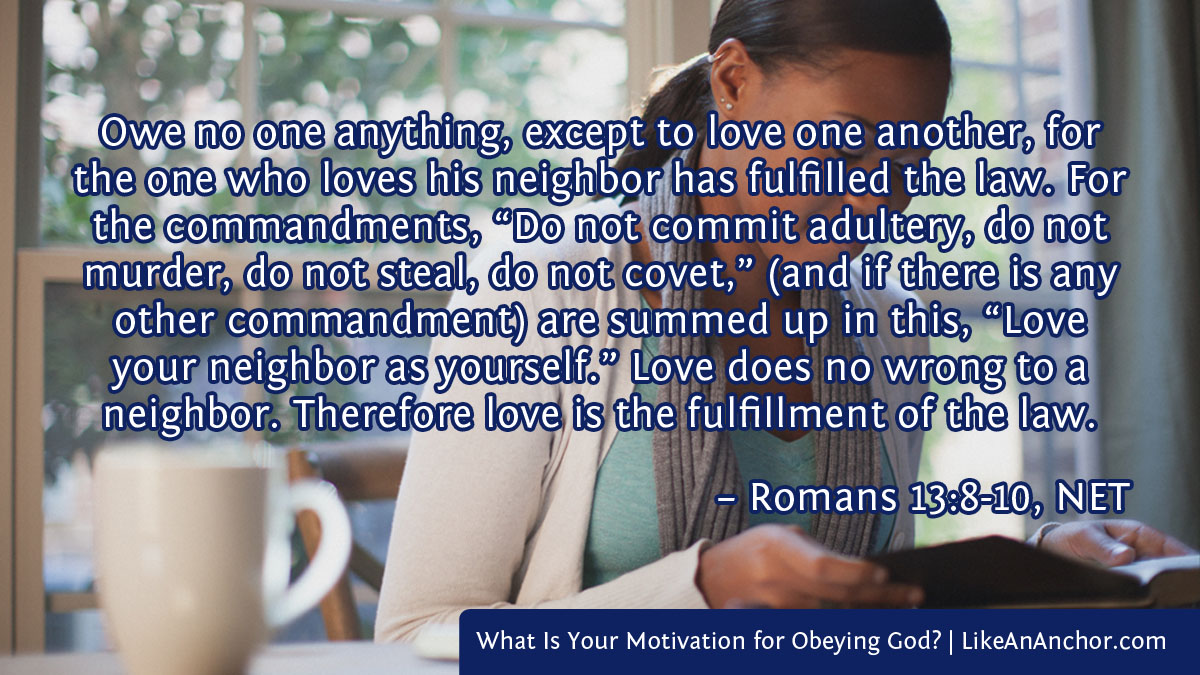
“If you love me, you will obey my commandments. …
“The person who has my commandments and obeys them is the one who loves me. The one who loves me will be loved by my Father, and I will love him and will reveal myself to him.” …
“If anyone loves me, he will obey my word, and my Father will love him, and we will come to him and take up residence with him. The person who does not love me does not obey my words.”
John 14:15, 21-24, NET
Relationship with God is connected to obedience and law in a way that modern readers likely find strange. We think of grace as something with no strings attached, but Biblical writers thought of it as something that established a relationship with commitments and expectations. If we’re not obeying God, then we don’t really know Him.
Now by this we know that we have come to know God: if we keep his commandments. The one who says “I have come to know God” and yet does not keep his commandments is a liar, and the truth is not in such a person. But whoever obeys his word, truly in this person the love of God has been perfected. By this we know that we are in him. The one who says he resides in God ought himself to walk just as Jesus walked.
1 John 2:3-6, NET
We declare by our choices whether we are children of God who practice righteousness, or children of the devil who practice lawlessness (1 John 3:8-10). It’s a scary thought, but Jesus indicated there will be people at the final judgement who thought that they were right with God but to whom He will say, “I never knew you. Go away from me, you lawbreakers!” (Mat. 7:23, NET). We don’t want to end up in that position, where we think we’re good enough Christians but in reality we don’t have a relationship with Jesus.
Getting To the Heart Of Obedience
Those words of caution bring us around to the other possible reasons for obeying God that we proposed in the introduction. God has the right to expect certain things from us because He created us and the whole universe. He is sovereign, and He knows best what “dos” and “don’ts” lead to a good outcome. He’s also a powerful God of justice who promises to bring divine judgment down on those who do not obey.
Those aspects of His character are just as real as the love and mercy aspects. We should obey God because of who He is and because we have a proper fear and respect for Him. He has the right to tell us what to do, and “because He says so” is a valid reason for obedience (Ps. 100:3; Rev. 5:9; 1 Cor 6:19-20; Rom. 6:15-23). Fear of the Lord–a proper respect for His power, might, and justice–is also a valid reason (Acts 5:1-11; Heb. 10:26-31). But at the same time, those aren’t the foundational reasons for our obedience.
To put it another way, God doesn’t want fear and duty to be the only or primary way that we relate to Him. For some of us, they might be a starting point for why we obey God. Eventually, though, they should take a back-seat to love as our motivation. We obey because we love God and want a relationship with Him, and we show our love by keeping His commands.
Now, Israel, what does Yahweh your God require of you, but to fear Yahweh your God, to walk in all his ways, to love him, and to serve Yahweh your God with all your heart and with all your soul, to keep Yahweh’s commandments and statutes, which I command you today for your good? Behold, to Yahweh your God belongs heaven, the heaven of heavens, and the earth, with all that is therein. Only Yahweh had a delight in your fathers to love them, and he chose their offspring after them, even you above all peoples, as it is today.
Deuteronomy 10:12-15, WEB
This passage is addressed to ancient Israel as God’s covenant people, but we’re included in that group because we’ve been grafted into the New Covenant people of spiritual Israel through the Messiah. God’s expectations are the same for us. The entire universe belongs to Him, yet He loved us and chose us to be His people. In return, He asks for our hearts. We should love Him so much that we want to obey Him even without considering His rights as sovereign Lord and His just consequences for disobedience (even though those two things are no less real).
Featured image by Inbetween from Lightstock

Song Recommendation: “Build My Life” by Pat Barrett


Leave a Reply