When God Breathes

There are a few verses that talk about God’s breath. In 2 Timothy 3:26, Paul makes a famous statement about scripture. He says, “Every scripture is inspired by God and useful for teaching, for reproof, correction, and for training in righteousness” (NET). Some translations use the more literal wording, “Every Scripture is God-breathed” (WEB). Another well-known verse describes God breathing life into Adam at creation, making him a living being.

The “God-breathed” translation of 2 Timothy 3:26 is what caught my eye to study this week, but there’s a lot more to this topic than I’d first realized. In both Greek and Hebrew, the words for breath are also connected to spirit and life. Amazing things happen when God breathes into something or breathes something out.

Life in the Word

In 2 Timothy 3:26, the Greek word translated “inspired by God” or “God-breathed” is theopneustos: theos (God) + pneo (breathe, blow). This is the only time that compound word is used in the Bible. Theos is, obviously, used frequently. Pneo is a verb that appears eight times, always in reference to literal wind blowing (Matt. 7:25, 27; Luke 12:55; John 3:8; 6:18; Acts 27:40; Rev. 7:1). In one of those verses, though, Jesus references wind to make a point about the spirit.

“Do not be amazed that I said to you, ‘You must all be born from above.’ The wind blows (pneo) wherever it will, and you hear the sound it makes, but do not know where it comes from and where it is going. So it is with everyone who is born of the Spirit (pneuma).”

John 3:7-8, NET

Pneo is the root word for pneuma, which is translated into English as “spirit” and appears 385 times in the New Testament. Usually, the word refers to God’s holy spirit or to the spirit in human beings, though it can also be translated “wind” or “breath.” If you’re like me, then this line of thought might have you thinking of a verse way back in Genesis.

The Lord God formed the man from the soil of the ground and breathed into his nostrils the breath of life, and the man became a living being.

Genesis 2:7, NET

This is another place where God breathed into something. In the first verse we looked at, He breathed out scriptures. In this verse, He’s breathing into man and turning him into a living being. This particular Hebrew phrase “breath of life” (nishmat khayyim) only appears here, but nishamah shows up in other places as well. This surprised me; I thought the only word for spirit/breath/wind was ruach (roughly equivalent to Greek pneuma) and the only word for soul/living thing/breathe was nephesh (roughly equivalent to Greek psuche). The Theological Wordbook of the Old Testament states that neshama “is frequently found in combination with ruah ‘spirit’ and seems synonymous with nepesh” (TWOT entry 1433a) (see Job 27:3; 33:4; Ecc. 12:7; Is 42:5; Dan. 5:23).

The Spirit (ruach) of God has made me,
    and the breath (neshamah) of the Almighty gives me life.

Job 33:4, NET

There is life in God’s breath. Interestingly, there’s also a strong connection between life and the God-breathed scriptures. In the Old Testament, God revealed that His words bring life to people (Deut. 8:3; 32:46-47; Prov. 4:4). Jesus even quoted one of those verses when resisting Satan’s temptation, saying, “Man does not live by bread alone, but by every word that comes from the mouth of God” (Matt. 4:4, NET). Other New Testament verses talk about the spirit and word as living, life-giving forces (John 6:63; Heb. 4:12; 1 Peter 1:23). There’s something special and uniquely powerful about God-breathed words and the life that God breathes into humanity.

Come To the Word

As I started pondering God-breathed words, another passage that I’ve been meaning to study came to mind. This passage doesn’t talk about breath specifically, but it does talk about the words that come out of God’s mouth.

“For my thoughts are not your thoughts,
    and your ways are not my ways,” says Yahweh.
“For as the heavens are higher than the earth,
    so are my ways higher than your ways,
    and my thoughts than your thoughts.
For as the rain comes down and the snow from the sky,
    and doesn’t return there, but waters the earth,
    and makes it grow and bud,
    and gives seed to the sower and bread to the eater;
so is my word that goes out of my mouth:
    it will not return to me void,
    but it will accomplish that which I please,
    and it will prosper in the thing I sent it to do.

Isaiah 55:8-11, WEB

I think this passage helps us see another connection between the two God-breathed verses (Gen. 2:7 with God breathing life into man and 2 Tim. 3:26 with Him breathing out scriptures). God has breathed out His words and breathed life into us; what happens when these two God-breathed things meet? In other words, when you (who have life because God breathed into humanity) encounter the words that God breathes out of His mouth, what happens?

God says that His word “will not return to me void, but it will accomplish that which I please, and it will prosper in the thing I sent it to do.” Another possible translation would be, “it accomplishes what I desire, and succeeds in what I commission it with” (NET footnote on Is. 55:11). God’s word will have the effect that He desires. But when His word comes to us, He doesn’t force us to do things against our will. If we don’t respond, His word can go prosper in someone else who’s more willing to listen. That’s what happened for the Jewish people who rejected Jesus as the Messiah (Acts 13:45-46; Rom. 11).

You people have never heard his voice nor seen his form at any time, nor do you have his word residing in you, because you do not believe the one whom he sent. You study the scriptures thoroughly because you think in them you possess eternal life, and it is these same scriptures that testify about me, but you are not willing to come to me so that you may have life.

John 5:37-40, NET

Scriptures by themselves don’t give full and abundant life. For that, we also need a relationship with the One who breathed the scriptures–with the Word of God (John 1:1-5, 14) who is also the Word of life (1 John 1:1) and “has the words of eternal life” (Jn. 6:68).

Scripture is God-breathed. Our physical lives are God-breathed. If we want eternal life, we need God to breathe into us again, making His words, spirit, and life part of us. And we need to respond to His work in us, making sure that His word doesn’t end up “void” in us because of our apathy, neglect, or hostility. By responding to God’s breathed-out words and the life He’s breathing into humanity in the right way, we strengthen our relationship with Him and participate in the redemptive, transforming work that He’s doing here on earth.


Featured image by Karl Egger from Pixabay

Do Not Lead Us Into Temptation, but Deliver Us From the Evil One

I’ve missed a couple weeks of blogging since our daughter was born, but I’m hoping to get back to weekly posts soon. For now, bi-weekly might be more doable (we’ll see how things go). Today’s post is our final study of Jesus’s model prayer. We’ve been focusing on the version in Matthew, which is part of the Sermon on the Mount where He’s talking about good and bad examples for how to pray (Matt. 6:5-15). There’s also a near-identical prayer recorded in Luke, where Jesus responded to a disciple’s request that Jesus teach them to pray (Luke 11:1-13).

So pray this way:
Our Father in heaven, may your name be honored,
may your kingdom come,
may your will be done on earth as it is in heaven.
Give us today our daily bread,
and forgive us our debts, as we ourselves have forgiven our debtors.
And do not lead us into temptation, but deliver us from the evil one.

Matthew 6:9-13, NET

Luke’s version is a little shorter than the one in Matthew, and the final line there simply reads, “And do not lead us into temptation” (see NET footnotes on manuscript evidence for a shorter reading in Luke). Whichever recorded version we’re looking at, we can think of this prayer as a helpful outline for our own prayers. And if we want to include this “do not lead us into temptation” sentiment when we pray, it’s helpful to understand what it does (and doesn’t) mean.

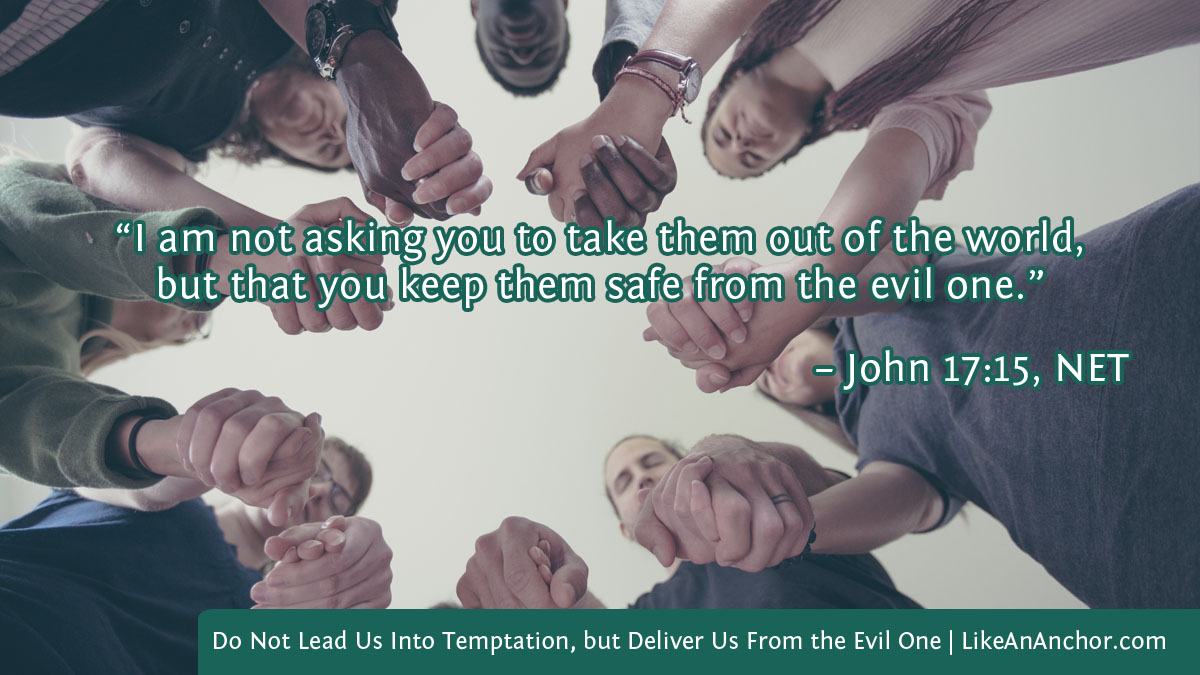
Image of people praying together overlaid with text from John 17:15, NET version: “I am not asking you to take them out of the world, but that you keep them safe from the evil one."
Image by Claudine Chaussé from Lightstock

Do Not Lead Us Into Temptation

The last line of this prayer is a little tricky to interpret, at least at first glance, in light of other scriptures. James 1:13 says, “Let no one say when he is tempted, ‘I am tempted by God,’ for God cannot be tempted by evil, and he himself tempts no one” (NET). The English translation of Matthew 6, at least, makes it appear that Jesus is advising us to pray against something (God leading us into temptation) that wouldn’t happen anyways. Looking at another piece of prayer advice that He gave his disciples helps clear this confusion up.

Then they went to a place called Gethsemane, and Jesus said to his disciples, “Sit here while I pray.” … Then he came and found them sleeping, and said to Peter, “Simon, are you sleeping? Couldn’t you stay awake for one hour? Stay awake and pray that you will not fall into temptation. The spirit is willing, but the flesh is weak.”

Mark 14:32, 37-38, NET

This is actually very similar to what Jesus told his disciples to pray in the model prayer. Both verses use the same Greek word for temptation, periasmos (G3986). This word involves putting something to the test. It’s “an experiment, attempt, trial, proving” that can include an internal or external “enticement to sin” for the purpose of making a “trial of man’s fidelity, integrity, virtue, constancy” (Thayer). In both cases, Jesus advised them to pray that this didn’t happen. Testing isn’t a pleasant experience. God will let it happen sometimes, though, when it’s for our good and when He knows we could succeed.

My brothers and sisters, consider it nothing but joy when you fall into all sorts of trials (periasmos), because you know that the testing of your faith produces endurance. …

Happy is the one who endures testing (periasmos), because when he has proven to be genuine, he will receive the crown of life that God promised to those who love him. Let no one say when he is tempted, “I am tempted by God,” for God cannot be tempted by evil, and he himself tempts no one. But each one is tempted when he is lured and enticed by his own desires. Then when desire conceives, it gives birth to sin, and when sin is full grown, it gives birth to death. Do not be led astray, my dear brothers and sisters.

James 1:2-3, 12-16, NET

Testing serves a purpose. It can strengthen our faith, provided that we overcome the test and not give into the temptation to sin. The NET footnote on Matthew 6:13 says “The request do not lead us into temptation is not to suggest God causes temptation, but is a rhetorical way to ask for his protection from sin.” In other words, we might see this as a prayer that we not be tested but we can also see it as a prayer that if we’re tested, we won’t fail the test.

So let the one who thinks he is standing be careful that he does not fall. No trial (periasmos) has overtaken you that is not faced by others. And God is faithful: He will not let you be tried beyond what you are able to bear, but with the trial (periasmos) will also provide a way out so that you may be able to endure it.

1 Corinthians 10:12-13, NET

When God allows tests and trials, He intends for us to successfully overcome them and prove the genuineness of our faith. If we couldn’t endure the test, He wouldn’t let it happen. We need to be cautious and humble, though, and not just assume we’ve hit a point in our spiritual growth where we won’t be tempted or that we won’t fall if tempted. I think that’s also what Jesus is hinting at in the model prayer. Our prayers should include an acknowledgment that we need God’s help “delivering us from evil” to avoid sin and overcome tests when they do come.

Deliver Us From the Evil One

Image of a woman studying the Bible, overlaid with blog's title text and the words, "Jesus closes the model prayer with a request that God help us resist sin and deliver us from the evil adversary and his influences."
Image by Pearl from Lightstock

Depending on the translation you’re reading, the end of Matthew 6:13 might read “deliver us from evil” or “deliver us from the evil one.” The Greek word poneros (G4190) can mean evil in a general sense, but here “it is most likely personified since it is articular (τοῦ πονηροῦ, tou ponērou)” (NET footnote). You can see other examples of this word being personified and standing in for the devil in Matt. 13:19, 38; John 17:15; 1 John 2:13-14. One of those examples is from the prayer that Jesus prayed right before his death.

I am no longer in the world, but they are in the world, and I am coming to you. Holy Father, keep them safe in your name that you have given me, so that they may be one just as we are one. … I have given them your word, and the world has hated them, because they do not belong to the world, just as I do not belong to the world. I am not asking you to take them out of the world, but that you keep them safe from the evil one.

John 17:11, 14-15, NET

Jesus told us to pray for deliverance from evil, and he modeled that by praying the Father would keep us safe from the evil one. Jesus’s followers later wrote about God faithfully delivering us from evil people, evil deeds, and the evil one, or Satan (2 Thes .3:2-3; 2 Tim. 4.18; 1 John 5:18-19). We are also counseled to take up the armor of God to provide defense against the evil one.

Clothe yourselves with the full armor of God, so that you will be able to stand against the schemes of the devil. For our struggle is not against flesh and blood, but against the rulers, against the powers, against the world rulers of this darkness, against the spiritual forces of evil in the heavens. For this reason, take up the full armor of God so that you may be able to stand your ground on the evil day, and having done everything, to stand. Stand firm therefore, by fastening the belt of truth around your waist, by putting on the breastplate of righteousness, by fitting your feet with the preparation that comes from the good news of peace, and in all of this, by taking up the shield of faith with which you can extinguish all the flaming arrows of the evil one.

Ephesians 6:11-16, NET

I have a whole book on the armor of God (Like An Anchor Study Guide: Armor of God), so we won’t go into it in too much detail in this post. But if we’re going to pray “do not lead us into temptation, but deliver us from the evil one,” we need to have some understanding of what sort of evil we’re praying to be delivered from and that includes knowledge of the fight that we’re in. “The whole world lies in the power of the evil one” (1 John 5:19), but we are people of God whom God protects, promises to strengthen against temptations, and delivers from the devil.


Quick note for those wondering why there isn’t going to be another post titled “For yours is the Kingdom, the power, and the glory forever:” manuscript evidence suggests that this phrase was added at some point, possibly for use in church liturgy (NET footnote on Matt. 6:13). Since it likely wasn’t part of the original prayer, I decided not to include it in this blog series.

If you want to catch up on or reread the previous posts in this series, here are the links: “Hallowed Be Your Name,” “May Your Kingdom Come,” “May Your Will Be Done On Earth As It Is In Heaven,” “Give Us Today Our Daily Bread,” and “Forgive Us Our Debts, as We Have Forgiven Our Debtors.”


Featured image by Matt Vasquez from Lightstock

Forgive Us Our Debts, as We Have Forgiven Our Debtors

Today’s post is our 5th on Jesus’s model prayer. If you need/want to catch up on the previous posts, here are the links: “Hallowed Be Your Name,” “May Your Kingdom Come,” “May Your Will Be Done On Earth As It Is In Heaven,” and “Give Us Today Our Daily Bread.” As mentioned in those posts, we find versions of Jesus’s model prayer in two gospels. We’ve been focusing on the one in Matthew, which is part of the Sermon on the Mount when He’s talking about good and bad examples for how to pray (Matt. 6:5-15). There’s also a near-identical one in Luke, where Jesus responds to a disciple’s request that Jesus teach them to pray (Luke 11:1-13).

So pray this way:
Our Father in heaven, may your name be honored,
may your kingdom come,
may your will be done on earth as it is in heaven.
Give us today our daily bread,
and forgive us our debts, as we ourselves have forgiven our debtors.
And do not lead us into temptation, but deliver us from the evil one

Matthew 6:9-13, NET

We can think of this prayer as a helpful outline for our own prayers. We’re not locked into repeating it word-for-word; He’s showing us the way to pray rather than giving us a specific prayer to recite (though there can be a time and place for that, too, just like we can read or sing psalms other people wrote at times when we can’t think of what to say or the psalms/prayers speak to our own situations). In this post, we’re looking at the second personal request that’s part of the model prayer: “forgive us our debts, as we ourselves have forgiven our debtors.”

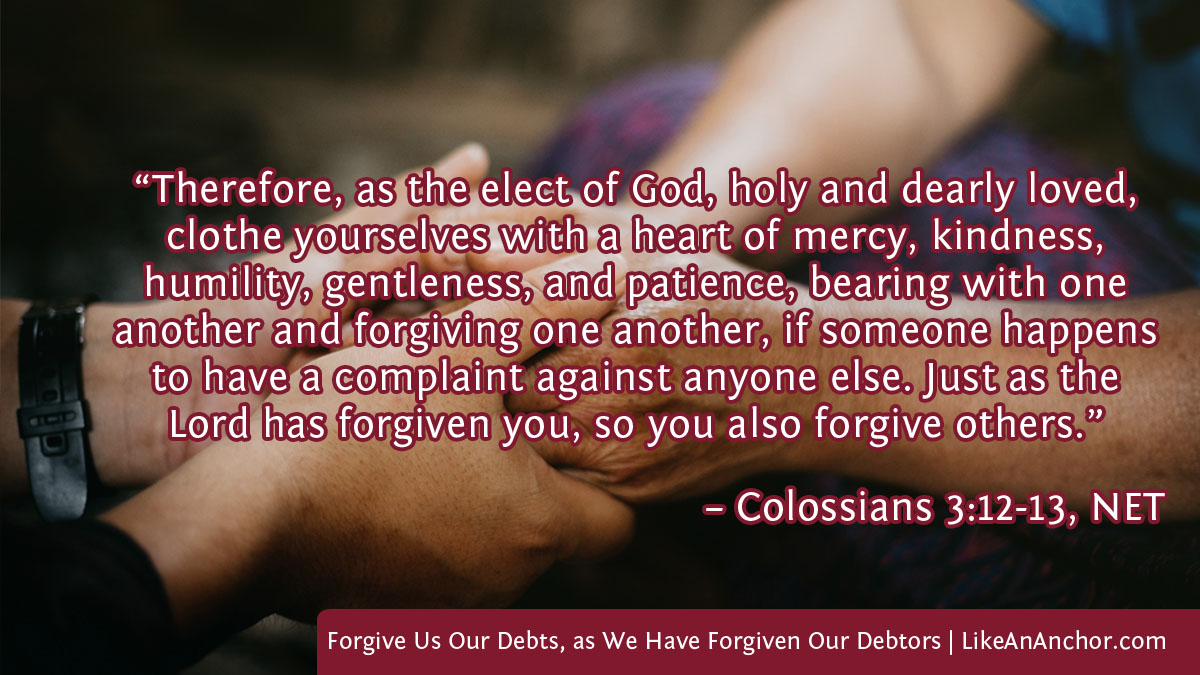
Image of two people's clasped hands overlaid with text from Colossians 3:12-13, NET version: “Therefore, as the elect of God, holy and dearly loved, clothe yourselves with a heart of mercy, kindness, humility, gentleness, and patience, bearing with one another and forgiving one another, if someone happens to have a complaint against anyone else. Just as the Lord has forgiven you, so you also forgive others.”
Image by Jantanee from Lightstock

Forgiving Debts

“Forgive us our debts, as we ourselves have forgiven our debtors” is the only point in this prayer that Jesus explains in more detail. Right after wrapping up the outline, He adds this:

“For if you forgive others their sins, your heavenly Father will also forgive you. But if you do not forgive others, your Father will not forgive you your sins.”

Matthew 6:14-15, NET

There are two different Greek words used here, which is reflected in the English translations “debts” and “sins.” In the prayer, the word used is opheilema, which means “that which is owed” as “a debt” (Thayer’s Dictionary, entry G3783). It’s metaphorically used of sins. “Debtors” is the related word opheiletes, which as you might guess means the person who owes something to another (Thayer; G3781). This word for debtor is also used in Matthew 18, which we’ll be looking at in a moment.

“Sin” is translated from paraptoma, which means “to fall beside or near” or “a lapse or deviation from truth and uprightness” (Thayer; G3900). When it appears in the New Testament it’s translated with English words like “trespass,” “offense,” “fault,” or “sin.” Interestingly, this still isn’t the most commonly used Greek word for sin. That would be hamartia, which means “to miss the mark” or “that which is done wrong, sin, and offense, a violation of the divine law” (Thayer; G266). Harmartia is the word used for “sin” in the version of Jesus’s model prayer that Luke records (Luke 11:4).

Despite the different words, “forgive us our debts, as we ourselves have forgiven our debtors” is clearly connected with “forgive others their sins” so your Father will forgive you. Jesus uses parallel wording to make the connection, and the word for “forgive” is the same in both cases. It’s translated from aphiemi, which means “to let go, give up a debt, forgive, to remit” (Thayer; G863). When we sin, it’s like we owe God something because we messed up. When Jesus died, He paid the penalty in our place, remitting our debts. We need to understand this sin-debt analogy if we’re going to make sense of what’s going on in this part of the model prayer.

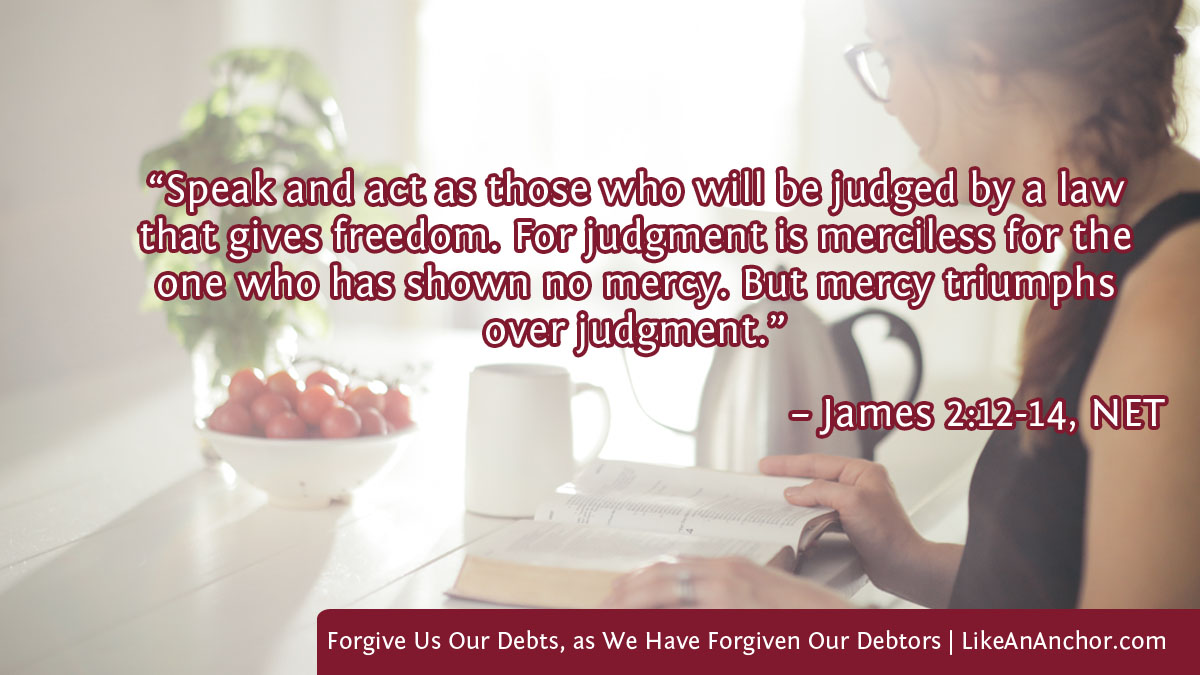
Image of a woman reading the Bible at a table, overlaid with text from James 2:12-14, NET version: “Speak and act as those who will be judged by a law that gives freedom. For judgment is merciless for the one who has shown no mercy. But mercy triumphs over judgment.”
Image by MarrCreative from Lightstock

The Necessity of Forgiveness

It might feel kind of weird to think that God’s forgiveness of us is conditional on our forgiveness of others. We like to think of His forgiveness and grace as something freely given that we don’t need to do anything in order to receive. But though we can’t do anything to earn His grace or forgiveness, there are some things we can do to reject them. Later in Jesus’s ministry, He shares a parable that sheds light on the connection between us forgiving others and us receiving forgiveness from God.

Then Peter came to him and said, “Lord, how many times must I forgive my brother who sins against me? As many as seven times?” Jesus said to him, “Not seven times, I tell you, but seventy-seven times!

“For this reason, the kingdom of heaven is like a king who wanted to settle accounts with his slaves. As he began settling his accounts, a man who owed 10,000 talents was brought to him. Because he was not able to repay it, the lord ordered him to be sold, along with his wife, children, and whatever he possessed, and repayment to be made. Then the slave threw himself to the ground before him, saying, ‘Be patient with me, and I will repay you everything.’ The lord had compassion on that slave and released him, and forgave him the debt. 

Matthew 18:21-27, NET

This is mercy. The man was an opheiletes, a debtor, who was incapable of repaying what he owed. Just one talent was “equal to 6,000 denarii. One denarius was the usual day’s wage for a worker” (NET footnote on Matt. 18:24). That means for a typical worker at the time, 10,000 talents was equal to 60,000,000 day’s wages, or about 164,384 years of work. A slave could never dream of repaying that, just like human beings can never do enough to make up for the sins we’ve committed against God (Rom. 3-6). As readers or listeners, we’re supposed to appreciate just what an incredible gift this lord gave the slave.

After he went out, that same slave found one of his fellow slaves who owed him 100 silver coins. So he grabbed him by the throat and started to choke him, saying, ‘Pay back what you owe me!’ Then his fellow slave threw himself down and begged him, ‘Be patient with me, and I will repay you.’ But he refused. Instead, he went out and threw him in prison until he repaid the debt. When his fellow slaves saw what had happened, they were very upset and went and told their lord everything that had taken place.  Then his lord called the first slave and said to him, ‘Evil slave! I forgave you all that debt because you begged me! Should you not have shown mercy to your fellow slave, just as I showed it to you?’ And in anger his lord turned him over to the prison guards to torture him until he repaid all he owed. So also my heavenly Father will do to you, if each of you does not forgive your brother from your heart.”

Matthew 18:28-35, NET

The fellow slave owed only 100 silver coins, or denarii, so about 3 months’ pay (NET footnote on Matt. 18:28). It’s a real debt, but compared to what the first slave owed the lord it’s a tiny sum. The difference between what the slave was forgiven and what he refused to forgive is enormous. We can see how ridiculous he’s being. But it’s just as ridiculous if we refuse to forgive another human being’s offenses against us after God has forgiven our offenses against Him.

It’s not just crazy for us to hold on to a tiny debt someone owes us when God has forgiven us a huge debt against Him. It’s dangerous. Jesus doesn’t leave room for ambiguity in interpreting this parable. The lord takes back His forgiveness, and Jesus says, “So also my heavenly Father will do to you, if each of you does not forgive your brother from your heart.” It’s exactly like He said after sharing the model prayer: “if you forgive others their sins, your heavenly Father will also forgive you. But if you do not forgive others, your Father will not forgive you your sins” (Matt. 6:14-15, NET). There’s an “if” in these verses, making forgiveness conditional. We need to show forgiveness if we want to receive forgiveness.

How To Let Go

Earlier, I said that aphiemi, the Greek word translated “forgive” means “to let go, give up a debt, forgive, to remit” (Thayer; G863). That’s the sense in which it usually applies to forgiveness. But it’s a complex word, and it can also mean “to send away,” “yield up,” “let alone, let be,” or “to leave, go away from one.” If we forgive, we stop holding on to the sins, offenses, debts, and trespasses of other people. We “let it alone,” send away our resentment, and walk away from what we might be owed. It’s much the same thing as our English definition of forgiveness.

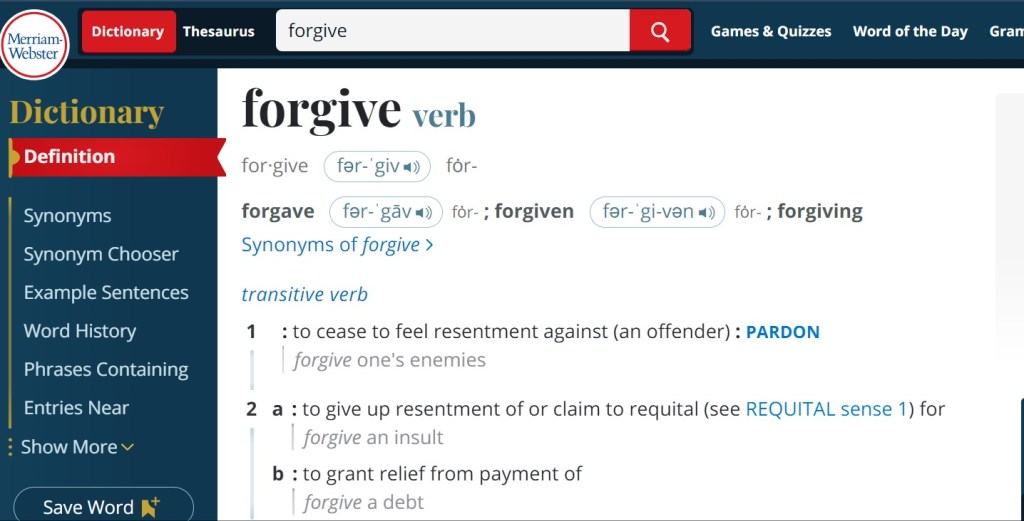
Screenshot of the definition of "forgive" in the Merriam-Webster dictionary. Definitions shown include " to cease to feel resentment against (an offender)," "to give up resentment of or claim to requital," and "to grant relief from payment of"

Notice that none of the things involved with forgiveness require the other person to take action. We can grant forgiveness–let go of resentment and yield any claim to payment owed us–without the other person asking for it. In fact, we should forgive as soon as possible regardless of the other person because we want God to respond positively when we ask Him to forgive us.

Image of a man praying in a church, overlaid with blog's title text and the words, "One of our main goals as Christians is to become like God. That involves learning to be loving, merciful, and forgiving just the same way that He is."
Image by Shaun Menary from Lightstock

One of the things I’ve struggled with related to forgiveness is how to tell if I’ve actually forgiven someone. Some things are relatively easy to forgive, and you might legitimately forget them when you release the debt. There are others, though, that can still color your perception of a person even if you don’t feel resentment or think they owe you something. In certain situations, that can be okay. It’s not always safe to reconcile or restore a relationship, but it’s always right to let go of resentment and the feeling that someone who hurt us owes us for something.

 “If your brother sins, go and show him his fault when the two of you are alone. If he listens to you, you have regained your brother. But if he does not listen, take one or two others with you, so that at the testimony of two or three witnesses every matter may be established. If he refuses to listen to them, tell it to the church. If he refuses to listen to the church, treat him like a Gentile or a tax collector.

Matthew 18:15-17, NET

This short formula for Christian reconciliation comes before Peter’s question about forgiveness and Jesus’s parable about the unforgiving slave. Ideally, we should reconcile if there’s an issue with a “brother” or “fellow believer.” The primary goal is reconciliation and restored relationship. But if that doesn’t work after repeated attempts, you don’t “associate with such a person” (NET footnote on Matt. 18:17). It’s our responsibility to try to reconcile, especially with a fellow believer, but regardless of how that goes we have an obligation to forgive and “live peaceably with all people” (Rom. 12:18, NET; see Rom. 12:16-21).

The conditionality of forgiveness from God should prompt us to extend forgiveness to others. But I don’t think He wants that to be the main reason why we forgive (just like the threat of punishment shouldn’t be the main reason we obey His laws). When we realize what a great debt God forgives us, we should want to forgive others. Similarly, as recipients of God’s great mercy, we should be eager to show mercy to others. Like forgiveness, there’s a reciprocity involved in mercy: “Blessed are the merciful, for they will be shown mercy” (Matt. 5:7, NET) and “For judgment is merciless for the one who has shown no mercy” (James 2:13, NET). One of our main goals as Christians is to become like God. That involves learning to be loving, merciful, and forgiving just the same way that He is. When we pray, “Forgive us our debts, as we ourselves have forgiven our debtors,” we acknowledge that we have an essential role to play in giving and receiving forgiveness.


Featured image by Pearl from Lightstock

Song Recommendation: “Mercy” by Casting Crowns