I’m 5 feet 6 inches tall (about 168 cm for my readers on the metric system). When I was a teenager I decided that was about 3 inches too tall for some reason ostensibly connected with Joe Hardy (yes, the fictional character. I know — I needed more real friends). That’s not the only reason I do things to make myself look smaller, but it’s one of the stranger ones. In general, though, being taller than other people simply makes me feel awkward. And even though I’ve explored that feeling before in a creative non-fiction class in college, I really wasn’t sure why.
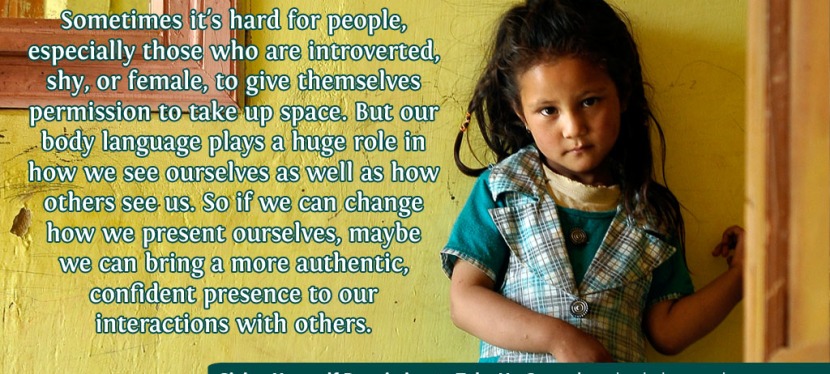
Recently, I’ve been asked why I use body language that makes me look small. That question made me take another look at why I’m doing what I do. I hunch my shoulders. I sit in corners of sofas. I cross my arms and legs or ankles. Or I have my hands together nervously fiddling with my fingers. Part of this is unconscious but I’m often aware of it as well. I know I make myself smaller and sometimes I do it on purpose, especially if I feel nervous or threatened. I suppose I’m saying with my body language, “Don’t notice me. Don’t hurt me.” And this sort of thing has become instinctive for me.
One of my more vivid childhood memories is of being enrolled in a summer school program and hiding under the playground equipment from the other kids. My experiences there played a large role in why my parents chose to homeschool. In some ways, that scared little girl is still part of me and hiding is still my default move. But, as someone recently reminded me, fear isn’t a good way to live your life. I feel like it’s time for a change. Read more →
I don’t have a regular blog post for you today. I just want to get real with you all for a moment. God spoke to me earlier this week. Not in the “I have a divine revelation to share with you all” way, but in the sense that He used someone to tell me something I really needed to hear.
This other person and I were talking one night and they told me they felt God’s presence as a near-constant thing. And I felt sad, as well as a bit envious, that I didn’t have that. It’s not that I’ve never felt God is there. I feel that He hugged me once when I was singing in church. I often feel Him when I dance. He drew me into deeper relationship with Him and led me to baptism when, at age 18, He showed me that He wants me as well as loves me. But I also feel myself slipping into a pattern of having more head-faith than heart-faith even though I write all the time about connecting with God at a heart level.
On top of that, I’ve recently realized that for all the work I did years ago on learning to love myself and accept God’s perspective on me that I’ve lost hold of that as well (if I ever really had it). I know that God loves me and values me and I’m precious in his sight. But dating my boyfriend has brought to light there was still a voice in my mind saying I’m not actually all those things. Or more accurately it’s saying that even though God sees me like that no one else ever will or should. Which simply isn’t true. But it feels true and I’m so grateful I’m in a relationship with a guy who thinks it’s important that I come to believe I’m truly precious and thinks everyone else should see that, too.
So getting back to the night God spoke to me. I really can’t put it any other way. Someone else was speaking the words but they were coming from God. And He said, “I choose you. I love you. And I’ve loved you for so very long. Why won’t you accept my love? I chose you all the time. All of you — writer, blogger, cook, girl who chose to follow Me even when she can’t feel Me, lover of people. And I accept you.” And more than I’ll share here. It was incredible. Can you blame me for breaking down in tears, crumpled at Jesus’ feet?
I’m not sure how most of you see me. I’ve had some people mention that it seems like I have a strong faith, or that I’m “spiritual,” or that it’s obvious God is working in me. I suppose we could say those are true. But I felt broken and lonely and terrified I would be rejected. Parts of me still feel like that, but not nearly so much. In fact, the person I was talking with might be right when they said they felt like I really accepted God into my heart for the first time that evening. Not that I hadn’t committed to God before, but that this was the first time I really believed deep in my heart that His love and acceptance is, and should be, for me.
At the very least, I realized I had “left my first love,” to borrow a phrase from the letter to Ephesus. I honestly don’t remember feeling anything like what I do now since I was 14 years old and realized I wanted to be baptized and spent a summer singing to God every morning. I don’t do that any more. And I suspect reading things like Captivating moved me to tears not because I really believed God loved me like that but becasue I wanted to believe it. Similarly, I loved songs like “Someone Worth Dying For” not because I believed that’s something I am but because the longing found the chorus’ questions was in my own heart as well.
I feel rather dense, to be honest. If you look back at the blog posts I’ve been writing it’s obvious that God has been trying to tell me this for years. But I just wrote the posts, thanked Him for His goodness and love, then shared them with others without really, truly internalizing it. I’m grateful that He has used my hurt to help other people — that because I’ve felt these things I know how much other people who are going through the same doubts need encouragement. But it took God having another person put their hands on my shoulders and insist I really listen this time to realize how much those studies were meant for me as well. Posts like the reminder to love yourself because God loves you so much. Or the one from two years ago about taking down barriers you’ve built between you and God. Or the series I’ve been doing on really believing God’s promises, including the one that He’ll never let you down.
I want to share with you the verses I went to the morning after this conversation. I think the most consistent way God communicates with us is through Bible study (though He’ll use other methods as well especially, as I just learned, if we’re not getting it otherwise). Many of these passages were already among my favorite verses and I even quoted most of them in my ebook God’s Love Story. Now they hold even more meaning than before.
But now Yahweh who created you, Jacob, and he who formed you, Israel says: “Don’t be afraid, for I have redeemed you. I have called you by your name. You are mine. When you pass through the waters, I will be with you; and through the rivers, they will not overflow you. When you walk through the fire, you will not be burned, and flame will not scorch you. For I am Yahweh your God, the Holy One of Israel, your Savior. I have given Egypt as your ransom, Ethiopia and Seba in your place. Since you have been precious and honored in my sight, and I have loved you; therefore I will give people in your place, and nations instead of your life. (Is. 43:1-4, WEB)
Now when I passed by you, and looked at you, behold, your time was the time of love; and I spread my skirt over you, and covered your nakedness: yes, I swore to you, and entered into a covenant with you, says the Lord Yahweh, and you became mine. (Ezk. 16:8, WEB)
Therefore behold, I will allure her, and bring her into the wilderness, and speak tenderly to her. I will give her vineyards from there, and the valley of Achor for a door of hope; and she will respond there, as in the days of her youth, and as in the day when she came up out of the land of Egypt. It will be in that day,” says Yahweh, “that you will call me ‘my husband,’ and no longer call me ‘my master.’ For I will take away the names of the Baals out of her mouth, and they will no longer be mentioned by name.
In that day I will make a covenant for them with the animals of the field, and with the birds of the sky, and with the creeping things of the ground. I will break the bow, the sword, and the battle out of the land, and will make them lie down safely. I will betroth you to me forever. Yes, I will betroth you to me in righteousness, in justice, in loving kindness, and in compassion. I will even betroth you to me in faithfulness; and you shall know Yahweh.
It will happen in that day, I will respond,” says Yahweh, “I will respond to the heavens, and they will respond to the earth; and the earth will respond to the grain, and the new wine, and the oil; and they will respond to Jezreel. I will sow her to me in the earth; and I will have mercy on her who had not obtained mercy; and I will tell those who were not my people, ‘You are my people;’ and they will say, ‘My God!’” (Hos. 2:14-23, WEB)
My beloved spoke, and said to me, “Rise up, my love, my beautiful one, and come away. For, behold, the winter is past. The rain is over and gone. The flowers appear on the earth. The time of the singing has come, and the voice of the turtledove is heard in our land. The fig tree ripens her green figs. The vines are in blossom. They give out their fragrance. Arise, my love, my beautiful one, and come away.” (Song 2:10-13, WEB)
Only Yahweh had a delight in your fathers to love them, and he chose their offspring after them, even you above all peoples, as it is today. (Deut. 10:15, WEB)
For Zion’s sake will I not hold my peace, and for Jerusalem’s sake I will not rest, until her righteousness shines out like the dawn, and her salvation like a burning lamp. The nations will see your righteousness, and all kings your glory, and you will be called by a new name, which Yahweh‘s mouth will name. You will also be a crown of beauty in Yahweh‘s hand, and a royal diadem in your God‘s hand. You will not be called Forsaken any more; nor will your land be called Desolate any more: but you will be called Hephzibah [“I delight in her”], and your land Beulah [“married”]; for Yahweh delights in you, and your land will be married. For as a young man marries a virgin, so your sons will marry you. As a bridegroom rejoices over his bride, so your God will rejoice over you. (Is. 62:1–5, WEB)
But God wasn’t yet done with confirming His message for me. This past week I was at an evening service for Yom Teruah and we read some confessions/prayers together as a congregation that spoke directly to this subject as well. We had a printed out program for some congregational readings, but only used about 1/4 of them in our service. I’m assuming the chosen readings weren’t a coincidence and God knew I needed this confirmation. The very first one we read together included these lines:
Abba Father, we come before You today to receive Your love anew, a love that never fails, and to experience the wonderful truth that we are “accepted in the Beloved” (Eph. 1:6). We come in faith to You, desiring freedom in our lives from past hurts and disappointments. … I receive your unconditional love. I declare that the enemy’s power of rejection over me is broken. Bless me, enlarge my territory, and keep me from evil. Give me fresh vision, heal my heart, and fill it with your love, joy, and peace.
Wow. Could that get any more relevant to what He’s been telling me? The language is so similar to what God was saying a few days earlier through my friend that I was getting choked-up reading it. I’m getting choked up typing it now.
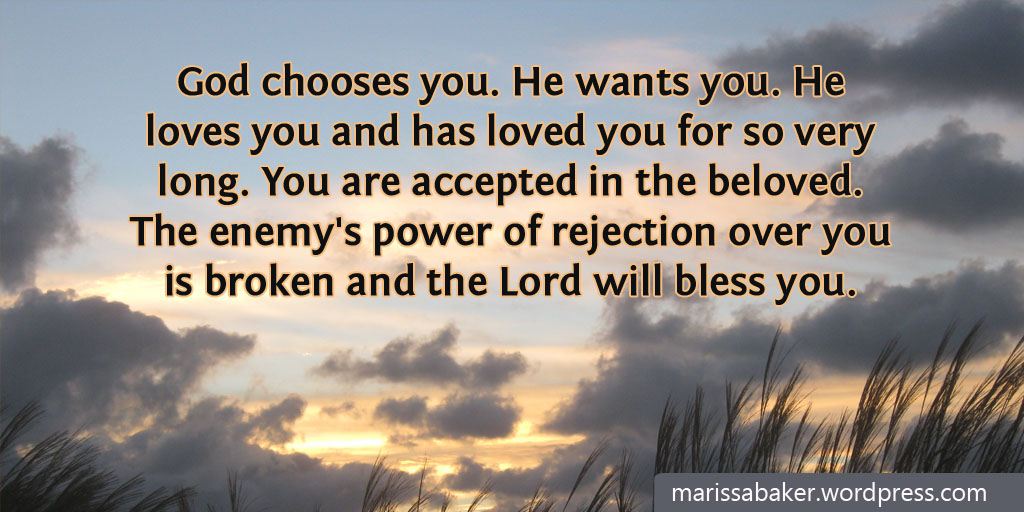
And you know what’s more? God’s saying the same things to you, dear readers. I know many of you have the same doubts, fears, and feeling I had that you lack value. But God chooses you. He wants you. He loves you and has loved you for so very long. You are accepted in the beloved. And because of Jesus’ triumph on the cross the enemy’s power of rejection over you is broken. The Lord will bless you indeed and always be there with you.
So you want to date an INFJ. I’m not quite sure whether to congratulate you or pat you consolingly on the shoulder. Perhaps both.
Assuming you want this relationship to go well, one of the most important things you can do is try to understand your INFJ love-interest. We’re the rarest personality type and we often feel misunderstood and alone. Showing us that’s not going to happen with you will instantly endear you to an INFJ’s heart.
And so here you are learning about the 15 things INFJs really want you to know as you begin a relationship with us. They might not all be equally true of every INFJ, but this list is the result of feedback from and discussion with nearly 20 different INFJs so you’re getting a pretty good idea of what we’d like to say to you.
Even though I’m an INFJ myself and I’ve written a fairly successful book about the INFJ personality type, I still like to get feedback from other INFJs before writing a post like this. And so I want to say a big “Thank you” to everyone in the Facebook group INFJs Are Awesome who responded to my question about what they thought people should know before dating an INFJ. You guys helped make this post so much better than if it were just me typing away my thoughts in a vacuum.
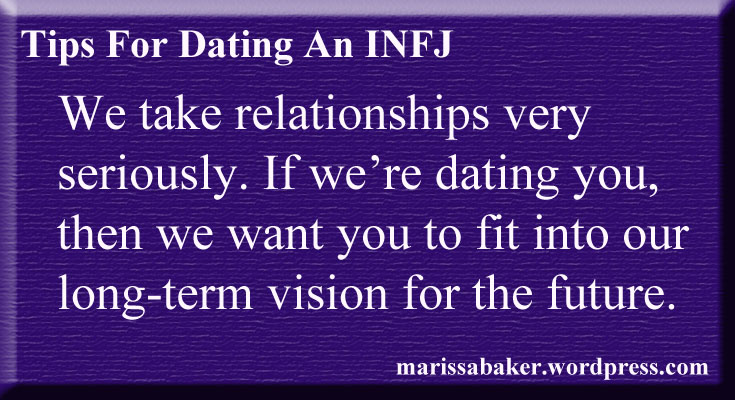
1) We take relationships very seriously
While there are some INFJs who will have one-night-stands or enter casual relationships, most of us are interested in something long-term. If you’re not willing to take the relationships seriously we need to know that up-front so we can make a decision about whether or not to bother with you. Most of us know how to be alone and we’d rather stay single than settle for a relationship that just adds stress and anxiety to our lives. We also have a vision for how we want our lives to go and we’ll be going into a relationship trying to figure out how you might fit in with that vision.
2) We need to feel safe and accepted
This one is huge for INFJs. If you’re not a safe person for us to be around then we either 1) won’t enter a relationship with you or 2) will be trying to get out of the relationship. We desperately need to know you won’t dismiss us. We don’t actually expect you to fully understand all our quirks, nuances, and oddities but we need to know you will accept and even love them. We need to know you’re interested in getting to know the “real” version of us and that you won’t run away when we start opening up. Similarly, we typically have strong values and we’re looking for someone who lines up with them. INFJs can be very accepting of other people’s differences, but the closer you get to us the more closely we want you to line-up with our core beliefs. Read more →
It’s easy to talk about trusting God when things in our lives are going well. It’s harder to recognize His presence when it feels like life is falling apart all around us. In times like that, we need reminders that God will not abandon us in our fights and that He will fight for us.
Several weeks ago, we talked about claiming God’s promises. There’s quite a few made in the pages of our Bibles, and that post only covered His promise to give the holy spirit, to be friends with those who love Him, and to hear when we call on Him. And even after adding another post about the promises in Psalm 91 we just barely scratched the surface of this topic.
One of the promises in Psalm 91 is about God’s protection in the midst of trials. Sometimes He doesn’t take us out of a dangerous or uncomfortable situation, but rather brings us through it. God doesn’t intend to coddle us. He wants us to be thriving and growing and overcoming. He knows we need a shelter and provides that, but He also wants to give us courage to keep going as well.
He Won’t Let You Down
When Moses addressed the Israelites before appointing Joshua as his successor, he reminded them that their human leader isn’t really the one who takes care of them. The Lord God is the one who fights for them and who they must obey. He then shares a promise from God:
Be strong and courageous. Don’t be afraid or scared of them; for Yahweh your God himself is who goes with you. He will not fail you nor forsake you. (Deut. 31:6, WEB)
Later, the Lord personally reiterates this promise to Joshua (Josh. 1:5). And we know the promise extends beyond Joshua and the Israelites because the writer of Hebrews tells us we can be emboldened by the Lord’s promise, “I will never leave thee, nor forsake thee” (Heb. 13:5, KJV).
Though “leave” and “fail” seem quite different in English, the Greek word used in Hebrews is actually a perfect translation for the Hebrew word used in Deuteronomy. Both words mean “to let sink,” as if you’d been holding something up and then let it go (H7503, raphah and G447, aniemi). In modern terminology, we would say that God promises not to let you down. Read more →
Once upon a time, I told my sister, “I don’t think I’d ever date an ENFP.” Even though I’d seen lots of people describing ENFP-INFJ as a “perfect” pairing it just didn’t sound like a good fit for me. I loved having ENFP friends, but the ones I knew were either so intense they made me feel anxious, or so extroverted they wore me out, or too scattered for me to think I wouldn’t eventually get irritated with them in a closer relationship (or all of the above).
Then a few years after making this statement, I started actually getting to know one of my ENFP acquaintances. And now we’re dating (doesn’t that sound like just the sort of coincidence that would happen in a romance story?). He does have an intense personality but I’ve done enough work overcoming my social anxiety that doesn’t scare me any more (actually, it’s rather exciting). He’s the most extroverted person I know but I’ve discovered it’s not a problem for us. And he’s not scattered or flaky (which, it turns out, is another of those unfair/too widely applied stereotypes bouncing around Myers-Briggs circles).
Now, I could spend the next 1,000+ words telling you about how wonderful my boyfriend is but that’s probably not what you clicked on this post for (if it was I’m afraid you’re going to be disappointed). Instead, we’re going to talk about why ENFPs and INFJs have a reputation in Myers-Briggs circles for getting along so well. Read more →
I’d meant to just write one post about the Sermon on the Mount. Now here we are three weeks later with a third post on this study. And the first two only got through chapter five! I’m marveling at how much depth there is in such a familiar passage of scripture.
In the first part of this sermon, Jesus focuses on what God expects from those He’s in a relationship with. And it’s not always something that makes sense to human beings. The Beatitudes cover actions and character traits that don’t seem particularly positive from a human perspective, yet Jesus describes them as “blessed.” Then He starts talking about how law-keeping will change under the New Covenant. Walking in the spirit raises the bar higher, aiming for being like God rather than just living by the letter of His law. We end up keeping the law as we live in the spirit. And Jesus sticks with this theme of God’s expectations verses man’s ideas as He continues the sermon.
Jesus tells His hearers not to “do merciful deeds,” pray, or fast “as the hypocrites do” (Matt. 6:1-18, WEB). Those things are good — even essential — but they need to come from the right heart. The word hupokrites (G5273) means a stage actor or player who assumes a character’s role. So if you call someone who’s not on stage a hupokrites, you’re accusing them of playing a role in their lives. These people are living a performance, pretending to follow God while having other motives.
Hypocrites pretend to follow God so they can show-off to other people. But if we do that, Jesus warns “you have no reward from your Father who is in heaven” (Matt 6:1, WEB). The hypocrites do things for human praise and when they get it “they have received their reward” (Matt. 6:2, 5, 16, WEB). If your only motive is impressing people, then that’s all you’ll get out of your righteous play-acting. Read more →





 Like An Anchor