“Thinking” Women and “Feeling” Men

One of the ways we relate Myers-Briggs type to culture is by saying most Feeling types are women and most Thinking types are men. This seems to work quite nicely as a partial explanation for gender stereotypes in Western culture. In spite of social pushes to break-down gender distinctions, Feeling-type attributes (emotionally expressive, nurturing, relational, etc.) are typically considered “female” and Thinking attributes (impersonal, fact-oriented, business-like, etc.) are considered more “male.”

If we fit this generalization, we probably haven’t even noticed it. If you’re a woman with traditionally feminine traits or a man with traditionally masculine traits, there’s little pressure to change (though there are exceptions, of course). But if you’re a woman whose mind naturally makes decisions in an impersonal way or a man who prefers harmony to competition chances are someone has told you at some point that there’s something wrong with you.

Type Distribution

As with many generalizations, there’s a whole slew of problems related to this observation. According to the Center for Applications of Psychological Type, about 57 to 84 percent of women are Feeling types and about 47 to 72 percent of men are Thinking types. It’s hard to get exact numbers on type distribution, but even these broad estimates show that, while the generalization holds true, there are also quite a few Feeling men and Thinking women.

"Thinking" Women and "Feeling" Men | LikeAnAnchor.comJust in my family of 5, there are three good examples of exceptions to the general rule that most men are Thinkers and most women are Feelers. My dad (ISFJ) and brother (ENFJ) are both Feeling types, and my sister (INTJ) is a thinking type. My mother has asked me not to type her, but as an INFJ I might be the only one in my family who fits the “women are Feeling types” generalization.

Thinking vs. Feeling

Lest these generalizations lead you to conclude Thinking people don’t have emotions or that Feeling people can’t be intelligent, let’s take a quick look at what Thinking and Feeling refer to when we’re talking about Myers-Briggs types. Both Thinking and Feeling are Judging functions, meaning they describe how you like to make decisions. Read more

Lies That Isolate Us

Lies That Isolate Us | marissabaker.wordpress.com We know how important a relationship with God is to our Christian walk, and last week we talked about how important it is for us to also have relationships with other believers. For some of you, that comes fairly easily — you have a church home where you feel welcome, and good friends who share your faith. Many of you feel much more isolated, through. Maybe there aren’t any options for fellowship in your area, but if you’re online reading this blog post you have at least one way to connect with fellow believers, if we’re willing to take advantage of it. Peter describes our “adversary the devil” as a “roaring lion” who walks about “seeking whom he may devour” (1 Pet. 5:8). When predators like lions hunt herd animals (like the sheep we’re so often compared to in scripture), they try to isolate one before going in for the kill. One of the tools our adversary uses to do this to us if the lies we tell ourselves that keep us from seeking out fellowship — things like “I’m not good enough,” or “I have nothing to offer,” or “No one values me.”

Let Them Love You

No matter how true these thoughts feel, they are not an accurate reflection of how God sees us. You say, “I have no value,” God says you’re so valuable that Jesus traded His own life to save you.

But God demonstrates His own love toward us, in that while we were still sinners, Christ died for us. (Rom. 5:8)

Jesus Christ’s was the most valuable human life ever, and that’s the price He and His Father paid for you. They didn’t do this because they “had to.” They did it because they thought you were worth it. Paul tells us that “Christ Jesus came into the world to save sinners, of whom I am chief,” and He came to save you as well (1 Tim. 1:15).

 Greater love has no one than this, than to lay down one’s life for his friends. You are My friends if you do whatever I command you. (John 15:13-14)

Jesus said this to His disciples, but He meant it for us as well. He died for you because He cares about you, and if you’re following His commandments you have the right to claim friendship with Him as well.

In this the love of God was manifested toward us, that God has sent His only begotten Son into the world, that we might live through Him. In this is love, not that we loved God, but that He loved us and sent His Son to be the propitiation for our sins. Beloved, if God so loved us, we also ought to love one another. (1 John 4:9-11)

Because of the love of God for us, we as His followers should have love for each other. This applies to us having and showing love, but also to us receiving love. You should be able to walk into a group of people who are following God and find love and companionship there. Sure there’ll be a few bad apples in most groups, but don’t focus on them — there’s usually more good people there who will love and befriend you if you give them the chance.

Accept Your Gifts

God loves, values and wants you, and He expects people following Him to love you as well. And that’s not where it ends. You might think you have nothing to offer God or a church group, but God tells us we’re each necessary to His family. God sees value in every life, and it is His desire for “all men to be saved and to come to the knowledge of the truth” (1 Tim. 2:4). He doesn’t give up on people, and He can work with anyone who seeks Him, including you. In fact, if you turn your back on Him, you’re depriving His family of someone He thought was important enough to call into relationship with Him. You’re not doing anyone a favor by “getting out of the way” or thinking they don’t need you.

But the manifestation of the Spirit is given to each one for the profit of all (1 cor. 12:7)

You might think it seems like everyone except for you has a spiritual gift, but God doesn’t say He makes exceptions in this. You do have gifts (click here to start discovering them), and He did have a reason for inviting you into His church.

For in fact the body is not one member but many. If the foot should say, “Because I am not a hand, I am not of the body,” is it therefore not of the body? And if the ear should say, “Because I am not an eye, I am not of the body,” is it therefore not of the body? If the whole body were an eye, where would be the hearing? If the whole were hearing, where would be the smelling? But now God has set the members, each one of them, in the body just as He pleased. (1 Cor. 12:14-18)

This is one reason that comparing ourselves among ourselves is not wise (2 Cor. 10:12). There is a wide range of available gifts, and you will fit much more comfortably into the body if you recognize your value and discover your gifts rather than trying to mimic other people. You are needed in your own unique way. If God wanted everyone to be the same, He wouldn’t have created so much variety.

And the eye cannot say to the hand, “I have no need of you”; nor again the head to the feet, “I have no need of you.” No, much rather, those members of the body which seem to be weaker are necessary. And those members of the body which we think to be less honorable, on these we bestow greater honor; and our unpresentable parts have greater modesty, but our presentable parts have no need. But God composed the body, having given greater honor to that part which lacks it, that there should be no schism in the body, but that the members should have the same care for one another. (1 Cor. 12:21-25)

God doesn’t want you to feel like you don’t fit in the body, and He doesn’t want anyone else to tell you that you don’t fit. His goal is unity, mutual respect, and genuine concern between members of His church. That’s what He wants for you, whether or not you think you deserve it. The truth is, none of us are “good enough” for God. That’s why Jesus had to die for us. Once we accept that sacrifice and repent, though, God does not intend for us to wallow in inferiority. He wants us to take the amazing gifts and opportunities He gives us and use them boldly. He wants us to take our place in His church and stop sabotaging ourselves with lies that keep us away from Him and from our brethren.

The Bookshelf Tag

I was going to skip having a post today because of my busy weekend, and then I saw Carissa’s post with this tag. The original tag comes from Raindrops On Roses and Whiskers On Kittens. Since I love my books so much (as you will know by the end of this post if you didn’t already), I thought it would be fun to write about them.

Describe your bookshelf (or wherever it is you keep your books-it doesn’t actually have to be a shelf!) and where you got it from:

The Bookshelf Tag | marissabaker.wordpress.comI have multiple book shelves. My computer desk has books on the shelves, then there’s a book shelf next to that and books in the china cabinet as well. One of the closets in my bedroom is a bookshelf, there’s 16-feet of shelf space above my sister’s bed, I have more books a dresser and cabinet that I think were designed for clothes, and a few crates of books in another closet. In total, I have 1,075 books that are on my master list of books I own (I recently cleaned out the book shelves — it was closer to 1,200 a few months ago).

Do you have any special or different way of organizing your books?

I have them loosely organized by subject. The system doesn’t make much sense to anyone else, but it rarely takes me more than 30 seconds to find any book I’m looking for.

What’s the thickest (most amount of pages) book on your shelf?The Bookshelf Tag | marissabaker.wordpress.com

I’m not checking the page count, but I’m guessing The Riverside Shakespeare has all the others beat.

What’s the thinnest (least amount of pages) book on your shelf?

I have quite a few thin books, so I’m going to go with the thinnest on the shelves around my computer. It’s The 38 Most Common Fiction Writing Mistakes (and how to avoid them) by Jack M. Bickham.

Is there a book you received as a birthday gift?

Several, including Ender’s Game by Orson Scott Card and some of Regina Doman’s fairy tale retellings.

What’s the smallest (height and width wise) book on your shelf?

Robin’s Country by Monica Furlong.

What’s the biggest (height and width wise) book on your shelf?

For width it’s The Riverside Shakespeare again, but for height is The Anglo-Saxon Chronicles as translated and collated by Anne Savage.

Is there a book from a friend on your shelf?

Yes. Friends give me books fairly regularly 🙂

Most expensive book?

They aren’t the most valuable books I own, but my hardcover copies of The Lord of the Rings are probably the ones I spent the most money on.

The last book you read on your shelf?

I own and am currently reading Far From the Madding Crowd by Thomas Hardy.

Of all the books on your shelf, which was the first you read?

I have no idea. Maybe one of the Hardy Boy or Nancy Drew books? Of the ones just out here by my desk it was probably Around the World in 80 Days by Jules Verne.

Do you have more than one copy of a book?The Bookshelf Tag | marissabaker.wordpress.com

Yes. I have reading copies and display copies for The Lord of the Rings and The Chronicles of Narnia, and I have several versions of some of my favorite classics like Pride and Prejudice.

Do you have the complete series of any book series?

Yes. I probably have more complete series than I do incomplete series.

What’s the newest addition to your shelf?

Shadow of the Giant by Orson Scott Card. I’ve been looking for a nice copy, and finally got one through Paperback Swap.

The Bookshelf Tag | marissabaker.wordpress.comWhat’s the most recently published book on your shelf?

I think it’s Allegiant by Veronica Roth.

The oldest book on your shelf (as in, the actual copy is old)?

An 1895 edition of Ivanhoe that I picked up at a little shop in Wisconsin.

A book you won?

I won an English Book Award my last year at The Ohio State University, and was given Equivocal Beings: Politics, Gender and Sentimentality in the 1790s by Claudia L. Johnson, The Iron Pen: Frances Burney and the Politics of Women’s Writing by Julia Epstein, and The Swerve: How The World Became Modern by Stephen Greenblatt.

A book you’d hate to let out of your sight (aka a book you never let someone borrow)?

I’m pretty good about loaning books if people ask and I trust them, but I probably wouldn’t give out my nice copies of The Lord of the Rings or books with sentimental value like my mother’s copy of Freckles by Gene Stratton Porter (technically it’s still hers, but I swiped it from her bookshelf).

Most beat up book?

The Bookshelf Tag | marissabaker.wordpress.comA 1901 King James Bible we found in my grandparent’s house after Grandma died. It’s so fragile I’m scared to open it, but I love it.

Most pristine book?

That’s easy — my gorgeous blue Barns and Noble edition of  The Arabian Nights is still in it’s shrink-wrap plastic.

A book from your childhood?

So many — I have most of the original Hardy Boys, Nancy Drew, and Tom Swift Jr. books.

A book that’s not actually your book?

Well, technically some of them may or may not belong to my sister …

A book with a special/different cover (e.g. leather bound, soft fuzzy cover etc.)?

Several of my Louis L’Amour books are leatherette bound, and my copy of The Hobbit has a lovely green cover with green speckles on the page edges.

Book that’s been on your shelf the longest that you STILL haven’t read?

Maybe my collection of Sherlock Holmes. I’ve read several stories from it, but not all of them. Or perhaps it’s one of my Charles Dickens books like Oliver Twist or David Copperfield.The Bookshelf Tag | marissabaker.wordpress.com

Any signed books?

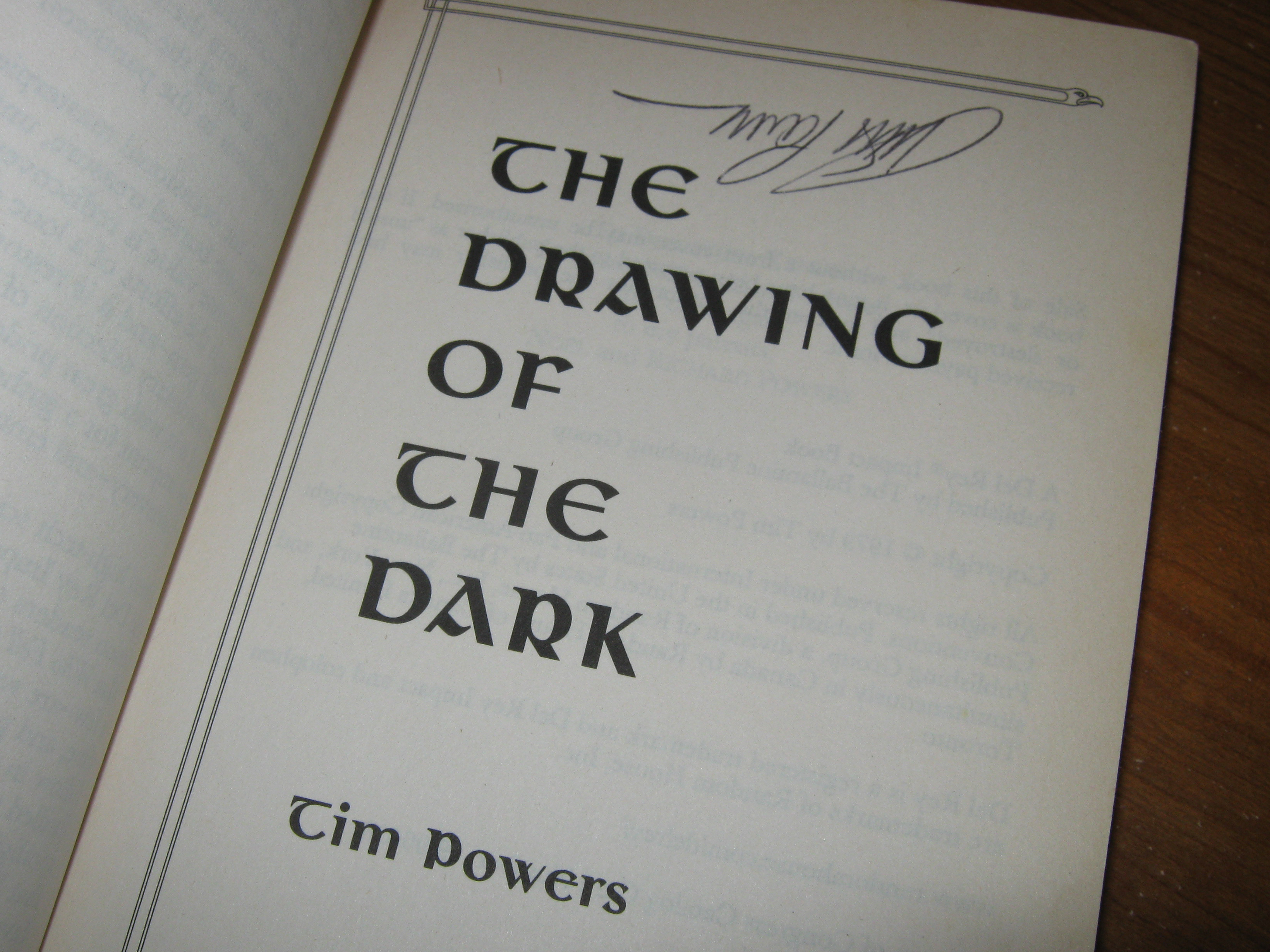
My copy of The Drawing of the Dark by Tim Powers is signed up-side-down on the title page. I got it through Paperback Swap and wonder why someone who went to a book signing got rid of the book.

The Second Greatest Commandment

Our relationship with God is the most important thing in our lives. How we stand in relationship with God determines whether or not we’re in His family and included as part of Christ’s church. It is not, however, the only important relationship.

Jesus said to him, “‘You shall love the Lord your God with all your heart, with all your soul, and with all your mind.’ This is the first and great commandment. And the second is like it: ‘You shall love your neighbor as yourself.’ On these two commandments hang all the Law and the Prophets.” (Matt. 22:37-40)

If we ignore the second commandment, then we’re not keeping the first one very well. Christ said, “If you love Me, keep My commandments” (John 14:15), so if we’re truly in a good relationship with God, we also have to be cultivating good relationships with other people.

From Death To Life

In the Greek, “neighbor” refers to anyone in your sphere of influence. If you know about them or are near them, they are your neighbor. For now, though, let’s focus on loving people we meet within the church. Sometimes it seems like they are the ones we have the hardest time getting along with, perhaps because we expect so much more from them than from people “out there” in the world. We’re less inclined to cut them some slack for being human.

A new commandment I give to you, that you love one another; as I have loved you, that you also love one another. By this all will know that you are My disciples, if you have love for one another.” (John 13:34-35)

If love is how people are supposed to identify Jesus’s followers, then I’m afraid there are far too may of us hiding our identities. I know many loving individuals who proclaim by their actions that they are true disciples, but loving churches seem few and far between.

The Second Greatest Commandment | marissabaker.wordpress.comChristian denominations are rife with division, disagreements, and fighting. It seems like there’s always someone with a new doctrine or a better way to run things, followed by arguments and people taking sides in a divided congregation. If we were all walking in the light, there would be love and not division (1 John 2:9-11). But we’re not always perfect, and it’s so easy to stumble right along with divisive people in an unloving reaction to their lack of love. We can’t control other people, but we are each responsible for how we respond to them, including those who really have done something wrong.

In this the children of God and the children of the devil are manifest: Whoever does not practice righteousness is not of God, nor is he who does not love his brother. For this is the message that you heard from the beginning, that we should love one another …. We know that we have passed from death to life, because we love the brethren. He who does not love his brother abides in death. Whoever hates his brother is a murderer, and you know that no murderer has eternal life abiding in him. (1 John 3:1-11, 14-15)

“We have passed from death to life because we love the brethren” — that’s how important love is. If we hate instead of love, we don’t get eternal life. Even brethren who have stumbled and fallen away from the faith still need and deserve our love, since they still come under the neighbor category or even “love your enemies” (Matt. 5:44).

Vital Friendships

We’ve talked about loving people because we have to, but there should also be people in our lives who we love because we want to — family and friends with whom we share common interests and who will be there for us as we go through life. We need other people, especially friends in the faith who will build us up and help us in our Christian walk. Jesus had 12 disciples who were closer than His other followers, as well as friends like Martha, Mary and Lazarus. When He sent people out to preach, He sent them in pairs (Luke 10:1). Paul also traveled with other believers, including Barnabus (Acts. 13:2), Silas (Acts 15:40) and Timothy (Acts 16:1-4).

And let us consider one another in order to stir up love and good works, not forsaking the assembling of ourselves together, as is the manner of some, but exhorting one another, and so much the more as you see the Day approaching. (Heb. 10:24-25)

“All you need is God” is true to a certain extent, but it is also true that God is the one who tells us it’s not good to lack human companionship. He is the source of our strength and our life, and He can sustain us through times when we have no friends or believers to fellowship with, but He also supplies our need for people around us because He knows friends and brethren are good for us.

Beloved, let us love one another, for love is of God; and everyone who loves is born of God and knows God. He who does not love does not know God, for God is love. (1 John 4:7-8)

The Second Greatest Commandment | marissabaker.wordpress.comI know people who say they don’t need friends because they have God, and people who stopped fellowshipping with brethren because no one agreed with their particular view of the sacred calendar. I am frightened for these people, because the God they say is all they need tells them in His Bible that they also need relationships with other believers.

If someone says, “I love God,” and hates his brother, he is a liar; for he who does not love his brother whom he has seen, how can he love God whom he has not seen? And this commandment we have from Him: that he who loves God must love his brother also. (1 John 4:20-21)

One of the ways we demonstrate our love for God is by loving other people, and we can’t do that if we deliberately isolate ourselves. It’s one thing to have no one else around who shares your faith, and if that’s the case I pray and believe that God will supply your need for fellowship. But it’s another thing entirely to avoid other people, no matter how tempting it might be for some of us introverts or for those of us who have been hurt by past associations with church goers. But if we aren’t around other people, then how can we keep the commandment to love our brethren? If we isolate ourselves, how will we keep the second greatest commandment?

Understanding The INFJ “Door Slam”

Shutting people out of your life after they’ve hurt you or someone you love isn’t specific to INFJs, but it happens often enough that we’ve given it a name: The INFJ Door Slam. I like the definition given in an article by Jenn Granneman titled “How INFJs Deal with Conflict: 10 Confessions” (which is no longer available online).

“It means you’ve hurt me so much, I’m no longer investing any of my (limited) supply of energy in you. It means I’ve come to resent you. If you value me, don’t let it get to this point. It’s really hard to go back.”

An INFJ door slam may or may not involve actually cutting a person out of your life. Depending on the circumstances, a door slam can range from ignoring someone completely, to limiting contact to the bare minimum, to acting almost normal. In some cases the person who’s been door slammed can’t help but notice, while in others they don’t realize anything has changed (though something definitely has, at least in the INFJ’s mind). Read more

All-In

Today is the first day of Unleavened Bread on God’s Holy Day calendar (Lev. 23:6-8). We just observed Passover, and now we’re starting a season of purging the leaven of sin our of our lives. Even if you’re not one of the Christians observing the Passover season, putting sin our of our lives is a necessary part of our walk with God so I hope you’ll keep reading.

Therefore purge out the old leaven, that you may be a new lump, since you truly are unleavened. For indeed Christ, our Passover, was sacrificed for us. Therefore let us keep the feast, not with old leaven, nor with the leaven of malice and wickedness, but with the unleavened bread of sincerity and truth. (1 Cor. 5:7-8)

In my personal pre-Passover studies, I spent time in Romans 12 and 13. This section of scripture covers what my study Bible calls “practical living.” It lists instruction, reminders, and exhortations that are crucial to our walk as Christians. I found it helpful as a guide for self-examination, and there was one thing in particular that I want to share today.

Time To Wake Up

The last few verses of Romans 13 are a summation of the previous exhortation to practical, godly living, as well as a call to active de-leavening.

And do this, knowing the time, that now it is high time to awake out of sleep; for now our salvation is nearer than when we first believed. (Rom. 13:11)

Let’s just pause for a moment and consider this verse. If we have to awake, then that means we’ve fallen asleep much like the ten virgins of Matthew 25:1-13. This subject of spiritual sleepiness also comes up in connection with the Passover.

But let a man examine himself, and so let him eat of the bread and drink of the cup. For he who eats and drinks in an unworthy manner eats and drinks judgment to himself, not discerning the Lord’s body. For this reason many are weak and sick among you, and many sleep. For if we would judge ourselves, we would not be judged. (1 Cor. 11:28-31)

Where it talks about judging ourselves, the Greek word is diakrino (G1252). It means to discern, to make a determination, to separate something and come to a judgement. I think of it as sorting through our thoughts, motives and actions to judge them in the light of God’s word. It’s when we stop doing that that we fall asleep. So it follows that when we wake up, we have to go back to the light in order to stay awake.

Putting on Light

We’ll get back to Romans 13 in a moment, but first let’s look at another passage that talks about what to do once we wake up.

You are all sons of light and sons of the day. We are not of the night nor of darkness. Therefore let us not sleep, as others do, but let us watch and be sober. For those who sleep, sleep at night, and those who get drunk are drunk at night. But let us who are of the day be sober, putting on the breastplate of faith and love, and as a helmet the hope of salvation. (1 Thes. 5:5-8)

All-In | marissabaker.wordpress.comSleepiness on a spiritual level is connected here with darkness and drunkenness. When we fall asleep, we’re stumbling around in a dark place, and we need light to wake us up. This light must come from God, but we also have a responsibility to take what He referees. We have to be the virgins who were ready to fill their lamps when they woke up, not the ones who had to run back to the shops.

The night is far spent, the day is at hand. Therefore let us cast off the works of darkness, and let us put on the armor of light. Let us walk properly, as in the day, not in revelry and drunkenness, not in lewdness and lust, not in strife and envy. (Rom. 13:12-13)

Once we commit our lives to God, that’s not the end of our responsibilities. He will help us, but we also have a role to play. We can’t put on light by ourselves, or put leaven our by ourselves, but it also doesn’t just happen without any action on our part. God wants us involved in working out our own salvation and resisting sin (Phil. 2:12-13; Rom. 6:12-13).

The Role of Christ

In John 1:9, Jesus is described as “the true Light which gives light to every man coming into the world.” it should come as no surprise, then, that both passages we’ve quoted about waking up and walking in the light conclude by talking about Jesus.

For God did not appoint us to wrath, but to obtain salvation through our Lord Jesus Christ, who died for us, that whether we wake or sleep, we should live together with Him. (1 Thes. 5:9-10)

God has not set us up for punishment, even those of us who have fallen asleep. His own Son died to offer us salvation – -surely He wants us to embrace that opportunity! We have the chance to be like the wise virgins who woke up from their sleep and were still ready to meet the bridegroom.

 But put on the Lord Jesus Christ, and make no provision for the flesh, to fulfill its lusts. (Rom. 13:14)

If we’re truly committed to putting on the character of Jesus Christ, we can’t try to keep one foot in the world at the same time. Paul tells us here that we shouldn’t make any provisions for fulfilling the lusts of the flesh — there shouldn’t be any part of us that’s holding back from God hoping to enjoy the temporary pleasures of sin. Easier said than done, I know, but that should be our goal. Let’s use this Passover season and the days of Unleavened Bread to continue de-leavening our lives, and filling the spaces that are left when we get rid of leaven with the light of Jesus Christ’s mind and character.