Choose God (Lessons from Hosea, part two)

Last week, we began a study of Hosea, and covered the first three chapters. We looked at how Hosea’s marriage to a prostitute pictured God’s covenant with unfaithful Israel in the Old Testament, and how that serves as a warning to us. We need to learn from Israel’s example and not follow their pattern of repeatedly rejecting God, but rather hold fast to Him as He fulfills His promises to reestablish a marriage covenant with His people.

As we continue in Hosea, we see God addressing the reasons for Israel’s unfaithfulness. Everything that separated Israel from God was Israel’s fault.  God never let down His side of the bargain — Israel got into trouble because they walked away from Him. This holds true for the New Testament as well.

If we endure, we shall also reign with Him. If we deny Him, He also will deny us. If we are faithless, He remains faithful; He cannot deny Himself. (2 Tim 2:12-13)

God is always faithful to His promises, including His promise that sin will be punished. Like with Israel, it is still up to us to choose between life and death, blessings and cursing (Deut. 30:9).

Lack of Knowledge

Hear the word of the Lord, you children of Israel, for the Lord brings a charge against the inhabitants of the land: “There is no truth or mercy or knowledge of God in the land.” (Hos 4:1)

God gives three reasons for His “controversy” with Israel. They lacked truth, did not show mercy, and had no knowledge of Him. This resulted in “swearing and lying, killing and stealing and committing adultery” (Hos. 4:2). The farther they strayed from God, the more corrupt and destructive they became.

My people are destroyed for lack of knowledge. Because you have rejected knowledge, I also will reject you from being priest for Me; because you have forgotten the law of your God, I also will forget your children. (Hos 4:6)

This verse specifically refers to knowledge about God and His ways. The New Testament tells us that “the wisdom of this age” — knowledge that the world esteems — is coming to nothing (1 Cor. 2:6), but that “all the treasures of wisdom and knowledge” are hidden for us to find in the Father and Christ (Co. 2:2-3).

Chapters 4 and 5 cover punishments for Israel, and deal with prophecies of an Assyrian invasion and Judah’s alliances with Egypt and Syria. In chapter 6, the people say, “Come, and let us return to the Lord,” but they are not sincere (Hos. 6:1, 4).  Their sham repentance is not what God was looking for.

For I desire mercy and not sacrifice, and the knowledge of God more than burnt offerings. But like men they transgressed the covenant; there they dealt treacherously with Me. (Hos. 6:6-7)

God is all about relationship. He wants to know the people we’ll become when we learn to know Him. All the religious services and laws given to Israel weren’t the “point” of the Old Covenant. They were supposed to be an outward sign of an inward condition — a heart full of truth, mercy, and the knowledge of God.

Because of Unbelief

Israel’s lack of relationship with God was a result of choices they make to walk away from Him.

When I would have healed Israel, then the iniquity of Ephraim was uncovered, and the wickedness of Samaria. For they have committed fraud; a thief comes in; a band of robbers takes spoil outside. They do not consider in their hearts that I remember all their wickedness; now their own deeds have surrounded them; they are before My face. (Hos. 7:1-2)

Wickedness, lies, adulteries (Hos. 7:3-4) — their sins kept piling up until God could say of the people that “none among them calls upon Me” (Hos 7:7). The entire nation rejected the One who they had entered into a covenant with.

Woe to them, for they have fled from Me! Destruction to them, because they have transgressed against Me! Though I redeemed them, yet they have spoken lies against Me. They did not cry out to Me with their heart when they wailed upon their beds.
They assemble together for grain and new wine, they rebel against Me; though I disciplined and strengthened their arms, yet they devise evil against Me; they return, but not to the Most High; they are like a treacherous bow. Their princes shall fall by the sword for the cursings of their tongue.  (Hos. 7:13-16)

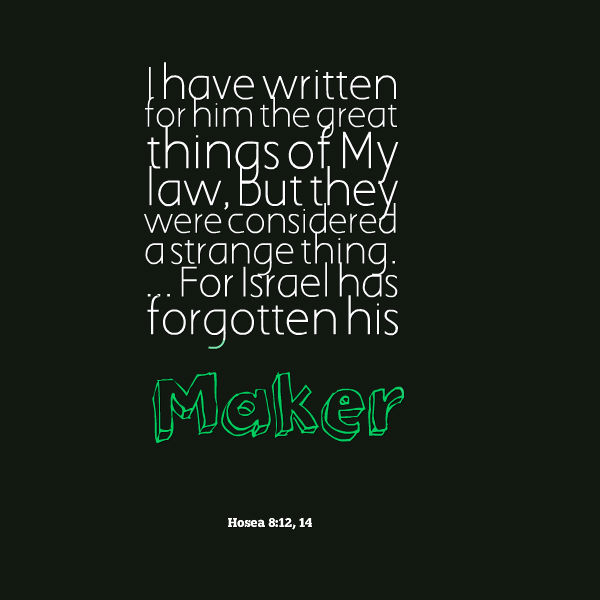
quotescover-JPG-96Israel did this continually in the Old Testament. Psalm 78 records that even though “their heart was not steadfast with Him, nor were they faithful in His covenant” that God was “full of compassion” and held back His anger many times (Ps. 78:37-38). He was grieved by their sins, because they would not let Him be their God. Though He acted as their Redeemer, Deliverer, and Rock, “again and again they tempted God, and limited the Holy One of Israel” (Ps. 78:35, 41-42). By not believing in Him, they rejected His good works in their lives.

This rejection of God continued into the New Testament as well. Matthew 13:58 records that Jesus “did not do many mighty works” in His hometown “because of their unbelief.” Mark’s account of this incident phrases it, “He could do no mighty work there, except that He laid His hands on a few sick people and healed them” (Mark 6:4-6). Where there was belief, simply touching the edge of Christ’s garments brought healing (Mark 5:27-29, 34). Where there was no faith, He was actually limited in how many miracles He could perform.

Make A Choice

Israel was given a choice whether or not to follow God and welcome His involvement in their lives. Many of them made the wrong choice, as Paul describes in Romans 11 when comparing God’s people to an olive tree where some of the natural branches were removed. In this analogy, Gentile New Testament Christians are wild olive branches grafted into the Rootstock. Once there, we also have a choice to make.

You will say then, “Branches were broken off that I might be grafted in.” Well said. Because of unbelief they were broken off, and you stand by faith. Do not be haughty, but fear. For if God did not spare the natural branches, He may not spare you either. Therefore consider the goodness and severity of God: on those who fell, severity; but toward you, goodness, if you continue in His goodness. Otherwise you also will be cut off.  And they also, if they do not continue in unbelief, will be grafted in, for God is able to graft them in again. (Rom. 11:19-23)

Like so many serious warnings in the Bible, this contains hope as well as caution. The Bible provides us with records of Israel rejecting God, being punished, and returning to Him again and again. God leaves as many doors open as possible for people to come back to Him, and He’s eager to “graft them in again” if they repent. These doors are open to us as well. But God still wants us to learn from Israel’s mistakes and choose not to leave Him at all, because even though He is a God of enormous mercy there is a point where we can go too far away to get back to Him.

For if we sin willfully after we have received the knowledge of the truth, there no longer remains a sacrifice for sins, but a certain fearful expectation of judgment, and fiery indignation which will devour the adversaries. Anyone who has rejected Moses’ law dies without mercy on the testimony of two or three witnesses. Of how much worse punishment, do you suppose, will he be thought worthy who has trampled the Son of God underfoot, counted the blood of the covenant by which he was sanctified a common thing, and insulted the Spirit of grace? (Heb. 10:26-29)

Like He did in Deuteronomy 30 with Israel, today God sets before His people a choice between life or death, blessings or cursing, and good or evil. He wants us — pleads with us — to choose life, blessings, and good, but the choice is still ours to make.

Love Languages and MBTI Types

Myers-Briggs types have much to tell us about ourselves and other people. Our MBTI type reflects our preferences for crowded parties or small gathering, describes how we connect with other people, shows us how we naturally respond to stress, and gives us a picture of our innate strengths and weaknesses. Another thing it’s often used for is trying to predict what type of person we’ll be attracted to, and most compatible with, in a romantic sense. Unfortunately, MBTI only gives part of the picture in this regard.

Types in Love

Disclaimer: some of the links in this post are affiliate links. This means that, at no additional cost to you, I will receive a commission if you click on the link and make a purchase on that website.

Use of the MBTI for romance is subject to much debate. Isabel Myer wrote in Gifts Differing*, chapter 11, that “it seems only reasonable that the greater mutual understanding between couples with more likeness than difference should lead, on the whole, to greater mutual attraction and esteem.” This was supported by her study of 375 married couples who were most frequently “alike on three of their four preferences rather than on only two, as would be expected by chance.” However, Isabel Myer was an INFP woman happily married to an ISTJ man. According to her own personality theory, they “shouldn’t” have gotten along, especially since she thought that shared S-N preferences were the most important for predicting a couple’s happiness together and understanding of each other. Obviously type isn’t the only important ingredient for happiness.

Elizabeth and Darcy from Pride and Prejudice, an NF – NT couple

David Keirsey’s book Please Understand Me II* agrees with Myers on the importance of S-N pairings, saying that his SP Artisan types are most compatible with SJ Guardians, and that NF Idealists are most compatible with NT rationals. His ideal pairing is someone who shares your S-N preference and is your opposite in the other three preferences. For example, he would pair an INFJ with an ENTP.

Continuing with INFJs as our example, these theories have influenced many INFJ profiles online. Jennifer Soldner’s Guide To INFJ Relationships lists ENFP, ENTP, INTJ and INFJ as the best matches for an INFJ. The worst matches are ESFP, ESTP, ESTJ, and ENTJ (note that this last one contradicts Keirsey’s rule for pairing NF and NT types). For the most part, these suggestions seem logical at first, much like Isabel Myer said when theorizing that people will get along best if they are similar. It doesn’t explain, however, why one study found that INFJs were most likely to marry either INFJs or ESTPs, or why Myers herself was happy married to someone so dissimilar in terms of type. Clearly there’s something else going on here.

The “Something Else”

Even with their generalizations about which types get along most easily together, both Isabel Myers and David Keirsey admit there are other very important ingredients to a lasting romantic relationship.

Individual relationships defy generalizations, and it should be stressed that two well-adjusted people of any two temperaments can find ways of making their marriage work for them.” (Keirsey)

“Understanding, appreciation, and respect make a lifelong marriage possible and good. Similarity of type is not important, except as it leads to these three. Without them, people fall in love and out of love again; with them, a man and woman will become increasingly valuable to each other and know that they are contributing to each other’s lives.” (Myers)

The 5 Love Languages by Gary Chapman

A mutual willingness to work together and actively build-up the relationships is more important than compatible MBTI types. One aspect of this is understanding the other person and learning how to love them. Becoming familiar with their Myers-Briggs type will help tremendously, but it’s not enough by itself. You also benefit from an understanding of Love Languages.

The five love languages theory was first published in 1995 by Gary Chapman, a relationship counselor and pastor. He says every person has a “language” that they use to communicate and receive love, either Words of Affirmation, Quality Time, Receiving Gifts, Acts of Service, or Physical Touch. Everyone has one primary love language, and you might have a secondary love language as well. If someone’s partner is not speaking their love language, they will not feel loved. There’s a test on Chapman’s website if you don’t know what your love language is and want to find out.

Layering Love Languages

In theory, any MBTI type can be combined with any one of the five love languages. I’m guessing, however, that there are some love languages that are more likely for certain MBTI types. Let’s take a quick look at the characteristics for the four type groups as related to different love languages.

SP types are typically concerned with outward, concrete ways of viewing the world, and focus on the here and now. Keirsey describes their preferred role in a romantic relationship as “playmate.” I could see SP types being particularly inclined toward Receiving Gifts, Quality Time, or Physical Touch as a primary love language. These all involve doing something for or with the loved one, which would appeal strongly to SP types.

Duty-fulfilling SJ types tend to play what Keirsey described as a “helpmate” role in relationships. They are stable, traditional, and thoroughly dependable people.  SJ types might be most in tune with Acts of Service, Quality Time or Words of Affirmation as a love language. These love languages visibly or verbally confirm that a SJ’s loved ones appreciate their constant reliability.

NF types are idealistic, enjoy abstract thought, and are natural romantics. Keirsey described their role in a romantic relationship as “soulmate.” They search for deep, genuine connections. Quality Time and Words of Affirmation seem like the most likely love languages, though Physical Touch and Acts of Service are also good possibilities. The key for NF types is genuine depth in a relationship, so they are inclined towards a language that increases emotional intimacy.

The NT types are highly intellectual, and Keirsey described their relationship role as “mindmate.” They are logical, abstract, and have little tolerance for the superficial. Words of Affirmation and Quality Time seem like the most likely love languages for an NT type, but after reading two different forum topics on MBTI types and love languages (one on Typology Central and one on Personality Cafe) I learned many NTs favor Physical Touch as well. My personal theory is that NT types view Service and/or Gifts with suspicion, wondering what the other person wants from them, while the others seem more genuine.

What about you? What are your Myers-Briggs type and love language(s)? Do you see a connection between the two? Share in the comments!

*indicates affiliate links

Mercy For My People (Lessons from Hosea, part one)

Of all the minor prophets, Hosea is probably the one I spend the most time reading. But I usually just focus on the first three chapters, where God is talking about His marriage covenant with Israel. I thought it might be interesting to look at the book as a whole and see what God has to teach us in the entire prophecy. I still only had time to get to the first three chapters today, but we can save the rest for a later post.

An Unfaithful Wife

Hosea’s book begins with God telling him to marry a prostitute. This rather unusual marriage was meant as an illustration of God’s relationship with Israel.

When the Lord began to speak by Hosea, the Lord said to Hosea: “Go, take yourself a wife of harlotry and children of harlotry, for the land has committed great harlotry by departing from the Lord.” So he went and took Gomer the daughter of Diblaim, and she conceived and bore him a son (Hos. 1:2-3)

The covenant established between God and Israel was like a marriage, to which Israel was unfaithful. To further illustrate God’s message to the people through Hosea, He gave Gomer’s children meaningful, specific names. The first child, which Hosea fathered, was named Jezreel. This name means “God will sow,” and is also a place name in the land of Israel.

Then the Lord said to him: “Call his name Jezreel, for in a little while I will avenge the bloodshed of Jezreel on the house of Jehu, and bring an end to the kingdom of the house of Israel. It shall come to pass in that day that I will break the bow of Israel in the Valley of Jezreel.”

And she conceived again and bore a daughter. Then God said to him: “Call her name Lo-Ruhamah, for I will no longer have mercy on the house of Israel, but I will utterly take them away. Yet I will have mercy on the house of Judah, will save them by the Lord their God, and will not save them by bow, nor by sword or battle, by horses or horsemen.”

Now when she had weaned Lo-Ruhamah, she conceived and bore a son. Then God said: “Call his name Lo-Ammi, for you are not My people, and I will not be your God.” (Hos. 1:4-9)

It’s chilling to hear God say He will not have mercy and will no longer call someone His people. This isn’t something we picture God ever saying in the New Testament church that we’re a part of, but Paul tells us that the things which happened to physical Israel were our “examples, and they were written for our admonition” (1 Cor. 10:11). We often think we’d never do anything like Israel did, turning away to worship other gods, but evidently the New Testament writers — and God Himself — thought there was a danger or they wouldn’t have given us warnings like John’s admonition “keep yourselves from idols” (1 John 5:21).

Oh, that you would bear with me in a little folly — and indeed you do bear with me. For I am jealous for you with godly jealousy. For I have betrothed you to one husband, that I may present you as a chaste virgin to Christ. But I fear, lest somehow, as the serpent deceived Eve by his craftiness, so your minds may be corrupted from the simplicity that is in Christ. For if he who comes preaches another Jesus whom we have not preached, or if you receive a different spirit which you have not received, or a different gospel which you have not accepted—you may well put up with it! (2 Cor. 11:1-4)

Paul is worried about the Christians he’s writing to doing exactly the same thing Israel did. They went after something that was not in line with the truth which God had given them. This started at Mount Sinai, when they made a golden calf to replace God just a few weeks after promising, “All the words which the Lord has said we will do” (Ex. 24:3). They made a covenant with God Himself, and when Moses took a bit longer to come back than they expected, they “corrupted themselves” by turning away from God’s commands and trying to replace Him with something else (Ex. 32:7-8).

Justice and Love

God’s covenant with His people is consistently compared to a marriage agreement. Because of Israel’s conduct, however, when Hosea was told to model the relationship between God and Israel in his own marriage he had to marry a harlot. That’s how unfaithful Israel was to God.

Bring charges against your mother, bring charges; for she is not My wife, nor am I her Husband! Let her put away her harlotries from her sight, and her adulteries from between her breasts; lest I strip her naked and expose her, as in the day she was born, and make her like a wilderness, and set her like a dry land, and slay her with thirst. …

She will chase her lovers, but not overtake them; yes, she will seek them, but not find them. Then she will say, ‘I will go and return to my first husband, for then it was better for me than now.’ For she did not know that I gave her grain, new wine, and oil, and multiplied her silver and gold—which they prepared for Baal.” ( Hos. 2:2-3, 7-8)

You can read the full conversation in verses 2 through 13, but this gives the general idea. We might think these words sound excessively harsh coming from God. Isn’t He a God of love and mercy with loads of forgiveness to pour out on us when we do something bad? yes, but He is also justice (Ps. 89:14). And His justice involves consequences for sin. Is there any one of us who wouldn’t be upset, angry even, if our spouse used the gifts we gave them to entice other lovers? and how many of us would then die to pay the price for that unfaithful spouse’s transgression, and freely forgive them the way God already has died for and forgiven us?

Ammi and Ruhamah

Therefore, behold, I will allure her, will bring her into the wilderness, and speak comfort to her. I will give her her vineyards from there, and the Valley of Achor as a door of hope; she shall sing there, as in the days of her youth, as in the day when she came up from the land of Egypt.

And it shall be, in that day,” says the Lord, “That you will call Me ‘My Husband,’ and no longer call Me ‘My Master,’ for I will take from her mouth the names of the Baals, and they shall be remembered by their name no more. In that day I will make a covenant for them with the beasts of the field, with the birds of the air, and with the creeping things of the ground. Bow and sword of battle I will shatter from the earth, to make them lie down safely.

I will betroth you to Me forever; yes, I will betroth you to Me in righteousness and justice, in lovingkindness and mercy; I will betroth you to Me in faithfulness, and you shall know the Lord.” (Hos. 2:14-20)

Hosea acts out this redemption in chapter 3 by buying back his unfaithful wife. He says, “I bought her for myself for fifteen shekels of silver, and one and one-half homers of barley.” My study Bible notes that the price paid in verse 2 adds up to 30 shekels — the same amount Judas was paid to betray Jesus (Matt. 26:14-16). 30 pieces of silver to redeem an unfaithful wife, 30 pieces of silver to betray the One whose sacrifice made the ultimate redemption pictured by this transaction possible.

It shall come to pass in that day that I will answer,” says the Lord; “I will answer the heavens, and they shall answer the earth. The earth shall answer with grain, with new wine, and with oil; they shall answer Jezreel. Then I will sow her for Myself in the earth, and I will have mercy on her who had not obtained mercy; then I will say to those who were not My people, ‘You are My people!’ and they shall say, ‘You are my God!’” (Hos 2:21-23)

Remember the names God gave Gomar’s and Hosea’s children? This promise hearkens back to them, and reverses the decrees of “No-Mercy” and “Not-My-People” that were contained in the names Lo-Ruhamah and Lo-Ammi. This is was also addressed earlier in Hosea, in some verses we skipped over in chapter 1.

Yet the number of the children of Israel shall be as the sand of the sea, which cannot be measured or numbered. And it shall come to pass in the place where it was said to them, ‘You are not My people,’ there it shall be said to them, ‘You are sons of the living God.’ Then the children of Judah and the children of Israel shall be gathered together, and appoint for themselves one head; and they shall come up out of the land, for great will be the day of Jezreel!

Say to your brethren, ‘My people,’ and to your sisters, ‘Mercy is shown.’” (Hos. 1:10-2:1)

The King James translates this last verse, “Say ye unto your brethren, Ammi; and to your sisters, Ruhamah.” Essentially, dropping the “Lo-” prefix changes “not my people” into “my people” and “not having obtained mercy” into “having obtained mercy.” God’s plan is to bring Israel back to Himself, and reverse the judgement that separated her from Him. This process began with Christ’s sacrifice, and will be completed after His return.

How To Be Friends With an INFJ

While trying to decide on my next topic, I saw that “how to be friends with an INFJ” was one of the top searches on my blog this past week. I’ve addressed the issue of friendship in some of my other posts about INFJs, but never written an entire post about it. It’s also something that has been on my mind recently, and it is a not infrequent topic of discussion between me and some close friends.

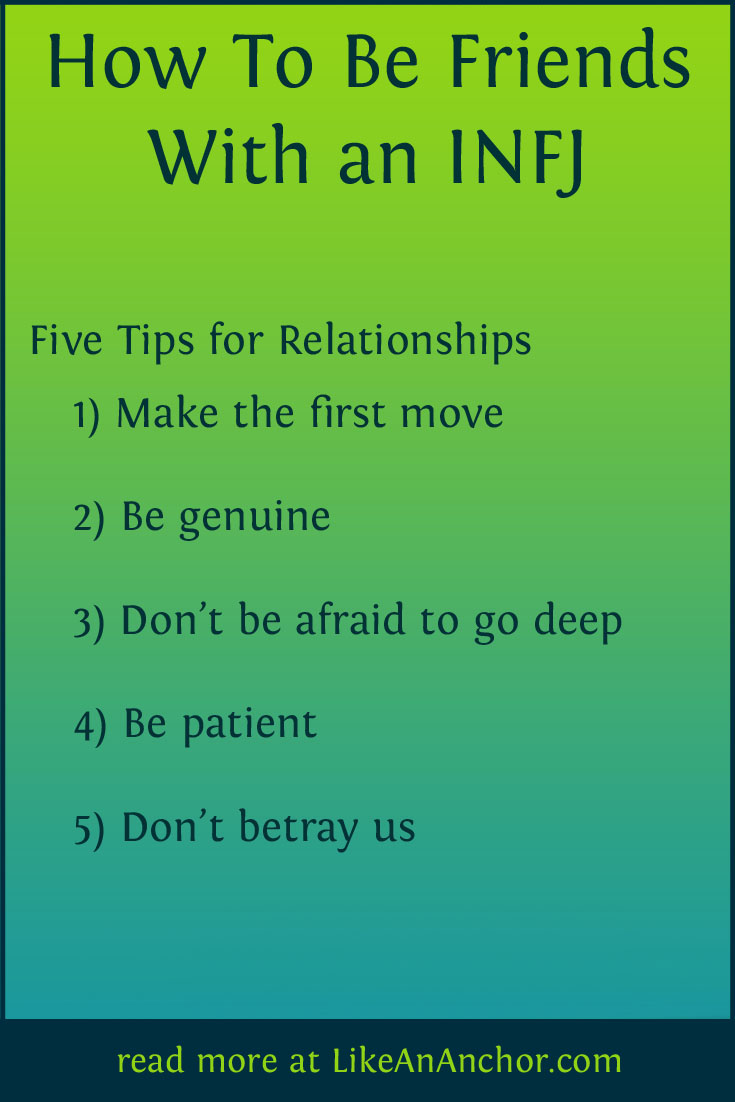
If you want to make friends with an INFJ, or get to know one better, there are a few key points to keep in mind. Some of these are true for all friendships, and especially friendships with INFJs, and others are more INF-specific. They are also a good first-step if you are romantically interested in an INFJ and want them to notice you.How To Be Friends With an INFJ | LikeAnAnchor.com

Five Tips for Relationships

1) Make the First Move

from INFJ Doodles

INFJs use extroverted feeling (Fe) to relate to the outside world. This means that we can draw energy from emotional interactions, and may appear more extroverted than other introverts. This is also true of ISFJs, who are often considered the most “extroverted” introverts since they love people so much.

Still, we are introverts, and we’re most comfortable talking with people we already know. If you want to get to know an INFJ, you’ll probably have to be the one who initiates a conversation. That lets us know you are interested in talking with us, which puts us at ease since we aren’t worried about whether or not we’re imposing on your time when you’d rather be doing something else.

2) Be Genuine

from INFJoe

Pairing Introverted Intuition (Ni) with Fe gives INFJs an almost super-human empathy. Many INFJs literally feel other people’s emotions, and we’re quick to pick up on unspoken cues that don’t match spoken words. We might not be able to tell what you’re holding back or lying about, but we can tell you’re not being genuine and that’s a huge turn off.

If an INFJ suspects you of being less than genuine, they loose interest very quickly. If you’re a new acquaintance, they might simply avoid seeing you again. If you’re someone they can’t avoid, then they will keep conversations civil but superficial. We don’t trust our true selves with people when we can’t get a read on what their true selves are like.

3) Don’t Be Afraid to Go Deep

INFJs have little interest in shallow conversations. We would rather have a few close friends than many casual acquaintances. The way the word “friend” is used has always bothered me as being imprecise. I have acquaintances, friends, and then close friends, but I just refer to them all as “friends” to avoid offending anyone who thinks they are a friend and then finds out I think of them as an acquaintance. People who meet INFJs often think that they know them well, while the INFJ thinks “they really don’t know me at all.”

If you want to be one of an INFJs close friends, then you have to make an effort to get beyond the superficial. INFJs respond very well to this, so once you indicate that you are interested in going beyond small-talk the sharing will go both ways. We like conversation, and we will talk as well as listen if we feel safe and interested. Here’s a great article called How To Turn Small Talk Into Smart Conversation. When I read this as an INFJ, my reaction was, “I wish more people would introduce themselves like this. I would be so much more interested in talking to them.”

4) Be Patient

found on Pinterest

Even if you’ve taken the first step to initiate a friendship, been completely honest, and encouraged deep conversation it can take quite a while for an INFJ to really open up. We have many layers, and the longer we are in a stable friendship with you, the more layers we’ll let you see. INFJs form instant perceptions of whether or not we can trust people, so first-impressions are important, but we also modify our impression based on how we observe your behavior over time. A bad first impression can be reversed if we see you making an effort to be friendly and trust-worthy, and a good first impression can be deepened as we see that what we’ve already shared with you stays safe.

Patience also comes into play during conversations. INFJs have trouble getting all their thoughts out into words. If the topic of conversation is something they’ve already thought about, they can speak readily and coherently. If it’s new and unfamiliar we typically do one of two things: 1) nod and make some general comments while our brains frantically race to come up with something to say. Usually that “something” shows up a week later in the shower. 2) start putting our thoughts into words, and sorting through ideas verbally. The final idea might take some time to emerge.

The second reaction is the one you’re going for in a friendship with INFJs. If we’re comfortable enough to think out-loud, it means we trust you. As long as you give us time to come up with an answer rather than look at us like we’re crazy, then we’ll relax and the conversation can continue to move forward. If you cut us off or jump to conclusions about what we think before we’ve had time to express outselves, we feel like you aren’t really interested in what we’re thinking and be hesitant to share with you later.

5) Don’t Betray Us

INFJs hold grudges. We might forgive readily (depending on the circumstances), but we don’t forget. It’s not something I’m proud of, but it is my automatic response. The closer you get to an INFJ, the harder it is to bounce-back to a close friendship after you’ve hurt us. The more we like you and the more we have invested in you, the more chances we’ll give you, but there’s a point at which we just give up and shut you out.

An INFJ might not completely sever ties with someone who has hurt them (depending on the nature of that betrayal), but they will withdraw. For example, if you give an INFJ the impression that you want to carry on a regular correspondence filled with deep discussion and then ignore her for 3 months and forget to answer any of her questions when you do reply, she will have no interest in continuing the correspondence.

Why Bother?

So why go to all this effort? What do you get out of a relationship with an INFJ?

check out this guide from Jennifer Soldner for more information about romantic relationships

For one thing, INFJs are surprisingly good fun to be around. We have a great sense of humor, delight in occasional spontaneity, and can talk about pretty much anything you like. But you don’t see all that until you make the effort to become friends. Until then, INFJs will hover in the background (away from other people) or blend in like a chameleon (with other people) to avoid stressful, superficial interactions.

INFJs are also good listeners, and we love to offer counsel. Sometimes we feel like our friends’ therapist, but we rarely mind. We want to help, and we’re good at suspending judgement. Since we’re so empathic, we aren’t often surprised by anything you tell us even if you thought you were doing a good job of keeping it hidden. Once it’s out in the open, we are sympathetic listeners who ask questions and want to fully understand what’s going on before we offer suggestions or any kind of judgements.

We’re also fiercely loyal. We don’t let many people get close, and we want to hold on to the very few that do become our true friends. We’ll do just about anything to keep the people we love in our lives. INFJs take the time to build-up their relationships, cultivate deepening friendships, and keep in touch with what’s going on in the lives of people we care about. We’re supportive, encouraging, and willing to adapt ourselves to make others happy as long as it doesn’t conflict with our core values. So get out there and start making friendships with INFJs. I don’t think you’ll regret it!

Save


Featured image credit: rawpixel.com via Pexels


If you’d like to know more about the INFJ personality type, check out my book The INFJ Handbook. I just updated it with a ton of new information and resources. You can purchase it in ebook or paperback by clicking this link.

Tabernacles and Temples

Why was Solomon’s Temple dedicated during the Feast of Tabernacles?

I’ve read 2 Chronicles several times, and I may even have heard someone point this out before, but I didn’t realize the Temple dedication was set during this holy day festival until just last week. Maybe I was paying more attention this time when I made it to 2 Chronicles 5-7 while reading through the Old Testament.

One one level, this was simply a logical time for an event of this magnitude, since people would have been traveling to Jerusalem anyway to keep the Feast. But I’m also sure there’s a greater significance to this “coincidence.”

Tabernacles Overview

Lets take a quick look at what was going on during the Feast of Tabernacles, or “Sukkot.” This year, Tabernacles runs from October 9-16, which makes today the Sabbath during this Feast.  The Jewish name for this holy day comes from the fact that the Israelites were commanded to build sukkah (H5521), which basically means a temporary dwelling place. Specific examples of a sukkah include a lair for an animal, a hut, a booth, “an arbor made of interwoven leaves and branches, a tent, a house” (Zodhiates).

Then the Lord spoke to Moses, saying, “Speak to the children of Israel, saying: ‘The fifteenth day of this seventh month shall be the Feast of Tabernacles for seven days to the Lord. On the first day there shall be a holy convocation. You shall do no customary work on it. For seven days you shall offer an offering made by fire to the Lord. On the eighth day you shall have a holy convocation, and you shall offer an offering made by fire to the Lord. It is a sacred assembly, and you shall do no customary work on it. (Lev. 23:33-36)

This is 15 days after the Feast of Trumpets (Yom Teruah) and five days after the Day of Atonement (Yom Kippur). In those days, we’ve been reminded that the King is coming and we must be ready to meet Him, and we’ve been given the privilege to deepen our relationship with God by being reconciled to Him at the mercy seat. Now, we have another special appointment with God to learn more about Him and His plan through the Feast of Tabernacles.

Also on the fifteenth day of the seventh month, when you have gathered in the fruit of the land, you shall keep the feast of the Lord for seven days; on the first day there shall be a sabbath-rest, and on the eighth day a sabbath-rest. And you shall take for yourselves on the first day the fruit of beautiful trees, branches of palm trees, the boughs of leafy trees, and willows of the brook; and you shall rejoice before the Lord your God for seven days. You shall keep it as a feast to the Lord for seven days in the year. It shall be a statute forever in your generations. You shall celebrate it in the seventh month. You shall dwell in booths for seven days. All who are native Israelites shall dwell in booths, that your generations may know that I made the children of Israel dwell in booths when I brought them out of the land of Egypt: I am the Lord your God. (Lev. 23:39-43)

After listing all the holy days in Leviticus 23, this is the only one that God elaborates on (in this chapter at least. The other days are mentioned again elsewhere in scripture, as is Tabernacles). Two key points emerge from both sets of instructions given in Leviticus 23. 1) Tabernacles is a Feast of rejoicing, and 2) Israel lived in temporary dwellings to remind them of their sojourning in and out of Egypt (Neh. 8:13-18).

Rejoicing

We started out talking about Solomon’s temple, so let’s head over to 2 Chronicles and see how that relates to Tabernacles.

So all the work that Solomon had done for the house of the Lord was finished; and Solomon brought in the things which his father David had dedicated: the silver and the gold and all the furnishings. And he put them in the treasuries of the house of God. Now Solomon assembled the elders of Israel and all the heads of the tribes, the chief fathers of the children of Israel, in Jerusalem, that they might bring the ark of the covenant of the Lord up from the City of David, which is Zion. Therefore all the men of Israel assembled with the king at the feast, which was in the seventh month. (2 Chr. 5:1-3)

This event was accompanied by “trumpeters and singers” who made “one sound to be heard in praising and thanking the Lord” (2 Chr. 5:13). There was much rejoicing, as befitted such a landmark Feast of Tabernacles.

At that time Solomon kept the feast seven days, and all Israel with him, a very great assembly from the entrance of Hamath to the Brook of Egypt. And on the eighth day they held a sacred assembly, for they observed the dedication of the altar seven days, and the feast seven days. On the twenty-third day of the seventh month he sent the people away to their tents, joyful and glad of heart for the good that the Lord had done for David, for Solomon, and for His people Israel. (2 Chr. 7:8-10)

God wants His people to be joyful. It’s one of the fruits of the Spirit (Gal. 5:22). In the Greek, this word is chara (G5479), which means delight, joy, or rejoicing, and it is part of the same word-family as charis (G5485). Charis carries the idea of joy being “a direct result of God’s grace” (Zodhiates). The most common translation of that word is “grace,” but other translations include “gifts,” “favor,” “benefit” and “pleasure.”

Chara is the word used when James writes, “count it all joy when you fall into various trials” (James 1:2). Basically, someone with chara is so delighted by the fact that they’ve been chosen by God to be part of His family that the trials seem unimportant in comparison.

And He said to me, “My grace is sufficient for you, for My strength is made perfect in weakness.” Therefore most gladly I will rather boast in my infirmities, that the power of Christ may rest upon me. Therefore I take pleasure in infirmities, in reproaches, in needs, in persecutions, in distresses, for Christ’s sake. For when I am weak, then I am strong. (2 Cor. 12:9-10)

Paul offered us an example of finding joy in the worst of circumstances. No matter what we’re going through, God gives us the opportunity to have joy through His Spirit.

But what does all this have to do with Tabernacles or temple dedication? I’m so glad you asked.

Now, therefore, you are no longer strangers and foreigners, but fellow citizens with the saints and members of the household of God, having been built on the foundation of the apostles and prophets, Jesus Christ Himself being the chief cornerstone, in whom the whole building, being fitted together, grows into a holy temple in the Lord, in whom you also are being built together for a dwelling place of God in the Spirit. (Eph. 2:19-22)

During the Feast of Tabernacles, we usually focus on the fact that we are “strangers and pilgrims on the earth” (Heb. 11:13), as tied in with the Old Testament command that the children of Israel dwelt in temporary sukkah. But God doesn’t intend for us to remain homeless (John 14:2-3). We are strangers on the earth because we are not stranger to Him, and because He is making us His temple. And that is truly cause for rejoicing.

Temple Dwelling

The question of where God dwells was central to Solomon’s temple dedication. The temple was built as a house for God’s use, but Solomon was not so arrogant as to believe this house would be good enough for God to take up permanent residence.

The Lord said He would dwell in the dark cloud. I have surely built You an exalted house, and a place for You to dwell in forever. … But will God indeed dwell with men on the earth? Behold, heaven and the heaven of heavens cannot contain You. How much less this temple which I have built! Yet regard the prayer of Your servant and his supplication, O Lord my God, and listen to the cry and the prayer which Your servant is praying before You: that Your eyes may be open toward this temple day and night, toward the place where You said You would put Your name, that You may hear the prayer which Your servant makes toward this place. (2 Chr. 6:1-2, 18-20)

The Lord respected this prayer, filling the temple with His glory to the point that the priests couldn’t even go inside (2 Chr. 7:1-3). It was a very visible sign that God had indeed chosen to put His name in this place. It was not, however, God’s place of permanent residence, as Stephen brought up in the sermon before his death.

But Solomon built Him a house. However, the Most High does not dwell in temples made with hands, as the prophet says: ‘Heaven is My throne, and earth is My footstool. What house will you build for Me? says the Lord, or what is the place of My rest? Has My hand not made all these things?’ (Acts 7:47-50)

So where does God dwell? The heavens are an obvious answer, given what Stephen says here in Acts and what Solomon said in his prayer (2 Chr. 6:30, 33, 39). But God also has other residences, which are in some ways similar to a temporary sukkah. One was the tabernacle He commanded Moses to make, another Solomon’s temple, and still another the human body of Jesus Christ.

And the Word became flesh and dwelt among us, and we beheld His glory, the glory as of the only begotten of the Father, full of grace and truth. (John 1:14)

This word “dwell” is the Greek skenoo (G4637). Strong’s dictionary says it means “to reside (as God did in the Tabernacle of old, a symbol for protection and communion).” Etymologically, it is very closely related to the words skene (G4633) and skenos (G4636), which are both translated “tabernacle.”

Jesus was fully God, became fully human, died, and was raised to have the same glory He had with the Father “before the world was” (John 17:5). Just like every other human being, His physical body was a temporary dwelling place. In Christ’s case, this body let God tabernacle among men, and His return to eternal life gave us an example of what to expect when we also leave our tabernacles to live with God in the permanent residence He is setting up for His family.

For we know that if our earthly house, this tent, is destroyed, we have a building from God, a house not made with hands, eternal in the heavens. (2 Cor. 5:1)

The Feast of Tabernacles reminds us that physical life is not a permanent residence. It’s the spiritual equivalent of living in a sukkah until we can move into a mansion. Our real home is with God as part of His family. Something else that reminds us of this is God’s indwelling presence. God doesn’t dwell, even temporarily, in a physical temple any more. He dwells in us, tabernacling with and inside His people until we reach the part of His plan when Christ returns and sets up a kingdom where all God’s family can be together as spirit beings.

For you are the temple of the living God. As God has said: “I will dwell in them and walk among them. I will be their God, and they shall be My people.” Therefore “Come out from among them and be separate, says the Lord. Do not touch what is unclean, and I will receive you.” “I will be a Father to you, and you shall be My sons and daughters, says the Lord Almighty.” (2 Cor. 6:16-18)

The Martian Chronicles

I’d actually forgotten this was on my Classics Club Book List and just started reading it because I saw it on the shelf. Now I have to write something. But first …

I just read some really exciting literary news that I want to share with you. There’s going to be a web-series re-telling of The Scarlet Pimpernel in a modern setting (think something like what The Lizzie Bennet Diaries did with Pride and Prejudice). You can find more about it at Yet Another Period Drama blog or The Day Dream blog. It sounds fantastic, and I’m so looking forward to seeing it next year.

Anyway, back to Mars.

*insert obligatory spoiler warning*

I really wasn’t sure what to expect from this book. All I knew was that it was written by Ray Bradbury (which pretty much guaranteed it would be intriguing) and it had something to do with Mars. The inside cover of my edition reads, “Ray Bradbury’s Mars is a place of hope dreams, and metaphor.” With that introduction, I was not expecting more than 20 people to have been killed by page 65 (and many more in the following pages). Warning: this is not a “happy” book.

If you’re not expecting a light, happy read, though, this book is fascinating. I think most of us know by now that Mars is not inhabited (as least not by aliens of this sort), but the world Bradbury creates on Mars still seems entirely possible. He has no trouble convincing his readers into a “willing suspension of disbelief,” probably because he doesn’t try. He just writes these stories as if they are real (but more in the sense of myth than history), and we’re perfectly happy to go right along with this fiction.

One of my favorite parts of the book was actually Bradbury’s introduction (You might be a writer if … you’re as intrigued by the author’s description of his writing process as you are by the book itself). He describes the stories that became The Martian Chronicles as “a series of Martian penseés, Shakespearean ‘asides,’ wandering thoughts, long night visions, predawn half-dreams.” He thought they weren’t anything special, until an editor “suggested that I might have woven an unseen tapestry.”

The Martian Chronicles was published in 1950. Since then, it has never been out of print, and my edition notes that it “has been read by more readers around the world than almost any other work of science fiction.” But Bradbury himself didn’t think of it as “science fiction.” This is what he said this book was:

It is King Tut out of the tomb when I was three, Norse Eddas when I was six, and Roman/Greek gods that romanced me when I was ten: pure myth. If it had been practical technologically efficient science fiction, it would have long since fallen to rust by the road. But since it is a self-separating fable, even the most deeply rooted physicists at Cal-Tech accept breathing the fraudulent oxygen atmosphere I have loosed on Mars. Science and machines can kill each other off or be replaced. Myth, seen in mirrors, incapable of being touched, stays on. If it is not immortal, it almost seems such.” — Ray Bradbury, introduction to The Martian Chronicles

Religion on Mars

There are so many threads that weave together The Martian Chronicles. It covers book banning, inadvertent genocide, the nature of man, implications of telepathy, ethics of murder — the list goes on and on. So I’m going to pick just one “thread” to talk about here, and that’s religion.

On Mars, science and religion are not incompatible — they are interconnected. Unfortunately, we only learn this after most of the Martians are already gone and it is too late for the knowledge to help mankind put back together what we separated.

Science is no more than an investigation of a miracle we can never explain, and art is an interpretation of that miracle.” — Ray Bradbury, The Martian Chronicles

Mankind has it all wrong, according to one character who may or may not have lost his mind. Instead of letting science, religion, and art flow into each other, as the Martians did, we tried to separate them. In the process, we lost ourselves and our faith. Then, not content with damaging one world and its people, we moved on to Mars, and killed it.

But The Martian Chronicles isn’t just about all the mistakes humanity made as a whole. It’s about the individuals who lived, loved, killed, and died for a whole host of different reasons. It’s about the priest who believes that even the glowing blue lights on Mars — the last Martians — have a soul and deserve to hear about Christ. It’s about the father who launched his family toward an abandoned Mars to save them from a dying earth. It’s about the young Martian whose telepathy turned him/her into a chameleon as he/she tried desperately to cure their loneliness by becoming a human family’s dead child. It’s about how these people respond to the unknown, and what beliefs they cling to in the end.

I read this book quickly, because I was so intrigued by it, but not so quickly as I have read other novels. It demands more than a cursory glance, and I think it warrants at least one re-reading. If you like “thinking books,” or sci-fi of any kind, I highly recommend giving The Martian Chronicles a try.


Click here to get a copy of The Martian Chronicles. Please note that this is an affiliate link. This means that, at no additional cost to you, I will receive a commission if you click on the link and make a purchase.