Thank You For Your Service

Dear Service men and women,

“Thank you” isn’t something I’m likely to tell you in person. I’m not someone who will walk up to you in a store or on the street and express my gratitude for your service to this country, but it’s not because I’m ungrateful. It’s because 1) I don’t usually even say “Hi” to people I recognize unless they see me first, and 2) I don’t like people striking up random conversations with me, so I assume in the absence of definite evidence to the contrary that you won’t either. My modus operandi is to smile (just to make sure you don’t think I’m one of those I-hate-you-because-you-wear-that-uniform people) and then let you go along uninterrupted with whatever brought you here.

So, here’s a long overdue “Thank you” presented in the best way I know how — writing. Thank you to the people throughout our nation’s history who died for our freedom and for the freedom of people in other countries, like my grandpa’s brother who didn’t come home from WWII. To the people who did come home like my great Uncle Bob, who never called himself a war hero and most people didn’t know until his obituary that he was awarded the Purple Heart with one oak leaf cluster and five bronze stars. To my Grandpa, who’s latest reminiscence about his exciting Navy life was about being disciplined for letting himself get sunburned. To the families who are praying for their dear ones overseas, and for the families who have lost someone they love. To the children who Skype with Mommy and Daddy because it will be months before they see them in person. To those currently serving overseas and those who are about to ship-out, like my family’s newly-wed friend whose wife cannot accompany him to South Korea. And to those of you here, who I walk past with a smile. We are praying for you, and we thank you.

Kindling The Spirit

Sabbath number 5 out of 7 in our count to Pentecost! Last week, we looked at what happens as God begins to work with us through His Spirit — baptism, a new way of life, a change in how we worship. This time, let’s focus on “how” instead of what, including how we should respond, starting once again with the baptism of the Holy Spirit.

Unity and Gifts

For as the body is one and has many members, but all the members of that one body, being many, are one body, so also is Christ. For by one Spirit we were all baptized into one body—whether Jews or Greeks, whether slaves or free—and have all been made to drink into one Spirit. (1 Cor. 12:12-13)

Jesus Christ baptizes us into His body, the church, as a beginning to His and the Father’s work in us. That key moment in our lives begins an ongoing process of spiritual growth.

If we back-up to the beginning verses of 1 Corinthians 12, we see the subject is spiritual gifts and unity. Paul tells us how to recognize the Holy Spirit in another person — “no one speaking by the Spirit of God calls Jesus accursed, and no one can say that Jesus is Lord except by the Holy Spirit” (1 Cor. 12:3). He emphasizes that while our gifts and roles differ, we all have the same Spirit, Lord, and God (1 Cor. 12:4-6).

But the manifestation of the Spirit is given to each one for the profit of all: for to one is given the word of wisdom through the Spirit, to another the word of knowledge through the same Spirit, to another faith by the same Spirit, to another gifts of healings by the same Spirit, to another the working of miracles, to another prophecy, to another discerning of spirits, to another different kinds of tongues, to another the interpretation of tongues. But one and the same Spirit works all these things, distributing to each one individually as He wills. (1 Cor. 12:7-11)

Spiritual gifts are the manifestation of God’s Holy Spirit in us, and we have a responsibility in this, to use the gifts we are given. Paul told Timothy to “stir up the gift of God” and not to “neglect the gift that is in you” (2 Tim. 1:6; 1 Tim. 4:14). We ought to do likewise.

Rekindling Fire

There is a short phrase in 1 Thessalonians that is pivotal in discussing how we should respond when God places His Holy Spirit in us.

Do not quench the Spirit. (1 Thes. 5:19)

The word translated “quench” is sbennumi (G4570), which means to extinguish, go out, or quench. It has the sense of putting out a literal or figurative fire (Matt. 12:20; Eph. 6:16; Heb. 11:34). It can also be passive, as when the foolish virgins let their lamps go out and the flame died through inattention (Matt. 25:8). Applying this to the Spirit, we see that not only should we avoid forcibly smothering God’s Spirit in us, but we also cannot neglect it. If we do not use what we have been given by God — including the manifestation of His Spirit — the gifts will be taken away (Matt. 25:24-29).

Therefore take heed how you hear. For whoever has, to him more will be given; and whoever does not have, even what he seems to have will be taken from him. (Luke 8:18)

The metaphor of tending a fire is continued in 2 Timothy 1:6. We’ve already quoted part of this but here’s the whole verse, with the context that shows it’s talking of the Spirit.

Therefore I remind you to stir up the gift of God which is in you through the laying on of my hands.  For God has not given us a spirit of fear, but of power and of love and of a sound mind. (2 Tim. 1:6-7)

This phrase “stir up,” from the Greek anazopureo (G329), is a compound word that means to revive a fire again. Strong’s lists the meaning as “rekindle.” It is the opposite of sbennumi. So, one way we can think of God’s Spirit in us is as a fire that needs fed and stirred up to prevent it from going out.

Indwelling

There are enormous benefits for us in choosing to continually rekindle God’s Spirit in us rather than smother it. One is a continuing relationship with God and Jesus. Another is that the Spirit makes it possible to walk in Christ’s footsteps and be given eternal life (Rom. 8:1-11). Yet another is the aid and assurance poured out on us through the Spirit as we try to lead a Christian life.

Likewise the Spirit also helps in our weaknesses. For we do not know what we should pray for as we ought, but the Spirit itself makes intercession for us with groanings which cannot be uttered. Now He who searches the hearts knows what the mind of the Spirit is, because He makes intercession for the saints according to the will of God. And we know that all things work together for good to those who love God, to those who are the called according to His purpose. (Rom. 8:26-28)

From Hebrews 7:25, we know Jesus Christ is the One who “always lives to make intercession for” us. This connection between Jesus Christ’s personal work in us and the indwelling of the Holy Spirit keeps coming up in these studies. We see it in John 14-16, in Romans 8:9-10, in Christ’s role as the One who baptizes with the Holy Spirit.

Having Christ in us is directly tied to having “the Spirit of Christ” (Rom. 8:9-10; John 14:18; 16:7). He cannot be present in us if we are smothering His Spirit in us. From what I’ve been studying these past few weeks, I would say that the Holy Spirit is the means by which Christ and God dwell in us.

For this reason I bow my knees to the Father of our Lord Jesus Christ, from whom the whole family in heaven and earth is named, that He would grant you, according to the riches of His glory, to be strengthened with might through His Spirit in the inner man, that Christ may dwell in your hearts through faith; that you, being rooted and grounded in love, may be able to comprehend with all the saints what is the width and length and depth and height — to know the love of Christ which passes knowledge; that you may be filled with all the fullness of God. (Eph. 3:14-19)


Berry Swirl Cheesecake (Updated Recipe)

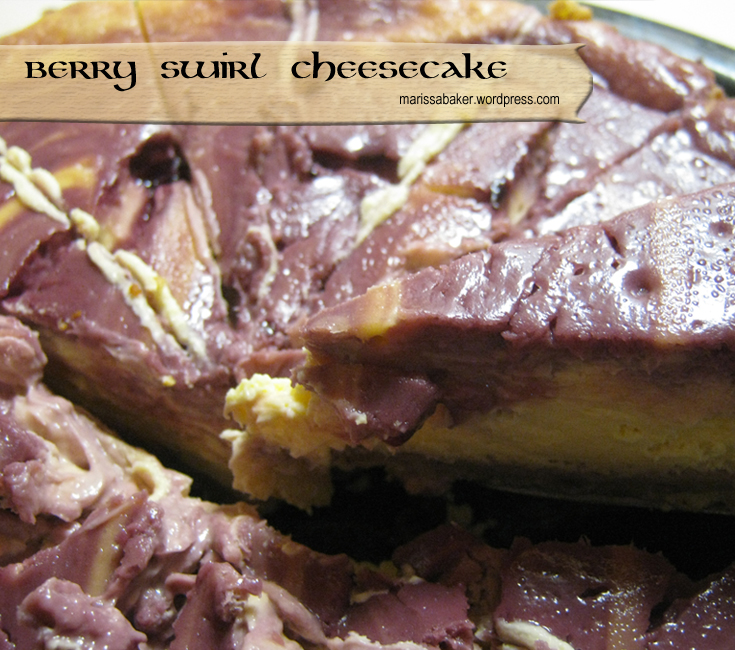
Berry Swirl Cheesecake recipe by marissabaker.wordpress.comI tried out an almond raspberry cheesecake a few weeks ago, which tasted great but I wasn’t quite happy with how it cooked up. Fortunately, this time I ran out of raspberry jam and substituted black raspberry jelly. Oh. My. Goodness. Black raspberries and cheesecake belong together.

The basic recipe is much the same as the last one, but I used dough hooks to make the crust instead of hand-kneading it and that worked well. I also didn’t swirl extra jelly into the top, hoping the cake would crack less. It was less, but still not perfect.

Berry Swirl Cheesecake

Berry Swirl Cheesecake recipe by marissabaker.wordpress.comprint this recipe

Crust

1/2 cup butter, softened

1/4 cup packed brown sugar

1/4 cup ground almonds

3/4 cup all-purpose flour

Preheat oven to 325° F. Line a 9-inch spring-form pan with aluminum foil. Using the dough hooks on an electric mixer, cream butter and sugar. Add ground almonds and 1/2 cup of flour, and mix well. Flour hands and press dough into the spring-form pan. Bake for 12 to 15 minutes.

Filling

3 (8-oz.) packages cream cheese, softened

3/4 cup sugar

1/2 teaspoon vanilla

1/4 teaspoon almond flavoring

3 eggs

1/4 cup berry preserves

Berry Swirl Cheesecake recipe by marissabaker.wordpress.comBeat cream cheese, sugar, and vanilla at medium speed with electric mixer until well blended. Add eggs, one at a time, mixing at low speed after each addition.
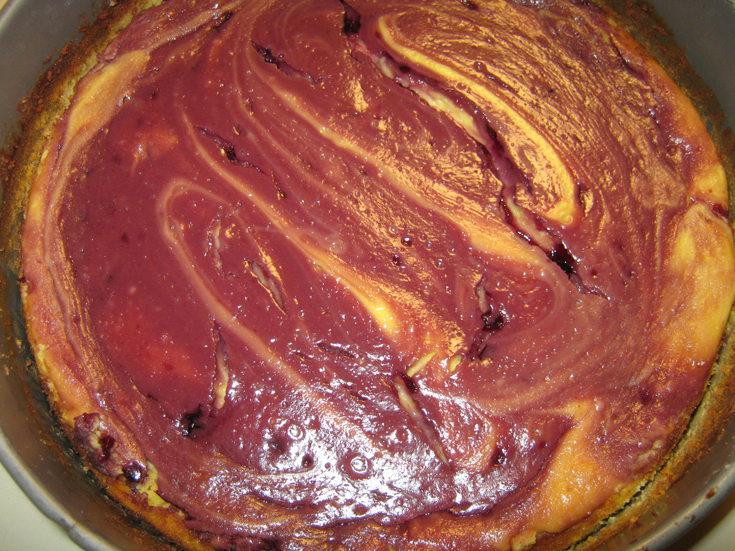

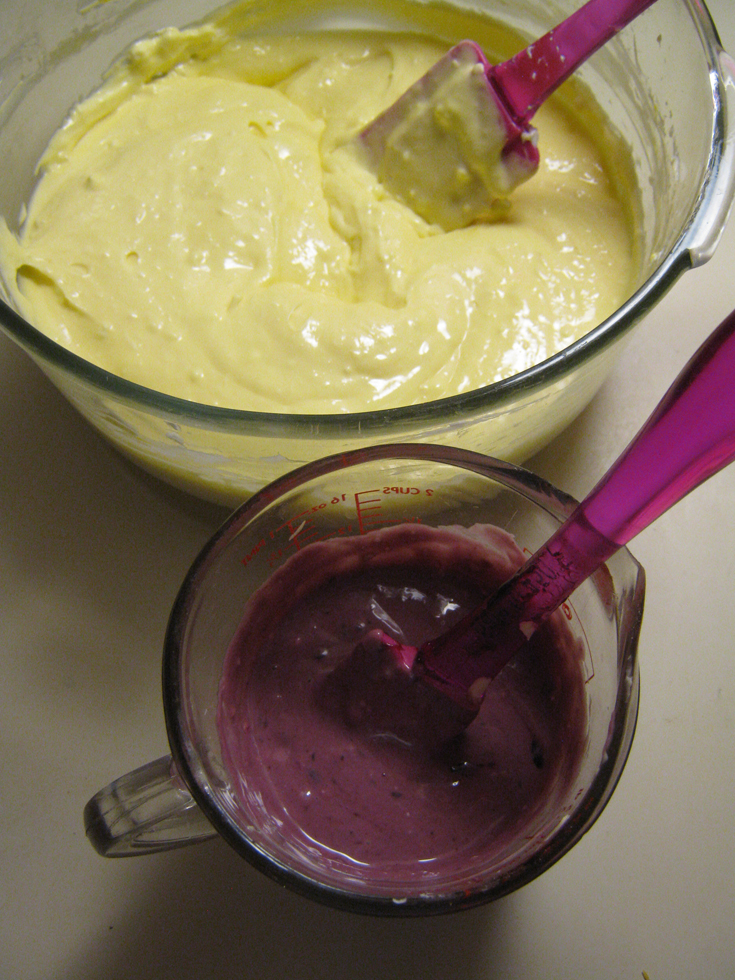
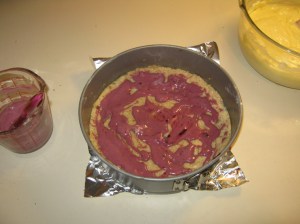
Mix 3/4 cup of batter with 1/4 cup raspberry preserves. Spoon 1/3 of the raspberry mixture over the crust. Pour the remainder of the cheesecake batter into the pan. Drop the remaining raspberry/cream cheese mixture by spoon fulls over the top of the cheesecake and smooth into the batter. Use a knife or spatula to swirl the berry mixture.

Bake cheesecake for 1 hour at 325° F or until center is almost set. Run a knife along the inside edge of the pan ring when it comes out of the oven. Cool before removing rim of pan. Refrigerate 4 hours or overnight.

Berry Swirl Cheesecake recipe by marissabaker.wordpress.com

Kate Morton’s novels

I love Kate Morton’s books. The first one I read, about 2 years ago now, was The Forgotten Garden. It was her second novel, and spans several time periods to discover the history of a girl abandoned on a ship sailing for Australia in 1913. It is not told in chronological order, and moves between the little girl, Nell, and her granddaughter Cassandra as they both travel to England and investigate Nell’s past as tied to the Blackhurst Manor on the Cornish coast.

One of the things I enjoyed most about this novel was the way it wove two different time periods together. If told in chronological order, the story may have been interesting but there would have been no mystery. This way of telling the story does not feel contrived, however, or as if the writer is telling the story out of order simply to confuse the reader with an elaborate plot.

The same is true of Morton’s third book, The Distant Hours, which I read last year.This one has more of a Gothic element. Though the story takes place in both present-day and the relatively modern World War II era, it still has clear ties to the more distant and mysterious past.

It was not until I read Daphne du Maurier’s book Rebecca for the first time a couple weeks ago that I realized what a great influence her writing style had been on Kate Morton (the inside cover of the dust jacket on one of Morton’s books even references du Maurier). A mystery uncovered through flash-backs. A young woman who discovers the past is even darker and more convoluted than she imagined. An ancestral home filled with secrets.

And that brings us to Kate Morton’s first novel, The House At Riverton, which I finally started reading. I’m about 2/3 of the way through now. This most likely means that I’m at the point in the book where I think I have everything pretty much figured out, and all my suppositions are about to be turned upside down. As I read this book, I realize another reason I love Morton’s writing style — there isn’t an extraneous scene in the book. Everything that happens builds the plot or contributes to essential character development. In novels this size (the shortest is 480 pages), that is an achievement.

I’m enjoying this novel quite a lot, partly for the reason that Morton’s writing style is just as enjoyable in her first novel as in later works, and partly because of the many parallels with Dowton Abbey (Morton’s book was published 3 years before the first season aired, so any similarities are coincidence or the script-writer pilfering from her). Unlike the other two novels, where one character in the present is investigating another in the past, the 98-year-old narrator of this book is looking back on her own life and telling her secrets to her grandson and a film maker.

There is one more novel to read once I finish this one, Morton’s latest book The Secret Keeper. I think I will wait a little while before reading it, though, perhaps a whole year like I did in between her other books. I don’t like the thought of not having another one waiting for me when that one is over.

TheGeekSpa.com
don’t forget to check out new Sherlock and Doctor Who themed items in my Etsy store


Beginning To Walk

We’re up to week 4 out of 7 in the count to Pentecost, and deep in a study about the Holy Spirit. The reason I wrote last week’s post explaining my beliefs about the Holy Spirit was so I could better write an exploration of what the Holy Spirit does and is used for by God. There is much to cover, so this will probably spill over into at least one more post.

Baptism

When John the Baptist was preaching and answering questions about the water baptism he was performing, he spoke of a greater Baptist who would baptize in something greater than water.

I indeed baptize you with water unto repentance, but He who is coming after me is mightier than I, whose sandals I am not worthy to carry. He will baptize you with the Holy Spirit and fire. (Matt. 3:11)

"Begining To Walk" by marissabaker.wordpress.comMy Dad has an excellent series of posts on his blog (starting with this one) dealing with the ongoing baptism of the Holy Spirit. If you’re interested, click over there and check them out. Here, though, I’m going to focus on just a small aspect of this baptism.

Just as water is the medium of our physical baptisms, so is the Holy Spirit the substance with which Jesus Christ baptizes us. Fittingly, then, the Spirit is compared to “rivers of living water” in John 7:37-39 and is said to be poured out in Isaiah 44:3. The Spirit is something we can be immersed in, and which works a real change in us.

Jesus answered, “Most assuredly, I say to you, unless one is born of water and the Spirit, he cannot enter the kingdom of God.” (John 3:5)

Being born into God’s family takes time and is an ongoing process. The starting point is when God’s Spirit begins interacting with our spirits and opening our minds to understand His mind.

Family

God’s calling goes beyond a mental awakening, though. The interaction of His Spirit with us changes our entire way of life.

For those who live according to the flesh set their minds on the things of the flesh, but those who live according to the Spirit, the things of the Spirit. For to be carnally minded is death, but to be spiritually minded is life and peace. Because the carnal mind is enmity against God; for it is not subject to the law of God, nor indeed can be. (Rom. 8:5-7)

The Holy Spirit is essential for us to even be capable of keeping God’s laws. Without God’s Spirit essence present and working in us with power, we “cannot please God” (Rom. 8:8) and we could not be part of His family.

Therefore, brethren, we are debtors—not to the flesh, to live according to the flesh. For if you live according to the flesh you will die; but if by the Spirit you put to death the deeds of the body, you will live. For as many as are led by the Spirit of God, these are sons of God. For you did not receive the spirit of bondage again to fear, but you received the Spirit of adoption whereby we cry out, “Abba, Father.” The Spirit itself bears witness with our spirit that we are children of God, and if children, then heirs—heirs of God and joint heirs with Christ, if indeed we suffer with Him, that we may also be glorified together. (Rom. 8:12-17)

From these verses, we learn that it is the presence of God’s Spirit in us that makes us His children. This comes as a result of Christ’s indwelling presence (Rom. 8:9-11). Two weeks ago, we read parts of John 14, 15, and 16 and talked about how the Holy Spirit acts as Christ’s representative on earth and in us. Through the Spirit, He and God the Father dwell in us and work directly with our innermost being.

 For this reason I bow my knees to the Father of our Lord Jesus Christ, from whom the whole family in heaven and earth is named,  that He would grant you, according to the riches of His glory, to be strengthened with might through His Spirit in the inner man, that Christ may dwell in your hearts through faith; that you, being rooted and grounded in love, may be able to comprehend with all the saints what is the width and length and depth and height — to know the love of Christ which passes knowledge; that you may be filled with all the fullness of God. (Eph. 3:14-19)

Worship

So, we see Jesus baptizing us with the Holy Spirit to begin a process of making us part of God’s family. Both the Father and Christ then work in us through Their Spirit to change our hearts and minds to bring us into fellowship with Them.

For through Him [Jesus] we both have access by one Spirit to the Father. Now, therefore, you are no longer strangers and foreigners, but fellow citizens with the saints and members of the household of God, having been built on the foundation of the apostles and prophets, Jesus Christ Himself being the chief cornerstone, in whom the whole building, being fitted together, grows into a holy temple in the Lord, in whom you also are being built together for a dwelling place of God in the Spirit. (Eph. 2:18-22)

"Begining To Walk" by marissabaker.wordpress.comWhen God’s Spirit dwells in us, we become His temple (1 Cor. 3:16). It is our responsibility to live in a way that glorifies “God in your body and in your spirit, which are God’s” (1 Cor. 6:20).

But the hour is coming, and now is, when the true worshipers will worship the Father in spirit and truth; for the Father is seeking such to worship Him. God is Spirit, and those who worship Him must worship in spirit and truth. (John 4:23-24)

We can’t truly worship God unless we are doing so in our spirits — in the part of us that is immaterial and given by God. The interaction between our spirits and God’s Spirit must go both ways. He cannot work in us unless we respond to Him in spirit and in truth. As Matthew Henry said in his commentary on Romans 8:26, “We must not sit still, and expect that the Spirit should do all; when the Spirit goes before us we must bestir ourselves. We cannot without God, and he will not without us.”

This is just the beginning, my friends. Once God starts to communicate with our spirits, and we respond to Him, we begin a journey toward being part of His family. And His presence — His Holy Spirit — is there with us every step of the way.

Fruity Thumbprint Cookies

Fruity Thumbprint Cookie recipe by marissabaker.wordpress.comReally wanted a filled cookie the other day, so I compared several recipes online and came up with this. The previous recipe I’d been using made fewer cookies with the same amount of butter, so this is definitely an improvement. We used black raspberry jelly from a local Amish store and they were delicious.

Fruity Thumbprint Cookies

print this recipe

Fruity Thumbprint Cookie recipe by marissabaker.wordpress.com
all ready for dipping

1 cup butter

1/2 cup brown sugar

2 eggs, separated

1 teaspoon vanilla

2 cups flour

1/4 teaspoon salt

1 cup chopped nuts

3/4 cup fruit jam or jelly

Using an electric mixer, cream butter and sugar on high speed until smooth (about 2-3 minutes).

Fruity Thumbprint Cookie recipe by marissabaker.wordpress.com
filling the cookies

Beat egg yolks and vanilla into the butter mixture. Reserve egg whites. Add flour and salt and mix until just combined. Refrigerate dough for at least 30 minutes.

Preheat oven to 350°F and line baking sheets with parchment paper. Beat egg whites in a small bowl until bubbly and frothy.

Form dough into 1-inch balls and dip in the egg whites, then roll in chopped nuts. Place on the cookie sheets. Flatten balls slightly, then press with your thumb or a small spoon to make a well in the center. If dough cracks, reshape with fingers. Fill each indentation with 1/2 teaspoon jam.

Bake cookies for 10-12 minutes or until slightly firm and barely golden on the edges. Let cookies cool for a minute or two on the cookie sheet, then transfer to a wire rack.

Fruity Thumbprint Cookie recipe by marissabaker.wordpress.com
all done

Glaze (optional)

1 cup powdered sugar

1 Tablespoon cream or milk

1 teaspoon vanilla or almond extract

Stir glaze ingredients together until smooth, adding sugar or milk to reach desired consistency. Drizzle over cooled cookies and allow a couple hours for glaze to set.

Fruity Thumbprint Cookie recipe by marissabaker.wordpress.com
glazed versions after I ran out of crushed walnuts