We Rejoice In Hope

Last week, we talked about learning to rejoice always because we know our God holds us (and everything else) in His hands. Shifting our focus to Him gives us the perspective we need to have true, lasting joy. It also gives us something else.

I quoted a definition of joy in last week’s post (titled “The Joy of the Lord”) that stated it is “acquired by the anticipation, acquisition or even the expectation of something great or wonderful.” We could further simplify this definition by saying joy is a result of hope.

Hope in the Bible isn’t just a vague sense of wanting something with no guarantee it will happen, the way we often use it today when we say things like “I hope I win the lottery” or “I hope this new superhero movie is good.” Rather, it’s about an expectation that you can count on being fulfilled. It’s intimately connected to salvation (Rom. 8:24; 1 Thes. 5:8), provides comfort in sorrow (1 Thes. 4:13), and is used as a title for God (Jer. 17:13; Rom. 15:13). And it’s essential to joy.

Hope, Suffering, and Joy

Being therefore justified by faith, we have peace with God through our Lord Jesus Christ; through whom we also have our access by faith into this grace in which we stand. We rejoice in hope of the glory of God. (Rom. 5:1-2, WEB)

“We rejoice in hope,” partly because, as Paul says later in this letter “we were saved in hope” (Rom. 8:24). Our hope and rejoicing are connected with faith and grace, as well as the glory of God. Though we don’t yet see the end result of our salvation, we hope for it and we have joy in that expectation. But that’s not all we rejoice in. Read more


“Always” and “Evermore” — New Fairy Tale Stories from Jody Hedlund

I recently had the opportunity to join Jody Hedlund’s release crew for her newest Young Adult books. Always is the prequel novella for the new Lost Princesses series, which kicks-off with Evermore. If you like sweet, YA romances with Christian themes and a fairy tale setting then I think you’d enjoy these books.

Unlike Jody Hedlund’s other medieval romances, these two are more fairy tale than historical fiction. The fairy-tale quality is fairly subtle, with hints of whimsy and magic slipping through the pages but never fully realized. She has said the final two books in this series will be even more fairy-tale like, and since I love fairy tales I’m very much looking forward to those.

  • Mild spoiler warning: I’m not going to disclose any major plot points but if you don’t want to know anything about the plot and character relationships before reading the books then you’ll want to skip my post for now.

Always

This lovely little novella follows the story of lady-in-waiting Felicia and elite king’s guard Lance as they race to save the lives of three young princesses. With the invading King Ethelwulf hot on their heels, Felicia and Lance are the only things standing between death and the orphaned, 3-year-old crown princess and her newborn twin sisters. Read more

Personality Type Myth-Busting: Are There Sensitive Extroverts?

Back in 1991, Dr. Elaine N. Aron began researching high sensitivity and discovered a trait she calls Sensory-Processing Sensitivity. You might have heard of it by the more popular term used describe those with this trait, Highly Sensitive Person (HSP).

This trait is not well understood by the majority of people. Dr. Aron says that it is “often mislabeled as” shyness or “introversion. It has also been called inhibitedness, fearfulness, or neuroticism.” HSPs can be like that, but it’s not part of the basic trait.

Even with discussion of HSPs becoming more mainstream this trait is still often lumped in with introversion. Couple that with descriptions of introverts as sensitive, thoughtful people who don’t need much outside stimulation and you can be forgiven for thinking that all HSPs are also introverts.

Almost 1/3 of HSPs Are Extroverts

I’ve written a couple articles for HSP introverts. “These Aren’t My Feelings: Absorbing Emotions as an INFJ” is focused on empathic, sensitive INFJs. “An Open Letter To Socially Timid Highly Sensitive People” is for my fellow HSPs who are both introverted and shy. They’re decent articles, but they ignore a good percentage of the highly sensitive population.

Sensory processing sensitivity is found in 15 to 20% of the total population (that’s about 1.4 billion highly sensitive people). Of that group, 30% are extroverts. This means that almost 1/3 of all the HSPs Dr. Aron has studied are not introverts after all. Read more

The Joy Of The Lord

I think most of us have learned there are multiple words for love in the Greek language. With seven words devoted to this concept, we assume it must be important. But did you know something similar is going on with the word “joy”?

In the New Testament the primary Greek word for joy is chara or its root chario. The Greek parts of the Bible also use agalliao, euphrosure, and (more rarely) skirtao and apolausis. Hebrew has even more words for joy. The primary one is samach and its close relatives simcha and sameach. Other words for joy include chadah, sus, alats, giyl, and alaz. The words for “shout” like ranan and rua also carry a joyful meaning in certain contexts. That adds up to more than a dozen words in the Bible to describe joy!

Clearly, joy is an important concept for Biblical writers and for the cultures they lived in. This type of joy isn’t just a happy feeling, though. It’s a state of being that we can have as a result of being in relationship with God. As a fruit of the spirit, joy is present in all spirit-led Christians. This joy can be bubbly, enthusiastic, and happy (and often is), but it can also be a quiet, enduring outlook that flourishes inside us even when we don’t feel outwardly merry.

Joy Is More Than Happiness

To those in less than pleasant circumstances, commands to rejoice (like Deut. 26:11: 1 Thes 5:16) often feel insensitive. “If you knew what I was going through,” we might say, “you wouldn’t tell me to feel happy.” Nevertheless, joy is something God expects and commands from His people.

It’s a similar situation as what happens with love. God is love, and He commands us to love others even when it doesn’t make sense from a human perspective. Biblical love is also something more than our modern concept of warm feelings toward someone. It’s much deeper. In much the same way, joy goes deeper than feelings of happiness. Read more

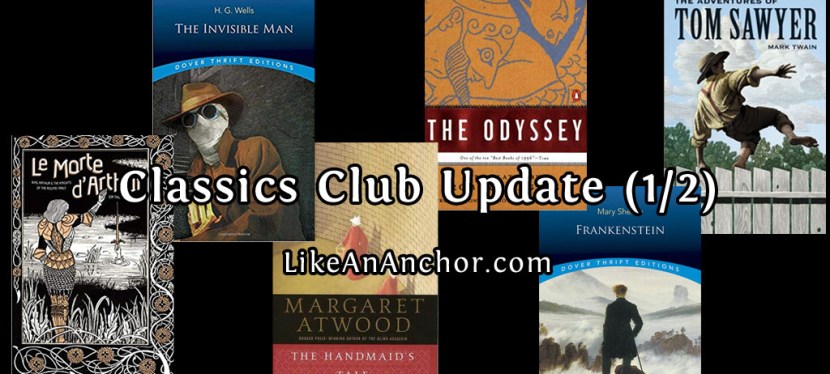
Classics Club Update (1/2)

Almost five years ago, I committed to reading 50 classic works of literature in 5 years. I’m starting to worry I won’t actually finish my Classics Club list by the August 18 deadline, despite the fact that I’ve already read more than 50 books this year alone. They just haven’t been the right books for the list (even with swapping out some of the titles for ones I’m more interested in now).

I’m not out of time yet, though, so I’m going to keep trying. Part of the agreement includes blogging about each title, but since this isn’t really a book blog I’m not going to write a whole post about each book I’ve read. Instead, here are a collection of my thoughts on six of the twelve books that were still on my list.

Frankenstein

Classics Club Update (1/2) | LikeAnAnchor.comMary Shelley’s Frankenstein has been on my list since the beginning. I’d read some of her mother’s work and had seen an on-stage version of Frankenstein as well as a modernized YouTube series, but this was my first time reading the original novel. It wasn’t entirely what I’d expected, though the format is familiar from reading other books from this time period. The story is told as if Victor Frankenstein is sharing his research (along with a cautionary tale) to the explorer who found him pursuing his created creature toward the North Pole.

Probably the thing that fascinated me most was the role Frankinstein’s psychology played in the story. Published in 1818 — 38 years before Sigmund Freud was even born — Mary Shelley explores the idea that Frankinstein’s path was shaped by his environment and his childhood as much as by the conscious choices he made. Did he make himself into the monster that created this creature? Or did was he a tragic product of his past? The story seems unsure and leaves us to answer that question for ourselves. Read more

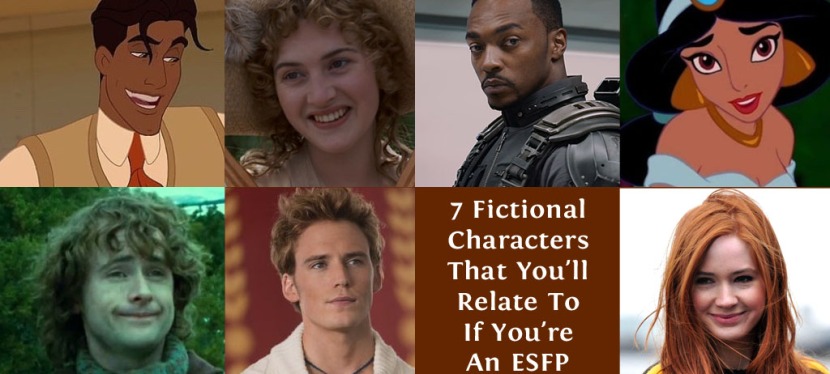
7 Fictional Characters That You’ll Relate To If You’re An ESFP

What fictional characters do you relate to as an ESFP?

Just as we can describe real people using the Myers-Briggs® typology system, we can also type well-written fictional characters. Some of fiction’s most iconic and intriguing characters are ESFPs and today we’re going to talk about seven that I think real-life ESFPs will find relatable.

One great thing about looking at character personality types is that it helps us better understand people who have different types than we do. Fictional ESFPs can serve as examples for what real-life ESFPs might be like, and also show how much variation can exist between individuals with the same type.

The things that makes ESFPs such great fictional characters are much the same things that make them so magnetic in real-life. ESFPs are engaging, passionate people who love “tangible reality” (to quote Jung’s description of Sensation types). They’re charming, interested in other people, and often have a talent for entertaining. Plus, ESFPs also have a highly practical side. It’s no wonder the fictional versions of this type can make for such intriguing characters!

Amy Pond

Like other EP types, Amelia Pond from Doctor Who thrives on new experiences. More specific to ESPs is the fact that Amy is very much in-tune with the physical world and finds ways (like modeling and working as a Kissogram) to engage with that world in sensual ways. She’s also easily bored when there aren’t new places to explore and experiences to be had (which is one reason she loves traveling with the Doctor).

Though a Feeling type, Amy is guarded with her emotions and often struggles with picking up on what other people are feeling. The Feeling side of her personality is turned inward, and mostly shows up as a strong desire to be true to her authentic self. She makes decisions based on what she believes is right. When she does share her thought processes, it’s mostly in a no-nonsense way that makes use of her tertiary Extroverted Thinking. She’s one of the fictional ESFPs that demonstrates this type has much more to offer than just being the life of the party. They can also be intelligent, stubborn, and principled people like Amy. Read more