10 Mental Health Habits to Try This 2019

This article first appeared on MadebyHemp. One of their representatives sent me an email last week suggesting we could promote some of each other’s articles. I haven’t tried CBD oil myself, but I did some research on it when writing for a client and it sounds like something that really could help a lot of people. I also thought this post had some very good content about habits that can help support our mental health. I hope you enjoy reading it!


2018 was the year we saw a strong surge of mental health awareness. The public’s focus on health broadened to also include taking care of one’s mental and emotional health. People have finally realized that one of the keys to maintaining a healthy body is to have a healthy mind.

This coming 2019, mental health awareness will continue to be one of the bigger focuses on overall well being. Learning a few habits that will promote and improve your mental health will be a great start to your new year.

1. Exercise

Source

The secret to a sound body is a sound mind. But it could also work both ways. The secret to a sound mind is a sound body. It might not work for everybody, but for a majority of able-bodied people, a great way to boost endorphins is to go out and move. Find an exercise that you love. You don’t need to do what everyone else is doing. Some people prefer lifting weights, some like yoga, some even run marathons. Find that one exercise you want to stick with and run with it.

2. Gratefulness

Source

Being thankful for the things you have instead of focusing on the things you don’t is a good way of bringing positive energy into your life. It will, more importantly, make you realize you are lucky to have the things you do. Practicing the habit of being grateful will help you become a more positive person.

3. Be kind

Source

Be the person you wish other people would be to you. Make someone’s day by smiling at them, or helping them carry a heavy load, or even just opening the door for someone who has their hands full. A bit of kindness paid forward will cultivate a world of kindness. It doesn’t take much to make others smile.

4. Sleep

Source

Get enough sleep. Sleep can do wonders for a tired mind and body. Don’t overdo it though. Get the right amount of sleep in order to feel rested and ready to tackle your day, every day. Put your screen away close to bedtime and concentrate on relaxing. Give your body and mind the time to recover and recuperate.

5. Hang out with friends

Source

Socialize. Even the most introverted person has someone they prefer to hang around with. It does wonderful things to your soul to share your time with the people that matter.

6. Chocolate

Source

Better yet, try Therapeutic Chocolate with Cannabidiol (CBD) oil.  Cannabinoids are non-psychoactive and can reduce anxiety. If you are looking to incorporate CBD into your diet, but is not very much of a fan of its earthy taste, chocolate is the way to go. Cannabinoids are found to keep the body in neutral state, and support the functions of the brain, as well as the central and peripheral nervous system. Get your chocolate fix for the day, and get CBD’s benefits while you’re at it.

7.  Laugh

Source

When they said laughter is the best medicine, they were not kidding. Laughter helps ease stress and anxiety. Hang out with a funny friend, or watch a comedy show. Or maybe learn a few jokes and share them with your friends. Laughter is one of those things that multiply when shared.

8. Eat well

Source

A few desserts won’t hurt you any but for the most part, feed your body the things it should be fed. Eat a healthy and balanced diet. This will ensure your body will feel healthy and will give you less things to stress or worry about. Avoid things that will harm your body like smoking or excessive drinking.

9. Love yourself

Source

Tell yourself something nice every day. Most people are generous with giving away compliments to others but are stingy when it comes to themselves. Start your day by giving yourself a sincere compliment. It could be something simple like “oh my skin looks very nice today”. Or “I do make an amazing omelet.” And develop this into a daily habit. Because loving yourself will allow you to love others more freely.

10. Meditate

Source

Give your mind a chance to empty itself out of the negative energy that is pervasive in the world. Give your mind the space to breathe and relax. And as you relax your mind, you relax your body. Meditation is a great way to connect your mind and your body into one plane. It is a good way to relax and to relieve yourself of any stress that you may have. Meditation also complements therapy.

Personality Type Myth-Busting: Are Extroverts Incapable of Understanding Introverts?

One of the things that really irritates me when I see certain introverts talking online is how much they seem to hate extroverts. They’ll even use that word — “I hate this thing that extroverts do” or “I hate it when extroverts are like this.” Some even have lists of all the things they hate about extroverts.

We introverts have been pushing for a while now to get recognized as “normal.” Introversion is how about 50% of the population’s brains are hardwired. It’s an inborn preference for the inner world of thoughts and ideas, which is also shaped by our unique individual experiences. So stop judging us for it, okay?

What far too many of us forget is that the exact same things are true of extroversion. For about 50% of the population, being an extrovert is perfectly normal. It’s an inborn preference for the outer world of things and people. Extroverted and introverted mental “wiring” are both perfectly normal. Both are needed, and both personality types deserve respect.

So with that clarification out of the way, let’s talk about whether or not extroverts are incapable of understanding introverts. Read more

The Value of Being Slow To Anger

The Old Testament often describes God as “slow to anger.” A more literal translation of the Hebrew is actually “long-nosed,” which makes no sense in English. But it’s a picture of a person who takes a long time to reach the point where they’re so angry that their nostrils flare and the air whooshes through their nose like a bull about to charge.

The phrases “slow to anger” and“long-suffering,” are both translated from two Hebrew words — “long” and “breath/passion/heat/anger.” The Greek equivalent is typically translated “patience” or “long-suffering.” It’s not about never getting angry, but about having control over when that happens and not flying off into a rage.

Anger is not inherently sinful. God gets angry, and Paul also tells us we can be angry without sinning (Eph. 4:26). But God doesn’t get angry quickly or without good cause, and we shouldn’t either. So how can we become “slower to anger” and “longer suffering”?

Quick Anger Fuels Strife

I think the dividing line between anger that is and is not sinful can be found in the effect that it has. Jesus throwing those who were exploiting believers out of the temple? Righteous anger. Me getting so upset at someone that I say something nasty which leads to conflict? Sinful anger.

God hates arrogance, wicked schemes, and discord. So if your anger is causing these (or anything else He hates), then it is leading to sin. There are several Proverbs addressing this. Here are a few: Read more

Personality Type Myth-Busting: Are All Introverts Quiet?

I think most people would tell you that one of the defining traits of introverts is that they are quiet. It’s even the name of one of the most popular introvert books — Quiet: The Power of Introverts In A World That Can’t Stop Talking by Susan Cain. This also happens to be the book that first got me started on studying and embracing introversion, and it’s still one of my favorite books.

But in the midst of this “quiet revolution” that’s pushing for greater acceptance of introversion, we might get the idea that all introverts are characterized by being soft-spoken people who rarely talk. However, that’s not entirely accurate and that’s not what really what Susan Cain meant when she named her book Quiet.

Confusing Introversion and Shyness

One of the most common mistakes regarding introversion is to assume it’s the same thing as shyness. But introversion is simply a description of how about 50% of the population’s brains are “hardwired.” It’s a preference for the inner world and a need to recharge in solitude. Shyness, on the other hand, is related to social anxiety. Read more

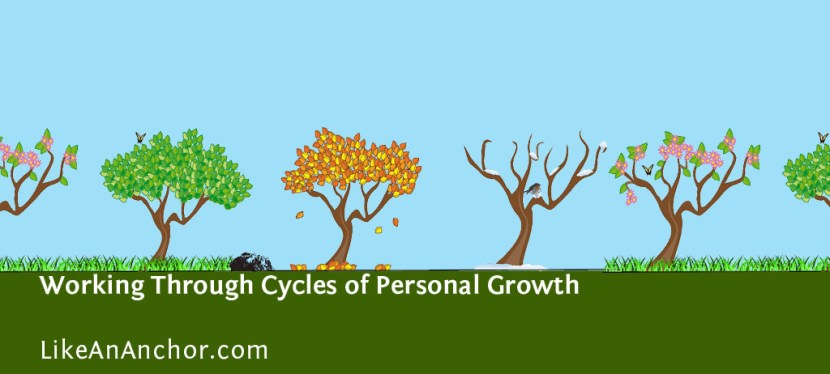
Working Through Cycles of Personal Growth

We often think of growth as happening one direction. Growing things expand and get older, they don’t shrink or get younger. If something is not moving forward, then it’s not growing.

But maybe that’s not always the case, especially when we’re talking about personal growth journeys. Growth like this doesn’t happen all at once or in a steady direction. Sometimes, a thing that you thought you dealt with will come back and needs to be worked through again. You often have to keep going back over the same ground in order to make progress.

This isn’t failure to grow. But it might look like it depending on our perspective. If we’re the type of person who wants to get everything right the first time, then it can be discouraging when we find ourselves having to deal with something we thought we’d already worked through. We might even decided that since we failed once there’s no point in trying again. But that isn’t really a healthy or helpful perspective.

New “Thought Paths” Take Time

Last year, I wrote a post about changing thought patterns related to anxiety. In that post, I talked about my counselor’s analogy of our minds as a big open field. As we live and grow, our thoughts travel over this field and we start to wear-down paths as we think along the same lines over and over. When we identify “thought paths” that aren’t doing us any good we need to create new pathways in our mind by learning to think in a different way. To do that, you have to keep going over the new paths again and again. Read more

The Romance Of Passover

Many Christians have a complicated relationship with the Song of Solomon, or Song of Songs as it’s also called. They skip it when reading through the whole Bible, ignore it in study, and struggle to explain what it’s doing in scripture. Even the idea that the Song is an allegory for the love between God and His people and/or Christ and the church (the dominant interpretation for thousands of years) has been largely abandoned by modern Bible scholars.

In Jewish tradition, the Song is associated with Passover (Pesach) and is read at this time of year. Some say this is just because the song references the spring season. But other rabbis describe this book as the “holy of holies” in the canon of scripture. They accept as a matter of fact that “Israel, in it’s covenant with God made on Mt. Sinai, was married to God” and the people owed Him their “absolute fidelity” (quotes from “Why Do We Sing the Song of Songs on Passover?” by Benjamin Edidin Scolnic).

This assumption explains why the prophets speak so often of Israel’s unfaithfulness to God as marital infidelity. In reference to Hosea, Gerson Cohen said this was “because his Israelite mind had been taught from childhood to think of the relationship between God and Israel in terms of marital fidelity, in terms of love” (quote from “The Song of Songs and the Jewish Religious Mentality”). The Song of Songs might be the most explicitly romantic book in the Bible, but it’s certainly not the only time romantic imagery is used to teach us something about the relationship between God and His people. The Apostle Paul (also a Jewish rabbi) even said after giving instruction to human husbands and wives that “this mystery is great, but I am speaking with reference to Christ and the church” (Eph. 5:32, LEB).

Covenants and Romance

So what does all this have to do with Passover? For some writers, the Song actually functions as a midrash on Exodus — a commentary in the form of a poetic, figurative retelling of the Exodus story. With this interpretation, “the Song of Songs, according to the rabbis, is a text which describes the very events that Pesah celebrates and commemorates.” You can read more about this viewpoint in Scolnic’s paper (click here).

Even without turning to Jewish midrash, though, we can find connections between God’s romance of Israel and the Exodus story. Take, for example, one of my favorite passages from Hosea: Read more