History Has Its Eyes On Us

I’m sitting here thinking, “What does one write on Independence Day when one is rather disappointed in the direction one’s country is headed?” Thousands of babies are being slaughtered, we just had the largest mass shooting in US history, there’s a systematized rejection of gender and acceptance of child abuse … the list goes on and on, and our presidential candidates aren’t making things look any better. I wonder if this is something like how Hamilton felt facing the election of 1800.

from sparkitors.tumblr.com

Except I’m not sure which of our current candidates is Burr in this analogy and which is Jefferson. I’m probably just going to not vote at all (side note: for some reason I’ve always felt uncomfortable with/guilty for voting, even though my church doesn’t teach against it. Weird, huh?).

Anyway, this isn’t going to be a depressing post! We’re celebrating Independence Day, and I’m quite certain the best way to do that this year is listening to the Hamilton Original Broadway Cast Recording. It’s on Amazon Prime, Spotify, YouTube — you have no excuse not to listen. Nor any excuse not to think about what you’re listening to.

Hamilton didn’t win 11 out of the record-breaking 16 Tony nominations just because it’s a run-away hit with a unique musical approach. The catchiest music couldn’t have sustained this level of success without a story that resonates deeply with fans. One of the many fantastic things about Hamilton is that it presents the founding father’s as real people. They’re not glorified by rose-eyed historical glasses or torn to shreds by an opposing historical perspective trying to vilify them. They’re just real men with a vision for the future and the necessary skills and commitment to found a country that is now celebrating its  240th birthday. Not too shabby a legacy. So what does that mean for us, real people today who have the chance to influence the course of history?

History Has Its Eye On Us | marissabaker.wordpress.com

A More Accurate Picture of America’s Ethnic Landscape

The only reason I would ever advocate casting with race in mind is for the purpose of historical or cultural accuracy. Now I’m re-thinking even that. A racially diverse cast works perfectly for Hamilton — America of today telling the story of America’s founding. And even though the individual characters’ casting doesn’t match the race of their historical counterparts, a racially diverse group working together to found our country is more accurate than most people think. Peter Salem (hero of the Battle of Bunker Hill), Prince Whipple (who fought alongside Washington), James Armistead (the double-spy who may have “won the revolutionary war”), Wentworth Cheswell (who rode to say “the British are coming” at the same time as Paul Revere) — they were all black, along with many other key figures in America’s founding.

Leslie Odom Jr. (Aaron Burr), Christopher Jackson (George Washington), Daveed Diggs (Marquis de Lafayette/Thomas Jefferson), Phillipa Soo (Eliza Hamilton), Renée Elise Goldsberry (Angelica Schuyler)

Renee Elise Goldsberry, who plays Angelica Schuyler, says that the most beautiful thing about Hamilton is that “it’s told by such a diverse cast with a such diverse styles of music. … We have the opportunity to reclaim a history that some of us don’t necessarily think is our own” (quote from Times article “Why History Has Its Eyes on Hamilton’s Diversity“).

One of the lines in Hamilton is “history has its eyes on me/you.” The founders knew what they were doing was going to make a mark on history, but this phrase can also be true of us today. Every generation has the potential to make its mark on history. Will future Americans look back on us and see a group of people who wouldn’t stand for white-washing of their history any more? or will they see us as complicit in maintaining the accepted historic narrative that all blacks were slaves and all whites were oppressors, even if that means marginalizing blacks who held influential positions at key points in American history?

Redefining The Moral Climate of Our Nation

One of the things Alexander Hamilton is known for is being involved in our country’s first political sex scandal. Perhaps this is one reason he was so often overlooked — he didn’t fit the squeaky-clean mold of a founding father that was popular in history books until very recently (now we seem to be going the other direction, trying to dig up as much dirt as possible on everyone. No one’s ever accused the human race of being balanced, have they?).

History Has Its Eye On Us | marissabaker.wordpress.com

In a post-Clinton age it seems strange to us that when Hamilton’s affair came out the immediate reaction was “Well, he’s never gon’ be President now” (though I’m sure in more historically accurate language). The idea of someone who cheated on his wife and openly confessed it becoming president was unimaginable. Hamilton himself down-played the seriousness of the affair, concentrating on proving he was a virtuous man innocent of the financial crimes he was accused of. Or, as he says in the play, “I have not committed treason, and sullied my good name.” He even wrote that he believed his wife “will approve, that even at so great an expence, I should effectually wipe away a more serious stain from a name, which it cherishes with no less elevation than tenderness. The public too will I trust excuse the confession” (read the full text of Hamilton’s Reynold’s Pamphlet here).

Committed treason he did not, but sully his good name Hamilton certainly did. “Hamilton’s reputation was in tatters,” an article from the Smithsonian says, “Talk of further political office effectively ceased.” Now, 219 years later, can you even imagine living in nation that expects moral behavior from its politicians? Or where the politicians themselves take responsibility for their own behavior? Hamilton was so worried about the possibility of a stain on his reputation that he confessed to an affair. And even though he did down-play its severity in light of the other charges, he still said of the affair, “I bow to the just censure which it merits. I have paid pretty severely for the folly and can never recollect it without disgust and self condemnation.”

It is one of my favorite things about the play Hamilton that Hamilton takes responsibility for the affair, acknowledging that he should have said “no to this.” It doesn’t absolve Maria Reynolds of her role in seducing a married man, but there’s “No Slut Shaming in Hamilton” either (<- that blog post is what prompted me to listen to Hamilton for the first time). Today, we don’t expect people in the public eye to even take responsibility, much less to hold themselves to a certain standard of morality. We’re scandal-hungry and ready to offer judgement on celebrity short-comings, but we don’t expect anything better. Perhaps this trend will continue until there’s no longer any such thing as a socially accepted moral standard, but I hope not. And when history turns its eyes back on us, will they see a generation sliding farther into cultural decay, or one that took a stand and said, “We expect better things of our role-models and leaders”?


There are plenty of other moral, social, and political issues we could discuss. If history’s eyes really are on America today, what would you like to see change for the better in our generation? financial disparity between rich and poor? the foster care system? environmental issues? whether or not to forfeit our second amendment rights? Please share your thoughts in the comments (bonus points for using Hamilton quotes)!


Why I Cover My Head In Church

It’s been a year since I first started really digging into 1 Corinthians 11 and began wearing a head covering when I attend church services. I’d been wondering about 1 Cor. 11 for years, but hadn’t really looked into it all that deeply. None of the explanations about why we don’t cover today satisfied me, but I didn’t feel I had a good enough argument in favor of covering to go against my church tradition. I’d discussed it with a few women in my congregation, but they seemed confused by the passage and had decided that your hair is your covering and the “we have no such custom” phrase meant veiling/covering in church wasn’t necessary today.

My Covering Testimony | marissabaker.wordpress.com

Then a year ago I stumbled upon The Head Covering Movement through a blogger. Here was a group who took this passage seriously. They were ready to talk about what “because of the angels” might mean. They engaged directly with a variety of arguments against covering in a respectful way solidly rooted in scripture and history. They even had a good explanation for the phrase “we have no such custom.”

How I started covering

My Covering Testimony | marissabaker.wordpress.com
Flea market find — head covering for $1!

My first reaction was to talk with my mother, who was suspicious of the whole idea. I then reached out to a friend who’d been sending me “rants” about scriptures that didn’t make sense to him. My own “rant” went something as follows: “should I start wearing a scarf because this makes sense to me? or did I miss something in their interpretation of these verses that I shouldn’t agree with? Maybe my mother’s right that it’s not a big deal and it would be too distracting to people around me in church.”

Even before I heard back from him, I wore a wide headband to church that Sabbath. I thought it was big enough to count as a covering, yet not something I hadn’t worn before so it wouldn’t attract much attention. A few days later, my friend wrote something that helped confirm my decision: “It is good that you’re mindful of not causing a ruffling of feathers among fellow congregants, but we can only control so much of other people. … So, I would just encourage you to follow your conviction wherever that leads you. If people have a problem, it is their Christian duty to confront you about it, and I doubt anyone would still have a problem with you/your apparel upon inquiring about your intent in doing so.”

My friend is a smart man. I’d already taken baby-steps toward covering, but his encouragement was reassurance that I wasn’t just going “off the deep end.” I ordered my first cover from Garlands of Grace on July 15 (pictured in the featured image), and started building a collection of head scarfs. Since then, I’ve only had one person in the United Church of God groups I attend ask about the fact that I cover my head, but at my Messianic group there are a few other women who cover and the topic comes up more often. I’ve received compliments on how I wear them, as well as on the fact that I’m covering. One person said, “I appreciate that you wear a cover when you dance.” I’m not doing this to seek attention of course, but for someone whose love language is Words of Affirmation this support was invaluable.

Support for covering

In terms of scripture, the passage in 1 Corinthians 11:1-16 is the main support for the practice of Christian head covering. A few other scriptures tie in to it (such as Num. 5:18 instructing the priest to uncover the head of a woman accused of adultery), but this is the only place where it’s focused on. You can check out The Head Covering Movement for more in-depth analysis, but here’s what convicted me that covering is for the church today:

  1. God’s created order for headship is the foundational reason for covering (v.2-3, 7-12).
  2. It’s described as a dishonor and a shame for women to “pray or prophecy” uncovered (v. 4-6).
  3. Paul says “nature itself” (including the examples of short hair on men and long hair on women) teach us covering is proper (v. 13-15). I also think this is support for the hair acting as a covering sometimes and an additional cover only being required when “praying and prophesying.”
  4. The “we have no such” custom phrase grammatically refers back to the question in v. 13 of women praying uncovered. No where in scripture does Paul suggest people can ignore a command he writes about simply because they are contentious over it.

On top of those reasons, the arguments most people use against head covering are, for me, an argument in favor of it. They say it was a strictly cultural matter that no longer applies — that in Corinth, only prostitutes went about with uncovered heads and we don’t want to be mistaken for prostitutes. But Paul mentions no such thing and when we start throwing out commands because we think they’re strictly cultural we’re on a very slippery slope. On top of that, historical evidence shows the prostitutes referenced in this argument belonged to a Corinth of about 200 years before Paul’s writings and art of the time shows respectable women both covered and uncovered. The covering Paul talks about wasn’t based on a Greek or Roman practice (or even a Jewish practice, since both men and women covered in Judaism).

Left: Michelangelo’s The Pietà (1498-1499). Right: film still from Brooklyn (2015, setting 1952)

In reality, history shows us that head covering was practiced unanimously among Christian women for centuries. I hate to cite Wikipedia as a source, but in this case their article on Christian headcovering throughout history is unusually well-researched and more thoroughly cited than many other articles I’ve found online. Until a little over 50 years ago (with the sexual revolution and the feminist movement gaining traction), covering was the norm in church and often in public as well. Even fairly recently, no respectable lady would leave the house without a hat of some kind and she was expected to keep it on during church services. If you’re looking closely, you’ll notice this in well-researched historical dramas. Last year’s film Brooklyn, for example, was set in 1951 and ’52, and you’ll see Eilis removing a veil as she leaves a church in one scene and another scene where she’s wearing a pink cover at church.

Take away thoughts

While I don’t like to seem as if I’m pushing the notion of headcoverings on other people, I am doing this for a reason and a year of covering has only confirmed my choice. My encouragement to you today is to just take a closer look at this passage of scripture, and not to ignore it because we’re not sure what to do about it. Don’t start covering just because someone tells you to — study it and see if you’re convicted. And if you are, then don’t be afraid to start covering in church. Sure some people will probably think it’s strange, but as my friend said, “we can only control so much of other people.” If you’re convicted that you should be covering at church, then you’re doing it for God and not for what other people think (though you do want to try and avoid offending our brethren by how we practice covering).

Now, I don’t mean to sound like covering has been without its struggles or that it wasn’t a little weird at first or that I don’t still have questions. For example, how often to cover is still something I’m not clear on. I’m convicted of covering at church services (which is all The Headcovering Movement sees as necessary), but “praying and prophesying” could apply to other times as well. Do Bible studies count? What about dance practice, since the dancers pray as a group and sometimes I’m asked to pray aloud? I cover at home when praying in private, but should I cover for blessings on meals? or when writing these Sabbath blog posts, since that’s a sort of prophesying/inspired speaking? I’m not sure.

While thinking these things over, I’m keeping in mind that we can’t turn this into a legalistic thing, and I do think God hears prayers of uncovered women. Covering should be a way of honoring God, never something that stands between us and our Lord. But if it is indeed a command, and I believe it is, then it’s meant for our good, and that has been my experience. I’ve found that covering draws me closer to God and reminds me that I’m here to worship and to honor the Lord.

Shalom, my friends!

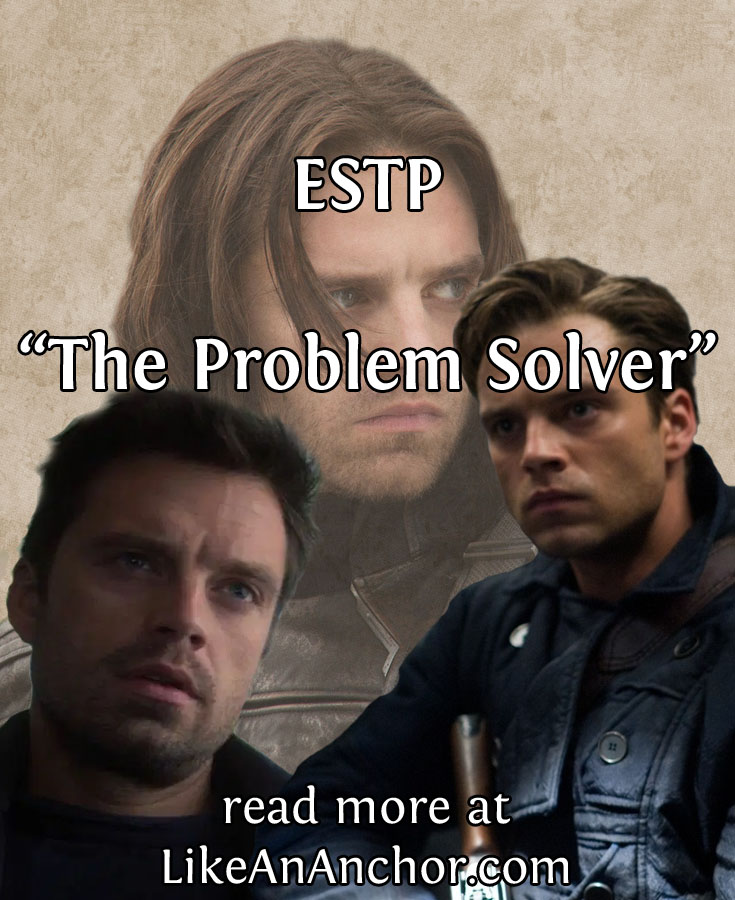
Fictional MBTI – James “Bucky” Barnes (ESTP)

It always intrigues me how certain characters attract so much investment from viewers. Browsing Pinterest lately, it seems like Bucky is the new Loki — the Marvel fandom’s dark, mistreated character who just needs a hug because we love him soooooo much. In Bucky’s case, the reasons why we find his character compelling aren’t too hard to find. He’s a good man who was forced to do terrible things and is now constantly fighting a battle to be himself. Sebastian Stan’s portrayal allows audiences to glimpse Bucky’s human side under the soldier persona he wears and the assassin role he’s forced to adopt, and audiences are drawn in by a realistic, sensitive portrayal of a compelling character.

Most people type James “Bucky” Buchanan Barnes as an ESTP, and I’m inclined to agree with them. Operating under the assumption that MBTI type doesn’t change, when we see him as Bucky in Captain America: First Avenger he’s a healthy, stable version of his MBTI type. The version of Bucky we see later in Captain America: The Winter Soldier is a severely stressed and traumatized man of the same MBTI type. Bucky in Captain America: Civil War is still dealing with the fall-out of all he went through, but he’s more recognizable as an ESTP.

Typing Bucky Barnes

We only get about 13 minutes of footage with Bucky in the first Captain America film, but those scenes reveal a character in line with type descriptions of ESTPs as people characterized by decisive action, contagious energy, and enjoyment of being in the moment. They are “thrillseekers who are at their best when putting out fires, whether literal or metaphorical. … They assess situations quickly and move adeptly to respond to immediate problems with practical solutions” (Truity.com description). David Keirsey writes that ESTPs (whom he nick-names Promoters) “live with a theatrical flourish which makes even the most routine events seem exciting. … Promoters demand new activities and new challenges. Bold and daring at heart, and ever-optimistic that things will go their way, Promoters will take tremendous risks to get what they want, and seem exhilarated by walking close to the edge of disaster.” Other nicknames for ESTPs include “problem solver” and “realist.”

ESTPs lead with a mental process called Extroverted Sensing, or “Sensation.” This process “can get into the action in the moment. Think of it as ‘real-time kinetic’” (from Personality Hacker). It’s a fun-loving function that delights in sensory experiences, such as Bucky spending his last night in New York dancing with girls he probably doesn’t care whether or not he ever sees again. On that same night, he and Steve are talking about Steve’s inability to enlist and he says, “I don’t see what the problem is. You’re about to be the last eligible man in New York.” He’s trying to make Steve feel better with joking and doesn’t really ‘get’ the duty-fulfilling and self-sacrificing aspect of Steve’s character. It’s not a deeply ingrained aspect of his personality type (like it is for ISFJ Steve), though in practice he still does his duty and sacrifices himself because he’s a loyal friend and a good man.

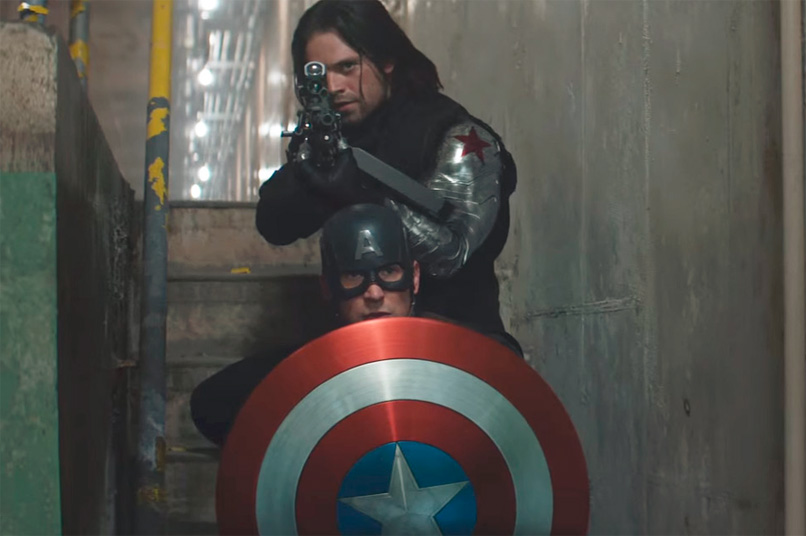
We also see Bucky demonstrate sensory skills in more serious situations. Even post-experimentation and groggy when escaping Redscull’s prison, Bucky could walk across that metal girder with coordination, balance, and no hints of fear other than a healthy caution. As a Howling Commando, we see him as a sniper (which requires skills that come naturally to SP types) and making split-second sensory decisions with ease in the final train fight.

ESTP types support their Sensation function secondary with Introverted Thinking (or “Accuracy”) and then tertiary Extroverted Feeling (or “Harmony”). These mental processes describe how ESTPs, like Bucky, make decisions. First he’s using impersonal criteria to evaluate information and make decisions that are motivated by his own understanding of how the world works. Extroverted Feeling gives ESTPs an insight into other people that they stereotypicaly use to be charming and get people to do what they want. When he tries to ask Peggy to dance, he’s clearly not used to being ignored in favor of his friend (or any other guy). ESTPs are not primarily an emotional sort of people, though. In an early scene, Bucky had just had an argument with his best friend and turns that emotionally invested side of himself ‘off’ to take the girls dancing and enjoy himself.

The Winter Soldier

Once Hydra turns Bucky into the Winter Soldier, it’s difficult to use any scenes to get a clear picture of his personality type. In Captain America: The Winter Soldier we see a few glimpses of the real Bucky trying to get out, but not really anything to help with typing him. In Civil War, however, his own mind is starting to reassert itself and we can talk about his personality type in that film.

When ESTPs are stressed, one of the most common things they experience is internal confusion. They feel out of control, forget details, and become paranoid. Their inferior, or 3-year-old, function is Introverted Intuition (also called “Perspectives”). It’s a mental process that speculates on things that cannot be known, which is great for creativity and insight if you’re using it as a driver process but not so good if it’s an underdeveloped function that comes out when you’re stressed. Most ESTPs snap out of what Naomi Quenk calls a “Grip experience” (where stress causes your inferior function to assert itself) fairly quickly, but “Chronic grip behavior can lead the individual and others to believe that he or she is typically negative, pessimistic, and worried about both the present and the future” (Was That Really Me? p.180). Add to that all the torture and brainwashing used to turn Bucky into the Winter Soldier, and you have the Bucky who’s fighting alongside Cap in Civil War.

Here, we see a man who is not only fighting physical battles (and with extraordinary skill now that super-soldier enhancements have been added to his natural sensory abilities), but who is also fighting a mental battle. As extroverts, ESTPs tend to focus more on the external. Bucky’s experiences have turned him inward, making him more serious and forcing him to develop his Introverted Thinking side. Though type theory holds that your base personality doesn’t change, Bucky is in many ways a different person than the one we see in The First Avenger. He’s burdened with the weight of what he’s done and his friend Steve is now his only real connection with another human being.

In some ways, Bucky’s joking remark from the first Captain America movie “I’m turning into you” has come true. He’s become much more introspective and aware of the weight of his actions. Yet he’s also still thoroughly himself. We have a scene where he and Cap are reminiscing about fun times they had and a girl Bucky tried to impress, and he’s really Bucky against instead of the Winter Soldier. The fun-loving young ESTP is still in there, just buried deeply under the weight of all he’s been though.

In The First Avenger, we see Bucky fighting to protect his best friend and giving his life for his country. Now in Civil War, he trusts his best friend to help him through and gives up his freedom by going into cryostasis so he’s can’t be used to hurt others. Bucky’s decision to enter cryostasis at the end of the movie is also an intensely individualistic move that’s characteristic of SP types. If he can’t guarantee he can control himself, then at least he can make sure no one else can take control of him either.

bucky

If you enjoyed this post, check out my other MCU typings:

Loki – INFJ

Scott Lang -ISFP

Steve Rogers – ISFJ

T’Challa – ISFP

Thor – ESTP

Tony Stark – ENTP

SaveSave

Save

Save

Why Does God Expect So Much?

Newly converted Christians (and even many of us who’ve been in the church for years) often struggle with God’s expectations for them, especially when reading the Old Testament. And I’ll admit, the Law can look really daunting. The Jews traditionally say there are 613 commandments, or mitzvot, in the Torah. Because there’s no temple or priesthood anymore, some have estimated only about 270 of these laws are still applicable today.

Why Does God Expect So Much? | marissabaker.wordpress.com

Reading the “thou shalts” and “thou shalt nots” might feel overwhelming (“How could I ever keep track of them all?”), or sound unfair (“These don’t make sense; is God setting me up to fail?”), or seem stifling (“Why would He dictate my behavior in this area?”). To get around this, many modern Christians have rejected the Law completely and adopted the mentality that once you accept Jesus Christ as your savior there’s nothing else you need to do in order to be called a Christian.

This belief is mistaken. Jesus told people, “if you want to enter into life, keep the commandments” (Matt. 19:17). He also said He did not come “to destroy the Law or the Prophets” (Matt. 5:17) and that those who love Him will keep His commandments (John 14:15). Jesus thought the Law was not only relevant but also vitally important, and if we claim to follow Jesus we have to agree with Him. But how do we reconcile 613 (even “only” 270) commandments with Jesus’s statement that “My yoke is easy and My burden is light”? (Matt. 11:30). Where is the love and grace of our Savior in the strict rules of the Law? Read more

INFJ User Guide

Congratulations on the procurement your new INFJ!* INFJs are highly sought after in the personality type collecting world given their extremely rare nature. INFJ spotting is a very difficult hobby, requiring forays into the deepest recesses of bookstores, yoga studios, and the internet. Keeping an INFJ in your life once you’ve found one can be even more of a challenge.

INFJs are widely considered one of the most amiable and empathetic personalities. Their minds offer a good balance of emotion and logic that helps them relate to most types of people, and they highly value commitment and relationships. As introverts, though, they have limited social energy and they don’t maintain relationships with most of the people they meet. Once you’ve found an INFJ, taking your acquaintance to the level or friendship, or relationship, isn’t simple. That is, unless you have this user guide.

INFJ User Guide | marissabaker.wordpress.com

Overview of the INFJ

The INFJ is a strange sort of creature, often compared to unicorns. Their uniqueness is a result of two things: the way their brains/personalities are hardwired and the rarity of their personality type. What’s perfectly normal for an INFJ seems unusual among humanity as a whole because so few people function this way. Understanding your INFJ’s basic functions is the first step towards successful interaction with the INFJ.

Read more

But What If God Scares Me?

So you’ve heard about the love and grace of Jesus and want to learn more. Maybe you even had another Christian lead you to Jesus and accepted Him as your savior. Then you sit down intending to read the Bible from start to finish and find something you weren’t quite expecting.

Genesis starts out with creation and the fall of man, then suddenly God’s wiping the whole earth out in a flood (Gen. 6:5-8). Next He’s scattering the people of Babel for building a tower (Gen. 11:5-9) and raining fire and brimstone down on Sodom and Gomorrah (Gen 19:24-25). Why does the God you know as forgiving and accepting seem so angry? Where is God’s love and grace here, in the Old Testament?

But What If God Scares Me? Bible reading for those who don't like the God they find in the Old Testament | marissabaker.wordpress.com

Many people give up on the Bible and/or their faith because God isn’t what they expect, or they go for a version of Christianity that highlights the New Testament and ignores any verses about uncomfortable topics like judgement and sin. But authentic Christianity demands something more of its followers. Jesus said, “Many are called, but few are chosen” twice in Matthew’s gospel (Matt. 20:16; 22;14). We don’t want to be the people who receive the seed of the gospel and then wither away because we have no root (Matt. 13:5-6, 20-21).

The lives of Christians are supposed to reflect the nature of our God. If we aren’t diving deep into His word, we won’t know who He is or what He requires, and we can’t grow roots into our faith. We can’t let misconceptions about or fear of His anger and expectations scare us away from getting to know Him. Read more