Shy Introverts

Last week, when I wrote about reasons to homeschool introverts, I touched on the difference between “shy” and “introverted.” I said that shyness and introversion are often confused, but introversion is an inherited preference for how you recharge (alone, rather than with other people), while shyness is a fear response. We talked about how introverted children can become shy and insecure if they are told there’s something wrong with their preference for introversion, which reinforces a low self-confidence and increases feelings of shyness.

But looking at shyness this way doesn’t give a complete picture. It still assumes shyness is “bad,” while in reality the more mild forms of shyness might simply be traits of an introverted temperament. Also, for those of us who are both shy and introverted, being told that shyness and introversion aren’t the same thing is not very helpful. I agree with people who argue that introversion needs to be understood rather than overcome — introverts shouldn’t feet guilty for not being extroverts. But I’ve read articles that set out to prove introverts should be accepted just the way they are, and then turn around and start criticizing shy people for their fears and anxiety in social situations. It’s not very encouraging to be told that your introversion is okay, but you need to “get over” your shyness.

Is Shy Really So Bad?

While researching for this post, I cam across “A Quiet Rant About Introversion and Shyness” by Barbara Markway. Like this writer, I’m both an introvert and a highly sensitive person (HSP).  We’re also both shy, though not as “painfully shy” as we once were. Like her , I worry that we risk hurting shy introverts when we focus the conversation about shyness and introversion on the idea that introverts are not shy. Because some of us actually are.

Shyness is not necessarily a bad thing. It’s just viewed as bad in current American culture. Other cultures see shyness as a sign of modesty, and treat it as a virtue (Asian cultures are typically used as an example). So for those of us who are shy, quiet, and introverted, know that there’s not necessarily something “wrong” with you. Extreme shyness becomes a problem when your fear gets in the way of you choosing to move forward with things you want to do, but a little shyness  can be a positive trait depending on how you look at it.

“the shy and the introverted, for all their differences, have in common something profound. Neither type is perceived by society as alpha, and this gives both types the vision to see how alpha status is overrated, and how our reverence for it blinds us to things that are good and smart and wise.” — Susan Cain

Shyness vs. Social Anxiety

Social anxiety is where “shyness” becomes problematic. Both shyness and social anxiety disorder are motivated by a fear of social situations, but social anxiety is more of a phobia-level fear. It’s often accompanied by a physical response (nausea, sweating, heart racing), and a person with social anxiety disorder might not appear shy all the time. It’s much more complex than simply an exaggerated form of shyness, as illustrated in the essay “Social anxiety is not the same as excessive shyness” by Chris Alaimo. I recommend clicking over there and reading what he wrote if you’re interested in this topic.

“Many people are a little bit shy. If you’re shy, you might be somewhat uncomfortable in situations such as going to a party where you don’t know anyone, but you do it. You give yourself a push, you go to the party, after a while you relax and talk to people. The social phobic person, at the prospect of the same party, would be overwhelmed by such anxiety that [he or she] would have a physical reaction — perhaps nausea, sweating, heart racing, dizziness — and would avoid it if at all possible. It’s a matter of degree.” Rudolf Hoehn-Saric, MD, head of the Anxiety Disorders Clinic at Johns Hopkins University School of Medicine (as quoted on WebMD).

I actually didn’t know about this distinction until someone asked what the difference was and I did some research. Now, I’m not sure anymore whether I qualify as shy or socially anxious. Using the above example, I do experience the the heart-racing, nausea, and panic-attack reaction to going to an event, but I usually go anyway (often because a family member pushes me out of the house. Literally, sometimes). So do I have mild social anxiety, or extreme occasional shyness? I suppose it doesn’t really matter, since WebMD says the typical treatment is anti-depressants and I’m not going to do that for something that’s not having a more drastic impact on my life.

I think it’s something worth thinking about, though, for people who are very shy. One of the reasons I like type psychology is because when you know yourself, you are better able to plan for and cope with your weaknesses, as well as utilize your strengths. Along the same lines, wven if you don’t plan on seeking medical help for shyness or social anxiety, knowing there’s a name for what you’re dealing with can help make it seem more manageable, and it helps you track down information like Must-Have Coping Strategies for Social Anxiety.


Shout For The King

These are the Days of Awe. That’s what Jewish believers call the 10 days between Yom Teruah/The Feast of Trumpets (which fell on Thursday, September 25th this year) and Yom Kippur/The Day of Atonement (Saturday October 4th).

Having recently started attending with a Messianic Jewish group, I wanted to focus my pre-Trumpets study this year on the Hebraic roots of this Holy Day. With the Feast of Trumpets just a few days past, I’d like to share some of that study with you today as we look forward to the Day of Atonement.

A Question of Trumpets

I found five different Hebrew words translated “trumpets” in the Old Testament. Let’s just take a quick look at each one:

  • chatsotserah (H2689). A metal trumpet (Num. 10:2, 8).
  • yobel (H3104). The signal of a trumpet or blast of a horn. A common noun referring to trumpets, horns , and the year of Jubilee (Lev. 25:10).
  • shophar/shofar (H7782). A ram’s horn. The word most often used in the Bible.
  • taqoa (H8619). A trumpet with a looped tube and flared bell that makes a shrill sound (Ezk. 7:14).
  • teruah (H8643). A shout of joy or alarm. The noise from a trumpet.
“Rabbi Blowing Shofar” by Carole Spandau

This last word is the one used in Leviticus 23 and in Numbers 29 in reference to the Feast of Trumpets. My Hebrew dictionary says it means “a shout of joy; a shout of alarm, a battle cry. It refers to a loud, sharp shout or cry in general, but it often indicates a shout of joy or victory. … It can refer to the noise or signal put out by an instrument” (Baker and Carpenter, 2003). A more literal translation of Yom Teruah, the phrase we translate as “Feast of Trumpets,” would be “Day of Shouting.”

Then the Lord spoke to Moses, saying, “Speak to the children of Israel, saying: ‘In the seventh month, on the first day of the month, you shall have a sabbath-rest, a memorial of blowing of trumpets, a holy convocation. You shall do no customary work on it; and you shall offer an offering made by fire to the Lord.’” (Lev. 23:23-25)

Now, I’m certainly not saying this day doesn’t involve blowing trumpets. Silver trumpets would have been blown for the new moon and because this was a high Holy Day (Num. 10:1-2, 10). Shofars (the ram’s horn trumpets) were blown as well. In fact, they were blown on every Sabbath and Festival.

Blow the trumpet at the time of the New Moon, at the full moon, on our solemn feast day. For this is a statute for Israel, a law of the God of Jacob. (Ps. 81:3-4)

Based on this scripture alone, I’d say shofars belong as part of every Christian service. And there are other passages too, like Joel 2:15, which indicates shofars are a key part of calling solemn assemblies and sanctifying fasts, and Psalm 150:3, which instructs us to praise God “with the sound of the trumpet.” But I digress …

So, lots of trumpets blasts on Yom Teruah. There’s even a traditional pattern for how to blow them, and shofars are sounded at least 100 times in a typical Yom Teruah service. (Here’s a link for more about Jewish tradition associated with Yom Teruah, and a recording of the shofar sounds). But even though trumpets are a huge part of this day, looking into the Hebrew had me wondering if I’d been keeping the “Feast of Trumpets” my whole life when I should have been keeping “the Day of Shouting for joy and battle cries.” I also wondered if it really made any difference. Does a better understanding of the Hebrew add layers of spiritual meaning?

The Day of Shouting

The word “Teruah” is used 36 times in the Old Testament. It is translated “blow an alarm” as for war (Num. 10:6, 31:6) and to shout like when the walls of Jericho fell (Josh. 6:5, 20). The people shouted for joy when seeing the ark of the covenant and when the temple was rebuilt (2 Sam. 6:15; 1 Chron. 15:28; Ezr. 3:11-13).  Teruah is also translated “joy,” “rejoicing,” and “joyful sound” (Job 8:21, 33:26; Ps. 27:6, 89:15). It is used of praising God (Ps. 47:5), and of fighting with Him on our side (2 Chron. 13:12).

The meaning of Yom Teruah/the Day of Shouting can be interpreted several ways. A website for Karaite Judaism says it may be “intended as a day of public prayer. The verb form of Teruah often refers to the noise made by a gathering of the faithful calling out to the Almighty in unison.” The examples they give are Psalms 47:2, 66:1, 81:2, and 100:1. A Messianic website says the shofar and trumpet blasts are “a wake-up blast — a reminder that the time is near for the Day of Atonement.” There are strong themes of repentance, rebirth, and resurrection associated with this day.

Another element of Yom Teruah was brought out in the teaching given by the Rabbi at my local Messianic congregation. He said that the shofar is blow every day in the month leading up to Yom Teruah as a proclamation that the King is returning. We are to prepare ourselves to hear the voice of the Lord (traditionally, the shofar is seen as symbolizing God’s voice). In Hebrew, the word “prepare” is connected with the human face — we’re making ourselves ready to be face-to-face with God. In that sense, Yom Teruah is a yearly reminder of something we should be doing all the time. It’s also just the beginning of such reminders to repent and be at one with God, since it’s starts out the 10-day count to Atonement (which will definitely be the subject of next week’s blog post).

This preparation to meet God reminds me of the giving of the Ten Commandments. Before delivering His laws, God commanded boundaries to be set up so the people couldn’t get dangerously close to His presence on the mountain, but He did want them to be present as He delivered the words of the covenant. The people were commanded to consecrate themselves and wash in preparation for meeting with God, and then God commanded, “When the trumpet sounds long, they shall come near the mountain” (Ex. 19:10-13). Here, the trumpet acted as a call to assemble in God’s presence.

The King is Coming!

In the New Testament, trumpet blasts and shouts are strongly associated with Jesus Christ’s return. Traditionally, Christians who keep Yom Teruah have said that the Feast of Trumpets pictures Christ’s second coming and the first resurrection from the dead.

For the Lord Himself will descend from heaven with a shout, with the voice of an archangel, and with the trumpet of God. And the dead in Christ will rise first. Then we who are alive and remain shall be caught up together with them in the clouds to meet the Lord in the air. And thus we shall always be with the Lord. (1 Thes 4:16-17)

For my readers who aren’t familiar with this particular interpretation of future prophecy and “what happens after death” belief, here’s a quick summary of what I believe: Those who have died are “asleep,” waiting for a resurrection. The believers who have died “in Christ” will be raised to eternal life at His second coming, and the non-believers will be raised 1,000 years later to be given as second (or in many cases a first) chance to understand God’s truth (Rev. 20:4-5, 11-15)

Behold, I tell you a mystery: We shall not all sleep, but we shall all be changed — in a moment, in the twinkling of an eye, at the last trumpet. For the trumpet will sound, and the dead will be raised incorruptible, and we shall be changed. (1 Cor. 15:51-52)

“Behold, He Cometh” by Simon Dewey

Right now, we’re in waiting for our Bridegroom, Jesus the Christ, to return for us (John 14:1-3). If we’re dead when that happens, we’ll be brought back to life. If we’re still alive, we’ll be changed into spirit beings.

At first, shouting for joy and shouting a battle cry seem only distantly related. But if we turn to Revelation and read more about Christ’s return, the connection in Yom Teruah becomes more clear.

And I heard, as it were, the voice of a great multitude, as the sound of many waters and as the sound of mighty thunderings, saying, “Alleluia! For the Lord God Omnipotent reigns! Let us be glad and rejoice and give Him glory, for the marriage of the Lamb has come, and His wife has made herself ready.” And to her it was granted to be arrayed in fine linen, clean and bright, for the fine linen is the righteous acts of the saints. (Rev. 19:6-7)

Here is where the shouts of joy, praise, and exhalation come in. We’ve been preparing to meet our Bridegroom, and here He is! Then, just a few verses down, we see how the shouts of joy turn into a battle cry.

Now I saw heaven opened, and behold, a white horse. And He who sat on him was called Faithful and True, and in righteousness He judges and makes war. His eyes were like a flame of fire, and on His head were many crowns. He had a name written that no one knew except Himself. He was clothed with a robe dipped in blood, and His name is called The Word of God. And the armies in heaven, clothed in fine linen, white and clean, followed Him on white horses. (Rev. 19:11-14)

The armies which follow Christ at His return are clothed in “white linen” garments just like His bride, so this is often read as a sign that we’ll be riding into battle alongside Him to set up the promised kingdom of peace.

Yom Teruah is already passed for this year, but our preparations to meet the King and become a suitable bride for Him are ongoing. In Matt. 22:2, Jesus said, “The kingdom of heaven is like a certain king who arranged a marriage for his son.” This marriage is an integral part of Their great plan, and we as the church are the focus of it. I pray we all hear and head the trumpet blast that calls out to us and says, “The King is coming! make ready to meet Him.”


Why Homeschool Introverts?

One of the big things that introverts want people to know is that “introversion is not the same as shyness.” And it isn’t — just because someone is introverted doesn’t mean they are shy, and there are plenty of shy extroverts as well (Susan Cain has an article about this). People tend to assume shyness is the same thing as introversion, but that’s just not true. Introversion refers to a preference for how someone gathers energy — they are energized by alone time rather than by being around groups of people. Shyness is fear.

But how is it that we become shy? If it’s not inborn, then we must learn it at some point, usually quite early in our lives. You might see an outgoing child become shy, but it’s rare that a socially confident adult suddenly develops traits of shyness. So what happens to turn introverted children shy?

Confusing “Shy” and “Introverted”

found on sparkpeople.com

The confusion between “shy” and “introverted” has a long history. Jung, whose work the Myers-Briggs test is based on, wrote that “the introverted attitude includes a tendency to be shy.” While extroverts can be shy (and it might actually be more difficult for them since shyness conflicts with their need to be energized by other people), shyness is more likely in introverts. A certain level of shyness might simply be part of the introverted temperament, but more extreme shyness and social anxiety is not an unavoidable part of introversion.

In his article “Are You Motivated by Your Fear or Your Preference?” Andy Mort says that understanding why introverts are believed to be shy and how that belief impacts society is important. Since introversion is so often confused for shyness, introverted children are often told that they are shy by well-meaning adults who think they need to “fix things.”

When I believed I was shy I adopted that label and acted shy; I feared certain social interactions because I didn’t want my ‘shyness’ to be picked up on, and so often withdrew. Shyness as an identity was reinforced by virtue of the fact that I believed my introverted tendencies were in fact me being shy. And the more I fought them by trying to be more extraverted, the more I withdrew (and more shy I believed I was) because I was using so much social energy. – Andy Mort

Rather than recognizing introverted children and teaching them how to be stable, confident introverts, we tell them they’re shy and try to turn them into extroverts. Someone once said, “Everybody is a genius. But if you judge a fish by its ability to climb a tree, it will live its whole life believing that it is stupid” (this quote is often attributed to Einstein, but I can’t find out if that’s accurate). Similarly, when we judge introverted children by their ability to be extroverts, we send them the message that there is something wrong with them, and we label that something shyness.

What Next?

It’s obvious that a solution to this problem has to include a flexibility that allows for people to actually be individuals. It’s one of the great ironies of today’s society that we’re obsessed with individualism, but only if it fits neatly within a certain standard. This is one of the many reasons parents choose to homeschool — to tailor the learning experience to each child’s needs.

One of the most common arguments leveled against homeschooling is that it creates shy, socially awkward children. In reality, homeschoolers are no more likely to be shy than public schooled children. In her book Introvert Power, Laurie Helgoe suggests that homeschooling is actually the best way for introverted children to learn, at least until school reforms like the ones Susan Cain discusses in this interview can be implemented.

from INFJoe

For an introverted child, homeschooling offers a chance for them to learn in their preferred environment — alone or in small groups of people they know well. Since they’re not stressed by the constant over-stimulation and energy drain of being around large groups, they’ll have more social energy available when they do interact with other children, which will help them develop stronger social skills and more confidence in social situations.

These social situations could be church gatherings, homeschool co-ops, field trips, play dates — pretty much any social activity with other children and with older or younger people. Since parents spend so much time with homeschooled children, they’ll usually know them well enough to tell when the child should be encouraged to get outside their comfort zone and make friends, and when to back-off and give them “introvert time.”

Under His Wings

The Rabbi in my local Messianic congregation recently gave a series of teachings on the Lord’s “secret place” of safety where His people abide and dwell (Ps. 91). It has been excellent food for thought, and I thought it would be interesting to study one of the Hebrew words that the Rabbi didn’t focus on.

He shall cover you with His feathers, and under His wings you shall take refuge; His truth shall be your shield and buckler. (Ps. 91:4)

The word I want to look at is “wings,” from the Hebrew kanap (H3671). I knew from my Pentecost study on Ruth that this word could also mean the edge of a garment, but I hadn’t spent much time with it before.

Meaning of Kanap

Under His Wings | marissabaker.wordpress.com
feather images from LunaNYXstock

By the way … can anyone recommend a good Hebrew dictionary? I’m not entirely happy with Baker and Carpenter’s The Complete WordStudy Dictionary of the Old Testament. Nevertheless, that’s the one I have, so it’ll have to do for now. Here’s what they have to say about kanap.

A common noun for a wing, the skirt or corner of a garment. It has the basic sense of the outer edges, corners, or extremities of something … The idiom to spread (one’s) wings over means to take to wife … God is often noted as providing a shadow of protection for His people under His wings.

The book of Ruth provides examples of both the idiomatic sense, to marry, and the use of kanap in reference to God’s protection. Boaz tells Ruth,

The Lord repay your work, and a full reward be given you by the Lord God of Israel, under whose wings you have come for refuge. (Ruth 2:12)

Later, Ruth asks Boaz to be her redeemer by saying,

I am Ruth, your maidservant. Take your maidservant under your wing, for you are a close relative.(Ruth 3:9)

Protective Covering

Use of this word to describe God’s involvement with His people covers pretty much all of history, from Deuteronomy 32:11 which describes God leading Jacob as an eagle who spreads her wings over her young, to a prophecy in Malachi which reads,

But to you who fear My name the Sun of Righteousness shall arise with healing in His wings; and you shall go out and grow fat like stall-fed calves.(Mal. 4:2)

The Psalms show that this kind of active protection and help (Ex. 19:4) is available to all God’s peple who pray to Him and abide in Him.

How precious is Your lovingkindness, O God! Therefore the children of men put their trust under the shadow of Your wings. (Ps. 36:7)

Under His Wings | marissabaker.wordpress.com
feather images from LunaNYXstock

It’s a beautiful cycle: God’s loving kindness inspires trust, trust makes us stay close to God and abide under His wings, where He gives more proof of His mercy and love, which in turn makes us trust Him even more.

Be merciful to me, O God, be merciful to me! For my soul trusts in You; and in the shadow of Your wings I will make my refuge, until these calamities have passed by. (Ps. 57:1)

Trust in God is never misplaced. When He wraps His covering of protection around us, we can be assured of abundant help.

Because You have been my help, therefore in the shadow of Your wings I will rejoice. (Ps. 63:7)

We see this analogy continuing in the New Testament as well. Remember this Hebrew word can mean the edge of a garment as well as wings? In the gospels, simply touching the edge of Christ’s garment in a spirit of faith was enough to heal physical ailments (Matt. 9:20-22).

Wherever He entered, into villages, cities, or the country, they laid the sick in the marketplaces, and begged Him that they might just touch the hem of His garment. And as many as touched Him were made well. (Mark 6:56)

Under His Wings

There’s also a far more sobering New Testament continuation of this analogy with wings. It follows one of Jesus’ confrontations with the scribes and Pharisees.

O Jerusalem, Jerusalem, the one who kills the prophets and stones those who are sent to her! How often I wanted to gather your children together, as a hen gathers her chicks under her wings, but you were not willing! (Matt. 23:37)

Both “wanted” and “willing” in this verse are translated from the Greek word thelo (G2309). It “indicates not only willing something, but also pressing on to action. … Thelo, therefore, means to will as the equivalent to purpose, to be decided upon seeing one’s desire to its execution” (Zodhiates). Christ isn’t saying a ho-hum, “oh, it would have been nice to gather you, but you didn’t like that idea.” This word is much more focused. It shows Christ reaching out with a longing and an intention to help His people, and it shows them purposing in their hearts to actively reject Him. No wonder He wept over Jerusalem in Luke 19:41. This was not at all the relationship God wanted with His people.

In Ezekiel 16, we find a narrative where God is speaking to Jerusalem to reproach her for her unfaithfulness. It begins with a reminder that she was unwanted and despised until He took pity on her (verses 1-7).

 “When I passed by you again and looked upon you, indeed your time was the time of love; so I spread My wing over you and covered your nakedness. Yes, I swore an oath to you and entered into a covenant with you, and you became Mine,” says the Lord God. (Ezk 16:8)

God took notice of Jerusalem, and made a marriage covenant with her, covering her with the boarders of His garment and protecting her in the shadow of His wings. And then she chose to reject Him.

Your fame went out among the nations because of your beauty, for it was perfect through My splendor which I had bestowed on you,” says the Lord God. “But you trusted in your own beauty, played the harlot because of your fame, and poured out your harlotry on everyone passing by who would have it.” (Ezk 16:14-15)

The sobering truth is that we can also reject God’s covering protection. We can push Him away, batting aside the wings stretched out to shelter us, and run the opposite direction. I can partly understand a hesitancy to step into a close relationship with God. He wants to know us more intimately than anyone else ever can, and that can be intimidating. But to leave Him after tasting of the good fruits of being in a relationship with God boggles my mind right now. And yet that’s exactly what Israel did again and again.

Paul says the stories of Israel’s disobedience were “written for our admonition” (1 Cor. 10:11). If we need to be admonished by their example, then that must mean there’s a chance that we might do the same things they did. We need to be warned against rejecting God, and on guard against straying away from Him. Going back to Psalm 91 and reading the first few verses, it reminds us of the necessity for dwelling and abiding in close relationship with God. Only when we actively choose to walk into His outstretched arms can we take part in the wondrous relationship He offers us.

He who dwells in the secret place of the Most High shall abide under the shadow of the Almighty.  I will say of the Lord, “He is my refuge and my fortress; my God, in Him I will trust.” Surely He shall deliver you from the snare of the fowler and from the perilous pestilence. He shall cover you with His feathers, and under His wings you shall take refuge; His truth shall be your shield and buckler. (Ps. 91:1-4)


Italian Chicken Marinade

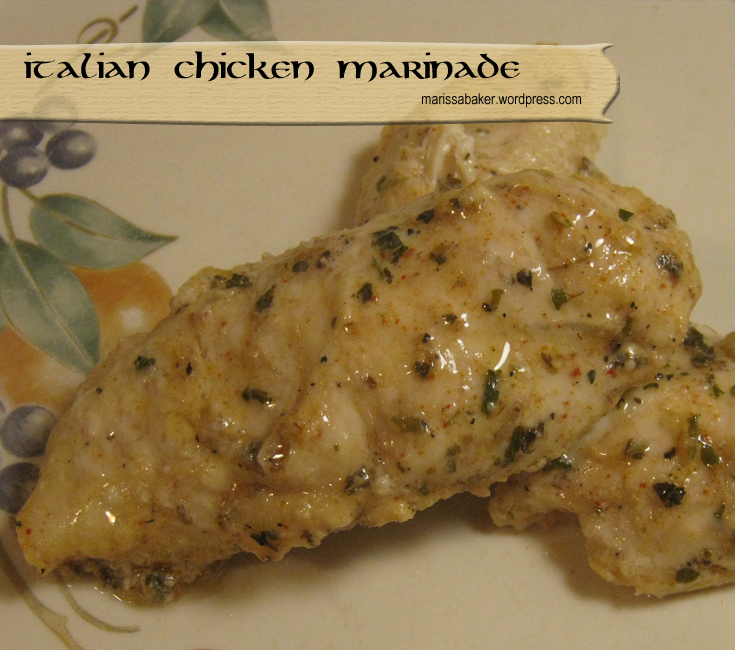
Italian Chicken Marinade | marissabaker.wordpress.comI ran out of the Italian dressing that I use as a marinade, so I decided to try making my own. I’d been thinking about it since reading the ingredients label on the dressing, which I think had more corn syrup in it than vinegar. Bleh.

I’ve tried this recipe out on chicken twice so far — once smothering the marinated pieces in tomato sauce and cheese and once baked on it’s own to accompany a potato side dish. It tasted good both ways. Let me know what you think if you try it in another dish or on a salad!

Italian Chicken Marinade

Italian Chicken Marinade | marissabaker.wordpress.com
spice mix

1 teaspoon sugar

1/2 teaspoon basil

1/2 teaspoon oregano

1/2 teaspoon parsley

1/2 teaspoon paprika

1/4 teaspoon salt

1/4 teaspoon pepper

1/4 teaspoon garlic powder

1/4 teaspoon onion powder

1 teaspoon lemon juice

3 Tablespoons olive oil

3 Tablespoons red wine vinegar

Italian Chicken Marinade | marissabaker.wordpress.com
whisk, whisk, whisk!

Combine all dry ingredients in a small bowl. Whisk in lemon juice, olive oil, and vinegar. Pour over chicken and marinade for at least 20 minutes.

Italian Chicken Marinade | marissabaker.wordpress.com
makes plenty of marinade for 10 to 15 chicken tenders.

The Phantom of the Opera

I choose The Phantom of the Opera by Gaston Leroux as the first book to read off my Classics Club book list for one simple reason. I had a dream about it.

The edition I read

Now, understand I’ve never read this book before. It’s not even one I checked out of the library, flipped through, and lost interest in. So when I dreamed about seeing the written pages of this book morph into film-like scenes that were not in the 2004 film or the play I saw this year, I decided I needed to read this book. It’s not unusual for me to dream vividly, but it was a bit odd to construct such an elaborate version of  something I hadn’t thought about recently.

So I ordered it into the library and read it (in translation, unfortunately, since my French isn’t very good). And I was pleasantly surprised to enjoy the book. It must have been almost 10 years ago that I first became seriously interested in the musical The Phantom of the Opera, and at the time I decided against reading the book because so many reviewers I read said they were disappointed. They said if you like the play, don’t bother reading the book because Andrew Lloyd Webber somehow managed to pull brilliance out of a terrible novel.

Overall Impressions

It is not a terrible novel, though I understand why some readers didn’t like it. Many who love the musical expect a more romantic Phantom character, while Leroux’s Erik (a.k.a. The Phantom) is firmly rooted in a Gothic tradition of villainy. He sleeps in a coffin. His lair includes a torture chamber. He has no nose in his deathly-pale face.

But we’ll get to comparing it with the play later. For now, back to the book. It is written as if by a narrator who began studying the events surrounding the tragedy of the Paris Opera House about 30 years after its haunting by the “ghost.” This haunting coincided with the famous disappearance of Christine Daaé and the Vicomte de Chagny. Our narrator connects these two events, interviews the only witness who is both surviving and locatable, and happens into possession of some very intriguing documents attesting to the ghost’s antics. In short, he is uniquely positioned to be the only person qualified to uncover the truth regarding the opera ghost.

Parts of the story are told as we would think of a “normal” 3rd-person narration, others are the narrator’s conjectures about what might have taken place, still others are written as if borrowed from the memoirs of a few key characters. This rather disconnected narrative style works surprisingly well, and there were only a few places where I thought it jarring to be reminded that the narrator is supposedly piecing this story together from multiple sources of evidence.

Comparing Phantoms

The Phantom of the Opera (1925)

Probably the main change from the book to the play is how Erik is portrayed. This blog post about The Many Faces of Erik collects pictures of the Phantom’s portrayal in film and on stage, both before and after Webber’s musical. I could have nightmares about that face from the 1925 version, but it’s probably the closest to Erik in the book.

Erik is described as having “a death’s head,” and his hands are skeletal and cold. Even the most ghoulish Phantom make-up in Andrew Lloyd Webber’s musicals can be hidden under a half-mask. In the book, the entire man is deformed in some vague way that can’t really be hidden. The people who glimpse him even in disguise get the impression of a ghost or skeleton.

And his character is more twisted in the book as well. In the play, we know the Phantom as a genius who has gone mad and kills to protect his secrets. In the book, we are given more of Erik’s back-story and made to see him not as an unstable, unloved man who is carried away by his passion, but as a violent man without a conscience who has a history of inventing new ways to kill and torment people for pleasure. He captures our imagination, our horror, our pity, but not our love.

Angel of Music

Christine and Raoul’s back-story was very similar in the book and play, with the book simply being more fleshed-out. I liked Raoul less in the book, though. He seems a rather pale, helpless character who follows Christine around vacillating between hating of her for loving someone else and being willing to do anything to protect her from Erik. If he was translated perfectly from the book to the musical and the changes for the Phantom left in place, I doubt there’s be any part of me hoping for Raoul to win Christine.

Poor Christine, in the book and play, was doomed by her father’s promise to send her the Angel of Music. This is built-up even better in the book, with her father telling stories about how the greatest musicians heard the Angel of Music, who moved them from talented to unforgettably brilliant. Christine’s father was a great violinist, but never heard the Angel. His daughter, however, was waiting for him to send one from heaven, and when Erik first sings to her she asks if he is her Angel. He grasps the title eagerly, and she’s lost to his music.

His voice first appears in the book simply as a speaking voice — the man Raoul hears but cannot find in Christine’s dressing room and the invisible speaker in Box 5. Madam Giry calls it “such a lovely man’s voice … so soft and kind.” When Erik finally sings, the word “captivating” hardly seems to do the listeners’ reactions justice:

The voice without a body went on singing; and certainly Raoul had never in his life heard anything more absolutely and heroically sweet, more gloriously insidious, more delicate, more powerful, in short, more irresistibly triumphant. He listened to it in a fever and he now began to understand how Christine Daaé was able to appear one evening, before the stupefied audience, with accents of a beauty hitherto unknown, of a superhuman exaltation, while doubtless still under the influence of the mysterious and invisible master.

Sierra Boggess as Christine and Ramin Karimloo as The Phantom in “Phantom Of The Opera At Royal Albert Hall.”

The voice was singing the Wedding-night Song from Romeo and Juliet. Raoul saw Christine stretch out her arms to the voice as she had done, in Perros churchyard, to the invisible violin playing The Resurrection of Lazarus. And nothing could describe the passion with which the voice sang: “Fate links thee to me for ever and a day!”

The strains went through Raoul’s heart. Struggling against the charm that seemed to deprive him of all his will and all his energy and of almost all his lucidity at the moment when he needed them most, he succeeded in drawing back the curtain that hid him and he walked to where Christine stood. (from Chapter IX)

Michael Crawford (original Broadway cast), Ramin Karimloo (25th anniversary cast), and Cooper Grodin (touring cast I saw in Columbus) have voices like this. That spectacular voice, which mesmerizes Christine and the audience, is the secret of Erik’s allure. Without it, he would just be a hideous man with an even more hideous soul hiding under an opera house. But add this voice, and he becomes something unforgettable — the dark menace who should be repulsive but is somehow irresistible.


Click here to get a copy of The Phantom of the Opera. Please note that this is an affiliate link. This means that, at no additional cost to you, I will receive a commission if you click on the link and make a purchase.