I found this amazing Homemade Caramel Corn recipe a couple weeks ago on a blog called Gimme Some Oven. The first recipe I had tried was too sticky and burnt easily, but this one is just right. The only alterations I made to the ingredients was less salt in the caramel. I also had to use two roasting pans to bake the corn — it just wouldn’t fit in one. I had them on two different racks in the oven, and switched the pans back and forth when I stirred them so the corn would be heated evenly. The recipe says it will keep for up to a week, but we’ve never had it last much more than 24 hours. If there’s any left, it will be something to munch on while watching Doctor Who.
I have no idea who the artist is, but this is a great painting. Here’s where I found it: doctorwhotv.co.uk
Since I became a Whovian, I’ve actually been looking forward to Christmas. As someone who does not observe the holiday, my previous feelings around this time of year mainly consisted of frustration with the endless barrage of Christmas music on the radio. Now, I look forward to “Whomas.” This year, however, I dread the Christmas special more than I anticipate it. I’m interested to see what kind of Doctor Peter Capaldi will be, but I don’t want to see Matt Smith leave. With his impending regeneration, I’ll have to make sure there’s a box of tissues on hand as well as the caramel corn.
Homemade Caramel Corn
don’t be afraid to let it cook on low for 5 minutes without stirring – it won’t burn
12 cups freshly popped popcorn (about 1 cup kernels before popped)
1/2 cup unsalted butter
1 cup light brown sugar, packed
1/4 cup light or dark corn syrup
1 teaspoon salt
1/4 teaspoon baking soda
the finished caramel
1/2 teaspoon vanilla extract
Preheat oven to 300 degrees F. Line two rimmed baking sheets or roasting pans with aluminum foil, and grease with cooking spray. Begin popping popcorn.
Melt butter in a large pot over medium-high heat. Add brown sugar and corn syrup, stir to combine. Bring to a rolling boil, then reduce the heat to low and let simmer undisturbed for 5 minutes. Stir, then continue to cook for an additional 4 to 6 minutes, stirring every 30 seconds, until the mixture is a deep golden color. Turn off the heat and slowly whisk in salt, baking soda and vanilla.
Pour caramel over the popcorn and toss until it is evenly coated with the caramel, being sure to scrape the caramel off the bottom of the pot. Spread the mixture onto the prepared baking sheets or pans in an even layer.
baking in the oven
Bake for 15 to 20 minutes, stirring every 5 minutes, until the caramel corn has turned a deep amber color. Remove the caramel corn from the oven and transfer to a surface covered with parchment or wax paper to cool (or lift the foil out of the pans and place it on the counter). Once it reaches room temperature, use your hands or a spoon to break up the caramel corn, then store in an airtight container for up to a week.
Optional: you can melt about 1/3 cup of milk chocolate and drizzle it over half the popcorn. It’s pretty tasty, but I didn’t do that this time because it takes so much longer to set-up and it’s messy to eat when still melted.
Having watched Frozen last Tuesday (I shoveled the driveway so I could get to the theater) I’ve been in a Disney watching mood. Since my sister and I had been discussing Lucifer the cat’s role in Cinderella recently, I decided to start with that film.
Is this really the story of poor, misunderstood cat?
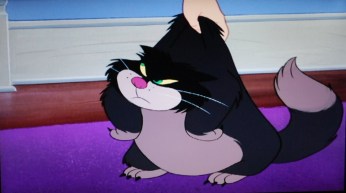
The mice describe Lucify as “meany, sneaky, jump at you.” But if Lucifer the cat could talk, what would his version of this film look like? Cinderella wakes him up early every morning, orders him to “come,” and then shuts the door on his rump. Next, she takes Lucify down to a kitchen inhabited by a dog – a dog that mocks him and dreams of chasing and eating him. If he tries to defend himself by getting that horrible dog thrown out of the house, Cinderella berates him.
But Cinderella isn’t the only person in this house who torments the cat. Cinderella says, “It’s certainly not my idea to feed you first,” which shows that it’s his owner’s idea to wake him up early. She also decrees that “Lucifer gets his bath,” a bath clearly meant to punish Cinderella at the cat’s expense. And then the stepmother leads a music lesson for her off-tune daughters in the room Lucify has chosen for his nap. It would make anyone grumpy.
On top of this, he is surrounded by a mouse infestation encouraged by the woman who drags him out of bed every morning. These mice must be gotten rid of – they are on the tables, in the serving trays, stealing trim from the sewing room, and have the entire house honeycombed with tunnels and secret doors — but when he catches one Cinderella takes his prize away and shakes him. These aren’t just any mice either – they attack him unprovoked in the middle of breakfast! They pluck out his whiskers, pull his tail, topple a broom on his head, trick him and snap a button in his face, pull on his eyelids, then one turns into a horse and attacks him. Finally the mice come after him with forks and fire, the birds gang up on him to drop pots and pans on his head, and they set the dog on him and he falls out of the tower (in the original uncut version, it is clear that this fall was fatal).
Not A Grimm Tale
Contrary to what you might read when people are contrasting Disney fairy tales with the “original Grimm version,” Disney’s Cinderella is not based on the version told by the Brothers Grimm, but rather on Charles Perrault’s “Cinderella, or The Little Glass Slipper” (as stated in the opening credits). This is the story where Cinderella sleeps in “the garret at the top of the house,” the one with a fairy godmother and magic pumpkin, and where the stepsisters’ feet don’t fit the glass slipper. It does depart from Perrault’s tale in a few aspects. For one thing, Cinderella’s father is absent from the story, but not necessarily dead, nor is Cinderella included in the invitation to the ball. She does not even ask to go, and says “That would not befit me at all” when her stepsisters teasingly ask if she would like to go to the ball. The ball lasts two days, and she leaves her slipper the second night. Her sister’s beg her forgiveness at the end, and she arranges marriages for them with “two great noblemen of the court.”
Grimm’s “Cinderella” is like Perrault’s concerning the main story (a girl is mistreated by her step-family, goes to a ball magically, leaves her shoe, and marries a prince), but there are significant differences. In this story, there is no fairy godmother – Cinderella’s father brings her a twig which she plants on her mother’s grave and it grows into a magical tree with a bird that lives in its branches and throws her “whatever she had requested.” That is where she gets the clothes for all three days of the ball. She does not loose her slipper because she is fleeing before the magic disappears – the prince coated the castle steps with pitch so she couldn’t run away so fast. The slipper that he gets as a result of this trick is made of gold. Both step sisters cut off parts of their feet to fit in the shoe, and the prince only notices the blood oozing out when they are halfway back to the castle. The Prince asks Cinderella’s father is he has any other daughters (he’s clearly alive in this version), and the man says, “No. There’s only little Cinderella, my dead wife’s daughter, who’s deformed, but she can’t possibly be the bride.” The prince demands to see her and marries her when the shoe fits. At the wedding, the stepsisters eyes get pecked out by birds.
Would the prince have married Cinderella if he didn’t have to chase her?
This isn’t so much a question inspired by re-watching Cinderella as it is something I’ve been wondering for a while now. Why does the prince pick Cinderella? Yes, I know it’s a fairy tale and he has to marry her for the happy ending, but it becomes an important question if you want to tell a story that fleshes out the prince’s character (my retelling makes them childhood friends to get around this problem). There’s even an entire song devoted to this question in the Rodgers and Hammerstein version: “Do I Love You Because You’re Beautiful?”
In this Disney film, the prince appears for the first time 48 minutes into the story. We don’t hear their meeting – we just see him bow and kiss her hand (it evidently wasn’t much of an introduction. She doesn’t realize he’s the prince, and he doesn’t know her name). He doesn’t even have a line until singing “So This Is Love.” Between the palace, and the waltzing, and the walk in the garden it’s a pretty impressive first date. It doesn’t seem like quite enough to lead to matrimony, yet the Grand Duke says, “He won’t rest until he finds her. He’s determined to marry her.” Not that the Prince actually does any searching himself – the Grand Duke is the one who travels around trying on slippers.
In the written version they spend a little more time together and there’s a reason for the secrecy about her name. Perrault’s version has a two-day ball, and Cinderella talks with her stepsisters in her princess guise. She has to keep her name a secret so they won’t know her. In Grimm’s version, the ball lasts three days and she hides her identity because the prince is actually following her far enough each night to question her father about the elusive princess.
While they do spend a little more time together in the written stories, it still doesn’t seem like enough to base a marriage on. The prince can choose any woman in the kingdom to marry, but the one he goes after is the mysterious princess who presents an intriguing challenge. Would she have held his attention if it had been easy to win her hand? I doubt it.
Have you ever taken a pottery or ceramics class? In my hand-formed ceramics course that I took in college, the first assignment was to make a collection of small vessels — pots, vases, bowls, things like that. The first attempts were lumpy, unusable things. One collapsed in on itself, but it looked like a cat with a squished-in nose so I drew whiskers and eyes on the clay and kept it. Some that I thought were good enough broke in the firing. By the time I was finished, I had a small collection of “earthen vessels” that could be used to hold something, but were not much to look at on their own. It is these oddly shaped pots that I thought of when reading this verse:
For it is the God who commanded light to shine out of darkness, who has shone in our hearts to give the light of the knowledge of the glory of God in the face of Jesus Christ. But we have this treasure in earthen vessels, that the excellence of the power may be of God and not of us. (2 Cor. 4:6-7)
We are not fit to hold “the light of the knowledge of the glory of God in the face of Jesus Christ.” But our very inadequacy serves as a helpful reminder that this glory does not belong to us, and that we need to be re-made by Him. Thankfully, God is a much better potter than I am. He isn’t limited by the fact that clay pots can’t be reformed after firing. We can be fired and re-molded multiple time, “being confident of this very thing, that He who has begun a good work in you will complete it until the day of Jesus Christ” (Phil. 1:6)
Trusting The Potter
At a certain level, we are literally made of earth. The clay and potter analogy extends farther than the verses that plainly describe God as our potter.
And the Lord God formed man of the dust of the ground (Gen. 2:7)
Remember, I pray, that You have made me like clay. And will You turn me into dust again? (Job 10:9)
He knows our frame; He remembers that we are dust. (Ps. 103:14)
We are earthen vessels that God is sculpting in His own image. We are being made and remade to be fit vessels for holding God’s Holy Spirit and the very mind of Jesus Christ.
But now, O Lord, You are our Father; we are the clay, and You our potter; and all we are the work of Your hand. (Is. 64:8)
Sculpting can be a painful process. In my ceramics class, we made hand-thrown tiles. When making tile this way, you take a lump of clay and drop or throw it onto a flat surface, pounding it until it flattens itself out enough that you can pat or roll it smooth and cut it into tiles. If the clay was animate, I suppose it would have thought this was torture, but it is a necessary step to make usable tiles. If something goes wrong, you squish the clay back up in a lump and start throwing it all over again.
Then I went down to the potter’s house, and there he was, making something at the wheel. And the vessel that he made of clay was marred in the hand of the potter; so he made it again into another vessel, as it seemed good to the potter to make. Then the word of the Lord came to me, saying: “O house of Israel, can I not do with you as this potter?” says the Lord. “Look, as the clay is in the potter’s hand, so are you in My hand, O house of Israel! (Jer. 18:3-6)
Sometimes, we might think we don’t like what God is turning us into or we find the sculpting process too painful. That’s why we need to keep our eyes on the goal, and remember Paul’s assurance “that the sufferings of this present time are not worthy to be compared with the glory which shall be revealed in us” (Rom. 8:18).
“Woe to him who strives with his Maker! Let the potsherd strive with the potsherds of the earth! Shall the clay say to him who forms it, ‘What are you making?’ Or shall your handiwork say, ‘He has no hands’? (Is. 45:9)
Antidote to Pride
Paul said God has shone His light into our hearts, through we are only imperfect earthen vessels, so “that the excellence of the power may be of God and not of us.” God has chosen to share His mind and presence with His called-out people. That incredible gift could either puff us up — “God chose me because I’m something special” — or inspire humility — “if I’m special, it is only because God made me so by choosing me.”
But God has chosen the foolish things of the world to put to shame the wise, and God has chosen the weak things of the world to put to shame the things which are mighty; and the base things of the world and the things which are despised God has chosen, and the things which are not, to bring to nothing the things that are, that no flesh should glory in His presence. (1 Cor. 27-29)
Pride is one of the things God hates. I doubt very much that He would indwell a person whose habitual attitude is one of arrogance. In Proverbs 6, the list of things “the Lord hates” begins with “a proud look” (Prov. 6:16-17). In Psalms, God says, “The one who has a haughty look and a proud heart, Him I will not endure” (Ps. 101:5). We certainly do not want to foster an attitude that is unendurable to God.
Christ assured Paul, “My grace is sufficient for you, for My strength is made perfect in weakness” (2 Cor. 12:9). I wonder if the flip-side is true as well, that Christ’s strength cannot be “made perfect” in someone who thinks they do not need Him. The rest of the verse would seem to bear this out: “Therefore most gladly I will rather boast in my infirmities, that the power of Christ may rest upon me.” We may be tiny vessels made of clay, but we need not be ashamed of our weakness because it allows Christ to live and work in us.
We very nearly had a crisis last night. I was sitting down to type up this recipe so I could schedule it for this morning when I realized I couldn’t find my notes. This is one of my original recipes, so it didn’t exist anywhere except wherever it was I put it. As you can see, I finally located it in the back of a pink notebook that I’d been taking notes in for something else.
One of my favorite things to cook is Chinese food. Ever since I was old enough eat things that didn’t come out of a baby food jar, my parents have been taking me to their favorite Chinese restaurants trying to teach me to love Chinese food. I guess it worked, since I’m now known around our house as “the red-headed Chinese chef.” I keep hearing how terrible soy sauce it for you, though, and I’ve been wondering if there’s a way to decrease the amount of soy sauce in our food without sacrificing flavor.
This recipe is the result of that experiment. Before this, I’d cut the amount of soy sauce in some dishes by up to half (adding rice wine to make up the difference), but this is the first time I’ve tried a full stir-fry without any soy sauce. The results were encouraging. It was a nice white sauce, similar to Moo Goo Gai Pan. Be sure not to leave out the salt — without the sodium in soy sauce it’s bland until the salt is added.
Note: if you’re going to serve this with long-grain brown rice, start it cooking before you put the chicken in the marinade. It usually takes about 45 minutes to cook.
Cooking the chicken
Marinade
1 pound boneless, skinless chicken breasts
1/2 teaspoon fresh, grated ginger
1/4 teaspoon red pepper flakes
1 tablespoon rice wine
Cut the chicken into bite-sized cubes. Mix in the marinade ingredients in a bowl and add chicken. Marinate for 15 to 20 minutes.
Sauce
Decided to try some of this bean flour I had in the cupboard instead of my usual tapioca starch. It worked pretty well
1 cup chicken broth
2 teaspoons fresh, grated ginger
2 tablespoons flour or starch
1 tablespoon sesame oil
1 tablespoon rice wine
1 tablespoon honey
1/4 teaspoon salt
Whisk the sauce ingredients in a medium bowl. Set aside. Prepare desired vegetables. I used carrots, cauliflower, broccoli, and green onions. Other suggestions include bamboo shoots, zucchini, and button mushrooms.
Let the sauce bubble until tit thickens a little
Heat 1 tablespoon of vegetable oil in a wok or large skillet over medium-high heat. Cook chicken until cooked through (no pink). Add vegetables and stir fry until just tender (they should still be a little crunchy if you bite into one). Chicken juices should be evaporated by now. Add sauce and bring it to boil. Stir while it bubbles and thickens, about 3 minutes. Serve over rice.
Update 6/7/2016: Since publishing this post, I’ve become increasingly unsatisfied with MBTI charts that try to find a character from a film or TV series to fit each type. Not every one of the 16 types appears in a given film or show and many charts (including mine here) include incorrect/forced typings. I leave this post here for archival purposes, and may do an up-dated LOTR chart in the future.
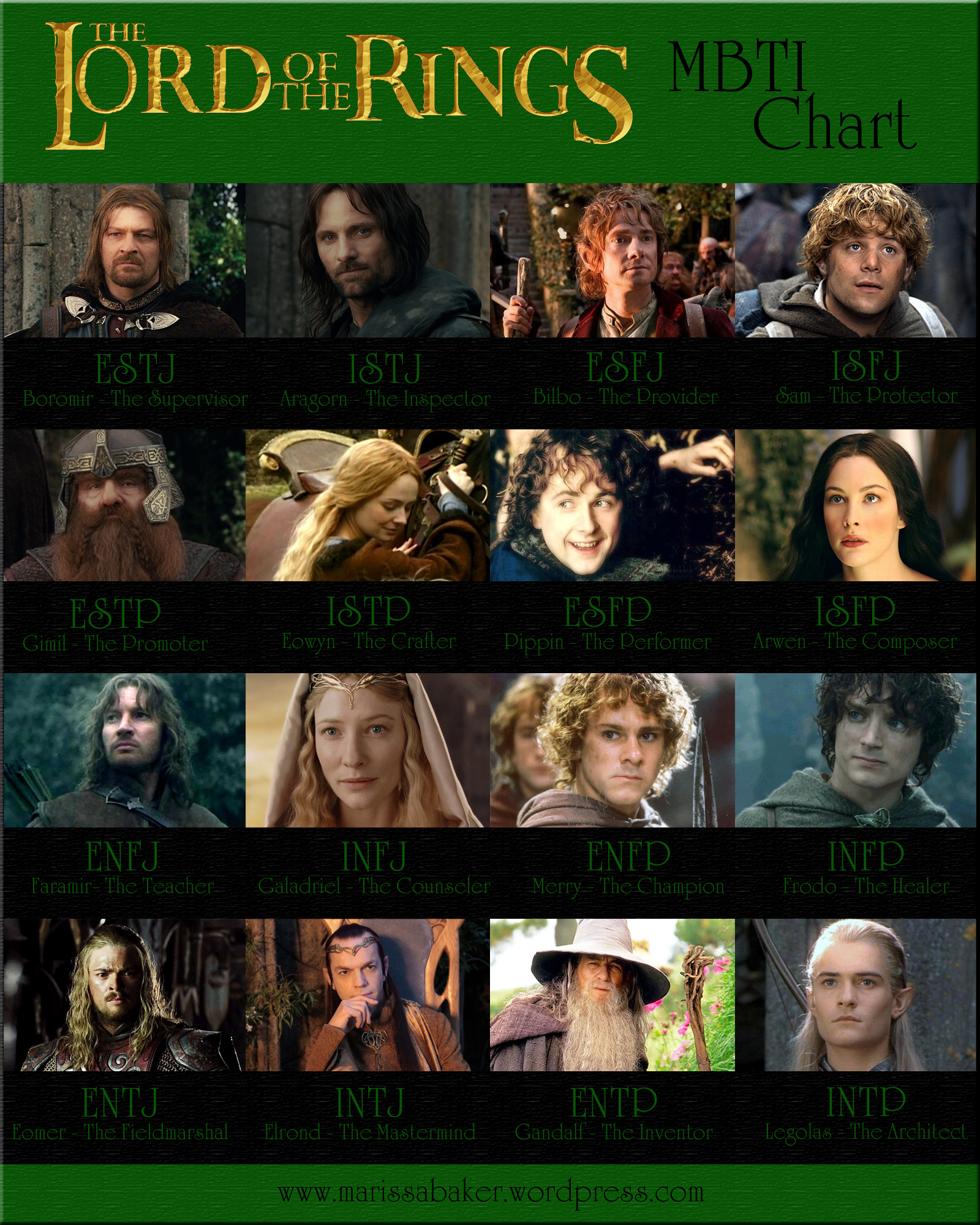
With the The Hobbit: Desolation of Smaug coming out this past weekend, I thought it was time to release my Lord of the Rings MBTI chart. My original idea was make this my 111th blog post so there would also be a tie-in with Bilbo’s fateful birthday party, but after missing some posts I decided just to release it now. This was inspired by the Star Wars chart by Geek in Heels that has been going around the social media sites, and I’m grateful to her for the idea.
I admit not every one of these characters fit perfectly where I put them. This is partly because typing fictional characers is always subjective, partly because I’m not an expert, and partly because there just don’t seem to be that many extroverts in Tolkein’s world. I also wanted to give everyone a good-guy character that they could relate to, which is why you don’t see people like Sauromon or Denethor on this chart (this is for you, INTJs). I do mention them in the discussion below. For the sake of convenience and consistency, I’ve grouped the 16 Myers-Briggs types into the four categories used by David Keirsey’s Temperament Sorter. You can take his test here, or try out an online test that will give you an idea of your Myers-Briggs type here or here.
What follows is an explanation of why I chose each type for these particular characters, so you can see the reasoning behind my choices and pick-apart my ideas if you disagree 🙂 Since there are so many characters in Lord of the Rings and The Hobbit, I’ve also mentioned other characters which might share each type. For the following information about cognitive functions and different Myers-Briggs types, I rely heavily on Dr. A. J. Drenth’s Personality Junkie website. For the sake of time, I’m mainly focused on the first two functions in each type’s function stack.
Tolkein’s Guardians
Supervisor (ESTJ) — Boromir
Extroverted thinking (Te) is an ESTJ’s dominant function. This makes ESTJs quick to express their ideas, usually in the form of judgements and measurable goals. Take, for example, Boromir’s eagerness to speak out at the Counsel of Elrond and his insistence that his plan for using the ring was the right one. An ESTJ’s auxiliary function is Introverted Sensing (Si). Supporting Te, this can make ESTJ’s appear stubborn because they prefer life to be predictable.They like tradition rather than change — “Gondor has no king. Gondor needs no king.”
Inspector (ISTJ) — Aragorn
Most characters seem to have fairly consistent personalities between the books and the films. Aragorn may be an exception. It’s been a while since I read Lord of the Rings, but I think if I was typing Aragorn from the books he might be an extravert. I’ve also seen the film version typed as an INTJ, an ISFx, and an ISxP.
Si is an ISTJ’s first function. Like ESTJs, this makes them interested in preserving old ways of doing things and resistant to change. For Aragorn, you can see this in his conflict about whether to take his rightful place as king or leave things the way they are. As an auxiliary function, Te manifests itself as a tendency for ISTJs to think out loud and share their ideas and plans. They like order and control, and this helps make Aragorn an efficient and effective leader.
Other ISTJs: this might be a good match for Treebeard — I would definitely describe him as an introverted Guardian type.
Provider (ESFJ) — Bilbo
Keirsey calls providers “the most sociable of all Guardians” and says they are “friendly, outgoing, [and] neighborly” to the point that they become “restless when isolated from people.” He also adds that they are careful to remember birthdays. Starting to sound like a hobbit?
An ESFJ’s primary function is Extroverted Feeling (Fe). This makes them quick to express their opinions and judgements, though they like to do this in a way that maintains peaceful social functions. Note how Bilbo responds to the arrival of all the dwarves — he is not shy about letting them know what he thinks about their unexpected arrival, yet he still plays the perfect host. Like other types with Si as an auxiliary function, ESFJs can become set in their ways and comfortable with routine (which is what makes him appear introverted when he is upset about being disturbed by company).
Protector (ISFJ) — Sam
Not many fictional characters are as easy to type as Samwise Gamge. He is the perfect ISFJ. Like the ISTJ, an ISFJ’s primary function is Si and they tend to resist change and be comfortable with traditional ways of doing things. They tend to settle down and be comfortable with routine (Sam never considered leaving The Shire until Frodo went on his quest). With Fe as an auxiliary function, ISFJs are very people-oriented and attuned to the needs of others, especially their close friends. They have a strong sense of responsibility and loyalty, and readily serve others — “Come on, Mr. Frodo. I can’t carry it for you… but I can carry you!”
Tolkein’s Artisans
Promoter (ESTP) — Gimli
Gimli might not seem an obvious choice for the ESTP character, since they are often charming, life-of-the-party types who enjoy stylish dressing and living well. But translate all that into a dwarf, and I’d say Gimli probably thinks fits the description. Extroverted Sensing (Se) is an ESTP’s primary function. This tends to make them seek out thrills, take risks, and flirt with danger (“Certainty of death, small chance of success… What are we waiting for?”). They also love food, drink, and merry making — which you can see in Gimli as he celebrates after the Battle of Helm’s Deep. Introverted Thinking (Ti) is his auxiliary function, and he can become serious and intense when called upon to make decisions or deal with feelings.
Crafter (ISTP) — Eowyn
According to Dr. A. J. Drenth, there are about three times as many ISTP men as women. Perhaps this is one reason Eowyn felt so out of place. An ISTP has the same functions as an ESTP, but reversed so Ti is first and Se is second. Keirsey calls them “crafters” because they have an impressive ability to master the use of tools. For Eowyn, the tools she chooses to focus on are weapons, and she is an accomplished fighter. ISTPs love action, crave excitement, and feel frustrated if they can’t act impulsively. They prefer to show their feelings through actions rather than words (Eowyn making soup for Aragorn and wanting to fight at his side).
Other ISTPs: Thorin — man of few words, inwardly thoughtful, physically active and skilled with weapons. Also known as one of several dwarves who make me want to cry every time they are on-screen because I know what’s going to happen to them in the next film 😦
Bonus round: My cousin and I were talking last night about what type Smaug might be. I decided on introvert, since he is so comfortable with being alone, and SP since they are the types most likely to be both concerned with physical wealth and unconcerned with what people think of how they acquire that wealth. He’s not caring or people-oriented, which rules out ISFP. So, I’m going with narcissistic ISTP in dragon-form.
Performer (ESFP) — Pippin
Pippin was the first character I added to the chart. I keep picturing him dancing on a table and singing “The only brew for the brave and true comes from the green dragon!” Performers/ESFPs are talkative, engaging, like to be around people, and become the center of attention wherever they go. Like the ESTP, they enjoy good food and drink and will rush into things without stopping to weigh the consequences (asking “Where are we going?” after joining the Fellowship). Introverted Feeling (Fi) is his auxiliary function, and that adds a seriousness to Pippin’s character which is not readily visible (because usually introverted). It shows up during the siege of Minas Tirith.
Composer (ISFP) — Arwen
Though they share functions with ESFPs (Fi and Se), ISFPs tend to look very different. They are people-oriented, caring deeply for others and having a heightened sensitivity to suffering. This can be seen in Arwen’s deep attachment to Aragorn, her willingness to risk the Ringwraiths to save Frodo’s life, and starting to waste away because of “the evil that now spreads from Mordor.” She’s not as playful as typical SP types are usually described, but I think part of that is the fact that she is an elf and that Fi (which seems emotionally mature and serious) is her dominant function.
Tolkein’s Idealists
Teacher (ENFJ) — Faramir
I had such a hard time deciding who to put on the chart for this personality type. I’m not entirely convinced Faramir fits, but he’s the closest I could up with and the more I think about it the more I think this might be right. Extroverted Feeling (Fe) as a primary function means that an ENFJ’s sense of self is largely tied-up in their relationships with others. Growing up with Denethor constantly belittling him would have been devastating for little ENFJ Faramir, and would contribute to making him less sure of himself than a typical ENFJ. However, you can still see ENFJ traits of good leadership and an intuitive understanding of people when you look at the loyalty Faramir’s men have for him and his encounter with Frodo and Sam. His Introverted Intuition (Ni) helps explain why Faramir went with his gut feeling and let Frodo and Sam go.
Other ENFJs: Watching The Hobbit: Desolation of Smaug yesterday made me think Balin might be an example of a mature ENFJ character.
Galadriel seems like a fairly standard INFJ character — otherworldly, introverted, wise, cares about others. INFJs have such a strong intuition that even some human INFJs report visions much akin to Galadriel’s and the feeling that they could almost be telepathic. As an elf in a fantasy world, Galadriel really is telepathic and can glimpse the future. She can also see right through people to discern their motives, as shown by her reaction to Boromir (or more tellingly, his reaction to her). They appear serious on the outside and are usually content to passively observe until they feel moved to speak. For more on INFJs, see this post.
Champion (ENFP) — Merry
With Extroverted Intuition (Ne) instead of sensing as his dominant function, Merry is more serious and given to reflection than Pippin. Unlike most hobbits, Merry is open-minded about the outside world and restless. He joins Frodo’s quest not just for the change of pace but because he recognizes the importance of destroying the ring. His commitment to fighting with the Rohirim and supporting Eowyn is typical of the ENFP championing causes they believe in.
Healer (INFP) — Frodo
In spite of the memes going around showing Frodo as an INFJ, he is generally considered an INFP by people who are more serious about their typology hobby. Fi is an INFP’s dominant function, and like ISFPs their emotions run deep. They are loyal to their friends and enjoy people, though at the same time can become loners who like to spend time in the outdoors. Sharing Ne (as their auxiliary function) with ENFPs, INFPs are also interested in championing causes. In the INFP’s case, they seek to heal conflicts and bring the world into a state of goodness.
Tolkein’s Rationalists
Fieldmarshal (ENTJ) — Eomer
ENTJs are natural leaders, and often find themselves in command even without seeking it. When leadership skills are encouraged, as with Eomer being trained to fight and lead, they become skilled commanders. Te as a primary function means ENTJs like order and rationality and planning is one of their strengths. They will respect authority to a point, but disobey orders if they feel the situation calls for it (Eomer standing up to Wormtongue). Ni adds a reliable gut instinct. Others might see them as hurried, wanting people to “cut to the chase,” and abrupt when making judgments (see the scene where Eomer meets and rapidly interrogates Aragorn, Gimli, and Legolas).
Other ENTJs: Possibly Theodin. I’m not sure.
Mastermind (INTJ) — Eldrond
I asked my INTJ sister who she thought might share her type in LOTR, and this is who she thought of. The primary function Ni gives them a view of the big picture and a keen insight for how the world works. Unlike INFJs, though, they use Te as an auxiliary function which makes them theorists who always have a plan or two (Plan A: send Arwen to the Undying lands. Plan B: reforge the sword and make Aragorn king). They often appear as aloof intellectuals and share a natural bent for leadership with ENTJS, but prefer to stay in the background until called upon to take charge for a short while (Counsel of Elrond).
Other INTJs: Masterminds make excellent villains, which I suppose would be why I’ve seen all the main villains typed as INTJs at one point or another. Saruman and Sauron I can see as INTJs, but I’m not convinced about Grima Wormtongue and Denethor.
Inventor (ENTP) — Gandalf
Gandalf is another character people don’t agree on how to type. I’ve seen him variously classified as an INTJ (most often), INTP, INFJ, and ENTP. I tend to lean toward this last one. He’s not focused enough to be an INTJ and instead of taking charge at a crucial moment, he steps back from leadership and says “Let the Ring-bearer decide” whether or not to go through the Mines of Moria.
As an ENTP, Ne is his primary function. He is curious, likes to collect data and use it to discover patterns, can see both sides of an issue, and uses his inventiveness to work with people as well as try to change social systems. Dr. Drenth says they “brainstorm aloud” and “may not always seem to ‘have a point,’” which Gandalf will do for page after page in the book. Auxiliary Ti gives him a respect for logic and reason. ENTPs are typically non-conformist and have many friends (enjoys Bilbo’s party, knows people all over Middle Earth).
Architect (INTP) — Legolas
An INTP’s primary function is Ti, followed by Ne as the auxiliary function. Kiersey notes that it is hard for them to listen to discussions without pointing out a speaker’s error (Legolas correcting Boromir at the Counsel of Elrond), and they would rather talk about ideas than about daily events or people. They are highly disciplined, which can help them achieve proficiency with something like archery, and also makes them appear serious.
UPDATE: Several people have pointed out (here and on other sites) that typing Legolas as an INTP is … controversial. For me, he is a hard character to type, and I’m not entirely sure about labeling him an INTP. I’m not sure what else to call him, though, or who else in LOTR might qualify as an INTP. Any thoughts?
Further Reading
There are a few other bloggers I found who did Myers-Briggs typologies for Lord of the Rings Characters. Sometimes my types agree with theirs, sometimes we interpret things a little differently. Here are their websites:
We tend to approach death with a kind of horror, even though we know that it is not permanent (1 Thes. 4:13-18). It is natural to value life, to not want to die and to not want to lose the people we love. I think much of our longing to live forever comes from a desire God has given us to become part of his family. But sometimes I hear people say they want to live forever, and they mean an indefinite extension of our human lives here on the earth. Personally, I wouldn’t want to live with myself the way I am now for that long.
When I think about the idea of immortality or living a really long time as a human, it makes me think of Tolkein’s elves in Middle Earth. Unless something interferes (they can be killed and they can fade away with grief) they’ll live forever. One of the things I find most interesting is that in The Silmarillion, the immortality of the elves is described as a sorrow and death is presented as a gift given to men.
the children of Men dwell only a short space in the world alive, and are not bound to it, and depart soon whither the Elves know not. Whereas the Elves remain until the end of days, and their love of the Earth and all the world is more single and more poignant therefore, and as the years lengthen ever more sorrowful. For the Elves die not till tile world dies, unless they are slain or waste in grief (and to both these seeming deaths they are subject); neither does age subdue their strength, unless one grow weary of ten thousand centuries; and dying they are gathered to the halls of Mandos in Valinor, whence they may in time return. But the sons of Men die indeed, and leave the world; wherefore they are called the Guests, or the Strangers. Death is their fate, the gift of Iluvatar, which as Time wears even the Powers shall envy.
Sown in Weakness
Death became something that every human being must face as a consequence of Adam and Eve’s sin. I wonder, however, if after the fall mortality might have been as much a gift as a curse. Yes, death is a penalty associated with disobedience to God and it is an enemy that will be conquered in the future. But the absence of death in our fallen state would not have been a kindness.
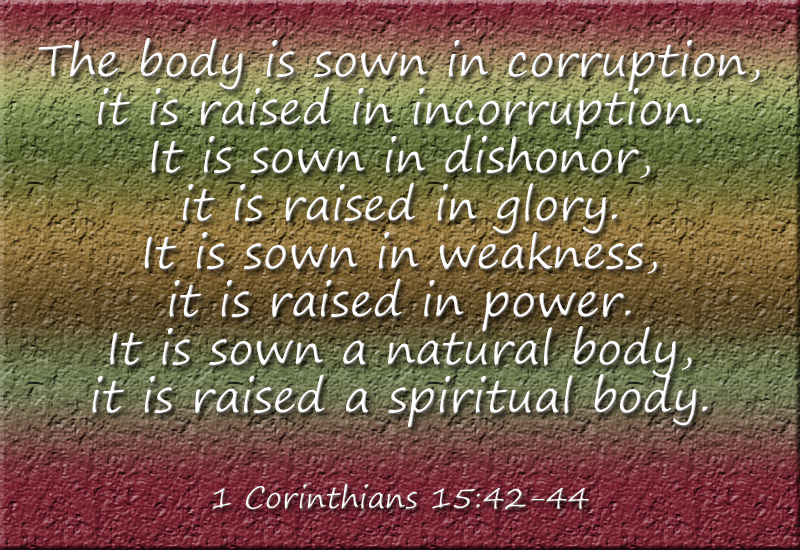
Foolish one, what you sow is not made alive unless it dies. And what you sow, you do not sow that body that shall be, but mere grain—perhaps wheat or some other grain. But God gives it a body as He pleases, and to each seed its own body. (1 Cor. 15:36-37)
We are “bare grain,” as the KJV says, which after it dies to this existence will spring up into the far more glorious body that God gives us. Thank God that immortality is not give not us as we are now — corrupted, dishonored, weak, and natural. Living like this forever would not be a gift. We cannot have eternal life as we are now, nor would we want to. We need to be changed first.
For this corruptible must put on incorruption, and this mortal must put on immortality. So when this corruptible has put on incorruption, and this mortal has put on immortality, then shall be brought to pass the saying that is written: “Death is swallowed up in victory.” (1 Cor. 15:53-54).
 I found this amazing Homemade Caramel Corn recipe a couple weeks ago on a blog called Gimme Some Oven. The first recipe I had tried was too sticky and burnt easily, but this one is just right. The only alterations I made to the ingredients was less salt in the caramel. I also had to use two roasting pans to bake the corn — it just wouldn’t fit in one. I had them on two different racks in the oven, and switched the pans back and forth when I stirred them so the corn would be heated evenly. The recipe says it will keep for up to a week, but we’ve never had it last much more than 24 hours. If there’s any left, it will be something to munch on while watching Doctor Who.



 The mice describe Lucify as “meany, sneaky, jump at you.” But if Lucifer the cat could talk, what would his version of this film look like? Cinderella wakes him up early every morning, orders him to “come,” and then shuts the door on his rump. Next, she takes Lucify down to a kitchen inhabited by a dog – a dog that mocks him and dreams of chasing and eating him. If he tries to defend himself by getting that horrible dog thrown out of the house, Cinderella berates him.
 On top of this, he is surrounded by a mouse infestation encouraged by the woman who drags him out of bed every morning. These mice must be gotten rid of – they are on the tables, in the serving trays, stealing trim from the sewing room, and have the entire house honeycombed with tunnels and secret doors — but when he catches one Cinderella takes his prize away and shakes him. These aren’t just any mice either – they attack him unprovoked in the middle of breakfast! They pluck out his whiskers, pull his tail, topple a broom on his head, trick him and snap a button in his face, pull on his eyelids, then one turns into a horse and attacks him. Finally the mice come after him with forks and fire, the birds gang up on him to drop pots and pans on his head, and they set the dog on him and he falls out of the tower (in the
  In this Disney film, the prince appears for the first time 48 minutes into the story. We don’t hear their meeting – we just see him bow and kiss her hand (it evidently wasn’t much of an introduction. She doesn’t realize he’s the prince, and he doesn’t know her name). He doesn’t even have a line until singing “So This Is Love.” Between the palace, and the waltzing, and the walk in the garden it’s a pretty impressive first date. It doesn’t seem like quite enough to lead to matrimony, yet the Grand Duke says, “He won’t rest until he finds her. He’s determined to marry her.” Not that the Prince actually does any searching himself – the Grand Duke is the one who travels around trying on slippers.







 Bonus round: My cousin and I were talking last night about what type Smaug might be. I decided on introvert, since he is so comfortable with being alone, and SP since they are the types most likely to be both concerned with physical wealth and unconcerned with what people think of how they acquire that wealth. He’s not caring or people-oriented, which rules out ISFP. So, I’m going with narcissistic ISTP in dragon-form.