7 Fictional Characters That You’ll Relate To If You’re An ESTJ

What fictional characters do you relate to as an ESTJ?

Just as we can describe real people using the Myers-Briggs® typology system, we can also type well-written fictional characters. Some of fiction’s most iconic and intriguing characters are ESTJs and today we’re going to talk about seven that I think real-life ESTJs will find relatable.

One great thing about looking at character personality types is that it helps us better understand people who have different types than we do. Fictional ESTJs can serve as examples for what real-life ESTJs might be like, and also show how much variation can exist between individuals with the same type.

The things that makes ESTJs such great fictional characters are much the same things that makes them such interesting people in real life. They tend to be well organized, disciplined, and skilled at making tough decisions. This makes them excellent leaders, something we see in most of the ESTJ characters on this list.

Bryan Mills

I haven’t seen Taken, but Susan Storm lists Bryan Mills as the ESTJ in her post “The Greatest Movie Heroes of Every Myers-Briggs® Personality Type.” She says that he “He embodies the quick-thinking precise nature of the ESTJ. He knows how to take charge, create an effective plan, and can easily give instructions to other people over the phone on how to move forward.” Like so many TJ types, he’s able to put emotions aside and take decisive, logical action.

As for the other aspects of his character, Susan says, “Mills shows his Introverted Sensing (Si) in the way he systematically pays attention to everything around him.” Like other ESTJs, he’s a detail-oriented person and can easily recall important information. He also relies on skills acquired in his past to solve the problems of his present situations — something SJ types tend to do very well.

7 Fictional Characters That You'll Relate To If You're An ESTJ | LikeAnAnchor.com
Quote from Taken (2008). Image: Liam Neeson as Bryan Mills

Eve Baird

Eve Baird from The Librarians is a fairly stereotypical example of an ESTJ in fiction, embodying the ESTJ’s blunt demeanor, no-nonsense attitude, and ability to keep things moving forward. ESTJs like Eve are grounded in reality and care about keeping the world running as it should be, a trait Eve devotes to keeping the Library safe and magical artifacts out of the wrong hands. Though she can seem gruff, she’s very loyal and cares deeply about people (a TJ trait that’s often overlooked).

Like other ESTJs, Eve’s preferred mental process of Extroverted Thinking involves measuring and managing impersonal criteria when making decisions. There are examples of this in literally every episode. Her co-pilot process is Introverted Sensing, which filters everything she learns learn through the lens of her own memories and experiences. That’s not to say ESTJs are inflexible. Once given enough information to work with, they’re quick to adapt their actions to match the situation. Anything else would be inefficient. This is partly due to the fact that they prioritize effectiveness, and partly due to their tertiary Extroverted Intuition.

7 Fictional Characters That You'll Relate To If You're An ESTJ | LikeAnAnchor.com
Quote from The Librarians Season 2, episode 9 (2015). Image: Rebecca Romijn as Eve Baird and Noah Wyle as Flynn Carsen

Leia Organa

Leia Organa of the Star Wars saga has a much different personality type than your typical princess figure in fiction. Most are Feeling types, but Leia’s response to Darth Vader, her criticism of her seemingly inept rescuers in A New Hope, and the way she instantly takes charge of every situation are characteristic of dominant Te types. She’s a take-charge sort of person who is fiercely loyal to family and values, and expects the same level of commitment from others.

Like other Sensing types, Leia’s focus is on the here and now. Even through she and the Rebellion (and later the Resistance) are fighting to change the future of the galaxy, she does that by shaping the present in a practical way. Her strengths as an ESTJ type make her a fantastic leader both in the Rebellion against the Empire and, later, in a variety of political and leadership roles. She also makes good use of her tertiary Extroverted Intuition (especially later in life) to help her see multiple solutions to problems and adapt quickly to changing situations.

7 Fictional Characters That You'll Relate To If You're An ESTJ | LikeAnAnchor.com
Quote from of The Last Jedi (2017). Image: Carrie Fisher as Leia Organa

Nick Fury

Nick Fury from the MCU might be more of an ENTJ than an ESTJ, but I include him on this list because I think ESTJs will find the way he uses the TJ side of his personality relatable and (depending on how you read his character) there’s also an argument to be made that he is an ESTJ type. Either way, Fury leads with a strong Extroverted Thinking function and (like many real-life ESTJs) he’s good at crashing through red tape to get the job done. He has zero patience for people who make stupid decisions, and he has cultivated the power needed to go around them.

Fury is motivated to make the world a safer place, even if he has to do that in ways that make other people like ISFJ Captain America uncomfortable. He’s concerned with the big picture and future security (more typical of ENTJs, but could be an ESTJ’s tertiary Extroverted Intuition). He is also highly pragmatic and makes decisions based on what he has learned in the past (more typical of ESTJs).

7 Fictional Characters That You'll Relate To If You're An ESTJ | LikeAnAnchor.com
Quote from of The Avengers (2012). Image: Samuel L. Jackson as Nick Fury

Olivier Armstrong

If you haven’t yet watched Fullmetal Alchemist Brotherhood I highly recommend it. It’s full of amazing characters, including ESTJ Olivier Armstrong. She is an extremely talented leader who commands absolute loyalty from her troops. While people might see her (and, in many cases, real-life ESTJs) as harsh and critical, those who get to know her find her scrupulously honest and see she doesn’t expect anything less of herself than she demands from others.

Major General Armstrong is the sort of character who self-confident, aggressive, go-getting ESTJs will find highly relatable. She doesn’t let other people, circumstances, or even herself stand in the way of what she wants to accomplish. She lives in a world of concrete facts and is devoted to a strong, efficient moral code much like many real-life SJ types.

7 Fictional Characters That You'll Relate To If You're An ESTJ | LikeAnAnchor.com
Quote and image from Fullmetal Alchemist Brotherhood).

Peter Pevensie

Peter Pevensie has been my favorite character from The Chronicles of Narnia since seeing the 2005 movie for The Lion, The Witch, and the Wardrobe (I didn’t read the books until later). In our modern world, ESTJs have a reputation for being the hard-hitting, no-nonsense types that steamroll anyone in their way. Peter’s an example of the more gentle, guardian-like role that characterizes certain ESTJ types.

Like many ESTJs, Peter likes to be in charge but he doesn’t abuse his power. He uses it for others’ good, and is reliable, practical, and logical in all his roles from eldest sibling to high king. He takes his responsibilities very seriously, even making them part of his identity, and has a hard time adjusting to the real world once he has to leave Narnia. Like many real-life SJ types, he doesn’t like change and it takes him a while to figure out how to navigate new situations if he doesn’t have an existing framework for interpreting reality.

7 Fictional Characters That You'll Relate To If You're An ESTJ | LikeAnAnchor.com
Quote from The Lion, the Witch, and the Wardrobe by C.S. Lewis (1950). Image: William Moseley as Peter Pevensie

Tiana

Like many real-life ESTJs, Tiana from Disney’s The Princess and the Frog is never shy about sharing her thoughts or making decisive decisions. She’s assertive and expressive in the face of friends, creditors, and villains alike. With her strong work ethic, family-focus, and adherence to doing what’s right, Tiana is strong example of the SJ Guardian type. She also has another trait I’ve noticed in SJs — they are, as Naveen observes, “secretly funny.”

Even better, Tiana isn’t an SJ stereotype. Many people assume types using Introverted Sensing as one of their functions are unimaginative, solidly traditional, and somewhat boring. That’s far from being true. Like other Sensing types, SJs are concerned with taking in information about the world around them, but they’re also interpreting that information in a highly subjective way. And so you get Tiana, building up a dream of the future that doesn’t look practical to outside observers, but makes perfect sense within her framework of reality. Her dream is solid, detailed, planned, and responsible.

7 Fictional Characters That You'll Relate To If You're An ESTJ | LikeAnAnchor.com
Quote and image from The Princess and the Frog (2009)

7 Fictional Characters That You'll Relate To If You're An ESTJ | LikeAnAnchor.comWhat did you think of this list? If you’re an ESTJ, which fictional characters do you relate to best? Is there anyone you’d add to or take off of this list? I’d love to hear your thoughts!


Feelings Don’t Care About Your Facts: Here’s Why Its so Hard to Change Someone’s Mind

A few weeks ago, I was in a conversation with someone who quoted Ben Shapiro saying, “Facts don’t care about your feelings.” The tension between facts and feelings is a topic that’s been coming up quite a bit in discussions recently for me, as I’ve talked with people who are frustrated by how many people today ignore scientific research related to several issues that I don’t want to get into right now. My reason for bringing this up is that listening to these comments prompted a related thought.

Feelings don’t care about your facts.

You can have all the research in the world to back you up but when feelings are involved people (as a whole) just don’t care. You can’t root out deeply help opinions by inundating people with logical reasoning. It’s like if you’ve ever spilled cooking oil on your clothes and then tried to scrub it out with water. The facts just run right off because they doesn’t mesh with what we already hold true.

“As a result of the well-documented confirmation bias, we tend to undervalue evidence that contradicts our beliefs and overvalue evidence that confirms them. We filter out inconvenient truths and arguments on the opposing side. As a result, our opinions solidify, and it becomes increasingly harder to disrupt established patterns of thinking.” — “Facts Don’t Change People’s Minds. Here’s What Does” by Ozan Varol

At its most simple, “Confirmation bias occurs from the direct influence of desire on beliefs. When people would like a certain idea or concept to be true, they end up believing it to be true.” Once we get an idea in our heads, we tend to hold on tight to information that supports it and ignore or reject anything that would threaten this idea. These tightly-held ideas can be anything from a political view, to an understanding of how the world works, to a belief about yourself (“What Is Confirmation Bias?” by Shahram Heshmat Ph.D.).

It’s Not Just “Them”

We tend to think that we’re right and other people who disagree with us are wrong. We can easily see confirmation bias at work in others, and many of us are more than happy to point that problem out and offer correction.

This isn’t just a problem with other people, though. It’s a problem with you and me too. We all have confirmation bias about the things we believe. We all filter-out opposing information and gravitate toward the things that agree with us. No matter how rational and fact based we think we are, we’re also influenced by confirmation bias. If we want to understand why it’s so hard to change people’s minds we need to recognize what’s happening in ourselves as well as in them. Read more

Putting God in a Clay Pot: How Much Does the Lord Understand You?

Do you ever feel like God doesn’t really know what you’re going through? That He doesn’t get how hard it is to be human or that He expects too much of us?

I think this is an easy thought pattern to fall into. “My problem is something different,” we think. “Other people don’t understand, and maybe God doesn’t either. Sure Jesus was human but that was 2,000 years ago. Things have changed.”

Truth is, though, things haven’t changed that much. “There is no new thing under the sun” because human nature stays the same (Ecc. 1:9). And even if things have changed so much that being human is fundamentally different than it once was, God has still taken steps to make sure He understands us. Evidently connecting with us is very important to Him, because He’s done some pretty incredible things in order to get inside our perspectives and also to share His mind with us. Firstly, He made us. Secondly, He experienced human life by Jesus living as a human. Finally, He indwells His people today through His spirit.

Made

If you make something you understand it. You know all the ingredients in the cookies, you know the hours put into shaping clay into an urn, you know the measurements and materials required to machine that part. God understands us even better than that, for He created all the materials we’re formed from and then fashioned us in His own image.

Like a father has compassion on his children, so Yahweh has compassion on those who fear him. For he knows how we are made. He remembers that we are dust. (Psalm 103:13-14, WEB)

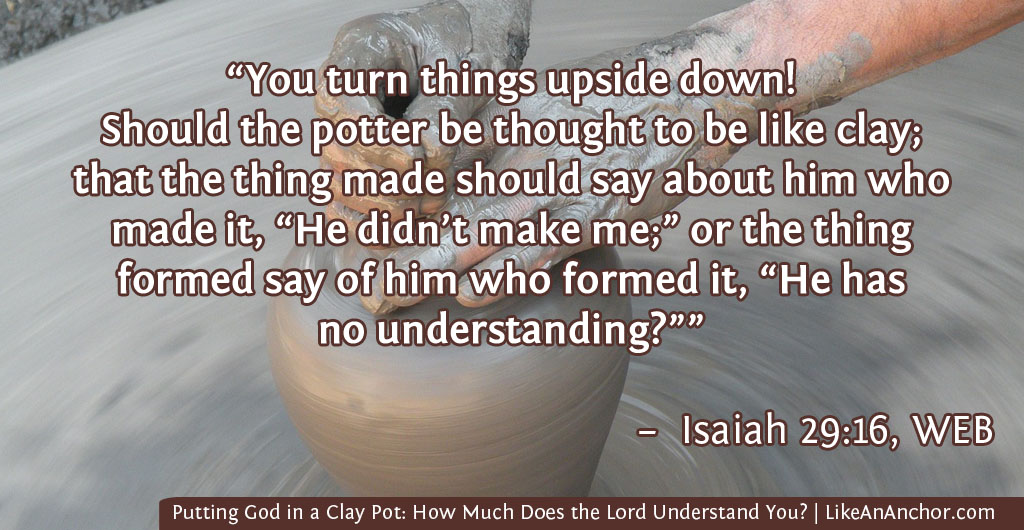
Other translations use the phrase “He knows our frame” (Hebrew word yetser, meaning form, framing, or purpose). God made us and knows all about us. We are something formed by him as if we were clay in the hands of a master potter (Is. 29:16 also uses the word yetser).

However, knowing how to make a clay pot isn’t the same as knowing what it’s like to be a clay pot. He could search us and know us more intimately than anyone else (see my favorite Psalm, number 139 for an example), but God in the Old Testament hadn’t yet lived as one of us.

Lived

They say if you want to understand someone you should walk a mile in their shoes. God did much more than that when the Son came to this earth as a man. He walked 33 years in our human form.

Who, existing in the form of God, didn’t consider equality with God a thing to be grasped, but emptied himself, taking the form of a servant, being made in the likeness of men. And being found in human form, he humbled himself, becoming obedient to the point of death, yes, the death of the cross. (Phil. 2:6-8, WEB)

Having created the form of man, God now inhabited it as the Word who took on the same form He created (John 1:1-4, 14). Both Father and Son were involved in creation (Eph. 3:9) and both were involved in the decision to send Jesus as the Messiah (John 5:36-37; 10:17-18). The God-family was in perfect agreement about how important it was for one of them to live and die as a human.

Since then the children have shared in flesh and blood, he also himself in the same way partook of the same, that through death he might bring to nothing him who had the power of death, that is, the devil … Therefore he was obligated in all things to be made like his brothers, that he might become a merciful and faithful high priest in things pertaining to God, to make atonement for the sins of the people. For in that he himself has suffered being tempted, he is able to help those who are tempted. (Heb. 2:14, 17-18, WEB)

This tells us that one of Jesus’ reasons for coming to this earth was to experience human life and so know first-hand what we are going through. This is an incredible sacrifice for God to make in order to understand you! It’s mind-boggling that one of the two all-powerful beings in the universe would choose to live like one of the clay pots He made all so He could save our lives and understand how to help each of us.

Indwelt

What Jesus did in coming to earth, living as human, and dying for us is amazing in itself. But He doesn’t stop there. He made us, then He lived like us, and now He lives inside us.

For we don’t preach ourselves, but Christ Jesus as Lord, and ourselves as your servants for Jesus’ sake, seeing it is God who said, “Light will shine out of darkness,” who has shone in our hearts to give the light of the knowledge of the glory of God in the face of Jesus Christ. But we have this treasure in clay vessels, that the exceeding greatness of the power may be of God, and not from ourselves. (2 Cor. 4:5-7, WEB)

Today, God is still putting His presence in clay pots (us) through His spirit. He has said, “I will dwell in them and walk in them. I will be their God and they will be my people” (2 Cor. 6:16, WEB). This is an intimate level of knowing that goes beyond how we are made or even what it’s like to be human (John 15:4; 17:22-23). Through the indwelling of His spirit, He knows what it is like to be us in the fullest way we could ever imagine.

So if you ever feel like maybe God doesn’t understand you, remember all the ways that He knows you. He made human kind, lived as a human, and now lives in each of us. No one (including yourself) will ever understand you as well as God does. And there’s a great comfort in that, “for we don’t have a high priest who can’t be touched with the feeling of our infirmities.” Our Lord and Savior knows what it’s like to be human and has deep sympathy for all of us (Heb. 4:14-16). Beyond that, He deeply sympathizes with each individual He’s in a relationship with because we dwell in Him and He in us through His spirit.

I know how hard it is when you’re struggling with loneliness, but when we have a relationship with God we never have to feel fundamentally alone or misunderstood. He’s gone to incredible lengths to have a deep, personal relationship with us. All we have to do is recognize that He’s there.

Featured image credit: JamesDeMers via Pixabay

10 Ideas for Introvert Friendly Socialization

Introverts need people. This isn’t something you’ll hear about very often, though. Most of the time, you’ll either hear people who are critical of introverts complaining about how unsociable we are or you’ll hear introverts talking about how much we dislike being around other people.

Humans are social creatures, however. We have different preferences for how much and in what ways we socialize, but we all need other people. Being an introvert doesn’t mean you hate people. It just means that you’re born with a trait that makes you prefer the internal world. It means you re-charge better in quiet, low-stimulation environments, not that you do well in social isolation.

It’s no exaggeration to say that isolation can be deadly. Living in loneliness has a serious impact on our health. In fact, “The increased mortality risk is comparable to that from smoking. And loneliness is about twice as dangerous as obesity. Social isolation impairs immune function and boosts inflammation, which can lead to arthritis, type II diabetes, and heart disease” (“Loneliness Is Deadly” by Jessica Olien). And that’s just the physical health risks. Loneliness also damages our mental and emotional health, often leading to issues like increased stress, depression, and alcoholism (“The Dangers of Loneliness by Hara Estroff Marano).

So what’s an introvert to do? If you don’t like typical social events or groups, how do you avoid the mental and physical health risks of loneliness while also honoring your introverted nature?

This list includes tips for introvert-friendly ways to socialize with other people. Some of these assume you’re trying to meet new people, while others are great for doing with people you already know.

10 Ideas for Introvert Friendly Socialization | LikeAnAnchor.com
Photo credit: Dimitris Vetsikas via Pixabay

1) Attend An Interesting Event

It’s not all that difficult to find out about events going on in your local area. Check city websites, Google “local events,” or browse through events on Facebook. There’s bound to be something in the area that interests you and there are often options for small gatherings (like a morning yoga meet-up) as well as larger ones. If you’re at an event that interests you, you have a good chance of meeting people with similar interests and perhaps even finding a local group to join. Read more

Lessons From Job: How to Interact with Hurting People

“They don’t need to say anything. Just be there.”

Those words, or a variation, come up again and again when I talk with people about what they need when they’re hurting. You’ll also find this advice in books, articles, and interviews talking about how to interact with grieving people. Don’t try to compare your pain to theirs, or explain it away, or slap verbal band aids on the wound. Just be there for them.

Whenever we think about suffering in the Bible, Job is one of the first stories that comes to mind. This man lost seven sons and three daughters all in one day, along with all his wealth. Shortly after that, Satan struck him “with painful sores from the soul of his foot to his head” (Job 1:13-22; 2:7-8, all quotes from WEB). Family, wealth, and health all gone in a moment. Job was about as low as you can humanly get. And so his three best friends came to comfort him and to teach us important lessons about how to interact with hurting people.

Comfort, Sympathy, and Silence

Now when Job’s three friends heard of all this evil that had come on him, they each came from his own place: Eliphaz the Temanite, Bildad the Shuhite, and Zophar the Naamathite; and they made an appointment together to come to sympathize with him and to comfort him. When they lifted up their eyes from a distance, and didn’t recognize him, they raised their voices, and wept; and they each tore his robe, and sprinkled dust on their heads toward the sky. So they sat down with him on the ground seven days and seven nights, and no one spoke a word to him, for they saw that his grief was very great. (Job 2:11-13)

Things started out well. 1) they cared about Job enough to keep track of what was going on with him and know he needed support. 2) they came to him for the purpose of comfort and sympathy. 3) they shared in his grief, weeping with him. 4) they didn’t talk; they just sat with him and waited to see what he’d need. Read more

How Do INFJs, ISFJs, ENFJs, and ESFJs Read People So Well?

Every personality type has unique, powerful gifts. For the FJ types, one of those gifts involves an ability to read people well. Exactly how this skill shows up varies from person to person.

  • You might meet an INFJ who picks up on so much about you that it seems like they’re reading your mind.
  • Or perhaps you know an ESFJ so in-tune with how people work in groups that every event they plan is an unqualified success.
  • You might find yourself in a group lead by an ENFJ who manages to make every single person there feel included.
  • Maybe you meet an ISFJ who knows exactly how to act in dozens of different social situations and always makes the people they interact with feel valued.

The FJ types all use a mental process called Extroverted Feeling, or “Harmony” (to use Personality Hacker’s nickname). ENFJs and ESFJs use it as their favorite (or primary) mental function. INFJs and ISFJs use it as their co-pilot (or auxiliary) function. Today, we’re going to take a closer look at how this cognitive function helps INFJs, ISFJs, ENFJs, and ESFJs read other people. Read more