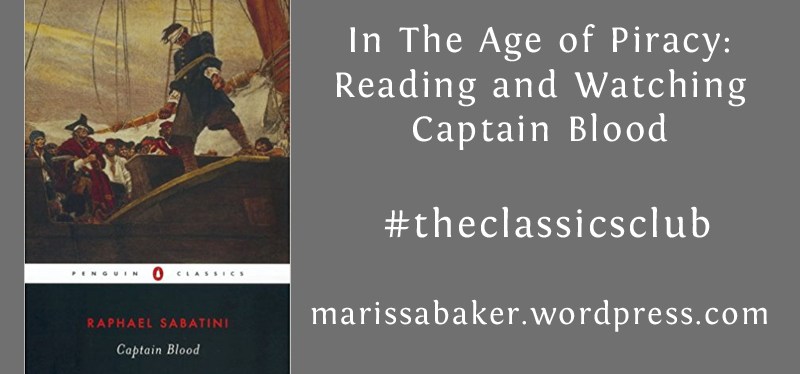
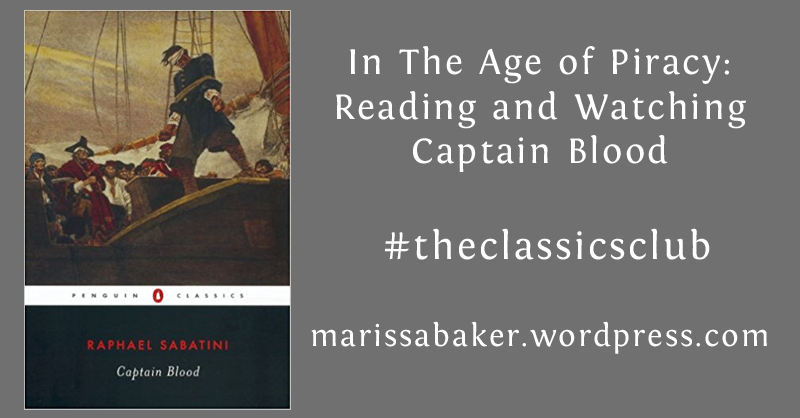
As I’ve mentioned once or twice before, I have something of an obsession with tall ships. This is probably a result of my love for stories set during the Age of Sail. One such story is Captain Blood by Rafael Sabatini, first published in 1922.
This book wasn’t on my original Classics Club list. I’d already read it and hadn’t intended a reread, especially after being disappointed by Sabatini’s Bardelys the Magnificent. But I ended up with a digital copy on my phone a year or so ago and started reading it while in a waiting room. So of course I had to finish it — one simply doesn’t abandon an adventure novel in the middle of the story.
I’m (once again) in the midst of a pirate obsession, for which we can thank the recent release of Daughter of the Siren Queen (sequel to my 2nd favorite novel of 2017, Daughter of the Pirate King). So I started reading a book on the history of pirates in reality and fiction, which prompted me to watch the 1935 version of Captain Blood. And that brings me to my decision to write a post for the classic novel.
But first, a brief digression about the film, which is really quite impressive. $1 million went into its production (to put this in perspective, online estimates tell me that $1 in 1935 has the same buying power as $17-18 today). It launched Errol Flynn’s and Olivia de Havilland’s careers and made an overall profit of $1.5 million. And it was scandalously realistic for a 1930s audience. In fact, a screenwriter named Robert Lord wrote to the producer, Hal Wallis, asking “Why do you have so much flogging, torturing, and physical cruelty in Captain Blood? … Women and children will be warned to stay away from the picture — and rightly so” (quoted in Under The Black Flag by David Cordingly, p.174).Read more →
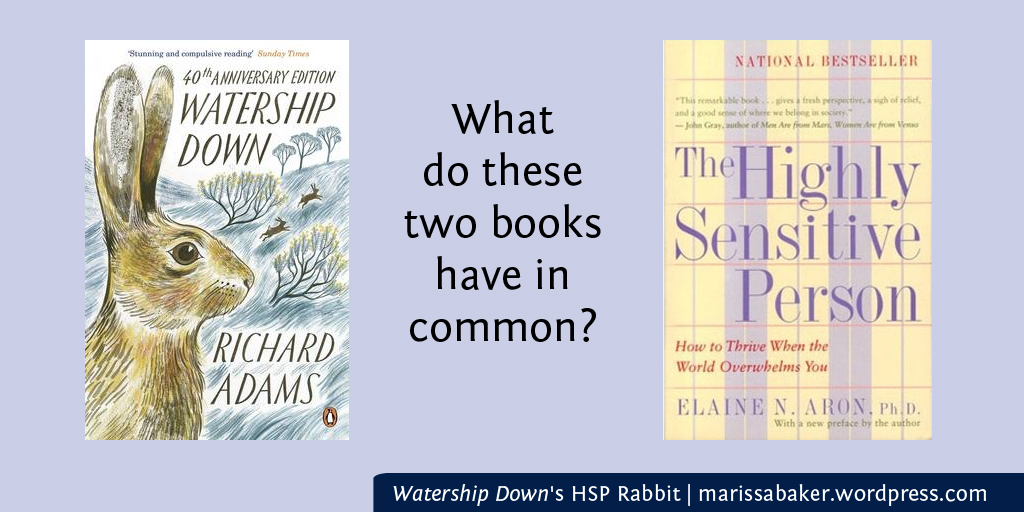
I just started rereading Watership Down by Richard Adams last night. Normally I wait to write about the books on my Classics Club list until after I’ve finished them, but I’m also rereading Elain Aron’s The Highly Sensitive Person In Love and I was struck by a connection between the two books.
In her research on high sensitivity (also known as Sensory Processing Sensitivity), Aron discovered that it’s found in 15 to 20% of the population. And it’s not just humans. The trait “can be observed in all higher animals — mice, cats, dogs, horses, [and] monkeys” at about the same percentage. I’m going to add rabbits to the list as well.
Research on HSPs had barely started by the 1970s, so I doubt Richard Adams would have been familiar with it as a scientifically validated trait when he published Watership Down in 1972. I think he was writing about it anyway, though, with his character Fiver.
When publisher Rex Collins acquired the book, he wrote to a friend saying, “I’ve just taken on a novel about rabbits, one of them with extra-sensory perception. Do you think I’m mad?” Fiver’s insights do go beyond simply being a highly sensitive rabbit, but it’s also true that Fiver would pass the HSP test. Easily overwhelmed by strong sensory input? Check. Aware of subtleties in the environment? Double check. Made uncomfortable by loud noises, startles easily, has a nervous system that feels frazzled, and so on down the list.
He was small, with side, staring eyes and a way of raising and turning his head which suggested not so much caution as a kind of ceaseless, nervous tension. His nose moved continually, and when a bumblebee flew humming to a thistle boom behind him he jumped and spun round with a start that sent two nearby rabbits scurrying for holes (Fiver’s introduction, Watership Down)
As a Highly Sensitive Person myself, I know that feeling all too well. The heightened awareness of the smallest noise. The tension so familiar you barely notice it until an unexpected sound startles you out of your chair (in fact, right after writing this sentence I jumped at a Facebook notification on my phone). And it’s kind of nice to see a character like that in a book, especially one with friends who don’t tell him he needs to change. They accept him for who he is, work with his weaknesses, and appreciate his unique strengths.
Can you think of any other HSP characters in fiction?
Click here to get a copy of Watership Down. Please note that this is an affiliate link. This means that, at no additional cost to you, I will receive a commission if you click on the link and make a purchase.
My friend Cody is launching a startup business called Affirmations Coffee. Part of that project involves an encouraging blog and a short e-book titled Be Awesome: One Week To A Better You. You can get the e-book by supporting his Kickstarter, along with some other really cool rewards like this mug:
I’ve been curious about the e-book for a while now, so when Cody asked me to review it for my blog I jumped at the chance. It’s a motivational 30-page devotional with repeatable weekly tasks to help you move forward in life. I spent a week working through the book and writing down something for each day.
Survey Sunday
Sunday’s task is to plan out a schedule for the rest of your week. I’ve been using The Freelance Planner to help keep track of assignments each week, so I spent some time Sunday morning filling out my main goals for the week. Mine is a very different sort of planner than the one recommended in the e-book so my planning took a less detailed form, but it was helpful to actually fill out all the days at the beginning of the week (something I don’t always do). I also spent some time journaling that morning — a habit I’ve been meaning to get back into.
Motivation Monday
Monday’s challenge is to think about what motivates you to achieve your goals. For me, it’s often quotes, scriptures, or songs that resonate with something deep inside.
This might seem odd to non-writers, but for quite some time one of the most motivating things I’ve encountered has been the song “Non-Stop” from Hamilton. That picture on the left is hanging over my desk right now, alongside John Keats’ poem “When I have fears that I may cease to be.” I suppose you could say I’m motivated by the idea that I’m running out of time to write all the stories, articles, and studies overflowing my mind.
Tranquility Tuesday
I already have a morning routine designed to build focus and calm, so Tranquility Tuesday started out with prayer, yoga, breakfast/reading (yes, those go together), and Bible study. We all need to take time for ourselves and I find that’s a good way to start every day if I want to be more productive and engaged.
Wisdom Wednesday
The Wednesday chapter reminds us to actively seek wisdom. As I mentioned before, I start every morning with Bible study so I suppose I could have just left it at that. Because of today’s theme, though, I determined to spend some extra time taking in other peoples’ perspectives, knowledge, and experience. I began reading an Enneagram book because I’ve heard the theory layers well with Myers-Briggs to give more complete pictures of personality. I took some time to read deep-thinking posts from other bloggers. And I read a chapter in Proverbs before bed.
Thankful Thursday
For today’s focus, I made a list of five things I’m thankful for. It’s not necessarily my top 5 (more like what came to mind first that morning). I’m thankful for
The Lord’s love and the fact that He offers us the chance to be friends with Him
My blog readers, family, and friends
Having the opportunity to dance and to help teach dance at my Messianic Congregation
Books. Every single one of the 1,100+ on my shelf, plus others
I really didn’t know what to do with this day. The books says to go outside your comfort zone and overcome a fear. But Friday is a whirlwind of article due-dates, blog scheduling, and baking for Shabbat. How’m I supposed to find time to identify a specific fear and conquer it today!? (somewhat ironically, I started feeling anxious just thinking about it.)
One line did resonate with me, though: “Live purposefully, not fearfully.” So my goal for Fearless Friday became not letting the little fears and anxieties that pop-up throughout the day control me.
Sabbath Saturday
Ah, the Sabbath. My favorite day of the week. Most of the day isn’t particularly “restful” for me since I leave at 9:15 to get to my morning church and pretty much go non-stop until getting home from my afternoon church around 5 or 6 that evening, but it’s a wonderful time of learning more about God and fellowshipping with brethren. And the Saturday that I worked through this book, I had a chance to spend some time after church chatting with two friends and my sister at a coffee shop, then come home and spend time with both my siblings.
I enjoyed this e-book’s daily suggestion to take time and focus on connecting with God and exploring an aspect of personal growth. You can get the book and support Cody’s Kickstarter at the same time for just $5. I also highly recommend you follow Cody’s blog and Facebook page. His positive, encouraging focus is something I think many of you would enjoy reading and appreciate seeing in your inbox or Facebook feed.
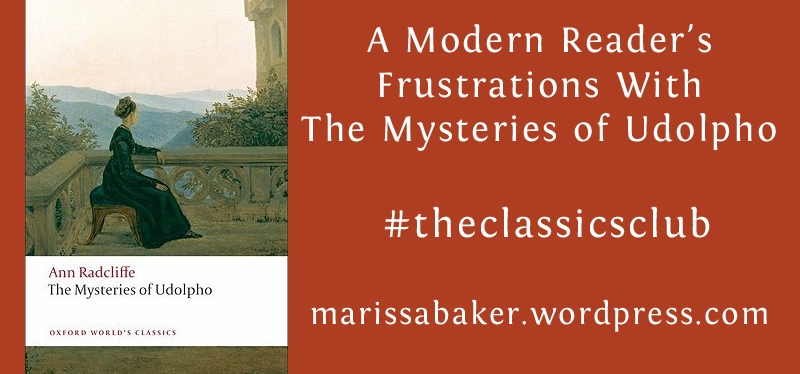
I’d been excited to read Ann Radcliffe’s The Mysteries of Udolpho (1794) since I first came up with my Classics Club Book List a few years ago. I haven’t read much Gothic fiction, but when I do I tend to enjoy it. And I knew this was one of the main inspirations for Jane Austen’s Gothic satire, Northanger Abbey (and you know how much I love Austen), so of course I was intrigued. Strangely, what surprised me most about Radcliffe’s most famous “classic work of Gothic fiction” is how much of it isn’t very Gothic at all.
The book is 223 years old, but still … spoiler warning.
The Mysteries of Udolpho opens with a pastoral travelog detailing the main character, Emily St. Aubert, and her father’s journey through picturesque Italy. There are a couple scenes with a harrowing flavor in the first of four volumes, but not many. Even after Emily’s father dies and she goes to live with her aunt in volume 2 there’s very little about the novel that feels “Gothic.” The setting isn’t gloomy, decaying, or haunted. There aren’t any supernatural elements. And there are only a few hints at a larger mystery. The heroine is a damsel and she’s in a bit of distress, but not much yet. The only hallmark of Gothic fiction that you see from start to finish in this novel is a focus on intense emotions (you know, the sort that inspire fainting fits and romantic swoons).
The novel becomes recognizably Gothic only after we arrive at the Castle Udolpho on page 226 (out of 672 in the edition I read). And now, suddenly, it’s very Gothic. We have a creepy house that becomes almost a character in its own right. We have mysterious rooms, whispered histories of possible murder, unbridled villains (who still manage not to physically harm the heroine), secret passageways, dead bodies, and rumors of ghosts.
This was my favorite part of the novel because it’s what I’d been expecting. But it doesn’t last even half the book, since Emily escapes on page 451 and has no further contact with the villain, Montoni, who conveniently dies off-page before making any further trouble. It’s also a hallmark of Radcliffe’s writings that she leaves nothing with a supernatural hint unexplained, so before the story ends all the ghosts, murders, and mysteries are explained in such a mundane or outlandish fashion that it robs the story of a spine-tingling emotional pay-off.
For example, in the Blake Veil incident Emily lifts a curtain and swoons because what she saw behind it was so dreadful. That happens shortly after arriving at Udopho, but it isn’t until the end of the novel that readers learn she thought she saw the body of a murdered woman. Emily is left under that illusion. For us, Radcliffe explained that it was actually a wax figure molded to resemble a decaying corpse that a previous owner of Udolpho was assigned to look at every day as penance to remind him of his mortality. He put it in his will that all future owners of Udolpho should do the same or forfeit a good chunk of their land to the church, but they just hung a curtain over it ans locked the room. Mystery solved! (though honestly the idea that Montoni left a murder victim in the room would have been less fantastic).
Illustration from The Mysteries of Udolpho (1806 edition)
I haven’t mentioned the romance yet because honestly there isn’t much to tell. Valancourt is a character throughout most of the novel but he doesn’t really do much. He befriends Emily and her father then spends most of his time after the father’s death moping around Emily’s home hoping she’ll step into the garden so he can declare his passionate love for her. While she’s in Udolpho he’s in Paris ruining his reputation. And when she returns, they get so tangled in miscommunication that they almost don’t get married. I found the romance incredibly frustrating because they were always so emotional that they wouldn’t just talk with each other.
In case it’s not clear by now, I didn’t really like this book. If you want to give Radcliffe a try I’d recommend The Romance of the Forest (which I read in college for my research project). It’s much shorter and, in my opinion, a more enjoyable read. So why was The Mysteries of Udolpho a best-seller in it’s day and now Radcliffe’s most famous work?
Perhaps the answer lies in an observation made in the introduction to my Oxford World’s Classic’s edition. This intro points out that while Radcliffe rationalizes the supernatural in the outside world of her novel, she “presents the mind itself as a kind of supernatural entity.” It is the characters’ perceptions of what is going on in the world around them that adds a magical, mysterious flavor to the story. Radcliffe gave the novel’s first readers “a fantasy about the mind itself” being haunted.
For modern readers this idea isn’t anything new. We live in a post-Freud world where we’re accustomed to thinking of our minds as having layers that we don’t fully understand and reading stories that explore how a character’s psyche unravels under stress. But for Radcliffe’s readers it was a new kind of thrilling, escapist reading even when the plot was a mess. The way she accomplished this psychological character exploration isn’t what we’re used to today and it feels sloppy to me an I suspect other modern readers. I usually find 18th and 19th century literature very accessible, but in this case I just couldn’t connect with the story.
Click here to get a copy of The Mysteries of Udolpho. Please note that this is an affiliate link. This means that, at no additional cost to you, I will receive a commission if you click on the link and make a purchase.
One of my Facebook friends shared a post about the ten books that have most influenced his life, which I thought was a great idea. But it took me two weeks to figure out which books I wanted to write about and by the time I hit 500+ words I thought, why not just make it a blog post? So if you are reading this and care to share your most influential books consider yourself “tagged.” I’d love to see what books have had the biggest impact on your lives either in the comments or on your own blog (there’s an article topic you don’t have to come up with on your own!). The original list was 10 but I ended up with 8, so post however many you like.
The Bible
A rather obvious first choice for a Christian blogger, but this book definitely deserves the top spot when talking about books that influenced my life. It’s still influencing everything I do and I fall more in love with this book and it’s Author every time I read it. It’s the greatest love story every told, the best handbook you’ll ever find for life, and an incredible source of hope and purpose. Since more than 50% of this blog is devoted to talking about this book I’ll stop now. You know I could (and have!) keep going on about it for several books worth of text.
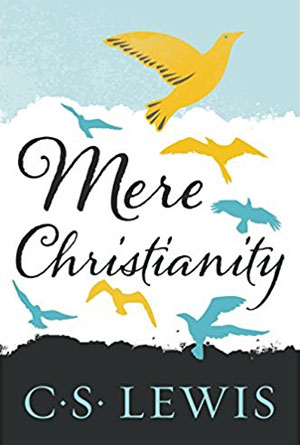
Mere Christianity by C.S. Lewis
I could have put several books by C.S. Lewis on this list, but this is the first of his non-fiction I read and it’s the one that’s been most influential (with Screwtape Letters a close second). I just love the way he writes about his faith. Not only is he firmly grounded in scripture, but he’s also a persuasive speaker to those who don’t already put their faith in the Bible. In the words of Anthony Burgess, “C.S. Lewis is the ideal persuader for the half convinced, for the good man who would like to be a Christian but finds his intellect getting in the way.”
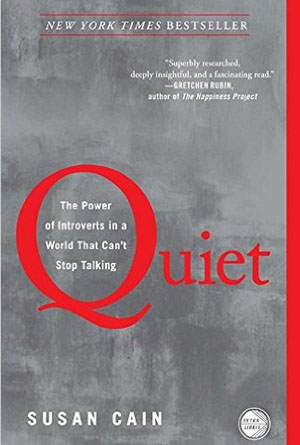
Quiet: The Power of Introverts In a World That Can’t Stop Talking by Susan Cain
I started researching my personality after starting college and realizing I was even more different from “normal” people than I’d previously thought. This is one of the first books I read on the subject and it literally changed my life. Like many introverts, particularly INFJs, I always felt there was something off about the fact that I couldn’t seem to socialize the way so many other people did. This book pointed out how introvert brains are wired differently and that there are strengths in that personality. In other words, it shows that we’re not broken extroverts and introversion isn’t something to “fix.” Read more →
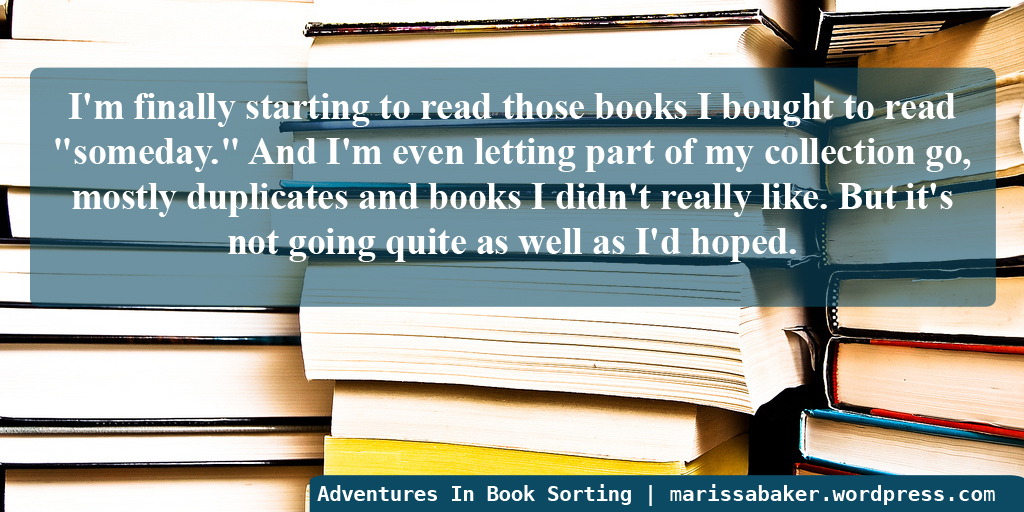
I’ve been sorting through my book collection and trying to get rid of things I don’t need. I can hear you laughing — Marissa getting rid of books. But it’s true; I actually let about four large bags leave. Most were either duplicates, or in bad shape, or ones that I’d read and hadn’t liked but hung onto anyway. There were quite a few that were really nice copies, but I just didn’t need them on my shelves.
Unfortunately, I didn’t plan out the way these books are leaving my house very well. Some went to a trading book store, which was fine, but I took others to Half Price Books yesterday and only got $4.00 for three bags of books. They don’t pay much as a general rule, but that seemed really low so I asked and she said, “Well, most weren’t in good shape and we have trouble selling ex-library books.” I’d had a stressful day already so I just signed the paper and left, but in hindsight I wish I’d refused to sell them. Only one of the bags was ex-library and I had some really nice classics and academic anthologies in the other bags that I know they’ll be trying to sell for at least $12 each. *sigh* I really need to work on being more comfortable with standing up for myself rather than avoiding minor conflicts.
Setting those bookish trials aside, in keeping with my new responsible book keeper persona I’m also starting to read all those books on my shelf that I picked up to read “someday.” I started with Pirate Freedom by Gene Wolfe. I’d picked it up because pirates and time travel has to be fun, right? (Spoiler warning: it was.) I really enjoyed that one, and the last paragraph made me rethink the whole story (in a good way). I’ll definitely be reading more by that author.
Which brings me to the first time I almost fell off the wagon. Though committed to reading books I already owned, I was so very close to checking Wolfe’s book Peace out of the library. And then I found out that a three-book series I loved and thought I just finished is actually six books long (it’s the Study series by Maria V. Snyder). I was online ordering book four into the library before I caught myself and canceled the hold. With a heavy sigh, I redirected myself to checking a book out of the library on my own shelves.
I stopped reading the next book from my shelf after one chapter. I feel bad about it since The Last Light Of The Sun by Guy Gavriel Kay has such high ratings on Goodreads, but nothing in chapter one made me want to keep going. Mostly because of the sex scene. I’m not such a discerningly prudish reader (or writer) that I think sex should be left out of a book, but dubiously consensual scenes that are more graphic than the plot calls for turn me off. I also didn’t love the writing style, so why put up with that for the next 500 pages?
Now I’m reading Slave of the Huns by Géza Gárdonyi. And I’m thinking I might abandon that one, too, which is sad since I was really looking forward to reading a Hungarian classic. With this one, my problem is that I think the main character is an idiot. The plot is being moved forward by the incredibly stupid decisions Zeta makes to spend time with a hot Hunnish girl. He even admits he’s obsessed with her body and not her mind since they’ve never actually had a conversation.
As if that wasn’t enough (spoiler warning) Zeta becomes the titular “slave of the Huns” by choice. A free Greek, he poses as a slave and forges a letter from his master giving himself to the girl’s father. He means to only do this for the last 6 months of his fictional slave contract, but then the Romans plot to kill Attila and Zeta’s stuck in the repercussions of that (Attila decrees Roman and Greek slaves can no longer be freed or ransomed). Like I said, he’s an idiot.
But then again, we’re all idiots sometimes. Like when I gave away books (some of which I originally spent $15+ each on) to Half Price Books at $4 for three bags. So maybe I’ll keep reading and give Zeta a chance to grow and change. After all, I wouldn’t want someone to give up on me because of a stupid thing I did in my late teens/early 20s to impress an attractive member of the opposite sex.
 . Please note that this is an affiliate link. This means that, at no additional cost to you, I will receive a commission if you click on the link and make a purchase.




 . Please note that this is an affiliate link. This means that, at no additional cost to you, I will receive a commission if you click on the link and make a purchase.

 Like An Anchor