How To Tell If An INFJ Likes You

INFJs have a reputation for being mysterious creatures. If you’re trying to figure out what an INFJ is really thinking, that reputation is somewhat justified. And judging by the number of people online asking, “How can I tell if an INFJ likes me?” it can be very difficult to figure out if an INFJ is attracted to you, especially in a romantic sense.
How To Tell If An INFJ Likes You | LikeAnAnchor.com
Photo credit: Yuriy Bogdanov via Unsplash

Even though the whole “otherworldly INFJ” thing has been blown way out of proportion in internet descriptions of the type, there are some things about INFJs that just don’t make sense to most other people. Since INFJs are the rarest type, our minds are wired to think in a fundamentally different (not better) way than the majority of the world’s population.

As a type which uses Extroverted Feeling to make decisions, INFJs are very interested in maintaining harmony in the outer world. This tends to make them very agreeable people. In groups, we can be friendly and sociable with just about everyone. However, we’re also introverts who spend a lot of time inside our own minds. We’re often reserved, private individuals, leaving many people confused about how we actually feel. In addition, many (though not all) INFJs struggle with varying levels of social anxiety and shyness which makes it even harder for us to make it clear when we like someone.

The following list of ways to tell if an INFJ likes you isn’t going to be 100% true of every INFJ. However, it does reflect general trends in the way many INFJs say that they act and think when they like someone. Read more

An Introvert’s Guide To Hosting A New Year’s Party

I always spend New Year’s Eve with my sister and cousin. There’s just the three of us, but we call it a party anyway. The tradition started with my cousin’s family hosting much larger New Year’s parties, and then after those went away the three of us just kept spending New Years together.

Though one of us (my cousin) is an ENFP, our New Year’s parties are very much something you could describe as introverted. There’s a small number of people and the party activities are generally relaxed, stay-at-home sorts of things. And because our sort of New Year’s party is clearly the best kind there is, I’ve made this helpful little guide to help other introverts (and those who like “introverted” parties) to host their own.

How To Host An Introverted New Year’s Party

Step One: Decline all invitations to traditional New Year’s parties.

Step Two: Find a small number of people you enjoy being around and who will get along well with each other. Read more

Can INFJs Be Intimidating?

The short answer to the question, “Can INFJs be intimidating?” is “yes.”

Of course, this partly depends on the specific INFJ and on what someone finds intimidating. Some people might be intimidated by the way INFJs people-watch. Others might find the way our minds work intimidating, or be overawed by our instinct for figuring others out.

Being intimidating can be a useful thing in some contexts. Unfortunately for INFJs, it seems like we come across as intimidating when we don’t mean to more often than when we do. INFJs are generally peaceful folk who don’t like confrontation and aren’t trying to intimidate anyone (even though the whole “good little INFJ” thing is mostly a myth).

Here are three ways that INFJs can come across as intimidating when they don’t mean to. If you’re curious about what INFJs are like when they are trying to be intimidating, click to check out my post “INFJ Dark Side.”

We Think Differently

Some people can find the way that INFJs think intimidating. We tend to be deep-thinkers and, in our own way, we’re pretty intense. Also, INFJs are a curious mixture of seemingly contradictory things and we’re hard for people to put into neat boxes. Some people find this fascinating, but others find it off-putting.

When I was finishing up my 4-year degree in college a guy at church asked me about my thesis project. So of course I waxed eloquent about how 18th century female writers used Biblical gender roles to present a solution to a “gender crisis” of their day. Not long after, this man described me as intimidating in a conversation with my father. He said that I was too well-educated and too deep thinking for any man in our church to want to marry me. Read more

7 Fictional Characters That You’ll Relate to If You’re An ENTP

What fictional characters do you relate to as an ENTP?

Just as we can describe real people using the Myers-Briggs® typology system, we can also use the system to type well-written fictional characters. Some of fiction’s most interesting and iconic characters are ENTPs, and today we’re going to talk about seven of them that I think real-life ENTPs will find very relatable.

One of the other great things about looking at character personality types is that it can help us to better understand people who have different types than we do. Fictional ENTPs can serve as examples for what real-life ENTPs can be like, and also show how much variation there can be between individuals with the same type. Read more

The Curious Case of the INFJ Hero

Today we’re going to talk about INFJ heroes in fiction, especially male heroes. But before we get to that, let’s talk about Russian literature for a moment. The Brothers Karamazov by Fyodor Dostoevsky opens with an apologetic explanation from the narrator about his hero, Alexei Fyodorovich Karamazov. Here are a few highlights:

“While I do call Alexei Fyodorovich my hero, still, I myself know that he is by no means a great man …

One thing, perhaps, is rather doubtless: he is a strange man, even an odd one. But strangeness and oddity will sooner harm than justify any claim to attention …

If I, that is, the biographer himself, think that even one novel may, perhaps, be unwarranted for such a humble and indefinite hero, then how will it look if I appear with two; and what can explain such presumption on my part?” (p.3-4, Pevear/Volokhonsky translation)

As you may have guessed from the title of this post, Alyosha is an INFJ (most characters and the narrator use this nickname throughout the novel. In the Cyrillic alphabet, Alyosha is two letters shorter than Alexei, which makes this something like calling a man named Robert “Bob”). And I suspect that it’s his personality type that makes the narrator so worried about how people will respond to his hero.

It’s not that there aren’t other INFJ heroes in fiction. Just take a look at my post about 10 Stories You’ll Relate To If You’re An INFJ if you want some examples. Jane Eyre, Amélie, Yoda, and Atticus Finch are all INFJs in fiction who play a hero role. But even though there are male characters on this list, I’m going to go out on a limb here and say that if Alyosha was a woman with all the same personality characteristics the narrator wouldn’t have felt the need to apologize for her.

Read more

Introverts Need People Too: A Closer Look At Introversion and Social Anxiety

A lot of introvert-themed posts that you see around this time of year are things like “An Introverts Guide To Surviving the Holidays” or “How Not to Run In Terror From Your Extrovert Relatives.” That last one’s not an actual article, but it’s pretty close to some I’ve seen.

Often, writers of articles like this assume introverts don’t like people, that they’re always overwhelmed in social situations, and that they hate parties. But being on-edge in social situations, panicking when you have to interact with people, and going out of your way to avoid places where people gather aren’t actually signs of introversion. Those things are more a part of social anxiety.

Definition Conundrums

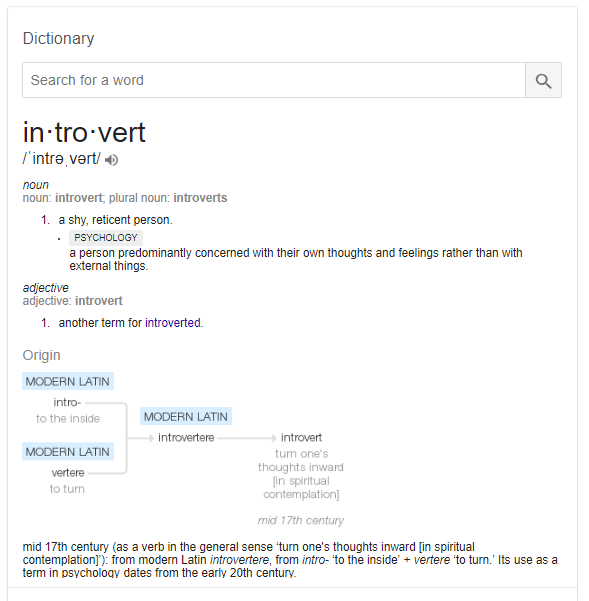
Part of the reason for this confusion is that people don’t understand what being an introvert actually means. For example, (despite numerous complaints and petitions) if you Google “introvert definition” the first thing that comes up is “a shy, reticent person.” Only if you expand the Google result to see translations, word origin, and other definitions do you finally get something a little closer to the correct result: “a person predominantly concerned with their own thoughts and feelings rather than with external things.”

Introverts Need People Too: A Closer Look At Introversion and Social Anxiety | LikeAnAnchor.com

Being an introvert doesn’t make you socially awkward. It doesn’t mean you hate people. Being an introvert means that you’re born with a trait that gives you a preference for the internal world. It also means you re-charge better in quiet, low-stimulation environments (usually alone, but not always). Introverts might avoid parties, but if so they do it because they’d rather be somewhere else (like at home reading or hanging our with a small group of friends), not because they’re inherently shy or scared of interacting with others. Read more