Fictional MBTI – T’Challa (ISFP)

I saw Black Panther yesterday, so naturally today’s post is a new installment in the superhero Myers-Briggs types series. I know I get pretty excited about most of the MCU films, but this one is seriously good. I love the hero characters and the principles they stand for like loyalty and peace. The acting is great, the plot’s tight, I love the music (I’m listening to the score as I type), and while it still has a superhero-movie feel it doesn’t shy away from digging into some really deep and difficult subjects.

T’Challa’s judging functions are pretty easy to pin-point: Fi/Te. But the fact that he uses Introverted Feeling and Extroverted Thinking when making decisions only tells us that he’s either a TJ or FP type. We’re going to need a little more to go on than just those two functions if we’re going to narrow-down a type for him. After Captain America: Civil War came out, most people typed T’Challa as an ISFP. However, a couple of the discussions I found online pointed out that he’s an ENTJ in the comics. I haven’t read the comics, though, so this typing is only going to focus on his film portrayal. From that, I ended up going with ISFP.

A Personal Code

Everyone has and uses both a Thinking and a Feeling mental process as part of their personality type. They’re both a “Judging” function, which means you use them to make decisions and answer “should” questions. The one you’re most comfortable with is either your driver process or co-pilot, and then its opposite is either your inferior or tertiary process.  Personality Hacker uses nicknames for the Jungian cognitive functions, and I think they make it easier to talk about exactly what I mean when saying T’Challa uses Fi/Te when making decisions.

Fictional MBTI - T'Challa (ISFP) | marissabaker.wordpress.com

Introverted Feeling is nicknamed “Authenticity” and it’s an ISFP’s primary function. It’s an internally focused, subjective process that mostly boils down to making decisions based on what “feels right” to you. Unlike the Extroverted Feeling process, it’s not primarily worried about what other people think. Authenticity is concerned with making a decisions that lines up with one’s own personal beliefs. And that’s what we see in T’Challa.

Though T’Challa certainly cares for other people, when he makes decisions they’re in line with what he believes is right rather than what will make the majority of the people around him happy. Fi is the mental process that drives his decision at the end of the film to share Wakanda’s resources with the world (see — I told you we were going to talk spoilers). And this personal code is also why he let his father’s killer live at the end of Civil War. He discovered that killing an unarmed man for revenge wasn’t in line with his moral compass (though making sure he faces justice is). Similarly in this new film, he offered to save his cousin’s life even after the man tried to kill him and steal Wakanda.

Impersonal Logic

Fictional MBTI - T'Challa (ISFP) | marissabaker.wordpress.com

Extroverted Thinking, or “Effectiveness,” is a much more impersonal function than Introverted Feeling, though it’s still used for making decisions. It’s an ISFP’s fourth function — the one they’re least comfortable using.

Effectiveness users look for the most efficient answer to a question. In other words, this process makes decisions based on what’s going to work. This is why in Civil War T’Challa tells Natasha that he doesn’t approve of all the politics. It’s because a hundred people arguing in a room doesn’t seem like an effective or efficient way to actually get things done.

I also don’t think his decision to go after Bucky himself was just fueled by an emotional type of revenge. It was also a coldly logical assessment of the most efficient way to handle the problem since he knows that, as Black Panther, he can take down a super assassin. Since Te is where an ISFP goes when stressed, it makes sense that one of the times we most clearly see T’Challa using it is after his father’s murder.

Interacting With The Real World

Fictional MBTI - T'Challa (ISFP) | marissabaker.wordpress.com

SP types have a certain advantage in physically-demanding tasks since this mental process is so focused on real-time interaction with the outer world. While being the Black Panther certainly enhances T’Challa’s abilities as a warrior, this new film shows us that he’s quite capable without them. He displays the sort of “real-time kinetic” intelligence that Personality Hacker says characterizes types that use the Extroverted Sensing, or “Sensation,” process. On a side-note, the ritualistic combat you see in Black Panther is inspired by real-world African martial arts, which is pretty cool.

SP types thrive on being in the middle of the action. And since Sensation is their Learning/Perceiving function, this is also how they prefer to learn new information. The things they can experience and verify with their five senses are the things that seem most reliable. And they often use their skill for interacting with the real world in creative, productive ways, earning ISFPs nicknames like Artist, Composer, and Producer.

As an SP type, T’Challa isn’t content with delegating tasks and that he can do himself. He goes after his enemies personally, even when not required by tradition and ritual. And he doesn’t just want to read reports or have people come to him to say what’s going on in Wakanda. We see him visiting his people and interacting with their worlds first-hand. He’s also interactive when planing missions. For example, there’s an early scene in Black Panther where he’s watching a projection of a convoy he’s about to attack as part of a rescue mission and he picks up one of the projected trucks to move it around and get a closer look.

Possibilities and Patterns

Fictional MBTI - T'Challa (ISFP) | marissabaker.wordpress.com

As far as we know, T’Challa is the first Black Panther to reveal his powers to the world at large. And he’s certainly the first king of Wakanda to share their country’s secrets with the world. While there is a struggle between the part of him that believes in a vision for Wakanda’s future where they help the world and his duty as king to protect his own people above the others, the idealistic visionary side wins out.

An ISFP has Introverted Intuition as their tertiary or “10-year-old” mental process. It’s also called “Perspectives” and it functions as a pattern-recognition system. ISFPs typically have conscious access to their Perspectives function, but it’s not always reliable.  T’Challa is mature enough to recognize this and does not rely on his Ni too much or make a rash decision based on it.

However, he’s also comfortable enough with Intuition to not shy away from what his friend Nakia and sister Shuri have to say about considering a future where Wakanda and its technology play a larger role in the world. And as an Ni-user myself, I find it very satisfying that Wakanda’s first outreach center will be built in the location where T’Challa’s father killed his own brother and abandoned the brother’s son to protect Wakanda’s secret. It brings the pattern together in a way that feels right.


If you enjoyed this post, check out my other MCU typings:

Bucky Barns – ESTP

Loki – INFJ

Scott Lang -ISFP

Steve Rodgers – ISFJ

Thor – ESTP

Tony Stark – ENTP

This Whole “Otherworldly INFJ” Thing Is Getting Out of Hand

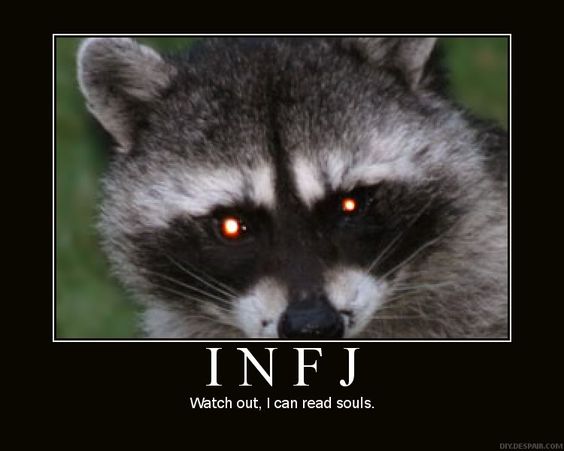
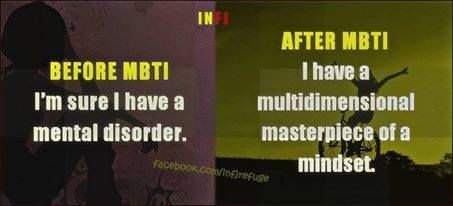
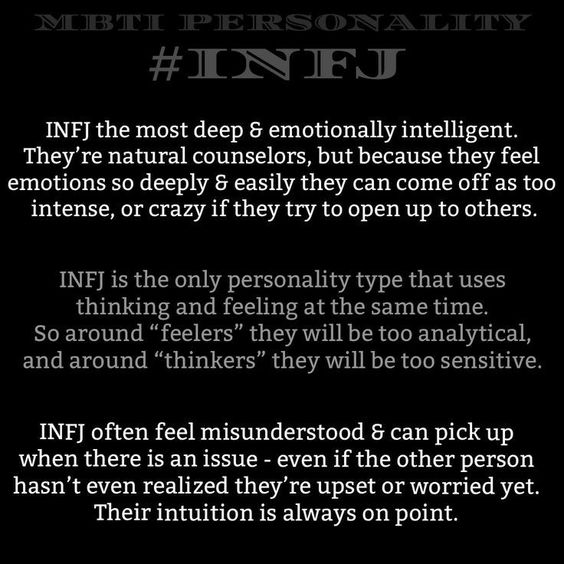
It’s nearly impossible to study Myers-Briggs® types on the Internet without coming across several articles about the incredibly rare and nearly magical INFJ type. I’m an INFJ myself, and I’ve seen us described as the world’s prophets and shamans with deep spiritual insights. We’re called natural empaths with unfailingly accurate telepathy. We appear so deep you’ll never plumb the depths of their souls. We’re even seen as the ideal type–the one everyone else mis-types as because they wish they were this special. And the more people describe INFJs as perfect and other worldly, the more ridiculous the claims about INFJ super-powers becomes. For example, I’ve actually seen such ridiculous claims like these made in INFJ memes and blog posts:

This Whole "Otherworldly INFJ" Thing Is Getting Out of Hand | LikeAnAnchor.com

If you’re laughing out loud at the craziness of this, you’re not alone. The tendency to portray INFJs as something akin to a demigod or goddess doesn’t sit well with most healthy INFJs, and yet these sorts of stereotypes are still around. On the one hand, you have certain INFJs and want-to-be INFJs embracing the idea that they’re better/special and using it to look down on other types (something that can be damaging to us as well as to others). And on the other hand, you have non-INFJs buying-in to the otherworldly stereotype and reacting to it in ways that aren’t good for the INFJs (such as when certain people “hunt” INFJs for a relationship, a disturbing thing that I’ve written about in another post).

How Did This Happen?

The simple fact that INFJs are the rarest personality type is going to make us feel and appear different than other people. That’s where this whole thing started–with acknowledging and explaining why INFJs aren’t like the other 98-99% of the population. So far so good. But soon, it started turning into an idea that “different” equals “better.”

INFJs process incoming information with a mental function called Introverted Intuition (Ni). INTJs also lead with this process, and they’re the second-rarest type. That means only 3-7% of the population has this as their preferred mental process (it’s the co-pilot for ENFJ and ENTJ, and they’re pretty rare too). Ni is a perceiving process that’s inward focused, tied to personal perspectives, highly interested in patterns, and is concerned with things that can’t be directly experienced.

It’s not too hard to see how this process could be seen as mystical, or even magical (as side-note, I actually like the nickname “The Mystic” for INFJs as much or more than “The Counselor,” since it focuses on our dominant function instead of our co-pilot). Introverted Intuition doesn’t “make sense” to most people, even the INFJs and INTJs who use it all the time. Pattern-recognition related to things you can’t directly experience is hard to explain. And if we stop trying to explain how this works, then some variation on “it’s magic” seems like a good enough stand-in.

The impression of INFJs as empaths and mind-readers comes from how Ni relates to their co-pilot process, Extroverted Feeling (Fe). Fe picks up on other people’s feelings and makes decisions based on meeting the needs of the whole group. When you couple a keen interest in other people and an ability to pick up their emotions with Ni pattern recognition, INFJs can be insanely good at predicting behavior. And so we became known as the telepathic mind-readers of the Myers-Briggs® community (even though other types use this process as well).

This Whole "Mystical INFJ" Thing Is Getting Out of Hand | marissabaker.wordpress.com

Perpetuating The Unicorn Stereotype

The fact that the quasi-mythical, somewhat deified image has become a stereotype for INFJs is party our fault. Many INFJs grew up feeling like outsiders who never fit in. We’re carrying around deep emotional scars and we’re longing for someone to look at us and say, “Your weirdness makes you wonderful and valuable.” And we find that in the personality type community. Here are a couple examples:

The INFJ has been called “The Mystic,” “The Counselor,” and “Empath”.  They are described as  original, gentle, caring, and highly intuitive. The quality of extrasensory perception, or ESP, is often attributed to them. People who have known INFJs for years continue to be surprised when yet another layer of their complex personality is revealed.  (Ann Holm, “The Mysterious INFJ”)

If we hearken back to humanity’s tribal days, we would likely find only a few INs in a given tribe. At that time, they would have assumed roles such as sage, healer, Shaman or prophet—anything that capitalized on their powers of insight and intuition. Indeed, their rare and unusual gifts would have made INs a precious commodity. (Dr. A.J. Drent,  “Why INFJ, INFP, INTJ, & INTP Types Struggle in Modern Life”)

While there are some INFJ haters out there, most of what you’ll find about INFJs on the internet is positive and supportive. In fact, the descriptions are so good at inviting you to identify with this type that non-INFJs are very likely to mis-type when reading about different types online. In at least one little niche of the world, INFJs are in vogue for the first time in their lives. On the one hand, this is a good thing–we do need to understand that there’s nothing wrong with our personalities and that we have amazing strengths. On the other hand, though, we also need to be aware that we’re not a special category of human that’s more valuable, impressive, intelligent, etc. than other people who aren’t INFJs.

This Whole "Mystical INFJ" Thing Is Getting Out of Hand | marissabaker.wordpress.com

The Dark Side of Special Snowflakes

As I mentioned in the opening for this post, there are a couple dangers to letting the mythical unicorn INFJ persona run around unchecked. On the one hand, it can build resentment towards INFJs or make them targets for unwanted attention. I’ve seen a few nasty, aggressive posts attacking INFJs for thinking they’re so special. But for now, let’s set aside how the mythical stereotype hurts people’s perceptions of INFJs and look at how it can lead INFJs to develop wrong ideas about ourselves and damage our relationships with other people.

After writing my “Myths About Sensing Types” post, a reader on Facebook commented that quite a bit of the Sensor-hate online comes from INFJs, who write a large percentage of the personality type content online. Since Sensors make up 70% of the population, that means most of the (very real) emotional wounds that INFJs carry around and feel so deeply came from Sensors. And so we may look down from our “I’m the most insightful personality type around” pedestal and turn Sensing types into villains, or at the very least a type that Intuitives like us cannot get along with.

It’s not just around Sensing types that this sort of thinking can become a problem. We also read that we’re too intelligent for the Feelers and too emotional for the Thinkers, which further alienates us from the other types. Depending on how an individual INFJ responds to the message that they’re special and different, they can become a terror in typology as they wield their 1% status to prove that we’re better than everyone else. Alternately, it might make an INFJ feel even more isolated and alone than they did before now that they’re sure they don’t fit in with other Feelers, or the Thinkers, or Sensors. If we’re to believe our special snowflake status makes it impossible for others to understand us, that leaves a depressingly small pool of people we can build relationships with.

This Whole "Mystical INFJ" Thing Is Getting Out of Hand | marissabaker.wordpress.com

Embracing Differences Without Becoming A Snob

In describing INFJs, it’s important to make sure we do so the same way we describe other types. INFJs are special and different, but we’re no more special and different than everyone else. We need to make sure we talk about and value the unique traits of each type, and show both INFJs and all the non-INFJs balanced, insightful, and helpful portraits of their types online. At the same time, we also need to remember that everyone individual is more than the mental hard-wiring that we call a Myers-Briggs® type.

As INFJs, we need to guard against the temptation to see ourselves as better because we’re more rare or because that’s what we read online. We also have to be careful not to resent or put down other types because they’re not like us or because someone of that type hurt us in the past (I know I have to be careful of that when I meet people with the same personality type as an ex-boyfriend). This shouldn’t really be a difficult thing to do, since as INFJs it’s usually easy for us to see things from other people’s perspectives. Most of us know what it’s like to be misunderstood, misinterpreted, and unfairly judged. Let’s commit to not doing that to other people.

It’s also important to point out that while INFJs aren’t perfect (we’ve all got a bit of a dark side to us), most of us don’t default to thinking we’re better than everyone else. It’s when we’re unhealthy, hurt, and/or stressed that we become adversarial or snobbish towards other people. A healthy INFJ is going to recognize that these tendencies are not ideal and work against them (or perhaps not even have a problem with this at all).

Personality type systems are meant to give us insight into how our minds work. That insight should empower us to understand and embrace our differences while also celebrating the uniqueness of others. It’s okay to enjoy what makes your type unique and, in the case of INFJs, rare as well. It’s even okay to embrace certain aspects of the mystic persona, if that fits your personality in a healthy way. But we should never use our INFJ-ness as an excuse to put-down other people or make ourselves look better than them.


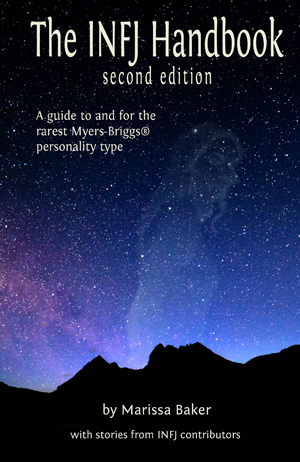
If you’d like to know more about the INFJ personality type, check out my book The INFJ Handbook. I just updated it with a ton of new information and resources. You can purchase it in ebook or paperback by clicking this link.

Ficitonal MBTI – The Librarians

The Librarians is one of my favorite TV shows. What could be better than a team of bookworms saving the world from runaway magic? Sure it’s campy and can’t be taken too seriously, but isn’t that part of the appeal?

Typing fictional characters is one of my favorite things to do in blog posts. I’d started writing this one for last week, but when I realized how many of the Librarians characters are Sensing types I thought it’d be a great follow-up to my “Myths About Sensing Types” post. One of the more pervasive myths about Sensors is that they’re neither intelligent nor imaginative. Since all the main characters in this show except Flynn are Sensors, The Librarians provides a perfect example to the contrary.

Please note: I type using cognitive functions, which are the basis of Myers-Briggs theory. If you’re not familiar with this concept or want a refresher, check out this articles: The Simplest Guide To Myers-Briggs Functions Ever

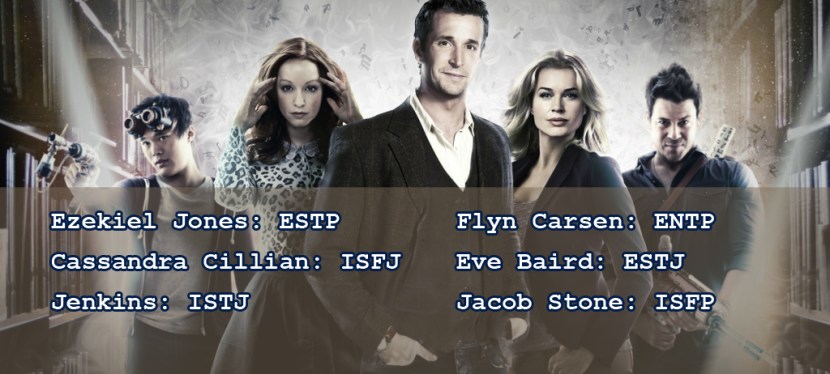
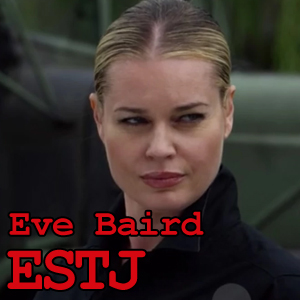
Eve Baird: ESTJ

Ficitonal MBTI – The Librarians | marissabaker.wordpress.com

Eve is the easiest character to type, partly because she’s such a stereotypical example of the type nicknamed “Supervisor” or “Guardian.” ESTJs are known for their blunt demeanor, no-nonsense attitudes, and ability to keep things moving forward. They also care about keeping the world running as it should be, a trait Eve devotes to keeping the Library safe and magical artifacts out of the wrong hands.

ESTJs lead with a judging function called Extroverted Thinking/Effectiveness. That means Eve’s preferred mental process involves measuring and managing impersonal criteria when making decisions. There are examples of this in literally every episode. Read more

Challenging Myths About Sensing Types and Inviting A More Balanced Dialogue In The Myers-Briggs® Community

One of the most disturbing trends I’ve noticed in the community of Myers-Briggs® enthusiasts is a bias against Sensing types. You’ll see it in comments from Intuitives about how they don’t want any Sensing friends because they couldn’t possibly understand us. It’s someone saying a fictional character is too dumb and shallow to be an INFJ so they have to be ISFJ (or insisting another character has to be INFJ because they’re relatable and imaginative). It’s assuming all SP types are dumb jocks who’d run off a cliff just for a thrill and all SJ types are conservative traditionalists who’d rather die than see the status quo change.

There was a similar issue when introverts finally started realizing they weren’t broken extroverts. In some cases, the introvert hype turned into an idea that introverts are better than extroverts, which is simply not true. It resulted in stereotypes being used to tear-down extroverts and build-up introverts. We’re still undoing that damage, but I think we’ve finally started to balance out and realize that introverts and extroverts are equally valuable.

Unfortunately, I’m not seeing a similar shift toward balance in how Intuitives view Sensing types, at least no everywhere. There are some wonderful groups out there (like Personality Hacker’s “Intuitive Awakening”) that insist on no Sensor-bashing while exploring what it means to be an Intuitive. But outside those groups it still happens. And even if we’re not staying Intuitives are better than Sensors, I wonder if the fact that there’s so much more material out there for Intuitives than for Sensors is still sending the message “you don’t matter as much as us.”

Sensing/Intuition Numbers

70% of the population are Sensing types, but when you Google individual personality types only 19% of the search results relate to Sensors (that’s if my math’s right — numbers aren’t one of my strengths). I searched each type and compared the number of results that came back. Here’s the full list:

  • INFJ – 16,100,000
  • INFP – 15,300,000
  • INTJ – 13,700,000
  • INTP – 8,090,000
  • ENFP – 5,680,000
  • ENTP – 3,510,000
  • ISTP – 3,100,000
  • ENFJ – 2,270,000
  • ISFJ – 2,230,000
  • ISTJ – 2,080,000
  • ESTP – 2,040,000
  • ENTJ – 2,020,000
  • ISFP – 1,900,000
  • ESTJ – 1,890,000
  • ESFP –  1,280,000
  • ESFJ – 1,210,000

No wonder so many people mistype themselves as an INxx — we’re the types flooding the internet with articles about what we’re like and inviting people to identify with us. That’s great for people with those types, but it’s actually one of the things contributing to the anti-sensor bias.

One of the reasons that so many people online identify as INFJs is because there is just so much more, and so much better, and more in-depth content on INFJs. If every second article you read is about INFJs, it’s only natural to come to identify more with INFJs, simply because we relate more to things that we understand more.” — Erik Thor, “Have You Ever Thought That You’re Actually Just A Smart Sensor?

If you Google “INFJ” you get back about 16,100,000 results. Search “ISTJ” and you get about 2,080,000 results. That’s almost 8 times as many results for the world’s rarest type as for the one that’s most common. We can argue that it’s because INFJs need more support online since they don’t get as much validation in-person from meeting people like them. But don’t Sensing types deserve the resources to learn about how their minds work as well? and the connection of seeing their types positively portrayed and defended by people writing about personality types? Read more

The Importance of Living Authentically As An INFJ

As an INFJ, you’re good at picking up on other people’s emotions. And when you pick up on what other people feel you also start to get a good feel for their expectations. For some of us, that seems like a good thing. We know what’s expected of us in different social settings and from different friend groups. We understand who we need to be so we can fit in.

But is that really a good thing for us? Does being able to fit in help an INFJ?

We call it the chameleon effect when an INFJ leverages their unique combination of mental processes to blend in with different groups of people. Chameleon INFJs might even appear as if they’re a different personality type in different situations because they’re automatically shifting toward being extroverted around the extroverts, logical around the thinkers, and interested in the real world around the sensors.

Blending in feels like an advantage at times. That’s why we do it. Fitting in feels safe. It seems like a way to protect ourselves from negative attention. But in reality, using our gifts in this way doesn’t just protect us from bad things. It also blocks us from really being seen and appreciated as ourselves. Read more

Living With INFJ Guilt And Overcoming Cycles of Shame

Disclaimer: some of the links in this post are affiliate links. This means that, at no additional cost to you, I will receive a commission if you click on the link and make a purchase on that website.

INFJ personality types* often live with ridiculous amounts of guilt. We feel guilty about things we did and didn’t say or do. We feel guilty about how the people around us feel and how they react to us, about our own short comings, and even about our successes.

Everyone experiences a certain amount of guilt. But it does seem like one of the more common struggles for INFJs. Most people attribute this propensity for guilt to INFJ perfectionism, saying that if we fail to make something “perfect” we’ll feel guilty about it. But it’s a bit more complex than that (a fact which, I’m sure, will surprise no one familiar with INFJs).

Living With INFJ Guilt And Overcoming Cycles of Shame | marissabaker.wordpress.com
Photo credit: “Incognito” by nasrul ekram, CC BY via Flickr

Why do INFJs feel guilty?

The INFJ mind is very good at coming up with reasons we should feel guilty. Our Introverted Intuition seeks out patterns in our own behavior. Our Extroverted Feeling picks up on how we make others feel and evaluates our actions in light of how people “should” be. Our Introverted Thinking is quite happy to analyze our faults to death. And that pesky Extroverted Sensing adds even more guilt by whispering that all this shouldn’t matter and we could just go have fun. Read more