“Who Is the One Who Will Condemn?”

Sometimes, I’ll come across something during Bible study that makes me sit up and think, “Oh! That’s what that means.”

I suspect this is one of the ways God keeps me humble; by reminding me that I haven’t figured anything out yet, even things that in hindsight seem obvious. It’s also one of the ways He keeps me interested in Bible study; I’m not very motivated to keep studying something after I’ve figured everything out, and thankfully that doesn’t happen when you’re studying scripture.

So, Romans 8:34 typically reads something like this: “Who is he who condemns? It is Christ who died, yes rather, who was raised from the dead, who is at the right hand of God, who also makes intercession for us” (WEB).

One thing I’ve learned studying Greek and French (the two languages other than English I’ve spent the most time with) is that sentence structures don’t always translate well from other languages into English. Word orders are different in many cases, and sometimes you need to add or rearrange things to get the same intention in English as there was in Greek. Figuring out how to do that is complicated by the passage of time. If we have a harder time guessing what Paul meant here because we can’t talk with him or anyone else who used this particular Greek; they all died centuries ago.

That’s a long, rambling introduction to saying that this particular sentence structure kinda makes it seem like Christ is the answer to the question, “Who is he who condemns?” We know from context that Paul is not saying Jesus condemns us; he’s saying the opposite. It still seems odd the way it’s setup in English, but I just read over it and didn’t really think about why it looks odd and if there might be a translation that would make more sense to me.
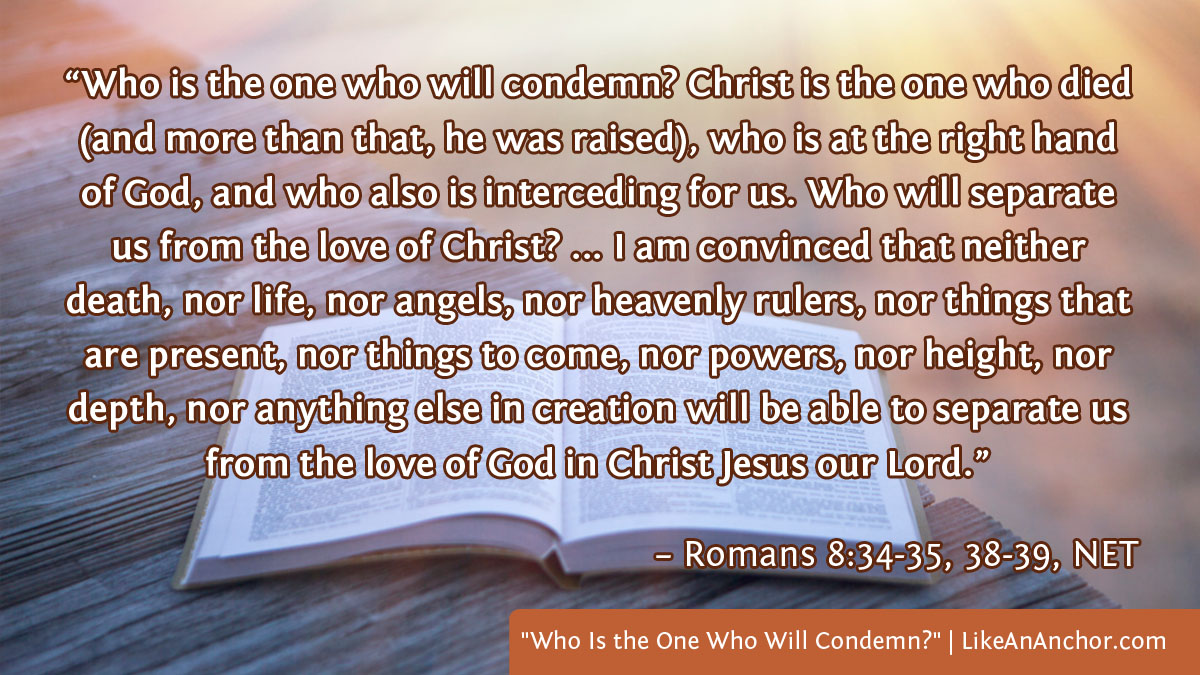
Image of a Bible laying on a deck in the sunset, with text from Romans 8:34-35, 38-39, NET version: “Who is the one who will condemn? Christ is the one who died (and more than that, he was raised), who is at the right hand of God, and who also is interceding for us. Who will separate us from the love of Christ? ... I am convinced that neither death, nor life, nor angels, nor heavenly rulers, nor things that are present, nor things to come, nor powers, nor height, nor depth, nor anything else in creation will be able to separate us from the love of God in Christ Jesus our Lord.”
Image by Lamppost Collective from Lightstock

Setting Up A Contrast

I started reading the NET Bible a few years ago, and I’m still finding translation choices that make me notice verses in a slightly new way. It’s one of the best translations I’ve found for balancing a desire to stay as close to the original languages as you can with transferring the sense of the original into English. I particularly like reading the New Testament in this translation. For Romans 8:34, the NET translators make it extra clear that Paul is setting up a contrast here rather than saying that Christ is the one who condemns.

What then shall we say about these things? If God is for us, who can be against us? Indeed, he who did not spare his own Son, but gave him up for us all—how will he not also, along with him, freely give us all things? Who will bring any charge against God’s elect? It is God who justifies. Who is the one who will condemn? Christ is the one who died (and more than that, he was raised), who is at the right hand of God, and who also is interceding for us.

Romans 8:31-34, NET

In other words, verse 34 continues the exact same pattern as the previous sentences. Do you think anyone can stand up against us or charge us with wrong doing? Don’t worry–God is for us and He’s the one who justifies His people. Do you worry about people who might condemn us? No need–Jesus Christ died for us and He’s interceding on our behalf with God, so we’ve got nothing to worry about. With Jesus mediating for us, not even the “the one called the devil and Satan … the accuser of our brothers and sisters” can condemn us (Rev. 12:9-10, NET).

Image of a woman looking up at the sky, with text from 1 John 3:19-22, NET version: "And by this we will know that we are of the truth and will convince our conscience in his presence, that if our conscience condemns us, that God is greater than our conscience and knows all things. Dear friends, if our conscience does not 
condemn us, we have confidence in the presence of God, and whatever we ask we receive from him, because we keep his commandments and do the things that are pleasing to him."
Image by Brightside Creative from Lightstock

No Condemnation

Paul addressed the topic of condemnation earlier in this same letter as well, just a page or so farther back in our Bibles. It’s part of a point he’s been building up to through the whole letter of Romans about how we relate to God’s law in the New Covenant.

There is therefore now no condemnation for those who are in Christ Jesus. For the law of the life-giving Spirit in Christ Jesus has set you free from the law of sin and death. For God achieved what the law could not do because it was weakened through the flesh. By sending his own Son in the likeness of sinful flesh and concerning sin, he condemned sin in the flesh, so that the righteous requirement of the law may be fulfilled in us, who do not walk according to the flesh but according to the Spirit.

Romans 8:1-4, NET

Paul is not contradicting Jesus’s statement that He did not “come to abolish the law or the prophets.” Rather, Paul is clarifying what Jesus meant when He said, “I have not come to abolish these things but to fulfill them. … whoever obeys them and teaches others to do so will be called great in the kingdom of heaven” (Matt. 5:17-20, NET). Jesus removes the condemnation that the Law placed on us as sinners by taking our sin away and paying the penalty for it Himself. Now, we’re free to keep God’s law by living in the Spirit, fulfilling the righteous requirements of the law as God’s grace covers our mistakes.
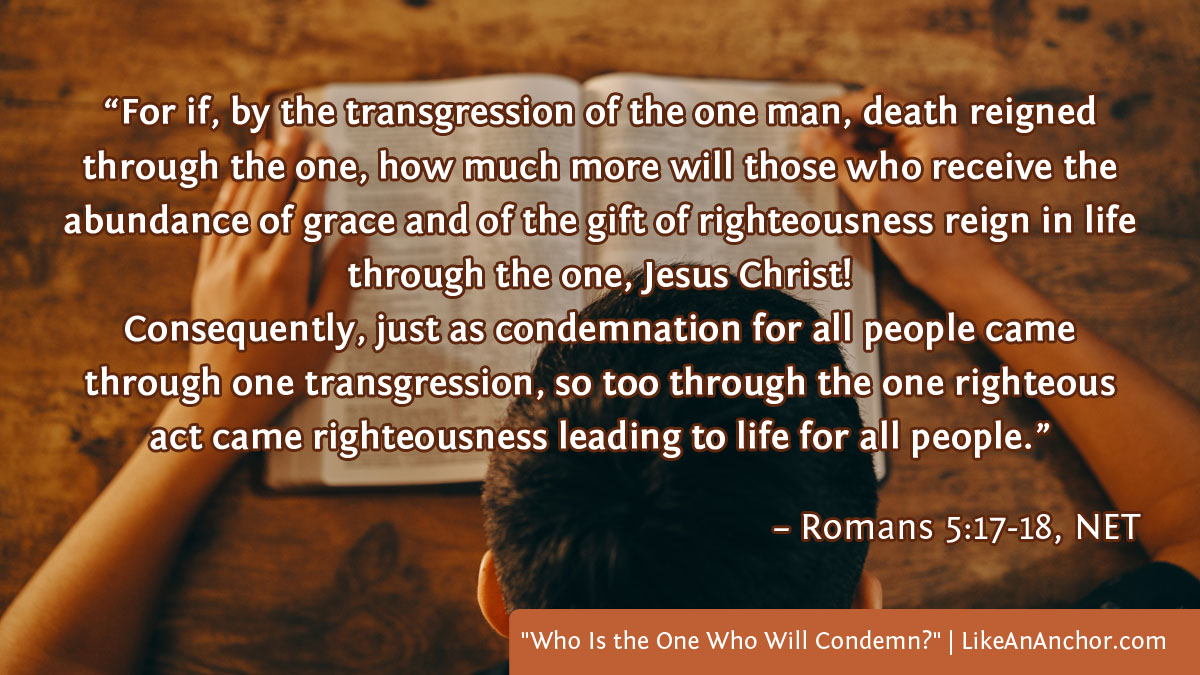
Image of a man reading a Bible, with text from Romans 5:17-18, NET version: "For if, by the transgression of the one man, death reigned through the one, how much more will those who receive the abundance of grace and of the gift of righteousness reign in life through the one, Jesus Christ!
Consequently, just as condemnation for all people came through one transgression, so too through the one righteous act came righteousness leading to life for all people.”
Image by Matt Vasquez from Lightstock

Salvation and Belief

There’s a delicate balance in how we understand God’s grace. I think we often error toward one extreme or another. On the one hand, we might make the mistake of thinking grace means we don’t have to obey God’s law and He’ll just give us salvation no matter what we do. On the other hand, we might stray too close to an idea of “salvation by works” and think our actions play a bigger role in salvation than they really do. The truth is something much more amazing.

Image of  a woman reading a Bible with the blog's title text and the words "We can live lives of righteousness with confidence, knowing all we need to do if we make a mistake is repent. There is no condemnation when we have Jesus interceding for us."
Image by Pearl from Lightstock

For this is the way God loved the world: He gave his one and only Son, so that everyone who believes in him will not perish but have eternal life. For God did not send his Son into the world to condemn the world, but that the world should be saved through him. The one who believes in him is not condemned. The one who does not believe has been condemned already, because he has not believed in the name of the one and only Son of God.

John 3:16-18, NET

God offers us salvation that we had nothing to do with; we cannot save ourselves. In return, He asks for life-changing belief. There’s a reciprocal aspect to grace. It’s part of a covenant agreement God offers us and if we accept this covenant we also accept our role as lovers of God who want to become like Him and follow His commands.

When we enter a relationship with God, we can trust that He is all-in with His commitment as well. He’s already demonstrated this in a spectacular way with Jesus dying for our sins. Moreover, He continues to demonstrate it today with Jesus acting as our mediator and advocate “who is at the right hand of God, and who also is interceding for us” (Rom. 8:34, NET). We can live lives of righteousness with confidence, knowing that if we make a mistake all we have to do is repent and ask forgiveness. There’s no condemnation for us when we have Jesus interceding for us.

Featured image by Aaron Kitzo from Lightstock

Song Recommendation: “Our God” by Chris Tomlin

Why Does the Bible Say to Pray for People in Authority?

The idea that a human being should be treated with a certain amount of respect based on a position they hold has fallen out of fashion in Western society. We routinely complain about U.S. Presidents and some people even display banners and signs cursing their names. We say no one has the right to tell us what to do. We treat “authority” like it’s a bad thing to have, assuming it will only be misused. There are still pockets of authority we might respect–patients may respect a doctor, and students a university professor, for example–but even those are being chipped away as corruption comes to light, our faith in institutions erodes, and our sense of individualism increases.

In sharp contrast to this attitude are passages from New Testament epistles talking about how Christians ought to submit to human authority. I’ve written about this before, near the start of the pandemic when I and many people across the world were struggling with questions like whether to submit to rules forbidding church groups to gather. In that post, we talked about a sermon I heard covering the question of how a Christian can know when to obey human authorities and when to follow the apostle’s example of disobedience when they said, “We must obey God rather than men” (Acts 5:29, WEB)

I’m approaching this question from a different angle today. We know from scripture that we’re supposed to obey human authorities because God tells us to. Submission to authority is a way for us to honor God. We also know that that obedience to human beings only goes so far because our primary loyalty lies with God. We do not obey laws that command us to do things God forbids or that command us not to do things God requires. However, appropriate submission and respect aren’t the only things the Bible says we should do for people in authority. We’re also supposed to pray for them.

Image of a man praying with text from Romans 12:11-12, NET version: “Do not lag in zeal, be enthusiastic in spirit, serve the Lord. Rejoice in hope, endure in suffering, persist in prayer.”
Image by Jantanee from Lightstock

Two Reasons Why We Pray

A command to pray for authority figures shouldn’t surprise us. There aren’t many limits on who we ought to pray for. Jesus even told us, “love your enemy and pray for those who persecute you” (Matt. 5:44, NET). If Jesus told us to love and pray for our enemies I doubt He’s going to say it’s okay to avoid praying for people in authority who might not even be enemies to the faith.

Sometimes, you might hear arguments that instructions to submit to and pray for rulers were added by translators. For example, I’ve heard people say the KJV includes verses about honoring the king because the men translating it wanted to curry favor with King James. Those men might have been happy to find they could include a verse like that, but they’re not where the idea came from. It came from Jesus, Paul, Peter, and other writers inspired by God. Paul explains why it’s so important to include authority figures in our prayers when writing to Timothy.

First of all, then, I urge that requests, prayers, intercessions, and thanks be offered on behalf of all people, even for kings and all who are in authority, that we may lead a peaceful and quiet life in all godliness and dignity. Such prayer for all is good and welcomed before God our Savior, since he wants all people to be saved and to come to a knowledge of the truth. For there is one God and one intermediary between God and humanity, Christ Jesus, himself human, who gave himself as a ransom for all, revealing God’s purpose at his appointed time.

1 Timothy 2:1-6, NET

I like the NET translation for this verse because it acknowledges that some readers might balk at the idea that praying for “all people” includes “kings and all who are in authority.” Paul had experience living in a world where the culture and the authority figures were hostile to his faith. He knew it wasn’t easy to pray for people who’d martyred your fellow believers or kicked them out of a guild, ruining their livelihood. But we need to pray for them anyways, and he gives two main reasons why:

  • It’s good for us. We pray for authorities so that we can lead “a peaceful and quiet life in all godliness and dignity.” Ideally, “rulers cause no fear for good conduct but for bad” (Rom. 13:3, NET). We pray that people in authority would be that kind of ruler, leaving us alone to worship God freely and working to keep society peaceful and safe.
  • It’s good for them. God welcomes prayers for everyone, even our enemies or those in positions of power, because “he wants all people to be saved and to come to a knowledge of the truth.” That should be our desire as well. Jesus “gave himself as a ransom for all,” and knowing that should motivate us to pray everyone would see His Light.
Image of a girl standing in church reading a Bible, with text from Colossians 4:2-3, NET version: “Be devoted to prayer, keeping alert in it with thanksgiving. At the same time pray for us too, that God may open a door for the message so that we may proclaim the mystery of Christ, for which I am in chains.”
Image by José Roberto Roquel from Lightstock

Praying for Peace

God has called us to live in peace (1 Cor. 7:15; Col. 3:15). He wants us to have peaceful lives that aren’t characterized by quarreling, tumult, fear, and other things that would destroy our inner or outer peace. We can have God’s peace inside us and cultivate lives of peace and joy even when the world around us is far from peaceful. However, we should still do everything in our power to live peacefully with all people (Rom. 12:16-21; Heb. 12:4). That includes praying for those who have the power to make things un-peaceful for others.

Yahweh of Armies, the God of Israel, says to all the captives whom I have caused to be carried away captive from Jerusalem to Babylon: … “Seek the peace of the city where I have caused you to be carried away captive, and pray to Yahweh for it; for in its peace you will have peace.”

Jeremiah 29:4, 7, WEB

There’s nothing wrong with wanting peaceful lives. Paul even tells one church that it should be their “ambition to lead a quiet life, and to do your own business” (1 Thes. 4:11, WEB). Life is better for us, the Christian community, and for everyone else living here if there’s peace in our communities and countries. Peace is a good thing to pray for. We can ask God to share His peace with us and to inspire people in authority to work towards peace in their spheres of influence.

Image of a woman sitting at a table with a Bible in front of her with text from Philippians 4:6-7, NET version: “Do not be anxious about anything. Instead, in every situation, through prayer and petition with thanksgiving, tell your requests to God. And the peace of God that surpasses all understanding will guard your hearts and minds in Christ Jesus.”
Image by Prixel Creative from Lightstock

Praying for Others’ Salvation

The second reason we should pray for people in authority is because, “Such prayer for all is good and welcomed before God our Savior, since he wants all people to be saved and to come to a knowledge of the truth” (1 Tim. 2:3-4, NET). We’re supposed to be praying for all people, and those with authority are included in that category.

God offers humanity two very clear choices: choose life with Him, or choose death without Him. That’s simply how the world works. There are no other options. Walking with God leads toward eternal life, and walking away/apart from God leads to nothing. God also makes it very clear that we each have individual choices, and that it’s possible for people to change the course of their lives. If someone is heading toward death, God wants that person to turn around and choose life (Ezekiel 18:1-32; 33:1-20).

The Lord is not slow concerning his promise, as some regard slowness, but is being patient toward you, because he does not wish for any to perish but for all to come to repentance. … Since all these things are to melt away in this manner, what sort of people must you be, conducting your lives in holiness and godliness, while waiting for and hastening the coming of the day of God?

2 Peter 3:9, 11-12, NET

In this letter, Peter reminds us that the end of this present world is coming. While it might sometimes seem like Jesus’s return is taking an awfully long time to get here, what’s really happening is that God is being very patient with people because He wants everyone to choose life. Keeping in mind both this aspect of God’s character and the knowledge that Jesus will return, Peter asks us this: “What sort of people must you be?” He partly answers that question by saying we’ll be “conducting our lives in holiness and godliness” as we wait on God. Being holy and godly involves mimicking God’s character, including His perspective on other people. We need to love earnestly and pray sincerely for other people.

But the end of all things is near. Therefore be of sound mind, self-controlled, and sober in prayer. And above all things be earnest in your love among yourselves, for love covers a multitude of sins.

1 Peter 4:7-8, WEB

Showing God Who We Are

Image of a man praying in a church with the blog's title text and the words "Following God’s instruction to pray for people in authority demonstrates our character to God. It is good for us, and it is good for other people."
Image by Shaun Menary from Lightstock

God is never happy when someone chooses death; it’s His desire that everyone will choose life. When we pray for other people, we participate in that godly desire. We show God that we also want other people to choose life with Him because we’re learning to care about them in much the same way that He does.

By praying for those in authority, we demonstrate our character to God. We show that we care more about following His instructions than we do about our own irritations with political leaders. We show that we long for people to change, grow, and work toward peace rather than wanting them punished because they didn’t do things the way we think they should.

I don’t always remember to pray for people in power. I don’t particularly want to pray for people who plunge nations into wars, vote to continue abortions, or use their authority to avoid the consequences of wrong action. But it does no one any good if I just get angry about this and sit around fuming or refuse to pray about it.

Prayer is the best response for everyone. I can pray for God’s justice to intervene and I can pray for His mercy to soften people’s hearts. I can pray He’ll protect those in danger because of a human leader’s actions. Jesus’s example of viewing people with compassion and praying for them even while not excusing their wrong actions.

Featured image by Claudine Chaussé from Lightstock

Song Recommendation: “Blessings” by Laura Story

Facing Any Challenge With Our Christian “Bat Belt”

Since seeing The Batman (2022) for the first time, and enjoying it so much I went back to the theater again, my sister and I’ve been watching a ton of Batman content. We rewatched the Nolan trilogy, laughed through The Lego Batman Movie (2017), and started Batman: The Animated Series (1992-1995).

I’ve been a fan of Batman since watching Batman (1966-1968) reruns on TV Land at my grandma’s house as a little girl. One of the things that stays consistent through all these different versions is that Batman wears a utility belt containing everything from batarangs to shark-repellant batspray. He’s ready for anything.

We have a similar belt as Christians. We often speak of the Armor of God that Paul describes in Ephesians 6, and I have a whole series of posts on spiritual warfare that goes into detail about that armor (I’ll link to those posts at the end of this article). One of my favorite Bible translations calls the first piece of this armor a “utility belt.” The comparison between Batman’s belt and the Armor of God might be a bit of a stretch (or even seem way too cheesy for a Bible Study blog post), but it did make me think and I thought some of you might find this interesting as well.

The Utility Belt of Truth

Therefore put on the whole armor of God, that you may be able to withstand in the evil day, and having done all, to stand. Stand therefore, having the utility belt of truth buckled around your waist

Ephesians 6:13-14, WEB

As a Batman fan, this wording made me think more deeply about what the “the belt of truth” is than I ever had before. I noticed this translation choice years ago when I first started using the WEB, and it’s been rolling around in my mind ever since. Watching more Batman content now, I realized just how useful–and how seemingly inexhaustible–his utility belt is. The Batman Wiki page lists nearly 50 tools on this belt including a stungun, rope, gasmask, cryptographic sequencer, and first-aid kit. It’s full of non-lethal offensive weapons, defensive tools to protect himself, and evidence-gathering tools to aid in crime fighting.

I don’t usually think of belts as being so universally applicable–they’re for holding your pants up or accessorizing an outfit. But in Bible times, girdles were a key part of soldier’s clothing (1 Sam. 18:4; 2 Sam. 20:8). They could also be decorative, signaling the respect and power of a prince or priest (Ex. 29:9; Isaiah 22:21; Ezk. 23:15). For Roman soldiers in particular (the most well-known army at the time and location of Paul’s writings), the belt was a status symbol and a practical tool that could be considered “even more important than armour or weapons” (Shawn M. Caza). When Paul says the first piece of God’s armor is “the utility belt of truth,” he means for us to understand how useful and versatile this belt is.

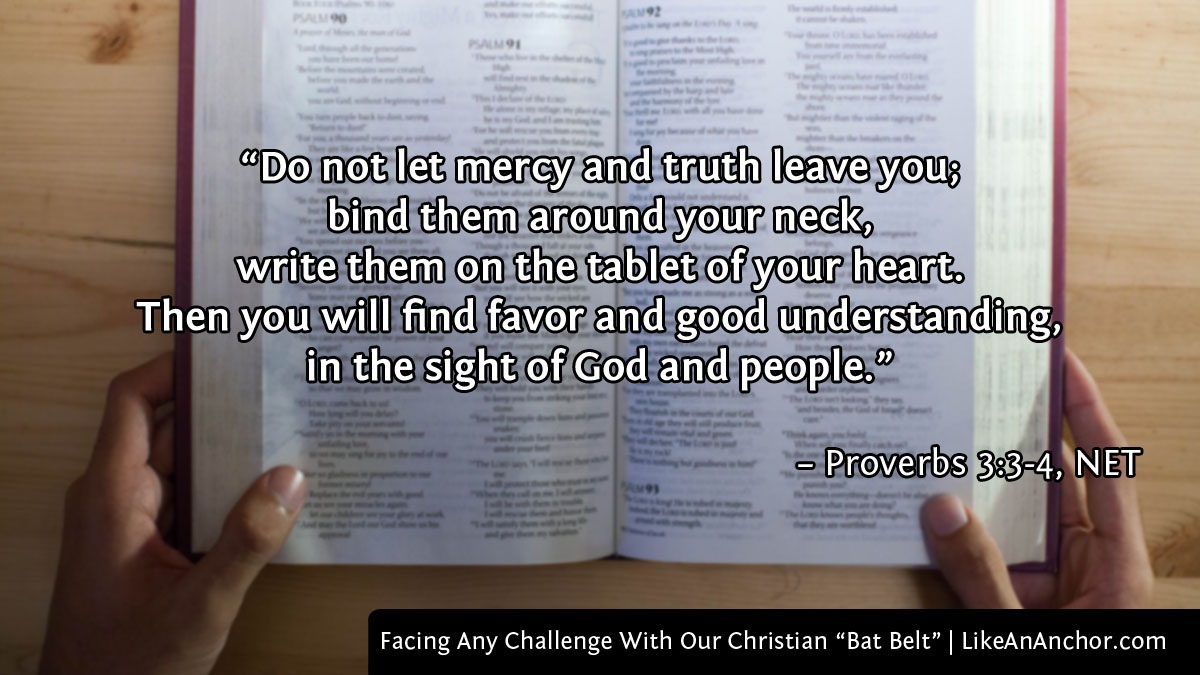
Image of an open Bible overlaid with text from Proverbs 3:3-4, NET version: “Do not let mercy and truth leave you; bind them around your neck, write them on the tablet of your heart. Then you will find favor and good understanding, in the sight of God and people.”
Image by Dakota from Lightstock

What is Truth?

Like Batman’s utility belt, the belt that God gives us to put on as the first piece of armor is applicable in every situation. There is no time when we can’t reach into the belt of truth and pull out something that’s helpful and relevant to our situation. But what, exactly, is truth?

Jesus replied, “I am the way, and the truth, and the life. No one comes to the Father except through me.”

John 14:6, NET

Set them apart in the truth; your word is truth.

John 17:17, NET

God’s word and Jesus Himself are where we find truth. They are truth. So when we read something like Proverbs 3:3, which says, “Don’t let kindness and truth forsake you. Bind them around your neck. Write them on the tablet of your heart” (WEB), we can think of staying close to God, never forsaking His word, and keeping Jesus so near it’s like He’s hanging on our neck and written in our hearts. He has the answers we need and He helps us navigate a complicated world with confidence, and even boldness, knowing that the Creator of the Universe keeps close to us as we keep close to Him.

Truth is a key part of how we worship God (John 4:23-24). It’s part of the fruit of the Holy Spirit (Eph. 5:9), and rejoicing in truth is part of the definition of love (1 Cor. 13:6). Believing, knowing, and loving Truth are closely connected with salvation (2 Thes. 2:8-14; 2 Tim. 2:24-26). We can even tell whether or not we’re in God’s light–in other words, if we have a relationship with Him–by looking at how well we obey His truth (John 3:20-21; 1 John 1:6-8; 2:4; 3:18-19). We’re actually supposed to become new people because the Father “gave birth to us by the word of truth, that we should be a kind of first fruits of his creatures” (James 1:17-18, WEB; see also 1 Pet. 1:22-23).

… if indeed you heard about him and were taught in him, just as the truth is in Jesus. You were taught with reference to your former way of life to lay aside the old man who is being corrupted in accordance with deceitful desires, to be renewed in the spirit of your mind, and to put on the new man who has been created in God’s image—in righteousness and holiness that comes from truth. Therefore, having laid aside falsehood, each one of you speak the truth with his neighbor, because we are members of one another.

Ephesians 4:20-25, NET

Applying Truth In Love

Image of an open Bible with the blog's title text and the words "God’s word applies to every situation, and when we put on His 'belt of truth,' we’re even better equipped for whatever we might face than Batman is with his utility belt."

We can use God’s truth when navigating any challenge that comes our way. By studying God’s word and cultivating our relationship with Jesus and the Father, we deepen our understanding of Truth and arm ourselves with a belt that helps equip us for facing any situation. As our understanding deepens, we gain an anchor that keeps us from being tossed around in the storms and confusions of life. We also learn better how to apply God’s truth in our lives.

So we are no longer to be children, tossed back and forth by waves and carried about by every wind of teaching by the trickery of people who craftily carry out their deceitful schemes. But practicing the truth in love, we will in all things grow up into Christ, who is the head. From him the whole body grows, fitted and held together through every supporting ligament. As each one does its part, the body builds itself up in love.

Ephesians 4:14-16, NET

This verse tells us that “practicing the truth in love” is part of growing up as a member of Jesus’s body. You’ll also find translations that say, “speaking the truth in love” (WEB, for example). The more we grow to be like Jesus, the more we’re able to apply His truth in a loving way through every aspect of our lives, including what we say and what we do.

Truth from God can do amazing things. Knowing truth makes us free (John 8:31). God can send out His truth to rescue us and vanquish enemies (Psalm 43:1-3; 54:4-5). We can tell whether a teacher is aligned with God by how they handle the Word of Truth (2 Cor. 4:1-2; 6:3-7; 13:8; 1 Thes. 2:13; 2 Tim. 2:15; Titus 1:1). And we can go to God’s truth for aid when we’re not sure what to do next or need to counter an attack from the Adversary (as Jesus did when the devil came after Him). God’s word applies to every situation, and when we put on His “belt of truth,” we’re even better equipped for whatever we might face than Batman is with his utility belt. 

Spiritual Warfare Series

Featured image by Abhishek Kashyap from Pixabay

To Each According to Their Need

John 6 is a chapter we read a lot during Passover and the closely connected Days of Unleavened Bread (Pesach and Chag HaMatzot). That annual festival ended yesterday, but I’m still thinking about the Bread of Life and all that He has done for us.

In this chapter of John’s gospel, Jesus feeds 5,000 people in one day, walks on water and calms the winds on a lake, then the next day He teaches the people who followed Him across that lake. All the gospels record miracles where Jesus multiplied bread to feed large crowds. John also includes Jesus’s teachings after one of those miracles about Himself as the bread of life, which is so much more valuable than the bread which filled His listeners’ stomachs.

Bread from Heaven

When they found him on the other side of the lake, they said to him, “Rabbi, when did you get here?” Jesus replied, “I tell you the solemn truth, you are looking for me not because you saw miraculous signs, but because you ate all the loaves of bread you wanted. Do not work for the food that disappears, but for the food that remains to eternal life—the food which the Son of Man will give to you. For God the Father has put his seal of approval on him.”

So then they said to him, “What must we do to accomplish the deeds God requires?” Jesus replied, “This is the deed God requires—to believe in the one whom he sent.” So they said to him, “Then what miraculous sign will you perform, so that we may see it and believe you? What will you do? Our ancestors ate the manna in the wilderness, just as it is written, ‘He gave them bread from heaven to eat.’”

John 6:25-32, NET

This conversation always makes me shake my head at these people (though I’m also not sure I’d have done much better). They’d just seen a miracle the day before, yet they have the audacity to ask Jesus what sign He’ll perform to make them believe in Him. They even suggest that bread from heaven, like the Israelites got with the manna in the wilderness, would be nice. Jesus understood them exactly right when He said they chased Him down to fill their bellies with bread rather than because they understood He could offer them eternal life.

Then Jesus told them, “I tell you the solemn truth, it is not Moses who has given you the bread from heaven, but my Father is giving you the true bread from heaven. For the bread of God is the one who comes down from heaven and gives life to the world.” So they said to him, “Sir, give us this bread all the time!” Jesus said to them, “I am the bread of life. The one who comes to me will never go hungry, and the one who believes in me will never be thirsty.” …

I tell you the solemn truth, the one who believes has eternal life. I am the bread of life. Your ancestors ate the manna in the wilderness, and they died. This is the bread that has come down from heaven, so that a person may eat from it and not die. I am the living bread that came down from heaven. If anyone eats from this bread he will live forever. The bread that I will give for the life of the world is my flesh.”

John 6:32-35, 47-51, NET

There’s a big difference between Jesus as the bread of life and the manna the Israelites ate in the wilderness. One was physical and could only sustain physical life. The other is spiritual, and partaking of Him means you won’t ever die. There are also important similarities, though. Both were sent by God into a situation that seemed hopeless. Both are miraculous. Both are available in just the right amount for everyone.

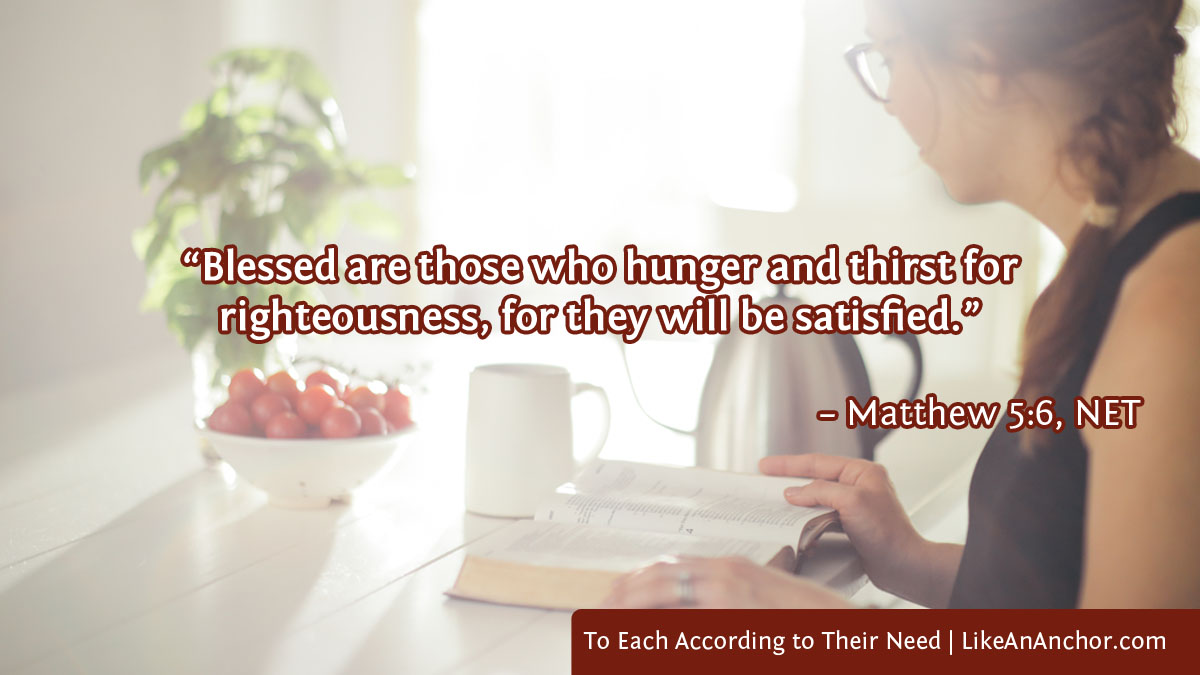
Image of a woman reading her bible at a table, with text from Matthew 5:6, NET version: "“Blessed are those who hunger and thirst for righteousness, for they will be satisfied."
Image by MarrCreative from Lightstock

Sustenance One Day At A Time

When the dew that lay had gone, behold, on the surface of the wilderness was a small round thing, small as the frost on the ground. When the children of Israel saw it, they said to one another, “What is it?” For they didn’t know what it was. Moses said to them, “It is the bread which Yahweh has given you to eat. This is the thing which Yahweh has commanded: ‘Gather of it everyone according to his eating; an omer a head, according to the number of your persons, you shall take it, every man for those who are in his tent.’” The children of Israel did so, and some gathered more, some less. When they measured it with an omer, he who gathered much had nothing over, and he who gathered little had no lack. They each gathered according to his eating.

Exodus 14-18, WEB

When people gathered manna according to God’s instructions, they had exactly enough. No one had too much and no one had too little to fully satisfy them for each day. The manna couldn’t be stored-up for the future, though; they had to gather and eat it each day if they wanted food. The only day of the week that manna didn’t rot by the next morning was on Friday–the preparation day for the weekly Sabbath, when God gave the people rest (Ex. 16:19-30).

Thinking of the link between manna and Jesus as the Bread of Life adds another layer of understanding to these words in Jesus’s model prayer: “Give us day by day our daily bread” (Luke 11:3, NET). We need to come to Jesus and “eat” Him every day, taking His words inside us and connecting with Him in prayer. Then on the Sabbath, we can come together with our fellow believers and rest in God’s presence, drinking Him and His words in even more deeply. When we trust Him and stay close to Him, he’ll supply all our needs.

I have learned to be content in any circumstance. I have experienced times of need and times of abundance. In any and every circumstance I have learned the secret of contentment, whether I go satisfied or hungry, have plenty or nothing. I am able to do all things through the one who strengthens me. … And my God will supply your every need according to his glorious riches in Christ Jesus. 

Philippians 4:11-13, 19, NET

These verses are reassuring. God will take care of our needs. That doesn’t mean we’ll never experience “times of need,” or when we go hungry or have nothing (as Paul said happened to him). What it does mean is that God will take care of us anyway and He’ll help us get through those things. It puts me in mind of Jesus’s sermon on the mount, where He said not to be anxious about food or clothing, and to take one day at a time (Matt. 6:25-34). God doesn’t want us fretting about stuff, especially things in the future that we can’t really control or predict. He wants us focused on Him.

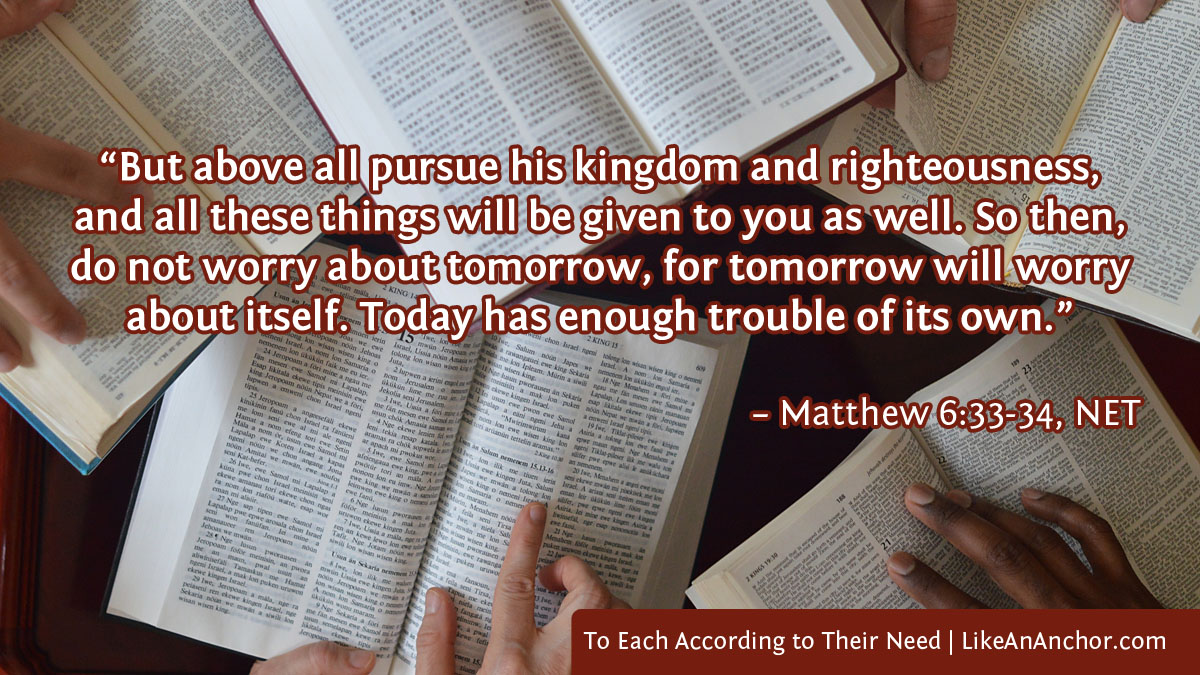
Image of 5 Bibles on a table, with people's hands following along on the page. The image is overlaid with text from Matthew 6:33-34, NET version: "But above all pursue his kingdom and righteousness, and all these things will be given to you as well. So then, do not worry about tomorrow, for tomorrow will worry about itself. Today has enough trouble of its own."
Image by Inbetween from Lightstock

New Mercies Each Day

The Lord’s loyal kindness never ceases;
his compassions never end.
They are fresh every morning;
your faithfulness is abundant!
“My portion is the Lord,” I have said to myself,
so I will put my hope in him.

Lamentations 3:22-24, NET
Image of people sitting in church holding Bibles, with the blog's title text and the words "God can, and will, supply all our physical and spiritual needs through Jesus as our daily Bread of Life."
Image by Brown Bag Photography from Lightstock

Like manna in the wilderness, God’s compassionate kindness renews every morning. He supplies mercy and forgiveness to each of us according to our need, giving Himself to us as the portion that fills our emptiness.

Jesus said to them, “I tell you the solemn truth, unless you eat the flesh of the Son of Man and drink his blood, you have no life in yourselves. The one who eats my flesh and drinks my blood has eternal life, and I will raise him up on the last day. For my flesh is true food, and my blood is true drink. The one who eats my flesh and drinks my blood resides in me, and I in him. Just as the living Father sent me, and I live because of the Father, so the one who consumes me will live because of me. This is the bread that came down from heaven; it is not like the bread your ancestors ate, but then later died. The one who eats this bread will live forever.” …

After this many of his disciples quit following him and did not accompany him any longer. So Jesus said to the twelve, “You don’t want to go away too, do you?” Simon Peter answered him, “Lord, to whom would we go? You have the words of eternal life. We have come to believe and to know that you are the Holy One of God!”

John 6:53-58, 66-69, NET

We know, as Peter did, that there’s nowhere else we can go if we want eternal life. We need Jesus every single day. We all benefit from God’s loyal kindness, unending compassion, abundant faithfulness, and renewing mercy. And He can supply as much of those things as we need. We just need to ask Jesus to give us each day our daily Bread of Life.

Featured image by Anggie from Lightstock

God Chose You Even Knowing You’ll Mess Up

This Sabbath follows shortly after the Passover–a day when we remember Jesus’s death and His sacrifice for sins. He told us to keep that day “in remembrance of me” with the symbols of His new covenant. As we think about His sacrifice, we’re forced to consider the terrible price that justice for humanity’s sins–including our sins–demanded. Jesus died an excruciating death. He endured that with His eyes fixed on “the joy set out for him” because He knew that sacrifice was needed to grow His and His father’s family.

Recognizing the high price Jesus paid for us should humble us deeply and move us to genuine repentance. It should also boggle our minds with a realization of His overflowing love. God has been inviting people into His family for thousands of years even though He knew the cost of that welcome. Moreover, He still chooses us today knowing that even after we receive the gift of forgiveness we’ll mess up again. Thankfully, Jesus’s perfect sacrifice keeps covering those sins when we repent after making a mistake; He doesn’t need to be sacrifice again each time we slip-up (Hebrews 10:1-18). God chooses us and keeps showing us mercy even knowing we’ll mess up. This is a kind of love that people rarely offer to each other, but the Creator of all things gives it to us.

A History of Gracious Relationships

Long ago, God chose to form a covenant with Abraham and with his children. Those descendants grew into a nation called Israel, and God delivered them from Egypt on the first Passover. About 50 days later (very likely on the day of Pentecost), God made a covenant with them as well. About 40 years later, when Israel was finally ready to go into the promised land, God had this conversation with Moses:

“Behold, you shall sleep with your fathers. This people will rise up and play the prostitute after the strange gods of the land where they go to be among them, and will forsake me and break my covenant which I have made with them. Then my anger shall be kindled against them in that day, and I will forsake them, and I will hide my face from them, and they shall be devoured, and many evils and troubles shall come on them; so that they will say in that day, ‘Haven’t these evils come on us because our God is not among us?’ I will surely hide my face in that day for all the evil which they have done, in that they have turned to other gods.

“Now therefore write this song for yourselves, and teach it to the children of Israel. Put it in their mouths, that this song may be a witness for me against the children of Israel. For when I have brought them into the land which I swore to their fathers, flowing with milk and honey, and they have eaten and filled themselves, and grown fat, then they will turn to other gods, and serve them, and despise me, and break my covenant. It will happen, when many evils and troubles have come on them, that this song will testify before them as a witness; for it will not be forgotten out of the mouths of their descendants; for I know their ways and what they are doing today, before I have brought them into the land which I promised them.”

Deut. 31:16-21, WEB

God knew Israel wouldn’t be faithful, but He chose them anyway and told them to keep coming back to Him when (not if) they strayed from the right path. Similarly, He choses us knowing we’ll make mistakes and already planning to keep welcoming us each time we turn back to Him repentantly asking for forgiveness. When we begin this relationship with God He asks us for faithfulness, we promise to be faithful, and He accepts that promise even though he knows we’ll slip up and He’ll need to forgive us again.

Even at my best, my faithfulness involves falling, picking myself up (or Him picking me up), and then recommitting to walking with God. I’m encouraged looking at centuries of Bible history that records God’s grace-fueled relationships with people. There’s so much forgiveness available from God; so many calls in His word for people to keep coming back to Him. The whole process of us trying to be faithful to God is enabled by His faithfulness.

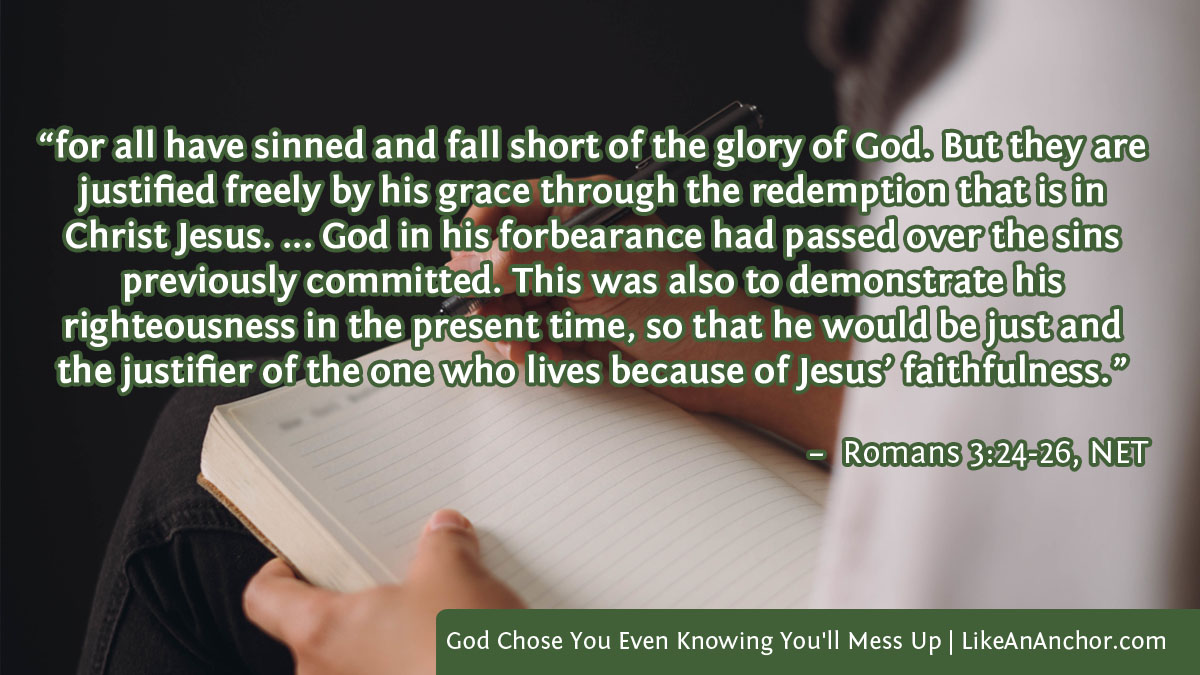
Image of a woman writing in a notebook, with text from Romans 3:24-26,  NET version: “for all have sinned and fall short of the glory of God. But they are justified freely by his grace through the redemption that is in Christ Jesus. ... God in his forbearance had passed over the sins previously committed. This was also to demonstrate his righteousness in the present time, so that he would be just and the justifier of the one who lives because of Jesus’ faithfulness.”
Image by Corey David Robinson from Lightstock

Saved Before We Were Good

Paul’s letter to Rome is one of the Bible books that I find most fascinating. There’s so much packed into this letter about our relationship with God and how His expectations for us work in the New Covenant. Paul spends quite a bit of time discussing the topic of God choosing us even though it’s still a battle for us to live in the spirit rather than in the flesh.

Therefore, since we have been declared righteous by faith, we have peace with God through our Lord Jesus Christ, through whom we have also obtained access into this grace in which we stand, and we rejoice in the hope of God’s glory. Not only this, but we also rejoice in sufferings, knowing that suffering produces endurance, and endurance, character, and character, hope. And hope does not disappoint, because the love of God has been poured out in our hearts through the Holy Spirit who was given to us.

For while we were still helpless, at the right time Christ died for the ungodly. (For rarely will anyone die for a righteous person, though for a good person perhaps someone might possibly dare to die.) But God demonstrates his own love for us, in that while we were still sinners, Christ died for us. Much more then, because we have now been declared righteous by his blood, we will be saved through him from God’s wrath. For if while we were enemies we were reconciled to God through the death of his Son, how much more, since we have been reconciled, will we be saved by his life? Not only this, but we also rejoice in God through our Lord Jesus Christ, through whom we have now received this reconciliation.

Romans 5:1-11, NET

God’s love is so amazing. No one could reasonably expect someone as perfect or as important as God to die for people like us. Most human beings would hesitate to die even for a good person, and we weren’t even good (Rom. 3:24-26). We are family, though, because God the Father decided He wants us to be His children. He claims us as His, justifies us even though we fall short of His glory, and gives us life through Jesus’s faithfulness.

Image of a smiling woman with her arm raised in worship with text from Lamentations 3:22-23, TLV version: “Because of the mercies of Adonai
    we will not be consumed,
    for His compassions never fail.
They are new every morning!
    Great is Your faithfulness.”
Image by Pearl from Lightstock

Mercies and Great Faithfulness

It’s incredible to think of how much God loves us and of the high price He was willing to pay to remove our sins and get us into His family. Knowing that God chose us despite our past sins and even though we aren’t perfect yet should both humble and inspire us.

It’s a strange sort of balance that we’re to have in our thinking. We’re supposed to be confident while acknowledging we have no power or strength on our own. We can fully embrace our importance to God, yet we must never become puffed up and self-important. We get to be heirs in God’s family alongside Jesus, but we must give thanks for God’s mercy and continue following His example rather than boasting about what He has given us.

Image of a man praying with the blog's title text and the words "Knowing that God chose us despite our past sins and even though we aren't perfect yet should both humble and inspire us."
Image by WhoisliketheLord Studio from Lightstock

So in the same way at the present time there is a remnant chosen by grace. And if it is by grace, it is no longer by works, otherwise grace would no longer be grace. What then? Israel failed to obtain what it was diligently seeking, but the elect obtained it. The rest were hardened …

But if you boast, remember that you do not support the root, but the root supports you. Then you will say, “The branches were broken off so that I could be grafted in.” Granted! They were broken off because of their unbelief, but you stand by faith. Do not be arrogant, but fear! For if God did not spare the natural branches, perhaps he will not spare you. Notice therefore the kindness and harshness of God—harshness toward those who have fallen, but God’s kindness toward you, provided you continue in his kindness; otherwise you also will be cut off. And even they—if they do not continue in their unbelief—will be grafted in, for God is able to graft them in again.

Romans 11:5-6, 18-21, NET

Here, Paul explains to his readers that even though many of the the peoples descended from ancient Israel turned their backs on God, He hasn’t given up on anyone. Rather, the Lord “has consigned all people to disobedience so that he may show mercy to them all” (Rom. 11:32, NET). This is a tricky verse, but I think it means that God chooses to treat people who ignore Him or who’ve broken covenants their ancestors made with Him as if they are ignorant and disobedient rather than unredeemably wicked. We’re accountable for what we know and what we do (see Rom. 2-3), but God still chooses mercy over judgment whenever He can (James 2:13).

As we embrace our godly identities more and more fully, we also become more and more like God. And the better we understand His holiness the more easily we see how far from being like Him we really are even as we get better at living His way of life. Alongside that comes an increased appreciation for the incredible gifts of His faithfulness, forgiveness, and mercy that keep guiding us back to Him when we miss the mark. God isn’t surprised that we aren’t perfect yet. He chose us anyway, and He keeps choosing us. We can take comfort in that, knowing that He’s just as invested (and often more so) in getting us into His kingdom as we are in being there.

Featured image by Shaun Menary from Lightstock

Song Recommendation: “Who Am I?” by Casting Crowns

Uprooting Your Sukaminos Trees

Have you ever heard someone read a familiar Bible passage–something from the gospels, for instance, which you’ve read many times before–and spotted something entirely new to you? It’s been right there the whole time, but you’d never noticed or thought about it before. That happened this past Sabbath when our pastor read Luke 17. He stopped after just a couple verses, but I kept reading and something struck me.

In Matthew, when Jesus says “if you have faith as a grain of mustard seed” He follows that up by saying you can move mountains (Matt. 17:20; 21:21). In this chapter of Luke, though, Jesus says faith like a grain of mustard seed can do something else. He’s using the analogy in different situational contexts. The one in Matthew’s gospel comes after the disciples couldn’t cast out a demon and Jesus had to take care of it. In Luke, it comes after a conversation about forgiveness. Let’s take a look at that:

Jesus said to his disciples, “Stumbling blocks are sure to come, but woe to the one through whom they come! It would be better for him to have a millstone tied around his neck and be thrown into the sea than for him to cause one of these little ones to sin. Watch yourselves! If your brother sins, rebuke him. If he repents, forgive him. Even if he sins against you seven times in a day, and seven times returns to you saying, ‘I repent,’ you must forgive him.”

The apostles said to the Lord, “Increase our faith!” So the Lord replied, “If you had faith the size of a mustard seed, you could say to this black mulberry tree, ‘Be pulled out by the roots and planted in the sea,’ and it would obey you.”

Luke 17:1-6, NET

I find it interesting that when Jesus told the apostles they needed to forgive people more freely and more often, they responded by asking for more faith. Then Jesus used the mustard seed analogy to say your faith could root up a “black mulberry tree.” That’s the part I hadn’t noticed before. He changes the analogy for this conversation about radical forgiveness. Why?

A Stubborn Root

Answering the question “why a black mulberry tree?” is complicated by the fact that we’re not 100% sure how to translate the word used there. It’s sukaminos in the Greek (G4807). There are two different trees that this word might represent:

Black mulberry tree (Morus nigra). This is the translation chosen by several modern translations including NIV, TLV, and NET. The NET’s footnote says, “A black mulberry tree is a deciduous fruit tree that grows about 20 ft (6 m) tall and has black juicy berries. This tree has an extensive root system, so to pull it up would be a major operation.”

Sycamine tree (Ficus sycomorus). This is the translation used by the KJV and WEB (among others). Thayer’s dictionary says it has “the form and foliage of the mulberry, but fruit resembling the fig.” This tree also has an extensive root system and it’s fruit is so bitter if you want to eat it raw you need to eat it in tiny pieces.

With either translation, the tree Jesus is talking about has a large root system. It would be extremely difficult to dig a large, full-grown mulberry or sycamine tree out of the ground–much less pluck it up by the roots. Yet Jesus says, “If you had faith the size of a mustard seed, you could say to this sukaminos tree, ‘Be pulled out by the roots and planted in the sea,’ and it would obey you.” This impossible thing is made simple with God’s help.

God’s perfectly capable of moving trees, but the chances of you literally needing to yank up a tree with faith are slim. Jesus isn’t talking about how to clear land here; He’s talking about faith and forgiveness. And it’s not just any forgiveness–this is forgiveness that keeps giving over and over again. From other scriptures, we know that someone doesn’t even need to turn to you and say “I repent” in order for you to forgive (Matt. 6:15; 18:21-35). We need to forgive always, in every situation where someone offends, hurts, or sins against us. We’re called to participate in God’s forgiveness–showing to others the same sort of mercy God shows toward us.

Rooting Out Bitterness to Produce Better Fruit

One of the reasons some translators opt for sycamine tree over mulberry tree is because the sycamine’s fruit is so bitter. This makes the tree a great analogy for the “root of bitterness” that can block us from forgiveness. The Bible does speak of people being rooted in bad things that aren’t associated with bitterness (for example: “the love of money is the root of all evils” [1 Tim. 6:10, NET]). However, if we’re looking for verses that speak of a specific thing that can take root in us, damage our hearts, and block forgiveness then bitterness is the most likely suspect in both the Old and New Testament.

Neither do I make this covenant and this oath with you only, but with those who stand here with us today before Yahweh our God, and also with those who are not here with us today … lest there should be among you a root that produces bitter poison; and it happen, when he hears the words of this curse, that he bless himself in his heart, saying, “I shall have peace, though I walk in the stubbornness of my heart”

Deuteronomy 29:14-15, 18-19, WEB

See to it that no one comes short of the grace of God, that no one be like a bitter root springing up and causing trouble, and through it many become defiled.

Hebrews 12:15, NET

The Hebrew words rō’š (H7219) and laʿănâ (H3939) for “bitter poison” refer to gall, venom, and poisonous plants (BDB Dictionary). Greek is similar, with pikra (G4088) literally meaning bitter gall and poison, and figuratively covering bitterness, hatred, and bitter roots that bear bitter fruit (Thayer’s dictionary). Considering scripture’s emphasis on us bearing good fruit, the possibility of producing something bitter, acrid, and poisonous should make us sit up and take notice.

On the topic of roots, God’s word spends more time urging us to root ourselves in good things than it does warning us away from bad things. The person who trusts in God will flourish, rooted in righteousness (Prov. 12:3, 12; Jer. 17:7-8). God promised His people a day when they would take root and thrive, bearing good fruit even though they’d failed to do that in the past (Is. 27:6; 37:30-32; Hos. 9:15-17; Mat. 3:9-11). This fruitfulness is enabled by the prophesied Messiah, “the root of David” (Is. 11:1-3, 9-10; Rev. 5:5; 22:16). Now, with Jesus Christ dwelling in our hearts, we can be “rooted and grounded in love” and in Him rather than in bitterness or other unstable foundations (Rom. 11:15-18; Eph. 3:16-18; Col. 2:6-7).

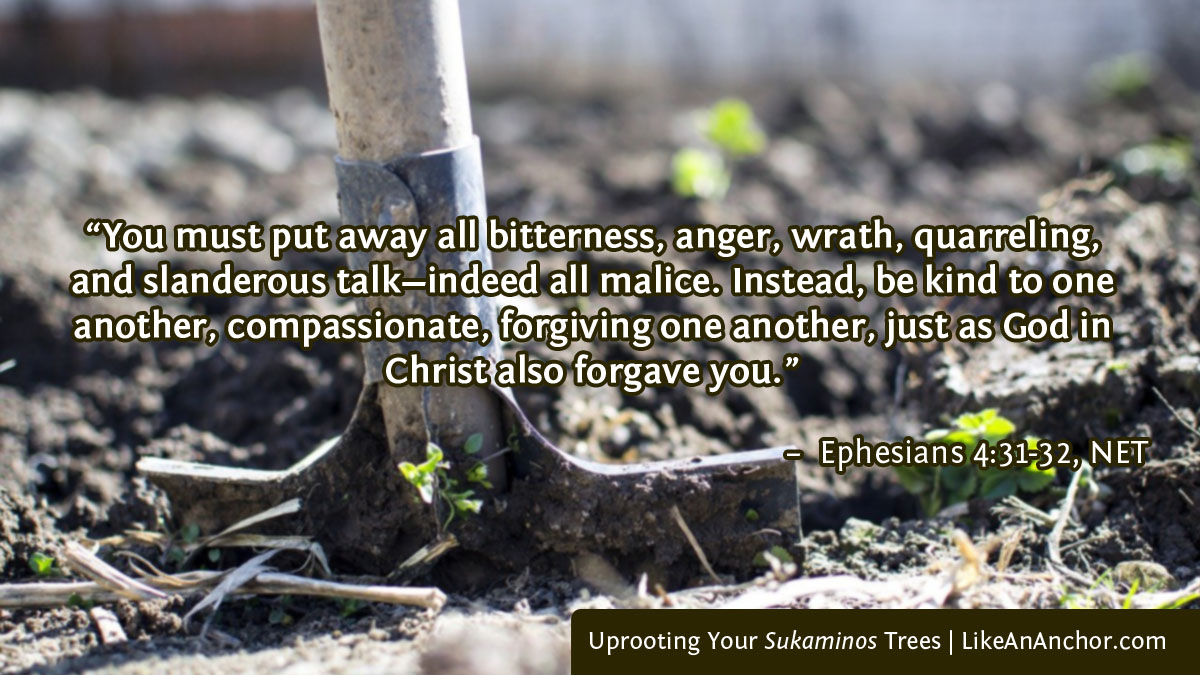
Image of a shovel digging into dirt, with text from Ephesians 4:31-32, NET version: "You must put away all bitterness, anger, wrath, quarreling, and slanderous talk—indeed all malice. Instead, be kind to one another, compassionate, forgiving one another, just as God in Christ also forgave you."
Image by Goumbik from Pixabay

Connecting To Forgiveness

It is imperative that we put away things like “bitterness, anger, wrath, quarreling, and slanderous talk—indeed all malice” and replace that with the compassionate, forgiving nature of God (Eph. 4:31-32, NET). That’s the main emphasis in this passage of Luke. We’re supposed to change. Once we’re following Jesus, we don’t react to people who offend us or sin against us the way that our human nature typically wants to. Rather, we’re to forgive them in the same way that we want God to forgive us. Let’s go back to Luke 17 and read a little farther this time. Here’s the whole conversation:

Jesus said to his disciples, “Stumbling blocks are sure to come, but woe to the one through whom they come! It would be better for him to have a millstone tied around his neck and be thrown into the sea than for him to cause one of these little ones to sin. Watch yourselves! If your brother sins, rebuke him. If he repents, forgive him. Even if he sins against you seven times in a day, and seven times returns to you saying, ‘I repent,’ you must forgive him.”

The apostles said to the Lord, “Increase our faith!” So the Lord replied, “If you had faith the size of a mustard seed, you could say to this black mulberry tree, ‘Be pulled out by the roots and planted in the sea,’ and it would obey you.”.

“Would any one of you say to your slave who comes in from the field after plowing or shepherding sheep, ‘Come at once and sit down for a meal’? Won’t the master instead say to him, ‘Get my dinner ready, and make yourself ready to serve me while I eat and drink. Then you may eat and drink’? He won’t thank the slave because he did what he was told, will he? So you too, when you have done everything you were commanded to do, should say, ‘We are slaves undeserving of special praise; we have only done what was our duty.’”

Luke 17:1-10, NET

This sort of deep change requires time, faith, and God’s spirit inside us transforming us to be more and more like Him. We need to commit to this change and work with God as He works in us. Forgiveness is part of our duty as people serving God the Father and following Jesus Christ. It’s not even like Jesus is asking us to go above and beyond–when we forgive the way that He does “we have only done what was our duty.”

God expects that we’ll get rid of “bitter jealousy and selfishness” and replace it with “the fruit that consists of righteousness” and the wisdom that is “first pure, then peacefulgentlereasonablefull of mercy and good fruitswithout partiality, and without hypocrisy” (James 3:14-18). He knows it’s an ongoing process, but He does expect us to work toward this goal of having His character and nature define us. In the final week before Passover (which we’ll be keeping April 14th after sunset), let’s consider and pray about whether there’s anything like bitterness that we should dig-up out of our lives. We can ask for faith, just as the disciples did, and God will help us move the stubborn struggles in our lives no matter how deeply rooted they are.

Featured image by Susan Cipriano from Pixabay

Song Recommendation: “Lord Reign In Me” by Vineyard