
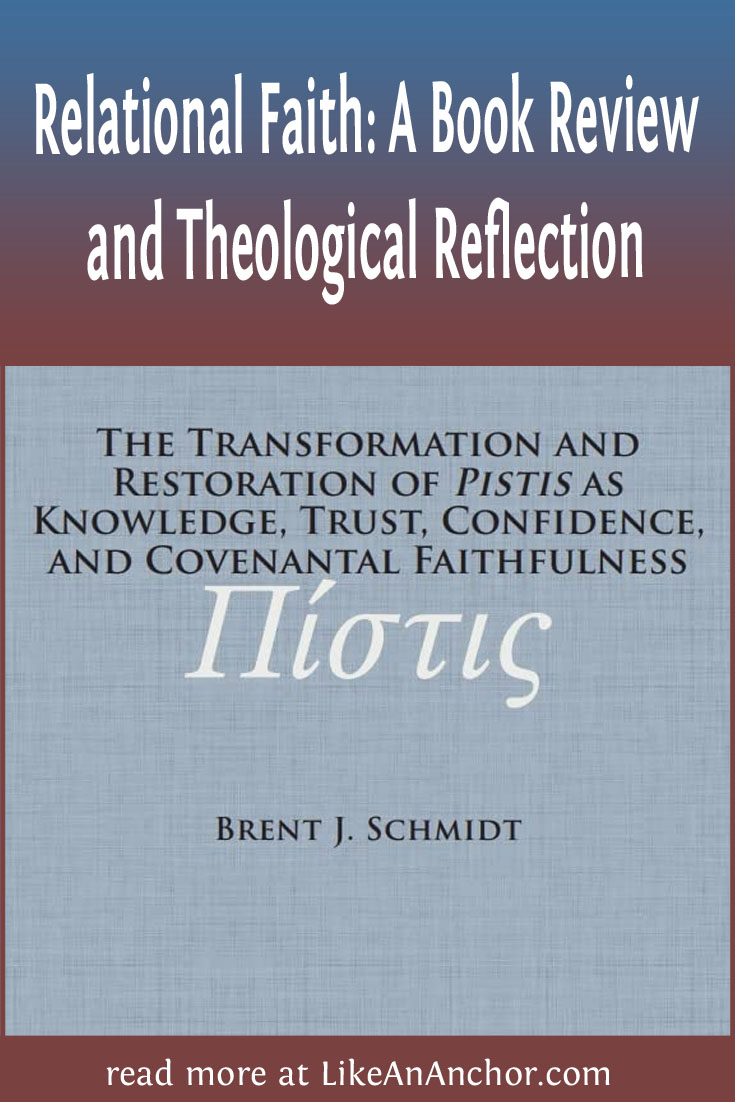
I was so happy to receive a comment from Brent Schmidt on my blog post about his book Relational Grace: The Reciprocal and Binding Covenant of Charis (2015) offering me the opportunity to read his new book Relational Faith: The Transformation and Restoration of Pistis as Knowledge, Trust, Confidence, and Covenantal Faithfulness (2023). I really enjoyed the book on grace, and I was eager to read this follow-up work on faith.
You could read Relational Faith on its own, but it builds on Relational Grace and is best read as a continuation of that study. The basic argument of this new book is, “A universal doctrinal apostasy regarding faith occurred, necessitating a restoration of relational, covenantal faith” (p. 233). Much like Schmidt explained with charis/grace, the original meaning of pistis is vastly different from most mainstream Christian ideas of faith. Studying the context for how these Greek words were used when the New Testament was written helps us understand how grace and faith work today. God’s character is unchanging and the way He relates to us–including what He expects of those in relationship with Him–also didn’t change just because theologians over the years came up with different interpretations and ideas.
I don’t remember if I’ve mentioned this here before, but if I could have constructed a perfect-for-me class to take as part of my Masters in Rhetoric and Writing program, it would have focused on the Apostle Paul’s use of classical and Jewish rhetorical strategies. Schmidt holds a PhD in classics, and reading this book I felt like I was getting much of what I’d want from that hypothetical class. Schmidt opens the introduction with the words, “Context is key if we are to understand the essential Christian doctrine of faith as taught by the Apostle Paul” (p. 1). Amen, sir. Also, pistis is the same word used for “persuasion” in Aristotle’s rhetoric, and Schmidt spends a good deal of time on classical rhetoricians’ use of the word.
In short, this book could have been written for me even though Schmidt and I have some significantly different theological views/backgrounds (a bit more on that at the end). Overall, I found this an excellent scholarly work situating pistis firmly in its ancient context for both Jewish and Gentile Christians in the first-century. It also contains a detailed history of the changes in doctrinal understandings of faith over the years, with comparisons between different interpretations of faith from a variety of theologians. I didn’t find this book quite as engaging as Relational Grace, but it was well worth reading.

Contextualizing Pistis
One of Schmidt’s basic premises is that we can better understand how Biblical writers use a Greek word by looking at how Classical writers earlier and around the same time used that word. This may seem an odd idea to us who live in a world where it’s considered normal and proper to separate religion from things like philosophy and science. There wasn’t such a separation in ancient times, though (Schmidt, p. 3). And while Biblical writers did give some words new/deeper Christian spiritual meanings, extrabiblical writings provide invaluable clues for understanding how people used these words at the time Paul and others were writing.
Schmidt’s etymological history of pistis and related words reveals that they can mean “faithfulness, steadfastness, and trustworthiness because of the underlying expressions of loyalty between parties in covenant relationships” (p. 11). He also places the word’s use in the context of classical Greek writers and Roman writers using the equivalent Latin word fides. He even looked into how pagan conceptions of the Pistis and Fides as goddesses influenced contemporary uses of the word. It’s a thorough scholarly investigation.
Additionally, Schmidt writes, “in the first century, pistis implied active loyalty, trust, hope, knowledge, and persuasion in the patron-client relationship or within the new covenant brought about through Christ’s Atonement” (p. 11). Faith in this sense is an active thing that’s connected with reciprocal relationships. When we’re in covenant with God, He is faithful to us and we must be faithful to Him. This is a concept that would have been very familiar to both Greek and Jewish audiences (Schmidt, p. 12-16). Also, Greek and Roman audiences were very familiar with the patron-client relationships that had pistis at the center. Whatever their religious background, first-century audiences would have thought of faith in a reciprocal relational context.
Jewish audiences in particular knew that faithfulness was key to covenants with God. In Hebrew, the basic root word for faith is aman (H539 in Strong’s). At the core, it means “firmness or certainty” (Theological Wordbook of the Old Testament, entry 116). Related words in this family include amen (verily, truly), emun (faithfulness, trusting), emuna (firmness, fidelity), and emet (truth). Schmidt points out that, like the Greek pistis, these Hebrew concepts were “knowledge-based, relational, and covenantal” (p. 37). And when Jewish writers wrote in Greek, they translated aman words into Greek as pistis (Schmidt 38). For example, when Paul quotes Habackuck 2:4, “the righteous will live by his faith (emunah),” he says, “the righteous shall live by faith (pistis)” (Rom. 1:17, WEB).

Tracking Changes in Descriptions of Faith
Neoplatonists and Augustine
Have I talked on this blog before about the Neoplatonists? I don’t think I have, but they keep coming up in books I read that trace how Christianity changed after the first century. This school of thought (along with other trends, including anti-Jewish sentiments) heavily influenced shifts such as the change from keeping the Sabbath on Saturday to gathering on Sunday and adding the idea of an immortal soul (whereas in the Bible, God ” alone possesses immortality” until He grants it to people in His family [1 Tim. 6:16; 1 John 3:1-3]). And apparently, it’s also connected to the change from thinking of faith as intimately connected to covenant to an expression of belief in accepted Christian doctrines.
- Side note: if you’re interested in exploring this idea more, I recommend Plato’s Shadow: The Hellenizing of Christianity by Gary Petty. It’s a good introduction/overview of the topic. (Please note this is an affiliate link, which means I’ll receive a small commission if you click on the link and make a purchase.)
While tracing the ways Christian conceptions of faith changed after the first century, Schmidt writes, “Neoplatonist faith (pistis) embraced the intelligible and pure through contemplation and also embraced emotional assurances that the soul was immortal by identifying with an abstract divine” (p. 116). Here’s where we start getting the idea of faith as something abstract, mystical, or requiring only passive acknowledgement. This is happening during the late Classical period (starting around 200 AD), and heavily influences Christianity of the Middle Ages. In contrast, “Ancient readers understood that faith obligated them to demonstrate their faithfulness actively” (p. 130).
The major shifts in conceptions of faith solidified around the 5th century. Schmidt comes down hard on Augustine for that, and rightly so I think based on other examinations I’ve read of Augustine’s work and the readings I’ve done of excerpts from his own texts (we covered him in my classical rhetoric class). Augustine introduced doctrinal concepts such as original sin and predestination, and defined faith as something God gave those He determined would be His people. Though an influential theologian, Augustine contradicted long-established Christian teachings in some of his doctrines, including the way he spoke about faith as something passively received from God, an emotion, and/or acknowledgment of a belief system (Schmidt, Chapter 9). In short, “Augustine’s model of faith fit very poorly with any Hellenistic notions of pistis because first-century pistis was ‘neither a body of beliefs nor a function of the heart or mind, but a relationship which creates community” (Schmidt, p. 167, quoting scholar Teresa Morgan).
I find it very interesting that the shift to seeing faith as a mystical thing granted to you by God, which helps you accept mysteries unknowable, coincides with the shift in popularly accepted Christian doctrine toward describing God’s nature as a Trinity (the Council of Nicae and the Council of Constantinople both happened in the 4th century). If you’re going to describe God as an unknowable three-in-one deity rather than as a family where the Father and Son make covenants with and know people individually, then it’s hard to define faith as a patron-client relationship that believers have with the Father modeled after the relationship the Father has with the Son. (For more on why I don’t think “trinity” is the best way to describe the nature of God, see my post “What Does It Mean For Each of Us That God Is A Family?“)
Medieval to Modern Theologians
Schmidt spends the next few chapters tracing Catholic and then Protestant teachings about faith through the Medieval, Renaissance, Enlightenment, and early Modern periods. William Tyndale stands out as a theologian working to balance the ideas of “salvation by faith alone” and the clear Biblical instructions for faith to result in good works (Schmidt, pp. 185-88). Heinrich Bullinger, John Locke, and Dietrich Bonhoeffer are also highlighted as rare examples of theologians hearkening back to the active, covenantal context of pistis. Overall, though, the meaning of faith shifted away from ancient conceptions of pistis as faithfulness in covenant and focused more on passive, mystical experiences. Debates at this time often centered on how/if good works were linked with faith and whether or not there was any human free will involved.
There still isn’t a clear consensus in modern Christianity about how to define faith. There are, however, influential theological movements hearkening back toward an ancient understanding of pistis. In Chapter 13, Schmidt explores one of the reasons why I wasn’t all that surprised by what I read in this book about covenants and faith. C.S. Lewis (my favorite Christian writer) taught that faith necessarily involves action. The modern theological movement known as The New Perspective on Paul (including authors I’ve read and enjoyed like N. T. Wright and others I’m familiar with including E.P. Sanders and James Dunn) teach that Paul must be read through a first-century Jewish lens. They also point out that mistakes in reading Paul’s writings and over-reliance on Medieval theologians have led to distorted ideas of faith.
A Few Last Thoughts
As someone who’s been part of a 7th-day Sabbath-keeping Church of God group her whole life and who also has a Messianic Jewish background, the core arguments of Relational Faith weren’t surprising to me. Similarly, when I first came across the New Perspective on Paul, it didn’t seem revolutionary to read Paul as a Jewish writer who sees covenants as central to Christianity. That’s simply how I think of Christianity.
I will admit, though, that reading Relational Faith challenged me to think more deeply about how I talk about faith. For example, I will use the phrase “my faith” to mean “the doctrines I believe in and the experience of feeling sure that God exists.” A first-century Christian, though, saw faith more as something you do than something you have. If they talked about “my faith,” they’d likely mean “my faithfulness to the covenant God makes with me, as well as the obedient actions associated with honoring that covenant.” Reading this book made me want to be more intentional and careful about how I conceptualize and speak of my relationship with God to ensure it aligns with His word.
Even with confusion about what faith really means and ongoing theological debates, I would argue that the original meaning of faith has not been entirely lost even in “mainstream” Christianity. Yes, there are plenty of songs and teachings that reduce faith to some internal sensation or belief, but there’s also Josh Wilson singing, “Faith is Not a Feeling,” Christianity.com pointing out that faith is often synonymous with obedience, and Baker’s Evangelical Dictionary of Biblical Theology connecting faith with covenants that bridge Old and New Testaments. There isn’t a simple “this group is all wrong, while this group is all right” answer.
Finally, as I mentioned in the beginning, Schmidt and I have some different theological views. I try to practice the first-century version of Christianity I read about in the New Testament as closely as possible (if you want to label me, “Messianic” or “Sabbath-keeper” works pretty well). Schmidt is a member of the Church of Jesus Christ of Latter Day Saints. Most of the focus of his book is on areas where he overlaps with other Christians (i.e. interpreting the New Testament in light of the writers’ use of classical Greek language), but the last two chapters are devoted to the concept of “faith” in the Book of Mormon and other Latter Day Saints’ writings. While I find this aspect of his beliefs rather puzzling, please read this more as an observation than a criticism–those chapters didn’t interest me much, but readers are free to do with them as they will.
Relational Faith was published on March 21, 2023. It is available on Amazon as a Kindle ebook or paperback book (please note this is an affiliate link, which means I’ll receive a small commission if you click on the link and make a purchase).
Featured image by Claudine Chaussé

Song Recommendation: “Faith is Not a Feeling” by Josh Wilson






 Like An Anchor