Empathic Feeling

I realized Tuesday night when I was reading Fire by Kristin Cashore and crying into the bath water that I wasn’t crying because I felt sad a character had died. I was crying because someone in the book felt sad that this character had died. Once I thought about it, I realized that at least half of the times when fiction moves me to tears, it is in empathy with the characters rather than my own feelings being affected. In other words, I’m crying because the character is crying, not because of what moved the character to tears. Sometimes it is both (Ender’s Game, for example).

This feeling other people’s feelings (fictional and real) is something I didn’t have much of a grasp on until I discovered my Myers-Briggs type and started reading what other INFJs wrote about being overwhelmed with the emotions of others. Adding high sensitivity to the mix only heightens this (here is a wonderful article about Elaine Aaron’s research on the Highly Sensitive Person).

A Range of Empathy

The extent to which INFJs report feeling other people’s emotions range from an awareness of how others are reacting, to not being able to remember the last time you experienced a feeling that belonged only to you. “You feel it, I feel it,” an anonymous INFJ wrote. I may not be quite ready to claim my feeling of and for others reaches that extent, but I share her decision to try and avoid encountering strong negative emotions (e.g. a news story about child molestation, a film where a family is torn apart, real-life conflict) because of how overwhelming it is — emotionally as well as physically in terms of headaches and stomach pain.

Managing Feelings

In INFJ Coach’s series of blog posts on “10 Steps to an Amazing INFJ Life,” part two is “Manage Those Pesky Emotions.” Her article is mainly about dealing with our own emotions when they surface, but the comments point out that this is only part of the problem. One commenter named Jennie wrote that she asks herself,

“Is this my emotion that I’m feeling, or is it someone else’s emotion?’ Many of us INFJs are emotional sponges for the emotions that other people are feeling. Our NF gives us a very high degree of empathy, but sometimes taking on other people’s emotions can be too much to handle.

The other side to this is what INFJ writer Cheryl Florus points out in Personality Junkie’s INFJ Strategies for Dealing with Emotions: Part I. Because an INFJ’s feeling is extroverted, we often have an easier time understanding the emotions of other people than our own emotions (for more on function stacks, see this post). We feel emotions strongly, but need to make an effort to learn how to experience and express them in a way that doesn’t seem overwhelming or uncontrolled. Often, writing down or talking about our emotions is a way to get them outside us so we can look at them more objectively (I keep a journal and talk to my closest family members). Sometimes, until I’ve done this, I’m not exactly sure what it is I’m feeling, let alone how it should be expressed and dealt with.

What about you? Are you an INFJ with experience feeling other people’s feelings (or a non-INFJ who does the same thing, because I’d love to hear from you)? Or are you someone who has never had this happen and thinks we’re crazy?
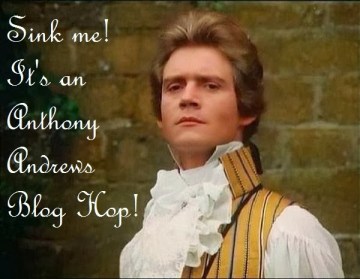
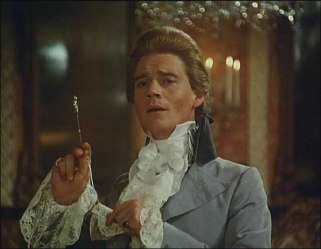
Sir Percival Blakeney. Baronet.

A blog I follow is participating in the Anthony Andrew’s Blog Hop this month, and after reading her post I decided to give it a go. The Scarlet Pimpernel (1982) has long been one of my favorite films, ever since my mother shared it with my sister and I as children. As a reader, of course the next thing I did was look up the books, which are just as enjoyable as the film.

Sir Percy’s Background

The 1982 film is based on two books by Baroness Emmuska Orczy: The Scarlet Pimpernel and Eldorado. According the extremely reliable site that is Wikipedia, Orczy may or may not have been the first to write a “hero with a secret identity.” It is quite likely that she influenced, if not inspired, the creation of later nobleman-hero characters like Zorro and Batman. She released 16 books related to the Scarlet Pimpernel, including novels and two short story collections directly related to Sir Percy’s exploits as well as a few novels about his relatives.

“We seek him here, we seek him there. Those Frenchies seek him everywhere! Is he in heaven? Or is he in hell? That demmed Elusive Pimpernel?”

The first book was published in 1905. It is set in 1792 in the midst of the French Revolution. Sir Percival Blakeney is one of the wealthiest and laziest men in England (he does, in fact, bear more than a passing resemblance to Johnston McCulley’s Don Diego Vega [aka Zorro], who debuted in 1919). The most ambitious thing he does is write poetry (see photo caption for a sample). At least, that’s what he wants people to think.

Behind this carefully cultivated facade, Sir Percival Blakeney is The Scarlet Pimpernel, a daring Englishman who leads a band of adventurers into France to rescue people from Madam la Guillotine’s blade. He usually meets with success, which earns him a dedicated adversary named Chauvelin (played by Ian McKellen).

Anthony Andrew’s Percy

Sine 1917, there have been several film and television adaptations of The Scarlet Pimpernel. I’ve not watched them all, or even most of them, but I doubt any of the actors could rival Anthony Andrew’s portrayal of Sir Percival Blakeney. He is the Scarlet Pimpernel — even when I read the books I can hear his voice in my head every time Percy has written dialogue. I hardly ever refer to the character without saying “Sir Percival Blakeney. Baronet” with the same affected pause that Anthony Andrew’s Sir Percy speaks with when introducing himself.

For my readers who are Myers-Briggs fans, one of the other writers participating in this blog hop typed Sir Percy as an ENFP. It makes sense — he is a visionary, a crusader, an idealistic champion who lives to right wrongs. The traits that are common to Champion/ENFP types serve him well as a hero with a secret identity. David Keirsey says people of this type

have outstanding intuitive powers and can tell what is going on inside of others, reading hidden emotions and giving special significance to words or actions. In fact, Champions are constantly scanning the social environment, and no intriguing character or silent motive is likely to escape their attention. Far more than the other Idealists, Champions are keen and probing observers of the people around them, and are capable of intense concentration on another individual. Their attention is rarely passive or casual. On the contrary, Champions tend to be extra sensitive and alert, always ready for emergencies, always on the lookout for what’s possible.

Sounds like the Scarlet Pimpernel to me, and Anthony Andrew’s portrays him perfectly. I’ve seen analysis written about certain actors’ eyebrows (yes, I have too much time on my hands for looking up weird things on the Internet), and we could certainly add the way Anthony Andrew’s raises his eyebrow when Percy is scanning a room to the list of analysis-worthy eyebrow-acting. You can tell in an instant, just by his posture and the look in his eyes, when he shifts from lazy Sir Percy to alert Scarlet Pimpernel.

Bog Hopping

I hope you’ll check out some of the other blogs in this blog hop. Anthony Andrews is not an incredibly prolific actor, but he is in several good films which are being covered by other bloggers this month. I’m looking forward to reading more of them myself. Since I’m on WordPress (which doesn’t support Javascript), you’ll have to click the link below to see other posts in the blog hop:

Powered by Linky Tools

Click here to enter your link and view this Linky Tools list…

The Power of Names

A friend of mine wrote a post about names last week that provided the inspiration for this post (he doesn’t post very often, but everything he writes is worth reading. Check out his blog here). He didn’t cover any of my main points — he took the discussion in a Biblical direction that I’m largely going to ignore for this post, but which I certainly find intriguing.

It has been several years now since I started researching names and wondering about the importance of name meanings. The meaning of my own name is hard to pin down, and searching for its origins lead me to looking up names of people I know, which lead me to collecting other names that I like.

Meaning of Names

In many cultures, names are something to be taken very seriously. Sometimes it is the meaning of the name which is important in determining a child’s destiny and character. Sometimes names are changed after a major event in a person’s life, as when God changed Abram’s name to Abraham and Sarai’s name to Sara (Gen. 17:4-6, 15-16). Some belief systems say that knowing someone’s name gives one power over them, and certain cultures make a practice of keeping true names a secret.

“The Power of Names”by marissabaker.wordpress.comMy own name has a confusing array of meanings. My mother tells me she saw the meaning “wished-for child” and that was what she thought my name meant when she and my dad named me. Since then, I have seen several different possible meanings for “Marissa” depending on which name/word it is derived from. If it is from the Hebrew mara, my name means “bitterness.” If it is from the Latin maris, then my name means “of the sea.” The “wished-for child” meaning is apparently associated with the Hebrew in some way, but I can find little information on it. Usually, I go with “of the sea” as my name meaning.

Naming Characters

I think part of the reason I like reading about, collecting, and researching names so much is that I’m a writer and all my characters need names. Some writers pay very close attention to the names they give their characters, and fit either the meaning or a historic significance to the character. For example, the character Cecil in A Room With A View by E.M. Forster is figuratively blind in many ways. His name is of Latin origin, and means “blind.”“The Power of Names”by marissabaker.wordpress.com

In my own writings, one of my favorite characters is a man named Bryant. His name is from the Irish, and means “strong, virtuous, and honorable.” From another story set in the same world, Jamen has a name derived from Benjamin and meaning “son of the right hand.” He and his twin brother are vying for their father to name one his heir, and Jamen would like nothing more than to be his father’s right hand.

My Favorite Names

Some of the names I collect have nothing to do with my fiction. There are a few names I like that I would be hesitant to use in my writings because I might like to give the name to a child some day. I don’t think I would want want my children to think I named them after one of my fictional characters. Typically for these names, I try to put them together so the first and middle names have meanings that fit together. Most of them are just names I like, but Eileen was also my Grandmother’s name and Renee is my sister’s middle name.

“The Power of Names”by marissabaker.wordpress.comJason Alexi. “God is my salvation and protector”

Christopher Hugh. “One who holds Christ in his heart, mind and soul”

Derek Callen. “Ruler and rock of the people.”

Eliana Eileen. “My God has answered with light”

Melody Chasia. “Music protected by God”

Liya Renee. “I am the Lord’s reborn”

Gift of Mortality

We tend to approach death with a kind of horror, even though we know that it is not permanent (1 Thes. 4:13-18). It is natural to value life, to not want to die and to not want to lose the people we love. I think much of our longing to live forever comes from a desire God has given us to become part of his family. But sometimes I hear people say they want to live forever, and they mean an indefinite extension of our human lives here on the earth.  Personally, I wouldn’t want to live with myself the way I am now for that long.

Elves leaving Middle Earth, from The Lord of The Rings

When I think about the idea of immortality or living a really long time as a human, it makes me think of Tolkein’s elves in Middle Earth. Unless something interferes (they can be killed and they can fade away with grief) they’ll live forever. One of the things I find most interesting is that in The Silmarillion, the immortality of the elves is described as a sorrow and death is presented as a gift given to men.

the children of Men dwell only a short space in the world alive, and are not bound to it, and depart soon whither the Elves know not. Whereas the Elves remain until the end of days, and their love of the Earth and all the world is more single and more poignant therefore, and as the years lengthen ever more sorrowful. For the Elves die not till tile world dies, unless they are slain or waste in grief (and to both these seeming deaths they are subject); neither does age subdue their strength, unless one grow weary of ten thousand centuries; and dying they are gathered to the halls of Mandos in Valinor, whence they may in time return. But the sons of Men die indeed, and leave the world; wherefore they are called the Guests, or the Strangers. Death is their fate, the gift of Iluvatar, which as Time wears even the Powers shall envy.

Sown in Weakness

Death became something that every human being must face as a consequence of Adam and Eve’s sin. I wonder, however, if after the fall mortality might have been as much a gift as a curse. Yes, death is a penalty associated with disobedience to God and it is an enemy that will be conquered in the future. But the absence of death in our fallen state would not have been a kindness.

Foolish one, what you sow is not made alive unless it dies. And what you sow, you do not sow that body that shall be, but mere grain—perhaps wheat or some other grain. But God gives it a body as He pleases, and to each seed its own body. (1 Cor. 15:36-37)"Gift of Mortality" a blog post by marissabaker.wordpress.com

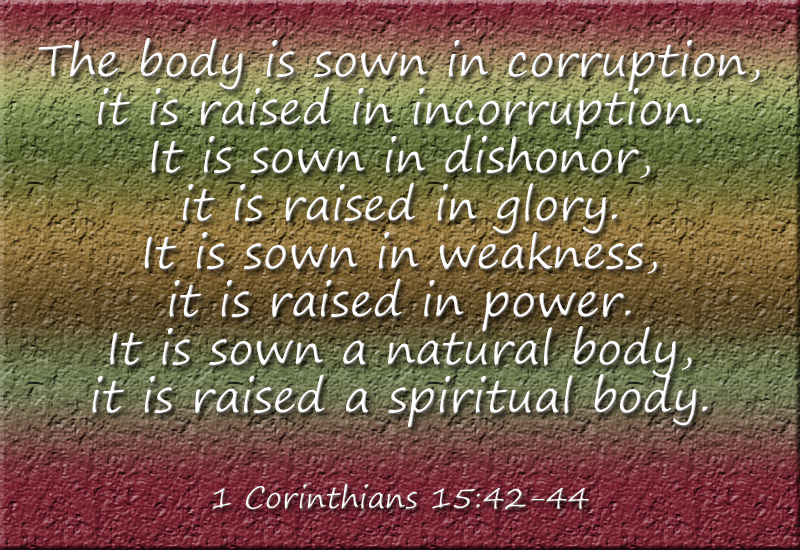
We are “bare grain,” as the KJV says, which after it dies to this existence will spring up into the far more glorious body that God gives us. Thank God that immortality is not give not us as we are now — corrupted, dishonored, weak, and natural. Living like this forever would not be a gift. We cannot have eternal life as we are now, nor would we want to. We need to be changed first.

For this corruptible must put on incorruption, and this mortal must put on immortality. So when this corruptible has put on incorruption, and this mortal has put on immortality, then shall be brought to pass the saying that is written: “Death is swallowed up in victory.” (1 Cor. 15:53-54).

Buying More Books

marissabaker.wordpress.comBefore I get into the subject of today’s post, I won NaNoWriMo! I hit the 50,000 word mark last Wednesday night. I think that puts me about 2/3 of the way through my plot outline, so I didn’t technically write a novel in a month. Still, 50,000 words is pretty impressive, if I may say so myself.

I have a fairly large library. Just over 1,100 books in total, according to the list I keep on my computer (I’ve been told this is “too many books” but I’m not convinced there’s any such thing). Even so, I’m constantly buying new books. The problem is, I have a limited book budget. That doesn’t mean I have to stop getting new books though. Here are some of my sources for finding more books without spending too much money.

Paper Back Swap

This is an amazing website: PaperBackSwap.com.  You post books you want to get rid of (yes, that sometimes happens), and when other members claim them you get a credit that can be used to request posted books. The only cost is shipping out books to other members. Unfortunately, many of the books I want have wait lists, but even so I’ve received enough books that the website estimates I’ve saved $84.17. Not too shabby. And I have 16 credits for whenever my wishlist books become available.

Trading Book Stores

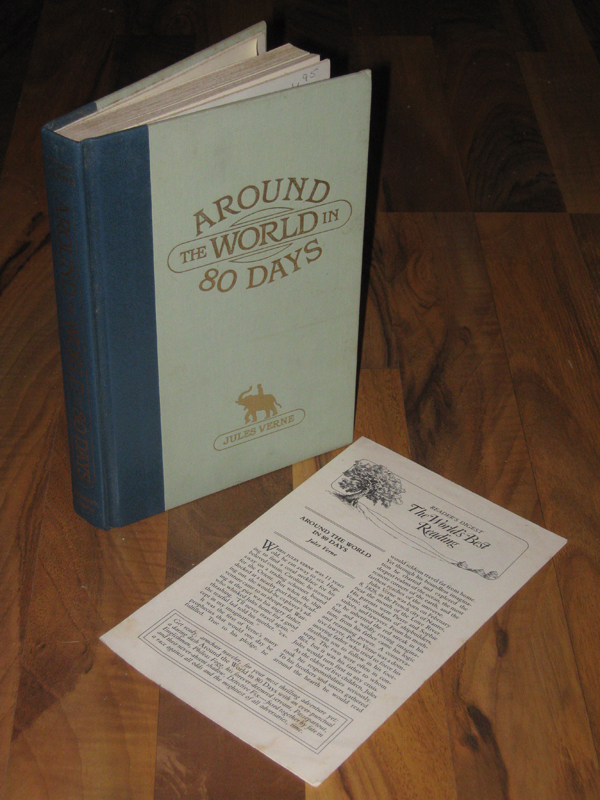
"Buying More Books," tips for economically growing your library. marissabaker.wordpress.comThere is a wonderful trading bookstore not half an hour’s drive from here that sells new and used books. My favorite way to approach this store is to turn in books my aunt no longer wants on her shelves, and then bring home books for me 🙂 That’s how I found books like my hardcover edition of Jules Verne’s Mysterious Island, several fairy tale volumes, and where I bought my first Reader’s Digest World’s Best Reading edition (not to be confused with those Reader’s Digest condensed book collections).

Library Book Sales

My local library has a book sale once a month. For a small fee, I’m a Friend of the Library and can get into the member pre-sale. Books sell for between $.025 and $1.00. Some months I buy nothing, sometimes I can hardly carry them all back to the car. If you don’t know when your local book sales are, try checking BookSaleFinder.com.

For Specific Books

For general book shopping, the three resources above are great. But if I’m looking for a specific title or edition. Amazon and Half.com are my go-to sites. If I want the book store experience, there’s three Half Price Books within about an hour’s drive.

Is there anywhere else you’d recommend looking for books to economically increase the size of your library? I’d love to hear your ideas. Also, if you have any ideas about finding more room for books, I’m starting to run out of space on my bookshelves …

My Favorite Fantasy Books

"My Favorite Fantasy Books" marissabaker.wordpress.comI’m writing a fantasy novel for NaNoWriMo this year, and since I have that genre on my mind, I thought I’d share a list of my favorite fantasy books. Maybe someday the novel I’m writing will be on another blogger’s favorite books list.

Books In No Particular Order

Concerning Hobbits

Though it is often considered childish compared to The Lord of the Rings, and I’ve heard that Tolkein wished he’d had time to re-write it, The Hobbit is my favorite book by J.R.R. Tolkein. I love all the books of Middle Earth for what Tolkein can teach me about writing fantasy, but just to sit down and enjoy reading a book I pick up The Hobbit.

“It’s all in the wardrobe just like I told you!”

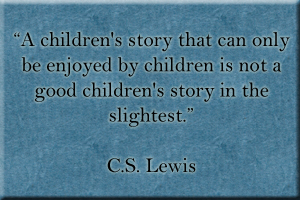
childrens_storyThe Chronicles of Narnia by C.S. Lewis are a few more “children’s books” that I didn’t read until I was in my late teens, and not all at once. I think I read The Lion, The Witch, and The Wardrobe when I was 16, then The Magician’s Nephew, and finished the series a few years after that. I suppose it is fitting that I didn’t appreciate Narnia until I was older, since it was C.S. Lewis who said, “Some day you will be old enough to start reading fairy tales again.”

I’m Okay With Corlath Kidnapping Me

I mentioned The Blue Sword by Robin McKinley on my previous book list, but it belongs on here as well. I like the way McKinley handles magic in this world, the lore she weaves through the story, and the strong characters she creates. Some of the most interesting characters are not even human — the heroine’s incredible war horse and a hunting cat named Narknon.

How To Melt Wizards

I don’t hesitate to laugh-out-loud when I’m reading books, and The Enchanted Forest Chronicles by Patricia C. Wrede kept me giggling most of the time I was reading. I received some pretty puzzled looks from my family, until my sister read the four books and laughed almost as much as I did. The first book, Dealing With Dragons, is the best, and features a princess who asks a dragon to take her captive so she can avoid marriage, then proceeds to chase off all the princes who try to rescue her.

Dancing Bears

The Shadow of the Bear by Regina Doman is the first in a series of modern fairy tale retelling. It’s based on “Snow White and Rose Red.” Bear (aka Arthur Denniston) is one of those fictional men I fell in love with as a teenager the moment I read the scene where he dances with Blanche. I also really like the cover art for the first edition.

“True love is the best thing in the world, except for cough drops.”

If you like the film The Princess Bride, you’ll love the book by William Goldman. I recommend the 30th Anniversary Edition, so you can read Goldman’s introductions. He talks about being on-set for filming (which was, of course, done on location in Florin). It can be fun trying to figure out what actually happened and what didn’t (and whether or not it really matters).

McKinley Fairy Tales

Rose Daughter by Robin McKinley is my favorite “Beauty and the Beast” retelling, and is also the only novel of hers that I’ve thought had a thoroughly satisfying ending. Her retelling of “Sleeping Beauty,” Spindle’s End, also deserves an honorable mention just for the fact that magic in that world is so thick and tangible they have to dust if off the kitchenware before cooking.

Visionary Fiction

A Sword For The Immerland King, by F.W. Faller, is the book that introduced me to “visionary fiction.” His website defines it this way:

a fiction, stated as fact to allow the reader to explore the greater life issues in the safety of a good armchair, to wonder at their own shortcomings and marvel at the confidence of others who inspire them to vision and purpose in their own lives. It is allegory and truth rolled together in a plausibility that transcends time and space and gives us pause to ponder who we are and where we are going.

What Faller does with his world of Tessalindria reminds me of Tolkein’s work with Middle Earth, and what I’m hoping to do with Ves’endlera.

An Oracular Pig

The Chronicles of Prydain by Lloyd Alexander, follow the adventures of an assistant pig-keeper named Taran. It spans five books and is, I suppose, technically another series of children’s books. One of the most interesting things about these novels is that they are based in part on Welsh legends. The author uses some names from the original legends and hints of Welsh geography (which he warns is “not to be used as a guide for tourists”), then inserts main characters born out of his own imaginings.

Worlds of Ink

Inkheart, Inkspell, and Inkdeath are the three books in the Inkworld series by Cornellia Funke. Setting aside the great fantasy content for a moment, these are beautiful books. Each chapter begins with a quotation and ends with a sketch. They are books about books, with main characters being read into the real world and back into books and blurring the lines between reality and fiction.