I finally heeded all the “you need to have an email newsletter” advice I’ve been reading for years (which was reinforced in an online writers’ summit I attended last week). Now, the only newsletters I subscribe to are the ones from authors who give you a free book when you sign up so you can get a feel for their writing style before you decide if you want to buy a book from them. So I took the very first book I published in 2015, revised, updated, and reformatted it, and I’m giving it away to everyone who signs up for my newsletter.
The editing and reformatting was a little more involved than I’d expected, which is why I didn’t have time to work on a regular blog post this week. I’m hoping the free book will make up for that 🙂 Even if you’ve read this one before, I updated enough that I think it’d be worth your time to redownload it (assuming you liked what you read).
Newsletters help creators keep in touch with people more reliably than social media. If you follow me on Facebook or Pinterest, for example, you probably won’t see all of my posts just because of how the algorithms work. A newsletter will also make it easier for me to share life updates, publishing info, and free resources, giveaways, and discounts. Plus, if any of you want to get in touch with me all you have to do is click “reply” to the email and you can write me a note.
I don’t want to clutter up your inbox, so my plan is to send out two emails a month (or every other week). You’ll get three emails pretty close together right after signing up so we can get to know each other and I can make sure you get your free book, then the frequency will drop down to every two weeks. If you’re subscribed to this blog by email, you’ll still receive weekly emails when I publish a new blog post; the newsletter is separate from that.
Thanks for reading (and thanks if you decide to sign up!). I look forward to hearing what you think of God’s Love Story.
One of the major turning points in my life involved taking a class on the English Bible as literature in my second semester of college for my undergraduate degree. The English Bible class helped me realize I can study the Bible as a scholarly project, I can defend my faith intelligently to other people, and how deeply the Bible in translation influenced the Western literary tradition. It also (along with a Shakespeare class and, more significantly, the Shakespeare professor) helped inspire me to pursue an English degree.
The Bibles that we read in English support this type of scholarly work. The format of pretty much every Bible you can pick up is designed for study and reference. “The addition of chapter breaks in the 13th century and verse numbers in the 16th century” made the standard Bible format “fragmented” into tidbits for cross-referencing different sections and pulling out isolated passages to preach about (“Three Bad Ways We Read the Bible and Three Tips to Improve“).
This is very different from the way we read most books. The only books that typically have similar layouts, references, and annotations are scholarly publications of texts like Shakespeare’s plays or The Iliad. This makes sense in some ways; the Bible is an ancient text and modern readers benefit from notes explaining context. But if you ever had to read a scholarly edition of a literary work, you probably realized that the notes and layout can also get in the way of your reading. For example, by the time you figure out what’s going on with Shakespeare’s language, you might have lost the plot thread.
In contrast, books that we read for enjoyment rarely have cross references and notes. Even non-fiction that is properly cited tucks the notes away in discreet footnotes or endnotes. Fiction may use glossaries at the back for historic context and pronunciation guides, but there’s rarely anything to interfere with the text itself. These books are designed for immersive reading. You can even read older texts immersively if you familiarize yourself with the writing style. For example, when I first started reading 17th and 18th century English literature, I read the introduction and all the notes. Now that I know more about the historical context and the language the writers used, though, I just dive right into the story.
What if we could read the Bible that way? Like it’s a story that we’re eager to lose ourselves in, without verse numbers and center notes getting in the way?
For context, when I say “story” I mean “an account of people and events, real or imaginary.” I am not suggesting that the Bible is fictional when I say that it is written as a story. I mean that this book has a narrative structure. More specifically, there are several metanarratives (overarching stories or big themes) that you can see when reading the whole Bible. I write about one, “A Story of Battle and Victory,” in my new Armor of God Study Guide. We have a harder time seeing those narrative themes if we’re only reading isolated chunks of the Bible.
Bible reading rates are shockingly low among Christians. Part of this is lack of time, but part is also because we’re not sure how to read it or we don’t really want to (more on this later, with data). And when we do read it, often we go to specific parts that make us feel better or which we think will offer guidance when we’re making decision.
The Bible is a book we can turn to for comfort and it does contain vitally important instructions, but it’s not just an instruction manual, a list of laws, or a collection of reassurances. The Bible is how God tells us about Himself, and when we read the whole thing together, we see He’s revealing Himself through a story with central themes of creation and redemption, love, building a family, and founding a kingdom. And I think maybe if we realized that, it would be easier to read the Bible more.
Image by Ben White from Lightstock
How Jesus Read The Bible
In Jesus’s time, if you wanted to read the Bible you’d have to go to a synagogue and unroll scrolls (assuming you were one of the people allowed to touch those scrolls). There weren’t chapter and verse breaks; only breaks between books. Scripture text was meticulously copied by hand and, as the text is sacred, great care was taken not to introduce mistakes into the text (“The Torah Scroll: How the Copying Process Became Sacred“). The lengthy copying process meant that owning a copy of scripture was out of reach of most individuals or families. Synagogues had copies that rabbis could read aloud to people. We can see an example of reading this type of scroll in the gospels.
Now Jesus came to Nazareth, where he had been brought up, and went into the synagogue on the Sabbath day, as was his custom. He stood up to read,and the scroll of the prophet Isaiah was given to him. He unrolled the scroll and found the place where it was written,
“The Spirit of the Lord is upon me, because he has anointedmeto proclaim good newsto the poor. He has sent meto proclaim releaseto the captives and the regaining of sightto the blind, to set freethose who are oppressed, to proclaim the yearof the Lord’s favor.”
Then he rolled up the scroll, gave it back to the attendant, and sat down. The eyes of everyone in the synagogue were fixed on him. Then he began to tell them, “Today this scripture has been fulfilled even as you heard it being read.”
Luke 4:16-21, NET (bold italics a quotation from Isa 61:1-2a)
Jesus hadn’t memorized that He’d need to turn to Isaiah 61 to read this verse. He was familiar enough with the whole scroll of Isaiah that He knew were to find this part within a much larger passage near the end of the scroll. And He didn’t only know where to look up passages and read them; He had large sections of scripture memorized. Just in the recorded gospels, we have evidence of Jesus quoting from “parts of the Scripts from all of the books of Law, most of the prophets, and some of the Writing – altogether 23 of the 36 books of the Modern Hebrew Bible” (Evans, 2006b, quoted in Metsämuuronen, 2019). It’s very possible that He had the entire Torah and large portions of the rest of the Old Testament (if not the whole thing) committed to memory.
Most of Jesus’s students and listeners were also Biblically literate, and when He referenced one part of a scripture they likely filled in the context automatically. Jewish children of the day grew up steeped in their religion, keeping the Sabbath and laws, learning from their parents, and frequently hearing scripture. Boys and girls started formal schooling around age six, and likely knew how to read before that (Metsämuuronen, 2019, “How Jesus Learned the Scriptures?”). Everyone learned Torah up to age 13, but only the most accomplished (male) students would go on to deeper studies with rabbis. It’s very likely that Jesus wasn’t one of the students chosen for advanced education since “the Jewish leaders were astonished” by the way He taught “and said, ‘How does this man know so much when he has never had formal instruction?'” (John 7:15, NET).
We don’t really have anything equivalent to this type of learning today. We’re so used to being able to look things up in books or on our phones that we don’t memorize much information. But imagine if you’d spent seven years of your childhood studying the first five books of the Bible. You’d know them as well as you know colors, shapes, multiplication tables up through 10, how to put a sentence together in your native language, and the controls for your favorite video game.
Image by Jantanee from Lightstock
Balancing Bible Reading and Bible Study
To be clear, I’m not saying it’s wrong to study the Bible in sections or by topic. In fact, since the Bible is such a big book, having center cross-references can help us appreciate the connections between different parts of scripture more easily. The chapter and verse numbers make it much easier for people to make sure they’re on the same page (quite literally) when having a Bible discussion, or for someone to follow along with and double-check a teacher. I usually choose to study the Bible thematically/topically, and I share those studies here.
One of the primary ways I relate to the Bible (e.g. my spiritual temperament) is intellectually. But I also sometimes wonder if I approach the Bible too academically and lose touch with the wonder of being in a relationship with God. That’s another aspect of my spiritual temperament: worshiping God with contemplation and adoration. The reference/study format for Bibles doesn’t really support that sort of immersive, story-reading Bible interaction, though.
Several years ago, a Kickstarter caught my eye. “Bibliotheca is an elegant, meticulously crafted edition of the Bible designed to invite the reader to a pure, literary experience of its vast and varied contents,” without any verse numbers or chapter breaks (bibliotheca.co). It was far outside my price range at the time and so I did not back the Kickstarter, but I desperately wanted to. I was reminded of that this past week when I read “Three Bad Ways We Read the Bible and Three Tips to Improve” on Tyndal.com. This article suggests using “a reading Bible” rather than a study Bible, finding a reading group so you’re not studying in isolation, and establishing a “reading rhythm” so you’re regularly reading the Bible.
This article recommends the Immerse Bible, which I was excited about at first but not so much after I checked up on the NLT translation by reading several chapters of Romans (my favorite book to look at when checking the quality of a translation). I think I’ll stick to the Tree of Life version as my reading Bible. The print copy I have still has chapter and verse numbers, but the verse numbers at least are minimized to reduce their impact on the text. Maybe someday I’ll try out Bibliotheca or find another reading Bible I like.
I think it’s important to balance reading straight through the Bible as if it’s a story you love so much you can’t put it down, and studying the Bible deeply like it’s the most important academic research you’ve ever done. By reading through the whole Bible, you gain vital context and the overarching stories/themes. By studying the Bible carefully and reading supportive texts, you can learn historical context, what the words used originally mean, and deepen theological understanding. Both support you in deepening your understanding of the scriptures that God breathed into existence and that He uses to teach us about Himself, what He expects of us, and how He relates to His people.
But evil people and charlatans will go from bad to worse, deceiving others and being deceived themselves.You, however, must continue in the things you have learned and are confident about. You know who taught youand how from infancy you have known the holy writings, which are able to give you wisdom for salvation through faith in Christ Jesus. Every scripture is inspired by God and useful for teaching, for reproof, for correction, and for training in righteousness, that the person dedicated to God may be capable and equipped for every good work.
2 Timothy 3:13-17, NET
The Bible is without doubt the most important book ever written. As followers of God, we’re blessed to know how important this book is and that the text comes straight from Him (through human writers, copiers, and translators). And yet, many people calling themselves Christians aren’t reading the book very much or at all.
Engaging With Something Epic
Image by Creative Clicks Photography from Lightstock
According to the Pew Research Center, about 63% of Americans currently identify as Christians (“How U.S. religious composition has changed in recent decades“). Yet according to the American Bible Society’s 2023 State of the Bible report, only 39% “of Americans said they used the Bible three or more times per year” (“State of the Bible 2023,” p. 6). Three or four times a year isn’t all that much. For more frequent users, “about 63 million American adults (24%) use the Bible—on their own, outside of a church service—at least once a week” (“State of the Bible 2023,” p. 7). Assuming most of the Bible-readers also identify as Christian, that means less than half the Christians pick up their Bibles at least once every week.
Interestingly, when American Bible Society’s survey asked people if they wanted to read the Bible more, 52% said “yes” (“State of the Bible 2023,” p. 12). When asked what challenges kept them from Bible reading more, relatively few said the layout was difficult or that they found the stories confusing (“State of the Bible 2023,” p. 11). The top reasons were, “Not enough time,” “Don’t know where to start,” and “Lack of excitement about reading it.” I don’t know this for sure, but I wonder if we spent more time talking about the story of the Bible and the big metanarrative themes it might be easier for people to pick up the book, start at the beginning, and get excited about reading the Bible.
One of the theories for why modern people find video games so engaging is because immersive adventures make us feel like we’re part of something bigger than ourselves; we long for “epic meaning” and to be part of an “epic story” (McGonigal, “Gaming can make a better world”). Now, I’m a gamer. I get why games are so engaging and I think the right kinds of games can be encouraging and educational as well as fun. But I don’t go to games for meaning, and I think it’s heartbreaking that as a society, we have lost touch with real-world things that welcome us to be part of something bigger than ourselves.
Do you like epic stories of great battles with good versus evil? God’s calling you to fight alongside Him in one (Eph. 6:10-18).
Do you like sweeping tales of daring and epic romance? Jesus conquered death to ransom His bride, and He wants that bride to include you (2 Cor. 11:2; 1 Tim. 2:5-6; Rev. 19:6-8).
Do you want to be involved in something on a world-saving, eternity-mattering scale? God offers you a position in His kingdom that will last forever, which He’s been preparing since the foundation of the world (Mat. 25:34; Rev. 1:5-6).
I remember the first time I read a Bible, it was a children’s Bible with very simple text and cute illustrations. The authors boiled everything down to big ideas and the main story beats. God created everything. Man fell. God asked people like Noah, Abraham, and the nation of Israel to be in relationship with Him. God rescued Israel from Egypt. Israel rebelled and God sent prophets. Jesus came to save us all, died, and rose again. The New Covenant church is what we’re part of now. Jesus is coming back.
Maybe that’s where we should all start. Not necessarily by reading a Bible for toddlers, but reading with an understanding of the main things that happen in the Bible and what that reveals to us about God. The details are vitally important, but we need the big picture if we’re going to make sense of them. We need the narrative God uses to reveal Himself, His values, and His purpose to understand how we fit into it all and what He expects from us when we’re in a relationship with Him.
I’ve started reading a new book that I’m really excited about. Misreading Scripture with Individualist Eyes: Patronage, Honor, and Shame in the Biblical World by E. Randolph Richards and Richard James aims to provide readers in Western cultures with cultural information that’s helpful when properly interpreting the Bible. There’s a lot of topic overlap with Relational Faith by Brent J. Schmidt, which I reviewed earlier this year, and I was eager to see how different authors approached the subject.
Misreading Scripture with Individualist Eyes is a follow-up to Misreading Scripture with Western Eyes: Removing Cultural Blinders to Better Understand the Bible by E. Randolph Richards and Brandon J. O’Brien. That’s one of my favorite non-fiction books and I’ve referenced it several times on this blog (most notably in reference to temples and to women’s roles in church). I heartily recommend Misreading Scripture with Western Eyes and though I’m only 30% finished with Misreading Scripture with Individualist Eyes I suspect it will become a new favorite as well.
The topic I want to share with you today comes from “Chapter 1. Kinship: Being in a Family.” In collectivist cultures, the family is incredibly important. There are three ways to join a family or kinship group: birth, adoption, and marriage. As I read this chapter, it struck me that God uses all three of those methods to describe how we enter into His family.
Image by Claudine Chaussé from Lightstock
“I” or “We”
I read a publication from a church once that went to great pains to explain when the Bible says God adopts us into His family, it doesn’t really mean adoption because we’re actually born into His family as His literal children. It’s been years, but I never forgot how irritated I was by that distinction. First, the Greek word does mean adoption, and if the Bible uses both birth and adoption to explain how we become God’s children, why wouldn’t we use both today? Second, I worried how someone who was adopted into their own human family think when reading that this church doesn’t think adoption means you’re really part of the family.
I share this to illustrate one of the ways that we can misinterpret things through a Western, individualist lens. We like things to be neat and separated; you can enter a family through birth or adoption, but not both. We also think of the individual as the basic unit of society rather than family (i.e. we conceptualize ourselves primarily as “I” rather than “we”). Our kinship groups are pretty lose, and no one is really surprised if you get married without intending to have kids or if you don’t have a relationship with your cousins, aunts, uncles, or even siblings and parents. If someone asks, “Who are you?” a Westerner is likely to respond by talking about their personality, achievements, interests, and work rather than by talking about their family and community.
Collectives are defined by the things they share with others, things such as shared blood, shared interests, shared history, shared land, and shared loyalty. They define their core identity as being part of a group, in distinction to other groups.
This is what we mean by collectivism. Collectivist people understand their identity from the group they are part of. It is about identity, which is why people in collective societies live their lives oriented toward their group.
Misreading Scripture with Individualist Eyes, Richards and James, p. 22
Richards and James are careful to point out that these are generalizations; not all collectivist or individualist cultures are identical. But these generalizations help Western individualists understand how different the Biblical culture was than what we’re familiar with today. If you’re one of my readers who lives in a collectivist culture, you probably have a much easier time relating to the collective aspects of Bible culture than a typical American or other Westerner.
Going back to my opening example, we shouldn’t think of the Bible’s explanation for how we become God’s children as something we need to put into one box or the other (i.e. birth vs. adoption). Biblical writers use being born as children and adopted as children to describe the process of becoming part of God’s family. They also use marriage symbolism. It’s not an either-or situation. It’s three analogies to help us understand more about what’ happening here.
Ways to Enter A Family
Suppose you were trying to describe the most beautiful sunset you’ve ever seen. You might give some literal descriptions–it was orange and pink with purple clouds, it was over a wheat field. But you might also decide the literal isn’t doing it justice and use similes, analogies, and metaphors–it was like a beautiful painting, it looked like cotton candy, it gave me the same feeling as when I look out over the ocean. Those metaphors are all very different. Paintings, cotton candy, and oceans are not the same thing. But we can use those different descriptions to describe the same sunset.
I think that’s part of what’s going on when Bible writers describe the way God makes us part of His family. Birth, adoption, and marriage are not equivalent to each other, but they all help us understand the same concept. God is bringing human beings into His family. We are becoming part of His kinship group.
In the biblical world, kinship terms were not tossed about … casually because kinship ordered society. Across the ancient Mediterranean world, one entered into a family, a clan, a tribe by birth, adoption, or marriage.
Misreading Scripture with Individualist Eyes, Richards and James, p. 34
That seems pretty obvious, but what struck me is that these three ways to enter a family are the three ways that God explains how we become His children. By describing the process of us entering God’s family in all three ways, God reinforces how much He wants us as part of His family. He shows that we’re going to become His family in every possible way, with all the rights and responsibilities accorded to those who are born, adopted, or marry into a family.
Birth was not just a matter of biology, though it included that. Birth was the way ancients received their identity. … When Jesus says to Nicodemus, “Very truly I tell you, no one can see the kingdom of God unless they are born again” (Jn 3:3), he is saying something very profound. To see the kingdom of God, you need to belong to a new family.
Misreading Scripture with Individualist Eyes, Richards and James, p. 38
We receive a new identity when we become Christians. Just as we’re no longer of the world, our primary identity is no longer determined by anything physical (including our human biology). This is an essential step in becoming children of God. Jesus told Nicodemus, “I tell you the solemn truth, unless a person is born of water and spirit, he cannot enter the kingdom of God. What is born of the flesh is flesh, and what is born of the Spirit is spirit. Do not be amazed that I said to you, ‘You must all be born from above'” (John 3:5-7, NET). We must be baptized with both water and the spirit to become children of God. This rebirth into a new family is something the Father accomplished through Jesus Christ.
Blessed be the God and Father of our Lord Jesus Christ! By his great mercy he gave us new birth into a living hope through the resurrection of Jesus Christ from the dead,that is, into an inheritance imperishable, undefiled, and unfading. It is reserved in heaven for you, who by God’s power are protected through faith for a salvation ready to be revealed in the last time. …
You have been born anew, not from perishable but from imperishable seed, through the living and enduring word of God.
1 Peter 1:3-5, 23, NET
There is great mercy involved in God birthing us into His family. He chose to give us new lives. We were buried with Jesus in baptism, dying to our old selves, and we come up from that water with new life (Rom. 6:1-4; Col. 2:12). As such, God expects that we will then walk in that newness of life, living as children who inherit His character traits. John talks about this frequently in his first epistle.
Everyone who believes that Jesus is the Christ has been fathered by God, and everyone who loves the father loves the child fathered by him.By this we know that we love the children of God: whenever we love God and obey his commandments. For this is the love of God: that we keep his commandments. And his commandments do not weigh us down, because everyone who has been fathered by God conquers the world. …
We know that everyone fathered by God does not sin, but God protects the one he has fathered, and the evil one cannot touch him.
1 John 5:1-4, 18, NET
When we are born of God (also translated “begotten” or “fathered”), we take on new identity. We become part of His family, we will eventually “be like Him,” and even today we strive to be righteous the way He is righteous (1 John 3:1-10). We keep God’s commandments because we love Him and we know that’s how we do things in this family.
Modern Westerners usually adopt so that they (the family) can care for the (young) child. In the ancient biblical world, people adopted so that the adopted son could care for the family. … Families [without an heir] chose a man to adopt as a son because they deemed him worthy of caring for the family. … adoption for this purpose was commonly called “adoption to sonship.” …
Adoption in the biblical world carried very real implications for the kinship of those adopted and the families they joined. The adopted members were placed into the family, they inherited in the family, and these realities shaped their lives and the lives of the family’s descendants.
Misreading Scripture with Individualist Eyes, Richards and James, p. 39, 40, 41
God the Father already has a firstborn Son to inherit all things: Jesus Christ. We’re not adopted to be the heir, but we are adopted to share in the inheritance of our Elder Brother. Adoption describes a process of taking someone who was formerly outside a kinship group and making them part of the family. It’s a good analogy for our relationship with God, particularly for Gentiles. Jewish believers might have thought they already stood to inherit God’s promises and didn’t need adopted into His family (though Paul says that wasn’t true; every New Covenant believer is adopted), but for those without Israelite heritage the imagery of adoption likely brought extra tears of joy to their eyes.
But when the appropriate time had come, God sent out his Son, born of a woman, born under the law,to redeem those who were under the law, so that we may be adopted as sons with full rights.And because you are sons, God sent the Spirit of his Son into our hearts, who calls “Abba! Father!” So you are no longer a slave but a son, and if you are a son, then you are also an heir through God.
Galatians 4:4-7, NET
For he chose us in Christ before the foundation of the world that we should be holy and blameless before him in love.He did this by predestining us to adoption as his legal heirs through Jesus Christ, according to the pleasure of his will—to the praise of the glory of his grace that he has freely bestowed on us in his dearly loved Son.
Ephesians 1:4-6, NET
Can you imagine how much it would have meant to believers in Rome, Galatia, and Ephesus to read Paul’s letters and learn they’ve received “adoption to sonship” from God Himself? It should still hit us with the same force today. God did not owe us anything because of our birth or ancestry. He chooses us as His heirs, calling each of us to join His family and inherit alongside our elder brother Jesus. This is an incredible blessing, which comes with all the rights (and responsibilities) of being God’s children and legal heirs.
The Bible assumes that we understand that marriage forged kinship links between many more people than just the husband and wife. … Ancients made such decisions collectively. Parents and other relatives were deeply involved.
Misreading Scripture with Individualist Eyes, Richards and James, p. 42, 44
Individualists often balk at the idea of arranged marriages, but they were commonplace in the biblical world. And when we think about it, our future marriage with Jesus as Christians follows that same pattern. In a parable, Jesus tells us, “The kingdom of heaven is like a certain king who arranged a marriage for his son” (Matt. 22:2, NKJV). We have veto-power in this arrangement (i.e. we can say we don’t want to marry Jesus) but we don’t get to choose a different bridegroom. We need to trust that the Father knows what is best for us, just like Jesus trusts Him to select who will be part of the Bride.
The analogy of marriage to explain how we become part of God’s family adds another layer of meaning to what we’ve already learned from birth and adoption. In this analogy, the church is the Bride. This means we have specific roles and responsibilities in the family in addition to those of born and adopted children.
We’re to submit to our husband Jesus in everything (Eph. 5:22-33). We’re to make ourselves ready to be “a companion for him who corresponds to him” (Gen. 2:18, NET); “a helper comparable to him” (Gen. 2:18, WEB). We must be absolutely faithful to Him, as Paul pointed out when he said, “I am jealous for you with godly jealousy, because I promised you in marriage to one husband, to present you as a pure virgin to Christ” (2 Cor. 11:2, NET).
Then I heard what sounded like the voice of a vast throng, like the roar of many waters and like loud crashes of thunder. They were shouting: “Hallelujah! For the Lord our God, the All-Powerful, reigns! Let us rejoice and exult and give him glory, because the wedding celebration of the Lamb has come, and his bride has made herself ready. She was permitted to be dressed in bright, clean, fine linen” (for the fine linen is the righteous deeds of the saints). Then the angel said to me, “Write the following: Blessed are those who are invited to the banquet at the wedding celebration of the Lamb!” He also said to me, “These are the true words of God.”
Revelation 19:6-9, NET
The Father and Jesus are wholly committed to the project of “bringing many children to glory” (Heb. 2:10, WEB). Even right now, “we are God’s children” and in the future “we will be like him” (1 John 3:1-3, NET). Birth, adoption, and marriage analogies all help us understand how we become part of God’s family.
These analogies also teach us about our roles and responsibilities in God’s family. As God’s born children, we inherit His nature and spiritual DNA, and we ought to become more and more like Him the longer we live. As His adopted children, we inherit a place in His kinship group and become part of His covenants, as well as inheriting the responsibilities that go along with that. And as Jesus’s affianced bride, we’re making ourselves ready to work alongside Him into eternity. The vastness of what God offers us by birthing, adopting, and marrying us is astonishing. We ought to place a very high value on these gifts and live with a consciousness that we are part of God’s wonderful family.
As I wrote last week’s post about “Seeking and Learning Righteousness,” I kept mentioning the connection between learning righteousness and paying attention to God’s judgements. The key scripture we looked at in that post reads, “Yes, with my spirit within me I will seek you earnestly; for when your judgments are in the earth, the inhabitants of the world learn righteousness” (Is. 26:9, WEB).
It’s clear from this and other verses we looked at last week that we can learn righteousness from God’s judgements. But how? That was a question I thought of while writing, but didn’t really have the time to address. To answer this, we first need to understand what Isaiah means by God’s judgements.
More than Simply “Judgements”
The word translated “judgement” in Isaiah 26:9 is the Hebrew mishpat (H4941). Common translations include “judgement, justice, ordinance” (Brown-Driver-Briggs). This word is not confined to what we think of as the judicial function of government. The root word shapat means “to exercise [all] the processes of government” (Theological Wordbook of the Old Testament [TWOT], entry 2443). Furthermore, ancient understanding didn’t really separate the law from the lawgiver–“the centering of law, rulership, government in a man was deeply ingrained” (TWOT 2443). This makes perfect sense when we think of God as the Lawgiver and Ruler. The Bible treats His Law as an extension of His character.
For mishpat specifically, there are “at least thirteen related, but distinct, aspects of the central idea, which if to be rendered by a single English word with similar range of meaning ought by all means to be the word ‘justice'” (TWOT 2443c). These 13 meanings include “the act of deciding a case of litigation,” “a sentence or decision issuing from a magistrate’s court,” “an ordinance of law,” and “one’s right under law,” among others.” One other key meaning is “sovereignty, the legal foundation of government in the sense of ultimate authority or right.” People today expect this to be centered in laws and governing documents, but in scripture “The mishpat is God’s” (TWOT 2443c; Deut. 1:17). He has all authority, and when He exercises judgement/justice He does so as head of everything (not just a single branch of government).
When we speak of learning from God’s mishpat, that includes learning from His sovereign authority, His ordinances of law, and His just legislative rulings. Mishpat appears 421 times in the Old Testament so obviously we can’t look at every verse right now, but we can look at some examples of how God expected people to interact with His mishpat.
God chose to share His plans about Sodom and Gomorrah with Abraham before it happened because “I have known him, to the end that he may command his children and his household after him, that they may keep the way of Yahweh, to do righteousness and justice (mishpat)” (Gen. 18:19, WEB). One of the reasons the Lord trusted Abraham is because he kept Yahweh’s mishpat and would teach the people under his care to do so as well.
The laws/rules/ordinances/commands revealed to Moses at Mount Sinai are called mishpat: “Moses came and told the people all Yahweh’s words, and all the ordinances(mishpat); and all the people answered with one voice, and said, ‘All the words which Yahweh has spoken will we do'” (Ex. 24:3, WEB). (See also Lev. 18:4-5; 20:22; 25:18; 26:46).
The people of Israel had to keep all the Lord’s mishpat if they wanted to inherit the promises He made. They were warned not to add to or take away from God’s commands, nor to forget them. They also had a responsibility to pass on the mishpat to their children, as Abraham did to his. If they kept the mishpat, God would give them great blessings (Deut. 4:1-14; 5:1-22, 31-33; 7:12-13; 11:1; 26:16-19).
David, whom God described as “a man after my heart, who will do all my will” (Acts 13:22, WEB), said, “I have kept Yahweh’s ways, and have not wickedly departed from my God. For all his ordinances (mishpat) were before me. As for his statutes, I didn’t depart from them” (2 Sam 22:22-23, WEB).
We often say Solomon asked God for wisdom, but the specific wording when God responds is, “Because you … have asked for yourself understanding to discern justice (mishpat); behold, I have done according to your word. Behold, I have given you a wise and understanding heart” (1 Kings 3:11-12, WEB).
Lessons from Ancient Israel’s Relationship With God
I want to spend a little more time looking at ancient Israel’s relationship with God’s mishpat. When God instituted the Sinai Covenant with Israel, it was like a marriage ceremony. The laws and ordinances that He delivered are like the marriage vows that couples make. Both God and the people bound themselves together in a formal relationship–a covenant–and agreed to live by His mishpat (Ex. 24:3). As co-inheritors with Jesus Christ of the covenants God made with His people in the past, His mishpat are still relevant for us today and we can learn from the ways that God’s people in the past related to Him and His justice/ordinances.
There’s a passage in Ezekiel where God summarizes His relationship with the people of Israel thus far, and He pays particular attention to how they related to His mishpat. Ezekiel records that “some of the elders of Israel came to inquire of Yahweh,” and Yahweh responded by telling Ezekiel, “Cause them to know the abominations of their fathers” (Ezk. 20:1, 4, WEB). As we read the history of Israel from the Lord’s perspective, keep in mind that He uses the word “abominations” to describe what the people did. The actions they took against Him and His mishpat were very serious.
“So I caused them to go out of the land of Egypt, and brought them into the wilderness. I gave them my statutes, and showed them my ordinances (mishpat), which if a man does, he will live in them. Moreover also I gave them my Sabbaths, to be a sign between me and them, that they might know that I am Yahweh who sanctifies them.
“But the house of Israel rebelled against me in the wilderness. They didn’t walk in my statutes, and they rejected my ordinances (mishpat), which if a man keeps, he shall live in them. They greatly profaned my Sabbaths. Then I said I would pour out my wrath on them in the wilderness, to consume them. But I worked for my name’s sake, that it should not be profaned in the sight of the nations, in whose sight I brought them out. Moreover also I swore to them in the wilderness, that I would not bring them into the land which I had given them, flowing with milk and honey, which is the glory of all lands; because they rejected my ordinances (mishpat), and didn’t walk in my statutes, and profaned my Sabbaths; for their heart went after their idols. Nevertheless my eye spared them, and I didn’t destroy them. I didn’t make a full end of them in the wilderness. I said to their children in the wilderness, ‘Don’t walk in the statutes of your fathers. Don’t observe their ordinances (mishpat) or defile yourselves with their idols. I am Yahweh your God. Walk in my statutes, keep my ordinances (mishpat), and do them. Make my Sabbaths holy. They shall be a sign between me and you, that you may know that I am Yahweh your God.'”
“But the children rebelled against me. They didn’t walk in my statutes, and didn’t keep my ordinances (mishpat) to do them, which if a man does, he shall live in them. They profaned my Sabbaths. Then I said I would pour out my wrath on them, to accomplish my anger against them in the wilderness. Nevertheless I withdrew my hand, and worked for my name’s sake, that it should not be profaned in the sight of the nations, in whose sight I brought them out.Moreover I swore to them in the wilderness, that I would scatter them among the nations, and disperse them through the countries; because they had not executed my ordinances (mishpat), but had rejected my statutes, and had profaned my Sabbaths, and their eyes were after their fathers’ idols.”
Ezekiel 20:10-24, WEB
This tragic story is not just ancient history. Paul told New Covenant Christians in Corinth, “These things happened to them as examples and were written for our instruction, on whom the ends of the ages have come. So let the one who thinks he is standing be careful that he does not fall” (1 Cor. 10:11-12, NET). We need to learn from the lessons of Israel’s history in the Old Testament so that we don’t make the same mistakes, such as rejecting the mishpat of our God. Then and today, God wants people who have a relationship with Him to live in and walk in His justice/ordinances/judgements. We’re supposed to become holy as He is holy, and doing what He tells us to is part of that process.
Image by Shaun Menary from Lightstock
Trained in Righteousness Today
Talking about the ordinances of God from the Old Testament makes some modern Christians uncomfortable. This is due to misinformation about how New Covenant believers relate to God’s laws. For example, Paul is often misread as doing away with God’s law. He preempted that reading by asking and answering a question: “Do we then nullify the law through faith? May it never be! No, we establish the law” (Rom. 3:31, WEB). This sentiment echoes something Jesus Himself said.
“Do not think that I have come to abolish the law or the prophets. I have not come to abolish these things but to fulfill them.I tell you the truth, until heaven and earth pass away not the smallest letter or stroke of a letter will pass from the law until everything takes place. So anyone who breaks one of the least of these commands and teaches others to do so will be called least in the kingdom of heaven, but whoever obeys them and teaches others to do so will be called great in the kingdom of heaven. For I tell you, unless your righteousness goes beyond that of the experts in the law and the Pharisees, you will never enter the kingdom of heaven!”
Matthew 5:17-20, NET
The scribes, or “experts in the law,” and Pharisees were a group of people that Jesus called out for putting on a righteous show while neglecting the true spiritual meaning of God’s laws and leaving “justice, mercy, and faith” undone (Matt. 23). Jesus wants His people to follow His words faithfully from the heart, not to put on a righteous show. Aligning ourselves with Jesus is how we become truly righteous.
That’s how the mishpat of God help us learn righteousness. The Law is an expression of God’s character, and keeping it aligns people with Him. Paul compared the Law to a “tutor to bring us to Christ, that we might be justified by faith” (Gal. 3:24, WEB). Even today, the mishpat of God (which we’re to keep on a spiritual and literal level as New Covenant believers with the law written in our hearts) point us to our Savior and help us learn righteousness.
You, however, must continue in the things you have learned and are confident about. You know who taught youand how from infancy you have known the holy writings, which are able to give you wisdom for salvation through faith in Christ Jesus. Every scripture is inspired by God and useful for teaching, for reproof, for correction, and for training in righteousness, that the person dedicated to God may be capable and equipped for every good work.
2 Timothy 3:14-17, NET
When Paul wrote these words to Timothy, the “holy writings” and “scripture” he refered to are what we now call the Old Testament. Over and over in those scriptures, we learn that righteousness and justice are something that God loves and that those who love Him will keep His mishpat (Deut. 11:1; 30:16; Ps. 33:5; 37:28). God pleads with His people to walk in and follow His mishpat and practice righteousness because that’s the way to life (Lev. 18:5; Neh. 9:29; Ezk. 18:9). Then, just as today, God “wants all people to be saved and to come to a knowledge of the truth” (1 Tim. 2:4, NET; see also 2 Pet. 3:9 and Ezk. 18; 33).
There are no human beings who can claim to be perfectly righteous on their own, “for all have sinned” (Rom. 3:10, 23, WEB). It is Jesus Christ’s act of righteousness that makes it possible for us to really become righteous (Rom. 5:17-18). Now that He has called us, we are obligated to obey God our Savior as servants of righteousness (Rom. 6:12-23). We’re not justified by our own righteousness, but having been justified by Jesus we must choose to live according to His righteousness. God’s mishpat train us in how to do that.
Called To Holiness
Image by WhoisliketheLord Studio from Lightstock
Like Timothy, we need God’s word “for teaching, for reproof, for correction, and for training in righteousness” so that we who are “dedicated to God may be capable and equipped for every good work” (2 Tim. 3:16-17, NET). God has called us for a purpose, which involves becoming part of His family. We’re literally supposed to become like Him. This is a process that won’t be completed until Jesus Christ’s return.
When Paul tells his readers they are “called to be saints,” the word translated “saints” literally means a holy thing/people (Rom. 1:7; G40 hagios). Peter expands on this idea when he says we must be “obedient children” who, “like the Holy One who called you, become holy yourselves in all of your conduct,for it is written, ‘You shall be holy, because I am holy‘” (1 Peter 1:15-16, NET [bold italics a quote from Lev 19:2]). God expects holiness and righteous conduct from those He calls into a relationship with Him.
The simplest way to put this is that we’re to follow Jesus’s holy and righteous example (Acts 3:14; 1 Cor. 11:1; Eph. 5:1-2). Expand on it a little more, and you get the two greatest commandments–love God and love your neighbor (Mark 12:28-34; Rom. 13:8-10). For more detailed instructions on how to be holy and righteous, we go to the Lord’s words, laws, ordinances, and teachings (those mishpat we’ve been talking about). God’s word shows us what people who are becoming holy do and do not do. As we obey His commands out of love for Jesus and the Father, we are training in righteousness and becoming holy like He is holy.
Isaiah is one of my favorite books in the Bible. I have very little interest in studying prophecy with a goal of figuring out what might happen in the future and when, but I find a lot of comfort and value in the Old Testament prophetic books. So much of Isaiah and the other prophets’ writings are devoted to messages of love from God and promises of deliverance. Many of these messages point to a time in the future and still offer encouragement to God’s people today by assuring us that He will establish His kingdom on earth and bring an end to death, suffering, and sadness.
In these books, we also see calls to repentance. God’s people were warned to come out of wicked, worldly societies by prophets who use wording that seems strangely relevant today. Like the original audience, we also live in a world that has turned its back on God and forsaken goodness and, more particularly, righteousness.
Last year, we spent ten weeks going through Isaiah 40-66. Many of the themes we looked at in that study series also show up earlier in the book. For example, we looked at the promise of a savior and our invitation to the Mountain of the Lord. Those themes also show up in chapter 25, where Isaiah speaks of a time when the Lord will have “swallowed up death forever! The Lord Yahweh will wipe away tears from off all faces. He will take the reproach of his people away from off all the earth, for Yahweh has spoken it” (Is. 25:8, WEB).
When that deliverance happens, the people will respond with praise and joy. “It shall be said in that day, ‘Behold, this is our God! We have waited for him, and he will save us! This is Yahweh! We have waited for him. We will be glad and rejoice in his salvation!’ For Yahweh’s hand will rest in this mountain” (Is. 25:9-10, WEB). The next chapter, Isaiah 26 records a song that will be sung in that day. It was v. 9 from this song that inspired today’s post. It reads, “Yes, with my spirit within me I will seek you earnestly; for when your judgments are in the earth, the inhabitants of the world learn righteousness” (Is. 26:9, WEB). Today, I want to look at the importance of seeking and learning God’s righteousness.
Image by Pearl from Lightstock
Judgments and Righteousness
Righteousness is one of God’s core character traits. It’s even one of the names given to the prophesied Messiah, the Branch of David, who “will be called: Yahweh our righteousness” (Jer. 23:5-6; 33:15-16). There are a couple of Hebrew words translated “righteousness,” depending on the Bible version you read, but the one used in these passages from Jeremiah and Isaiah is tsedeq, which “basically connotes conformity to an ethical or moral standard” (Theological Wordbook of the Old Testament [TWOT],entry 1879). It’s also a concept that’s very closely connected to God’s justice and judgements.
The way of the just is uprightness. You who are upright make the path of the righteous level. Yes, in the way of your judgments, Yahweh, we have waited for you. Your name and your renown are the desire of our soul. With my soul I have desired you in the night. Yes, with my spirit within me I will seek you earnestly; for when your judgments are in the earth, the inhabitants of the world learn righteousness. Let favor be shown to the wicked, yet he will not learn righteousness. In the land of uprightness he will deal wrongfully, and will not see Yahweh’s majesty.
Isaiah 26:7-10, WEB
The word translated “judgements” in this passage is mishpat. This word is concerned with “the process of government” (TWOT entry 2443). It’s a much more complex word than we might assume reading the English translations since mishpat is a concept with “at least thirteen related, but distinct, aspects of the central idea” related to judicial government, authority, and legislation (TWOT entry 2443c).
Righteousness is conformity to a moral standard, and God’s judgements are that standard. As we see here in this passage from the Isaiah 26 song, those on the path of the righteous walk in the way of Yahweh’s judgements. And when His judgements are in the earth, the world’s inhabitants learn righteousness. If we also want to learn righteousness, then we need to walk in God’s judgments and immerse ourselves in them.
Image by Aaron Kitzo from Lightstock
Why We Seek Righteousness
The passage we just read in Isaiah points to God’s judgements as an ideal starting place if we also want to learn righteousness. So now the question is, do we want to learn righteousness enough to submit to God’s standards?
We should. Jesus tells us to “seek first God’s Kingdom and his righteousness” (Matt. 6:33, WEB). Another translation says, “above all pursue his kingdom and righteousness” (Matt. 6:33, NET). He presents righteousness to us as one of the most important things for us to focus on. Similarly, Paul counseled Timothy to “pursue righteousness, faithfulness, love, and peace,” (2 Tim. 2:22, NET). Though “conformity to an ethical or moral standard” is out of fashion in today’s world, it is essential for Christians. We cannot have a relationship with God unless we’re conforming ourselves to His standards.
Old Testament writings paint an even more detailed picture of how God feels about those who are righteous. The fact that “Yahweh is righteous” and “He loves righteousness” (Ps. 11:7, WEB) is inescapable when you read the psalms and proverbs (Ps. 33:4-5; 99:4-5; 146:8; Prov. 15:8-9). In Hosea, God promises to commit Himself to His people “forever … in righteousness and justice, in steadfast love and tender compassion” (Hos. 2:19-20, NET). Then, Hosea tells people they need to “sow righteousness” (like a farmer planting seed) if they want to “reap unfailing love” because “it is time to seek the Lord” (Hosea 10:12, NET). Seeking the Lord involves seeking righteousness.
The connection between a loving relationship with God and practicing righteousness (aligning with God’s moral standards) cannot be overstated. On the night before His death, Jesus repeated three times that “If you love me, you will obey my commandments” (John 14:15, NET). When we do that, He tells us, the Father will love us and we’ll remain in Their love (John 14:21; 15:10). Commandment-keeping (in other words, walking in the way of God’s judgements) is how we show that our love for the Lord is genuine.
Everyone who has been fathered by God does not practice sin, because God’s seed resides in him, and thus he is not able to sin, because he has been fathered by God. By this the children of God and the children of the devil are revealed: Everyone who does not practice righteousness—the one who does not love his fellow Christian—is not of God.
1 John 3:9-10, NET
Everyone who believes that Jesus is the Christ has been fathered by God, and everyone who loves the father loves the child fathered by him.By this we know that we love the children of God: whenever we love God and obey his commandments. For this is the love of God: that we keep his commandments. And his commandments do not weigh us down, because everyone who has been fathered by God conquers the world. This is the conquering power that has conquered the world: our faith.
1 John 5:1-4, NET
John tells us that our ability to love and our practice of righteousness is what sets us apart as children of God. We’ll be able to tell if we’re genuine Christians by looking at whether we practice sin or righteousness, whether we love or hate, and whether we obey or disobey God’s commands. We ought to regularly examine ourselves to see that we’re following God’s judgements and doing righteousness, and if we find that we re not we need to repent and recommit to walking faithfully with God. To “follow after righteousness” is what you do if you “seek Yahweh” (Is. 51:1, WEB). In other words, if you are one who seeks the Lord then you also “pursue godliness” (Is. 51:1, NET). This will be a lifelong process.
Doing True Righteousness
Image by MarrCreative from Lightstock
We’re drawing close to the fall holy days. The Day of Trumpets is just six weeks away (if you’re reading this post the weekend it went live), and the Day of Atonement is 10 days after that. Traditionally, those 10 Days of Awe are used for self-examination and repentance before the fast. One of the passages we often go to at that time is Isaiah 58.
“Cry aloud! Don’t spare! Lift up your voice like a trumpet! Declare to my people their disobedience, and to the house of Jacob their sins. Yet they seek me daily, and delight to know my ways. As a nation that did righteousness, and didn’t forsake the ordinance of their God, they ask of me righteous judgments. They delight to draw near to God. ‘Why have we fasted,’ they say, ‘and you don’t see? Why have we afflicted our soul, and you don’t notice?’
“Behold, in the day of your fast you find pleasure, and oppress all your laborers. Behold, you fast for strife and contention, and to strike with the fist of wickedness. You don’t fast today so as to make your voice to be heard on high.”
Isaiah 58:1-4, WEB
Here, God’s people say they are seeking Him and doing righteousness but their actions tell a different story. Like them, we need to take a close look at ourselves and ensure that we are sincerely seeking righteousness. Not our own ideas of what God wants, but what He reveals in His word. We do not want to be like those Paul spoke of who, “ignoring the righteousness that comes from God, and seeking instead to establish their own righteousness, they did not submit to God’s righteousness” (Rom. 10:3, NET).
“Isn’t this the fast that I have chosen: to release the bonds of wickedness, to undo the straps of the yoke, to let the oppressed go free, and that you break every yoke? Isn’t it to distribute your bread to the hungry, and that you bring the poor who are cast out to your house? When you see the naked, that you cover him; and that you not hide yourself from your own flesh? Then your light will break out as the morning, and your healing will appear quickly; then your righteousness shall go before you, and Yahweh’s glory will be your rear guard. Then you will call, and Yahweh will answer. You will cry for help, and he will say, ‘Here I am.’”
Isaiah 58:6-9, WEB
Seeking and learning God’s righteousness is vital to our walks as Christians. He abundantly rewards those who live rightly and walk humbly with Him. We’re not called to do whatever we like, pursue our own pleasure, or conform to the world. We’re called to become like God, which includes having His character shaped in us.
The author of Hebrews tells us that God chastises or disciplines us so “that we may share his holiness. Now all discipline seems painful at the time, not joyful. But later it produces the fruit of peace and righteousness for those trained by it” (Heb. 12:10-11, NET). We’re in training to become part of God’s family. As such, He’s shaping His character in us and part of that means becoming righteous the way that He is righteous. We need to discipline ourselves to conform to God’s ethical/moral standard.
I think it’s safe to say everyone reading this blog wants a relationship with God. We’re seeking His kingdom, which means we also need to seek His righteousness. Like the singers in Isaiah 26:9, we can say, “Yes, with my spirit within me I will seek you earnestly; for when your judgments are in the earth, the inhabitants of the world learn righteousness” (WEB). We should long for God to be in our lives, and take full advantage of the opportunity we have now to learn righteousness from Him. We should also long for the day when He will set up His kingdom on earth, filling the world with His judgements so that all may learn righteousness.
Featured image by Creative Clicks Photography from Lightstock
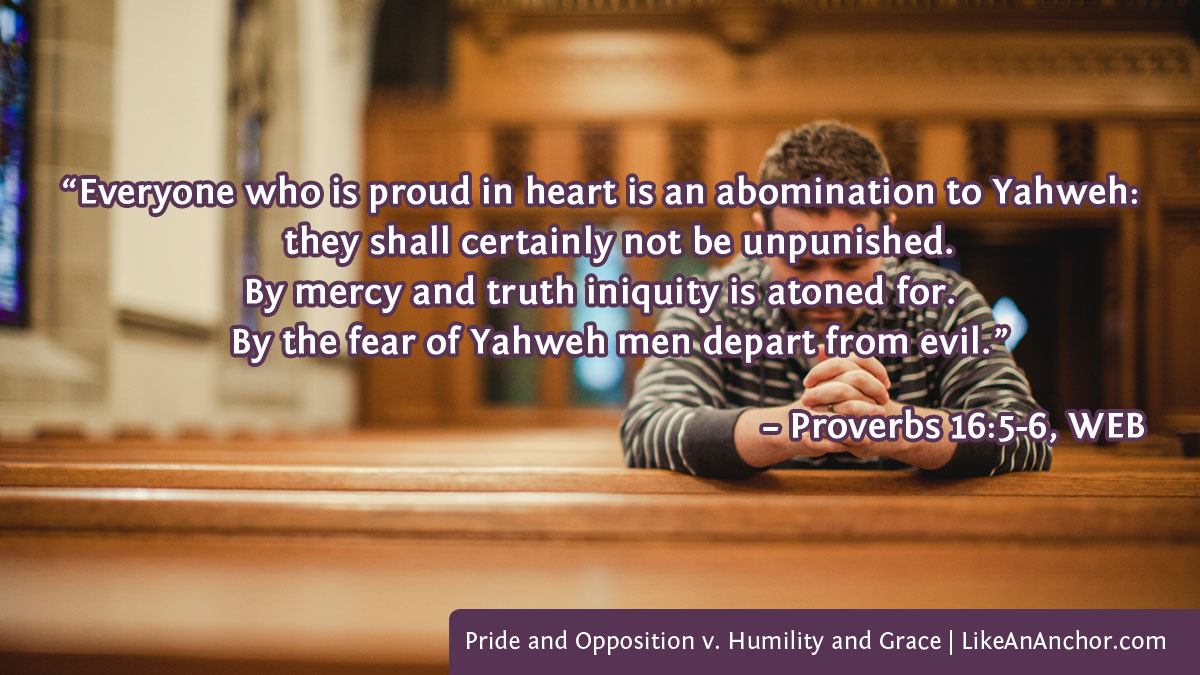
There’s a proverb that both Peter and James quote in their epistles. It goes like this: “God opposes the proud, but he gives grace to the humble” (James 4:6; 1 Peter 5:5, NET). Here, we see two different reactions that God has to two different human attitudes. On the one hand, He offers grace when we’re humble (the mindset needed to acknowledge that we need His grace). On the other hand, He is in opposition to the proud (a mindset that sets itself in opposition to God).
God cares a great deal about the state of our hearts, how we relate to Him, and the way we behave. Once God opens our eyes to His truth and begins a relationship with us, we still have choices to make. We can live as His friends or we can keep doing things that would make us His enemies. There are many verses addressing this idea, but these provide a particularly succinct summary.
The Proverbs Context
Both Peter and James are quoting Proverbs 3:34. Many proverbs stand on their own, but this one is part of a larger message of instruction that begins, “My son, don’t forget my teaching; but let your heart keep my commandments” (Prov. 3:1, WEB). Readers are admonished to pay careful attention to sound teachings, trust in the Lord rather than themselves, and accept correction from the Lord as required (something only possible with a humble attitude). We’re also told to prioritize wisdom and use it in our dealings with others. The passage ends with some warnings.
Don’t envy the man of violence. Choose none of his ways. For the perverse is an abomination to Yahweh, but his friendship is with the upright. Yahweh’s curse is in the house of the wicked, but he blesses the habitation of the righteous. Surely he mocks the mockers, but he gives grace to the humble. The wise will inherit glory, but shame will be the promotion of fools.
Proverbs 3:31-35, WEB
The phrase “he mocks the mockers” is what was translated into Greek as “he opposes the proud.” In Hebrew, “mocks” and “mockers” are from the same word, luts (H3887). The basic meaning is to scorn or mock. By showing it as the opposite of humility, this proverb indicates “that the particular type of wickedness of the scorner is pride” (Theological Wordbook of the Old Testament, entry 1113). Proverbs 21:24 also bears out this connection: “The proud and arrogant man—“Scoffer” is his name—he works in the arrogance of pride.”
It makes me think of the verse in Hosea that says, “The pride of Israel testifies to his face” (Hos. 5:5, WEB). God’s people had been proud, and haughty, and think they know best but their pride stands testament to their misdeeds. Keep reading in chapter 5, and you’ll see God sounding a battle cry to go out and “pour out my wrath on them like water” (Hos. 5:10, WEB). That imagery of God going out in battle against the proud is what we find in the Greek translations of Proverbs 3:34.
As mentioned earlier, the New Testament quotes of this proverb read, “God opposes the proud, but he gives grace to the humble” (James 4:6; 1 Peter 5:5, NET). In Greek, “oppose” is translated from antitassomai (G498), which means “to range in battle against” (Thayer). That’s also the word used in the Septuagint when they translated Proverbs 3:34 into Greek. It seems to have been well understood that the right way to translate God’s response to pride-filled scorners was as fierce opposition.
Image by Shaun Menary from Lightstock
Proverbs 3:34 In James
Let’s look at the passage where James quotes this proverb. It’s the verse that inspired me to take a closer look at this topic (interestingly, I’d made myself a note to study grace and pride next, and then the sermon I heard last Sabbath also covered pride). We’ll start reading several verses before the quote for context.
Where do the conflicts and where do the quarrels among you come from? Is it not from this, from your passions that battle inside you? You desire and you do not have; you murder and envy and you cannot obtain; you quarrel and fight. You do not have because you do not ask; you ask and do not receive because you ask wrongly, so you can spend it on your passions.
Adulterers, do you not know that friendship with the world means hostility toward God? So whoever decides to be the world’s friend makes himself God’s enemy. Or do you think the scripture means nothing when it says, “The spirit that God caused to live within us has an envious yearning”? But he gives greater grace. Therefore it says, “God opposes the proud, but he gives grace to the humble.” So submit to God. But resist the devil and he will flee from you. Draw near to God and he will draw near to you. Cleanse your hands, you sinners, and make your hearts pure, you double-minded. Grieve, mourn, and weep. Turn your laughter into mourning and your joy into despair. Humble yourselves before the Lord and he will exalt you.
James 4:1-10, NET (bold italics mark a quote from Prov. 3:34)
The phrase “but he gives greater grace” puzzles me. Why not simply “grace;” isn’t that already great? What is “greater grace,” and why is it contrasted with the human spirit that lives in us? Then, why does that contrast lead into Proverbs 3:34 with a “therefore.” James clearly sees these concepts as both interconnected and very meaningful for us, so it seems like something we’d benefit from puzzling out.
Let’s go through this passage again. First, James calls attention to the source of conflicts among believers (the audience he’s addressing is the “brothers and sisters” in “the twelve tribes dispersed abroad” [Jas. 1:1-2, NET]). The root cause of these issues is wrong passions and desires for things of the world. It is a basic truth that loving and lusting after worldly things makes you God’s enemy. You can’t befriend the world and stay a friend of God.
Though James references scripture when he says, “The spirit that God caused to live within us has an envious yearning,” it doesn’t exactly match any Old Testament verse. The NET translators point out, “No OT verse is worded exactly this way. This is either a statement about the general teaching of scripture or a quotation from an ancient translation of the Hebrew text that no longer exists today” (note on James 3:5). We do know from scripture that God breathed life into man in the garden of Eden, and that there is a big difference between that human spirit and the holy spirit of God (Gen. 2:7; 1 Cor. 2). In Jeremiah, God said, “The heart is deceitful above all things and it is exceedingly corrupt” (Jer. 17:9, WEB). Another translation phrases this line, “The human mind is more deceitful than anything else. It is incurably bad” (Jer. 17:9, NET). Perhaps that verse in Jeremiah was one of the scriptures James had in mind when we wrote his letter.
When you focus in on descriptions like “hostility toward God,” “envious yearning,” “exceedingly corrupt,” and “incurably bad,” it makes more sense why we desperately need grace that stands in sharp contrast to that human spirit inside us. In Greek, the word translated “greater” is meison (G3187), the comparative form of megas (G3187; root of the English word “mega”). It describes something that is “greater, larger, elder, stronger” (Thayer’s dictionary, entry G3187). The grace God gives us is bigger, older, stronger, and so much greater than the problems we face within or outside of ourselves. I think the emphasis here is that while human nature can be terribly wicked and hostile to God, His grace is surpassingly greater. He can fix even the most prideful, quarrelsome person if they are willing to cleanse their hands, purify their hearts, “grieve, mourn, and weep” over their sins, and admit they need His grace.
Image by Matt Vasquez from Lightstock
Proverbs 3:34 In 1 Peter
When Peter quotes this proverb, he also focuses on how people in the church interact with each other. His emphasis is not so much on the depravity of human nature and the necessity of repentant humility, though. He’s urging his readers–particularly those in leadership–to care for others without lording over them. Really, though, submission and humility is a subject that’s relevant for everyone, as supported by the proverbs quote.
So as your fellow elder and a witness of Christ’s sufferings and as one who shares in the glory that will be revealed, I urge the elders among you: Give a shepherd’s care to God’s flock among you, exercising oversight not merely as a duty but willingly under God’s direction, not for shameful profit but eagerly.And do not lord it over those entrusted to you, but be examples to the flock. Then when the Chief Shepherd appears, you will receive the crown of glory that never fades away.
In the same way, you who are younger, be subject to the elders. And all of you, clothe yourselves with humility toward one another, because God opposesthe proud but gives grace to the humble.
1 Peter 5:1-5, NET (bold italics mark quote from Prov. 3:34)
There’s a Rick Warren quote that says, “Humility is not thinking less of yourself, but thinking of yourself less” (The Purpose Driven Life, Day 19). Similarly, C.S. Lewis wrote that “if you meet a really humble man … He will not be thinking about humility: he will not be thinking about himself at all” (Mere Christianity, Book 3, Chapter 8). Our focus shouldn’t be on ourselves, but on doing the will of God. We need to realize that pride is a sin, confront it in our lives (identifying it, repenting of it, and asking God to help us change), and move forward with living lives patterned after God’s holiness. That will help us in our relationships with others. It will open us up to God’s grace. And it even helps us in our spiritual battles (which James also mentioned when he said, “resist the devil and he will flee from you”).
Image by Pearl from Lightstock
And all of you, clothe yourselves with humility toward one another, because God opposesthe proud but gives grace to the humble.And God will exalt you in due time, if you humble yourselves under his mighty handby casting all your cares on him because he cares for you. Be sober and alert. Your enemy the devil, likea roaring lion, is on the prowl looking for someone to devour. Resist him, strong in your faith, because you know that your brothers and sisters throughout the world are enduring the same kinds of suffering.And, after you have suffered for a little while, the God of all grace who called you to his eternal glory in Christ will himself restore, confirm, strengthen, and establish you.To him belongs the power forever. Amen.
1 Peter 5:5-11, NET (bold italics mark quote from Prov. 3:34; italics may be an allusion to Ps 22:13)
I’ve been wrapping up final copyedits this week on the Like An Anchor Study Guide: Armor of God book (which I’d planned to release last month, but I temporarily lost all my editing notes when we moved), so this feels like a particularly relevant passage right now. One of the things we need to realize when approaching spiritual warfare is that we can’t do it on our own. Thinking you can stand up against the roaring lion all by yourself is a recipe for disaster. We need to humble ourselves before the Almighty and entrust Him with all our cares. Then we can stand against His adversary while wearing His armor (Eph. 6:10-18).
Also, notice that Peter once again calls our attention to “the God of all grace” before wrapping up his letter. It is God’s charis–favor within a reciprocal covenant relationship–that enables us to live humble, victorious lives. His “greater grace” makes it possible for us to overcome pride in ourselves and to resist our adversary the devil, who was so proud he thought he could overthrow God. When we give into that same sin of pride, we’re putting ourselves on the wrong side of that battle. But when we humbly admit pride is a problem and ask God for help getting rid of it and keeping it out of our lives, He graciously aids us with all our cares and empowers us to win spiritual battles.











 Like An Anchor