Forgive Us Our Debts, as We Have Forgiven Our Debtors

Today’s post is our 5th on Jesus’s model prayer. If you need/want to catch up on the previous posts, here are the links: “Hallowed Be Your Name,” “May Your Kingdom Come,” “May Your Will Be Done On Earth As It Is In Heaven,” and “Give Us Today Our Daily Bread.” As mentioned in those posts, we find versions of Jesus’s model prayer in two gospels. We’ve been focusing on the one in Matthew, which is part of the Sermon on the Mount when He’s talking about good and bad examples for how to pray (Matt. 6:5-15). There’s also a near-identical one in Luke, where Jesus responds to a disciple’s request that Jesus teach them to pray (Luke 11:1-13).

So pray this way:
Our Father in heaven, may your name be honored,
may your kingdom come,
may your will be done on earth as it is in heaven.
Give us today our daily bread,
and forgive us our debts, as we ourselves have forgiven our debtors.
And do not lead us into temptation, but deliver us from the evil one

Matthew 6:9-13, NET

We can think of this prayer as a helpful outline for our own prayers. We’re not locked into repeating it word-for-word; He’s showing us the way to pray rather than giving us a specific prayer to recite (though there can be a time and place for that, too, just like we can read or sing psalms other people wrote at times when we can’t think of what to say or the psalms/prayers speak to our own situations). In this post, we’re looking at the second personal request that’s part of the model prayer: “forgive us our debts, as we ourselves have forgiven our debtors.”

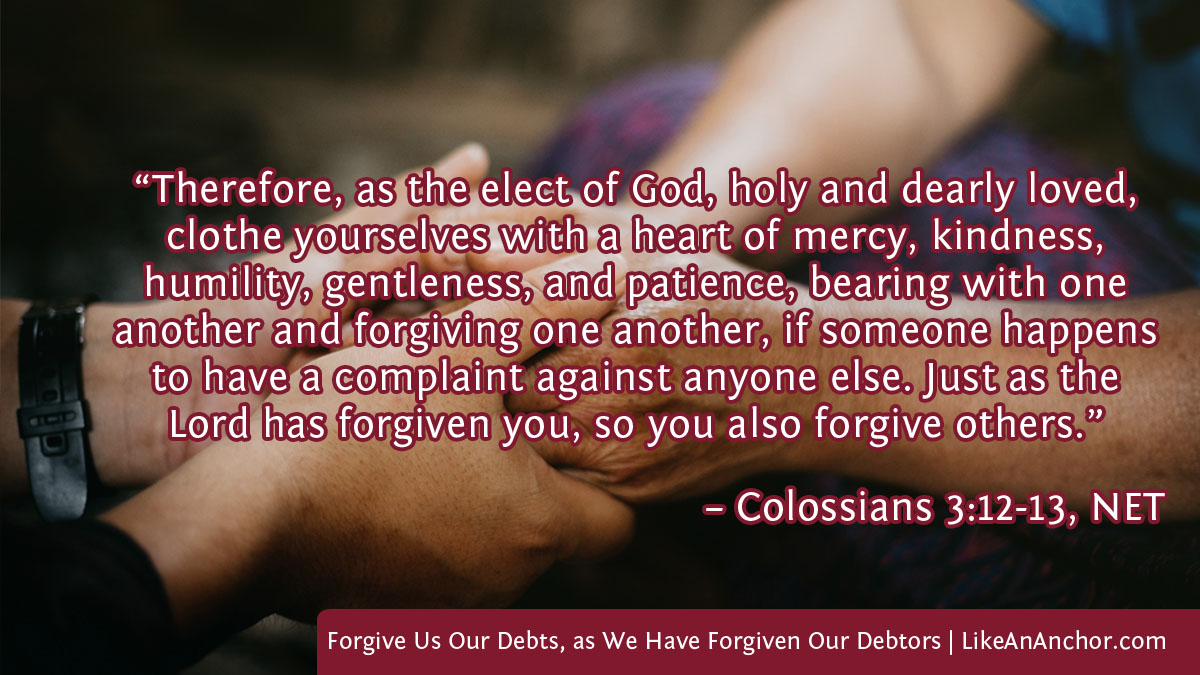
Image of two people's clasped hands overlaid with text from Colossians 3:12-13, NET version: “Therefore, as the elect of God, holy and dearly loved, clothe yourselves with a heart of mercy, kindness, humility, gentleness, and patience, bearing with one another and forgiving one another, if someone happens to have a complaint against anyone else. Just as the Lord has forgiven you, so you also forgive others.”
Image by Jantanee from Lightstock

Forgiving Debts

“Forgive us our debts, as we ourselves have forgiven our debtors” is the only point in this prayer that Jesus explains in more detail. Right after wrapping up the outline, He adds this:

“For if you forgive others their sins, your heavenly Father will also forgive you. But if you do not forgive others, your Father will not forgive you your sins.”

Matthew 6:14-15, NET

There are two different Greek words used here, which is reflected in the English translations “debts” and “sins.” In the prayer, the word used is opheilema, which means “that which is owed” as “a debt” (Thayer’s Dictionary, entry G3783). It’s metaphorically used of sins. “Debtors” is the related word opheiletes, which as you might guess means the person who owes something to another (Thayer; G3781). This word for debtor is also used in Matthew 18, which we’ll be looking at in a moment.

“Sin” is translated from paraptoma, which means “to fall beside or near” or “a lapse or deviation from truth and uprightness” (Thayer; G3900). When it appears in the New Testament it’s translated with English words like “trespass,” “offense,” “fault,” or “sin.” Interestingly, this still isn’t the most commonly used Greek word for sin. That would be hamartia, which means “to miss the mark” or “that which is done wrong, sin, and offense, a violation of the divine law” (Thayer; G266). Harmartia is the word used for “sin” in the version of Jesus’s model prayer that Luke records (Luke 11:4).

Despite the different words, “forgive us our debts, as we ourselves have forgiven our debtors” is clearly connected with “forgive others their sins” so your Father will forgive you. Jesus uses parallel wording to make the connection, and the word for “forgive” is the same in both cases. It’s translated from aphiemi, which means “to let go, give up a debt, forgive, to remit” (Thayer; G863). When we sin, it’s like we owe God something because we messed up. When Jesus died, He paid the penalty in our place, remitting our debts. We need to understand this sin-debt analogy if we’re going to make sense of what’s going on in this part of the model prayer.

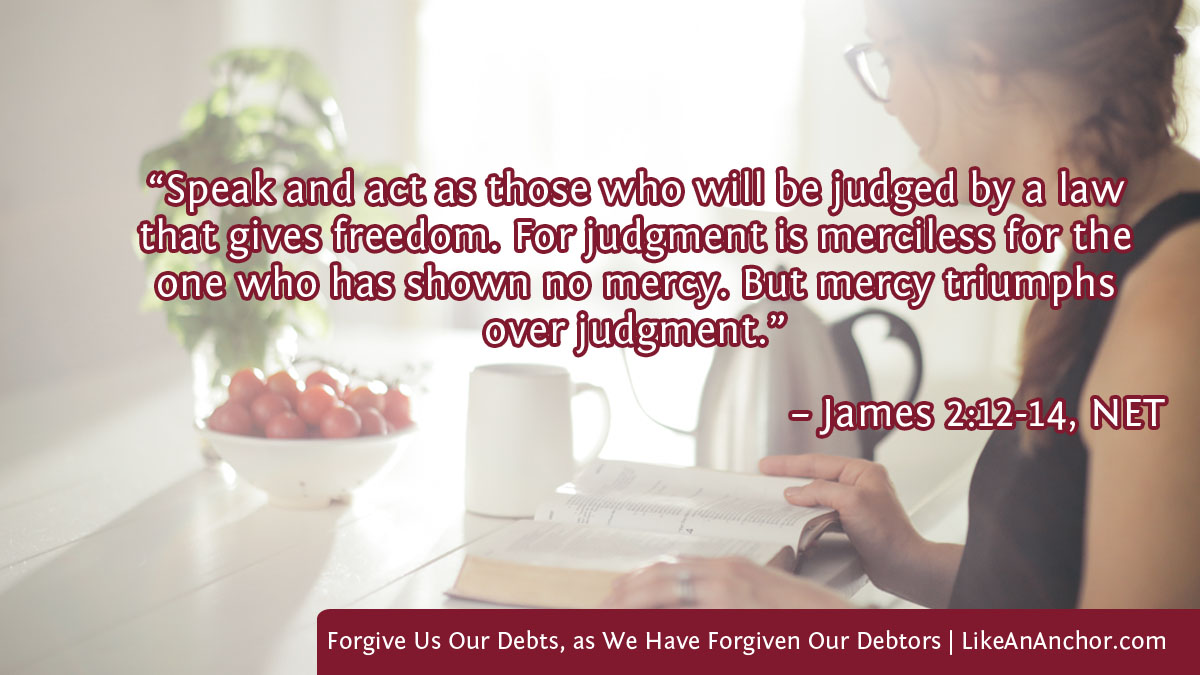
Image of a woman reading the Bible at a table, overlaid with text from James 2:12-14, NET version: “Speak and act as those who will be judged by a law that gives freedom. For judgment is merciless for the one who has shown no mercy. But mercy triumphs over judgment.”
Image by MarrCreative from Lightstock

The Necessity of Forgiveness

It might feel kind of weird to think that God’s forgiveness of us is conditional on our forgiveness of others. We like to think of His forgiveness and grace as something freely given that we don’t need to do anything in order to receive. But though we can’t do anything to earn His grace or forgiveness, there are some things we can do to reject them. Later in Jesus’s ministry, He shares a parable that sheds light on the connection between us forgiving others and us receiving forgiveness from God.

Then Peter came to him and said, “Lord, how many times must I forgive my brother who sins against me? As many as seven times?” Jesus said to him, “Not seven times, I tell you, but seventy-seven times!

“For this reason, the kingdom of heaven is like a king who wanted to settle accounts with his slaves. As he began settling his accounts, a man who owed 10,000 talents was brought to him. Because he was not able to repay it, the lord ordered him to be sold, along with his wife, children, and whatever he possessed, and repayment to be made. Then the slave threw himself to the ground before him, saying, ‘Be patient with me, and I will repay you everything.’ The lord had compassion on that slave and released him, and forgave him the debt. 

Matthew 18:21-27, NET

This is mercy. The man was an opheiletes, a debtor, who was incapable of repaying what he owed. Just one talent was “equal to 6,000 denarii. One denarius was the usual day’s wage for a worker” (NET footnote on Matt. 18:24). That means for a typical worker at the time, 10,000 talents was equal to 60,000,000 day’s wages, or about 164,384 years of work. A slave could never dream of repaying that, just like human beings can never do enough to make up for the sins we’ve committed against God (Rom. 3-6). As readers or listeners, we’re supposed to appreciate just what an incredible gift this lord gave the slave.

After he went out, that same slave found one of his fellow slaves who owed him 100 silver coins. So he grabbed him by the throat and started to choke him, saying, ‘Pay back what you owe me!’ Then his fellow slave threw himself down and begged him, ‘Be patient with me, and I will repay you.’ But he refused. Instead, he went out and threw him in prison until he repaid the debt. When his fellow slaves saw what had happened, they were very upset and went and told their lord everything that had taken place.  Then his lord called the first slave and said to him, ‘Evil slave! I forgave you all that debt because you begged me! Should you not have shown mercy to your fellow slave, just as I showed it to you?’ And in anger his lord turned him over to the prison guards to torture him until he repaid all he owed. So also my heavenly Father will do to you, if each of you does not forgive your brother from your heart.”

Matthew 18:28-35, NET

The fellow slave owed only 100 silver coins, or denarii, so about 3 months’ pay (NET footnote on Matt. 18:28). It’s a real debt, but compared to what the first slave owed the lord it’s a tiny sum. The difference between what the slave was forgiven and what he refused to forgive is enormous. We can see how ridiculous he’s being. But it’s just as ridiculous if we refuse to forgive another human being’s offenses against us after God has forgiven our offenses against Him.

It’s not just crazy for us to hold on to a tiny debt someone owes us when God has forgiven us a huge debt against Him. It’s dangerous. Jesus doesn’t leave room for ambiguity in interpreting this parable. The lord takes back His forgiveness, and Jesus says, “So also my heavenly Father will do to you, if each of you does not forgive your brother from your heart.” It’s exactly like He said after sharing the model prayer: “if you forgive others their sins, your heavenly Father will also forgive you. But if you do not forgive others, your Father will not forgive you your sins” (Matt. 6:14-15, NET). There’s an “if” in these verses, making forgiveness conditional. We need to show forgiveness if we want to receive forgiveness.

How To Let Go

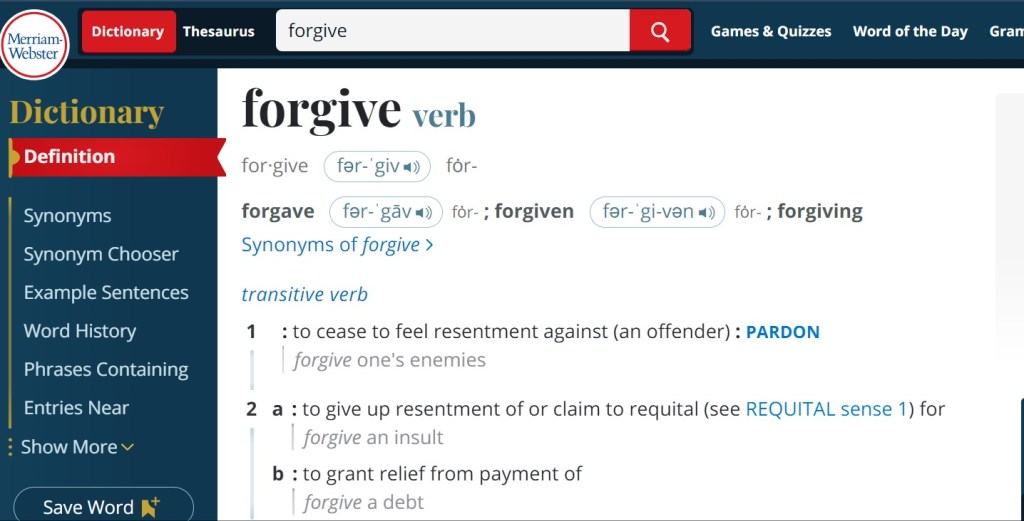
Earlier, I said that aphiemi, the Greek word translated “forgive” means “to let go, give up a debt, forgive, to remit” (Thayer; G863). That’s the sense in which it usually applies to forgiveness. But it’s a complex word, and it can also mean “to send away,” “yield up,” “let alone, let be,” or “to leave, go away from one.” If we forgive, we stop holding on to the sins, offenses, debts, and trespasses of other people. We “let it alone,” send away our resentment, and walk away from what we might be owed. It’s much the same thing as our English definition of forgiveness.

Screenshot of the definition of "forgive" in the Merriam-Webster dictionary. Definitions shown include " to cease to feel resentment against (an offender)," "to give up resentment of or claim to requital," and "to grant relief from payment of"

Notice that none of the things involved with forgiveness require the other person to take action. We can grant forgiveness–let go of resentment and yield any claim to payment owed us–without the other person asking for it. In fact, we should forgive as soon as possible regardless of the other person because we want God to respond positively when we ask Him to forgive us.

Image of a man praying in a church, overlaid with blog's title text and the words, "One of our main goals as Christians is to become like God. That involves learning to be loving, merciful, and forgiving just the same way that He is."
Image by Shaun Menary from Lightstock

One of the things I’ve struggled with related to forgiveness is how to tell if I’ve actually forgiven someone. Some things are relatively easy to forgive, and you might legitimately forget them when you release the debt. There are others, though, that can still color your perception of a person even if you don’t feel resentment or think they owe you something. In certain situations, that can be okay. It’s not always safe to reconcile or restore a relationship, but it’s always right to let go of resentment and the feeling that someone who hurt us owes us for something.

 “If your brother sins, go and show him his fault when the two of you are alone. If he listens to you, you have regained your brother. But if he does not listen, take one or two others with you, so that at the testimony of two or three witnesses every matter may be established. If he refuses to listen to them, tell it to the church. If he refuses to listen to the church, treat him like a Gentile or a tax collector.

Matthew 18:15-17, NET

This short formula for Christian reconciliation comes before Peter’s question about forgiveness and Jesus’s parable about the unforgiving slave. Ideally, we should reconcile if there’s an issue with a “brother” or “fellow believer.” The primary goal is reconciliation and restored relationship. But if that doesn’t work after repeated attempts, you don’t “associate with such a person” (NET footnote on Matt. 18:17). It’s our responsibility to try to reconcile, especially with a fellow believer, but regardless of how that goes we have an obligation to forgive and “live peaceably with all people” (Rom. 12:18, NET; see Rom. 12:16-21).

The conditionality of forgiveness from God should prompt us to extend forgiveness to others. But I don’t think He wants that to be the main reason why we forgive (just like the threat of punishment shouldn’t be the main reason we obey His laws). When we realize what a great debt God forgives us, we should want to forgive others. Similarly, as recipients of God’s great mercy, we should be eager to show mercy to others. Like forgiveness, there’s a reciprocity involved in mercy: “Blessed are the merciful, for they will be shown mercy” (Matt. 5:7, NET) and “For judgment is merciless for the one who has shown no mercy” (James 2:13, NET). One of our main goals as Christians is to become like God. That involves learning to be loving, merciful, and forgiving just the same way that He is. When we pray, “Forgive us our debts, as we ourselves have forgiven our debtors,” we acknowledge that we have an essential role to play in giving and receiving forgiveness.


Featured image by Pearl from Lightstock

Song Recommendation: “Mercy” by Casting Crowns

Give Us Today Our Daily Bread

Today, we’re continuing our study of Jesus’s model prayer. If you missed any of the others, here are the links: “Hallowed Be Your Name,” “May Your Kingdom Come,” and “May Your Will Be Done On Earth As It Is In Heaven.” As mentioned in those posts, we find versions of Jesus’s model prayer in two gospels. In Matthew, it’s part of the Sermon on the Mount when He’s talking about good and bad examples for how to pray, and that’s the one we’ve been focusing on (Matt. 6:5-15). In Luke, He uses a similar prayer to respond to a disciple’s request that Jesus teach them to pray (Luke 11:1-13).

So pray this way:
Our Father in heaven, may your name be honored,
may your kingdom come,
may your will be done on earth as it is in heaven.
Give us today our daily bread,
and forgive us our debts, as we ourselves have forgiven our debtors.
And do not lead us into temptation, but deliver us from the evil one

Matthew 6:9-13, NET

You don’t have to repeat this prayer word-for-word to pray correctly, but it’s a very helpful outline for our own prayers. The first personal request included in this prayer is, “Give us today our daily bread.”

Daily Bread

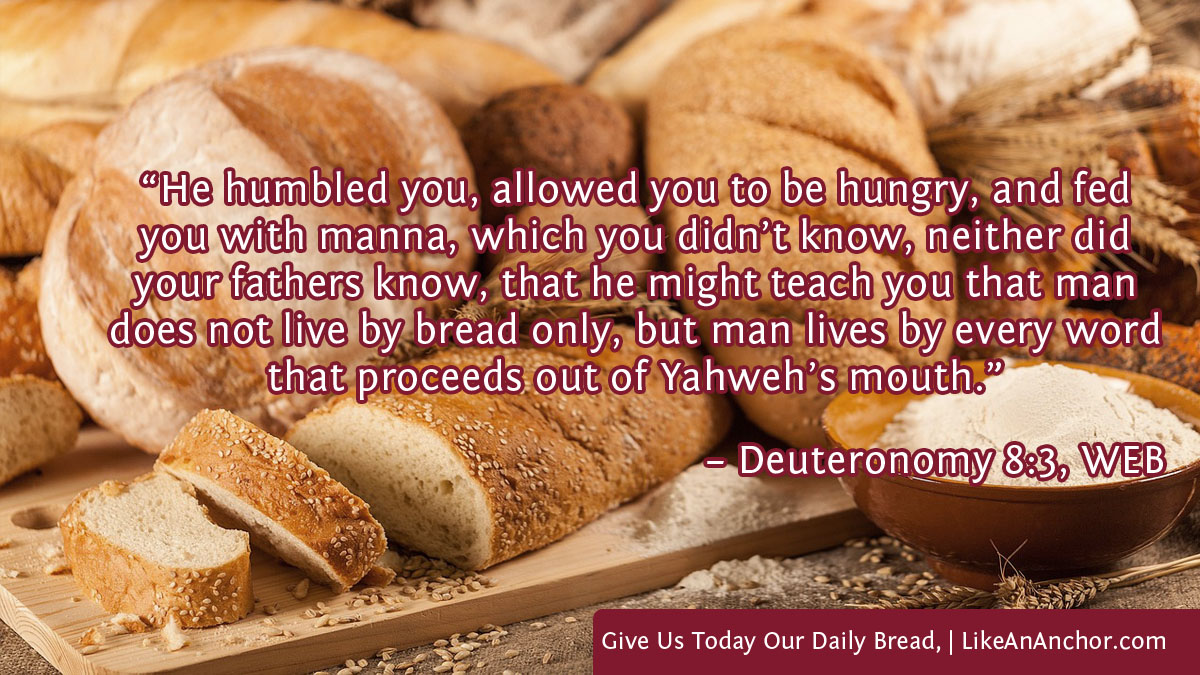
One of the things we need to remember when reading the New Testament is how profoundly connected it is to the Old Testament. For the people of Jesus’s day, these weren’t two separate books. All they had was what we call the Old Testament. It was the the holy scriptures, and anytime Jesus or His followers reference the word of God that’s what they’re talking about. Even when they don’t reference these writings directly, chances are their listeners would have stories and principles from the Old Testament in the back of their minds. Everyone in Jewish society studied the scriptures as children and heard them read each week on Shabbat for the rest of their lives. When Jesus said, “Give us today our daily bread,” I imagine it would have been almost impossible for people not to think of the Exodus story.

They took their journey from Elim, and all the congregation of the children of Israel came to the wilderness of Sin, which is between Elim and Sinai, on the fifteenth day of the second month after their departing out of the land of Egypt. The whole congregation of the children of Israel murmured against Moses and against Aaron in the wilderness; and the children of Israel said to them, “We wish that we had died by Yahweh’s hand in the land of Egypt, when we sat by the meat pots, when we ate our fill of bread, for you have brought us out into this wilderness to kill this whole assembly with hunger.”

Then Yahweh said to Moses, “Behold, I will rain bread from the sky for you, and the people shall go out and gather a day’s portion every day, that I may test them, whether they will walk in my law or not. It shall come to pass on the sixth day, that they shall prepare that which they bring in, and it shall be twice as much as they gather daily.”

Exodus 16:1-5, WEB

When Yahweh miraculously provided manna to feed ancient Israel, He gave them bread day-by-day. He didn’t dump a week’s worth of bread on them all at once, or give them extra that they could keep on hand “just in case.” The manna even rotted if they tried to save it over, making it impossible to eat anything but “daily bread.” The only exception to this rule was extra manna on Friday that would stay fresh until Saturday, so no one had to work to gather bread on Shabbat (Ex. 16). Ancient Israel had to trust God would provide for them each day, just like we still need to today even if it’s not as obvious as it was for them with the manna.

New Bread From Heaven

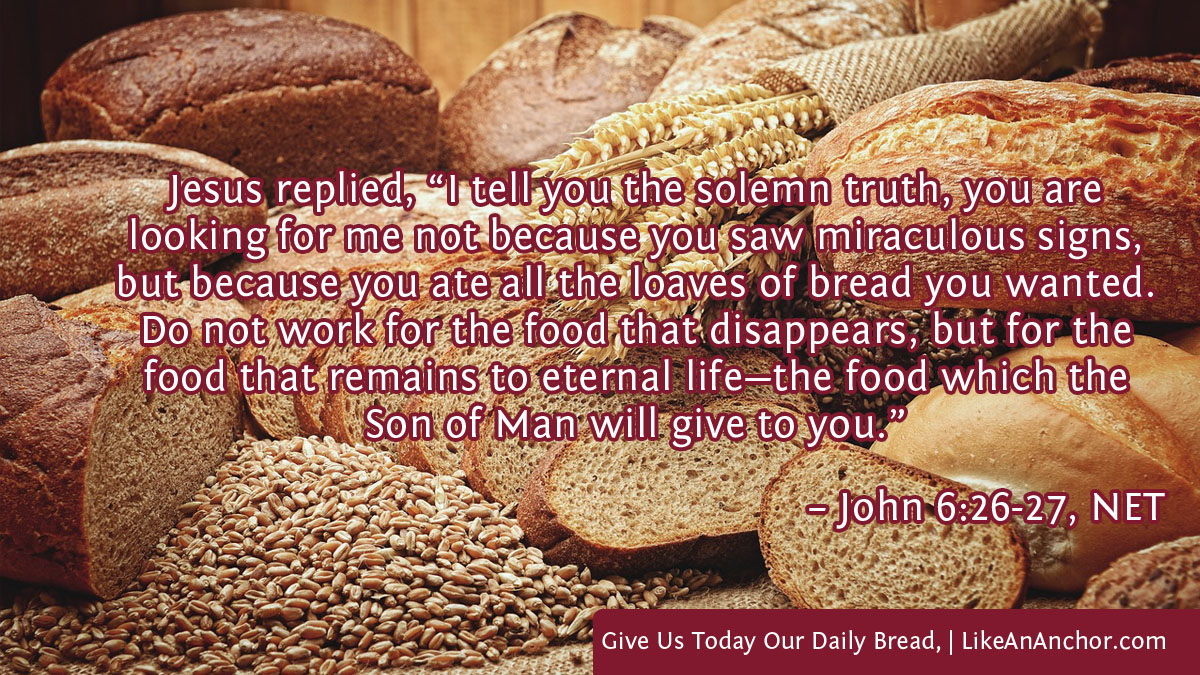
Later in His ministry, Jesus discussed manna directly. After miraculously feeding 5,000 people, Jesus tried to travel to a new place but the people who’d eaten the food followed Him. Even after partaking of that miracle, they had the nerve to ask, “what miraculous sign will you perform, so that we may see it and believe you? What will you do? Our ancestors ate the manna in the wilderness, just as it is written, ‘He gave them bread from heaven to eat’” (John 6:30-31, NET, quoting Ps. 78:24). It appears that they were challenging Him to keep providing physical daily bread for them, but Jesus redirected their focus.

Then Jesus told them, “I tell you the solemn truth, it is not Moses who has given you the bread from heaven, but my Father is giving you the true bread from heaven. For the bread of God is the one who comes down from heaven and gives life to the world.” So they said to him, “Sir, give us this bread all the time!”

Jesus said to them, “I am the bread of life. The one who comes to me will never go hungry, and the one who believes in me will never be thirsty.” …

 “I am the bread of life. Your ancestors ate the manna in the wilderness, and they died. This is the bread that has come down from heaven, so that a person may eat from it and not die. I am the living bread that came down from heaven. If anyone eats from this bread he will live forever. The bread that I will give for the life of the world is my flesh.”

John 6:32-35, 48-51, NET

It’s very possible that when Jesus told His followers to pray, “Give us today our daily bread,” He meant both physical necessities and spiritual ones. We need Him every day even more than we need actual food. Just like Jesus cared about providing food to the 5,000 AND teaching them about Him as the Bread of Life, so we should care about asking God to provide our daily food AND asking for the Bread of Life to feed us every day.

Don’t Worry About The Bread

You might say that I’m reading too much into “give us today our daily bread” to say that it’s spiritual food as well as physical food. On the surface, it’s just a simple, straightforward statement: “Please provide the food we need for today.” But as Jesus points out just a short while later in this Sermon on the Mount, God already knows that we need things like food and clothing. He doesn’t really need the reminder, and we don’t really need to worry about it.

“Therefore I tell you, do not worry about your life, what you will eat or drink, or about your body, what you will wear. Isn’t there more to life than food and more to the body than clothing? Look at the birds in the sky: They do not sow, or reap, or gather into barns, yet your heavenly Father feeds them. Aren’t you more valuable than they are? …  So then, don’t worry saying, ‘What will we eat?’ or ‘What will we drink?’ or ‘What will we wear?’ For the unconverted pursue these things, and your heavenly Father knows that you need them. But above all pursue his kingdom and righteousness, and all these things will be given to you as well. So then, do not worry about tomorrow, for tomorrow will worry about itself. Today has enough trouble of its own.

Matthew 6:25-26, 31-33, NET

There’s nothing wrong with asking for day-to-day necessities. Just because God already knows something and intends to provide it doesn’t mean He won’t appreciate us asking rather than taking His provision for granted. But we shouldn’t spend time worrying about what we’ll eat or drink, and especially not worrying about it long-term and borrowing trouble from tomorrow. And even if we’re famished, there’s still something more important than physical bread to focus on.

Then Jesus was led by the Spirit into the wilderness to be tempted by the devil. After he fasted forty days and forty nights he was famished. The tempter came and said to him, “If you are the Son of God, command these stones to become bread.” But he answered, “It is written, ‘Man does not live by bread alone, but by every word that comes from the mouth of God.’”

Matthew 4:1-4, NET (bold italics mark a quotation from Deut. 8:3)

Jesus was in a unique situation here, but the principle in the verse He quoted still applies to us. Like ancient Israel did with manna, we’re supposed to learn to rely on God every day and we’re supposed to learn that listening to His words sustains life. Food isn’t the only thing we need to keep us alive, at least not to give us the abundant life that Jesus wants for us (John 10:10). We also need the Bread of Life and the words of God.


Featured image by Couleur from Pixabay

Song Recommendation: “Word of God Speak” by MercyMe

May Your Will Be Done on Earth as It Is in Heaven

After writing about the phrases “Hallowed Be Your Name” and “May Your Kingdom Come” from Jesus’s model prayer, I think it might be good to just keep going and study the whole prayer line-by-line. I wasn’t going to continue this study because I’m pretty sure I know what Jesus means by “may your will be done,” but then I remembered what Paul said: “If someone thinks he knows something, he does not yet know to the degree that he needs to know” (1 Cor. 8:2, NET). We need to beware of intellectual pride that makes us think there’s nothing more to learn from “basic” concepts about God that we’ve already “mastered.” There’s always more to learn where God is concerned.

Prioritizing God’s Will

We find versions of Jesus’s model prayer in two gospels. In Matthew, it’s part of the Sermon on the Mount when He’s talking about good and bad examples for how to pray (Matt. 6:5-15). In Luke, He uses this prayer to respond to a disciple’s request that Jesus teach them to pray (Luke 11:1-13). You don’t have to repeat this prayer word-for-word to pray correctly, but it’s a very helpful outline for our own prayers.

So pray this way:
Our Father in heaven, may your name be honored,
may your kingdom come,
may your will be done on earth as it is in heaven.
Give us today our daily bread,
and forgive us our debts, as we ourselves have forgiven our debtors.
And do not lead us into temptation, but deliver us from the evil one

Matthew 6:9-13, NET

Submitting to God’s will isn’t the very first thing in the prayer, but it is in the first half. It comes before other, more personal requests but after the proper acknowledgement of God’s holiness and the request that His kingdom come. I’m not sure how important the order is, but it strikes me as interesting that Jesus put the Father’s will before other, more individual requests like daily bread or personal deliverance. That’s a priority list Jesus modeled in His own life.

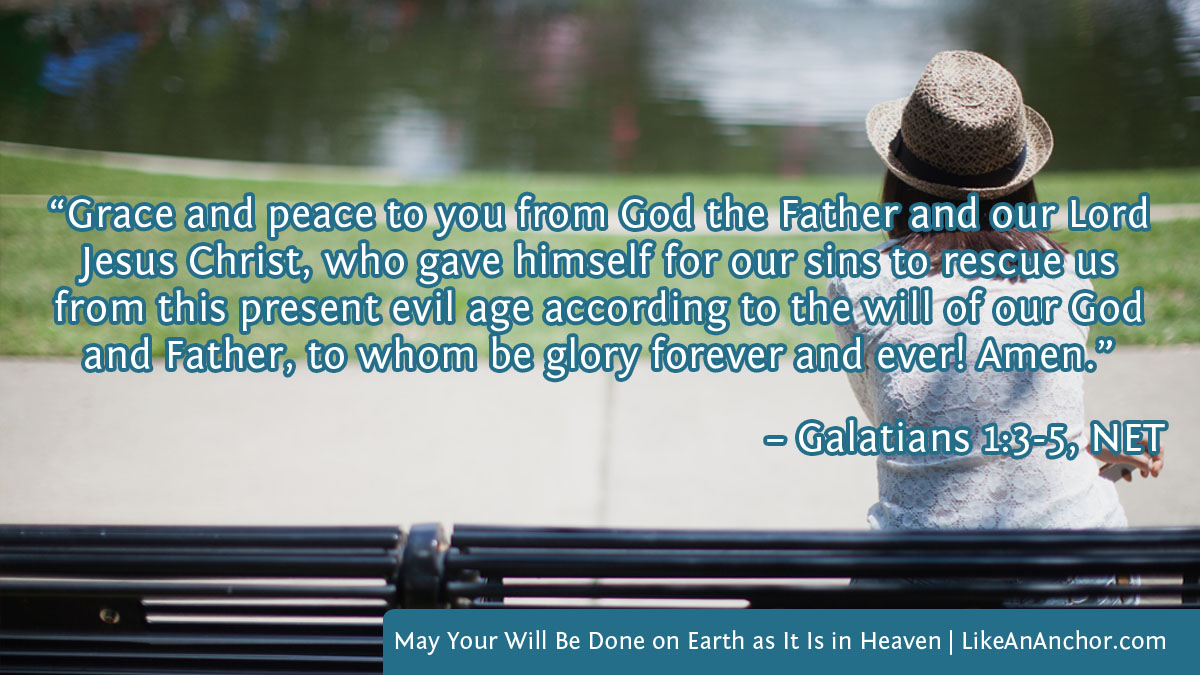
Image of a woman sitting on a park bench overlaid with text from Gal. 1:3-5, NET version: “Grace and peace to you from God the Father and our Lord Jesus Christ, who gave himself for our sins to rescue us from this present evil age according to the will of our God and Father, to whom be glory forever and ever! Amen.”
Image by Anggie from Lightstock

Jesus and the Father’s Will

Remember, it’s our Father that we’re talking with here. We come before God not as some distant petitioners, but as His own children. There’s a relationship established before we even get to this prayer, and it’s the same type of relationship that Jesus has with the Father (John 16:27; 17:23; 1 John 3:1-2).

Before Jesus’s death, He prayed, “My Father, if possible, let this cup pass from me! Yet not what I will, but what you will” (Matt. 26:39, NET; see Matt. 26:36-46; Mark 14:32-42; Luke 22:39-46). This wasn’t the first time He’d prioritized the Father’s will. Doing the Father’s will was one of His main focuses in life, as John records several times in his gospel.

Jesus said to them, “My food is to do the will of the one who sent me and to complete his work.”

John 4:34, NET

“I can do nothing on my own initiative. Just as I hear, I judge, and my judgment is just, because I do not seek my own will, but the will of the one who sent me.”

John 5:30, NET

“For I have come down from heaven not to do my own will but the will of the one who sent me.”

John 6:38, NET

I imagine with this focus that the model prayer and the prayer in Gethsemane were not the only times Jesus prayed, “may your will be done.” It was likely at the forefront of His mind frequently, whether He was formally praying at the time or not. And since we’re supposed to become like Jesus, doing the Father’s will should be a priority for us as well.

“Not everyone who says to me, ‘Lord, Lord,’ will enter into the kingdom of heaven—only the one who does the will of my Father in heaven.”

Matthew 7:21, NET

“For whoever does the will of my Father in heaven is my brother and sister and mother.”

Matthew 12:50, NET

Jesus has a close, personal, familial relationship with people who do the Father’s will. Additionally, only those who do His will can enter the kingdom of heaven. The emphasis that Jesus placed on following His Father’s will and the way He talked about it as a requirement for us reveals just how important it is that we do this. We need to align ourselves with God’s will, as Jesus did, if we want to spend forever in His family.

Image of an open Bible by a notebook overlaid with text from 1 John 2:17, NET version:  “And the world is passing away with all its desires, but the person who does the will of God remains forever.”
Image by Alyssa Marie from Lightstock

What Is God’s Will?

When Jesus talked about God’s will, He often emphasized how it relates to God’s overall plan. The Father is making a family, and it’s His will that as many people as possible receive salvation and eternal life (John 6:38-40; Matt. 11:25-27; 18:14). That gives us an overall view of God’s will, desire, and purpose. But it still doesn’t tell us what it means for us to do God’s will.

 “What do you think? A man had two sons. He went to the first and said, ‘Son, go and work in the vineyard today.’ The boy answered, ‘I will not.’ But later he had a change of heart and went. The father went to the other son and said the same thing. This boy answered, ‘I will, sir,’ but did not go. Which of the two did his father’s will?” They said, “The first.” Jesus said to them, “I tell you the truth, tax collectors and prostitutes will go ahead of you into the kingdom of God!”

Matthew 21:28-31, NET

Jesus shared this parable shortly before His death. He “entered the temple courts” and “the chief priests and elders of the people came up to him as he was teaching” to question Him and challenge His authority (Matt. 21:23, NET). These were the religious leaders, the people who probably thought they were doing God’s will better than anyone else and living more righteous lives. But as Jesus pointed out several other times, thinking you’re righteous isn’t the same thing as actually living by God’s words (Matt. 5:17-20; 23:1-3). If you want to do the father’s will, then you actually need to follow His commands.

Image of a man praying, overlaid with blog's title text and the words, "As God shares deeper understanding of His will with us, we’ll learn to do His will and align ourselves with what He's doing to accomplish His will."
Image by Shaun Menary from Lightstock

There are several things that Paul, Peter, and John describe as “God’s will” for us in their writings. It was God’s will that Jesus save us from our sins (Gal. 1:4; Eph. 1:11). It’s His will that we obey Him from the heart, become holy, give thanks always, do good, and live in accordance with His ways rather than fleshy human desires (Eph. 6:6; 1 Thess. 4:3; 5:18; 1 Pet. 2:15; 4:2). Sometimes, it’s in accordance with His will that we suffer even while doing good (1 Pet. 3:17; 4:19). But we also know that it’s His will that we’ll grow, mature, and “receive the promise” of eternal life if we align ourselves with His will (Col. 4:12; 1 John 2:17; Heb. 10:36).

Therefore I exhort you, brothers and sisters, by the mercies of God, to present your bodies as a sacrifice—alive, holy, and pleasing to God—which is your reasonable service. Do not be conformed to this present world, but be transformed by the renewing of your mind, so that you may test and approve what is the will of God—what is good and well-pleasing and perfect.

Romans 12:1-2, NET

The will of God isn’t just one thing. It includes all His desires and plans, for the universe and for us. In some ways it’s very simple–it’s God’s will to save humanity and doing His will involves following Him. In other ways, it’s something complex enough we can spend our whole lives learning to understand. Developing knowledge of His will and doing His will are key parts of our ongoing Christian walk.

For this reason we also, from the day we heard about you, have not ceased praying for you and asking God to fill you with the knowledge of his will in all spiritual wisdom and understanding, so that you may live worthily of the Lord and please him in all respects—bearing fruit in every good deed, growing in the knowledge of God, being strengthened with all power according to his glorious might for the display of all patience and steadfastness, joyfully giving thanks to the Father who has qualified you to share in the saints’ inheritance in the light. 

Colossians 1:9-12, NET

Look at why Paul says he asked God to fill people with “the knowledge of His will.” It’s so that we can “live worthily of the Lord,” please Him, bear fruit, do good deeds, grow “in the knowledge of God,” receive strength, display “patience and steadfastness,” and “joyfully give thanks.” As God shares deeper understanding of His will with us and we learn to pray “may your will be done on earth as it is in heaven,” our lives will be transformed. We will “live out the message ” rather than “merely listen to it” (James 1:22, NET). We’ll align ourselves with what He’s doing to accomplish His will. We’ll even be doing His will, helping fulfill the prayer “may your will be done on earth” as we live our lives in accordance with His will


Featured image by Claudine Chaussé from Lightstock

All of the Good Fruit, None of the Bad

I’m guessing you all know about the fruit of the spirit. You might have them memorized: “love, joy, peace, patience, kindness, goodness, faithfulness, gentleness, and self-control” (Gal. 5:22-23, NET). You might even have done in-depth studies on them, such as spending a month writing scriptures about each trait with my free 30-day scripture writing plans.

There’s another list in Galatians, though. It comes right before the fruit of the spirit passage and details the works of the flesh. We’re meant to read both and notice a contrast between the two because Paul is making a point about how Christians live. When he says you’re “not under the law,” he doesn’t mean God gives you freedom to go out and live a hedonistic, sinful life. Quite the opposite, in fact. We’re given freedom so we can fully follow God from the heart, with all the fruit of the spirit in our lives and none of the works of the flesh.

The Works of the Flesh

There’s a lot going on in Paul’s letter to the Galatians. He wrote to correct errors in the Galatian believers’ theology. They were confused, even following what Paul described as other gospels. It seems their main issue involved a too-strict reliance on Old Covenant law and Jewish additions to the law. Paul reinforces the good news he originally preached to them: the Old Covenant ended with Jesus’s death and a New Covenant took its place. Jesus’s faithfulness is what brings us righteousness and justification, not our own efforts. That doesn’t mean we break God’s law (Christ does not encourage sin nor did He do away with God’s law [Matt. 5:17-20; Rom. 3:28-31]), but Jesus didn’t redeem us and give us the Spirit so that we could then try to save ourselves by our own efforts. He saved us, and we’re to reciprocate with faith that involves active, relational loyalty

For you were called to freedom, brothers and sisters; only do not use your freedom as an opportunity to indulge your flesh, but through love serve one another. For the whole law can be summed up in a single commandment, namely, “You must love your neighbor as yourself.” However, if you continually bite and devour one another, beware that you are not consumed by one another.  But I say, live by the Spirit and you will not carry out the desires of the flesh. For the flesh has desires that are opposed to the Spirit, and the Spirit has desires that are opposed to the flesh, for these are in opposition to each other, so that you cannot do what you want. But if you are led by the Spirit, you are not under the law. 

Galatians 5:13-18, NET (bold italics mark a quotation from Lev. 19:18)

When we’re baptized into Jesus Christ, we symbolically die to our “old man” and we’re reborn as children of God (Paul covers this extensively in Romans). That transformation has (or should have) a profound effect on our lives. We’re to change, becoming less and less like fleshy, selfish humans and more and more like spirit beings in God’s family. That involves putting off things associated with fallen humanity living in a world influenced by Satan.

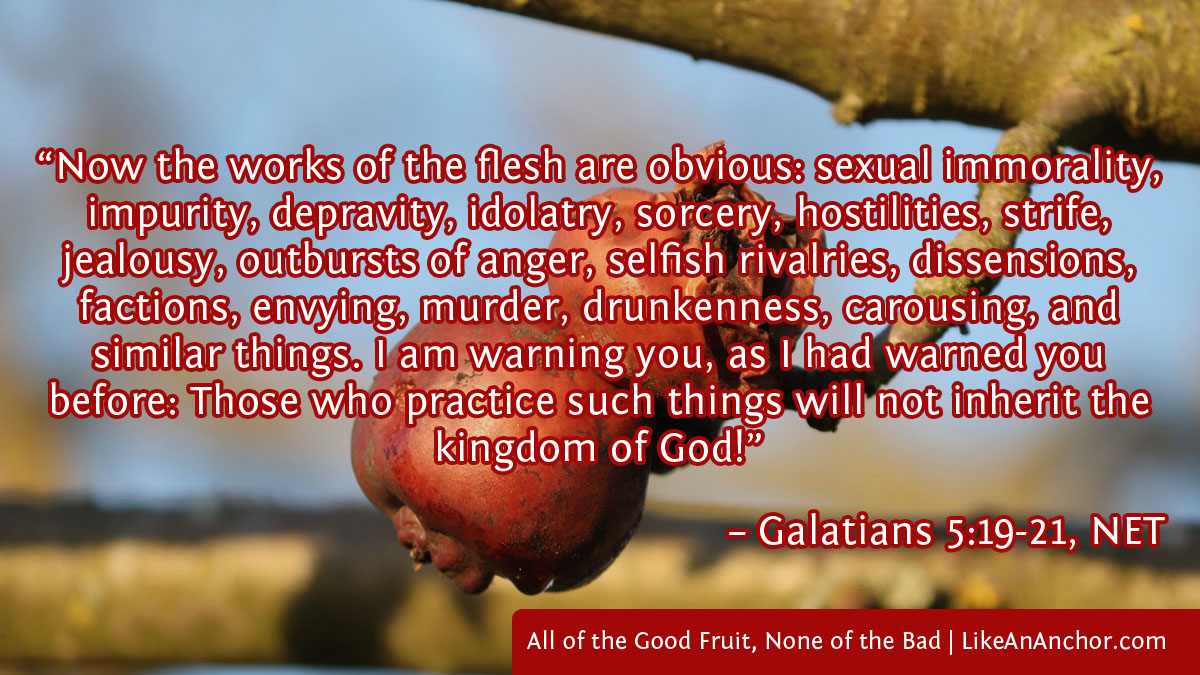
Now the works of the flesh are obvious: sexual immorality, impurity, depravity, idolatry, sorcery, hostilities, strife, jealousy, outbursts of anger, selfish rivalries, dissensions, factions, envying, murder, drunkenness, carousing, and similar things. I am warning you, as I had warned you before: Those who practice such things will not inherit the kingdom of God!

Galatians 5:19-21, NET

This isn’t a complete list (Paul has similar ones in other letters, like 1 Cor 6:9-11; Eph. 5:1-6; Col. 3:1-10), but the message is clear. If we continue to do things that God defines as sinful or unrighteous we will not inherit as His children or be in His kingdom. That’s one of the reasons it’s still important for us to know about God’s law; His law defines sin and acts as a tutor or guardian pointing to Christ (Rom. 3:20; Gal. 3:24).

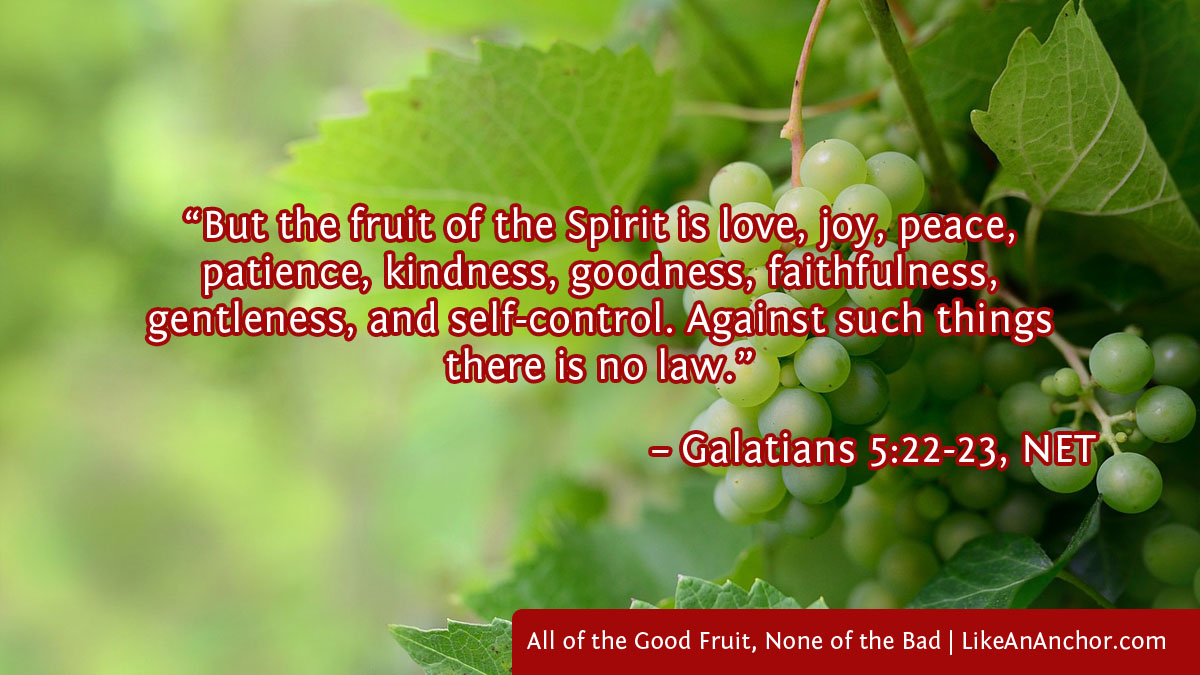
Image of green grapes overlaid with text from Gal. 5:22-23 version: "But the fruit of the Spirit is love, joy, peace, patience, kindness, goodness, faithfulness, gentleness, and self-control. Against such things there is no law. "
Image by congerdesign from Pixabay

Live In The Spirit

Cleaning things God hates out of our lives is an important part of our relationship with Him. It’s not the most important part, though. First, Jesus is the one who initially washes us clean; only believing in Him, repenting of our sins, and accepting His sacrifice can make us clean. Then, we’re called to participate in His ongoing work in us. We’re supposed to keep examining ourselves, putting away bad things, and putting in good things as we become more and more like Him. If we don’t take any action, then we’re like the person Jesus warned about in this analogy:

“When an unclean spirit goes out of a person, it passes through waterless places looking for rest but does not find it. Then it says, ‘I will return to the home I left.’ When it returns, it finds the house empty, swept clean, and put in order. Then it goes and brings with it seven other spirits more evil than itself, and they go in and live there, so the last state of that person is worse than the first. It will be that way for this evil generation as well!”

Matthew 12:43-45, NET

If you remove something evil from your life and don’t replace it with something good, then there’s a chance something worse is going to move in. It’s like if you give up eating candy so you can be healthier, but don’t add any good eating habits, then take up smoking on top of going back to eating tons of sugar. Except in this case, we’re taking out works of the flesh and we’re supposed to replace them with fruit of the spirit. If we try to take out something like “outbursts of anger” without putting in things like love, peace, and patience then the anger isn’t going to stay gone and might get worse.

But the fruit of the Spirit is love, joy, peace, patience, kindness, goodness, faithfulness, gentleness, and self-control. Against such things there is no law. Now those who belong to Christ have crucified the flesh with its passions and desires. If we live by the Spirit, let us also behave in accordance with the Spirit. 

Galatians 5:22-25, NET

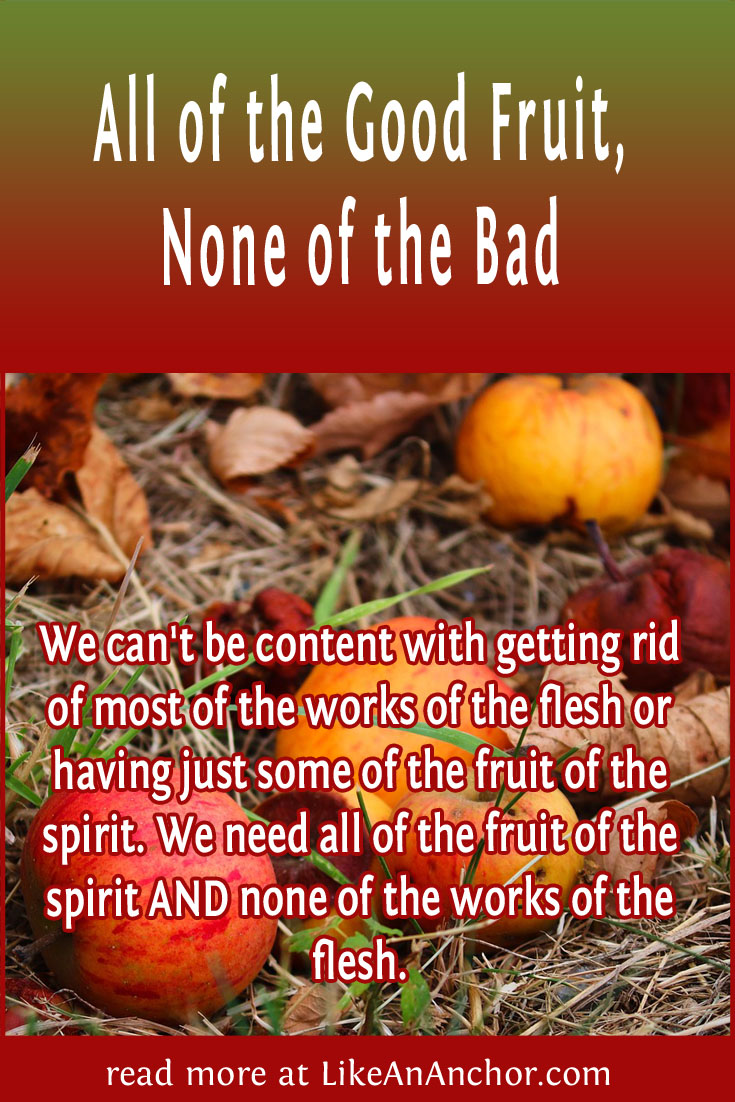
We need to have all of the fruit of the spirit AND none of the works of the flesh. It’ll be a life-long process, but that’s the goal. We can’t be content with getting rid of most of the works of the flesh or having just some of the fruit of the spirit. God’s people shouldn’t look at themselves, shrug their shoulders and think, “Eh, guess I’m good enough now” (Rom. 11:18-21; 1 Cor. 8:2; 10:12). We need to stay faithful, keep learning, humble ourselves and repent as needed, and ask God to guide our growth.

Helping Each Other

If we just stopped at the end of chapter 5, we might think that removing the works of the flesh and putting on the fruit of the spirit is just an individual, private thing. In some ways it is: we’re each responsible for ourselves and we’re the ones who will answer to God for what we did with the gifts He gives us and the work He does in us. But at the same time, we’re also responsible for how we interact with other people. Christians are not called to isolated, individual walks. God calls us into a family, a collective body of believers who are meant to support each other.

Brothers and sisters, if a person is discovered in some sin, you who are spiritual restore such a person in a spirit of gentleness. Pay close attention to yourselves, so that you are not tempted too. Carry one another’s burdens, and in this way you will fulfill the law of Christ. For if anyone thinks he is something when he is nothing, he deceives himself. Let each one examine his own work. Then he can take pride in himself and not compare himself with someone else. For each one will carry his own load.

Galatians 6:1-5, NET

We’re supposed to help each other put away the works of the flesh and cultivate the fruit of the spirit. Notice that Paul doesn’t say “judge,” “condemn,” or even “correct.” He says to “restore” this person. The Greek word is katartizo, and it means to mend something that’s broken or “to strengthen, perfect, complete, make one what he ought to be” (Thayer’s Dictionary entry G2675). Sometimes, we’ll be the one in need of mending who needs help from other believers. Other times, we’ll be “carrying our own load” well enough that we can be the one who helps another.

Now the one who receives instruction in the word must share all good things with the one who teaches it. Do not be deceived. God will not be made a fool. For a person will reap what he sows, because the person who sows to his own flesh will reap corruption from the flesh, but the one who sows to the Spirit will reap eternal life from the Spirit. So we must not grow weary in doing good, for in due time we will reap, if we do not give up. So then, whenever we have an opportunity, let us do good to all people, and especially to those who belong to the family of faith.

Galatians 6:6-10, NET

The sowing and reaping analogy fits so well with calling godly characteristics “fruit of the spirit.” Right before His crucifixion, Jesus told His disciples that He chose them to bear fruit, that their fruitfulness honors the Father, and that it shows they are genuine followers of God (John 15:8, 16). Our connection with Jesus should be a fruitful one. If we invest or “sow” into the life of the spirit–our life following Jesus and becoming like Him and Our Father–then we’ll produce good fruit to replace the works of the flesh that He’s working with us to remove from our lives.


Featured image by Manfred Richter from Pixabay

Song Recommendation: “I Am New” by Jason Gray

When God Does (and Doesn’t) Share His Glory

Almost two weeks ago, I was reading my devotional for this year when the author, Chris Tiegreen, made a point that I’d never thought about before. He pointed out that God once said He doesn’t share His glory with others, but He does share His glory with His children (The One Year Hearing His Voice Devotional, June 17). In the first case, God is being zealous for His reputation and relationship with His people, refusing to share the glory due to Him as Yahweh with idols or anything else. But in the second case, He’s inviting people to become part of His family and share in the glory that belongs to Him.

It’s really an amazing thought. Our God is great and powerful, almighty and sovereign. He has absolute and ultimate authority that no one else can check. He’s truly glorious and inherently holy. It’s incredible that He pays attention to us at all, let alone that He invites us to become part of His family and wants to make us like Him.

Image of a man sitting on a beach watching the sunset overlaid with text from 2 Cor. 3:18 version: “But we all, with unveiled face seeing the glory of the Lord as in a mirror, are transformed into the same image from glory to glory, even as from the Lord, the Spirit.”
Image by Aaron Kitzo from Lightstock

Our Jealous God

There are two places, both in Isaiah, where God specifically says “I will not share my glory” or “I will not give my glory to” anyone else (phrasing depends on translation). Let’s take a look at those; they’re both part of the final section of Isaiah, which we studied extensively here on this blog a couple years ago.

“I am Yahweh.
    That is my name.
    I will not give my glory to another,
    nor my praise to engraved images.

Isaiah 42:8, WEB

For my sake alone I will act,
for how can I allow my name to be defiled?
I will not share my glory with anyone else!

Isaiah 48:11, NET

Notice the emphasis God places on His name. In Hebrew thought, names are linked with reputation. God cares about how people see His name; it should be regarded as holy. He won’t allow people to defile His name, and He doesn’t share His glory with anyone else. I think this links back to some of God’s warnings in Exodus. When He made a covenant with ancient Israel, He made sure to let them know that He would not tolerate them worshiping other gods. It’s right there at the beginning of the 10 commandments.

 God spoke all these words, saying, “I am Yahweh your God, who brought you out of the land of Egypt, out of the house of bondage.

“You shall have no other gods before me.

“You shall not make for yourselves an idol, nor any image of anything that is in the heavens above, or that is in the earth beneath, or that is in the water under the earth: you shall not bow yourself down to them, nor serve them, for I, Yahweh your God, am a jealous God

Exodus 20:1-5, WEB

Later in Exodus, God reinforces this command. He warns Israel not to make covenant relationships with the other nations in the promised land and to destroy all their altars, places of worship, and idols because “you shall worship no other god; for Yahweh, whose name is Jealous, is a jealous God” (Ex. 34:14, WEB). We often think of jealousy as bad, but God feels it as a right and proper emotion. His jealousy is “zeal for one’s own property” or spouse (Theological Wordbook of the Old Testament, entry 2038). Just like a husband or wife doesn’t want to share their spouse with someone else, God doesn’t want to share His people with another god or anything else they might prioritize above Him.

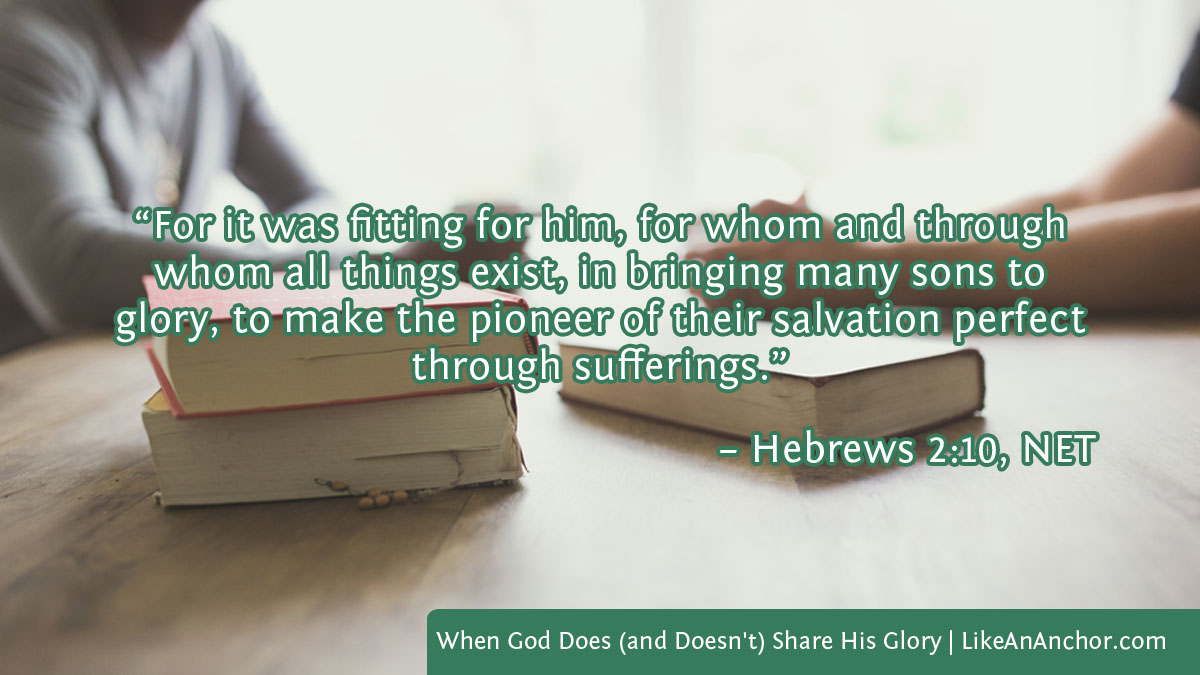
Image of two men sitting across a table from each other with books on the table overlaid with text from Heb. 2:10, NET version: “For it was fitting for him, for whom and through whom all things exist, in bringing many sons to glory, to make the pioneer of their salvation perfect through sufferings.”
Image by Claudine Chaussé from Lightstock

Shared, Familial Glory

In the New Testament, most of the time when “glory” is mentioned, it’s in the context of glorifying God or acknowledging the glory of Jesus Christ. That’s no surprise–they’re the ones who deserve glory, and if we see them correctly we’ll know to glorify Them rather than something or someone else. What’s surprising is that there are moments when God chooses to share His glory.

“I am not praying only on their behalf, but also on behalf of those who believe in me through their testimony, that they will all be one, just as you, Father, are in me and I am in you. I pray that they will be in us, so that the world will believe that you sent me. The glory you gave to me I have given to them, that they may be one just as we are one—I in them and you in me—that they may be completely one, so that the world will know that you sent me, and you have loved them just as you have loved me.”

John 17:20-23, NET

There’s so much just in this little section of Jesus’s prayer before His death that should make our jaws drop. He prayed for us, looking ahead to think of all the people who would believe in Him because of what His disciples would teach. He prayed for oneness between us and Him and the Father–that we’d actually get to share in the same relationship They have with each other. He says He gives glory to them–all those who believe in Him–just like the Father gave Him glory. He even says that the Father loves us the same way He loves Jesus.

This should blow our minds. Our jealous God, zealous to guard the glory of His name and keep an exclusive relationship with His people, decided to share His glory in a very specific way. Even though all human beings “have sinned and fall short of the glory of God” (Rom. 3:23, NET), He’s inviting people to join Him in His family and thereby receive His glory. It’s not like we’re earning glory on our own; we get to have glory because He is glorious and He’s making us like Him.

Called To A Glorious Future

Image of two girls studying a Bible, overlaid with blog's title text and the words, "God doesn't share His glory with just anyone, but He wants to share it with us. He won't tolerate rival deities, but He's making us part of His family."
Image by Ryan Klintworth from Lightstock

God called us for a purpose. He wants to grow His family. That’s been His plan from the beginning: to make more god-beings who will be the Father’s children, Jesus’s younger (adopted) brothers and sisters, and who will make up Jesus’s bride. In other words, He wants to share His glory by making us like Him (2 Thess. 2:13-14; Heb. 2:9-10; 1 Pet. 5:10-11).

As you know, we treated each one of you as a father treats his own children, exhorting and encouraging you and insisting that you live in a way worthy of God who calls you to his own kingdom and his glory.

1 Thessalonians 2:11-12, NET

We’ve been called to glory now, but it’s not fully shared with us yet. That’s happening in the future, just like we are already the children of God but we’re still waiting to see exactly what it means that we will be like God (1 John 3:1-2).

But our citizenship is in heaven—and we also eagerly await a savior from there, the Lord Jesus Christ, who will transform these humble bodies of ours into the likeness of his glorious body by means of that power by which he is able to subject all things to himself.

Philippians 3:20-21, NET

In the future, after Jesus’s return, we’ll be transformed into glory (Rom. 8:18-21; 1 Cor. 15:41-43; 2 Cor. 3:18). It’s one of the blessings associated with the promise of eternal life. God doesn’t share His glory with just anyone, but He wants to share it with us. He won’t tolerate rival deities, but He’s making us like Him as part of His family.

Reading that God won’t share His glory with others, but that He does share His glory with us, reinforces the high value God places on His people. It also helps us understand our relationship to Him. It’s not just that He likes us the way we like our pets. He’s literally making us part of His family, meaning we get to share in the things that are part of His family including His glory.


Featured image by Pearl from Lightstock

Song Recommendation: “Glorious” by Ted Pearce

May Your Kingdom Come

When I wrote about the phrase “hallowed be your name” at the beginning of Jesus’s model prayer (also known as the Lord’s Prayer), I hadn’t intended to write any follow up posts. But I recently found myself pondering the next phrase in that prayer: “may your kingdom come,” and I wanted to study that more deeply as well.

I notice that when I pray, I tend to add a sentiment like “your kingdom come, your will be done” at the end of my prayers. I don’t think this is unusual. I remember reading a book about prayer where the author said he does the same thing, feeling it makes a better summation than an opening idea. Still, Jesus put this phrase at the beginning of His model prayer. We don’t have to follow that model exactly (it’s a guide and outline rather than a prayer to just repeat word-for-word all the time), but I have to think there’s a reason He organized the model prayer the way that He did.

Image of a woman with her hands lifted in praise overlaid with text from Heb. 12:28, NET version: "So since we are receiving an unshakable kingdom, let us give thanks, and through this let us offer worship pleasing to God in devotion and awe."
Image by Pearl from Lightstock

Prioritizing the Kingdom

Two gospels record the model prayer. In Matthew, Jesus gives this outline as part of the Sermon on the Mount when He’s talking about good and bad examples for how to pray (Matt. 6:5-15). In Luke, He uses this prayer to respond to a disciple’s request that Jesus teach them to pray (Luke 11:1-13). Both versions are about the same, though Luke’s is a little shorter depending on the translation (it seems that later manuscripts borrowed from Matthew’s gospel to expand the prayer in Luke’s [NET footnotes on Luke 11:2, 4). Let’s look at the version recorded by Matthew.

So pray this way:
Our Father in heaven, may your name be honored,
may your kingdom come,
may your will be done on earth as it is in heaven.
Give us today our daily bread,
and forgive us our debts, as we ourselves have forgiven our debtors.
And do not lead us into temptation, but deliver us from the evil one

Matthew 6:9-13, NET

We begin by addressing “our Father in heaven.” It’s an intimate, relational way to speak to the one true God. Also, by saying “our” instead of “my,” we’re reminded that He’s the Father of a whole family that we’re part of. “May your name be honored” continues properly aligning how we view and approach God. We should regard Him as holy, and we should also pray that others come to the same realization.

Then, Jesus says, “may your kingdom come.” It’s the first thing He prays for after acknowledging God’s holiness. I wonder if He prioritizes this part of the prayer for the same reason that He counsels us to prioritize God’s kingdom just a little later in this Sermon on the Mount.

So then, don’t worry saying, ‘What will we eat?’ or ‘What will we drink?’ or ‘What will we wear?’ For the unconverted pursue these things, and your heavenly Father knows that you need them. But above all pursue his kingdom and righteousness, and all these things will be given to you as well. So then, do not worry about tomorrow, for tomorrow will worry about itself. Today has enough trouble of its own.

Matthew 6:31-34, NET

We shouldn’t get preoccupied by worry about physical things. God already knows that we need them and we can trust Him to take care of us. More of our focus should be on pursuing His kingdom and righteousness. Other translations often use the phrase “seek first” (Matt. 6:33, WEB). If we arrange our prayers so all of our requests for ourselves crowd into the first part of the prayer and then tack on “your kingdom come” at the end, maybe that’s a sign that we’ve gotten into the habit of prioritizing something other than His kingdom and righteousness.

Image of a man reading the Bible overlaid with text from Matt. 7:21, NET version: "Not everyone who says to me, ‘Lord, Lord,’ will enter into the kingdom of heaven—only the one who does the will of my Father in heaven.”
Image by Matt Vasquez from Lightstock

What Is the Kingdom?

What does it mean to “seek first” or “pursue” God’s kingdom? To answer that, we first need to understand what His kingdom is. Jesus spoke often about the kingdom in the gospels (especially as recorded by Matthew and Luke). At the beginning of His public ministry, “Jesus began to preach this message: ‘Repent, for the kingdom of heaven is near!'” (Matt. 4:17, NET). He came here to preach the good news about God’s kingdom (Matt. 4:23; 9:35; Luke 4:42-44; 8:1). The kingdom of heaven, or God’s kingdom, is a central part of the gospel message.

The kingdom of God is both a future thing and a present reality. It’s where we’re heading, and it’s also our homeland right now. For example, John’s opening salutation in Revelation says Jesus has already “appointed us as a kingdom, as priests serving his God and Father” (Rev. 1:6, NET). But we’re also still waiting on the future time when the seventh angel will sound his trumpet and voices proclaim, “The kingdom of the world has become the kingdom of our Lord and of his Christ, and he will reign for ever and ever” (Rev. 11:15, NET). When we entered into a covenant relationship with God, we placed ourselves under His authority and became citizens of the kingdom of heaven (Phil. 3:20) even though that kingdom isn’t physically present on earth yet.

giving thanks to the Father who has qualified you to share in the saints’ inheritance in the light. He delivered us from the power of darkness and transferred us to the kingdom of the Son he loves, in whom we have redemption, the forgiveness of sins.

Colossians 1:12-14, NET

The kingdom of God is where God rules and where His people belong. Right now, it’s growing in the world in little pockets. It’s like yeast kneaded in flour, grain sowed in a field, or hidden treasure (Matt. 13:23-51). In certain senses, the kingdom is already here among us. It “came near” when Jesus or His followers arrived in a city to preach the good news and heal the sick. At one point, Jesus even said “the kingdom of God is in your midst” (Luke 10:9-11; 11:19-20; 17:20-21). But at the same time, He had to correct people who “supposed that God’s Kingdom would be revealed immediately” (Luke 19:11, NET; see Luke 19:9-28). The kingdom was there in Jesus, it’s here now in His people, but Jesus hasn’t yet visibly taken up the authority God the Father has given Him to directly rule the entire world.

We’re still waiting on the full realization of the promise that Jesus “will be great, and will be called the Son of the Most High, and the Lord God will give him the throne of his father David. He will reign over the house of Jacob forever, and his kingdom will never end” (Luke 1:32-33, NET). Most of that has already happened. We’re just waiting for His kingdom to fully arrive here on this earth (Luke 21:5-36; 1 Cor. 15:20-28). When we pray, “may your kingdom come,” we’re looking forward to that time.

Keep On-Track Toward the Kingdom

Image of a man reading a Bible, overlaid with blog's title text and the words, "Praying, "may your kingdom come,"  helps put our lives into perspective and focuses us on our goal."
Image by Anggie from Lightstock

In the future, Jesus will come, separate out the kingdom-people, and settle accounts with them (Matt. 18:23-35; 20:1-16; 25:1-46). He’s hoping to pass good judgement and welcome them fully into His kingdom, but there are also warnings. You don’t get into the kingdom of God at the end of the age unless you’re doing God’s will, living righteously, and producing good fruit (Matt. 5:18-20; 7:21; 18:1-3; 21:43-22:14). In other words, as Paul says, those practicing unrighteous things have no inheritance in the kingdom (1 Cor. 6:9-10; Gal. 5:19-21; Eph. 5:5). The warnings are to motivate us out of complacency so that we actually live the lives that God called us to live, not to terrify us.

“Do not be afraid, little flock, for your Father is well pleased to give you the kingdom. Sell your possessions and give to the poor. Provide yourselves purses that do not wear out—a treasure in heaven that never decreases, where no thief approaches and no moth destroys. For where your treasure is, there your heart will be also.”

Luke 12:32-34, NET

God chose us out of this world and made us “heirs of the kingdom that he promised to those who love him” (Jas. 2:5, NET). That has already happened. We could choose to leave that kingdom, but God is highly invested in making sure we stay part of His family. His kingdom is unshakable (Heb. 12:28) and He can bring us “safely into His heavenly kingdom” (2 Tim. 4:18, NET). We just need to do our part to “live in a way worthy of God who calls you to his own kingdom and his glory” (1 Thess. 2:12, NET).

 Therefore, brothers and sisters, make every effort to be sure of your calling and election. For by doing this you will never stumble into sin. For thus an entrance into the eternal kingdom of our Lord and Savior, Jesus Christ, will be richly provided for you.

2 Peter 1:10-11, NET

By praying, “may your kingdom come,” we remind ourselves of our goal. It helps put our lives into perspective to remember that we belong in God’s kingdom and, because we’re under His authority, we’re supposed to live a certain way. It also helps us remember not to get bogged down in the day-to-day stuff, and instead remember that we’re part of something bigger and longer-lasting than this present world.


Featured image by Prixel Creative from Lightstock