Wisdom for A Reason

A couple weeks ago while listening to a sermon, I noticed something about Solomon’s request for wisdom that I’d never realized before. It’s a familiar story: King David’s son Solomon became king in his father’s place, and God came to him in a dream. God told Solomon to ask something of Him, and Solomon asked for wisdom (1 Kings 3).

In Gibeon, Yahweh appeared to Solomon in a dream by night; and God said, “Ask for what I should give you.”

Solomon said, “You have shown to your servant David my father great loving kindness, because he walked before you in truth, in righteousness, and in uprightness of heart with you. You have kept for him this great loving kindness, that you have given him a son to sit on his throne, as it is today. Now, Yahweh my God, you have made your servant king instead of David my father. I am just a little child. I don’t know how to go out or come in. Your servant is among your people which you have chosen, a great people, that can’t be numbered or counted for multitude. Give your servant therefore an understanding heart to judge your people, that I may discern between good and evil; for who is able to judge this great people of yours?”

This request pleased the Lord, that Solomon had asked this thing. God said to him, “Because you have asked this thing, and have not asked for yourself long life, nor have you asked for riches for yourself, nor have you asked for the life of your enemies, but have asked for yourself understanding to discern justice, behold, I have done according to your word. Behold, I have given you a wise and understanding heart, so that there has been no one like you before you, and after you none will arise like you. I have also given you that which you have not asked, both riches and honor, so that there will not be any among the kings like you for all your days. If you will walk in my ways, to keep my statutes and my commandments, as your father David walked, then I will lengthen your days.”

1 Kings 3:5-14, WEB

The part of this story that I hadn’t paid attention to before is why Solomon asked for wisdom. It wasn’t to be the smartest person in the room or so he’d have an advantage in making political decisions. He asked for wisdom so that he could properly judge God’s people; Solomon wanted to govern with justice.
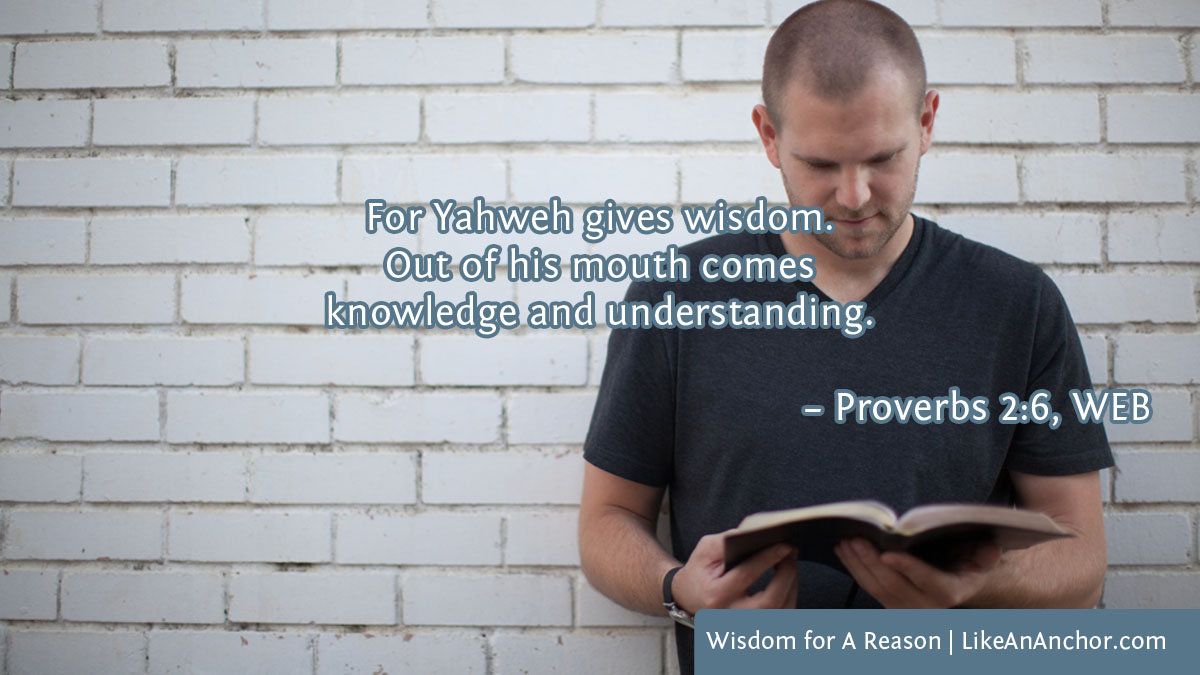
Image of a man reading a Bible overlaid with text from Proverbs 2:6, WEB version: "For Yahweh gives wisdom. Out of his mouth comes knowledge and understanding."
Image by Anggie from Lightstock

Justice, Judgement, and Governance

In the English language, judgement, government, and justice are separate things. We hope they’re connected, but we don’t see the judicial system or people who govern/rule as inseparably about justice. In Hebrew, though, it’s the same word. The root word shapat (which is used in 1 Kings 3:9, 28) means “to exercise [all] the processes of government” (Theological Wordbook of the Old Testament [TWOT], entry 2443). Ancient understanding didn’t really separate what we think of as different branches of government nor did they separate the law from the lawgiver: “the centering of law, rulership, government in a man was deeply ingrained” (TWOT 2443). This makes perfect sense when we think of God as the Lawgiver and Ruler. The Bible treats His Law as an extension of His character, and a good king of Israel was expected to act as God’s representative in upholding divine law.

The derivative word mishpat (used in 1 Kings 3:11, 28) has “at least thirteen related, but distinct, aspects of the central idea, which if to be rendered by a single English word with similar range of meaning ought by all means to be the word ‘justice’” (TWOT 2443c). These 13 meanings include “the act of deciding a case of litigation,” “a sentence or decision issuing from a magistrate’s court,” “an ordinance of law,” “one’s right under law,” and “sovereignty, the legal foundation of government in the sense of ultimate authority or right.” We get to see Solomon use his gift of wise judgement immediately, as the next thing recorded in this narrative is the story of the two mothers arguing over one living child. Both claim to be the baby’s mother and that a child who died belonged to the other. Solomon wisely figured out who the real mother was without even needing to conduct an investigation.

All Israel heard of the judgment (mishpat) which the king had judged (shaphat); and they feared the king, for they saw that the wisdom of God was in him to do justice (mishpat).

1 Kings 3:28, NET

Solomon’s wisdom wasn’t confined to judicial matters or government–God’s blessing exceeded Solomon’s initial request (1 Kings 4:229-34)–but that was the central reason he gave for requesting wisdom. It seems from the way that Solomon talked about his new responsibilities that he was worried he wouldn’t be able to govern as well as he ought, and he asked for supernatural help to discern and do justice. There was a purpose behind his request, and it was related to the role he was meant to fill in ruling and serving God’s people.
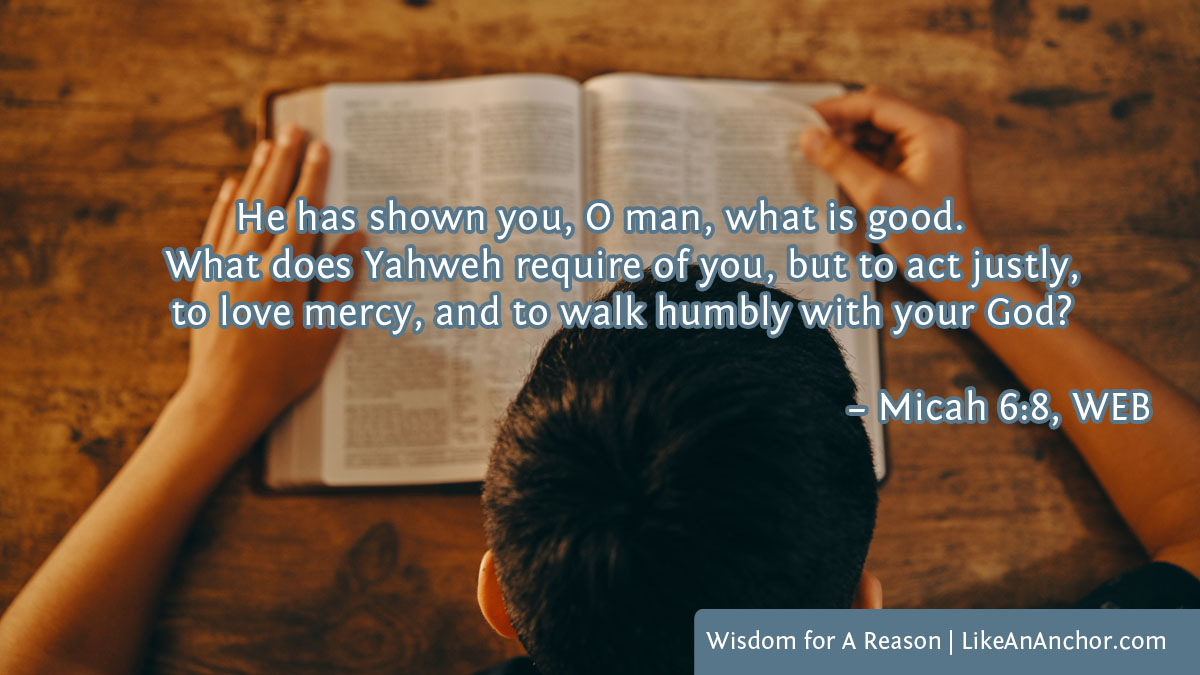
Image of a man reading the Bible overlaid with text from Micah 6:8, WEB version: "He has shown you, O man, what is good. What does Yahweh require of you, but to act justly, to love mercy, and to walk humbly with your God?"
Image by Matt Vasquez from Lightstock

Next-Level Justice and Love

As I pondered Solomon’s reason for asking God to give him wisdom, it made me think of what Paul told the Corinthians about wisdom and knowledge. In the opening part of 1 Corinthians, Paul made a distinction between wisdom as the world defines it and wisdom that God gives through His holy spirit. Earthly wisdom can get in the way of us following God–we get so impressed with what we know and how we wisely apply our knowledge that it’s hard for us to realize how much we need God and how little our own talents impress Him (Jer. 9:23-24; 1 Cor. 1:26-31). It took Solomon a long time to realize this, even with his wisdom being a gift from God (Ecc. 12:9-14).

The wisdom that Paul talked about is “not a wisdom of this age or of the rulers of this age, who are perishing. Instead we speak the wisdom of God, hidden in a mystery, that God determined before the ages for our glory” (1 Cor. 2:6-7, NET). It’s a different sort–or maybe a different level–of wisdom than Solomon had. This fits into a larger pattern in the New Testament of Jesus taking things from God’s Old Covenant interactions with people to a higher, deeper, more spiritual level.

We see good examples of this in the Sermon on the Mount, [where He mentions a law (e.g “You have heard that it was said, ‘Do not commit adultery’ [Matt. 5:27, NET]) and then shares the New Covenant application (e.g. “But I say to you that whoever looks at a woman to desire her has already committed adultery with her in his heart” [Matt. 5:28, NET]). He goes through this pattern several times, revealing that God expects more of us under the New Covenant because we’re to keep the spirit and intent of the law, not just the letter.

There is one law that seems like an outlier to this pattern. In the past, God’s law let you exact equal retribution for a crime (e.g. “An eye for an eye and a tooth for a tooth” (Ex. 21:24; Lev. 24:20; Matt. 5:38). Jesus doesn’t say to be more extreme with this law, but rather “do not resist the evildoer” (Matt. 5:39, NET). It might not seem like a logical escalation to us, but when God takes justice to the next level, it turns into mercy, long-suffering, peace, and love (Matt. 5:38-48).

Heading
Image of a woman reading the Bible, overlaid with blog's title text and the words, "When we ask God for wisdom and knowledge,  we should remember why He gives these sorts of gifts and know how He wants them to be used."
Image by Pearl from Lightstock

Wisdom by itself doesn’t do much for us. There has to be a purpose behind it, and it has to be the right kind of wisdom (i.e. “wise in what is good and innocent in what is evil” [Rom. 16:19, NET]). In 1 Corinthians, Paul discussed both wisdom and knowledge (which aren’t the same thing, but are connected). This church had several issues they needed to work through, including a mistaken idea that they had all the answers.

 With regard to food sacrificed to idols, we know that “we all have knowledge.” Knowledge puffs up, but love builds up. If someone thinks he knows something, he does not yet know to the degree that he needs to know.

1 Corinthians 8:1-2, NET

Having knowledge isn’t a problem in itself; we’re actually supposed to have some types of knowledge (1 Cor. 12:8; 14:6; 15:34). But no matter how much we know, we still have incomplete knowledge and a limited perspective compared to God. Also, not everyone has the same understanding, and there are times that acting on your knowledge–even if you’re right–can undermine someone else’s faith (1 Cor. 8:4-13). If you’re using your knowledge to increase your pride or hurt other people, then it’s worse than useless.

And if I have prophecy, and know all mysteries and all knowledge, and if I have all faith so that I can remove mountains, but do not have love, I am nothing. 

1 Corinthians 13:2, NET

Wisdom is often defined as using knowledge in the right way. I think there’s a connection here between Solomon’s wisdom to do justice and Paul’s teaching that knowledge is useless without love. Just like there was a reason behind the wisdom Solomon asked for, so there should be a driving factor behind our use of knowledge as well. Without love (a central aspect of God’s character and law [Rom. 13:10; Gal. 5:14; 1 John 4:8, 16]), intellectual gifts are pointless.

Solomon spent a lot of time in Ecclesiastes bemoaning how empty his life felt even with so much wisdom. He ultimately came to the conclusion that wisdom is definitely better than folly, but that the most important thing is to “Fear God, and keep his commandments; for this is the whole duty of man” (Ecc. 12:13, WEB). When we ask God for wisdom, knowledge, and understanding (which He will give us if we ask [James 1:5]), we should remember why He gives these sorts of gifts–so that we can follow His example and develop His character in us, including His love and justice.

He has told you, O man, what is good,
and what the Lord really wants from you:
He wants you to carry out justice, to love faithfulness,
and to live obediently before your God.

Micah 6:8, NET

Featured image by Pearl from Lightstock

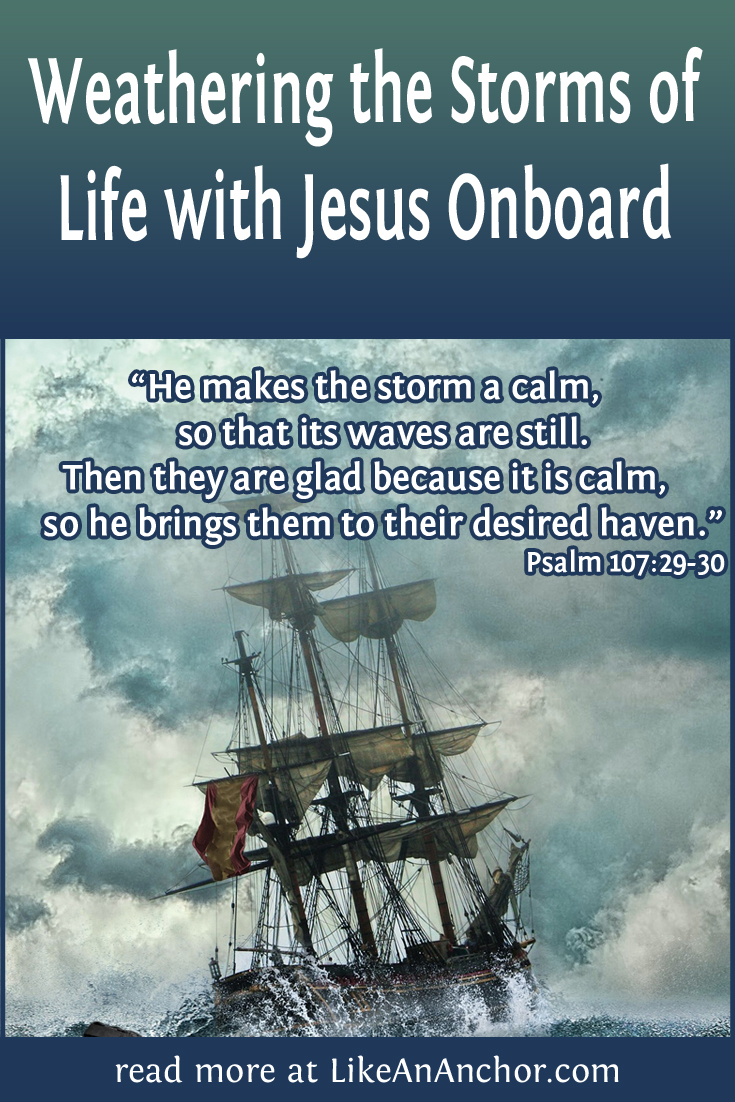
Weathering the Storms of Life with Jesus Onboard

As I’ve studied “big questions” over the past couple of weeks, one in particular stuck in my mind. It’s a question the disciples asked Jesus during a big storm while they were crossing the Sea of Galilee in boat.

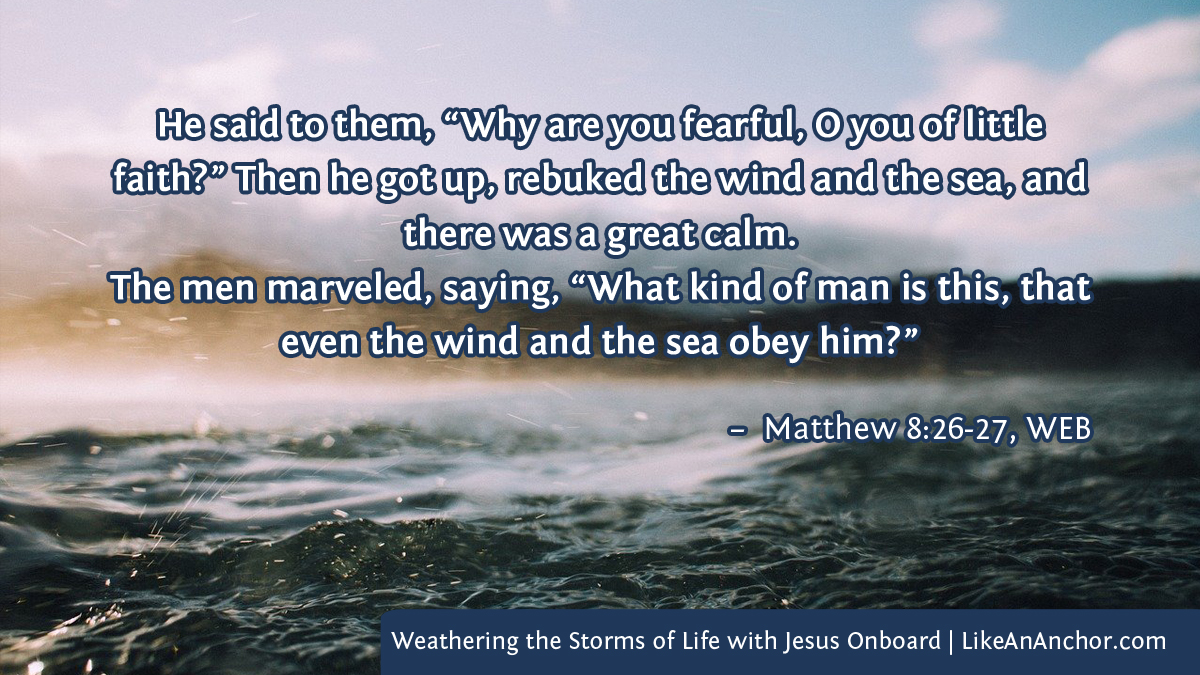
Now a great windstorm developed and the waves were breaking into the boat, so that the boat was nearly swamped. But he was in the stern, sleeping on a cushion. They woke him up and said to him, “Teacher, don’t you care that we are about to die?” So he got up and rebuked the wind, and said to the sea, “Be quiet! Calm down!” Then the wind stopped, and it was dead calm. And he said to them, “Why are you cowardly? Do you still not have faith?” They were overwhelmed by fear and said to one another, “Who then is this? Even the wind and sea obey him!”

Mark 4:35-41, NET

There are a few questions in this story. The disciples ask Jesus, “Don’t you care that we are all about to die?” I’m not sure they even expected Him to do anything other than wake up and reassure them. But then He calmed the storm, and had questions for them. He asked, “Why are you cowardly? Do you still not have faith?” From His perspective, there’d never been anything to worry about. That the disciples were worried showed they didn’t yet fully trust in Him or His power. Then the final question is one the disciples asked among themselves: “Who then is this?” Typical rabbis could not order a storm to stop and have it obey. This teacher they were following was clearly different than the usual prophets or rabbis.

Image by Pexels from Pixabay

Commander and Creator

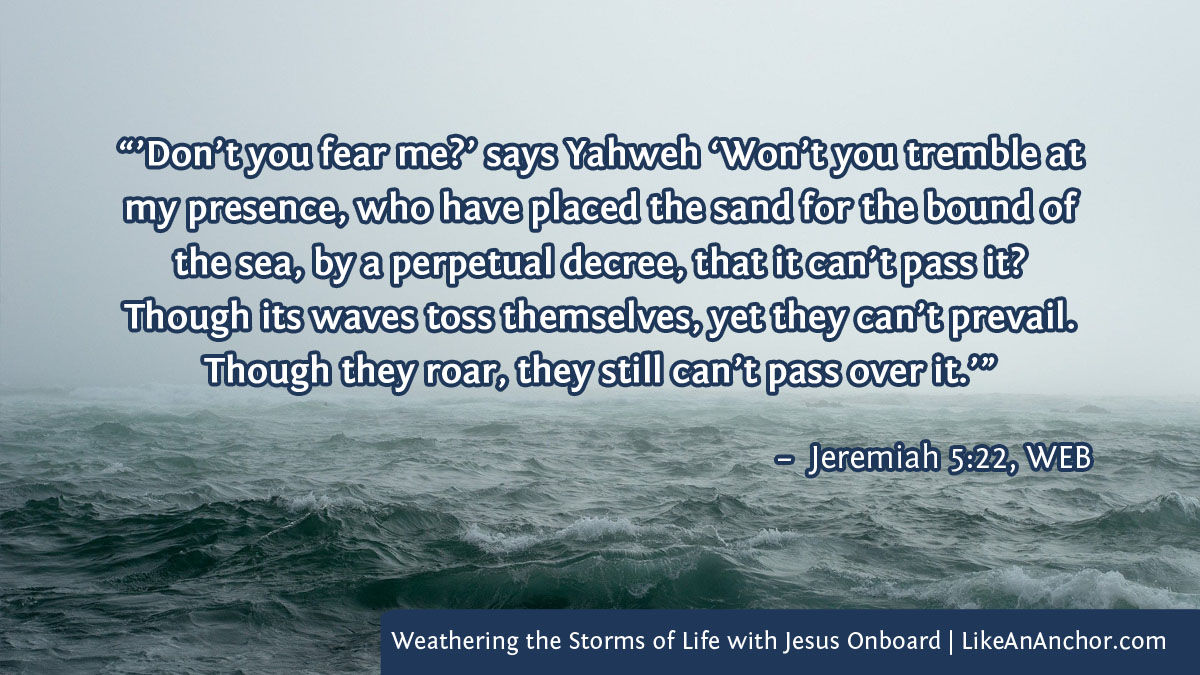
The Jews of Jesus’s day, including His disciples, were typically very familiar with the words of the Old Testament. Some of those words likely came to mind during this storm and miracle. In Job, God describes Himself as the one who “laid the foundations of the earth,” “shut up the sea with doors,” and “made clouds its garment” (Job 38:1-11). Psalms describe Him as the one who “walks on the wings of the wind” and “makes lightnings with the rain” (Psalms 104:3; 135:7). In the prophets, He’s the one who keeps the sea and its waves in check, causes the waves to “stir up and roar,” and “makes storm clouds” (Jer. 5:22; 31:35; Zech, 10:1). Perhaps the scripture most likely to come to the disciples’ minds, though, is in Psalms.

Those who go down to the sea in ships,
who do business in great waters;
These see Yahweh’s deeds,
and his wonders in the deep.
For he commands, and raises the stormy wind,
which lifts up its waves.
They mount up to the sky; they go down again to the depths.
Their soul melts away because of trouble.
They reel back and forth, and stagger like a drunken man,
and are at their wits’ end.
Then they cry to Yahweh in their trouble,
and he brings them out of their distress.
He makes the storm a calm,
so that its waves are still.

Psalm 107:23-29, WEB

No wonder Jesus’s disciples were “overwhelmed by fear” even after He proved they weren’t going to die in a storm. He’d just done something only Yahweh could do. By calming the sea, Jesus illustrated He was God here on earth in the flesh.

Image by Pexels from Pixabay

Storm-Maker and Anchor

In scripture, waves and storms are used as metaphors for great trials. God’s anger and judgement on persistently sinful people are linked to storms (Is. 28:2; 29:6; 30:30; Jer. 23:19; 30:23; Ezk. 30:3; Joel 2:2; Nah. 1:3). David speaks of being surrounded by “waves of death” and “floods of ungodliness” (2 Sam. 22:5; Ps. 18:4). Both David (figuratively for despair and possibly depression) and Johan (in a more literal sense) talk about being in the depths of the sea with “waves and billows” passing over them (Ps. 42:7; Jon. 2:3). In all these verses, the storms are representative of great trials or hardships.

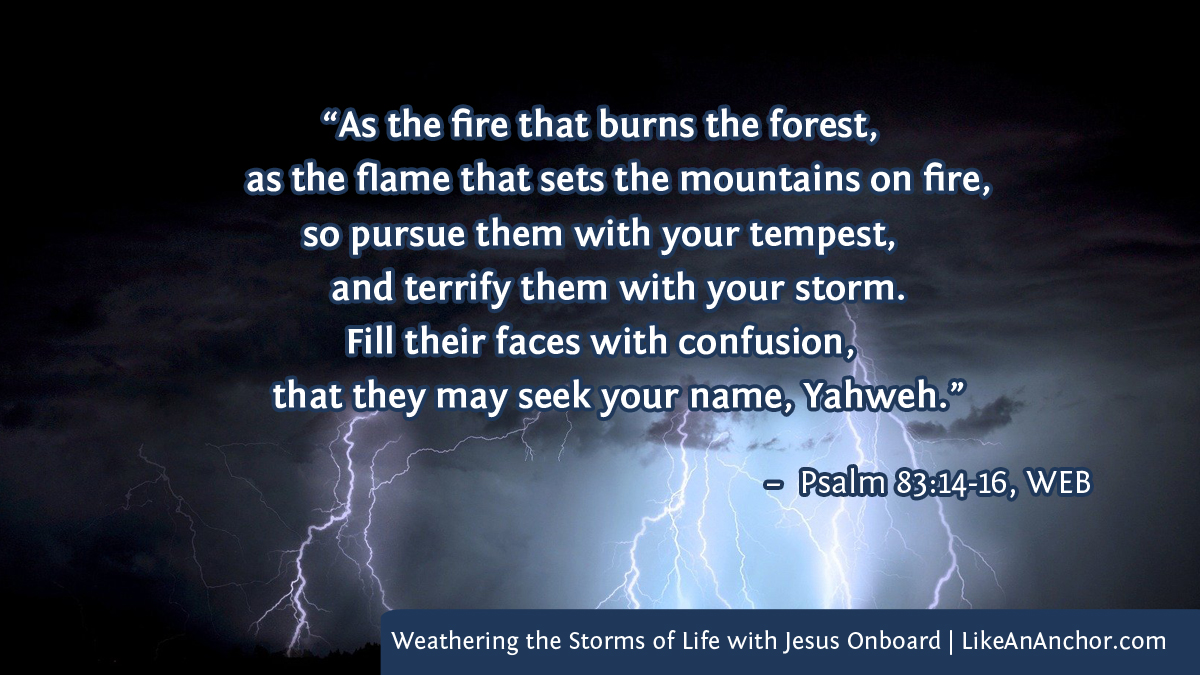
The purpose of such tempest and storms is “that they may seek your name, Yahweh” (Ps. 83:15-16). We’re to learn from the storms of life to listen to Yahweh and turn to Him for shelter and safety. Those who don’t learn that lesson may make “a shipwreck concerning the faith” and eventually find that God does not listen to their cries for help during storms (Prov. 1:24-29; Zech. 7:13-14; 1 Tim. 1:19). As the writer of Hebrews said, though, I am “persuaded of better things for you, and things that accompany salvation, even though we speak like this” (Heb. 6:9, WEB). Bible teachers don’t share warnings in order to condemn; we share them as reminders to keep faithfully seeking God. The righteous stand firm in the whirlwind and storm since they are founded on the Rock, and that is what I want for myself, for you, and for all who follow the Lord (Prov. 10:25; Matt. 7:24-27).

Keep Jesus in your boat, and the storms of life have no power over you. You might get tossed around and nearly swamped, as the disciples were when they cried out asking if Jesus cared that they were dying, but ultimately there’s nothing to worry about. Faith and hope anchor our souls (Heb. 6:19; 10:23).

Image by Keli Black from Pixabay

Hold Fast

With Jesus on board our ships, we can weather the storms of life. Working together in unity, He and His Father are the same God who created the seas and storms, and rule over them (Gen. 1:6-8; Job 28:23-27; Ps. 93:3-4; Eph. 3:8-9). They are the ones who’ve seen faithful people through earth-shaking storms and who still the roaring sea (Ps. 46:2-3; 65:7; 89:9; 107:29-30). Today, He still saves and anchors us so that “we are no longer to be children, tossed back and forth by waves and carried about by every wind of teaching by the trickery of people who craftily carry out their deceitful schemes” (Eph. 4:14, NET).

Image by Comfreak from Pixabay

Yahweh, you are my God. I will exalt you! I will praise your name, for you have done wonderful things, things planned long ago, in complete faithfulness and truth. … For you have been a stronghold to the poor, a stronghold to the needy in his distress, a refuge from the storm, a shade from the heat, when the blast of the dreaded ones is like a storm against the wall.

Isaiah 25:1, 4, WEB

If we’re in the middle of a storm and asking God, “Don’t you care that we are about to die?” the answer is two-fold. First, God tells us we don’t need to worry so much; He’s got this. Second, He assures us that He definitely does care; He cares so much that Jesus came to this world and lived and died as a human being to save those who believe in Him and give them everlasting life.

As we face the storm-like trials of our lives, remember that Jesus is there with us in our boats. Even if it seems like He’s fallen asleep and isn’t paying attention, He still has us in His power and under His protection. Hold fast to Him, and He’ll get us through.

He has said, “I will never leave you and I will never abandon you.” So we can say with confidence, “The Lord is my helper, and I will not be afraid. What can people do to me?”

Heb. 13:5-6, NET

Featured image by Enrique Meseguer from Pixabay

Big Questions of the Bible

Since last week’s post, inspired by the big questions Leo Tolstoy asked in his book A Confession, I’ve been thinking about the questions that people in the Bible asked. From the sorts of questions recorded in Job, Psalms, Ecclesiastes, and elsewhere in scripture, it seems clear that God is okay with us asking Him things such as “Why am I here?”, “What is the purpose of suffering?”, and “What ought I do with my life?”

Today, we still have a lot of questions for God. Some of them are specific, such as “Why did that bad thing happen to me?” or “How can I decided what the next step for my life is?” Others are more general, the sorts of things that most thinking people wondered at some point in their lives, such as “What is the meaning of life?” and “Where do I fit into the universe?”

It often seems like these types of questions are too big to answer and so we shouldn’t try to ask them. Or it might seem as if we’re the only ones who haven’t figured this out yet, since everyone else seems like they’re functioning just fine. But we’re all asking questions and we all have things we’re uncertain about, just like people in the Bible. Even the “heroes of faith” like Job and David asked big questions, some of which seem audacious to us. We might expect God to get angry or offended at questions like “Why did you make me like this?” or “What do you think you’re doing, letting this terrible thing happen to me?” But throughout scripture, God shows remarkable patience with His people’s questions and also a willingness to answer. One of the most amazing things about Job’s story, for example, isn’t that Job asked questions about his suffering; it’s that God showed up to give an answer and ask questions of His own.

If you search for question marks in the Bible, you come back with 3,256 results in the WEB translation and 2,990 in the NET. The exact number varies depending on how translators choose to interpret phrases and where they put punctuation marks, but however you figure it up that’s a lot of questions. We can’t cover them all in one post, and not all fit in the “big questions” category. I’ve picked out four types of these questions I want to look at today, and there are plenty more that we could examine. If this inspires you to do a study on questions for yourself, I’d love to hear about it in the comments below or in an email.

Image by Free-Photos from Pixabay

What is the point of anything?

In his darkest trials, Job asked why he’d even been born if this is what was going to happen (Job 3:11-16; 6:11-13; 10:18). It wasn’t a self-destructive thought for him, but it does seem to be one of frustration and despair. Why even live if suffering is the main result? What’s the point of being born, and living, and dying in a world where such terrible things can happen to good people?

Similarly, Solomon in Ecclesiastes wonders what the point is of living and working here on earth (Ecc. 1:3; 3:9; 4:8). Life seems to just go on and on with no real profit or gain, especially if you’re working alone rather than in a community. If there’s no satisfaction, or wealth, or any sort of meaningful profit then it’s all “vanity. Yes, it is a miserable business” (Ecc. 4:8, WEB). Others ask this type of question more specifically, wondering “What is the point of serving God?” (Job 21:15; Mal. 3:13-14).

God counters this sort of thinking with a question of His own: “Why do you spend money for that which is not bread, and your labor for that which doesn’t satisfy? Listen diligently to me, and eat that which is good, and let your soul delight itself in richness” (Is. 55:2, WEB). In other words, if our lives and efforts seems pointless it’s because we’re devoting them to the wrong sorts of things. This reminds me of one of Tolstoy’s observations in A Confession* that I wrote about last week. He realized that just because it felt as if his life wasn’t meaningful that didn’t mean all life had no meaning.

Another answer that God offers to this question is a clearer picture of Himself. He answered Job’s questions about the meaning of life and the purpose of suffering by revealing Himself to Job more fully (for an interesting take on that aspect of Job, see Philip Yancey’s The Bible Jesus Read*). It might seem an oddly indirect answer to us, but it’s one that appeared to satisfy Job. The clearer we can see and understand God, the more meaningful life seems.

*please note that this is an affiliate link, which means I'll earn a small commission (at no extra cost to you) if you purchase this book.
Image from Lightstock by Jantanee

Does God really care?

Faith in God answers a lot of life’s big questions. But it also brings up new questions. Once you believe that God exists and that He’s all powerful, it often follows that we wonder why He lets certain things happen. Why is there suffering? Why are there wars? How could a loving God allow such terrible things? Doesn’t He care?

The psalms are full of these sorts of questions. “Why do you stand far off, Yahweh?  Why do you hide yourself in times of trouble?” (Ps. 10:1, WEB), “My God, my God, why have you forsaken me?” (Ps. 22:1, WEB), and many more questions like these echo through history in the cries of many hurting people today (Ps. 13:1; 43:2; 44:24; 74:1, 11; 89:46; 108:11). We wonder why it seems that God leaves us alone in our times of trouble, and why it seems like He’s ignoring our cries for help (Lam 5:20; Hab. 1:2). Doesn’t He care about us at all?

There’s a story of a time when Jesus and his disciples were on a boat and a storm blew up. Jesus was sleeping through it, but they woke Him with the question, “Teacher, don’t you care that we are dying?” (Mark 4:38, WEB). Jesus hadn’t been worried at all, but at their question He got up and stopped the storm. I suspect there’s a reason Jesus wasn’t worried. With God on our side, the storms of life don’t present a real danger to us. Even if He seems to not be paying attention, He’s still very present and protective. He has the power to stop the storms instantly, and sometimes He does to show us His power and reliability, but things are still going to work together for good in the end even if He decides to let us go through the storms.

Perhaps a better question would be, “Why does God care so much?” There’s tons of evidence that God cares deeply about humanity. The main proof of that is found in Jesus’s sacrifice–God cares enough about us to die in our place. With that perspective in mind, our question may become “What are we that God should even think of us, much less care so much about us?” (Job 7:17; Ps. 8:4; Heb. 2:6). It’s awe-inspiring to think about the creator of the universe wanting us to be part of His family simply because He loves so much.

Image by Free-Photos from Pixabay

Why isn’t God doing things the way I want?

This next question is closely related to the last one. We wonder how long our trials will last, sure it would be better if God stepped in now and took care of things for us. We wonder how long it will be until the end comes, since it seems like the sooner the better for Jesus to return and stop pain, suffering, death, and evil. Similarly, we may question God’s planning and timing in other areas, wondering if He is unfair in the things that He commands or the way He interacts with people.

Even though these questions can sound like a lack of faith or an accusation, they’re still questions that it’s okay to ask. Jesus didn’t get upset when His disciples said, “Tell us, when will these things be? What is the sign of your coming, and of the end of the age?”–He just answered their question (Matt. 24:3, WEB). Yahweh didn’t cut-off Moses for asking, “How long must this suffering last?” (Ps. 90:13, NET). We can ask these things. It only becomes problematic when we decided the answer must be that God is wrong and we’re right.

Tolstoy talks about the insanity of this attitude by comparing “learned and liberal” people who reject God to kids who tear apart a watch without understanding how to put it back together, then complain that it doesn’t work. That’s similar to the analogies found in the Bible. When people accuse God of unfairness or of not knowing what He’s doing, God turns some big questions back on them. He says, “You turn things upside down!” It’s not for the creation to question the Creator and decide that He’s the one who lacks understanding. “Yet the house of Israel says, ‘The way of the Lord is not fair.’ House of Israel, aren’t my ways fair? Aren’t your ways unfair?” (Job 8:3; Is. 29:16; Jer. 2:5; Ezk. 18:23-29). God’s not the problem here; our limited understanding and lack of trust are what’s to blame.

What must I do now?

A rich young man once asked Jesus, “Good teacher, what good thing shall I do, that I may have eternal life?” When Jesus replied that this man should keep the commandments, he responded, ““All these things I have observed from my youth. What do I still lack?” (Matt. 19:16-20; Mark 10:17-21; Luke 18:18-23). That question is at the top of my list for things I’d like to ask God and get a clear answer on right now. I grew up in the church and didn’t really have a rebellious phase (though that doesn’t mean I haven’t sinned/missed the mark on God’s commandments). But I do sympathize with this young man. I’ve been following God my whole life; what do I still lack?

Whether you’re just starting out your journey as a Christian–like those in Acts whose response to hearing the gospel was, “What shall we do?” (Acts 2:37; 16:30)– or you’ve been following God for many years, the question of what to do now is a good one. Throughout scripture, people asked questions like, “How can man be just with God?”, “Where does wisdom come from?”, “Where is the good way?”, and “How shall I come before Yahweh?” (Job 9:2; 28:12, 20; Ps. 119:9; Jer. 6:16; Mic. 6:6-8). We treat these questions like they’re very complicated, but God gives us simple answers.

He has shown you, O man, what is good.
What does Yahweh require of you, but to act justly,
to love mercy, and to walk humbly with your God?

Micah 6:8, WEB

Jesus reiterates the simplicity of this point in the gospels. His answer to “How can we know the way?” is “I am the way, the truth, and the life” (John 14:5-6, WEB). His answer to “Which is the greatest commandment in the law?” and “What shall I do to inherit eternal life?” is to love God and love your neighbor (Matt. 22:35-40; Luke 10:25-29). It’s not that complicated.

God welcomes His people to engage with Him in real, dynamic relationship. Part of that relationship involves asking questions. If we have concerns, we’re invited to take them to God. If we have questions about Him or for Him, we ought to ask and then seek answers from Him through prayer, Bible study, meditation on the Word, and fasting.

Featured image from Lightstock by Jantanee

“Why Do I Live?” Finding Answers to Life’s Big Questions

If you’re familiar with Leo Tolstoy, chances are it’s in the context of him being one of the greatest Russian novelists rather than as a Christian writer. He published his two best-known works in the mid-to-late 19th century: War and Peace in 1869 and Anna Karenina in 1878. It was after finishing Anna Karenina early in 1877, and before resuming his literary work in 1885, that he devoted himself to a close study of faith (reference: Aylmer Maude’s introduction to A Confession, The Gospel in Brief, What I Believe, printed by Oxford University Press).

Tolstoy’s essay titled A Confession was mostly written in 1879 and was first circulated in Russia (with a short additional note from the author) in 1882 despite efforts to suppress its publication. In this essay, Tolstoy recounts his own loss of faith, the years of his life spent in dissipation among other “learned and liberal” people, and finally his disillusionment with that sort of life. He describes himself as coming to a seemingly inescapable realization that life is meaningless and that he ought to kill himself. This was a time of mental agony for him. Tolstoy was a highly successful and respected author, with a wife and children whom he loved, yet he had to hide ropes and guns lest he use them against himself.

As he recalls his reasoning in those days, Tolstoy talks about asking questions such as, “What am I with my desires?” and “Why do I live?” As a well-educated man, he naturally turned to science and reason for answers. Yet there, he found that people aren’t so much interested in answering these questions as they are in studying and observing the world. What he found from science indicated that everything happened by chance and you must understand “infinite complexity” and “the laws of those mutations of form” before you could hope to understand why you’re alive. Then Tolstoy turned to philosophy, where he found that philosophers had been asking his same questions for thousands of years. Yet they didn’t have an answer which satisfied him either–they just gave back “the same question, only in a complex form” (Section V).

People in the Bible also asked big questions, and we’re still doing that today as well. The questioner from the Bible whom Tolstoy focused on in his writings was Solomon, and he quotes extensively from Ecclesiastes (which I’ve written about in “Crash Course in Ecclesiastes”). Other Bible people who asked big questions include Job and his three friends. And while Solomon and Job are the first people who come to mind as wrestling with big questions, other questions like “If it is like this, why do I live?” (Gen. 25:22), “My God, my God, why have you forsaken me?” (Psalm 22:1), and “Is there unrighteousness with God?” (Rom. 3:5; 9:14) fill the pages of the Bible. We serve a God who invites us to ask big, difficult, and troubling questions and then come to Him for answers.

It’s fitting, then, that Tolstoy found the most satisfying answers for his big questions when he turned to faith. He realizes that just because he’d decided that his life was not meaningful did not mean all life was without meaning. As he looked around him, he realized that people had been acting as if life were meaningful for thousands of years. Perhaps they hadn’t been wrong. Perhaps they–and the people alive now who saw value in living–knew something that he’d missed. And so Tolstoy began seeking answers among those who believe that life is worth living in spite of the hardships, namely, among people of faith. He was not impressed by those Christians among his wealthy, highly educated acquaintances because most professed faith but did not live it out, but Tolstoy did find something to admire in the simple working people. Those people lived with faith that deeply affected their lives and which answered their big questions.

Image from jacqueline macou from Pixabay

At this point, Tolstoy describes the highly educated and intelligent people who reject God as those who “have decided that the master is stupid or does not exist, and that we are wise, only we feel that we are quite useless and that we must somehow do away with ourselves” (Section XI). These sorts of people are so impressed with themselves that they’ve missed what gives life meaning. He also says, “Were it not so terrible it would be ludicrous with what pride and self-satisfaction we, like children, pull the watch to pieces, take out the spring, make a toy of it, and are then surprised that the watch does not go” (Section IX). It should be no surprise that if we try to take out God and faith–which make life worth living and reveal the meaning of existence– we’ll feel as if life is worthless and meaningless. Tolstoy found this born out in his own experiences: “I need only be aware of God to live; I need only forget Him, or disbelieve Him, and I died” (Section XII).

A Confession is a fascinating read. Tolstoy speaks frankly about terribly difficult subjects, including his struggles with suicidal thoughts and with finding answers to life’s most important questions. He also touches on his conflicts with church dogma (in this case the doctrines of the Russian Orthodox church), which I understand he develops more fully in writings that I haven’t yet read. In a way that reminds me a little of C.S. Lewis, Tolstoy left his childhood Christian faith and then later came back as a more mature and intelligent adult, concluding that God is the only thing which can give life meaning.

So many people in the modern world like to set up “faith” and “reason” as things that are opposed. I love reading about highly intelligent people like Lewis and Tolstoy who come to the conclusion that faith in God is the only reasonable answer to life’s big questions. It helps encourage me that a life of faith is not a life that’s opposed to reason, logic, and intelligence–that, in fact, the most reasonable use of our intelligence leads to the conclusion that faith in God is right and good.

Featured image by Dariusz Sankowski from Pixabay

Crash Course In Ecclesiastes

It’s always puzzled me why so many people think of Ecclesiastes as depressing. For me as a teenager, it provided a map for navigating my way out of depression. Of course, I’m not saying it’s a magic cure for mental illness, but if you’re struggling with questions about the meaning of life or frustrated with how pointless it all seems, this book can provide a great deal of hope.

The book of Ecclesiastes contains the reflections of a deep thinker who works through an existential crisis. This sort of crisis happens when an individual starts to question whether their life (or life in general) has any purpose, meaning, or value. Solomon wrestled with these questions and records his thoughts for us to learn, as he did, that true meaning and purpose can only be found in God.

Ecclesiastes is one of those books that it’s not a good idea to read isolated pieces from. That’s one way you end up thinking there are few spiritual lessons in this book or misinterpreting its message. The whole thing is interconnected, with layers of thoughts building on each other as Solomon goes back and forth asking questions and contemplating possible answers. It’s vital that we look at this piece of writing as a whole before we start to dive deep into individual passages.

Cycles of Futility …

“Vanity of vanities,” says the Preacher; “Vanity of vanities, all is vanity” (Ecc. 1:2 , unless otherwise noted, all quotes are from the WEB version). Thus the book of Ecclesiastes opens, and Solomon will repeat this phrase throughout and in the conclusion (Ecc. 12:8). He presents everything in life as vanity, or hebel (H1892) — a vapor/breath; a transitory or unsatisfactory thing. That might seem like a depressing outlook, but can you really look at the world and say he’s wrong? Do things of this life last? Do they make sense? Is this world satisfying? Not on its own.

All things are full of weariness beyond uttering. The eye is not satisfied with seeing, nor the ear filled with hearing. That which has been is that which shall be; and that which has been done is that which shall be done: and there is no new thing under the sun.

Ecclesiastes 1:8-9, WEB

With a few thousand more years of history to look back on than Solomon had, we can see the truth of these statements. Nothing really changes. We’re not advancing toward a utopia. People just keep making the same mistakes over and over again, which looks to Solomon like cycles of futility and meaninglessness. Oh, there are technology advances and improvements in our lives, but people stay the same.

… Become Cycles of Hope

Having come to this conclusion about life, Solomon tries to resolve his existential crisis by looking for some kind of meaning. He says, “I applied my heart to seek and to search out by wisdom concerning all that is done under the sky” (Ecc. 1:13). He indulged in all sorts of sensory pleasures, amassed wealth, and created created great things but it was also vanity.

Next, he tried out wisdom and folly to compare the two, and found “that wisdom excels folly as far as light excels darkness” (Ecc. 2:13). But the wise and foolish both die. They can’t keep what they worked for or guarantee what they leave behind will have any effect. At this point, Solomon “hated life” and says, “I began to cause my heart to despair concerning all the labor which I had labored” (Ecc. 2:17, 20). Even realizing that you can have wisdom, knowledge, and joy in your life if you please God seems to him like “vanity and chasing after wind” (Ecc. 2:26). But now we come to the first part of Solomon’s ruminations where he glimpses hope.

For everything there is a season, and a time for every purpose under heaven … He has made everything beautiful in its time. He has also set eternity in their hearts, yet so that man can’t find out the work that God has done from the beginning even to the end.

Ecclesiastes 3: 1, 11, WEB

Solomon realizes that God is the one who made the cycles of time. What Solomon initially saw as hopeless repetition he now recognizes as beautiful (Ecc. 3:1-11). Solomon sees that it is a gift from God that we can do good and enjoy this life. He knows that God has a plan in place and that the righteous and wicked will be judged (Ecc. 3:12-17).

But What About Death?

Existential crises aren’t that easy to resolve, though, and Solomon still has questions. He’s accepted that God has a purpose for how the world keeps on turning. He knows that this life can be seen as a gift. but what about after you die? In Ecc. 3:18-22, Solomon concludes that humans die just like animals, and who knows whether their spirits really go to different places? Maybe this life is all we have and we should just make the most of it.

But that’s not a satisfactory answer either, since not everyone gets to enjoy this life. People oppress each other, and the oppressed have no comfort. People envy each other, live lonely lives, and there’s no end to the people who keep being born and dying in this fallen world. Solomon even suggests it would be better to never be born than to live and see all the evil that fills this world (Ecc. 4:1-16).

Immediately, the conversation turns. Solomon says, “Don’t be rash with your mouth and don’t let you heart be hasty to utter anything before God” (Ecc. 5:2). Perhaps he knows that’s what he’d been doing, as his thoughts ran away with fears and questions.

Don’t allow your mouth to lead you into sin. … For in the multitude of dreams there are vanities, as well as in many words: but you must fear God.

Ecclesiastes 5:6-7, WEB

Solomon knows God has a plan and the times are in His hands — he just needs to find a way to trust Him. He desperately wants to make sense of what’s going on in his life, in the world, and in the afterlife (if there is one).

Letting Death Give Us Perspective

Even with this reminder not to jump to hasty conclusions, Solomon continues to struggle. Everything people strive for in this life still seems futile to him. Sure you can enjoy it in this life, but you can’t take it with you when you go. Then we come to another major turning point in Solomon’s thought process. Instead of seeing death as the thing which robs life of meaning, he proposes that we use death to give us perspective on life. There truly is value in a good life well-lived and there is a future worth striving for. I talked about this section of Ecclesiastes in-depth last week, so if you haven’t read it yet here’s a link: “Letting Death Give Us Perspective On Life.”

As we continue in chapter 7, Solomon counsels to avoid extremes. Even a good thing like wisdom can drive you crazy if you “make yourself overly wise” (Ecc. 7:11-2, 16). We can’t make sense of everything or know the future (7:23-25). “There is no man who has power over the spirit to contain the spirit; neither does he have power over the day of death” (Ecc. 8:8). Because this is true we need to beware of hasty judgements, offenses, and conclusions. Rather, focus on fearing God (Ecc. 7:18).

Though a sinner commits crimes a hundred times, and lives long, yet surely I know that it will be better with those who fear God, who are reverent before him. But it shall not be well with the wicked, neither shall he lengthen days like a shadow; because he doesn’t fear God.

Ecclesiastes 8:12-13, WEB

More Questions

The latter part of chapter 8 and into chapter 9 seems like a step backward. Solomon was talking about it being “better with those that fear God” but then he remembers “that there are righteous men to whom it happens according to the work of the wicked. Again, there are wicked men to whom it happens according to the work of the righteous” (Ecc. 8:14). This frustrating situation sends Solomon right back to commending mirth, then reapplying his heart to wisdom trying to figure things out (8:15-16).

He concludes that “man can’t find out” the work of God no matter how much he seeks it, nor comprehend God’s plan and thoughts even if he is wise (Ecc. 8:17-9:1). Solomon even starts to question whether there’s purpose in death or not because he’s still wrestling with the fact that the same things happen to both righteous and wicked people (9:2-6).

I think most (if not all) of us can relate to this. Just because we think we’ve figured something out doesn’t mean nothing will shake our faith. Gross injustice, friends who die too young, tragic health trials — they can all make us question the frame through which we see the world. The fact that Solomon keeps going back and forth, asking the same questions and wrestling with the answers makes him very relatable.

Life’s Absurd, Enjoy It Anyway

We’re approaching the end of the book now and Solomon presents a revised conclusion: that we should live life to the fullest even though it’s absurd. We can’t predict the future, we can’t control anything, and we’ll be better off if we just live well and try not to overthink things (Ecc. 9:7-12).

Of course, overthinking things is something we humans are very good at. Solomon continues comparing wisdom and folly, and continues coming up against the conclusion that wisdom is far better. Chapter 10 reads much like part of Proverbs, and it leads into the final conclusions of Ecclesiastes.

Practice wisdom. Remember “you don’t know the words of God who does all.” Don’t get distracted or complacent. Keep working and living (Ecc. 11:5-6). Balance is key — rejoice in all your years but also “remember the days of darkness” that help give perspective. Remember that “God will bring you into judgement” for all you do, so put off both sorrow and evil (Ecc. 11:8-10).  He’s now speaking most pointedly to young people, urging them to “remember your Creator” today, before life gets harder or trials come or you grow old and full of regrets (Ecc. 12:1-6).

Now Let Us Hear The Conclusion

Crash Course In Ecclesiastes | LikeAnAnchor.com
Photo credit: Pearl via Lightstock

Here at the end is where Solomon finally answers his earlier question, “Who know the spirit of man, whether it goes upward?” (Ecc. 3:21).

Remember also your Creator in the days of your youth … before the silver cord is severed, or the golden bowl is broken, or the pitcher is broken at the spring, or the wheel broken at the cistern, and the dust returns to the earth as it was, and the spirit returns to God who gave it.

Ecclesiastes 12:1, 6-7, WEB

Solomon has reached the point where he has a confident assurance that there is life after death and God will sort-out everything that doesn’t make sense now. I suspect, and Matthew Henry’s commentary agrees, that Solomon wrote this in old age, hoping that his young audience would heed his wisdom without feeling the need to themselves experiment with life as he did.

Solomon shared what he learned from wresting with questions and doubts so others wouldn’t have to. This also seems to be when he put together the book of Proverbs (Ecc. 12:9-10). As Ecclesiastes wraps up, he admonishes young people not to study too widely, for not all the information out there is good (12:11-12). Better to stick with “the words of the wise” which “have been given by one Shepherd” (Ecc. 12:11, TLV).

This is the end of the matter. All has been heard. Fear God, and keep his commandments; for this is the whole duty of man. For God will bring every work into judgment, with every hidden thing, whether it is good, or whether it is evil.

Ecclesiastes 12:13-14, WEB

It’s so nice to have such a straight-forward conclusion at the end of such a deep, complex book. Here, Solomon tells us in no uncertain terms what the point of Ecclesiastes is. From it, we’re to learn that fearing God and keeping his commandments is man’s whole duty and that God will judge all our works.


Letting Death Give Us Perspective On Life

Ecclesiastes records the reflections of a deep thinker who works through an existential crisis and concludes meaning can only be found in God. While many people find this book depressing, I think taken as a whole it offers a remarkably hopeful perspective that can actually help us work through the sort of questions that were weighing on the author (most likely Solomon’s) mind.

When I recently went back to studying Ecclesiastes, I had this grand vision that I would write a post about the entire book (similar to “Crash Course in Romans”) in less than a week and post it today. I’m currently laughing at myself for thinking that was an attainable goal. Instead, we’re just going to talk about a handful of verses in the middle of the book that have captured my attention, and save the Crash Course in Ecclesiastes for next week.

The Vanity of Everything

Like Romans, Ecclesiastes is hard to understand if you take bits and pieces out of context, so before we get to the verses that I want to focus on today we need to take a quick look at what came before.

Solomon had shown the vanity of pleasure, gaiety, and fine works, of honour, power, and royal dignity … [and] there is as much vanity in great riches (Matthew Henry’s Commentary on Ecc. 5:9-17)

He has also been questioning the meaning of life. If all the things that people pursue on earth are meaningless, then what is there for us? Several times he argues that there is “nothing better” for men than to rejoice in this physical life (Ecc. 2:24; 3:13, 22; 5:18). But that’s still not a satisfactory answer for him. He wants more, something to explain why we should keep trying and what’s the purpose in living.

For who knows what is good for man in life, all the days of his vain life which he spends like a shadow? For who can tell a man what will be after him under the sun? (Ecc. 6:12, WEB)

A Different Perspective on Death

Up until this point, there has been a, “Let us eat and drink, for tomorrow we will die” theme running through Ecclesiastes (Is. 22:12-13). It seems that in Solomon’s mind at this time, death was the point at which hope falls apart. Sure you can enjoy this life, but it’s all emptiness because you still end up dead with no guarantee that you have anything to show for it. Now, though, Solomon suggests that we can use death to give us perspective on life.

It is better to go to the house of mourning than to go to the house of feasting: for that is the end of all men, and the living should take this to heart. Sorrow is better than laughter; for by the sadness of the face the heart is made good. The heart of the wise is in the house of mourning; but the heart of fools is in the house of mirth. (Ecc. 7:2-4, WEB)

We must not forget that there is “a time to be born, and a time to die … a time to weep, and a time to laugh; a time to mourn, and a time to dance” (Ecc. 3:2, 4, WEB). There’s nothing wrong with feasting and laughter in its proper time, but staying there makes your heart foolish. Wise men keep their ends in mind. Death reminds us that we only have so much time to decide how we’re going to live our lives and what we’ll be remembered for.

Letting Death Give Us Perspective On Life | LikeAnAnchor.com
Photo credit: Rosie Fraser via Unsplash

The End Is Better

We just talked about verses 2-4 in chapter 7. Now let’s go back to verse 1:

A good name is better than fine perfume; and the day of death better than the day of one’s birth. (Ecc. 7:1, WEB)

There is much value in a good life well-lived. Solomon has already concluded that “wisdom excels folly, as far as light excels darkness” (Ecc. 2:13, WEB). Here he reinforces that a good name — that is “a name for wisdom and goodness with those that are wise and good”(MHC on Ecc. 7:1-6) — is worth more than all the pleasures, wealth, etc. that he’d found so empty.

if we have lived so as to merit a good name, the day of our death, which will put a period to our cares, and toils, and sorrows, and remove us to rest, and joy, and eternal satisfaction, is better than the day of our birth, which ushered us into a world of so much sin and trouble, vanity and vexation. We were born to uncertainty, but a good man does not die at uncertainty. (MHC on Ecc. 7:1-6).

Death is not the end of the story, and for a man who considers his death and prepares for it (as Solomon goes on to say in the next verses, which we’ve already talked about) he has the opportunity to die with “a good name.” The word for “name” here is shem (H8034), and in the Hebrew concept it’s always connected with your reputation and character.

Those who die having a good reputation and a good character are no longer subject to the evils of this present life and await their resurrection to a much better life in the future. That gives those of us left behind great hope even in the midst of sorrow (1 Thes. 4:13-14).

Backing Into The Future

Letting Death Give Us Perspective On Life | LikeAnAnchor.com
Photo credit: Ashim D’Silva via Unsplash

The idea that the day of our death is better than the day of birth can be a hard one for people to come to grips with, even given the context we just talked about. We still grieve at death even though we know (as Solomon also concludes by the end of this book) that “the spirit returns to God who gave it” and that He will raise believers up in the last day (Ecc. 12:7; John 6:40). But maybe another verse in this section of Ecclesiastes can provide further explanation.

Better is the end of a thing than its beginning. (Ecc. 7:8, WEB)

The Hebrew word for “end” is achariyth (H319). To understand achariyth, we have to understand that the Hebrew concept of time is like “the view a man has when he is rowing a boat. He sees where he has been and backs into the future” (H.W. Wolff quoted in TWOT entry 68e). That’s why this word translated “end” can also mean last/latter days, after part, future, or reward. The end of a thing is better than the beginning because you will have arrived at the future goal and can now look back on where you’ve been with a better perspective.

If you’d rather not think about death then the idea that the end is better than the beginning can be a depressing one because it forces you to confront something uncomfortable. But ignoring the idea of our lives ending is foolish. Everyone is going to die whether we think about it or not, so why not use the fact that our lives will end as motivation to make the life we have a good one?


Featured image credit: carolynabooth via Pixabay