Confidence in Salvation

Are you saved?

It’s a question associated with overly enthusiastic or exceptionally earnest evangelists, knocking on doors and chatting you up in coffee shops. But it’s also a question that haunts many Christians. Like many things, we often fall into two extremes related to this question. On the one hand, we have people who say, “Once saved, always saved, so it doesn’t matter what I do now.” On the other hand, we have people who are terrified that they’re not actually saved and spend their lives struggling to measure up to God’s perfect standard with no assurance that they’ll make it in the end.

A few weeks ago, our pastor gave a message about the three ways that the Bible talks about salvation: we are saved, we are being saved, and we will be saved. He also mentioned an analogy that I’ve been mulling over for a couple weeks now. Like all analogies, it breaks down if you carry it too far, but I think it gives us a good starting point.

People who say they are already saved by Jesus are correct. But so are people who say that you can “lose” that salvation (though “reject” would be a much more accurate term). It’s like if a firefighter pulls you out of a burning building. Once you’re out of the fire, you’ve been saved. The salvation has already happened and it’s not going to be undone by the person who rescued you. But you can still run back into the burning building. It would be phenomenally stupid, but you have the free will to reject salvation. Knowing that can lead to anxiety for many people, but how worried should you actually be about this knowledge?

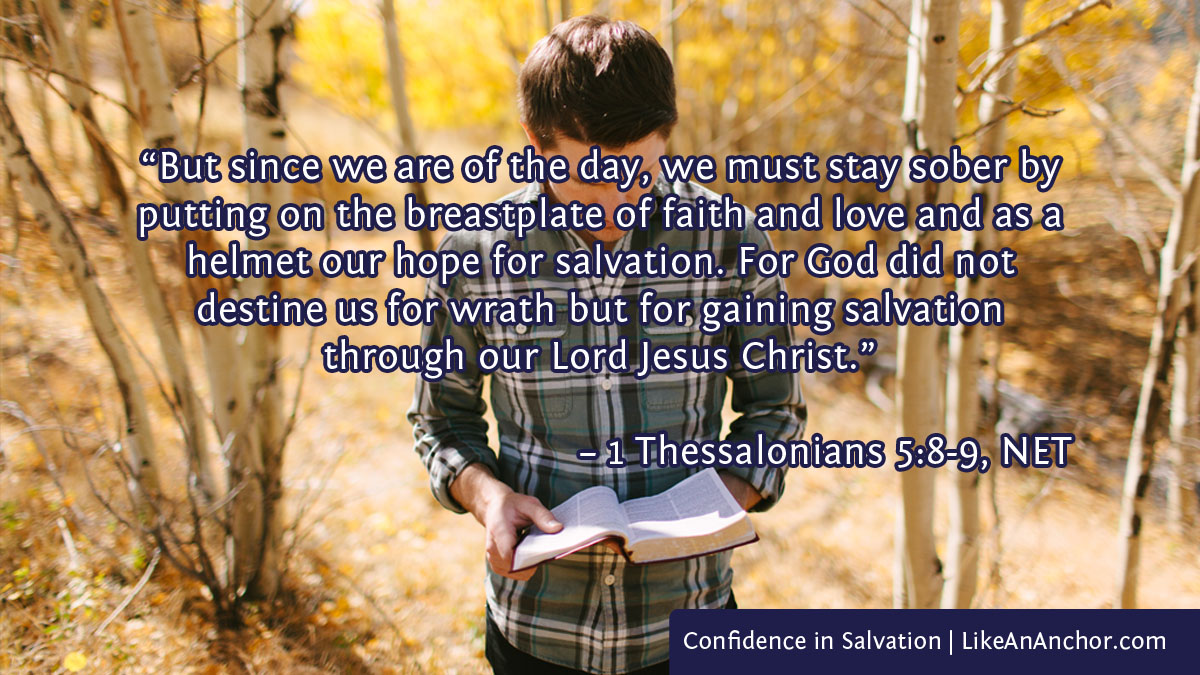
Image of a man walking in the woods while reading a Bible overlaid with text from 1 Thes. 5:8-9, NET version: "But since we are of the day, we must stay sober by putting on the breastplate of faith and love and as a helmet our hope for salvation. For God did not destine us for wrath but for gaining salvation through our Lord Jesus Christ.”
Image by HarveyMade from Lightstock

Be Confident

In my church, we spend quite a bit of time refuting the “once saved, always saved” heresy. No, you didn’t do anything to earn salvation–it’s a gift of God–but once you’re saved by grace, you owe God loyalty, faithfulness, and obedience. You can even choose to reject salvation, either verbally or by actions that deny your relationship with God (see, for example, 1 Cor. 6:9-10; Gal. 5:19-21; Heb. 10:26-31). We are currently saved, but it is also an ongoing process of walking with God that He will finally accomplish at Jesus’s return.

It’s an important point to understand, but I think perhaps we should spend just as much time countering the mistake that is more pervasive in our church, namely, the fear that we’re not good enough for God and might not really be saved. I’ve known people paralyzed by anxiety and fear that they don’t measure up to God, that He won’t give them salvation, and that they won’t be good enough to be in the kingdom. While we should have a great deal of respect for God, He does not want the people He welcomed into a relationship with Him to cower in fear!

You’re not supposed to feel guilty that you needed God’s grace. You should realize that you’re guilty of sin and can only be saved by His grace, but you shouldn’t beat yourself up because you couldn’t earn salvation. You were never meant to earn it! Reading through all of Paul’s letter to the Romans (preferably in one setting) is a beautiful exploration of these facts. None of us can earn salvation, but God knows that and in His great mercy, He worked things out so we don’t need to; we just need to believe in Jesus and commit to following Him. None of our works earn God’s favor or pay Him back for His grace, but good works (and refusing to go back to living in sin) are the correct response to His work in us. Confidence that we’ve received salvation is a topic Paul kept coming back to again and again in his letters.

And so, since we have been justified by his grace, we become heirs with the confident expectation of eternal life.

Titus 3:7-8, NET

This was according to the eternal purpose that he accomplished in Christ Jesus our Lord, in whom we have boldness and confident access to God by way of Christ’s faithfulness.

Ephesians 3:11-12, NET

God wants us to be bold and confident in relation to our salvation. He accomplished it, and He wants us to realize that it’s something He will not revoke and no one else can revoke. Jesus pulled us out of the fire when we accepted His sacrifice on our behalf. He’s not going to throw us back in. At the same time, that moment of salvation starts a participatory process. We’re meant to be fully involved in the transformation that salvation starts in our lives.

Balancing Humility and Certainty

We can have great confidence and boldness in the fact that “God did not destine us for wrath but for gaining salvation through our Lord Jesus Christ” (1 Thes. 5:9, NET). He doesn’t set us up for failure. In fact, He wants us to succeed! He’s already proved how invested He is in saving us by Jesus literally dying in our place. We don’t need to worry that God thinks we’re not good enough (Jesus cared enough to die for us while we were yet sinners [Rom. 5:8]) or that He’ll give up on us partway through the salvation process (Phil. 1:6).

Therefore, since we have been declared righteous by faith, we have peace with God through our Lord Jesus Christ, through whom we have also obtained access into this grace in which we stand, and we rejoice in the hope of God’s glory. …

Much more then, because we have now been declared righteous by his blood, we will be saved through him from God’s wrath. For if while we were enemies we were reconciled to God through the death of his Son, how much more, since we have been reconciled, will we be saved by his life?

Romans 5:1-2, 9-10, NET
Image of three women holding hands, overlaid with blog's title text and the words, "When we are confidently devoted to God, we have no reason to fear that He won't accomplish our salvation."
Image by Anggie from Lightstock

Here, Paul uses the term “reconciliation” for the salvation already accomplished–the restoration of relationship between us and God when Jesus’s sacrifice covered our sins–and “we will be saved” for the final salvation that we look forward to when Jesus returns and we become fully part of God’s family. We are assured without a doubt that Jesus accomplished salvation in our lives when we entered a covenant relationship with Him, and that God will finish the work that He started in us unless we choose to stop working with Him (Phil. 2:12-13; Heb. 2:1-3).

There is a delicate balance we must maintain between humility and confidence. We must confidently expect that God will deliver on His promises of eternal life while at the same time recognize that we could be disqualified from receiving those promises if we reject and abandon God. Even the apostle Paul didn’t dare say he’d already attained the resurrection during most of his life (1 Cor. 9:27; Phil 3:10-14); it was only right at the end of his life that he could say, “I have kept the faith” and will inherit the crown (2 Tim. 4:6-8). Self-righteous confidence is a danger we must be careful to avoid; our confidence should rest in God, not ourselves (Luke 18:9-14; Rom. 2:17-29). And when our confidence is placed firmly in God, then we have nothing to fear.

Yahweh is my light and my salvation.
Whom shall I fear?
Yahweh is the strength of my life.
Of whom shall I be afraid? …
Though war should rise against me,
even then I will be confident. …

I am still confident of this:
I will see the goodness of Yahweh in the land of the living.
Wait for Yahweh.
Be strong, and let your heart take courage.
Yes, wait for Yahweh.

Psalm 27:1, 3, 13-14, WEB

Featured image by PhotoGranary from Lightstock

Where Does My Help Come From?

As a new parent, I find myself worrying a lot. What if my baby stops breathing in the middle of the night? What if something falls on her and hurts her? How am I supposed to live with knowing that something bad could happen to her?

I had terrible nightmares when I first came home from the hospital, so bad I woke my husband up a couple times as I frantically looked around to find my baby and make sure she was alright. Someone suggested I could follow James’s instruction to call an elder of the church for prayer and anointing as if I was sick (Jam. 5:14-15). I did, and the nightmares stopped that very night, praise God. I didn’t have another one for over two months, and even then it was more of a normal bad dream than the terror-inducing ones from before.

I wasn’t specifically directing these worry-filled questions at God in my mind, but perhaps I should have. He has answers for our fears, worries, anxieties, and what ifs. It’s been over three years since I put together a 30-day scripture writing plan titled “Big Questions,” but I recently dug it back out of my archives to share with my scripture writing group at church for this month and I’ve started considering the topic of questions again.

Thankfully, God lets us ask Him questions. We’re not supposed to rebel against Him and do things our own way (1 Sam. 15:22-23), tempt or put Him to the test (Deut. 6:16; Matt. 4:5-7), or complain, murmur, and argue (1 Cor. 10:10; Phil. 2:14), but He lets us question. He isn’t threatened or put off when we ask something. He might decide not to answer the exact questions we asked (like He did with Job), or He might correct a wrong assumption at the root of our questions (like He did for some of Habakkuk’s questions), or He might indicate that we need to stop asking after we ask for the same thing several times (like He did for Paul), but He doesn’t tell us not to question Him at all.

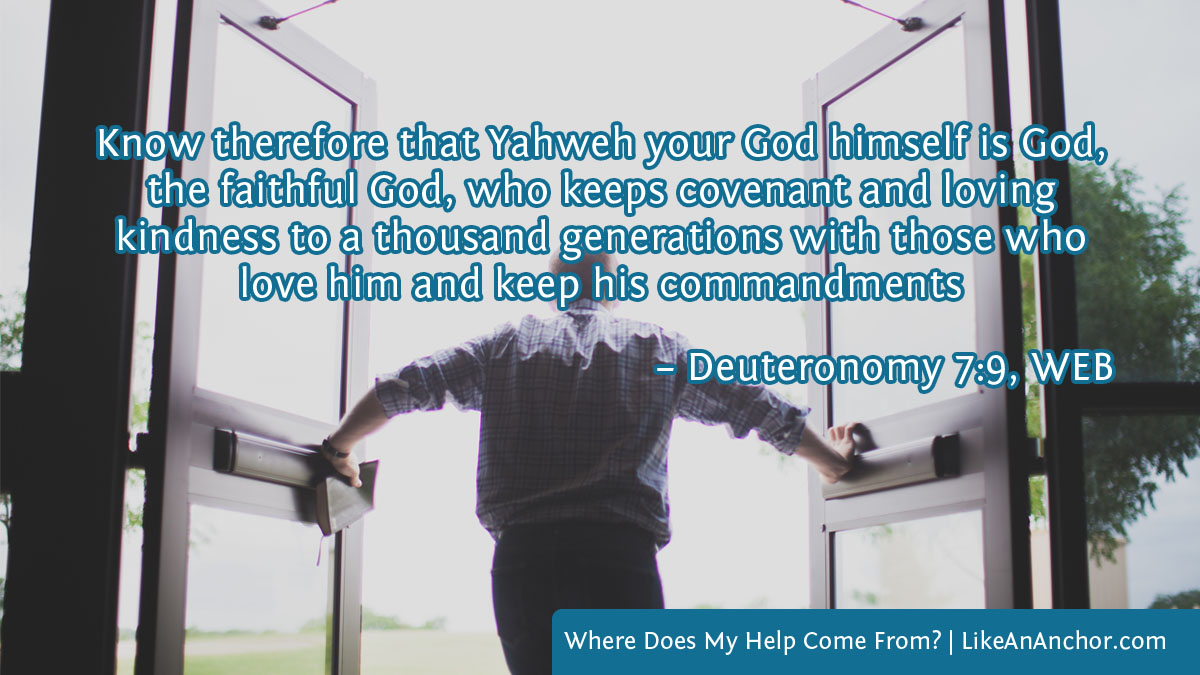
Image of a man pushing open glass doors to step outside overlaid with text from Deut. 7:9, WEB version: "Know therefore that Yahweh your God himself is God, the faithful God, who keeps covenant and loving kindness to a thousand generations with those who love him and keep his commandments"
Image by Pearl from Lightstock

Where is my help?

One of God’s answers to our fearful questions is found in a psalm that kept coming to mind as I worried about my newborn baby. As is often the case for me, I specifically thought of a song, this one with words from Psalm 121: “He that keepeth Israel neither slumbers nor sleeps” (the version playing in my head is one I heard in-person at a Messianic church, but here’s a link to a version of the same song). Repeating this psalm/singing this song was often the only way I could fall asleep, trusting that God would stay awake to watch my baby while I couldn’t.

I will lift up my eyes to the hills.
    Where does my help come from?
My help comes from Yahweh,
    who made heaven and earth.
He will not allow your foot to be moved.
    He who keeps you will not slumber.
Behold, he who keeps Israel
    will neither slumber nor sleep.
Yahweh is your keeper.
    Yahweh is your shade on your right hand.
The sun will not harm you by day,
    nor the moon by night.
Yahweh will keep you from all evil.
    He will keep your soul.
Yahweh will keep your going out and your coming in,
    from this time forward, and forever more.

Psalm 121, WEB

This psalm starts with a question: “Where does my help come from?” Immediately, the writer answers, “My help comes from Yahweh.” It’s a rhetorical question in this psalm, but for many people it’s a very real question that we wonder about. For those of us asking this question or one of it’s many variations, the psalmist goes on to share reasons that we can count on Yahweh to come through as our helper and keeper.

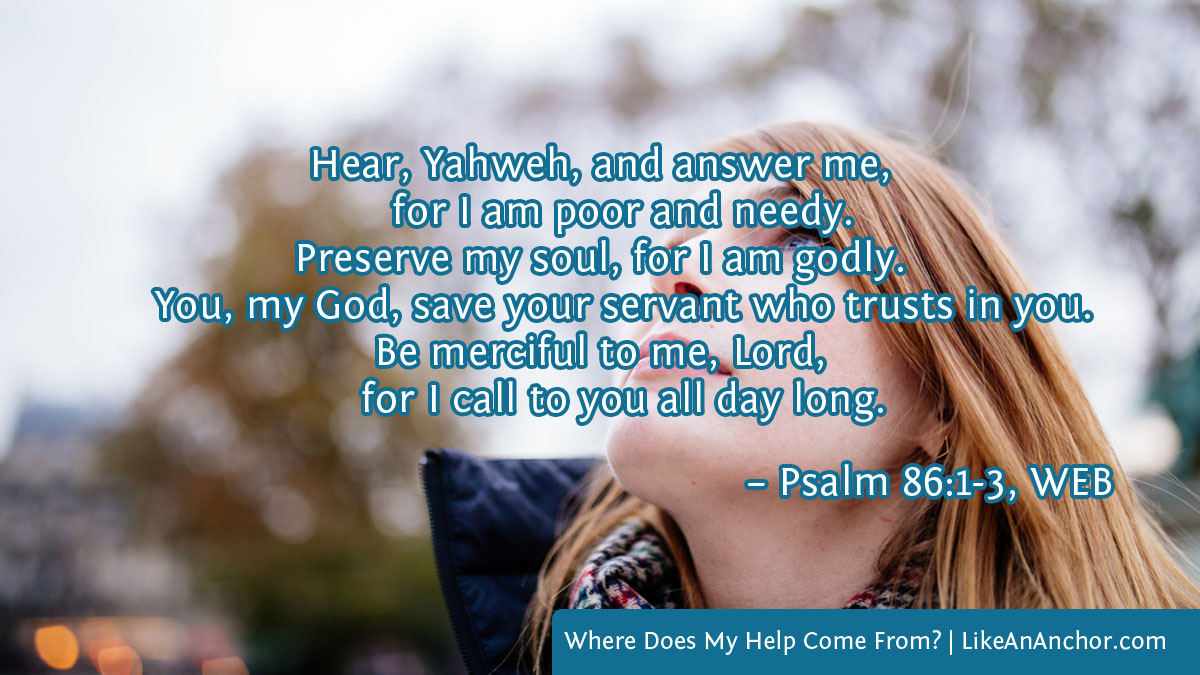
Image of a woman looking up at the sky overlaid with text from Psalm 86:1-3, WEB version:  Hear, Yahweh, and answer me, for I am poor and needy. Preserve my soul, for I am godly. You, my God, save your servant who trusts in you. Be merciful to me, Lord, for I call to you all day long.
Image by Brightside Creative from Lightstock

The Keeper

Did you notice how many times the word “keep” or “keeper” is used in Psalm 121? This word is translated from the Hebrew word shamar (H8104), which appears 468 times in the Old Testament. The primary meaning is “to keep, guard, observe, give heed” (Brown, Driver, Briggs [BDB]). Digging deeper, the Complete Theological Wordbook of the Old Testament states, “The basic idea of the root is ‘to exercise great care over'” (TWOT entry 2414). The TWOT breaks it into a few broad categories of meaning within that basic idea:

The number of times that we’re told to keep covenant with God or to keep ourselves in the right way would make a fascinating study on their own. For this post, though, I want to spend some more time looking at the ways that God keeps us. First, He keeps His covenant obligations. We’re supposed to “exercise great care” to keep ourselves faithful to Him and do things His way, and He is also careful to keep all of His covenant obligations as well. Unlike us, God keeps covenant perfectly. He’s the perfect “keeper,” which leads us to another facet of this word as it applies to God.

May Yahweh Keep You

Image of a small Bible held in two hands, overlaid with blog's title text and the words, "God really can—and does!—answer when we need Him to show up as our Helper and Keeper who exercises great care over us."
Image by Anggie from Lightstock

God keeps covenant with us and He also “keeps” us, exercising great care over His people. For example, when God spoke to Jacob, He introduced Himself by saying, ““I am Yahweh, the God of Abraham your father, and the God of Isaac” and making a promise: “ Behold, I am with you, and will keep you, wherever you go” (Gen. 28:15, WEB). Later, God instructed the Levitical priesthood to use shamar in the blessing for all the children of Jacob (later renamed Israel).

 Yahweh spoke to Moses, saying, “Speak to Aaron and to his sons, saying, ‘This is how you shall bless the children of Israel.’ You shall tell them,

‘Yahweh bless you, and keep you.
    Yahweh make his face to shine on you,
    and be gracious to you.
Yahweh lift up his face toward you,
    and give you peace.’

“So they shall put my name on the children of Israel; and I will bless them.”

Numbers 6:22-27, WEB

A number of Psalms claim this blessing, with writers calling Yahweh their keeper or asking Him to keep/guard/preserve them (Ps. 16:1; 17:8; 41:2; 86:2; 91:11; 97:10; 116:6; 140:4; 141:9). And these promises aren’t just for people in the Old Testament. As God’s New Covenant people, we can claim these promises of God to His Old Covenant people, as the writer of Hebrews demonstrates here:

Be free from the love of money, content with such things as you have, for he has said, “I will in no way leave you, neither will I in any way forsake you.” (Deut. 31:6) So that with good courage we say,

“The Lord is my helper. I will not fear.
    What can man do to me?” (Ps. 118:6-7).

Hebrews 13:5-6, WEB

Remember the question from Psalm 112, “Where does my help come from?” That word translated “help” is ezer, which is the same Hebrew word family as azar, the word used for “helper” in Psalm 118. When we’re looking for help, we can confidently trust that God is our Helper and that we can count on Him as our Keeper who neither slumbers nor sleeps. We can even count on Him to change our minds so we’re less worried.

For God did not give us a spirit of timidity or cowardice or fear, but [He has given us a spirit] of power and of love and of sound judgment and personal discipline [abilities that result in a calm, well-balanced mind and self-control].

2 Timothy 1:7, AMP

I like the Amplified Bible’s version of this verse because “sound mind” (e.g. KJV) or “self control” (e.g. NET) by themselves don’t quite get at what’s going on with the Greek word sophronismos, which includes the sense of discipline leading to self control and/or sound mindedness. God’s spirit inside us can settle the worries and fears swirling in our minds, helping us accept that God really can answer when we need Him to show up as our Helper, the Keeper who exercises great care over us.


Featured image by Temi Coker from Lightstock

Forgiveness and Fear: Companions, Not Opposites

Often, we think of fear and love as opposite sides of a spectrum. It reminds me of reading Machiavelli in college. Even all these years later, I remember him advising that though it’s better for a prince to be both feared and loved, if he must chose one it should be fear. I looked up that quote again while working on this post, and I’d like to share part of it with you. It comes from The Prince, Machiavelli’s advice for ruling, which he dedicated to Lorenzo di Piero de’ Medici in 1532.

Upon this a question arises: whether it be better to be loved than feared or feared than loved? It may be answered that one should wish to be both, but, because it is difficult to unite them in one person, is much safer to be feared than loved, when, of the two, either must be dispensed with. Because this is to be asserted in general of men, that they are ungrateful, fickle, false, cowardly, covetous, and as long as you succeed they are yours entirely; they will offer you their blood, property, life and children, as is said above, when the need is far distant; but when it approaches they turn against you. … and men have less scruple in offending one who is beloved than one who is feared, for love is preserved by the link of obligation which, owing to the baseness of men, is broken at every opportunity for their advantage; but fear preserves you by a dread of punishment which never fails.

The Prince: Chapter 17 by Niccolo Machiavelli

It’s a rather bleak view of human nature. We might not like it, but I suspect some of us are nodding our heads in agreement. An individual person might be honorable enough to stay loyal to a beloved ruler or friend, but people in general likely would turn on a leader they didn’t fear if he needed their aid. To human reasoning, Machiavelli’s advice makes a lot of sense even if we’d rather it didn’t.

God takes a very different view. He risks loving even though it would be very easy for Him to only relate to us through fear of a dreadful punishment. And throughout human history, a lot of people proved Machiavelli’s point right—they did take advantage of God’s mercy and run away from Him when things were going well for them, only turning back when they needed His help or He did something shocking. We learn a lot about how God felt during these cycles of faith and disobedience in ancient Israel’s history when reading prophets like Isaiah and Hosea. It hurt God and angered Him that His people were so fickle but rather than changing His character, He leaned even more into making sure He was both feared and loved. Ultimately, while He deserves fear and honor as our Lord, Master, and Creator, He chooses to relate to us primarily through a love that ought to inspire awe.

Image of a man reading a Bible overlaid with text from Ephesians 1:7, NET version:  “In him we have redemption through his blood, the forgiveness of our offenses, according to the riches of his grace that he lavished on us in all wisdom and insight.”
Image by Creative Clicks Photography from Lightstock

You Forgive, and So We Fear

I didn’t actually start this study intending to talk about Machiavelli. It was originally inspired by reading one little verse in Psalm 130 as part of the Dec. 16 reading in Chris Tiegreen’s OneYear Worship the King Devotional. It’s a short psalm so I’ll quote the whole thing here, but the part we’ll focus on is verse 4.

Out of the depths I have cried to you, Yahweh.
Lord, hear my voice.
    Let your ears be attentive to the voice of my petitions.
If you, Yah, kept a record of sins,
    Lord, who could stand?
But there is forgiveness with you,
    therefore you are feared.
I wait for Yahweh.
    My soul waits.
    I hope in his word.
My soul longs for the Lord more than watchmen long for the morning,
    more than watchmen for the morning.
Israel, hope in Yahweh,
    for there is loving kindness with Yahweh.
    Abundant redemption is with him.
He will redeem Israel from all their sins.

Psalm 130, WEB

I’m sure I’ve read this dozens of times before, but this time the wording for verse 4 really jumped out at me. “There is forgiveness with you, therefore you are feared” shows a causal link between forgiveness and fear. In other words, because God offers forgiveness, we fear Him. Here are a few other translations:

  • “But with you is forgiveness, so that you may be feared.” (LEB)
  • “But you are willing to forgive, so that you might be honored.” (NET)
  • “For with You there is forgiveness, so You may be revered.” (TLV)

It seems odd at first that God forgiving us would make us fear Him, but the more I meditate on this the more it makes sense. Why do we need forgiveness? Because “the compensation due sin is death, but the gift of God is eternal life in Christ Jesus our Lord” (Rom. 6:23, LEB). If God was only interested in justice, then we’d be dead. But He decided to do something else—Jesus died in our place and, as the lawgiver and judge, God accepts that substitutionary sacrifice and pardons us. He is the one with our fate in His hands, and yet He chooses to forgive. When we start trying to wrap our minds around what He’s done to give us our lives, we can’t help but tremble in fear, awe, and reverence.

Image of hands clasped on a Bible overlaid with text from Psalm 130:3-4, NET version: "If you, O Lord, were to keep track of sins, O Lord, who could stand before you? But you are willing to forgive, so that you might be honored."
Image by Jantanee from Lightstock

Fear, Awe, Righteousness, and Worship

Jamieson, Fausset, and Brown’s commentary on this verse in Psalm 130 points out that “pardon produces filial fear and love. … the sense of forgiveness, so far from producing licentiousness, produces holiness” (MySword app, JFB module, commentary on Psalms 130:4). Similarly, Barnes’s commentary says, “The offender is so pardoned that he is disposed to worship and honor God, for God has revealed himself as one who forgives sin, in order that the sinner may be encouraged to come to him, and be his true worshipper” (MySword app, Barnes module, commentary on Psalms 130:4). When God forgives us, we’re not supposed to take that as license to go out and do sinful things that would require more forgiveness. We’re supposed to recognize that forgiveness is a big deal, and take seriously what God chose to do for us. Our reaction should involve awe, reverence, worship, and honor for the God who saves our lives.

It’s also important that we don’t make the mistake of thinking “fear” here ought to be understood only as honor or reverence. While the concepts of fear and reverence are distinct in English, they aren’t so separated in Hebrew. Biblical uses of the word yare fall “into five general categories: 1) the emotion of fear, 2) the intellectual anticipation of evil without emphasis on the emotional reaction, 3) reverence or awe, 4) righteous behavior or piety, and 5) formal religious worship” (Harris, Archer, and Waltke, Theological Wordbook of the Old Testament, entry 907). Translators figure out which of those meanings to emphasize based on context, but we need to remember people hearing or reading this word originally would have had all five of those connections in mind even when one was the primary meaning.

Our respect for God includes a certain amount of fearful emotion simply because we have a proper view of His power and importance. If you don’t think, “It is a fearful thing to fall into the hands of the living God,” then you don’t really understand Him (Heb. 10:31, WEB). But if fear is the only thing you feel, then you don’t understand the truth that “God is love” (1 John 4:8, 16, WEB). We need both fear and love for our wonderful God who seeks a deep, lasting relationship with us. And understanding/appreciating forgiveness seems key to deepening that relationship.

The Depth of God’s Forgiveness

Image of a woman worshiping with the blog's title text and the words "Forgiveness is the result of a great victory over sin and death. It demonstrates both God's fearsome power and His amazing love."
Image by PhotoGranary from Lightstock

Forgiveness is too large a topic to fully cover in the concluding section for a single blog post. But we can look at how the early church talked about forgiveness and see the emphasis they placed on it. In Acts, we see that the forgiveness of sins through Jesus Christ was a central part of the gospel message preached (Acts 2:37-39; 5:30-31; 10:40-43; 13:35-39). We learn even more about how the apostles saw forgiveness in Paul’s letter to the Colossians.

giving thanks to the Father who has qualified you to share in the saints’ inheritance in the light. He delivered us from the power of darkness and transferred us to the kingdom of the Son he loves, in whom we have redemption, the forgiveness of sins. …

For God was pleased to have all his fullness dwell in the Son and through him to reconcile all things to himself by making peace through the blood of his cross—through him, whether things on earth or things in heaven. And you were at one time strangers and enemies in your minds as expressed through your evil deeds, but now he has reconciled you by his physical body through death to present you holy, without blemish, and blameless before him— if indeed you remain in the faith, established and firm, without shifting from the hope of the gospel that you heard. …

And even though you were dead in your transgressions and in the uncircumcision of your flesh, he nevertheless made you alive with him, having forgiven all your transgressions. He has destroyed what was against us, a certificate of indebtedness expressed in decrees opposed to us. He has taken it away by nailing it to the cross. 

Colossians 1:12-14, 19-23, 2:13-14, NET

If you skimmed that last quote (as I often skim parts of articles when I’m reading), you might want to go back and read it again more slowly. Look at what Paul says is involved in forgiveness. When God forgives us, He’s taking us out of a kingdom of darkness and turning strangers and enemies into family. Forgiveness is the result of a great victory over sin and death. It demonstrates both God’s power and His love.


Featured image by Temi Coker from Lightstock

Don’t Panic

If you’re a fan of Hitchhiker’s Guide to the Galaxy you probably recognize today’s title. It’s also a quote from the Bible (and ironic in how I’m using it, given Douglas Adams’ views on religion), but as a sci-fi fan that phrase jumped out at me when reading Joshua precisely because of Hitchhiker’s Guide. In Adams’s novel, this phrase is written “in large, friendly letters on the cover” of the in-universe Hitchhiker’s Guide. Though it’s played humorously, in an interview with Sci Fi Weekly, Arthur C. Clarke (another sci-fi great) said he thinks “don’t panic” is “the best advice” he could give if addressing humanity as a whole.

While I suspect we could come up with better advice for the whole world than “don’t panic,” it is good advice. Panicking doesn’t do anyone much good. I’ve had many panic attacks, and when you’re panicking it’s hard to focus on anything else. For me, it’s like my chest is closing up, my stomach feels ill, and I start shaking all over. I just want to freeze or run. If it gets really bad, my skin starts prickling and I can’t stand being touched. Many people end up in the hospital with their first panic attack because they literally think they’re dying.

My anxiety has improved and panic attacks lessened significantly in more recent years. It’s still something I track carefully, though, and pray about regularly. I think C.S. Lewis is right when he says our anxieties are “afflictions, not sins” and that we should take them to God rather than feel paralyzed with guilt about them. Even so, there are many indications in the Bible that God doesn’t want us to live with panic, anxiety, and fear as part of our daily lives. It isn’t helpful to feel guilty about experiencing those things, but it’s also not good to just accept them as a normal part of life. God wants to help free us from the burden of panic. And that is good news for us and the whole world.

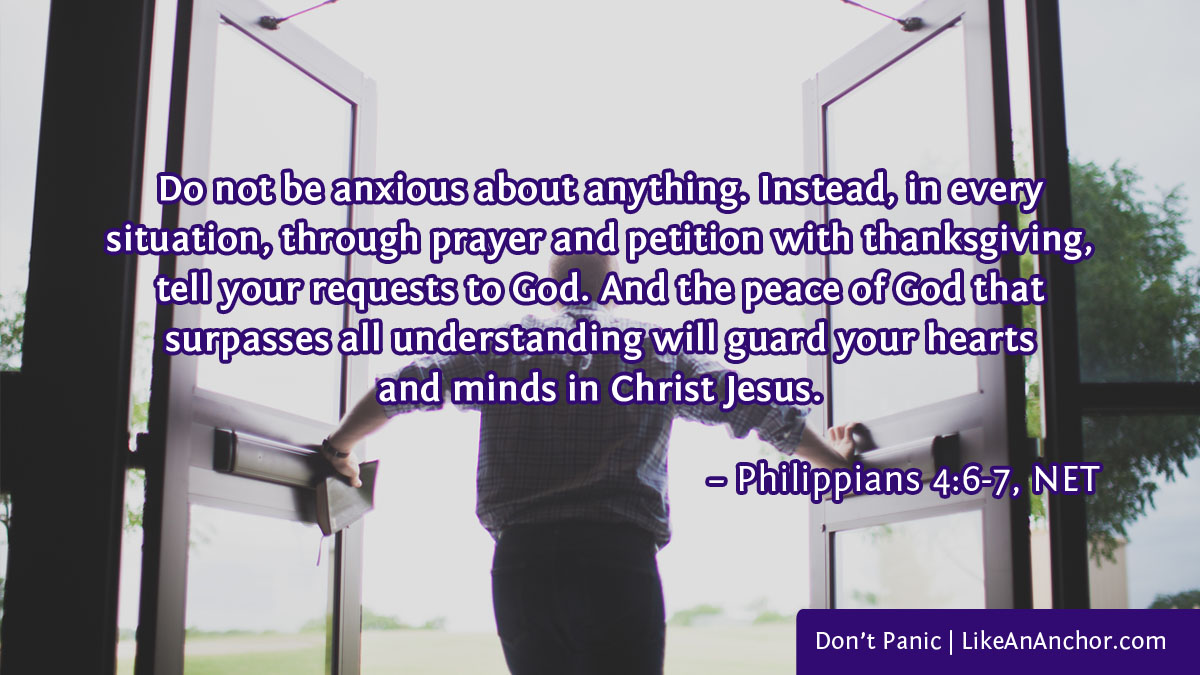
Image of a man pushing doors open, with text from Phil. 4:6-7, NET version: "Do not be anxious about anything. Instead, in every 
situation, through prayer and petition with thanksgiving, tell your requests to God. And the peace of God that surpasses all understanding will guard your hearts and minds in Christ Jesus."
Image by Pearl from Lightstock

Courage to Live as Kingdom-Citizens

We just got home from celebrating Sukkot (Feast of Tabernacles/Booths). This week-long festival that God commands us to observe (Lev. 23:33-43) reminds us that our lives here on earth are temporary. It also invites us to look forward to a future when “our earthly house of this tabernacle” will be replaced with a spirit body (2 Cor. 5:1, KJV) and the kingdom of God will be here on earth at last (as we looked at in our recent Isaiah Study).

Today, we are citizens of God’s kingdom but we’re not living in it yet. We’re still here on earth, like expatriates whose native land is the kingdom of God and who live in foreign countries. Sometimes those countries are nice places to stay. Other times, they’re actively hostile to people following God. When the world around us opposes us for being citizens of heaven, it would be easy to get scared. But Jesus encourages us to do something else.

“Peace I leave with you; my peace I give to you; I do not give it to you as the world does. Do not let your hearts be distressed or lacking in courage. …

“I have told you these things so that in me you may have peace. In the world you have trouble and suffering, but take courage—I have conquered the world.”

John 1427; 16:33, NET

Jesus doesn’t mince words here. He promises peace, but He also says there’s going to be trouble for us in this world. We live in a place that’s war-torn, subject to natural disaster, faces famines, and is full of diseases and danger. There are many beautiful things in this world, but creation is fallen and captive, groaning as it awaits the future kingdom when Jesus will set all things right (Rom. 8:12-25). And on top of those troubles common to all people, many Christians in the world today face persecution for their faith.

If that were the end to the story, it’d be a wonder anyone wants to be a Christian. But the benefits far out weigh the temporary downsides. For one thing, “our present sufferings cannot even be compared to the coming glory that will be revealed to us” (Rom. 8:18, NET). In addition to the future we anticipate in God’s kingdom, we enjoy His presence, comfort, blessings, and aid right now. We can ask Him for help, confident that He will respond, just like the first-century church did. When they were threatened, they prayed for courage to keep teaching (Acts 4:18-31). God didn’t stop all the persecution, but He did answer their prayers. He even turned one of their most feared enemies into a highly effective apostle (Acts 8:1; 9:1-31; 1 Cor. 15:9-10). We can have both peace and courage as followers of God, even in a dangerous world.

Image of four people walking into a church with text from 1 Cor. 16:13-14, WEB version: "Watch! Stand firm in the faith! Be courageous! Be strong! Let all that you do be done in love."
Image by Pearl from Lightstock

Courage to Keep Going

I promised in the introduction that “don’t panic” isn’t just a sci-fi reference. It’s also a quote from the Bible. After Moses’s death, God entrusted Joshua with leading the Israelite people into the promised land. Joshua had seen all the things this people put Moses through in the 40 years since they’d left Egypt. He’d also spied out the land they were heading into, and knew the dangers they’d face there. The last time they’d tried to go into this land, Joshua had been confident that God would fight for them (Num. 14:6-8). Still, it’s understandable that he might have some worries now. God makes sure to address those worries when speaking with Joshua.

No one will be able to resist you all the days of your life. As I was with Moses, so I will be with you. I will not abandon you or leave you alone. Be strong and brave! You must lead these people in the conquest of this land that I solemnly promised their ancestors I would hand over to them. Make sure you are very strong and brave! Carefully obey all the law my servant Moses charged you to keep. Do not swerve from it to the right or to the left, so that you may be successful in all you do. This law scroll must not leave your lips. You must memorize it day and night so you can carefully obey all that is written in it. Then you will prosper and be successful. I repeat, be strong and brave! Don’t be afraid and don’t panic, for I, the Lord your God, am with you in all you do.

Joshua 1:5-9, NET

What an incredible message of reassurance! Look how many times God says, “Be strong and brave,” and the reasons He gives for that courage and strength. “Don’t be afraid and don’t panic,” God says, “For I, the Lord your God, am with you in all you do.” And this wasn’t just a one-time promise to Joshua. We’ve also received promises from the Lord, saying, “I will in no way leave you, neither will I in any way forsake you” (Heb. 13:5, WEB).

In Romans, Paul asks the rhetorical question, “If God is for us, who can be against us?” The answer, obvious to anyone whose been paying attention to the Old Testament record, Jesus’s gospel message, and Paul’s writings so far is that nothing can stand against us when God is with us in all that we do (Rom. 8:28-39).

Courage Thinking of the Future

Image of a woman reading a Bible with the blog's title text and the words "God promises He'll be with us. If we can remember that–if it really sinks in and feels real to us–then panicking will be the farthest thing from our minds."
Image by Pearl from Lightstock

Remember near the beginning when I said the Feast of Tabernacles reminds us there will be a time when “our earthly house of this tabernacle” will be replaced with a spirit body (2 Cor. 5:1, KJV)? Paul also talks about courage in this section of scripture. We live in temporary bodies, just like the Israelites lived in temporary shelters while traveling from Egypt to the Promised Land. We need courage to keep heading toward our own promise of a better future.

For we know that if our earthly house, the tent we live in, is dismantled, we have a building from God, a house not built by human hands, that is eternal in the heavens. … For we groan while we are in this tent, since we are weighed down, because we do not want to be unclothed, but clothed, so that what is mortal may be swallowed up by life. Now the one who prepared us for this very purpose is God, who gave us the Spirit as a down payment. Therefore we are always full of courage, and we know that as long as we are alive here on earth we are absent from the Lord— for we live by faith, not by sight. Thus we are full of courage and would prefer to be away from the body and at home with the Lord. So then whether we are alive or away, we make it our ambition to please him.

1 Corinthians 5:1, 4-9, NET

Our hope for the future contextualizes our present worries. If I’m worried about what someone might think of me, it helps to remember that ultimately God’s the one whose opinion matters most. If I’m worried about a health concern, it’s a comfort to remember that my body is temporary and God plans to give me a better one. If I’m worried something’s going to go horribly wrong, it’s encouraging to remember God won’t let me go through anything by myself.

When it comes from God, “Don’t panic” is advice we have good reason to follow. He’s the Creator, the Sovereign Lord, the God of armies in heaven, the One in charge of how the whole story ends. He promises He’ll be with us. If we can remember that–if it really sinks in and feels real to us–then panicking will be the farthest thing from our minds. That doesn’t mean we’ll never feel worry or even panic, but it does put us in the mindset to welcome in the peace Jesus and Paul promise will guard our mins.

Featured image by Claudine Chaussé from Lightstock

Isaiah Study: Replacing Fear With Joy

As we continue our now two-month study of Isaiah 40-66, I want to connect two of the themes I noted in my very first post at the start of this study. That list of themes included (among other things) “Reminders to ‘fear not!'” and “Joy in our relationships with God.” We already talked about joy in connection to the Sabbath covenant, but there’s a lot more joy here as well. These last 27 chapters of Isaiah record an extended dialog where God shares His feelings, desires, and plans for the future. A large part of those plans and desires have to do with working out wonderful things for His people. We have nothing to fear, and great cause for joy, when we’re in a relationship with God.

Fearless Joy for the Future

Isaiah wrote during a time of upheaval in his country. Israel fell to invading Assyrian armies and, while God delivered Judah for a time in response to righteous King Hezekiah’s prayer, Isaiah warned Jerusalem’s fall would come as well. We can understand why the people already in exile and those who knew captivity was coming might feel abandoned by God. At the same time, we can also see God’s perspective on that crisis–His rebuke for those who abandoned Him, His disgust for idolatry, His reminders of His power and justice, and His desire to dwell with and bless a people who follow Him faithfully. As part of His commitment to justice and salvation, He promises a New Covenant and a new type of relationship; one where He and His people won’t drift apart.

It’s really amazing. After all of the grief we put God through when we sin (Gen 6:5-6); after all the heartbreak of watching the people who covenanted with Him as His bride run off after other gods (Jer. 3:20; 5:7; Is. 54:4-8), He still loves us and wants a relationship with us. He wants that relationship so much Jesus died to replace the Old Covenant marriage with a better covenant and better promises (Rom. 7:1-6; Heb. 8:6-10).

The Lord Yahweh’s Spirit is on me,
    because Yahweh has anointed me to preach good news to the humble. …
    to comfort all who mourn,
to provide for those who mourn in Zion,
    to give to them a garland for ashes,
    the oil of joy for mourning,
    the garment of praise for the spirit of heaviness …

Everlasting joy will be to them.
“For I, Yahweh, love justice.
    I hate robbery and iniquity.
I will give them their reward in truth
    and I will make an everlasting covenant with them.”

Isaiah 61:1, 3,8, WEB

This section of Isaiah has a very hopeful, Messianic message. There are so many prophecies in here looking forward to Jesus’s first coming as well as His second coming. There’s a new covenant, a new marriage relationship, and a new earth that (from our perspective today) have already started happening and will reach fulfillment soon. By “soon” I mean in the same sense that the apostle John did when he said “these are the end times.” We don’t know exactly when Jesus will be back, but His coming is now “nearer to us than when we first believed” and we ought to be making ourselves ready. The promise of His coming should feel real to us, and we should react with fearlessness and joy, just as God’s people are told to do in Isaiah.

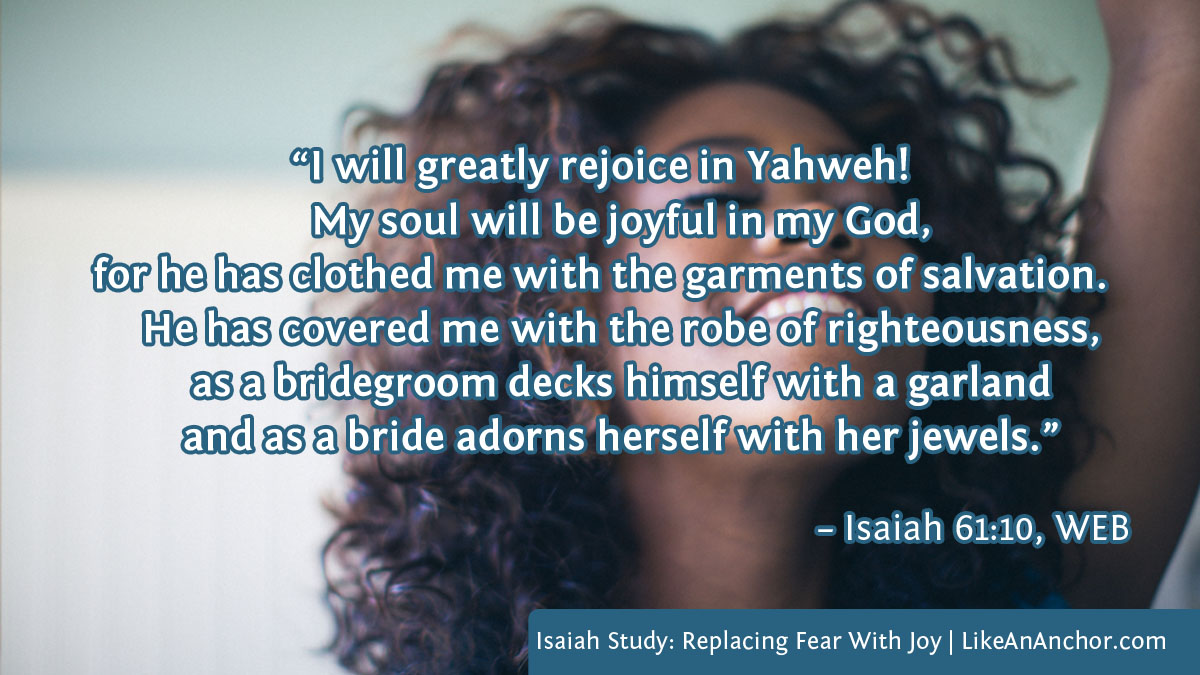
Image of a smiling woman worshiping overlaid with text from Isaiah 61:10, WEB: "I will greatly rejoice in Yahweh! My soul will be joyful in my God, for he has clothed me with the garments of salvation.   He has covered me with the robe of righteousness, as a bridegroom decks himself with a garland and as a bride adorns herself with her jewels.”
Image by Pearl from Lightstock

No Fear of Anyone Who’s Not God

Isaiah chapters 40-66 open with messages of comfort and punishment, a call to prepare the way for the Lord (a prophetic passage pointing to John the Baptist declaring the Messiah), and reminders of God’s sovereignty. He’s incomparable, irreplaceable, and all powerful. Knowing this about God should make us treat Him with the sort of respect, awe, and reverence that’s often called “fearing the Lord.” Knowing that this powerful One calls us His people and promises to help us also gives us joy and confidence. When we fear God, we don’t need to fear anything or anyone else.

“‘You are my servant, I have chosen you and have not cast you away.’
Don’t you be afraid, for I am with you.
    Don’t be dismayed, for I am your God.
    I will strengthen you.
    Yes, I will help you.
    Yes, I will uphold you with the right hand of my righteousness. …
For I, Yahweh your God, will hold your right hand,
    saying to you, ‘Don’t be afraid.
    I will help you.’
Don’t be afraid, you worm Jacob,
    and you men of Israel.
    I will help you,” says Yahweh.
    “Your Redeemer is the Holy One of Israel”

Isaiah 41:9-10, 13-14, WEB

Similar wording shows up again and again in this section of Isaiah. The words, “Don’t be afraid, for I have redeemed you. … Don’t be afraid, for I am with you,” also come with a reminder that Yahweh created us and He is our God (Is. 43:1, 5, WEB). Similarly, God reminds us that He is the only true God and Creator while saying, “Don’t fear, neither be afraid” to the people who say, “I am Yahweh’s … and honor the name of Israel” (Is. 44:8, 5, WEB). Again, God says, “Don’t be afraid, for you will not be ashamed. Don’t be confounded, for you will not be disappointed” as He promises, “my loving kindness will not depart from you, and my covenant of peace will not be removed” (Is. 54:4, 10 WEB).

God doesn’t ask us to pretend the bad things never happened, just like He didn’t pretend Israel wasn’t going through terrible times. Instead, He says in Isaiah 51, “Yahweh has comforted Zion … and I will establish my justice for a light to the peoples.” He promises, “my salvation will be forever, and my righteousness will not be abolished” (Is. 51:3, 4, 6, WEB). He also asks why we would fear any oppressor when the God of the universe is on our side? He could stretch out the heavens and break the seas; why wouldn’t He be able to deliver? Why would we doubt His promise that “Those ransomed by Yahweh will return, and come with singing to Zion. Everlasting joy shall be on their heads. They will obtain gladness and joy. Sorrow and sighing shall flee away”? (Is. 51:11, WEB).

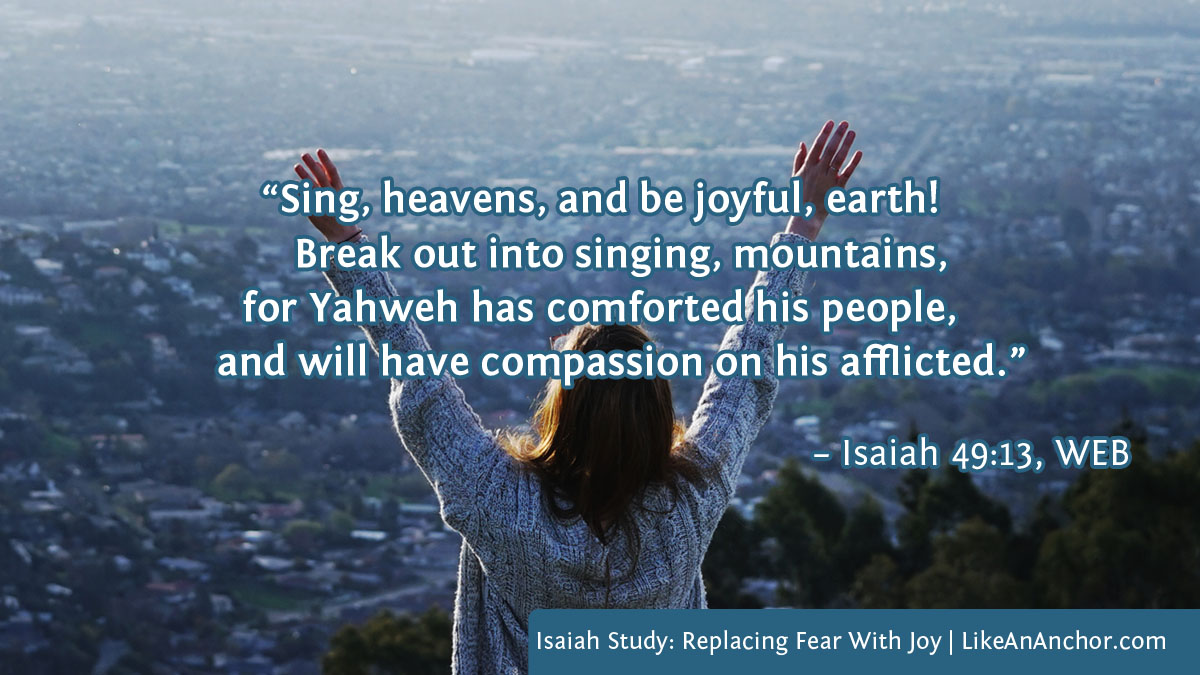
Image of a smiling woman worshiping overlaid with text from Isaiah 49:13, WEB: “Sing, heavens, and be joyful, earth! Break out into singing, mountains,
for Yahweh has comforted his people, and will have compassion on his afflicted.”
Image by Ruby-Rose from Lightstock

The Joy of Salvation

As we look more closely at the declarations of joy in this part of Isaiah, we see that it’s connected with God’s power and deliverance over and over again. We “shout joyfully” to “give the Lord the honor he deserves” (Is. 42:11-12, WEB). Messengers are told to shout with joy as they proclaim that God is on His way with deliverance and salvation (Is. 48:20-21; 52:7-9). God assures His people that there’s no way He’ll get them to the point of deliverance and then fail to follow-through. Rather, His “servants will rejoice” and “sing for joy of heart” (Is. 65:13-19; 66:9-11).

Image of a man sitting on a beach next to a Bible with the blog's title text and the words "We have nothing to fear, and great cause for joy, when we're in a relationship with God."
Image by Aaron Kitzo from Pixabay

For as the rain comes down and the snow from the sky,
    and doesn’t return there, but waters the earth,
    and makes it grow and bud,
    and gives seed to the sower and bread to the eater;
so is my word that goes out of my mouth:
    it will not return to me void,
    but it will accomplish that which I please,
    and it will prosper in the thing I sent it to do.
For you shall go out with joy,
    and be led out with peace.
The mountains and the hills will break out before you into singing;
    and all the trees of the fields will clap their hands.

Isaiah 55:10-12, WEB

Joy and salvation are connected several times in the Old Testament’s more poetic writings. David wrote, “My soul shall be joyful in Yahweh. It shall rejoice in his salvation” (Ps. 35:9, WEB). After David sinned, his repentant prayer included the request, “Restore to me the joy of your salvation” (Ps. 51:12, WEB). Earlier in Isaiah, he writes about joyfully drawing water “out of the wells of salvation” (Is. 12:3, WEB). Similarly, Habakkuk declares, “I will be joyful in the God of my salvation!” (Hab. 3:18, WEB). This link between joy and salvation is essential for understanding God’s commands to rejoice. Even if there are things in our lives that might make joy seem impossible, they can never negate the deep, lasting joy that comes from knowing God saves us.

The promise of joy and salvation includes everyone who responds to God’s invitation to join His family. In Isaiah, God speaks to “the foreigners who join themselves to Yahweh” and “everyone who keeps the Sabbath from profaning it, and holds fast my covenant.” The promise isn’t exclusive; God welcomes everyone who wants “to serve him, and to love Yahweh’s name, to be his servants.” For these people, God promises, “I will bring these to my holy mountain, and make them joyful in my house of prayer.
Their burnt offerings and their sacrifices will be accepted on my altar; for my house will be called a house of prayer for all peoples” (Is. 56:6-8, WEB). That’s an amazing promise, and it’s one that we get to be part of today.

Featured image by Inbetween from Lightstock

The Rightness of Trusting God’s Will Even When It’s Scary

One of the most astonishing statements in all of scripture was made on Passover evening nearly 2000 years ago, on the night in which Jesus was betrayed. Knowing exactly what was about to happen, Jesus still prayed “not my will but yours be done” (Matt. 26:36-46; Luke 22:39-46). This is the ultimate example of meekness–power submitted to the will of God. Jesus could have asked His Father for “more than twelve legions of angels” to free Him from the arresting mob if He’d wanted to(Matt. 26:51-45). Instead, He said, “Father, if this cup cannot be taken away from me unless I drink it, your will must be done” (Matt. 26:42).

Scripture describes Jesus as being “anguished and distressed” and feeling “deeply grieved” in His soul. Emotionally, that sounds like just about as bad as it can get for a human being. Yet even in such a dire situation, He prayed for God’s will to be done. I suspect He even prayed that in part because of the dire situation, using His conviction that God can be trusted and that His will is best to carry Him through what lay ahead.

For us today, who’ve committed to following Jesus’s example, “Your will be done” should also be our prayer during times of testing and trouble (as well as in good times). That’s not always easy to say, though. We might even be afraid or reluctant to pray for God’s will to be done, especially when the future seems uncertain. It comes down to an issue of trust and perspective.

God Knows Best

I often think about the spiritual implications of my struggles with anxiety. If I give in to catastrophizing and fear, what does that say about my level of (mis)trust in God? Connecting that idea to today’s post, it seems that whether or not we want to pray, “Your will be done,” is often tied-in to all those fears and worries. Is God really good all the time? Does He care enough to make this situation work out for me? What if praying for His will means I don’t get what I want or need?

I think we need to reject shaming people (including ourselves) for weaknesses and fears, and rather encourage each other to keep choosing trust and faith over and over again. Anxieties are “afflictions, not sins” (to quote C.S. Lewis), though they can lead us into sin if we let them. Overcoming fear is an ongoing process and it involves conscious choice, including the choice to trust that God knows what He’s doing.

We know that we should pray for God’s will to be done, but we’re often afraid to. Why? Because we do not trust that His will is best for us. We think His agenda and ours are by nature at odds with one another.

Because of our corruption, they may in fact be at odds. But if we could see the whole picture, we would understand that it is our own will that falls short of fulfilling our well-being, not His.

CHRIS TIEGREEN, 365 POCKET DEVOTIONS, DAY 114

It’s often easy to pray, “May your kingdom come, may your will be done on earth as it is in heaven” (Matt. 6:10, NET). When it’s less personal, sometimes it’s easier to wrap our minds around the idea that God changing things and making them better is a good thing (especially when it’s becoming more and more clear how much suffering and corruption is in the world). But it’s often harder to pray, “May your will be done (not mine)” in very personal situations that affect us immediately and directly (especially if we have a preferred outcome in mind). And yet that’s exactly what Jesus did, and what His disciples do.

His Good Plans Will Come to Pass

Paul’s a great example of one of Jesus’s disciples who submitted his own will and plans for his life to God. He started out by persecuting those who believed in Jesus the Messiah, then completely changed his life in response to God making His will known. That cost Paul greatly in terms of physical things, but also blessed him richly in terms of spiritual things.

I’m pretty sure I’ve written before about Paul’s view on trials–“that our present sufferings cannot even be compared to the coming glory that will be revealed to us” (Rom. 8:18, NET). It might not seem at first as if he’s talking about God’s will here, but he is. Going back to Romans 7:14-21, we find Paul describing the struggle between his unspiritual self and the spiritual law of God–his will versus God’s will. Next, Romans 8:1-17 talks about the leading of God’s spirit and Him saving us from sin, which is something He desires/wills for all people (1 Tim. 2:4; 2 Pet. 3:9). Then, Paul describes a struggle in creation, which was not willingly “subjected to futility … in hope,” but as part of God’s will for adopting children into His family (Rom. 8:19-26).

And he who searches our hearts knows the mind of the Spirit, because the Spirit intercedes on behalf of the saints according to God’s will. And we know that all things work together for good for those who love God, who are called according to his purpose …. What then shall we say about these things? If God is for us, who can be against us?

Romans 8:27-28, 31, NET

God has a plan. It’s a good plan. And because He’s the all-powerful Creator and Sustainer of the universe, His good plans for each of us and the whole of creation will come to pass. When we keep this in mind, there’s no need for us to fearfully grasp for control or to worry and fret about the future (Matt. 6:25-34).

We Follow in Christ’s Footsteps

I recently started reading C.S. Lewis’s collection of passages from George MacDonald’s writings. One of the quotes which caught my eye says that because God “is against sin,” sometimes it also feels as if He is against the things that we want, strive for, and dream about. Which might actually be the case, if we’re still living lives influenced by sin, but God is never against us. When God is against someone’s sinful desires,” He is altogether and always for them” (Unspoken Sermons, First Series, The Consuming Fire). God is for us, and sometimes that means showing us that the things we want aren’t good for us. MacDonald also said that God’s “wrath will consume what they call themselves so that the selves God made shall appear” (same source). Coming to the Light isn’t always a comfortable process, but it is always good for us.

What these quotes make me think of is the fact that because God’s will and His love always work for good in the end, sometimes the immediate result of submitting to His will is painful, as it was for Jesus. Jesus knew, though, that His suffering was part of God’s plan to bring about good for the whole world, and things happened exactly as the Father purposed (Acts 4:27-28). Jesus prayed for God’s will knowing with absolute certainty “that the Father had handed all things over to him, and that he had come from God and was going back to God” (John 13:3, NET). We also know that He focused on “the joy set out for him” when “he endured the cross, disregarding its shame,” and that He “has taken his seat at the right hand of the throne of God” (Heb. 12: 2, NET). Following His example, we can also pray for God’s will to be done knowing that God has good things in store for us and for the entire world.

Thinking about Jesus’s trust in His Father also adds another layer to how we can understand the verse, “Endure your suffering as discipline; God is treating you as sons” (Heb. 12:7, NET). Jesus did not need to be disciplined in order to correct bad behavior (since He never sinned), but He certainly suffered. Scripture is clear that following in His footsteps will involve suffering (sometimes from the world, sometimes as an attack from spiritual evil, and sometimes as part of God’s refining process that’s meant to strengthen us and help us grow). When we suffer, we know that we’re not going through anything that Jesus wasn’t willing to go through as well; God is not treating us any differently than He did His only begotten son. We also know that we can look forward to the same goal that Jesus focused on–the goal of eternal life together with God, as a family. We can also pray “your will be done” knowing that God is faithful, that He knows what He’s doing, and that He will work things out for good in the end.

Featured image by Jantanee via Lightstock