How Do We “Eat” Jesus Christ, and What Does That Even Mean?

As we approach Passover (Pesach) and the Feast of Unleavened Bread (Chag HaMatztot), I like to think about Jesus Christ’s sacrifice and the symbolism associated with that. For New Covenant believers, the principal symbols of Passover are foot washing, eating unleavened bread, and drinking red wine. Those are the three things Jesus did at His last Passover here on earth that He told His followers to continue doing (John 13:1-17; Luke 22:14-20).

Today, I want to specifically focus on the bread that symbolizes Jesus’s body. At first, I’d intended to study altars in the New Testament to dig into Hebrews 13:10 more deeply, but I was only a few minutes into that study when I felt prompted to take things in a different direction this week. We’ll still go to Hebrews, but from a different direction than I’d expected when I first started thinking about the topic.

Image of a piece of flatbread overlaid with text from John 6:35, NET version: Jesus said to them, “I am the bread of life. The one who comes to me will never go hungry, and the one who believes in me will never be thirsty.”
Image by Matt Vasquez from Lightstock

The Bread of Life

Because of my focused interest in covenants, I typically spend more time in my Passover studies focused on the wine that Jesus described as “the new covenant in my blood” (Luke 22:20, NET). Today, though, let’s take a look at the bread part of the Passover service. Matthew and Mark’s accounts are nearly identical, so I’ll just quote one of them and Luke.

 So the disciples did as Jesus had instructed them, and they prepared the Passover. When it was evening, he took his place at the table with the twelve. … While they were eating, Jesus took bread, and after giving thanks he broke it, gave it to his disciples, and said, “Take, eat, this is my body.” 

Matthew 26:19-20, 26 NET

Now when the hour came, Jesus took his place at the table and the apostles joined him. And he said to them, “I have earnestly desired to eat this Passover with you before I suffer. … Then he took bread, and after giving thanks he broke it and gave it to them, saying, “This is my body which is given for you. Do this in remembrance of me.” 

Luke 22:14-15, 19, NET

Here, Jesus and His disciples were observing the first holy time of the year on God’s sacred calendar. As commanded, they’re eating the Passover meal on the evening that begins Nisan 14 on the Hebrew calendar. Per Exodus 12:8, that meal includes “bread made without yeast” or “unleavened bread.” The bread was already there, but Jesus assigned a new, deeper meaning to it. Now when we take Passover, the unleavened bread we eat reminds us of Jesus’s body and His sacrifice. It might also remind us of a discussion recorded in John’s gospel.

Jesus’s miraculous feeding 5,000 people is recorded in every gospel (Matt. 14:13-21; Mark 6:30-34; Luke 9:10-16; John 6:1-13). Interestingly, John includes an extra piece of information: “Now the Jewish Feast of the Passover was near” (John 6:4, NET). This would be the Passover one year before Jesus’s death (NET footnote on John 6:4). John also goes on to describe what happened after the miracle. The crowds followed Jesus to the other side of the lake, hoping for more food. Jesus used the opportunity to talk to them about “food that remains to eternal life—the food which the Son of Man will give to you” (John 6:27, NET). Now, they thought this sounded like a pretty good deal, maybe even better than the manna in the wilderness (Ex. 16.4-36; John 6:28-34). They challenged Him to perform a miracle, and He challenged them to understand at a deeper level.

“I tell you the solemn truth, the one who believes has eternal life. I am the bread of life. Your ancestors ate the manna in the wilderness, and they died. This is the bread that has come down from heaven, so that a person may eat from it and not die. I am the living bread that came down from heaven. If anyone eats from this bread he will live forever. The bread that I will give for the life of the world is my flesh.”

 Then the Jews who were hostile to Jesus began to argue with one another, “How can this man give us his flesh to eat?” Jesus said to them, “I tell you the solemn truth, unless you eat the flesh of the Son of Man and drink his blood, you have no life in yourselves. The one who eats my flesh and drinks my blood has eternal life, and I will raise him up on the last day. For my flesh is true food, and my blood is true drink. The one who eats my flesh and drinks my blood resides in me, and I in him. Just as the living Father sent me, and I live because of the Father, so the one who consumes me will live because of me. This is the bread that came down from heaven; it is not like the bread your ancestors ate, but then later died. The one who eats this bread will live forever.”

John 6:47-58, NET

My guess is that Jesus was thinking ahead one year, to the next Passover when He would tell His disciples the unleavened bread represented His body and the red wine His blood. He wants us to understand how much we need Him. Physical food keeps us alive for a while, but “eating” Him–taking Him inside us and accepting His sacrifice–is far more important. A real relationship with Jesus will keep us alive forever.

Inheritance and Sacrifice

The author of Hebrews spends a lot of time explaining how the Old Testament sacrifices, tabernacle/temple, and priesthood all pointed to Jesus. Near the end of the book, the author says, “We have an altar that those who serve in the tabernacle have no right to eat from” (Heb. 13:10, NET). This hearkens back to an Old Covenant practice: the priests serving in the tabernacle or temple ate from the meat of the sacrifices offered in the temple (Lev. 10:10-18; Num. 18:22-24; 1 Cor. 9:13-14).

The priests and the Levites—all the tribe of Levi—shall have no portion nor inheritance with Israel. They shall eat the offerings of Yahweh made by fire and his portion. They shall have no inheritance among their brothers. Yahweh is their inheritance, as he has spoken to them. This shall be the priests’ due from the people, from those who offer a sacrifice, whether it be ox or sheep, that they shall give to the priest: the shoulder, the two cheeks, and the inner parts. You shall give him the first fruits of your grain, of your new wine, and of your oil, and the first of the fleece of your sheep. For Yahweh your God has chosen him out of all your tribes to stand to minister in Yahweh’s name, him and his sons forever.

Deuteronomy 18:1-5, WEB

The Levites–the tribe that all priests came from under the Old Covenant–didn’t inherit land with the rest of the tribes of Israel. Instead, they inherited a special relationship with Yahweh God. New Covenant believers do not directly correlate to the Old Testament priesthood, but we do have similarities with them and the Levites. Peter tells us we’re part of a “priesthood” and Revelation describes the saints as “priests” (1 Pet. 2:5, 9; Rev. 1:5-6; 20:5-6). We also don’t have an inheritance or citizenship on this earth; our citizenship is in heaven and our inheritance is connected with Jesus Christ (Rom. 8:16-17; Phil. 3:20). The verse we opened with from Hebrews indicates we have another similarity with them as well: we’re allowed to “eat from” the altar.

Jesus Christ is the same yesterday and today and forever! Do not be carried away by all sorts of strange teachings. For it is good for the heart to be strengthened by grace, not ritual meals, which have never benefited those who participated in them. We have an altar that those who serve in the tabernacle have no right to eat from. For the bodies of those animals whose blood the high priest brings into the sanctuary as an offering for sin are burned outside the camp. Therefore, to sanctify the people by his own blood, Jesus also suffered outside the camp. We must go out to him, then, outside the camp, bearing the abuse he experienced.

Hebrews 13:8-14, NET

The author of Hebrews just spent a huge section of this letter explaining that Jesus Christ is both the High Priest and the perfect, once-for-all-time sacrifice offered for sins (Heb. 8-10). If we get to “eat from” the altar where He offered His sacrifice, then we’re eating from Jesus Himself. It’s about partaking of His sacrifice, just like we do at Passover.

Our Participation in Passover
1 Corinthians is a letter closely tied to Passover and the Feast of Unleavened Bread. In that letter, Paul asks a rhetorical question about the Israelite priesthood: “Are not those who eat the sacrifices partners in the altar?” (1 Cor. 10:18, NET). The Greek word translated “partners” is koinonos (G2844), which also means “associate, comrade, companion … sharer, in anything” (Thayer’s Dictionary). It is the root word of “fellowship,” the Greek word koinonia (G2842), which describes a believer’s proper relationship with God and His whole family as a “fellowship, association, community, communion, joint participation” (Thayer’s Dictionary; see 1 John 1:3-7). It’s the word that’s translated “sharing” in the verses leading up to the one we just quoted:

 I am speaking to thoughtful people. Consider what I say. Is not the cup of blessing that we bless a sharing in the blood of Christ? Is not the bread that we break a sharing in the body of Christ? Because there is one bread, we who are many are one body, for we all share the one bread. Look at the people of Israel. Are not those who eat the sacrifices partners in the altar?

1 Corinthians 10:15-18, NET

When we “eat” Jesus Christ’s symbolic body, we’re participating in the altar. Our part in the Passover service is to accept deliverance from God and confirm our covenant commitment to Him. Jesus is the only way to salvation; His sacrifice atones for our sins (Acts 4:11-12; 1 John 2:1-3; 4:9-10). It doesn’t just happen automatically, though: we’re expected to participate to a certain degree, namely, by repenting and believing and committing to follow Him (Mark 1:14-15; 16:16; Acts 2:37-38; Rom. 10:8-11). Once we do that, our lives should change. Passover reminds us of that every year.

For I received from the Lord what I also passed on to you, that the Lord Jesus on the night in which he was betrayed took bread, and after he had given thanks he broke it and said, “This is my body, which is for you. Do this in remembrance of me.” In the same way, he also took the cup after supper, saying, “This cup is the new covenant in my blood. Do this, every time you drink it, in remembrance of me.” For every time you eat this bread and drink the cup, you proclaim the Lord’s death until he comes.

For this reason, whoever eats the bread or drinks the cup of the Lord in an unworthy manner will be guilty of the body and blood of the Lord. A person should examine himself first, and in this way let him eat the bread and drink of the cup. For the one who eats and drinks without careful regard for the body eats and drinks judgment against himself. That is why many of you are weak and sick, and quite a few are dead. But if we examined ourselves, we would not be judged.  But when we are judged by the Lord, we are disciplined so that we may not be condemned with the world.

1 Corinthians 11:23-32, NET

As Thayer’s Dictionary says when defining koinonia, our fellowship with God as part of His body of believers involves “joint participation.” When we participate in Passover, symbolically taking in the body of Jesus that He sacrificed for us, we’re part of something much bigger than ourselves. We’re reminding ourselves of the covenant commitment we made with God, of His sacrifice that we’ve accepted on our behalf, and of the way we ought to live as people transformed by Jesus. That’s one of the reasons we’re supposed to examine ourselves before taking the Passover–to make sure we’re doing so “in a worthy manner” that correctly values Jesus’s sacrifice and the fellowship God invites us into as part of His family.


Featured image by WorldInMyEyes from Pixabay

Our Daily Bread

We recently observed Passover and the Feast of Unleavened Bread (Chag haMatzot). I suppose studying what the Bible has to say about bread is an obvious topic after that, but it’s been a more interesting study than I’d expected for something that seems so basic. Even the Lord’s model prayer that so many of us memorize talks about bread, and it has more to say on that topic than I’d assumed. Bread also acts as a spiritual symbol in scripture–Jesus calls Himself the “Bread of Life” and Paul talks about what kind of bread we’re supposed to be.

Bread for Each Day

So pray this way:

Our Father in heaven, may your name be honored,
may your kingdom come,
may your will be done on earth as it is in heaven.
Give us today our daily bread,
and forgive us our debts, as we ourselves have forgiven our debtors.
And do not lead us into temptation, but deliver us from the evil one.

Matthew 6:9-13, NET

The phrase “our daily bread” involves a curious word. In Greek, “daily” is epiousios (G1967) and it’s only used here and in Luke’s account of this same prayer. It’s not even used outside of the Bible anywhere but other “early Christian literature,” which makes the meaning hard to figure out (NET footnote). “Daily” is just a best-guess for the translation. Other suggestions include “the coming day,” “for existence” (NET footnote), “the bread of our necessity,” and “the bread that suffices for each day” (Thayer’s dictionary).

I wonder if, in using a word that indicated sufficient, needed bread for each day, Jesus might have been thinking about Proverbs 30. Here, Agur asks for two things from God: “Remove falsehood and lies far from me; do not give me poverty or riches” (Prov. 30:7-8, NET). This last one might seem an odd request–who wouldn’t want to be rich?–and Agur provides further details.

feed me with my allotted portion of bread,
lest I become satisfied and act deceptively
and say, “Who is the Lord?”
Or lest I become poor and steal
and demean the name of my God.

Proverbs 30:8-9, NET

It seems there’s as much of a danger in feeling as if you are “rich and have acquired great wealth, and need nothing” (to quote the Laodiceans from Revelation 3) as there is in being so poverty stricken that you’re in danger of starving. Neither extreme is healthy, and so balance in prosperity is a prayer worth praying. We need balance–both in the physical things like Agur is talking about and in the spiritual things that Jesus is talking about in the letter to Laodicea (Rev. 3:14-22).

I usually think of the request in the model prayer as asking for provision of needs, with bread standing in for all the things like food and clothing that Jesus tells us we don’t need to worry about just a little later in this same sermon (Matt. 6:25-34). I recently heard someone point out, though, that the focus of this prayer isn’t on physical things. It’s about honoring God’s name, praying for His will and His kingdom, and asking for forgiveness and deliverance. There’s no reason not to assume physical provision is included, but it’s likely that Jesus also intended for us to think about spiritual bread. He is, after all, the bread of life.

Living Bread from Heaven

After one of the loaves and fishes miracles (recorded in John 6), Jesus crossed over to the other side of a lake and the whole multitude followed Him. There, He told them they’d followed Him not because they believed He was the Messiah or because they saw miracles, but because they’d eaten a free meal. He advised them, “Do not work for the food that disappears, but for the food that remains to eternal life” (John 6:27, NET). To work for this eternal food, they must do “the deed God requires—to believe in the one whom he sent” (6:29). Then, these same people who’d just seen Jesus turn five loaves of bread and two fish into enough food for more than 5,000 people with 12 baskets full of leftovers, actually asked Him, “what miraculous sign will you perform, so that we may see it and believe you?” They even brought up the manna in the wilderness miracle, showing full well that they knew they’d seen one bread miracle and were asking for another (John 6:30-31).

Jesus and His Father weren’t focused on delivering physical bread this time, though. There wasn’t going to be a repeat of free food on the ground every morning when the Israelites woke up (Ex. 16:4-36). Rather, they’d planned a far more enduring way to satisfy a deeper, spiritual hunger. Yes, Jesus fed the people when they were hungry but the plan was to go far beyond providing for physical needs. Just as Jesus was here on earth to take the Law and the Covenants to a deeper, higher, fuller level, He did the same thing with the miracle of bread from heaven.

“I am the bread of life. Your ancestors ate the manna in the wilderness, and they died. This is the bread that has come down from heaven, so that a person may eat from it and not die. I am the living bread that came down from heaven. If anyone eats from this bread he will live forever. The bread that I will give for the life of the world is my flesh. … the one who eats my flesh and drinks my blood has eternal life, and I will raise him up on the last day. For my flesh is true food, and my blood is true drink.”

John 6:48-51, 54-55, NET

This brings us right back to where we started this post: Passover and Unleavened Bread. Jesus’s flesh is symbolized by the bread and His blood by the wine that form the core symbols of the New Covenant Passover (Matt. 26:26-30; 1 Cor. 11:23-26). The invitation for us to eat this bread from heaven is also an invitation to be part of His covenant community and be sustained by God.

Our Unleavened Lives

Grace and salvation through Jesus Christ are gifts that we can do nothing to earn. Once we accept those gifts, though, we enter a reciprocal covenant relationship with God. We are supposed to respond a certain way after we’ve received grace. In other words, it is because of the Bread of Life that we ourselves can take on the characteristics of a very particular kind of bread.

Purge out the old yeast, that you may be a new lump, even as you are unleavened. For indeed Christ, our Passover, has been sacrificed in our place. Therefore let’s keep the feast, not with old yeast, neither with the yeast of malice and wickedness, but with the unleavened bread of sincerity and truth.

1 Cor. 5:7-8, WEB

Because we “eat” the Bread of Life, we become “unleavened” bread. Symbolically during the Passover and Days of Unleavened Bread, leaven represents sin. Eating unleavened bread for that seven-day festival pictures us putting sin out of our lives and replacing it with His character. During the remaining days of the year, though we are free to eat yeasted and otherwise leavened breads, the importance of turning to God to fill all our needs (including our need to daily take-in Jesus Christ) remains the same.

God is concerned about our physical needs. He appreciates it when we choose not to fret about where we’ll get our physical daily bread and instead ask Him to provide (as Jesus did in His model prayer), trusting that He can and will take care of us. Even more than that, though, He is concerned about supplying our spiritual needs because that has eternal ramifications. We also ought to pray for God to “give us today our daily Bread of Life,” trusting that He will satisfy our spiritual hunger.

Featured image by FotoshopTofs from Pixabay

Exodus To Corinthians: A Passover Message For The New Testament Church

In 1 Corinthians, Paul makes several references to leavening and to Passover. For many readers today, these references mean very little because so many Christian churches have left the roots of their faith, which Paul was referencing here. In order to really understand key passages of 1 Corinthians, we need to understand Passover and the Feast of Unleavened Bread.

I know some (perhaps quite a few) of you are Christians who don’t keep Passover, but I hope you’ll still keep reading today’s post. I think you’ll find it interesting and maybe it’ll give you something new to think about and study.

Passover Background

The Passover story begins in Exodus 12. We’re nearing the end of the plagues of Egypt, and the Lord is telling Moses what the Israelite must do to avoid the final plague — the death of the first born. In the first month of the year, on the evening that begins the 14th day (Hebrew days begin at sunset), Israel was to kill a young male lamb, paint the door posts of their houses with its blood, then roast the lamb whole and eat it with unleavened bread and bitter herbs (Ex. 12:1-13).

This day shall be to you for a memorial, and you shall keep it a feast to Yahweh: throughout your generations you shall keep it a feast by an ordinance forever. (Ex. 12:14, WEB)

The Lord goes on to describe a festival of unleavened bread (matzah) that follows the Passover. For seven days, no leavening (hametz) is permitted in anyone’s house and whoever eats leavened food will be cut off from God’s people (Ex. 12:15-20). Later instructions in Leviticus clarify the timing of all this, stating that Passover is on the 14th and Unleavened Bread begins with a holy convocation on the 15th, then ends with another holy convocation on the seventh day (Lev. 23:4-8). The two holy days are Sabbaths of rest where you are not to work, much like the weekly Sabbath.

The New Covenant Passover

Moving into the New Testament, the gospels make careful note of Passovers that Jesus kept during his ministry. The first is recorded in John 2:13-23. The second is skimmed over, though Luke 6:1 probably references the last day of Unleavened Bread. John 6:4 mentions the third Passover, and Christ’s final Passover is recorded in detail by all four gospels because that was the day He died.

He said to them, “I have earnestly desired to eat this Passover with you before I suffer, for I tell you, I will no longer by any means eat of it until it is fulfilled in God’s Kingdom.” (Luke 22:15-16, WEB)

He then proceeded to institute new Passover symbols for New Covenant believers. Jesus will not partake of the Passover again until the kingdom of God comes in the future, but He tells us to do so in memory of Him (Luke 22:17-20).

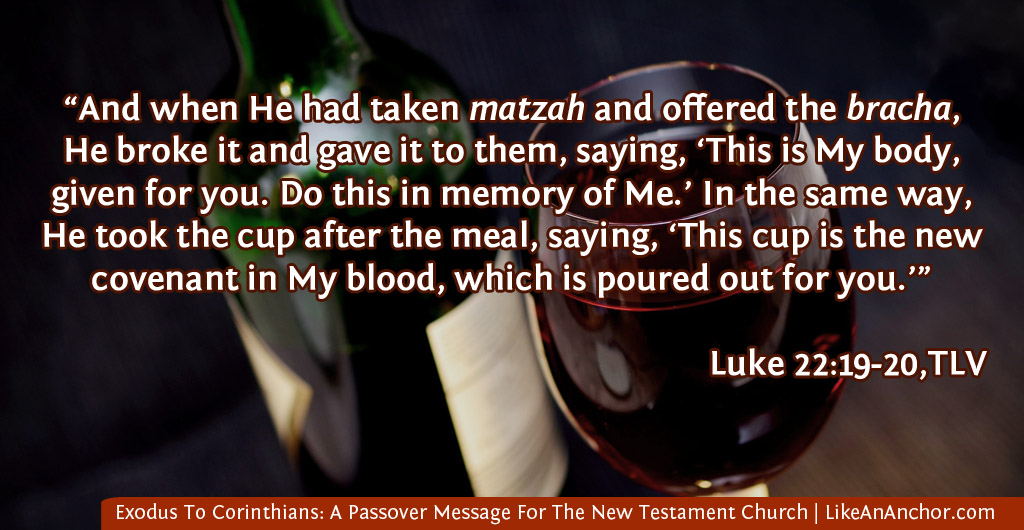
For I received from the Lord that which also I delivered to you, that the Lord Jesus on the night in which he was betrayed took bread. When he had given thanks, he broke it, and said, “Take, eat. This is my body, which is broken for you. Do this in memory of me.” In the same way he also took the cup, after supper, saying, “This cup is the new covenant in my blood. Do this, as often as you drink, in memory of me.” (1 Cor. 11:23-25, WEB)

Exodus To Corinthians: A Passover Message For The New Testament Church | LikeAnAnchor.com
Photo credit: congerdesign via Pixabay

Honoring Jesus By Keeping The Passover

The passage we just read from 1 Corinthians 11 is part of the most obvious Passover reference in this letter. Paul goes on to share instructions on how we’re supposed to prepare for Passover, as well as warnings about the dangers of not keeping Passover the correct way. Read more

How Should We Honor The Days God Sets Apart For Him?

Practicing righteousness. Learning to love. Developing the mind of God. Following Christ. Those are all essentials of the Christian life, and there are many “tools” God has given us to help us succeed in these goals. These include prayer, Bible reading and study, the Holy Spirit inside us, and fasting.

God’s Sabbaths and holy days are also vital, and often overlooked, gifts given to help us align with God and His ways. Keeping these days as God commanded helps line us up with His will, reinforces His plan, and deepens our relationship with Him. Just as responding to an invitation to get together with your physical family lets you build relationships with them, so does responding to our heavenly Father’s invitations help us build relationships with Him, our Bridegroom, and the other children in His family.

For many Christians, keeping God’s holy days is a foreign concept because they’ve been (incorrectly) told “that’s just a Jewish/Old Testament thing. But when you start to recognize there’s lasting value in the days God calls holy to Him, you come up against the question, How do you keep the Sabbaths in a way that honors God?

Even if you have been keeping these days for a while, you know this isn’t always an easy questions to answer. There are certain rules and guidelines in scripture, but they don’t answer all our questions. Plus, knowing what to do, and what not to do, in keeping the holy days is about more than a list of rules. It’s about honoring God’s instructions on how to come before Him. So let’s take a look at what God says to do for these days and how we can obey those commands in the spirit and from our hearts. Read more

Understanding The Days That God Calls Holy To Him

Did you know that there are certain days in the Bible that God calls holy? One of these holy times happens every 7 days and we call it the weekly Sabbath. The other 7 holy days happen at set times in the spring, early summer, and fall.

If you’re reading this when it was posted, the fall holy days ended a couple weeks ago and the spring ones won’t start again for 6 months. This in-between time seems to me like the perfect opportunity for those of us who do keep the holy days to reflect on their meaning, along with how and why we keep them. And if you’ve never observed God’s holy days before, I hope you’ll find value in learning about them and maybe even join us in keeping them.

All the holy days are outlined in Leviticus 23, and then expounded on in other passages as well. In this chapter they’re all called “set feasts” (mo’ed) and “holy convocations (miqra). This identifies them as appointments that God has set at specific times for specific reasons. We talked about these Hebrew words, and others that describe God’s holy days, in last week’s post (click here to read it).

Sabbath

“The children of Israel shall keep the Sabbath, to observe the Sabbath throughout their generations, for a perpetual covenant. It is a sign between me and the children of Israel forever; for in six days Yahweh made heaven and earth, and on the seventh day he rested, and was refreshed.”

Exodus 31:16-7, WEB

As spiritual Israel (Rom. 9:6-8; Gal. 3:29; Eph. 2:12-13), this is part of God’s eternal law that is transferred to us (see post “Inheriting Covenants“). The author of Hebrews talks about this topic from 3:7 to 4:9 and concludes, “There remains therefore a Sabbath rest for the people of God.” The Greek word sabbatismos literally means “keeping Sabbath” (G4520, Thayer’s dictionary).

The Sabbath (which happens every week from sunset on Friday until sunset on Saturday) is a time when we stop doing work and other things that clutter our weeks and enter God’s rest. It’s a time to gather with other believers in God’s presence, to learn from Him, and take on His delights as our own. The Sabbath reminds us of His plan, purpose, and presence, and let’s us practice His rest.

Further study: “Delighting In The Sabbath” by Brian Shaw and Isaiah Study: Joy in the Sabbath Covenant With God

Passover

When the hour had come, he [Jesus] sat down with the twelve apostles. He said to them, “I have earnestly desired to eat this Passover with you before I suffer.”

Luke 22:14-15, WEB

The Passover (Pesach in Hebrew) observance was instituted in Exodus 12, and Israel was told they should keep it and the Feast of Unleavened Bread that followed “throughtout your generations by an ordinance forever” (Ex. 12:14, WEB). Jesus changed/added to (depending on your interpretation) the symbols associated with Passover, but still told his followers to continue keeping it “in remembrance of me” (Luke 22:19; 1 Cor. 11:23-26).

For New Covenant believers, Passover reminds us of God’s deliverance and Jesus’ sacrifice. Drinking the wine and eating the bread symbolize our commitment to and participation in the New Covenant. Passover also lets us “proclaim the Lord’s death until he comes” (1 Cor. 11:26, WEB). It is a way for us to keep in mind of, and remind others, that Jesus died for our sins and that He will return.

Further study: “Passover Questions: Am I Ready To Hear What God Says?” and “Why I’m Keeping Passover On Nisan 14

Feast of Unleavened Bread

Purge out the old yeast, that you may be a new lump, even as you are unleavened. For indeed Christ, our Passover, has been sacrificed in our place. Therefore let us keep the feast, not with old yeast, neither with the yeast of malice and wickedness, but with the unleavened bread of sincerity and truth.

1 Corinthians 5:7-8, WEB

Beginning the day after the Passover, the Feast of Unleavened Bread (Chag HaMatzot) lasts for 7 days. The first and last days are both holy convocations and days when we do no work. For all 7 days, we eat nothing with leavening in it and we eat unleavened bread (Lev. 23:6-8; Ex. 23:15).

As we can see in this quote from Paul’s letter, the early New Testament church was still keeping this Feast. They were doing so in the spirit as well as the letter, recognizing that there’s a purpose behind the symbolism of putting leaven out and taking in unleavened things. These days are a yearly reminder to keep putting off sin and putting on Christ’s nature.

Further study: “Rhythms of Worship” and “Exodus To Corinthians: A Passover Message For The New Testament Church

Feast of Weeks

Now when the day of Pentecost had come, they were all with one accord in one place.

Acts 2:1, WEB

On the Sunday after Passover, ancient Israel performed a ceremony called Firstfruits or Wavesheaf (Lev. 23:9-14). From that day, you count seven Sabbaths plus one day to get 50 days, then o-bserve the Feast of Weeks (better known today as Pentecost or, in Hebrew, Shavuʿoth).

Pentecost is a fascinating holy day. It’s connected with the story of Ruth and our role as firstfruits in God’s harvest. It’s the day Jesus and His Father gave the precious gift of their Holy Spirit to the church. It’s also the only single day called by the Hebrew word a chag (the other holy days designated “Feasts” are the 7-day long Unleavened Bread and Tabernacles). There’s a great deal of significance in this day, and it’s there for us today as well as for earlier believers.

Further study: “Firstfruits from the Rejects” and “The Bridegroom’s Pledge

Day of Trumpets

Speak to the children of Israel, saying, “In the seventh month, on the first day of the month, shall be a solemn rest to you, a memorial of blowing of trumpets, a holy convocation.”

Leviticus 23:24, WEB

There’s not nearly as much information in scripture about the Day of Trumpets/Shouting (Yom Teruah) as for the other holy days, but that doesn’t mean it’s any less important. Many believers (and I think rightly so) see it as the holy day which points to Christ’s return because of the connection with trumpet blasts (1 Thes. 4:16; Rev. 11:15). It’s one of the “shadows” speaking to us of Christ’s reality (Col. 2:16-17).

Further study: “Preparing For The Bridegroom To Come Back” and “With The Sound of Trumpets

Understanding The Days That God Calls Holy To Him | LikeAnAnchor.com
Photo credit: slgckgc via Flikr

Day of Atonement

Yahweh spoke to Moses, saying, “On the tenth day of this seventh month is the day of atonement: it shall be a holy convocation to you, and you shall afflict yourselves; and you shall offer an offering made by fire to Yahweh. … It shall be a Sabbath of solemn rest for you, and you shall deny yourselves. In the ninth day of the month at evening, from evening to evening, you shall keep your Sabbath.”

Leviticus 23:26-27, 32, WEB

The Jews consider the Day of Atonement (Yom Kippur) as the most solemn and holy time of the year. It was the only day a human being could enter the Holy of Holies inside the temple, and even then only the high priest. There was also a ceremony of two goats — one killed for the sins of the people as a picture of Jesus Christ and the other banished as picture of what will happen to Satan (Lev. 16; Heb. 2:17; Rev. 20:1-3).

Today, Atonement reminds us of Christ’s sacrifice, looks forward to a time when Satan is removed from the picture, and invites us to think deeply about our High Priest Jesus Christ. It’s also the only specific day we’re commanded to fast, which in itself has a whole host of spiritual benefits. Exactly how to “fast” is debated, but most people I know (including me) believe it’s a fast of no food or drink for 24 hours. This holy day is briefly mentioned in the New Testament (Acts 27:9).

Further study: “Clean Temples For Yom Kippur” and “Fasting

Feast of Tabernacles

And then every survivor from all those nations coming against Jerusalem will go up year after year to worship the king, Yahweh of hosts, and celebrate the Feast of Booths.

Zechariah 14:16, LEB

The Feast of Tabernacles or Booths (Sukkot) is a week-long feast with an 8th day, the Last Great Day, on the end (Lev. 23:33-36; 39-44). It was a Feast that Jesus kept (John 7:1-10; 37-39), and this prophecy in Zechariah shows it will still be celebrated in the future. It’s a time when we’re told to stay in temporary shelters. Most people I know celebrate this Feast by traveling to a “Feast site” hosted by a church group, staying in a hotel (a place we live temporarily) or camping in a tent (a temporarily set-up shelter), and attending daily church services.

This Feast is a season of great rejoicing, followed on the 8th day by a solemn observance called an atsarah (click here to go to last week’s post on Hebrew words associated with the holy days). Tabernacles reminds us that we’re strangers and pilgrims on this temporary earth, but that a time is coming when God will establish His kingdom here and all people will live in His peace.

Further study: “Tabernacles and Temples” and “Do You Value The Gifts From Your Bridegroom?

Conclusion

This is a long post, but it’s just the briefest overview of the days God calls holy to Him. These days offer a weekly (in the Sabbath) and yearly (in the annual Feasts) rehearsal of God’s plan. He invites — and commands — us to keep these days with Him on His set appointed times because they matter.

“You shall keep my Sabbaths, and have reverence for my sanctuary. I am Yahweh.”

Leviticus 26:2, WEB

We keep His Sabbaths because He is Yahweh — the eternal Lord and the only true God. These days mean something to God, and therefore should mean something to His children. The Sabbaths and Feasts are appointments that God has set at specific times for His people to gather together for specific reasons. God places a high value on these days, calling them “holy” or set-apart for Him. As His children, we should value these days as well.

Free resource! Click here to download a chart summarizing these holy days, including the Hebrew words used for each, when and how they were observed, and New Covenant applications:


Featured image credit: tihanyitom via Pixabay

What Are God’s Holy Days and Why Would We Care?

Prayer is a time we can choose to come before God however we are, whenever we want, and whatever we need. In these cases, we’re sort of “in control” of the interaction. There are also times when God commands/invites us to come before Him on His terms. Those times when God “hosts” us are His weekly Sabbath and the yearly holy days.

Though I’ve been keeping the holy days outlined in Leviticus 23 my whole life, I hadn’t thought about them quite like this before. My family and I kept the Feast of Tabernacles (Sukkot) with a group in West Virginia this year, and one of the Bible studies there was called “Keeping A Holy Convocation.” It’s one of the best, most thought-provoking messages I’ve ever heard and it’s what prompted today’s post (click here to listen to that Bible study).

I won’t take the time here to address the question of whether or not modern believers should keep these holy days, but you can check out my posts “Top 5 Reasons for Christians to Keep God’s Holy Days” and “Rhythms of Worship” if you’re curious. One reason these days are important to us is that they teach us about God’s plan and His priorities, including who we’re meant to be in Him. They’re part of our identity as God-followers, which makes them a key part of our faith and it also relates to this blog’s theme of finding our true selves in God.

This is probably going to be the first post in a series, since there is so much to explore in this topic and I don’t want today’s post to become unreadably long. So for now, let’s just take a look at the ways God describes His holy days. There are 5 key Hebrew words that give us a picture of what these days are and why we should care about them.

Mo’ed

The word mo’ed (Strong’s number H4150) means an appointed time and/or place, as well as an assembly or congregation. The word is used 223 times in the Bible. It’s also translated “season,” as in its first use in Genesis:

God said, “Let there be lights in the expanse of sky to divide the day from the night; and let them be for signs to mark seasons, days, and years” (Gen. 1:14, WEB)

Mo’ed is used of the time for a baby to be born, the right season to keep a commanded Feast day, and for the place of a gathering and/or the people gathered. The Rabbi at my Messianic congregation defines mo’ed as the right person/people, in the right place, at the right time, for the right reason.

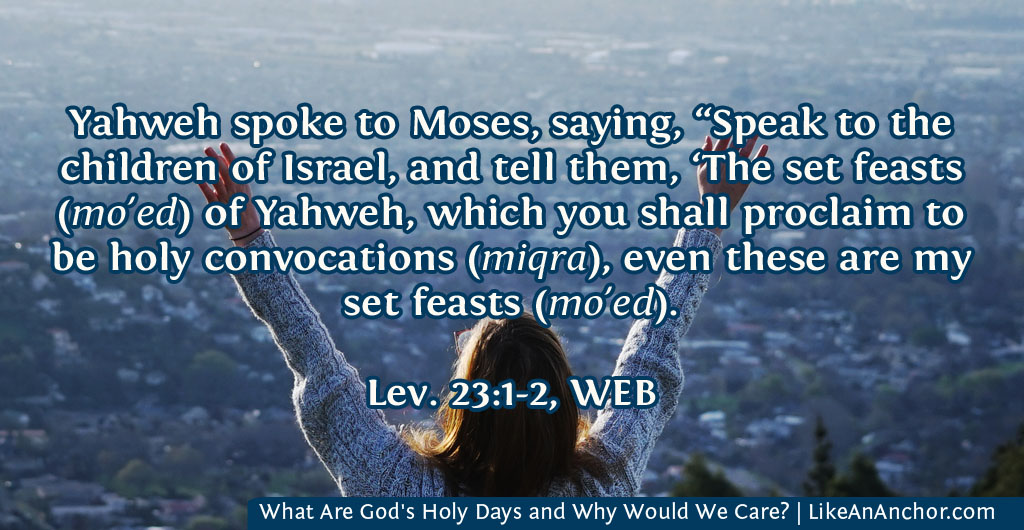
Yahweh spoke to Moses, saying, “Speak to the children of Israel, and tell them, ‘The set feasts (mo’ed) of Yahweh, which you shall proclaim to be holy convocations, even these are my set feasts (mo’ed). … These are the set feasts (mo’ed) of Yahweh, even holy convocations, which you shall proclaim in their appointed season (mo’ed). (Lev. 23:1-2, 4 WEB)

The root word of mo’ed is ya’ad (H3259), which means to appoint, assemble, meet, or betroth. The betrothal translation isn’t used much, but I find it interesting given how much the analogy of Christ as our bridegroom is tied-in with the holy days.

Miqra

Miqra (H4744) is considered a synonym for mo’ed and it’s used 23 times in the Bible. It refers to a rehearsal, assembly, or convocation (which means to call together, as for a meeting). God’s feast days are called “holy convocations,” marking them as meeting times set apart for His purposes.

Yahweh spoke to Moses, saying, “Speak to the children of Israel, and tell them, ‘The set feasts of Yahweh, which you shall proclaim to be holy convocations (miqra), even these are my set feasts. … These are the set feasts of Yahweh, even holy convocations (miqra), which you shall proclaim in their appointed season. (Lev. 23:1-2, 4 WEB)

Miqra can also mean reading aloud. Its root word qara (H7121) means to call, cry out, recite, or enunciate a specific message. In some cases, it means calling by or calling on a name.

They read in the book, in the law of God, distinctly; and they gave the sense, so that they understood the reading (miqra). Nehemiah, who was the governor, and Ezra the priest the scribe, and the Levites who taught the people, said to all the people, “Today is holy to Yahweh your God. Don’t mourn, nor weep.” For all the people wept, when they heard the words of the law. (Neh. 8:8-9, WEB)

The use of miqra to mean readings or callings is often connected to the Feasts. Here in Nehemiah, the people had just rediscovered the fall holy days and were devastated to learn how much they’d lost. As the story continues, we see them overjoyed at the chance to keep the Feast of Tabernacles (Neh. 8:11-18).

What Are God's Holy Days and Why Would We Care? | LikeAnAnchor.com
Photo credit: Ruby-Rose via Lightstock

Chag

The previous two words apply to all the holy days of God. This one, chag (H2282), is used more specifically. It means festival or feast, and refers to the three pilgrim feasts of God: Unleavened Bread, Pentecost, and Tabernacles. Chag appears 62 times in the Old Testament.

Three times in the year all of your males shall appear before Yahweh your God at the place that he will choose, at the Feast (chag) of Unleavened Bread and at the Feast (chag) of Weeks and at the Feast (chag) of Booths, and they shall not appear before Yahweh empty-handed. Each person shall give as he is able, that is, according to the blessing of Yahweh your God that he has given to you. (Deut. 16:16-17, LEB)

These holy festival seasons are described with a different word than the other holy days, and there are some differences in how they’re kept. For example, individuals are told to bring offerings during these days, but not on the other holy days. We’re also told to “keep” these days, which is the word chagag (H2287). Chagag is the root word of chag, and it means to hold or keep a feast. It can also be translated “dance” or “reel,” which connects to other instructions to rejoice in these days.

Shabbat

Shabbat and the closely related word shabbaton (H7676 & H7677) refer to a Sabbath observance. These words show up 122 times in the Old Testament. They are used of the weekly Sabbath and of the fall holy days (Lev. 23:24, 32, 39).

Six days shall work be done, but on the seventh day is a Sabbath (shabbat) of solemn rest (shabbaton), a holy convocation; you shall do no kind of work. It is a Sabbath (shabbat) to Yahweh in all your dwellings. (Lev. 23:3, WEB)

The root word is shabbath (H7673), which means to cease, desist, or rest, and that’s something we do on all the holy days. Though shabbat is not used of the spring holy days or Pentecost, instructions about these days still include the command to not work, so we tend to describe them as Sabbaths as well.

Atsarah

This last word only shows up 11 times in the whole Bible. Atsarah (H6116) means an assembly or sacred/solemn meeting of a company or group. The atsarah that belonged to God are among the things that Israel profaned.

When you come to appear before me, who has required this at your hand, to trample my courts? Bring no more vain offerings. Incense is an abomination to me; new moons, Sabbaths, and convocations: I can’t bear with evil assemblies (atsarah). My soul hates your New Moons and your appointed feasts. They are a burden to me. I am weary of bearing them. (Is. 1:12-14, WEB)

In a positive sense, atsarah is only used specifically of the Last Day of Unleavened Bread (Deut. 16:8) and the 8th day concluding the Feast of Tabernacles (Lev. 23:36). Its root word, atsar (H6113), means to restrain, retain, withhold, close up, or refrain. Apparently, these are two most solemn holy days that God commands.

Why So Much Repetition?

What Are God's Holy Days and Why Would We Care? | LikeAnAnchor.com
Photo credit: Pearl via Lightstock

I’ve heard it said that we should listen closely even when God says something once, but when He says something two or more times then we know it’s something to pay extra attention to. Not only does He talk about these holy days more than once, He uses five different words to explain over and over again how special they are.

The God who cared so much about these days in the Old Testament is the same God that we worship today, which should be reason enough for us to care about these days as well. I’m very much looking forward to studying deeper into His holy days, including how He talks about us keeping them and why He wants so much to share them with His people. I hope you’ll join me 🙂

Free resource! Click here to download a chart summarizing these holy days, including the Hebrew words used for each, when and how they were observed, and New Covenant applications: