Focusing On Authority Misses the Point (How Do Women Serve in the Church?)

I recently read a social media discussion centered on the issue of women in ministry. Without going into too much detail, the original post criticized the idea of “women pastors,” and subsequent comments went in the direction of debating whether or not women had any authority roles in the church. As I read these comments, I started feeling uncomfortable. It’s not as if I’m unfamiliar with this topic or I don’t have my own ideas on whether women are “allowed” to teach, speak, pray, prophecy, or lead in churches (one example: my post “Women Who Speak in Scripture”). But the focus on who gets to have authority struck me as wrong. If we focus discussions like this on who is in charge, I think we’re missing one of the New Testament’s big points about how all Christians are supposed to relate to one another.

Jesus’s Take on Authority

Authority is not a bad thing. Jesus taught with authority, used the authority His father gave Him for good (such as to forgive sins), and currently has “all authority in heaven and on earth” (Matt. 7:29; 9:6; 28:18; John 5:27; 10:18). He also clarifies that His authority comes from God–it’s legitimate authority conferred upon Him by the highest authority (John 12:49). As someone with authority, He could and did give His disciples certain authority, such as over unclean spirits (Matt. 10:1).

In these verses, the Greek word translated “authority” is exousia (G1849). Thayer’s dictionary lists several primary meanings: “1. power of choice, liberty of doing as one pleases … 2. physical or mental power … 3. the power of authority (influence) or right (privilege) 4. the power of rule or government.” Like the English word “authority,” it can refer to legitimate, well-wielded authority or it can have a darker side. We see that in a discussion Jesus had with His disciples at least twice: once after James and John asked for authority in His kingdom and once at the Passover when all the disciples debated who would be the greatest after Jesus died.

Now when the other ten heard this, they were angry with the two brothers.  But Jesus called them and said, “You know that the rulers of the Gentiles lord it over them, and those in high positions use their authority over them. It must not be this way among you! Instead whoever wants to be great among you must be your servant, and whoever wants to be first among you must be your slave—just as the Son of Man did not come to be served but to serve, and to give his life as a ransom for many.”

Matthew 20:24-28, NET

 A dispute also started among them over which of them was to be regarded as the greatest. So Jesus said to them, “The kings of the Gentiles lord it over them, and those in authority over them are called ‘benefactors.’ Not so with you; instead the one who is greatest among you must become like the youngest, and the leader like the one who serves. For who is greater, the one who is seated at the table, or the one who serves? Is it not the one who is seated at the table? But I am among you as one who serves.

Luke 22:24-27, NET

“Authority” in these verses is exousia (or it is in Luke 22; Matthew 20 uses katexousiazo, a derivative meaning “to exercise authority, wield power” [G2715, Thayer]). In this case, it’s talking about people among the nations who have worldly authority. The phrase “lord it over” is another word: kurieuo in Luke 22, which means “to be lord of, to rule, have dominion over” (G2961, Thayer) and katakurieu in Matthew, a related word meaning “to bring under one’s power … to hold in subjection to be master of, exercise lordship over” (G2634, Thayer). It’s definitely not a good thing in this context, and Jesus clearly tells his disciples not to act this way. If you want to be great in His church, then you serve.

When I saw people arguing things like, “How dare women try to get authority over men?” or “I can’t stand that only men get authority, why can’t women like me be in charge?” I thought about these verses. There are certain kinds of authority given to people in the church (and legitimate roles instituted by Jesus or those He taught directly, such as apostle, pastor, and deacon), but if we’re concerned about who gets to lord it over other people then we’re missing the point. No one is supposed to be lording it over other people or coveting a position where they could do that. We’re supposed to be humble and focus on service.
Image of a young woman standing in church reading the Bible overlaid with text from Gal. 5:13, NET version:  “For you were called to freedom, brothers and sisters; only do not use your freedom as an opportunity to indulge your flesh, but through love serve one another.”
Image by José Roberto Roquel from Lightstock

Who Can Serve and How?

Maybe instead of asking, “Can women have authority in the church?” we should ask, “Can women serve in the church?” The answer to that is a resounding “Yes!” supported by the examples of many women in the Old and New Testaments. What gets more to the heart of the original debate, though, is the question, “How do women serve in the church?” We have examples to answer that question as well. We know for certain that women in the Bible served God’s people in these ways:

There may even have been a woman apostle, Junia (Rom. 16:7), but her exact role is so hotly debated that I didn’t put “apostle” on my list (scholars pretty much agree that she was a woman, but not on whether the phrase used in this verse indicates she could have been an apostle). Clearly, women were heavily involved in the church, both in what we think of as “behind the scenes” roles and (apparently more rarely, though female prophets are relatively common) in the more public leading, serving, teaching, preaching roles. When God uses a woman to do something in scripture, we really can’t argue that the church shouldn’t allow women to do those same things today.

Things Women (Probably) Don’t Do

It’s worth noting some of the roles that we don’t see examples of women in. If we look at the lists of ministry gifts/roles in 1 Corinthians 12:28 and Ephesians 4:11, we see “first apostles, second prophets, third teachers, then miracles, gifts of healing, helps, gifts of leadership, different kinds of tongues” (1 Cor. 12:28, NET) and “some as apostles, some as prophets, some as evangelists, and some as pastors and teachers” (Eph. 4:11). Let’s use those lists as a guide for examining women’s possible roles in the church.

We might have one possible example of a woman as an apostle, but no specific examples of them as pastors (from the same Greek word translated “shepherd”) or evangelists (Greek word only used 3 times). However, “evangelist” is a title that comes from the Greek verb euaggelizo (G2097), “to bring good news” or preach the gospel (Thayer). It is likely that women did participate in that activity (Acts 8:1-4; Phil 4:2-3). We also don’t have specific examples of women performing miracles or healings. But we know for certain that women can be prophets, that women teach even if not called “teacher” as a title, that they fill helper roles, that they can have leadership-related gifts, and that those at Pentecost spoke in different languages just like the apostles and other men (Acts 1:14; 2:1-4).

It seems, then, that we can say women did not serve as pastors/shepherds in the Bible and that they were not typically apostles or evangelists. The only other church “authority” roles I can think of in the New Testament are elder, bishop/overseer, and deacon/servant. We have a concrete example of a woman as a deaconess/servant, but no women in the overseer role. “Elder” seems to refer to men most of the time, but the feminine version of the Greek word is used in 1 Tim. 5:2. I suspect that when “elder” is used to refer to respected older people in the church it often includes men and women, but when it’s used to refer to an ordained role in the church it typically or exclusively refers to men. That said, we also don’t have any verses directly saying, “women cannot be pastors.”

You might be uncomfortable with how ambiguous I’m being here, but it is deliberate. The need to have hard rules defining what women and men can and cannot do is a product of Western cultural mindset being applied to the Biblical text. We want specific and inflexible rules for things, but Eastern cultures (like those of Biblical writers) see rules differently: “rules apply except when the one in charge says otherwise. Westerners might consider this arbitrary; many non-Western Christians consider this grace” (Misreading Scripture With Western Eyes, Richards & O’Brien, p. 174). As an example, one of the authors of this book recounts a time when he was invited to speak to a group of pastors in Indonesia. He was shocked, knowing the group’s bylaws say pastors must be male, to see a few women in the audience. When he asked about it, he was calmly told, “Yes, and most of them are [male]” (p. 169). The Indonesian man he spoke with saw nothing strange about an exception to the rule. Perhaps Christians at the time Paul wrote Romans would have heard us say, “Women can’t be apostles,” and responded by saying, “That’s right, except for the times when they are apostles.”
Image of three women holding hands to form a circle and pray, overlaid with text from Acts 2:17-18, NET version: “And in the last days it will be,” God says, “that I will pour out my Spirit on all people, and your sons and your daughters will prophesy,
and your young men will see visions, and your old men will dream dreams. Even on my servants, both men and women, I will pour out my Spirit in those days, and they will prophesy.”
Image by Pearl from Lightstock

But What About 1 Timothy 2?

Because we’ve been talking about authority, we need to address 1 Timothy 2:12, where Paul wrote, “I don’t permit a woman to teach, nor to exercise authority over a man” (WEB). Seems straightforward enough, until we start looking at the context and Greek words. Paul doesn’t use any of the typical words for authority here, but rather the incredibly rare word authenteō. This word may refer to wrongly used authority and/or could be connected to astrology practiced by some pagan women at the time, but it’s hard to say for sure since this is the only time it’s used in the Bible and it’s rarely used in contemporary writings (“The Strangeness of 1 Timothy 2:12,” Andrew Bartlett). Paul also uses a different phrase, “I don’t permit,” than he typically uses when laying down rules for the churches.

We also should take note of the fact that Timothy was in Ephesus when he received this letter, a church that Paul specifically brought Priscilla and Aquilla into and where he left them to serve (including teaching Apollos when they arrived [Acts 18:18-28]). It makes a whole lot more sense to interpret this as a prohibition against women usurping (KJV), dominating (ASV), or lording it over (TLB) a man (note that “man” is singular in the Greek, not the plural “men”) rather than a general rule that women never speak or have any authority, particularly given how involved some women were in ministry in the New Testament.

This analysis might seem pedantic or as if we’re trying to “get around” this scripture, but when you come across something in Paul’s writings that is hard to understand (and a lot of things are [2 Pet. 3:16-17]) we need to look at how it fits with the rest of scripture. Our interpretation of what he says has to match other things in the Bible. In this case, if scripture shows women consistently involved in various types of ministry work–including, occasionally, what we’d think of as “authority” roles like prophet or church host–then Paul’s words here can’t be a prohibition on women serving in the body of believers. It would go against precedent in the entire Bible–including Jesus’s radical treatment of women as equals and Paul’s own writings about how God views converted men and women on a cosmic scale (1 Cor. 11:11-12; Gal. 3:28)–if Paul were making a blanket declaration against women serving in the church. It is much more likely that he is telling Timothy not to let women in Ephesus do things that men wouldn’t be allowed to do either (e.g. lord it over others in the church or teach things related to astrology).

It seems very strange to me that we pull out a few isolated phrases Paul uses (1 Cor. 11:3; 14:34; 1 Tim. 2:12) and come up with this whole doctrine that women can’t ever teach, speak, or have public roles in the church. What about the whole rest of the Bible? What about how Jesus treated women? It seems just as misguided to me as those who take Paul’s statement, “you are not under law but under grace” (Rom. 6:14, NET) to mean that New Covenant Christians don’t have to obey God. We need to be careful about things like this, and test our assumptions (even if they’ve been assumptions for centuries of church history) to make sure they actually fit what God teaches through His word.

Motivated by Service and Humility
Image of two clasped hands, overlaid with blog's title text and the words, "When God uses a woman to do something in scripture, we really can't argue that the church shouldn't allow women to do those same things today. It’s not about who has authority; it’s about serving where God wants us to."
Image by Anggie from Lightstock

As we look at the roles we see women in the Bible filling or not filling, we need to be careful how we conceptualize authority related to those roles. The point isn’t to figure out who is most important (e.g. is it the male pastor or the female prophet?) but to serve God with the gifts He provides in the role He supplies. If God calls a woman to host the church in her home, that’s what she does. If He gives a woman the gift of prophecy, then she’s supposed to prophecy.

Likewise, if He chooses not to place women in the role of ordained pastor, elder, or overseer, that is God’s choice and the New Testament makes it seem like this is indeed the case (at least most of the time). Most men don’t fill those roles either; other roles are more commonly needed in the church. We’re not supposed to be jealous of or resent people who have roles that we think of as more authoritative than us any more than Jesus resents His Father for being greater than Him (to be clear, there is no resentment or competition between Jesus and the Father [John 10:29-30; Phil. 2:5-11]).

 Instead of being motivated by selfish ambition or vanity, each of you should, in humility, be moved to treat one another as more important than yourself. Each of you should be concerned not only about your own interests, but about the interests of others as well. You should have the same attitude toward one another that Christ Jesus had,

who though he existed in the form of God
did not regard equality with God
as something to be grasped,
but emptied himself
by taking on the form of a slave

Philippians 2:3-7, NET

No one in God’s church is supposed to seek authority roles for the prestige or the power. We should seek to serve with humility, the same way that Jesus modeled. In a healthy church following God’s lead, we’ll filter into the roles most suited to the gifts He has given us (ideally without doctrinal misinterpretation or other people’s “selfish ambition or vanity” blocking someone from what they’re supposed to be doing). It doesn’t always work that way because the church is composed of people–redeemed people working on becoming more like God, but still people who can make mistakes. We need to have patience with each other in that. For example, it is not wrong for me to want churches I’m involved with to let me exercise my teaching gifts (and other women to exercise their gifts), but it is wrong when I feel as if I deserve more recognition and responsibility than I get or when I resent other people who have the opportunity to use their gifts differently than I do.

Two of the things that we’re called to do is submit “to one another out of reverence for Christ” (Eph. 5:21, NET) and “through love serve one another” (Gal. 5:13, NET). We’re not called to seek authority or argue about who gets to be in charge. Ultimately, Jesus is the one in charge as head of the church (Eph. 1:22; Col. 1:18). The rest of us are here to serve in a variety of different capacities, but all of them characterized by encouragement, love, and humility (see, for example, John 13:35; 2 Cor. 1:24; Eph. 4:1-3; Col. 3:12-13). If we think any of this is about being in charge, claiming authority over others, or getting what we think we’re owed, then we’ve missed the whole point.


Featured image by Shaun Menary via Lightstock

Song Recommendation: “Way Maker” by Mandisa

Women Who Speak In Scripture

One of the things I hoped for when I began a Master’s degree in Rhetoric and Writing at a Christian-founded university was that I’d get a chance to study some Biblical rhetoric. This semester, I’m taking classes on Classic and Contemporary rhetoric. In one of them, we read texts by women written during the Renaissance where they used rhetorical strategies to prove that women have a role in teaching scripture.

It was both fascinating (and a little discouraging) to read Sor Juana Inés de la Cruz using the exact same arguments to defend her ability to teach the scriptures in 1691 that I’ve used in the 21st century. I agree with her that when Paul calls for women to remain quite in church (1 Cor 14:34; 1Tim 2:12), his “prohibition applied only to public speech from the pulpit” not to writing or even to teaching (The Rhetorical Tradition, 2nd ed., p. 788). It’s absurd to think that Paul meant women should never speak or teach when he also gives instructions for how and when it’s appropriate for women to pray and prophecy in church (1 Cor. 11:1-16) and since he directly instructs women to teach other women (Titus 2:3).

Stepping away from Paul’s writings for a moment, we see examples of women speaking, leading, and teaching throughout scripture. Deborah, the Queen of Sheba, Abigail, Ester, Rahab, and Hannah are all mentioned by de la Cruz, and she could have added Miriam, Ruth, Huldah, Anna, Philip’s daughters, and Priscilla as well. We also read another text in my class from 1666 written by Margaret Fell–one of the earliest Quakers and a highly influential teacher. She points out that there’s no indication in scripture that the apostles despised or rebuked women like Priscilla for teaching (The Rhetorical Tradition, 3rd ed., p. 860). Furthermore, God Himself said that His daughters would prophesy (Acts 2:14-18), so who are human beings to say women should not speak when they’re inspired by the Lord?

Fell also points out something I hadn’t thought of before. Women’s words are recorded throughout scripture and men often base sermons on their words. Fell accused men in the churches of her day of hypocrisy in this area, saying, “you will make a Trade of Women’s words to get money by, and take Texts, and Preach Sermons upon Womens words; and still cry out, Women must not speak, Women must be silent; so you are far from the minds of the Elders of Israel” (The Rhetorical Tradition, 3rd ed., p.865). Even if ministers today aren’t profiting off their work the same way the priests Fell criticizes were, many will still use Biblical women’s words as a sound foundation for teaching while telling modern women not to teach.

Last week, I wrote about a woman from the Bible named Hannah in my post “What Potential Does God See In You?” She’s one of the women whose example and words–including her recorded prayer–are still used to teach people today. God saw her and regarded her with favor though she was initially judged harshly by the priest. And Hannah is far from being the only example of women whom God takes notice of and whom He gives a key role in His plan. Let’s look at some others today.

Huldah

King Josiah was one of the very few righteous kings in the years following David’s reign over Israel. He became king at just eight years old, and when he was 26 he asked his scribe to make sure the priests had the funds needed to repair the temple in Jerusalem (2 Kings 22; 2 Chr. 34). While working in the temple, the priests found a book of the Law. They read it to Josiah, and he tore his clothes in grief when he realized how badly his nation had strayed from following God. He told his advisers, “Go inquire of Yahweh for me, and for the people, and for all Judah, concerning the words of this book that is found.”

So Hilkiah the priest, Ahikam, Achbor, Shaphan, and Asaiah, went to Huldah the prophetess, the wife of Shallum the son of Tikvah, the son of Harhas, keeper of the wardrobe (now she lived in Jerusalem in the second quarter); and they talked with her.

She said to them, “Yahweh the God of Israel says, ‘Tell the man who sent you to me, “Yahweh says, ‘Behold, I will bring evil on this place, and on its inhabitants, even all the words of the book which the king of Judah has read. Because they have forsaken me, and have burned incense to other gods, that they might provoke me to anger with all the work of their hands, therefore my wrath shall be kindled against this place, and it will not be quenched.’” But to the king of Judah, who sent you to inquire of Yahweh, tell him, “Yahweh the God of Israel says, ‘Concerning the words which you have heard, because your heart was tender, and you humbled yourself before Yahweh, when you heard what I spoke against this place, and against its inhabitants, that they should become a desolation and a curse, and have torn your clothes, and wept before me; I also have heard you,’ says Yahweh. ‘Therefore behold, I will gather you to your fathers, and you will be gathered to your grave in peace. Your eyes will not see all the evil which I will bring on this place.’”

2 Kings 22:14-20, WEB

Though this group included the high priest, he didn’t ask God for advice directly. Prophets and priests had different roles–the priests served in the temple and a prophet or prophetess delivered God’s messages to people. At this time, the go-to person for making inquiries of God was a prophetess named Huldah. She delivered God’s message, and King Josiah listened (2 Kings 23:1-30). There was no question of whether or not God could speak through her because she was a woman; He simply did, and that was that.

Priscilla

The first time in the Bible that we hear of Priscilla and her husband Aquilia is when Paul went to Corinth (Acts 18). They were tentmakers like Paul, and so he stayed with them to practice his trade while he preached Jesus Christ. When Paul left, Priscilla and Aquilia went with him to Caesarea. They stayed in that region while Paul went on to preach in Galatia, and they were there in the city of Ephesus when Apollos showed up.

Now a certain Jew named Apollos, an Alexandrian by race, an eloquent man, came to Ephesus. He was mighty in the Scriptures. This man had been instructed in the way of the Lord; and being fervent in spirit, he spoke and taught accurately the things concerning Jesus, although he knew only the baptism of John. He began to speak boldly in the synagogue. But when Priscilla and Aquila heard him, they took him aside, and explained to him the way of God more accurately.

Acts 18:24-26, WEB

Here, both Priscilla and Aquilia explained the way of God. She was teaching alongside her husband. In his letters, Paul sends greetings to them both and describes them as his “fellow workers” (Rom. 16:3-4; 1 Co. 16:19-20; 2 Tim. 4:19). Not once does he tell Priscilla to stay silent or stop teaching and let her husband do all the talking. That’s particularly worth noting because sometimes people will argue that Paul’s instruction for women to be silent applies only to wives (the Greek word could be translated either way), but both Priscilla and Huldah were married when they acted as teacher and prophetess. The more evidence we look at, the clearer it becomes that silence for women is situational (e.g. they shouldn’t disrupt church services, and typically don’t hold public/authority roles in the church).

Thoughts for Further Study

There are so many more examples we could look at. We could go to Exodus 15 where Moses’s sister Miriam is called a prophetess. We could turn to Judges 4-5 and read about Deborah the prophetess, a judge and leader of Israel. We can read in 1 Samuel 25 of how Abigail’s words and actions turned King David away from vengeance. Or we could travel in the New Testament to Luke 2 where Anna the prophetess proclaims Jesus to those looking for redemption. Then we could go to Acts and read about Philip’s four daughters who prophesied. We can also look at the end of Paul’s letter to the Romans and see how many women he mentions helping forward the gospel including Junia, who is “notable among the apostles,” and Phoebe who is “a servant of the church in Cenchrea” (the word translated “servant” is the same as the one translated “deacon” in 1 Tim. 3).

One of the things I appreciated about both Sor Juana’s and Margaret Fell’s writings is that they were careful about how they used scripture. Rather than saying Paul was wrong or that his words could be dismissed as outdated, they argued from scriptures that Paul’s letters were misinterpreted. That misinterpretation led to hundreds of years of women needing to fight for the roles in modern churches which God already gave us in His Bible. Thankfully, women are far more fully involved churches today than they were several centuries ago. Even so, I still occasionally hear things like, “Is it okay for you to have a blog where you’re teaching? Women shouldn’t do that, you know.”

There are ways that God has different roles for men and women to play (see, for example, Paul’s words on how marriage pictures Christ and the church). This includes some differences in how they serve in the church. Women in the Old Testament didn’t serve as priests in the temple, but they did serve as prophetesses and they continued that role into the New Testament. And while we don’t see women spoken of as pastors or church leaders in the New Testament, they are clearly serving in the congregations and sharing the gospel. It makes sense that there’d be plenty of areas where our serving roles overlap. We’re all children of God and we’re all one in Christ Jesus (Gal. 3:26-28). God pours out His spirit on all of us alike, and gives us gifts and roles to serve and build up the church congregations (Acts 2:17; 1 Cor. 12).

Women have always been closely involved in God’s church and in His plan. They prayed, taught, sang, preached, and followed Jesus. In His time here on earth, He interacted with women as equals in a way that shocked His disciples (John 4:27). He included women in the gospel and pointed out that their actions should be recorded (Mark 14:3-9, for example). Women traveled with Him during His ministry, and they’re the ones He appeared to first after His resurrection and entrusted with taking the news to His disciples (click here to read that account across gospels). In Acts, women and men both received the gospel, got baptized, and endured persecutions together (Acts 5:14; 8:3, 12; 9:1-2; 17:4, 12). God even uses feminine imagery for the church as a whole, calling it calling it a Bride fully involved in serving alongside her Bridegroom, Jesus Christ. He doesn’t have a problem with women being fully involved in His church; He thinks it’s a good thing.


Want to study this subject further?

Download my free month-long scripture writing program, “Women Who Speak.”


Featured image by Ben White from Lightstock

Feeling Is A Rational Function, and Other Things You Might Not Know About Thinking and Feeling in Myers-Briggs®

In the Myers-Briggs® typology system, a preference for Feeling (F) or Thinking (T) shows up as the third letter in your personality type. But what does it actually mean to use Thinking over Feeling, or vice versa?

You’ve probably heard that Thinking types tend to be more rational and cerebral than Feeling types, who are typically more emotional. There’s a lot more to it than that, though, and the stereotype isn’t entirely accurate. Keep reading to learn 5 things you might not have known about the Thinking and Feeling processes.

They’re Both Judging Functions

Thinking and Feeling are both what we call “Judging” functions. They’re used to describe the psychological process you use most often when making decisions. If you have an F in your four-letter type code, then you use Feeling to make decisions. If you have a T in your type, then you use Thinking.

If you’re a Judging (J) type, then that means you use your judging function to interact with the outer world. A TJ type uses Extroverted Thinking and an FJ type uses Extroverted Feeling as their most comfortable way of making decisions. If you’re a Perceiving (P) type you still have a judging function, but it’s oriented to your inner world. A TP type uses Introverted Thinking and an FP type uses Introverted Feeling.

Both Thinking Are Feeling Are Rational

One of the biggest surprises when I started diving deeper into research on psychological types is that Feeling and Thinking are both considered rational processes. Read more

The Curious Case of the INFJ Hero

Today we’re going to talk about INFJ heroes in fiction, especially male heroes. But before we get to that, let’s talk about Russian literature for a moment. The Brothers Karamazov by Fyodor Dostoevsky opens with an apologetic explanation from the narrator about his hero, Alexei Fyodorovich Karamazov. Here are a few highlights:

“While I do call Alexei Fyodorovich my hero, still, I myself know that he is by no means a great man …

One thing, perhaps, is rather doubtless: he is a strange man, even an odd one. But strangeness and oddity will sooner harm than justify any claim to attention …

If I, that is, the biographer himself, think that even one novel may, perhaps, be unwarranted for such a humble and indefinite hero, then how will it look if I appear with two; and what can explain such presumption on my part?” (p.3-4, Pevear/Volokhonsky translation)

As you may have guessed from the title of this post, Alyosha is an INFJ (most characters and the narrator use this nickname throughout the novel. In the Cyrillic alphabet, Alyosha is two letters shorter than Alexei, which makes this something like calling a man named Robert “Bob”). And I suspect that it’s his personality type that makes the narrator so worried about how people will respond to his hero.

It’s not that there aren’t other INFJ heroes in fiction. Just take a look at my post about 10 Stories You’ll Relate To If You’re An INFJ if you want some examples. Jane Eyre, Amélie, Yoda, and Atticus Finch are all INFJs in fiction who play a hero role. But even though there are male characters on this list, I’m going to go out on a limb here and say that if Alyosha was a woman with all the same personality characteristics the narrator wouldn’t have felt the need to apologize for her.

Read more

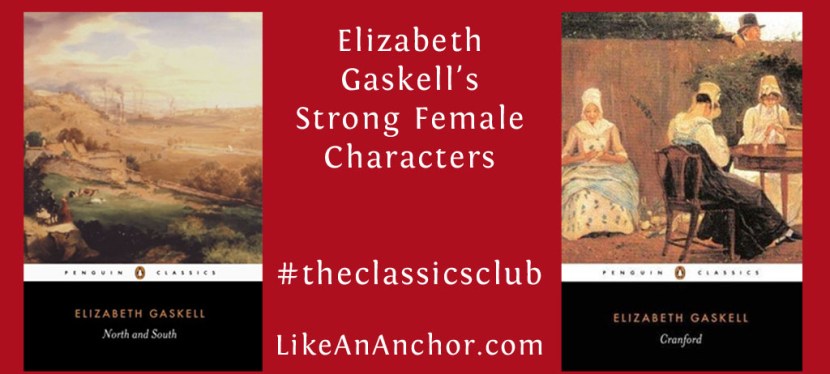
Elizabeth Gaskell’s Strong Female Characters

I’m fascinated by female characters who find ways to live life on their own terms within their culture’s ideas of femininity. Many of my favorite “strong female characters” from Classic literature (like those in Jane Austen, Charlotte Bronte, Francess Burney, and Elizabeth Gaskell’s books ) already have a sense of their own worth and, while they may push against certain confining ideas on appropriate female behavior, they don’t hate their own femininity or attack other women for being feminine. When they fight for their rights, they do it as women who are inherently equal to men — not as women trying to be men.

My two latest books for The Classics Club list are both written by Elizabeth Gaskell. North and South is a re-read for me and Cranford was a new one. I decided to blog about these two books together so I wouldn’t be devoting quite so many articles here to book reviews. I’d expected them to have enough similar themes that this would be easy to do (similar to blogging about Cooper’s sea tales together). But I was pleasantly (if somewhat inconveniently) surprised to find out that the two books are very different. Gaskell is a much more versatile writer than I’d been giving her credit for in my mind.

Characters Who Need Each Other

The contrast is immediately apparent. North and South (1855) opens with a wedding while Cranford (1853) opens with the line, “In the first place, Cranford is in possession of the Amazons; all the holders of houses, above a certain rent, are women.” Men are extremely rare and viewed with much suspicion in Cranford, but in the world of North and South most of the action is driven by or centers around men. One might say Cranford is defined by the absence of men and North and South by the actions of men.

That wouldn’t quite be fair to the women of these books, though. Both stories are filled with what I would call strong female characters. They don’t punch things, shoot stuff, or walk around talking about how empowered they are while wearing sexy clothes. But I would submit to you they’re actually better-written and even “stronger” than the female characters who run around modern films insisting they don’t need anyone’s help. Gaskell’s characters model a connected community of both men and women who are stronger together. Read more

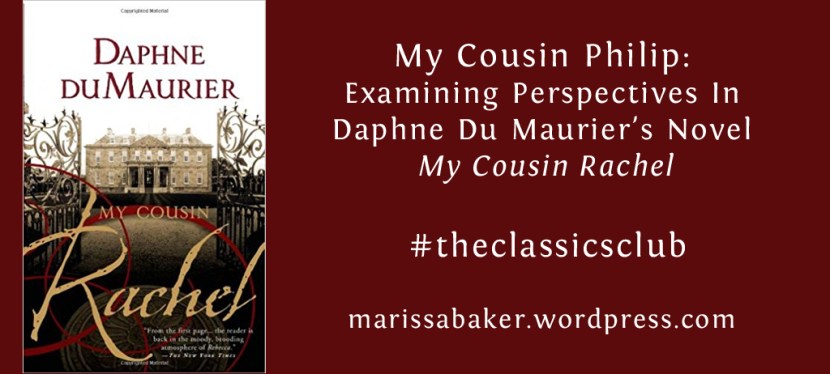
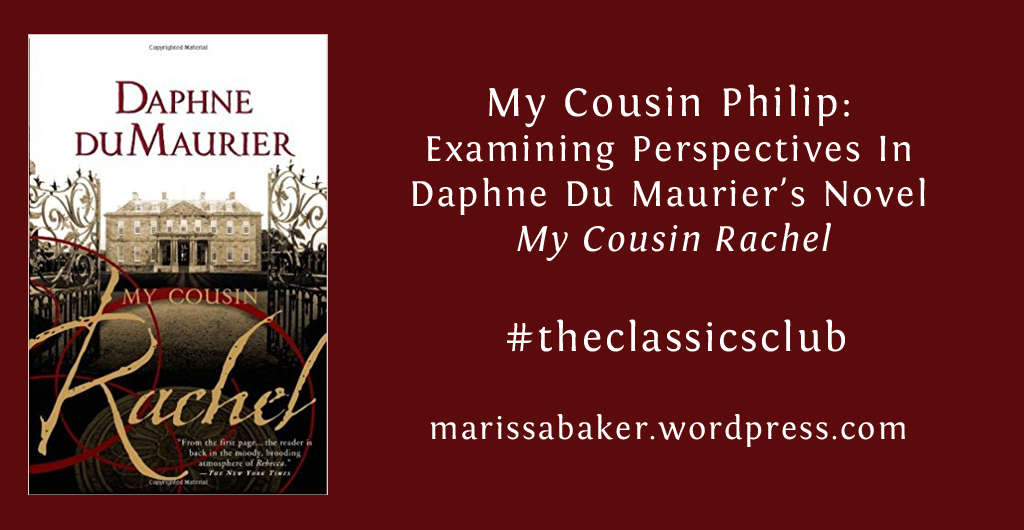
My Cousin Philip: Examining Perspectives In Daphne Du Maurier’s Novel My Cousin Rachel

I should never have stayed here. Nay, I should never have left Italy.

If my cousin Philip had not been so like Ambros perhaps I could have left. To see his face — that beloved, tormenting face — staring into my eyes once more was more than I could leave. More than I could resist when he asked me to stay. Or I should say ordered me. They were orders, though I turned a blind eye to it then because I wanted him. Or perhaps not him, but Ambros back in my life. I know not.

My Cousin Philip: Examining Perspectives In Daphne Du Maurier's Novel My Cousin Rachel | marissabaker.wordpress.com
My Cousin Rachel (2017)

I’m in such fear. It was a foolish thing on both our parts, the midnight of his birthday. He knows too little of the world to realize what I gave him was nothing more than a thank you. A birthday gift that would mean more than that stupid little pearl cravat pin. And yes, I wanted it too. A younger, more devoted Ambros to worship me once again if only for a moment.

And how could I have known that he meant marriage by his comment about lacking warmth and comfort? Or that he thought I’d agreed to be his when he took me into those primroses? Or that he would get so drunk he’d announce our engagement to his godfather and poor Louise at dinner?

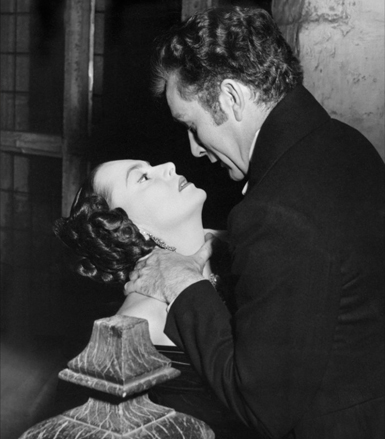
I still feel the pressure of his hands at my throat. Those big, powerful hands of a man who works on his farm every day and stands a head taller than me. Stronger than the ones Ambros once put around my neck. My cousin Philip could have snapped my neck, though he wouldn’t have had to. The slightest squeeze more and I’d not have been able to draw the thinnest breath.

My Cousin Philip: Examining Perspectives In Daphne Du Maurier's Novel My Cousin Rachel | marissabaker.wordpress.com
My Cousin Rachel (1952)

Should I feel guilty for bringing Mary Pascoe into this house? Surely his fury won’t touch her, too. The worst he’d do is throw her out of the house. While me … I know not what he’d do were we alone now. Would he wrap his hands around my throat again and expect me to make myself his? Would he force me and afterward tell me I liked it and must marry him?

His fantasy is as complete as the paranoia that claimed Ambrose. I half-believe in his mind we’re already married. That he thinks I’m so sure to agree it’s as if I’ve done so already. That his ridiculous present of his entire fortune will surely convince me to stay.

I must get away. I have the means to do so now, though God knows it’s not why I came here. I simply wanted to see the home Ambros talked about. The symbol of what could have been before he turned on me. The idea of our marriage rather than the reality of it. The allowance my cousin Philip gave me was more than enough. More than I expected or even hoped. To have him honor the will Ambros never signed …

Did he think he’d bought me?

Will he let me leave?


This is quite a bit different than my usual review for books I’m reading on my Classics Club Book list. But I think Daphne Du Maurier’s My Cousin Rachel (1951) is the sort of novel that invites you to look at it from different perspectives. The fact that you’re trapped inside Philip Ashley’s mind for the entire novel leaves you guessing at what the other characters are really thinking. He’s an unreliable narrator and he’s hopelessly naive, especially when it come to women, so the motives he assigns to Rachel are likely untrue. But if he’s wrong about her, then what is right? Everything we know of her is filtered through Philip. We don’t know her true motive or any of her thoughts. We can only guess, as I’m doing in my little retelling from Rachel’s point of view (which overlaps Chapter 23 of the original novel).

My Cousin Philip: Examining Perspectives In Daphne Du Maurier's Novel My Cousin Rachel | marissabaker.wordpress.com
My Cousin Rachel (2017)

I watched the 2017 film adaptation of My Cousin Rachel before reading the book. I suspected I would still enjoy the book after seeing the movie, but knew if I read the book first there was a good chance I’d spend the film grumpy about how they’d adapted it. It turned out to be a very faithful adaptation, though.

*Spoiler Warning* The only major changes were made at the end. The film provides less evidence of Rachel’s alleged guilt, pointing viewers towards the idea that she was not poisoning Philip. And it also has Philip sending her to ride along a dangerous path rather than choosing not to warn her about a dangerous bridge in the garden. The film pushes you toward believing he intended her to die where the book leaves it a little more ambiguous. But then again, Philip’s the one telling the story. Of course he’d make himself look as good as possible.

Philip wants us second-guessing his cousin Rachel. But I suspect Du Maurier wants us to look at Philip just as closely. Because even though we’re getting his perspective on things and he’s certainly not putting any blame on himself, there are things about being in his mind that make me as scared of him as I think Rachel is.

My Cousin Philip: Examining Perspectives In Daphne Du Maurier's Novel My Cousin Rachel | marissabaker.wordpress.com
My Cousin Rachel (1952)

Repeatedly, Philip says he wants to isolate Rachel from everyone but him. And that’s before he starts becoming overtly controlling. And when he puts his hands around her throat, it’s not in the heat of anger. He presents it as a calculated decision to add fear to the list of reasons she should marry him. Later, he barely contains his fury and indignation when (after he’s given her all his property and she still hasn’t married him) she states that she can and will invite whoever she likes to stay with them because the house belongs to her and she doesn’t feel safe alone with him.

So instead of just asking, “Did Rachel poison Ambros and/or Philip?” I think we need to ask whether such an act could be considered self-defense. Abuse does not justify murder, but even if Rachel killed someone she may not be the evil and/or misguided character that Philip (who describes himself as feeling a strange compassion for her once he makes up his mind about her guilt) makes her out to be. It might have been more of an act of desperation and fear than calculating malice.

But that’s assuming she’s guilty at all. And there’s no clear evidence that she is. Laburnum (the plant Philip settles on as the murder weapon) isn’t even all that poisonous. The most common symptoms are nausea and vomiting, and that’s after eating several seeds. “Higher doses can produce intense sleepiness, convulsive possibly tetanic movements, coma, slight frothing at the mouth and unequally dilated pupils. … [However] the MAFF publication ‘Poisonous Plants in Britain and their Effects on Animals and Man’, says that all stories about laburnum causing serious poisoning and death are untraceable” (The Poison Garden).

My Cousin Philip: Examining Perspectives In Daphne Du Maurier's Novel My Cousin Rachel | marissabaker.wordpress.com
“Laburnum” by Neil Turner

Perhaps Du Maurier believed her chosen poison really was deadly based on the rumors that have made it one of the most feared garden plants. But perhaps she did her research and knew that Philip was jumping to unjustifiable conclusions. Maybe she would have known, as Rachel surly did with her expertise in herb lore and gardening, that most gardens are home to far more reliably deadly plants (like foxglove and oleander). Perhaps Du Maurier meant for her readers to realize that a brain tumor (for Ambros) and a relapse of meningitis (for Philip) are the most logical explanations for symptoms both men attribute to “Rachel, my torment.”

There’s an argument to be made that Philip isn’t really concerned about whether or not Rachel poisoned Ambros at all. He decides her guilt based on whether or not she “conforms to his desires and whims” (from “My Cousin Rachel (2017) and Male Entitlement“). After all, he already possesses everything else that belonged to Ambros. Why not Rachel as well?

The question of whether or not Rachel poisoned Ambros consumes Philip only until their first meeting. After that he’s quite certain she’s innocent until she makes it clear she won’t marry him. All his worry about whether or not she’s guilty of murder covers the fact that his inability to deal with rejection brings out a desire to posses and control her. He and Ambros call Rachel “my torment” because she brings out the ugliest side of their natures and they blame her for their darkness rather than looking to the true culprits. Themselves.My Cousin Philip: Examining Perspectives In Daphne Du Maurier's Novel My Cousin Rachel | marissabaker.wordpress.com

Click here to get a reading copy of My Cousin Rachel, and here for the movie. Please note that these are affiliate links. This means that, at no additional cost to you, I will receive a commission if you click on the link and make a purchase.