Laid Hold Of By Christ

There is great depth to the entire Bible, but for me, Paul’s writings in particular are something I can come back to over and over again and keep discovering deeper meaning. I wrote about Philippians 3 nine years ago, and I want to go there again today to dig deeper into one particular phrase.

I strive to lay hold of that for which Christ Jesus also laid hold of me.

Philippians 3:12, NET

This is such an evocative phrase. Other possible translations include “I am apprehended of Christ Jesus” (KJV), “the Messiah Yeshua took hold of me” (CJB), “I have been taken possession of by Christ [Jesus]” (DARBY), “Christ grabbed hold of me for just this purpose” (CEB), and “Christ Jesus has made me his own” (ESV). There’s a forward-focus and intentionality here that makes me want to learn more about how and why Jesus laid hold of Paul and, likely, us as well.

Setting the Stage

Let’s start by putting this phrase in context. It’s in the letter that “Paul and Timothy” wrote “to all the saints in Christ Jesus who are in Philippi” (Phil. 1:1, NET). Paul was imprisoned at the time of the writing (Phil. 1:12-14), but it’s a very encouraging letter. It’s full of confidence, hope, and an exhortation to keep living faithful lives. Unlike some letters, Paul wasn’t focused on correcting a problem in this church. Rather, he urged them on to Godly living and unity in the church.

In the section we call chapter 3, Paul talked about his own walk in more detail than we often find. He summarized the earthly credentials that he could have been proud of (Phil. 3:3-6), then said he now regards them as “liabilities” and “dung” compared to the far higher value of knowing Jesus (Phil. 3:7-9).

My aim is to know him, to experience the power of his resurrection, to share in his sufferings, and to be like him in his death, and so, somehow, to attain to the resurrection from the dead.

Not that I have already attained this—that is, I have not already been perfected—but I strive to lay hold of that for which Christ Jesus also laid hold of me. Brothers and sisters, I do not consider myself to have attained this. Instead I am single-minded: Forgetting the things that are behind and reaching out for the things that are ahead, with this goal in mind, I strive toward the prize of the upward call of God in Christ Jesus. Therefore let those of us who are “perfect” embrace this point of view.

Philippians 3:10-15, NET

Here, Paul was talking about himself but then he expands it to others. All those who are “perfect” should embrace the same point of view he has about striving toward the goal and laying hold of the thing “for which Christ Jesus also laid hold of” us. Paul then continued with exhortation to imitate him and others who are faithfully living this way (Phil. 3:17). He concluded with more appeals to unity and more encouragement, urging his readers not to give up and to embrace the peace that God offers (Phil. 4:1-9). Even his appeal for support emphasizes contentment and mutual aid rather than his own pressing needs (Phil. 4:10-20).

Seize the Prize

The Greek word translated “lay hold of” is katalambano (G2638). Spiros Zodhiates lists three primary meanings: 1) “To lay hold of seize, with eagerness, suddenness,” 2) “In allusion to the public games, to obtain the prize with the idea of eager and strenuous exertion, to grasp, seize upon,” and 3) “Figuratively, to seize with the mind, to comprehend.” He links Phil. 3:12 with the second meaning. The word is used 15 times in the New Testament, and looking at some of the other uses can help us get some additional context for the meaning here in Philippians.

One thing we learn from looking at the other uses of katalambano is that it’s not an extremely specific word. Like the English words “take hold of,” the meaning depends a lot on context. Sometimes it’s a bad thing, as when a demon seizes a child (Mark 9:18), being caught in the act of adultery (John 8:3-4), or being overtaken by darkness (John 12:35, see also John 1:5 and 1 Thes. 5:4). Several times, it’s used in the sense of that third, figurative meaning that Zodhiates highlights (Acts 4:13; 10:34; 25:25; Eph. 3:18). The second meaning, the one we’re focusing on today, appears in three of Paul’s letters: Romans 9:30, 1 Corinthians 9:24, and Philippians 3:12-13. The one in 1 Corinthians is particularly relevant to our study today.

 Do you not know that all the runners in a stadium compete, but only one receives the prize? So run to win (katalambano). Each competitor must exercise self-control in everything. They do it to receive a perishable crown, but we an imperishable one.

So I do not run uncertainly or box like one who hits only air. Instead I subdue my body and make it my slave, so that after preaching to others I myself will not be disqualified.

1 Corinthians 9:24-27, NET

This is katalambano in the sense of obtaining or attaining (two words used in other English translations) a prize. When we’re looking at verses where Paul uses the word in this sense, there is an emphasis on continuing on toward a future goal. Jesus called us with purpose and set us on a path toward a prize that everyone can win if we continue striving for our imperishable crown. It’s not a prize that we’re competing against others to win, but one where we all compete together, striving to get ourselves and our brethren to fully grasp that prize.

Grasped For A Purpose

Yet, my brothers, I do not consider myself to have “arrived”, spiritually, nor do I consider myself already perfect. But I keep going on, grasping ever more firmly that purpose for which Christ grasped me. My brothers, I do not consider myself to have fully grasped it even now. But I do concentrate on this: I leave the past behind and with hands outstretched to whatever lies ahead I go straight for the goal—my reward the honour of being called by God in Christ.

Philippians 3:12-14, PHILLIPS

This version translates katalambano as “grasped” three times here in verses 12 and 13. The image of us grasping for eternal life (Phil. 3:11) like a runner racing toward a prize is a familiar one, but I think this is the only time that we have it paired with Jesus grasping on to us. That’s a really amazing thing to think about. He grabs us for the purpose of getting us to eternal life just as eagerly as we strive to grasp onto that prize.

“There are many dwelling places in my Father’s house. Otherwise, I would have told you, because I am going away to make ready a place for you. And if I go and make ready a place for you, I will come again and take you to be with me, so that where I am you may be too. …

 “Just as the Father has loved me, I have also loved you; remain in my love. … No one has greater love than this—that one lays down his life for his friends. You are my friends if you do what I command you.  … You did not choose me, but I chose you and appointed you to go and bear fruit”

John 14:2-3; 15:9,13-14, 16, NET

We can see Jesus’s focus on bringing more children into His Father’s family throughout His life, but perhaps it’s illustrated most clearly in the dialog during this final Passover with His disciples and the prayer that follows. Jesus doesn’t use the phrase “take hold of” here, but it’s a similar idea. He loves us so much He laid down His life for us, and He wants us to walk with Him in this life and finally join Him and His father in their kingdom. He wasn’t just talking about His disciples at the time, either; He makes clear in His prayer that we’re included as well.

 “I am not praying only on their behalf, but also on behalf of those who believe in me through their testimony, that they will all be one, just as you, Father, are in me and I am in you. … The glory you gave to me I have given to them, that they may be one just as we are one—I in them and you in me—that they may be completely one, so that the world will know that you sent me, and you have loved them just as you have loved me.

“Father, I want those you have given me to be with me where I am, so that they can see my glory that you gave me because you loved me before the creation of the world.”

John 17:20-24, NET

Jesus’s desire that those who belong to him will “be with me where I am” will be fully realized when we finally “lay hold of that for which Christ Jesus also laid hold of” us. He wants us to become part of His family and “attain to the resurrection from the dead” (Phil. 3:11, NET). God has grasped onto our lives for an eternal, life-giving reason. They want us to firmly take hold of that same vision for the future and keep moving forward with focus, hope, and commitment. “With this goal in mind,” we should imitate Paul and “strive toward the prize of the upward call of God in Christ Jesus” (Phil. 3:14, NET).


Featured image by Sasin Tipchai from Pixabay

The Purpose of Your Redemption

Often when we bring up redemption, we talk about how Jesus redeemed us and why He needed to. We’re sinners–people who’ve broken God’s laws and in doing so earned a death penalty. Jesus shifted that penalty onto Himself. When we accept His sacrifice for our sins, the burden of that sin and the associated death penalty is lifted away so we can live forever with Him.

As incredible as all that is, there’s more to redemption than simply saving us from our sins. God has a purpose for us after we’re redeemed. There’s something He wants us to do and someone He intends for us to become. I find this an exciting thought. God doesn’t start a wonderful work in our lives and then just let us sit there wondering, “Now what?” He gives us a purpose and a goal as well as a dynamic relationship with Him.

Leaving Egypt To Serve God

The way that God delivered ancient Israel from Egypt is a type of how He delivers us from sin. There are so many parallels between the Passover story and the crucifixion story that we don’t have time to go into them all now. In summary, they’re both stories of God’s incredible redemption of a chosen people for a specific purpose. In Exodus, the Lord gives Moses a purpose that he’s supposed to share with Pharaoh for why God wants to take Israel out of Egypt.

Then the Lord said to Moses, “Go to Pharaoh and tell him, ‘This is what the Lord, the God of the Hebrews, has said, “Release my people that they may serve me!

Exodus 9:13, NET

God sets up a contrast here. “The Egyptians ruthlessly made the children of Israel serve” as slaves (Ex. 1:13, WEB), and now God commands them to free His people so they may serve Him instead. This command is repeated over and over early in Exodus as Moses and Pharaoh go back and forth on whether Egypt will obey God’s demand to let Israel go.

The Hebrew word translated “serve” is abad (H5647). It’s used 290 times in the Old Testament. The Theological Wordbook of the Old Testament connects it with two root words that mean “to do or make” and “to worship, obey” (entry 1553). It’s used both of forced labor for an oppressive master and for joyful service given to God. Abad is also the word used for the type of service the Levites performed in God’s tabernacle and temple. As such, when used of serving God, it involves worship and obedience in our actions. We might say, then, that the reason God redeemed His people is so that they could serve Him as joyful worshipers doing actions that glorified Him.

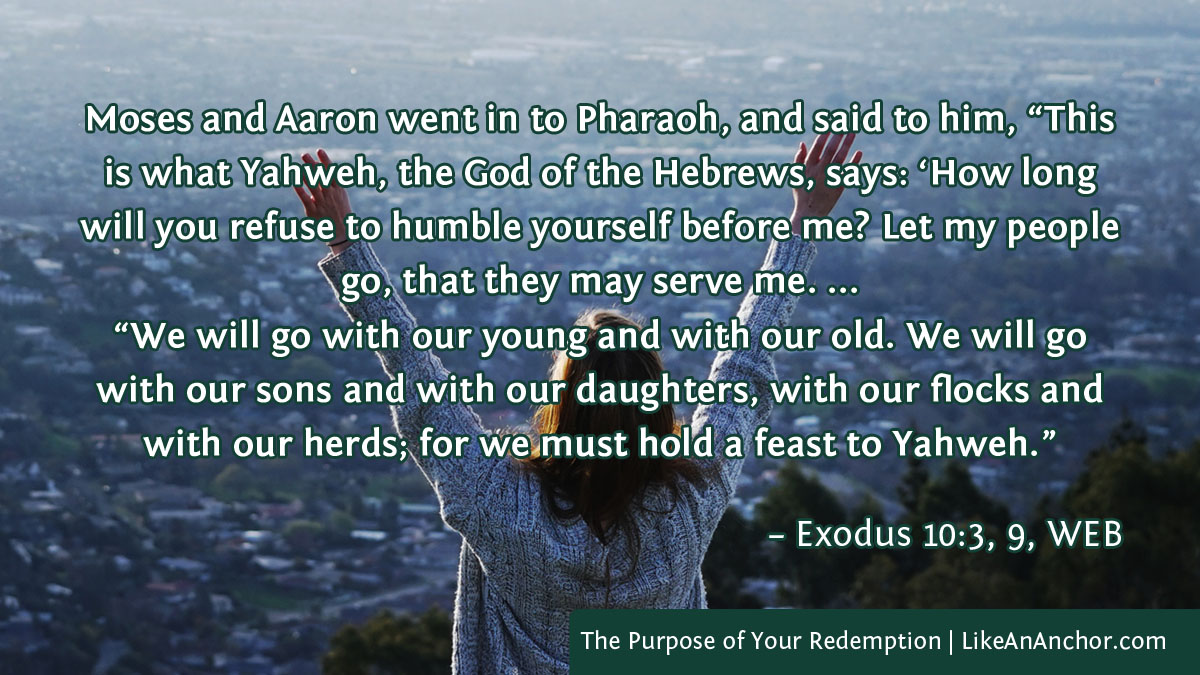
Image of a woman with her hands raised in worship, with text from Exodus 1-0: 3 and 9, WEB version: "Moses and Aaron went in to Pharaoh, and said to him, “This is what Yahweh, the God of the Hebrews, says: ‘How long will you refuse to humble yourself before me? Let my people go, that they may serve me. ... “We will go with our young and with our old. We will go with our sons and with our daughters, with our flocks and with our herds; for we must hold a feast to Yahweh.”
Image by Ruby-Rose from Lightstock

“So That”

There’s a simple phrase that Paul uses in Romans and 2 Corinthians to indicate God redeemed us for a purpose. Jesus died for us and we are crucified alongside him “so that the body of sin would no longer dominate us, so that we would no longer be enslaved to sin” and “so that we serve in newness of the spirit, and not in oldness of the letter” ((Rom. 6:6, NET and Rom. 7:6, WEB; emphasis added).

Now that we’ve been redeemed, we’re to serve God and be reconciled to Him because “God made the one who did not know sin to be sin for us, so that in him we would become the righteousness of God” (2 Cor. 5:20-21, NET, emphasis added). In these passages, Paul draws our attention to the purpose for redemption. God accomplishes our salvation so that something can happen next. Peter uses this type of language as well.

you yourselves, as living stones, are built up as a spiritual house to be a holy priesthood and to offer spiritual sacrifices that are acceptable to God through Jesus Christ. … But you are a chosen race, a royal priesthood, a holy nation, a people of his own, so that you may proclaim the virtues of the one who called you out of darkness into his marvelous light. You once were not a people, but now you are God’s people. You were shown no mercy, but now you have received mercy.

1 Peter 2:5, 9-10, NET

Like ancient Israel (whom Peter references by quoting Hosea), we are called and chosen for a specific purpose. It is “so that” we can proclaim God’s virtues and “offer spiritual sacrifices.” In other words, we’re redeemed so we can serve God, just as the children of Israel were in Exodus.

Next Steps in Light

Image of a man walking in the woods reading a Bible with the blog's title text and the words "God didn't start a wonderful work in our lives just to leave us wondering, "Now what?" He gives us a purpose and a goal."
Image by HarveyMade from Lightstock

So far, we’ve seen the purpose God has for us after redemption described a few different ways. We’re to serve God in the spirit. We’re to become righteous like God. We’re to proclaim His virtues and goodness. Putting it all together, we could sum up our purpose as sincere, obedient worship that results in righteous action.

The book of Hebrews dives deep into this idea. It lays out Jesus’s relationship to the Old Testament sacrifices for sin, explaining how He fulfills them all by offering Himself once as a final, perfectly effective sacrifice. It also describes what we should do next after receiving redemption.

For if the blood of goats and bulls and the ashes of a young cow sprinkled on those who are defiled consecrated them and provided ritual purity, how much more will the blood of Christ, who through the eternal Spirit offered himself without blemish to God, purify our consciences from dead works to worship the living God.

Hebrews 9:13-14, NET

So since we are receiving an unshakable kingdom, let us give thanks, and through this let us offer worship pleasing to God in devotion and awe.

Hebrews 12:28, NET

Look at the wording here. Jesus died for us and purified us so we can “worship the living God.” Then, because we realize that God is offering us incredible gifts, including a place in His kingdom, we should “offer worship pleasing to God in devotion and awe.” These verses also echo other passages that talk about the importance of worshiping God in the spirit (John 4:23-24; Phil. 3:2-3).

As redeemed people, we walk with God in a new, spiritual life. His goal in redeeming us is to make us fully part of His family. Along with that position as family members in covenant with God comes a purpose for us to accomplish. We have a role now; a way that we’re supposed to live. We ought to serve God in the spirit of the law, modeling His righteousness and worshiping Him joyfully. After all, when we consider the gift of redemption, it’s clear that we have much to be joyful about.

Featured image by Pearl from Lightstock

Song Recommendation: “Redeemed” by Big Daddy Weave

Our God Delights In Helping Us Succeed

There can be great peace and security in having a relationship with God. That’s something He wants us to enjoy. But if you’re struggling, feeling as if you may never measure up to God’s standards, serenity is likely the last thing you feel. It might even be discouraging to see other Christians seem so confident when you’re secretly unsure if you’ll make it through the week as a good and godly person.

One of the most comforting truths revealed in the Bible is that God wants us to succeed. His “mercy triumphs over judgement,” which in Greek means that mercy “boasts against, exalts over” judgement “in victory” (Jas 2:13, NET). When He looks at us, He hopes to see us doing well and He wants to support our growth far more than He wants to pass judgement on us. And when we slip-up or stray off the “straight and narrow” path, He’s eagerly looking for us to come back. God wants as many people as possible to be in His family, and He’s deeply committed to making that happen.

The Compassionate Father

You’re likely familiar with the parable of the prodigal son. In some translations, it’s labeled The Parable of the Compassionate, or Forgiving, Father. This name shifts our focus as we read this parable to notice the father’s role. In this parable, a man’s younger son demanded his share of the inheritance, then went off and “squandered his wealth with a wild lifestyle” (Luke 15:13, NET). Once he’d lost everything and was living destitute, barely scraping by feeding pigs, he realized he’d be better off going home even if his father only let him be a servant rather than acknowledged again as a son.

So he got up and went to his father. But while he was still a long way from home his father saw him, and his heart went out to him; he ran and hugged his son and kissed him. … the father said to his slaves, ‘Hurry! Bring the best robe, and put it on him! Put a ring on his finger and sandals on his feet! Bring the fattened calf and kill it! Let us eat and celebrate, because this son of mine was dead, and is alive again—he was lost and is found!’ So they began to celebrate.

Luke 15: 20, 22-24, NET

This father’s joy is the same joy God and all the hosts of heaven feel when a sinner repents (Luke 15:7, 10). God has felt this joy over us; we’ve all sinned (Rom. 3:23) and we’ve all had to repent many times. We count on God’s mercy to say, “Yes, I forgive you” every time we come to Him repentant and committed to doing better.

Image by Free-Photos from Pixabay

Wanting Us To Choose Life

God sincerely “desires all people to be saved and come to full knowledge of the truth” (1 Tim. 2:4, WEB). He does not wish “that any should perish, but that all should come to repentance” (2 Pet. 3:9, WEB). His goal is salvation and truth for, and repentance from, everyone (with that last one connected to our acceptance of the first two). We need to opt-in to grace; God doesn’t give people eternal life unless we take Him up on His offer. But He very much wants us to accept His gift and He’s invested in our success.

“But if the wicked person turns from all the sin he has committed and observes all my statutes and does what is just and right, he will surely live; he will not die. None of the sins he has committed will be held against him; because of the righteousness he has done, he will live. Do I actually delight in the death of the wicked,” declares the Sovereign Lord? “Do I not prefer that he turn from his wicked conduct and live?”

Ezekiel 18:21-23, NET

We might sometimes think God seems strict or unfair, but the reality is that His whole focus is on making things turn out well for His people (Rom. 8:28). He says to people He’s working with, “I have plans to prosper you, not to harm you. I have plans to give you a future filled with hope” (Jer. 29:11, NET). That group He’s working with can include any of us; people from all sorts of backgrounds, personalities, and experiences. Through Jesus’s sacrifice, God has opened up the opportunity to live in covenant with Him to anyone who hears His voice and responds.

Invested In and Delighted With Us

God delights in people who do their best to follow Him, not in people who are already “perfect.” Which is good for us, since we’re all still quite a ways off from attaining perfection even though we’re headed that direction. What’s important to God is that we stay on the journey toward being more and more like Him.

So then, my dear friends, just as you have always obeyed, not only in my presence but even more in my absence, continue working out your salvation with awe and reverence, for the one bringing forth in you both the desire and the effort—for the sake of his good pleasure—is God.

Philippians 2:12-13, NET

There are so many verses saying God delights in His people. Ps. 149:4; Prov. 11:20; 12:22; Is. 62:4-5; Jer. 32:40-41; Zeph. 3:17 are just a sample that point out He specifically delights in those who keep covenant with Him; who love and obey Him. Doing these things leads to delight for us as well (Ps. 16:11; 21:1; 37:4; 112:1; 119:16, 24, 35, 47, 77, 143, 174; 149:2; Is. 29:19). The more we delight in God and His laws, the more He delights in us. And when we do sin–since, as Paul said, it’s a struggle to do good all the time even when you delight in God’s law (Rom. 7:14-25)–then God delights in our repentance; our choice to run home to our compassionate Father.

Featured image by SnapwireSnaps from Pixabay

Encourage Your Hopes, Not Your Fears

I’m not really big on New Year’s resolutions, but people talk about them enough that the idea is something I think about. And so January has become a time for thinking about what happened last year, what I’d like to change in this next year, and how I plan to “show up” for my life.

Part of this focus in the new year comes along with participating in 30 days of yoga. I’ve been doing this Yoga With Adrienne program every January since 2015 and it’s a wonderful way to check in with yourself, get healthy, and focus on becoming a person who can serve others wholeheartedly. In addition to this, I happened upon an interesting blog post titled “Intentions Not Resolutions.” 

“I no longer make New Year’s resolutions – they’re too easy to give up on after week one and only become a source of guilt. … Instead, a few years ago, I began starting my New Years by choosing a word to inspire the kind of intentional living I wanted to focus on for the year.” — Jen of E.C.B.C

I’d sort of tried this last year when I discovered a site called My Intent that makes bracelets with a custom word on them. I couldn’t pick one word, though, and ended up with a bracelet that says “Balance” and “Connect.” I rarely wear it any more, though those two concepts still resonate deeply.

Encourage Your Hopes, Not Your Fears | LikeAnAnchor.com
Photo credit: MarrCreative via Lightstock

I’ve been thinking for a while now that if I made a new bracelet it would say “fearless.” What with working through my breakup and (finally) getting counseling for the anxiety I’ve been living with for 15+ years, 2018 was a year that I realized that 1) I have a lot of fears, and 2) I don’t have to let them control me.

There’s another bracelet that I picked up last year at an art festival that says, “Encourage your hopes, not your fears.” I’ve been wearing that one a lot. It’s the perfect message to combat my anxiety, which generally pushes hopes aside behind all the things that could go wrong because of all the things that I’m sure are wrong with me. But if I spend all my time turned inward thinking about my fears, then I’m just encouraging my anxiety to take over.

If, on the other hand, I encourage my hopes it changes things. And if I can learn to do that more consistently it might drastically change things. I hope I can keep growing this blog to reach and encourage more people. I hope that I’ll stop sabotaging myself because I’m scared of dealing with everything that might come with being a successful blogger and author. I hope I can climb out of my own head more often and connect with others (including God) in a deeper way.

My intention for 2019 isn’t just one word, but I do have one. I’m going to encourage my hopes, not my fears.

What about you? Did you set any intentions or resolutions for the New Year?

The Classics Club

In my never-ending search for new things to write about, I stumbled upon The Classics Club by way of Carissa’s post at Musings of an Introvert. I love classic literature (not really a surprise to most of you — if someone doesn’t like at least some classic literature they probably shouldn’t major in English), so why not come up with a reading list and blog about each title? That will give me topics for 10 of Mondays blog posts for the next five years.

The Classics Club | marissabaker.wordpress.com

The challenge for those who join The Classics Club is to make a list of at least 50 books and read through it in no more than 5 years. I thought 10 books a year would be thoroughly doable (to put this in perspective, I’ve read 45 books so far this year), and so I posted my list and I’m signing up today. Some of them are re-reads, but most of the ones on the list are new to me. The titles on the list may change as I read, but here are the one I’m starting out with (*indicates a re-read):

  1. Adams, Richard: Watership Down*
  2. Anonymous: The Arabian Nights
  3. Austen, Jane: Lady Susan
  4. Beagle, Peter S: The Last Unicorn
  5. Bradbury, Ray: The Martian Chronicles
  6. Bronte, Anne: The Tenant of Wildfell Hall
  7. Bronte, Charlotte: Villette
  8. Burke, Edmund Burke: Reflections on the Revolution in France
  9. Burnett, Frances Hodgson: A Little Princess*
  10. Burnett, Frances Hodgson: The Secret Garden*
  11. Burney, Frances: Evelina*
  12. Burney, Frances: The Wanderer
  13. Burroughs, Edgar Rice: Tarzan of the Apes*
  14. Cooper, James Fenimore: The Red Rover*
  15. Cooper, James Fenimore: The Water-Witch
  16. Dickens, Charles: Bleak House
  17. Dickens, Charles: Oliver Twist
  18. Dickens, Charles: The Mystery of Edwin Drood
  19. Dostoevsky, Fyodor: The Brothers Karamazov
  20. Doyle, Sir Arthur Conan: The Hounds of the Baskervilles
  21. Doyle, Sir Arthur Conan: The Memoirs of Sherlock Holmes
  22. Doyle, Sir Arthur Conan: The Sign of Four
  23. Dumas, Alexandre: The Count of Monte Cristo
  24. Eliot, George: Adam Bede
  25. Eliot, George: Middlemarch
  26. Gaskell, Elizabeth: North and South*
  27. Gaskell, Elizabeth: Wives and Daughters
  28. Hardy, Thomas: Far From the Madding Crowd
  29. Hawthorne, Nathaniel: The House of the Seven Gables
  30. Hawthorne, Nathaniel: The Scarlet Letter
  31. Homer: The Iliad
  32. Homer: The Odyssey
  33. Keats, John: Poems
  34. Leroux, Gaston: The Phantom of Opera
  35. Malory, Sir Thomas: Le Morte d’Arthur
  36. Montgomery, L.M.: Emily of New Moon
  37. Poe, Edgar Allen: Collected Stories and Poems
  38. Radcliffe, Ann: The Mysteries of Udolpho
  39. Rousseau, Jean-Jaques: Emile
  40. Scott, Sir Walter: Waverly
  41. Shakespeare, William: Henry IV, part 1
  42. Shakespeare, William: Henry IV, part 2
  43. Shakespeare, William: Measure for Measure
  44. Shakespeare, William: Othello
  45. Shelley, Mary: Frankenstein
  46. Stevenson, Robert Louis: The Black Arrow*
  47. Swift, Jonathon: Gulliver’s Travels
  48. Tolstoy, Leo: Anna Karenina
  49. Twain, Mark: The Adventures of Tom Sawyer*
  50. Wells, H.G.: The Invisible Man