Keep Planting, Even If You’re Weeping

Last week, I’d stayed up later than usual and instead of reading a chapter in Acts before bed, I turned to the Psalms to find a short passage to read. I just happened to open the Bible (a Tree of Life Version that I keep in my nightstand) to Psalm 126. Something about this translation caught my eye, and it prompted today’s post. Here’s the full psalm to start us off:

When Adonai restored the captives of Zion,
it was as if we were dreaming.
Then our mouth was filled with laughter,
and our tongue with a song of joy.
Then they said among the nations,
Adonai has done great things for them.”
Adonai has done great things for us
    —we are joyful!
Restore us from captivity, Adonai,
like streams in the Negev.
Those who sow in tears
will reap with a song of joy.
Whoever keeps going out weeping,
    carrying his bag of seed,
will surely come back with a song of joy,
    carrying his sheaves.

Psalm 126, TLV

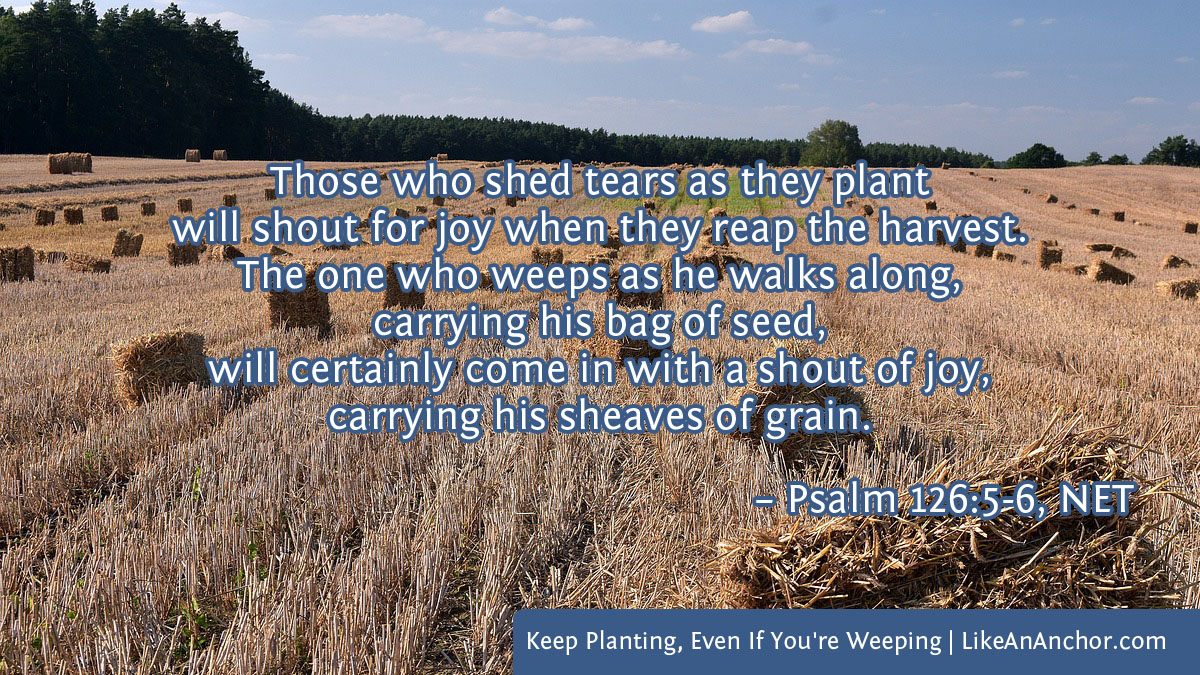
It’s that last verse that captured my attention: “Whoever keeps going out weeping, carrying his bag of seed, will surely come back with a song of joy, carrying his sheaves.” It might (if you’re at all familiar with American gospel songs and Protestant hymns) make you think of the 1874 hymn “Bringing in the Sheaves.” For me, the part that captured my attention is this “keeps going out” line.
Keeping Going Out

In Psalm 126:6, some translations simply say, “He who goes out weeping” (WEB) but the TLV and others like the NKJV include this sense of continuing to go out while you’re weeping. The setting for this psalm is restoration from captivity. Israel had gone into captivity, and now God delivered them and brought them back to the land. The psalmist is looking back on this and making an agricultural analogy.

Suppose you’re in the spring, ready to plant, but something happens. It’s a set back, a tragedy, a calamity, a grief-inducing event. It’s the sort of thing that would make you weep. At that point, you have a choice. You can “keep going out” and sowing into the future, or you could give up. But you know that if you want to reap a harvest, you need to plant seed. Similarly, the metaphorical future “harvest” that we get in our own lives is determined (at least in part) by what we “sow” now.

Do not be deceived. God will not be made a fool. For a person will reap what he sows, because the person who sows to his own flesh will reap corruption from the flesh, but the one who sows to the Spirit will reap eternal life from the Spirit. So we must not grow weary in doing good, for in due time we will reap, if we do not give up.

Galatians 6:7-9, NET

If the agricultural metaphor isn’t working for you, we can relate it to other things with a cause and effect. If you put a steady diet of unhealthy food into your body, you’ll get an unhealthy body; if you eat healthy foods, you’ll have a healthier body. Sowing (like how we eat and whether we exercise) is an investment in the future, for better or worse.

Notice that Paul says “we must not grow weary in doing good” and that we should “not give up.” Sowing is a long-term investment. It takes time for the seed to sprout, grow, and bear fruit. We might not see the results of it for quite some time. As Psalm 126 says we need to “keep going out” to sow, trusting that God will give us a good harvest.
Planting In Hope

The word “hope” isn’t used in the psalm that we’re looking at today, but it’s an essential ingredient for what we’re talking about here.

 For it is written in the law of Moses, “Do not muzzle an ox while it is treading out the grain.” God is not concerned here about oxen, is he? Or is he not surely speaking for our benefit? It was written for us, because the one plowing and threshing ought to work in hope of enjoying the harvest. 

1 Corinthians 9:9-10, NET (bold italics mark a quotation from Deut. 25:4)

Here, Paul is saying that teachers of the word have the right to make their living by preaching the gospel (1 Cor. 9). The basic principle is that if you put the work into something, you have a right to expect to enjoy the results of that labor. Hope in the Bible isn’t something nebulous. When hope is related to God, there’s a level of certainty to it. God provides a solid anchorage for our hope (Heb. 6:19), giving us good reason to confidently expect that if we keep going out sowing, we will eventually bring in a harvest with joy.

 Not only this, but we ourselves also, who have the firstfruits of the Spirit, groan inwardly as we eagerly await our adoption, the redemption of our bodies. For in hope we were saved. Now hope that is seen is not hope, because who hopes for what he sees? But if we hope for what we do not see, we eagerly wait for it with endurance.

Romans 8:23-25, NET

Come Back Rejoicing
One of the things that we humans can find frustrating is that God is a long-term thinker. When He promises to give us the desires of our heart, for example (Ps. 37:6), we want that to happen immediately. I didn’t expect it to take 15+ years and a healthy dose of heartache before He answered my prayers to be a wife and mother, but then I found myself marrying a wonderful man and just over a year later having a beautiful daughter with him. I don’t think I’d be so blessed now if I hadn’t continued “sowing into” my life and my relationship with God during the season of weeping.

When we read, “all things work together for good for those who love God, who are called according to his purpose” (Rom. 8:28, NET), we often forget that Paul is talking on a cosmic timescale. Before the statement about all things working together for good, he says, “I consider that our present sufferings cannot even be compared to the coming glory that will be revealed to us” (Rom. 8:18, NET; see Rom. 8:18-30). Sometimes–even often–a harvest of joy happens now, in our human lives. But even if it doesn’t happen now, it will certainly happen at the end if we don’t give up.

My aim is to know him [Jesus Christ], to experience the power of his resurrection, to share in his sufferings, and to be like him in his death, and so, somehow, to attain to the resurrection from the dead.

Not that I have already attained this—that is, I have not already been perfected—but I strive to lay hold of that for which Christ Jesus also laid hold of me. Brothers and sisters, I do not consider myself to have attained this. Instead I am single-minded: Forgetting the things that are behind and reaching out for the things that are ahead, with this goal in mind, I strive toward the prize of the upward call of God in Christ Jesus. Therefore let those of us who are “perfect” embrace this point of view. If you think otherwise, God will reveal to you the error of your ways.

Philippians 3:10-15, NET

Scripture encourages us to look beyond our immediate circumstances with hope, trusting in the glorious future that God has planned for us. Long-term, if we’re going to “reap” the future God promises to His firstfruits, we need to keep pressing on toward the goal of eternal life. It’s this perspective that lets us “consider it nothing but joy when you fall into all sorts of trials, because you know that the testing of your faith produces endurance” and endurance helps bring us to perfection (James 1:2-3, NET). You’ll reap blessings in this life as well (especially if you have a mindset that looks for and recognizes them), but the biggest blessings we have are the opportunity to become God’s children and the promise of eternal life forever with Him after He “harvests” us with great joy.


Featured image by vargazs from Pixabay

Song Recommendation: “Bringing In The Sheaves”

Grief, Depression, and Healing through Gaming

I’ve read books that handle the topic of mental health extremely well, such as Eliza and Her Monsters. I’d dare say most of us have seem films or TV series, or read books, that touched us deeply and maybe even pushed us toward personal growth and healing. I’d never experienced that with a game before, though, until playing through Gris over the past couple weeks.

Gris is a single-player adventure game by indie developer Nomada Studio, where you play as “a hopeful young girl lost in her own world, dealing with a painful experience in her life.” The game is a “journey through sorrow,” and you help Gris “navigate her faded reality.” In addition to being the character’s name, gris means “gray” in Spanish and that reflects the gray world where you begin gameplay.

I bought Gris after it came up in my Rhetoric of Gaming class (a special topics course I’m taking during this semester of grad school). I expected to enjoy the game, knowing it has a beautiful soundtrack, stunning animation (it’s gorgeous even on my laptop that’s not designed for gaming), and frustration-free gameplay where you’re challenged by puzzles but not worried about running out of time or dying. I hadn’t expected it to move me to tears so many times or make me want to write about mental health.

I suspect one of the reasons Gris resonated so strongly with me is because of my interest in how people talk about mental health in everyday conversation and various forms of media. As my regular readers know, I’ve struggled with anxiety and depression since I was about 15, and I also lost a close friend to a car accident seven years ago. Gris pulled all those feelings of hurt, sorrow, and sadness up to the surface, punctuated them with moments of beauty and hope, and handled them with great care.

mild spoilers ahead

Grief, Depression, and Healing through Gaming | LikeAnAnchor.com

One of the things that stood out to me in particular about Gris is that they didn’t fall into the trap of oversimplifying grief and depression. It wasn’t a smooth, easy journey out of despair nor was it something that happened in an overly linear fashion. Most people don’t experience depression or grief as a moment of dull, faded, gray in their lives that grows gradually lighter and lighter until finally the world is set right again. It’s more like what happens in Gris as you travel steadily toward something hopeful and light and good, and you still go through cycles when the darkness comes back and seems ready to devour or choke you. But you do get through it, and even though the marks of when you fell apart are still there you are whole again.

end spoilers

I’d go so far as to say that playing Gris has the potential to be a healing experience, particularly for those who’ve struggled with depression and grief. While it’s no substitute for professional counseling and/or personal healing work, Gris is a powerful example of the potential that games–and art in general–have as a positive force in this world.

The Beatitudes, Part Two: Blessed Are Those Who Mourn

“Beatitude” means “a state of blessedness,” and it’s used to describe the type of people Jesus spoke about in the beginning of His famous sermon on the mount. We talked about the first one last week, so today we move on to the second.

“Blessed are those who mourn, for they shall be comforted.” (Matt. 5:4, all quotes from WEB translation)

The Greek word translated “blessed” is makarios (G3107), which means blessed and happy (Thayer’s dictionary) and is a state of being “fully satisfied” (Zodhiates’ dictionary). Seems like an odd word to pair with mourning, doesn’t it? I’m not sure about you, but “happy” and “satisfied” aren’t usually what I think of when I think of grief and lament, even if it comes with a promise of comfort. What is Jesus talking about here?

A Time to Weep, A Time To Mourn

For everything there is a season, and a time for every purpose under heaven … a time to weep, and a time to laugh; a time to mourn, and a time to dance (Ecc. 3:1, 4)

Mourning is right and proper in its time. While joy is a fruit of God’s spirit, He does not demand unrelenting cheerfulness from us. There is a time for mourning, weeping, grief, and lament. It can even be good for us to experience those feelings. “The heart of the wise is in the house of mourning,” it says in Ecclesiastes, because death reminds us of what really matters in life (Ecc. 7:1-4).

Draw near to God, and he will draw near to you. Cleanse your hands, you sinners. Purify your hearts, you double-minded. Lament, mourn, and weep. Let your laughter be turned to mourning, and your joy to gloom. Humble yourselves in the sight of the Lord, and he will exalt you. (James 4:8-10)

Mourning is a proper response to realizing that we have personally sinned, and that the world is twisted by humanity’s sins and the devil’s influence. This type of mourning is often connected with a realization of our spiritual helplessness (which is covered in the first Beatitude) and it can lead to the sort of humility that it’s good for us to have in relation to God.

To Comfort All Who Mourn

Of course, not all mourning is a good thing. In many cases, it’s prompted by the sorts of unjust, tragic, grief-inducing events that God intends to put an end to in His kingdom (the sort of events we were reminded of yesterday, on the anniversary of the 9/11 terrorist attacks). One day, God “will wipe away every tear from their eyes. Death will be no more; neither will there be mourning, nor crying, nor pain, any more” (Rev. 21:4). That time has not yet come, but God still cares deeply about us when we’re in pain and He offers comfort.

The Lord Yahweh’s Spirit is on me, because Yahweh has anointed me to preach good news to the humble. He has sent me to bind up the broken hearted, to proclaim liberty to the captives and release to those who are bound, to proclaim the year of Yahweh’s favor and the day of vengeance of our God, to comfort all who mourn, to provide for those who mourn in Zion, to give to them a garland for ashes, the oil of joy for mourning, the garment of praise for the spirit of heaviness, that they may be called trees of righteousness, the planting of Yahweh, that he may be glorified. (Is. 61:1-3)

Jesus fulfilled this scripture by coming to earth and beginning His ministry (Luke 4:16-21). And what an incredible blessing it is that the Word, God, would come from heaven to earth in a human body with the expressed purpose of comforting those who mourn!

Fully Satisfied With and By God

In his definition of makarios, Spiros Zodhiates says, “In the biblical sense, a blessed person is one whom God makes fully satisfied, not because of favorable circumstances, but because He indwells the believer through Christ.” Those who mourn are not blessed simply because they’re in distress, but because God responds to human distress with comfort.

Blessed be the God and Father of our Lord Jesus Christ, the Father of mercies and God of all comfort; who comforts us in all our affliction, that we may be able to comfort those who are in any affliction, through the comfort with which we ourselves are comforted by God. For as the sufferings of Christ abound to us, even so our comfort also abounds through Christ. (2 Cor. 1:3-5)

God knows what it’s like to grieve and, because of Christ’s sacrifice, what it’s like to suffer as a human being. When we turn to Him for comfort, He responds in a way that makes us blessed even when external circumstances are terrible. Though His presence may not take away our reasons for mourning or the unpleasant feelings that go along with that, He is there. He does not abandon us, and that is indeed a blessing.

Featured image credit: Shaun Menary via Lightstock

Why Is It So Hard For Certain Personality Types To “Just Get Over It”?

You know when you’re struggling with something bad that happened to you and someone says, “Just get over it,” but you know it’s not that simple? For some reason, this particular hurt lodged deep inside and letting go seems well-nigh impossible.

For this post, I’m not talking about a hurt like grief over losing someone you love. We know why things like that are hard to “get over,” and in many cases it wouldn’t be appropriate to move on quickly. Most people recognize that hurts of that sort require time to heal and grieve. I’m talking about interpersonal hurts that might seem “little,” but have a big impact anyway. For example…

  • You express an authentic part of yourself (like your happy, fun-loving side), then people assume that’s all there is to your personality.
  • You receive 99% positive feedback about a project, but that 1% haunts you anyway.
  • You help someone out of the goodness of your heart, but others misinterpret your motives.
  • You decide to open up to someone, then lie awake at night worrying about their reaction.

Hurts like this touch on the core of who we are and/or our relationships with other people. These hurts are often deeply individual, and others might not understand them. If you don’t care what other people think of you, then you’re not going to understand why someone else is so upset about the one person in their life who’s a critic. If you find it easy to adapt to different social situations, you might not understand why someone’s so upset about not being able to express their true self all the time.

The reason why things like this can hurt us so deeply is often nuanced and complicated, but it has a lot to do with how we use the Feeling sides of our personalities. Everyone has a Feeling side (whether or not there’s an F in your four-letter Myers-Briggs® type), and we each use this part of our personality a little differently. Read more

A Time To Move On

Sometimes reminders to grow come as a gentle nudge. Other times they smack you upside the head.

It’s sort of the same way that God sometimes speaks to you in a still small voice and other times He uses a trumpet blast.

This past weekend the Rabbi in my Messianic church gave a message about keeping your eyes on the end goal; on what the “song-writer” of your life has planned for you. The part of this message that really stood out to me is what he said about moving on from grief. He started by reading this verse:

Yahweh said to Samuel, “How long will you mourn for Saul, since I have rejected him from being king over Israel? Fill your horn with oil, and go. I will send you to Jesse the Bethlehemite; for I have provided a king for myself among his sons.” (1 Sam. 16:1, WEB)

Because of Saul’s disobedience and pride, God rejected him and moved on to the next step in His plan. He gave the prophet Samuel time to grieve Saul, since there is “a time to mourn” (Ecc. 3:4), but now God expected him to move on. Similarly, in our lives, there is a season to mourn when something bad happens. However, we’re not meant to stay there.

I was already thinking about my breakup that happened 4 months ago when the rabbi started talking about this subject, and then he specifically used a relationship ending as an example. So when he said, “There are a few people here who really need to hear this message” I felt like I was definitely one of them.

How long will you keep grieving over something that is past and can’t be fixed or recovered? he asked. We need to look to the end, trusting God has better plans and a new season waiting for us. There are times when our situations have to come to a point where things look dead before God can raise up something else that will produce fruit. And all of this ties-in to my own blog post from Saturday, “Are You Growing Or Shrinking?”

I’m starting to feel like God’s trying to get my attention. Read more

When Heroes Can’t Save Themselves: Death and Loss in Infinity War

Even if you haven’t yet seen Avengers: Infinity War you’ve probably picked up on the vibe that not everything ends happy. Well before the film’s release there were charts out detailing which characters were safe, which ones in danger, and which ones we definitely expected to die. Even my cousin, who’s outside the MCU Fandom, wanted to see it because she had to find out who lived and who died.

Warning: Mild Spoilers Follow For Avengers: Infinity War

When Heroes Can't Save Themselves: Death and Loss in Infinity War | marissabaker.wordpress.comWhile the film has been well received overall, some are describing the deaths that do happen (and in some cases the whole movie) as pointless because we “know” pretty much how this is going to go. Coulson and Loki have already come back from death scenes in the MCU. It’s something we expect from the genre. And some of the characters that died at the end have sequel movies that are filming right now. We assume they won’t stay dead, and so might conclude that their deaths don’t matter.

It’s also been quite a shock to see earth’s and the galaxy’s mightiest heroes lose such an important battle. This isn’t the end of the story, since a sequel film is coming in May 2018, but the only one who gets a happy ending in this film is Thanos. This isn’t just the Empire scattered the rebellion and Han Solo is frozen in carbonite. This is Darth Vader got exactly what he wanted and retired to Mustafar to spend the rest of his life watching lava bubble.

Second Warning: Major Spoilers Follow For Avengers: Infinity War

Read more