When God Breathes

There are a few verses that talk about God’s breath. In 2 Timothy 3:26, Paul makes a famous statement about scripture. He says, “Every scripture is inspired by God and useful for teaching, for reproof, correction, and for training in righteousness” (NET). Some translations use the more literal wording, “Every Scripture is God-breathed” (WEB). Another well-known verse describes God breathing life into Adam at creation, making him a living being.

The “God-breathed” translation of 2 Timothy 3:26 is what caught my eye to study this week, but there’s a lot more to this topic than I’d first realized. In both Greek and Hebrew, the words for breath are also connected to spirit and life. Amazing things happen when God breathes into something or breathes something out.

Life in the Word

In 2 Timothy 3:26, the Greek word translated “inspired by God” or “God-breathed” is theopneustos: theos (God) + pneo (breathe, blow). This is the only time that compound word is used in the Bible. Theos is, obviously, used frequently. Pneo is a verb that appears eight times, always in reference to literal wind blowing (Matt. 7:25, 27; Luke 12:55; John 3:8; 6:18; Acts 27:40; Rev. 7:1). In one of those verses, though, Jesus references wind to make a point about the spirit.

“Do not be amazed that I said to you, ‘You must all be born from above.’ The wind blows (pneo) wherever it will, and you hear the sound it makes, but do not know where it comes from and where it is going. So it is with everyone who is born of the Spirit (pneuma).”

John 3:7-8, NET

Pneo is the root word for pneuma, which is translated into English as “spirit” and appears 385 times in the New Testament. Usually, the word refers to God’s holy spirit or to the spirit in human beings, though it can also be translated “wind” or “breath.” If you’re like me, then this line of thought might have you thinking of a verse way back in Genesis.

The Lord God formed the man from the soil of the ground and breathed into his nostrils the breath of life, and the man became a living being.

Genesis 2:7, NET

This is another place where God breathed into something. In the first verse we looked at, He breathed out scriptures. In this verse, He’s breathing into man and turning him into a living being. This particular Hebrew phrase “breath of life” (nishmat khayyim) only appears here, but nishamah shows up in other places as well. This surprised me; I thought the only word for spirit/breath/wind was ruach (roughly equivalent to Greek pneuma) and the only word for soul/living thing/breathe was nephesh (roughly equivalent to Greek psuche). The Theological Wordbook of the Old Testament states that neshama “is frequently found in combination with ruah ‘spirit’ and seems synonymous with nepesh” (TWOT entry 1433a) (see Job 27:3; 33:4; Ecc. 12:7; Is 42:5; Dan. 5:23).

The Spirit (ruach) of God has made me,
    and the breath (neshamah) of the Almighty gives me life.

Job 33:4, NET

There is life in God’s breath. Interestingly, there’s also a strong connection between life and the God-breathed scriptures. In the Old Testament, God revealed that His words bring life to people (Deut. 8:3; 32:46-47; Prov. 4:4). Jesus even quoted one of those verses when resisting Satan’s temptation, saying, “Man does not live by bread alone, but by every word that comes from the mouth of God” (Matt. 4:4, NET). Other New Testament verses talk about the spirit and word as living, life-giving forces (John 6:63; Heb. 4:12; 1 Peter 1:23). There’s something special and uniquely powerful about God-breathed words and the life that God breathes into humanity.

Come To the Word

As I started pondering God-breathed words, another passage that I’ve been meaning to study came to mind. This passage doesn’t talk about breath specifically, but it does talk about the words that come out of God’s mouth.

“For my thoughts are not your thoughts,
    and your ways are not my ways,” says Yahweh.
“For as the heavens are higher than the earth,
    so are my ways higher than your ways,
    and my thoughts than your thoughts.
For as the rain comes down and the snow from the sky,
    and doesn’t return there, but waters the earth,
    and makes it grow and bud,
    and gives seed to the sower and bread to the eater;
so is my word that goes out of my mouth:
    it will not return to me void,
    but it will accomplish that which I please,
    and it will prosper in the thing I sent it to do.

Isaiah 55:8-11, WEB

I think this passage helps us see another connection between the two God-breathed verses (Gen. 2:7 with God breathing life into man and 2 Tim. 3:26 with Him breathing out scriptures). God has breathed out His words and breathed life into us; what happens when these two God-breathed things meet? In other words, when you (who have life because God breathed into humanity) encounter the words that God breathes out of His mouth, what happens?

God says that His word “will not return to me void, but it will accomplish that which I please, and it will prosper in the thing I sent it to do.” Another possible translation would be, “it accomplishes what I desire, and succeeds in what I commission it with” (NET footnote on Is. 55:11). God’s word will have the effect that He desires. But when His word comes to us, He doesn’t force us to do things against our will. If we don’t respond, His word can go prosper in someone else who’s more willing to listen. That’s what happened for the Jewish people who rejected Jesus as the Messiah (Acts 13:45-46; Rom. 11).

You people have never heard his voice nor seen his form at any time, nor do you have his word residing in you, because you do not believe the one whom he sent. You study the scriptures thoroughly because you think in them you possess eternal life, and it is these same scriptures that testify about me, but you are not willing to come to me so that you may have life.

John 5:37-40, NET

Scriptures by themselves don’t give full and abundant life. For that, we also need a relationship with the One who breathed the scriptures–with the Word of God (John 1:1-5, 14) who is also the Word of life (1 John 1:1) and “has the words of eternal life” (Jn. 6:68).

Scripture is God-breathed. Our physical lives are God-breathed. If we want eternal life, we need God to breathe into us again, making His words, spirit, and life part of us. And we need to respond to His work in us, making sure that His word doesn’t end up “void” in us because of our apathy, neglect, or hostility. By responding to God’s breathed-out words and the life He’s breathing into humanity in the right way, we strengthen our relationship with Him and participate in the redemptive, transforming work that He’s doing here on earth.


Featured image by Karl Egger from Pixabay

Little Nudges From The Holy Spirit

The Holy Spirit is the power of God in our lives. As the part of God that gets inside us and transforms us, this Spirit is essential to our walk of faith. But I don’t think we spend enough time letting these truths really sink in (I know I haven’t).

While reading Dr. Juli Slattery’s book Rethinking Sexuality, I’ve been surprised by how many lessons in this book are applicable to the whole of our Christian walk. Pages 116-117 in particular struck me as some of the deepest Christian writings I’ve ever read. In this passage, Dr. Slattery says that embracing the truth that “the Holy Spirit is the power of God in our lives” radically changes how we try to follow God.

It really should be an obvious concept. But far too often, I think many of us ask God for help with living His way of life and yet don’t recognize how that help shows up. We ask to be filled with power, but don’t always know how to use it or even recognize it’s there. And to further complicate matters, we keep trying to do things on our own instead of truly relying on God working in us.

Little Nudges From The Holy Spirit | LikeAnAnchor.com
Photo credit: Mar Dais via Pixabay

Working Inside-Out

“The ability to live the Christian life is impossible outside of the work of the Holy Spirit. Jesus knew this when He told His disciples, ‘Be glad I’m going away because the Holy Spirit is coming!’ His words mean that we are more equipped to live the Christian life by the power of the Holy Spirit than we would be if we could follow Jesus around everywhere.” (Rethinking Sexuality, p. 116)

I’m sure Jesus’ disciples were confused when He said, “It is to your advantage that I go away, for if I don’t go away the Counselor won’t come to you” (John 16:7, WEB). And I think if given the choice, most of us would rather be able to see Jesus and talk with Him face-to-face than have things like they are now. But Jesus would never lie to us, so it must be true that there’s an advantage to knowing Him and the Father through the Holy Spirit that we wouldn’t have if Jesus had stayed here on earth. Read more

What Do You Want Your Inner World To Look Like?

The world inside our minds can be a fascinating place. For some of us, it’s even more “real” than the outer world. Introverts in particular approach the world from the perspective that reality is what we bring to it from within. However, every type has an introverted and an extroverted side. Extroverts have an inner life, just like Introverts have an extroverted persona they use in the outer world. We all prefer one or the other as our starting point for conceptualizing reality, but every human being has an “inner world” of some kind.

Susan Storm’s post “The Secret World of Every Introverted Myers-Briggs® Personality Type” is what prompted today’s post. It got me thinking about how the worlds inside our own heads work, especially in connection with the Joyce Myers’ book Battlefield of the Mind that I’ve been reading. How much control do we have over the types of thoughts that we think? To what extent is our inner world shaped consciously? And if we don’t like something about the way our inner world or “thought life” is now, can we change it?

Our Minds Shape Us

The question of what our inner world looks like is probably most interesting to introverts, but I think it’s one that extroverts benefit from considering as well. None of us walk around all day with our minds a blank slate waiting for something outside us to fill out thoughts. We’re all using our inner thought life for something, even if it seems to just be running on automatic.

The Book of Proverbs tells us that as a man “thinks within himself, so is he” (Prov. 23:7, TLV). Even if you’re not a Bible-reader, it’s still a principle that we can apply. The things that we think about on the inside shape who we are and who we’re becoming on the outside. It’s impossible to separate what our inner world looks like from the reality of who we are as a whole person. Read more

Water, Spirit, Fire: The Three Baptisms of Christianity

How many times have you been baptized?

Scripture talks about baptism — full immersion in water — as a first step in believers’ walks of faith. It’s an outward sign of our identification with God’s people and our commitment to leave our old lives behind. Some church groups stop there, some sprinkle people from a baptismal instead, and Messianics continue to mikvah on a semi-regular basis.

I thought practicing mikvah once a year (more or less) was an odd idea when I started attending a Messianic group. Part of me still does, though I don’t really see anything wrong with it. However, while we are supposed to undergo water baptism at least once, it doesn’t stop there. When Scripture talks about multiple baptisms they’re not all done with water. Here’s what John the Baptist said about the baptism he was doing and the baptisms Messiah would do:

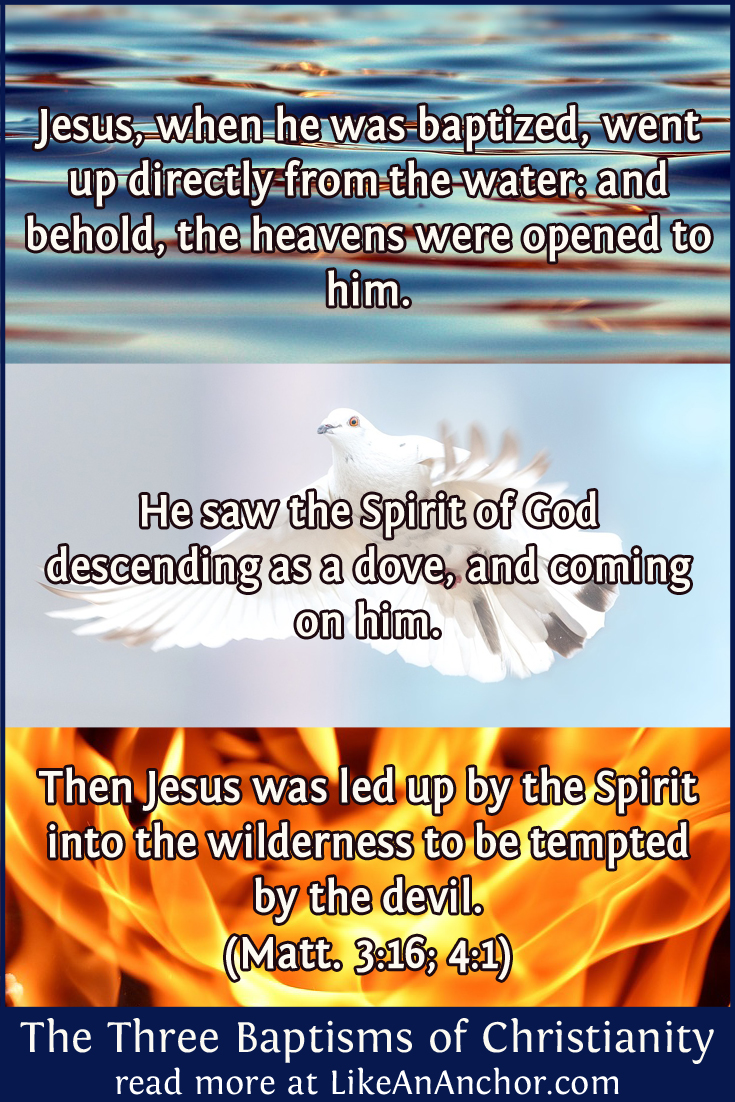
I baptize you with water for repentance, but the one who comes after me is more powerful than I am, whose sandals I am not worthy to carry. He will baptize you with the Holy Spirit and fire. (Matt. 3:11, LEB)

Water, Spirit, Fire: The Three Baptisms of Christianity | LikeAnAnchor.com

Water, spirit, and fire — those are the three baptisms that John tells us believers in Jesus will go through. I think this is what the writer of Hebrews means when he describes “the doctrine of baptisms” (plural) as a foundation of Christianity (Heb. 6:1-2).

Read more

Praying At All Times

We’ve spent the last nine weeks looking at the famous Armor of God passage in Ephesians. There are six pieces of armor named there: the Girdle of Truth, the Breastplate of Righteousness, the Footwear of the Gospel, the Shield of Faith, the Helmet of Salvation, and the Sword of the Spirit. Those six character traits and spiritual items are where most lists stop, since they’re the ones compared to physical pieces of armor. But there’s a seventh item on the list.

with all prayer and supplication praying at all times in the Spirit, and to this end being alert with all perseverance and supplication for all the saints (Eph. 6:18, LEB)

All the armor must be put on and used with prayer. In this context, we can see prayer either as the connective tissue buckling the other armor on us or as a necessity before and when using the armor (or both). Whether you count prayer as a piece of armor or not, it’s clear that praying is essential when going into a battle we want God to fight for and with us.

Praying At All Times | marissabaker.wordpress.com
Photo credit: Ben White via StockSnap

Prayer Before Battle

As with the six pieces of armor listed earlier, we have examples of prayer being used in physical battles as well as spiritual ones. People of God have always recognized that even when facing physical enemies there’s a more important spiritual side to the battle. And it’s the Lord of Hosts who determines the outcome.

Three righteous kings left us records of their prayers before battle. Asa prayed when facing “an army of a thousand thousands” (2 Chr. 14:9-12), Jehoshaphat when facing “a great multitude” of Moabites and Ammonites (2 Chr. 20:1-29), and Hezekiah when threatened by a powerful Assyrian army (Is. 37:8-38).

In all three cases, God answered with a powerful victory. “Yahweh defeated the Cushites before Asa” and his army (2 Chr. 14:12, LEB). The Lord sent Jehoshaphat and his men armored into battle, but did all the fighting Himself (2 Chr. 20:16-29). And Hezekiah woke up one morning to find his enemy struck dead outside (Is. 37:36-37). Clearly, prayer is an effective battle strategy for those following God and fighting against His enemies. Read more

Sword Of The Spirit

Thus far, the armor of God we’ve been studying has all been defensive. The girdle, breastplate, footwear, shield, and helmet all protect us. They’re essential in battle, but they’re not something we can use to attack and (with the exception of the shield) they’re not actively defensive either. This next piece of armor, though, is a weapon.

receive … the sword of the Spirit, which is the word of God (Eph. 6:17, LEB)

Paul tells us exactly what we’re given as the only weapon included in this Armor of God. It’s called the Sword of the Spirit and it is the Word of God. Now it’s up to us to learn how to use the word as a sword.

Sword Of The Spirit | marissabaker.wordpress.com
Photo credit: Paul Kitchener via Flickr

Avoiding Word Confusion

There are two words in Greek for “word,” and we have to start by defining them if we want to avoid confusion. Just looking at the English, we would connect Eph. 6:17 with Heb. 4:12, which says, “the word of God is living and active, and sharper than any two-edged sword, piercing even to the dividing of soul and spirit” (WEB). But these versus aren’t talking about the same thing.

In Hebrews, it’s talking about the logos (G3056). This word refers to a spoken word of intelligence, and it’s what’s used as a name for Jesus in John 1:1, 14. Reading on in Hebrews makes it clear that He’s being talked about in this passage as well (Heb. 4:13-16).

In Ephesians, on the other hand, the word is rhema (G4487). It refers to the spoken or written sayings of God, but isn’t used as a title for the speaker. So in Hebrews, the Word as a sword refers to Jesus cutting into people’s spirits and knowing them deeply. Ephesians is talking about wielding the word, or scriptures, of God as a weapon. Read more