Once upon a time, I told my sister, “I don’t think I’d ever date an ENFP.” Even though I’d seen lots of people describing ENFP-INFJ as a “perfect” pairing it just didn’t sound like a good fit for me. I loved having ENFP friends, but the ones I knew were either so intense they made me feel anxious, or so extroverted they wore me out, or too scattered for me to think I wouldn’t eventually get irritated with them in a closer relationship (or all of the above).
Then a few years after making this statement, I started actually getting to know one of my ENFP acquaintances. And now we’re dating (doesn’t that sound like just the sort of coincidence that would happen in a romance story?). He does have an intense personality but I’ve done enough work overcoming my social anxiety that doesn’t scare me any more (actually, it’s rather exciting). He’s the most extroverted person I know but I’ve discovered it’s not a problem for us. And he’s not scattered or flaky (which, it turns out, is another of those unfair/too widely applied stereotypes bouncing around Myers-Briggs circles).
Now, I could spend the next 1,000+ words telling you about how wonderful my boyfriend is but that’s probably not what you clicked on this post for (if it was I’m afraid you’re going to be disappointed). Instead, we’re going to talk about why ENFPs and INFJs have a reputation in Myers-Briggs circles for getting along so well. Read more →
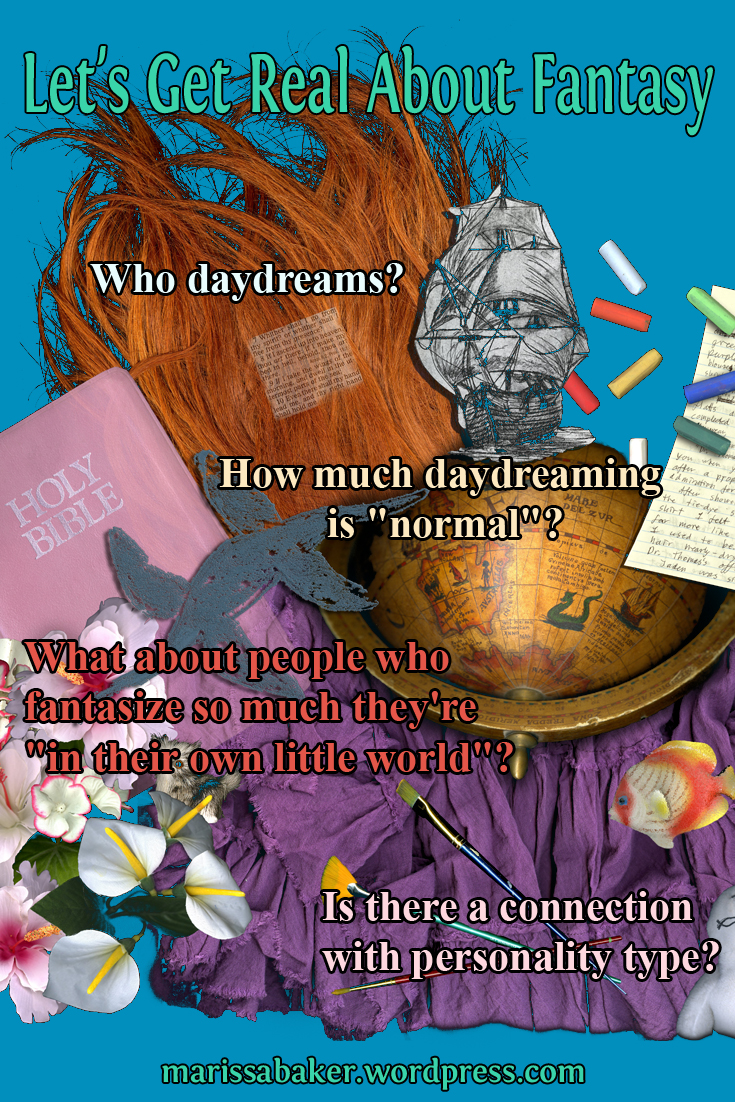
Daydreaming is often considered a childish activity. So it might come as a surprise that studies indicate at least 96% of adults engage in daydreams and/or fantasizing on a daily basis. These daydreams typically last for just a few minutes while the mind wanders, but they can also be more involved, frequent, and lengthy. And getting caught up in daydreams is not, as previously thought, as sign of tending toward mental illness.
According to an article in theDartmouth Undergraduate Journal of Science, we’re learning that daydreaming is “a normal part of our cognitive processes.” In fact, it’s pretty normal to “spend one-third to one-half of our waking hours daydreaming, although that amount can vary significantly from person to person.” I was honestly pretty surprised to learn this. I mean, I know I do that, but I wasn’t expecting such a large percentage of the population to also daydream so much.
But while reading different articles about daydreams, I realized something else. They’re talking about people’s minds drifting into fantasies about their real lives. For example, it’s considered healthy for someone approaching a job interview to daydream about getting the job or for someone in a high-stress job to spend time fantasizing about how all their conversations for the upcoming day could go well. Other studies asked people to daydream about taking vacations or their childhood home. These daydreams are about things that could happen or have happened. I have those types of daydreams, too, but that’s not what most of mine are.
this picture is part of a psychological self-portrait I made in a college art class
Extreme Fantasizers
While studying hypnotic suggestibility in 1981, psychologists Theodore X. Barber and Sheryl Wilson discovered that the 27 women they identified “as extremely good hypnotic subjects … all had a fantasy life so intense that it seemed ‘as real as real.'”‘ After more research, people in this group are now described as having a “fantasy prone personality” (FPP). On the more extreme side, where fantasies start to take over reality, it’s called “maladaptive daydreaming” (click here to read an interview with a maladaptive daydreamer).
According to researchers, about 4 percent of people spend half or more of their waking hours absorbed in reverie. The fantasies are not mere fleeting daydreams but something of a cross between a dream and a movie, where an elaborate scenario unfolds once a theme is set. (from a New York Times article)
Reading about this group is where I start to recognize myself. Read more →
It’s no secret I’m a big fan of Myers-Briggs®. I’ll defend it against people who say it’s useless, write and re-write posts trying to come up with the simplest introduction to function stacks ever, and spend my time musing about how type influences both real people and fictional characters. But as much as I like the Myers-Briggs® system of personality types, I also know there are things it’s not meant to do.
In fact, applying Myers-Briggs® wrongly is one of the biggest reasons it has come under so much criticism. For example, you can find quite a few articles online that argue Myers-Briggs® is basically useless in a work environment. They’ll tell you it’s not a good indicator of job performance nor is it all that useful for screening potential employees. But that shouldn’t come as a surprise, considering those aren’t the test’s purpose. And it’s unfair to dismiss a test for not doing something it wasn’t meant to do in the first place.
So what is the Myers-Briggs® test supposed to tell you? And just how much can we apply what we learn from finding our type to real life?
This Is Your Brain On Decision Making
The Myers-Briggs® test is designed to measure how people’s minds work. It describes their preferred mental processes or “cognitive functions” (to use the technical term). Contrary to what so many critics of the test think, it doesn’t force people into dichotomies. Rather, each type has a “stack” of preferred functions. So an ENFJ type isn’t someone who’s 100% extroverted, intuitive, feeling, and judging. They’re a type that prefers making decisions with Extroverted Feeling, learning new things with Introverted Intuition, and then also uses Extroverted Sensing and Introverted Thinking to a lesser extent (click here to learn how we get from the four letter type to the functions).
These characteristics of Myers-Briggs® theory means that taking the test can help you: Read more →
Most of my readers find this blog looking for INFJ posts, so I’m sure many of you know I have a keen interest in personality types. Until very recently, my whole focus has been on the Myers-Briggs typing system. But someone finally convinced me to give the Enneagram a try. I was suspicious at first. It seemed strange, vague, largely negative, and not all that verifiable. Then I thought perhaps I hadn’t picked a good book to start with as my introduction and started prowling around online for recommendations.
And that’s how I found Discovering Your Personality Type: The Essential Introduction to the Enneagram by Don Richard Riso and Russ Hudson. These guys know how to write a personality type book. This particular one is a short little book that packs a whole lot of information in its 224 pages, including their type indicator questionnaire (you can either purchase the test online or get this book and do the paper version). They’ve also written other, more in-depth, books including one that I’m reading now.
What On Earth Is The Enneagram?
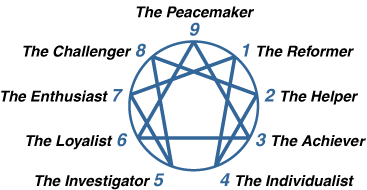
The Enneagram of Personality Types is “a modern synthesis of a number of ancient wisdom traditions” originally put together by Oscar Ichazo (click here to read more). There are nine basic personality types and everyone is born with one type that dominates their personality. Read more →
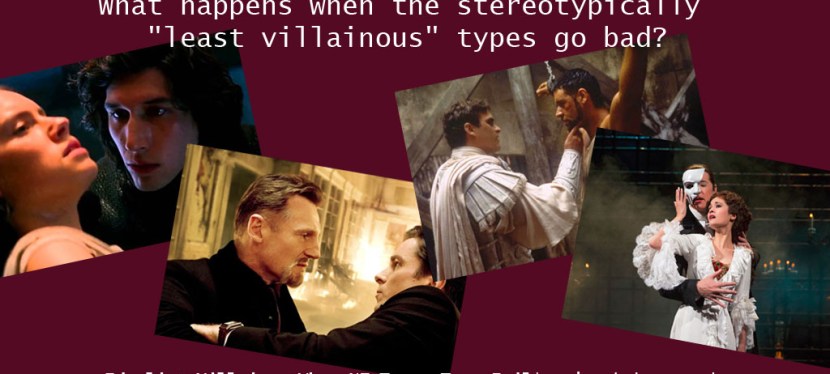
A few weeks ago I observed something curious in one of the personality type groups I frequent on Facebook. One member started a discussion about what kind of villain different personality types would be and there were a few types they didn’t even list. Their assumption was that most Feeling types wouldn’t become villains and especially not NF or FP types.
Rather than bask in the knowledge that we’re the lest villainous type a surprisingly high number of NFs jumped into the comments to defend our ability to turn evil. Most of their comments went something like this: “Well, I wouldn’t personally be a villain, but I could be because *insert reasons.* And on top of that, *insert fictional or real name* is a villain of my type.” I laughed at the number of INFJs who reminded people that Hitler was an INFJ while at the same time reassuring people they don’t feel Hitler-ish tendencies themselves.
Who Gets To Be The Villain?
I dare say when most people think about villains, they think of a detached mastermind. There’s a ridiculously high percentage of NT type villains (and correspondingly few NT heroes; it’s even harder to find heroic INTJs in fiction than it is to find NF villains). In real life, of course, people of any personality type can lean more towards the best version or the worst version of their type. No one personality type is inherently “better” than any other. However, society does stereotype certain characteristics associated with types as better or worse.
Prioritizing other’s safety over your own, a characteristic most commonly associated with FJ types, is often seen as a heroic trait. Hence, we see characters like Captain America with an ISFJ personality type. But what if you have an ISFJ character who decides only a certain group of people (or even just one person) is more valuable and it’s their duty to protect them? Suddenly the heroic trait doesn’t seem so safe any more. Especially when you consider the prime example of a villainous ISFJ is Norman Bates from Psycho. Read more →
Because INFJs and INTJs both use Introverted Intuition as their favorite mental process, the two types can appear very similar. Quite a few people who take a Myers-Briggs test and get either of these results (or both on different tests) are left wondering, how can I tell whether I’m an INFJ and INTJ?
My personality type is INFJ and my sister’s is INTJ. It would be well-nigh impossible to assume we share a personality type, but if you don’t have that contrast living with you (or if you’re a little less extreme on your T/F preference) I can see how deciding which type is your best fit could be a challenge. INFJs and INTJs lead with the same mental process and they react in very similar ways when stressed out. The main differences between the two types have to do with how they handle their Thinking/Feeling preference.
INFJs use auxiliary Extroverted Feeling as their copilot and support it with tertiary Introverted Thinking. INTJs use auxiliary Extroverted Thinking as their copilot and support it with tertiary Introverted Feeling. The auxiliary process is how they prefer to make decisions and interact with the outer world, but they can slip into their tertiary quite easily. It’s not as well developed or as reliable, but it can seem comfortable since it’s introverted (just like their dominant intuitive function).
How comfortable each INFJ/INTJ is with their thinking and feeling processes depends on a number of factors, including age, environment, and past experiences. You can find INFJs who are very people-oriented and social, or INFJs that seem distant and logical. Similarly, you’ll meet INTJs who are stereotypically blunt and calculating, and INTJs who are comfortable experiencing their own emotions. Even so, the way these functions shows up looks different for each type.
My Cup of T
An INTJ’s Thinking side is focused on the outer world. It’s also the function they’re most comfortable using when making decisions. While mature, well-balanced INTJs will take the human side of a question into consideration, it’s typically secondary to finding the most logical, fact-based solution. Personality Hacker calls this mental process “Effectiveness” and says it “focuses on impersonal criteria for making decisions” and prioritizes efficient problem solving.
INFJs, on the other hand, use an inward-focused Thinking process and they’re not usually as comfortable with it as they are with their Feeling side. Personality Hacker calls Introverted Thinking “Accuracy” and says this function gives users “the ability to reason through a subject or concept within one own’s understanding, even if it doesn’t match ‘outer world’ data.” Basically, this process is trying to work through things until they make sense.
INTJs are much more likely to express their Thinking judgements externally than an INFJ. They’ll often seem more blunt and direct because efficient communication is more important to them than worrying another person’s feelings. INTJs are also more likely to draw on objective, external facts to support their ideas. They want their ideas to work and they want outer world validation for their problem solving. That’s not nearly as important to INFJs, who need things to make sense personally more than to the people around them.
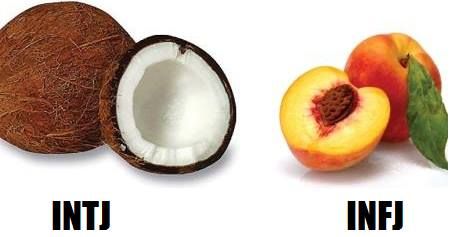
spotted this on Pinterest and I love it
Feeling The Feels
An INFJ’s Feeling side, like INTJ Thinking, is the function they use most comfortably when making decisions. It’s also outward focused, but it’s primarily people-oriented. Personality Hacker nicknames this function “Harmony” because it “makes decisions based on how things are impacting people on an emotional level.” The key thing to remember about this function is that it’s outward focused. INFJs are more in touch with other people’s feelings than they are their own.
INTJs use a Feeling process that’s introverted, which Personality Hacker calls “Authenticity.” While it’s also concerned with how decisions impact on an emotional level, it’s focused on one’s own emotions rather than other people’s. To again quote Personality Hacker, “Introverted Feeling is about checking in with all those inner parts and voices to determine what feels the most in alignment with oneself.” Somewhat ironically, the stereotypically cold and logical INTJs are often much more in-tune with their own feelings than the stereotypically emotional INFJs.
INFJs are more comfortable expressing feelings in the outer world and also more likely to pick-up on what other people are feeling. They’ll typically seem much more empathic and expressive than an INTJ. An INFJ who’s comfortable with their Extroverted Feeling side will also appear more social and “extroverted” than a typical INTJ. But INTJs are far more in-tune with their own emotions than most people (and many type descriptions) will give them credit for.
Even after you know about the technical differences between the ways INFJs and INTJs use thinking and feeling, you might still wonder they show up in real life. Let me give you some quick examples.
When making an everyday decision — an INFJ’s first impulse will be finding what makes as many people as possible happy, while an INTJ’s first impulse will be quickly finding the most logical answer. For me and my sister at least, the INTJ has a much easier time making simple decisions without overthinking them than the INFJ does.
In a stressful/emergency situation — I’m the one who’s in logic mode and my INTJ sister is the one indecisive and unsure. We’re talking something that calls for quick action and is stressful enough to push you out of your most comfortable mental processes (such as deciding to take someone to the hospital), Might not hold true for every INFJ or INTJ, but it’s an interesting observation I’ve made.
If asked to change their minds — an INTJ is most likely going to stick with what they’ve already decided because they know their idea is based on logic and that it feels right to them. To change their mind, you’ll need to present a fact-based counterargument that matches their deeply held beliefs about what’s right. A confronted INFJ will second-guess themselves because now they know someone isn’t happy with what they chose but they’ll also be reluctant to abandon something that makes sense to them. To change their mind, you’ll need to present an argument that hits emotion as well as logic.
I hope this helps you with telling the difference between these two types If you can’t tell if you’re an INFJ or and INTJ, looking at the differences in Thinking and Feeling functions is a good place to start figuring out your type. You’re not going to be a perfect 100% fit for every description of any one personality type, but there should be one that’s a “best fit” for your personality.
Your Turn: What are some differences and similarities you’ve noticed between INFJ and INTJ types?




 Like An Anchor