How Do You Know When To “Door Slam” Someone?

Have you ever cut someone out of your life because you were 100% done with that relationship? Then you’ve done a door slam. Anyone can door slam someone else, but it’s INFJs who are most “famous” (infamous?) for it in personality type circles. The INFJ Door Slam involves deciding not to invest any more time or emotional energy into another person. It’s also pretty final.

When you’re struggling with a hurtful and/or decaying relationship it’s always hard to know how to handle things. Do I slam the door on them and avoid more hurt? Do I try to address the problem and patch things up? The more self-aware I become, the more I realize that I have the capability to emotionally hurt those close to me and that I don’t want to do that. Sometimes relationships have to end, but perhaps it’s worth taking a little extra time to step back and ask how you can protect yourself while minimizing the damage you do to the other person.

While the door slam can be a healthy defense mechanism (like if you need to get out of a relationship with a narcissistic personality that’s controlling and manipulating you), it can also be a way of avoiding conflict. Much as we hate conflict, it’s sometimes necessary to rebuild a friendship that might actually be valuable if you’d put time and effort into fixing things. But how can you tell the difference between relationships you should fight for and ones you need to let go?

Are You Being Hurt?

That’s the first question. For a type known for their lie-detecting skills, INFJs are surprisingly prone to ending up in relationships with people who are not trustworthy. We can be far too inclined toward initially giving people the benefit of the doubt and then holding on to people who aren’t healthy for us. This might be because we feel that we need to help them, or because we see the person they want to be rather than who they are, or because we don’t feel that we have the energy to get out of the relationship. Read more

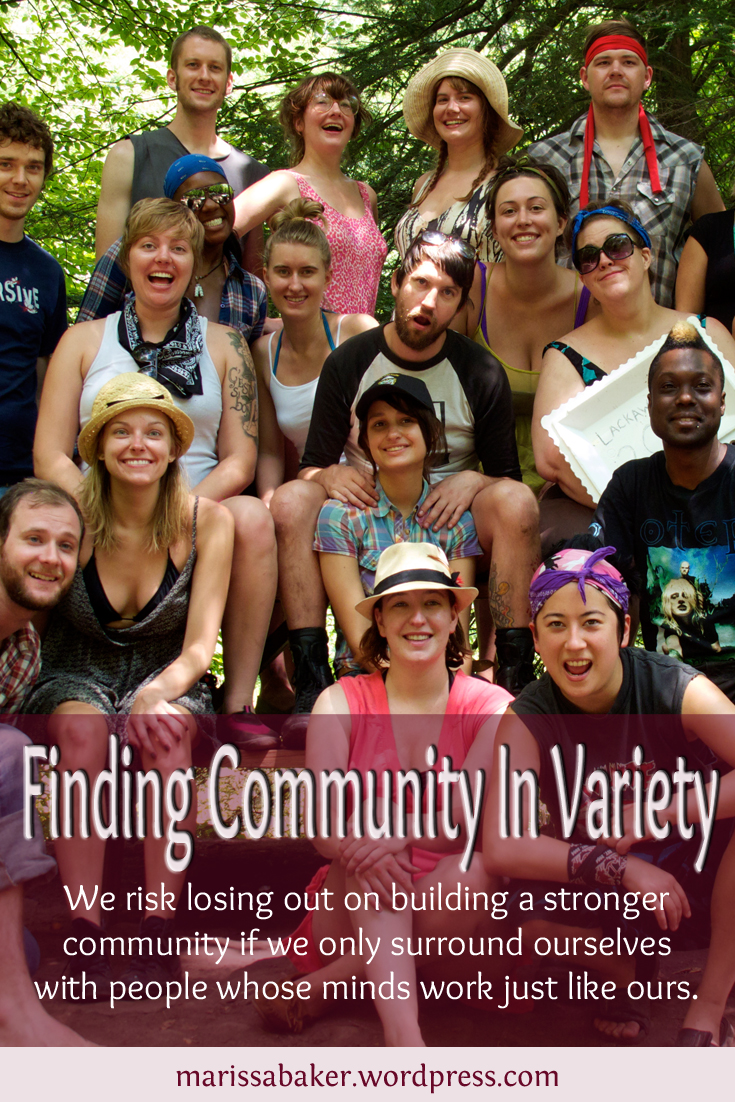
Finding Community In Variety

There’s something magical about meeting a person who “gets” you. It’s like your minds work on the same wavelength and you’re instantly talking as if you’re old friends. The two of you think so much alike that there’s no struggle to explain yourself.

This sort of connection often has to do with personality type. Our Myers-Briggs types describe the way our minds work (click here for tips on finding your true Myers-Briggs type). When we meet someone else whose brain processes the word in a similar way, we’re likely to experience a connection with them, especially if we have overlapping interests.

click to read article, "Finding Community In Variety" | marissabaker.wordpress.com
photo credit: “Camp Photo 1” by Matthew Hurst, CC BY-SA via Flickr

In contrast, when we seem to clash with someone for no reason it often has to do with differences in how we process the world. To use a fictional example from the Marvel Cinematic Universe, Steve Rogers and Tony Stark don’t just conflict ideologically. Their ISFJ and ENTP types are exact opposites, which means the mental process Steve is most comfortable using is the one Tony finds most stressful (and vice versa).

Many of us seek to surround ourselves with people who think like us. They’re the people we’re most comfortable with, the ones who identify with us, the ones with similar priorities and goals. Often this type of community is based around interests, such as spending time with people in your church, joining a bird watching club, or hanging out with friends at a ballgame. Personality similarities in these groups are typically accidental.

For those with rare personality types, though, it’s hard to find communities of like-minded people. Only about 30% of the population is made up of Intuitive types, and among those INTJ and INFJ are the rarest. How do you find community when only 1-4% of the world’s population thinks like you? Read more

These Aren’t My Feelings: Absorbing Emotions as an INFJ

This past Friday I did something I’ve never done before and which provided my father with much amusement. I danced at someone’s funeral. More precisely, it was at a memorial service for a man I didn’t really know. I’d seen him at church services, but we never spoke. His wife was on our dance team, though, and she asked us to open the service by dancing to Bo Ruach Elohim.

At first, I didn’t really feel much about this man’s death beyond a rather abstract sense of sympathy for those who loved him. But as soon as I was surrounded by those who were grieving, I started to feel it as well. Layering on top of that were the emotions I imagined other people I cared about feeling. I won’t go into any details, but some of the things this man’s wife and daughter mentioned when they spoke about him directly touched on struggles I know two other friends are going through. And my heart ached with/for them all.

INFJ Empaths

These Aren’t My Feelings: Absorbing Emotions as an INFJ | LIkeAnAnchor.com
Photo credit: Milada Vigerova via StockSnap

INFJs are inherently sensitive to other people’s emotions. On top of that, many describe themselves as an HSP (Highly Sensitive Person) and/or empath. This trait, “empath,” isn’t simply a person who feels empathy. Here’s a description written by Jennifer Soldner, an empathic INFJ:

An empath is a person who feels exactly what others feel. This is not to be mistaken with sympathy, which is trying to understand what someone is going through, or even the very similar word empathy, which is actually just being familiar with what someone else is experiencing. An empath literally feels exactly what someone else feels, even if they have never experienced, nor can they relate in any way to what the other person is going through. (from The INFJ Empath Explained)

Talking about being an empath is kind of tricky. Going back to my opening story, suppose I told you that I didn’t start out having feelings of my own about this man’s death, but when I walked into a room of people grieving for him I felt grief. Someone who reads that and assumes I’m an empath would say it’s because I was picking up the other people’s energy waves and feeling their grief as if the emotion were my own. Someone who doesn’t think I’m an empath would say I’m mirroring the other people’s grief because I observe it and care about them, or that I’m projecting my ideas of what they are feeling and then responding to that. Read more

An Open Letter to Socially Timid Highly Sensitive People

I’m so excited to share with you my first article published on Introvert, Dear. Read an excerpt below, then follow the “Read More” link for the full article.

Dear fellow highly sensitive person,

Like many of you, I didn’t know I was a highly sensitive person (HSP) for a long while. I just knew I was “different.” For me, this was particularly marked in social situations. Other people went shopping together to unwind, but I felt tense in brightly lit malls bombarded by flashing advertisements, milling crowds, and heavy perfumes. My friends didn’t wince at dances when the music was turned up, they danced harder. My classmates in college seemed like they could relax and focus, while I noticed the flickering lights, the quality of air, the spot on the professor’s shirt, the scratch of pencils on paper.

Sound familiar? If you were like me, you were sure this wasn’t normal—but you weren’t sure what to do about it. I couldn’t understand why it was so hard to get over my shyness and start acting like other people. I had discovered my Myers-Briggs personality type was INFJ when I was preparing to graduate high school as a homeschooler, but it wasn’t until I was floundering through the social landscape of college that I started really researching it. I began at the library, desperately digging through books, looking for ways to cope with my introversion. …. Read More

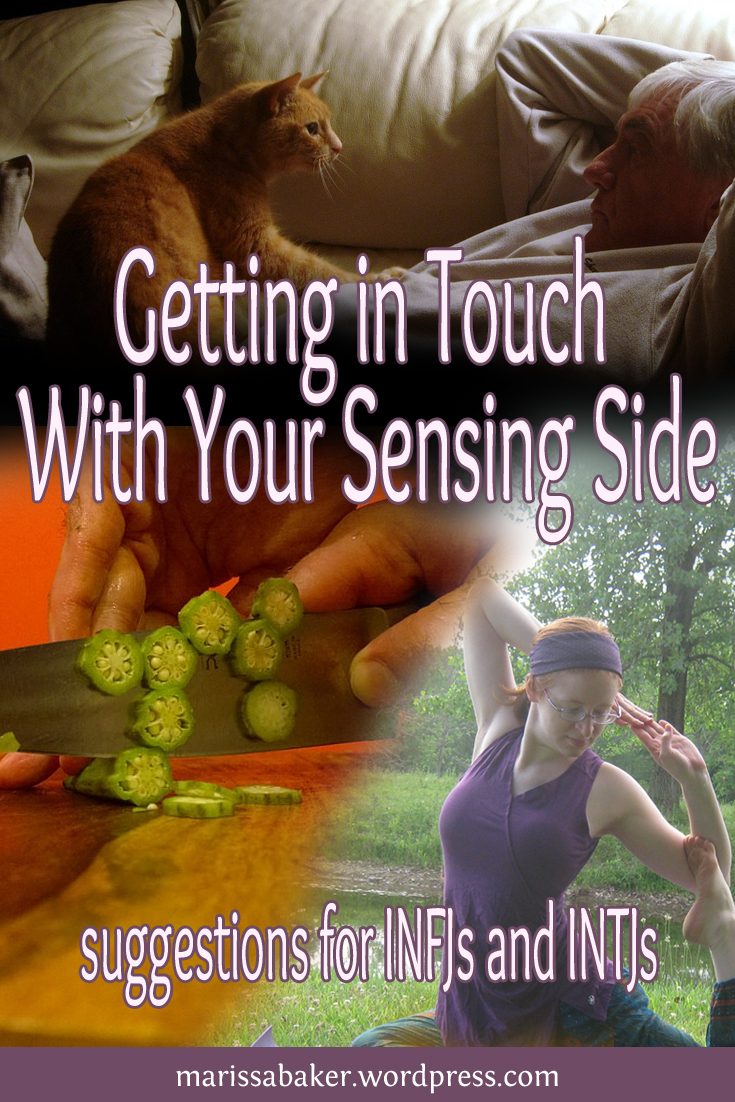
Getting in Touch With Your Sensing Side (for INxJs)

We’ve all gotten lost in thought and stubbed our toes or run into something because we weren’t paying attention (or is that just me and my friends?). But for some of us, keeping track of what’s going on in the outer world is actually quite a challenge. People who are Sensing types in the Myers-Briggs system are naturally “wired” to interact with the real world of sensory information, but Intuitives are more concerned with abstract thought and possibility. It can be quite a strength, but it has its downsides as well (perhaps there’s a reason only 30% of the population is Intuitive).

Getting in Touch With Your Sensing Side (for INxJs) | marissabaker.wordpress.com
Photo credits: Les Chatfield (Conversation With a Cat, CC BY), Eve Tisler (untitled, CC BY-SA), and my brother’s photo of me doing yoga

When Sensing isn’t your preferred function (or, in the case of INxJs and ENxPs, isn’t even your second or third function), it can be easy to loose touch with the outer world. Dominant Intuitives may forget to eat or exercise when they’re distracted by non-sensory concerns. We might zone-out and miss important things going on in the outer world. Sometimes we even get hurt and can’t remember how (if I had a dollar for the bruises, cuts, and bumps I notice and wonder “How’d that get there?” …). Yet as challenging as it is, getting in touch with our inferior function, and even befriending it in some way, offers rich opportunities for growth and stability. Read more

INFJ User Guide

Congratulations on the procurement your new INFJ!* INFJs are highly sought after in the personality type collecting world given their extremely rare nature. INFJ spotting is a very difficult hobby, requiring forays into the deepest recesses of bookstores, yoga studios, and the internet. Keeping an INFJ in your life once you’ve found one can be even more of a challenge.

INFJs are widely considered one of the most amiable and empathetic personalities. Their minds offer a good balance of emotion and logic that helps them relate to most types of people, and they highly value commitment and relationships. As introverts, though, they have limited social energy and they don’t maintain relationships with most of the people they meet. Once you’ve found an INFJ, taking your acquaintance to the level or friendship, or relationship, isn’t simple. That is, unless you have this user guide.

INFJ User Guide | marissabaker.wordpress.com

Overview of the INFJ

The INFJ is a strange sort of creature, often compared to unicorns. Their uniqueness is a result of two things: the way their brains/personalities are hardwired and the rarity of their personality type. What’s perfectly normal for an INFJ seems unusual among humanity as a whole because so few people function this way. Understanding your INFJ’s basic functions is the first step towards successful interaction with the INFJ.

Read more