I’m sure I read somewhere that David Keirsey originally called the INFJ personality type “The Writer” instead of “The Counselor,” but I can’t find the article now. Nevertheless, it does seem that quite a few INFJs are attracted to writing. Even if they aren’t working as writers or typing away at a novel, they probably keep a journal/diary and are often more comfortable with written communication than they are with speaking. I’m a fairly typical example of INFJs in this regard — I write a blog (obviously), keep a journal, work as a writer, prefer writing e-mails to taking on the phone, and write fiction.
Speaking of writing fiction …
I won NaNoWriMo! I’m particularly pleased with myself for conquering the 50,000 words a day early in spite of having pneumonia in November. Anyway, back to INFJ writers.
Imaginative Fiction
There’s an INFJ profile written by Dr. A.J. Drenth (which no longer appears on his website, but you can read it here) that has this to say about INFJs:
Although INFJs are commonly drawn to music, visual arts, design, or architecture, writing may well be this type’s signature creative talent. Adept at channeling their right-brain creativity into a fluid and engaging left-brain storyline, INFJs are unmatched in their feel for and creative use of the written word.
This creative aspect of our writing talent seems to be tied to an INFJ’s primary function — Introverted Intuition (Ni). Intuitive types prefer possibility to actuality, future to the present, intuition to fact, and improvement over the status quo. When intuition is introverted, as for INFJs, the focus is mostly on an internal world where our minds tinker with “ideas, perspectives, theories, visions, stories, symbols, and metaphors” (Dr. A.J. Drenth, Introverted Intuition).
Even INFJs who don’t write typically have an affinity for stories and a “rich inner life.” We tend to live in a world of possibilities, and I find that one way to keep my fantasy life anchored in reality is to turn those ideas into stories and write them down. It’s weakness/temptation for INFJs to never move their ideas from possibility to reality. With creative writing, I can set my imagination loose and tell myself there’s a practical application for it as well.
INFJs as Writers
It’s hard to type people when you don’t know them, but there are some famous writers that we can guess were INFJs. Keirsey lists Emily Bronte and Emily Dickenson as “Counselor” types. Another list of famous INFJs adds writers like Chaucer, Dante Alighieri, Fyodor Dostoevsky, and Nathaniel Hawthorne. A forum discussion suggests Madeleine L’Engle, Antoine de Saint-Exupery, Lois Lowry, Ursla LeGuin, Franz Kafka, and several others could be added to the list.
my latest novel, laid-out in Post-It notes above my bed, with a different color for each point-of-view character
Now, the fact that many INFJs gravitate towards writing doesn’t mean that it’s always easy for us. I’m not sure how many stories I started and abandoned before finally finishing my first novel in 2011. It was for NaNoWriMo, and I needed that deadline to keep myself writing. It’s so easy to build the story in my head, and then lose interest in writing it down once I think I know how it ends.
Though knowing the end makes me lose interest in the story, I also need some kind of outline to keep me on track. I’ve discovered sticky notes on the wall is my new favorite way to plot-out novels. They can be removed or rearranged as needed, and you don’t need to have them all there to start writing. For my NaNo novel this year, I began with only half the plot laid-out, and added more scenes as I wrote and the direction of the story became clear.
Myers-Briggs types have much to tell us about ourselves and other people. Our MBTI type reflects our preferences for crowded parties or small gathering, describes how we connect with other people, shows us how we naturally respond to stress, and gives us a picture of our innate strengths and weaknesses. Another thing it’s often used for is trying to predict what type of person we’ll be attracted to, and most compatible with, in a romantic sense. Unfortunately, MBTI only gives part of the picture in this regard.
Types in Love
Disclaimer: some of the links in this post are affiliate links. This means that, at no additional cost to you, I will receive a commission if you click on the link and make a purchase on that website.
Use of the MBTI for romance is subject to much debate. Isabel Myer wrote in Gifts Differing*, chapter 11, that “it seems only reasonable that the greater mutual understanding between couples with more likeness than difference should lead, on the whole, to greater mutual attraction and esteem.” This was supported by her study of 375 married couples who were most frequently “alike on three of their four preferences rather than on only two, as would be expected by chance.” However, Isabel Myer was an INFP woman happily married to an ISTJ man. According to her own personality theory, they “shouldn’t” have gotten along, especially since she thought that shared S-N preferences were the most important for predicting a couple’s happiness together and understanding of each other. Obviously type isn’t the only important ingredient for happiness.
Elizabeth and Darcy from Pride and Prejudice, an NF – NT couple
David Keirsey’s book Please Understand Me II* agrees with Myers on the importance of S-N pairings, saying that his SP Artisan types are most compatible with SJ Guardians, and that NF Idealists are most compatible with NT rationals. His ideal pairing is someone who shares your S-N preference and is your opposite in the other three preferences. For example, he would pair an INFJ with an ENTP.
Continuing with INFJs as our example, these theories have influenced many INFJ profiles online. Jennifer Soldner’s Guide To INFJ Relationships lists ENFP, ENTP, INTJ and INFJ as the best matches for an INFJ. The worst matches are ESFP, ESTP, ESTJ, and ENTJ (note that this last one contradicts Keirsey’s rule for pairing NF and NT types). For the most part, these suggestions seem logical at first, much like Isabel Myer said when theorizing that people will get along best if they are similar. It doesn’t explain, however, why one study found that INFJs were most likely to marry either INFJs or ESTPs, or why Myers herself was happy married to someone so dissimilar in terms of type. Clearly there’s something else going on here.
The “Something Else”
Even with their generalizations about which types get along most easily together, both Isabel Myers and David Keirsey admit there are other very important ingredients to a lasting romantic relationship.
Individual relationships defy generalizations, and it should be stressed that two well-adjusted people of any two temperaments can find ways of making their marriage work for them.” (Keirsey)
“Understanding, appreciation, and respect make a lifelong marriage possible and good. Similarity of type is not important, except as it leads to these three. Without them, people fall in love and out of love again; with them, a man and woman will become increasingly valuable to each other and know that they are contributing to each other’s lives.” (Myers)
A mutual willingness to work together and actively build-up the relationships is more important than compatible MBTI types. One aspect of this is understanding the other person and learning how to love them. Becoming familiar with their Myers-Briggs type will help tremendously, but it’s not enough by itself. You also benefit from an understanding of Love Languages.
The five love languages theory was first published in 1995 by Gary Chapman, a relationship counselor and pastor. He says every person has a “language” that they use to communicate and receive love, either Words of Affirmation, Quality Time, Receiving Gifts, Acts of Service, or Physical Touch. Everyone has one primary love language, and you might have a secondary love language as well. If someone’s partner is not speaking their love language, they will not feel loved. There’s a test on Chapman’s website if you don’t know what your love language is and want to find out.
Layering Love Languages
In theory, any MBTI type can be combined with any one of the five love languages. I’m guessing, however, that there are some love languages that are more likely for certain MBTI types. Let’s take a quick look at the characteristics for the four type groups as related to different love languages.
SP types are typically concerned with outward, concrete ways of viewing the world, and focus on the here and now. Keirsey describes their preferred role in a romantic relationship as “playmate.” I could see SP types being particularly inclined toward Receiving Gifts, Quality Time, or Physical Touch as a primary love language. These all involve doing something for or with the loved one, which would appeal strongly to SP types.
Duty-fulfilling SJ types tend to play what Keirsey described as a “helpmate” role in relationships. They are stable, traditional, and thoroughly dependable people. SJ types might be most in tune with Acts of Service, Quality Time or Words of Affirmation as a love language. These love languages visibly or verbally confirm that a SJ’s loved ones appreciate their constant reliability.
NF types are idealistic, enjoy abstract thought, and are natural romantics. Keirsey described their role in a romantic relationship as “soulmate.” They search for deep, genuine connections. Quality Time and Words of Affirmation seem like the most likely love languages, though Physical Touch and Acts of Service are also good possibilities. The key for NF types is genuine depth in a relationship, so they are inclined towards a language that increases emotional intimacy.
The NT types are highly intellectual, and Keirsey described their relationship role as “mindmate.” They are logical, abstract, and have little tolerance for the superficial. Words of Affirmation and Quality Time seem like the most likely love languages for an NT type, but after reading two different forum topics on MBTI types and love languages (one on Typology Central and one on Personality Cafe) I learned many NTs favor Physical Touch as well. My personal theory is that NT types view Service and/or Gifts with suspicion, wondering what the other person wants from them, while the others seem more genuine.
What about you? What are your Myers-Briggs type and love language(s)? Do you see a connection between the two? Share in the comments!
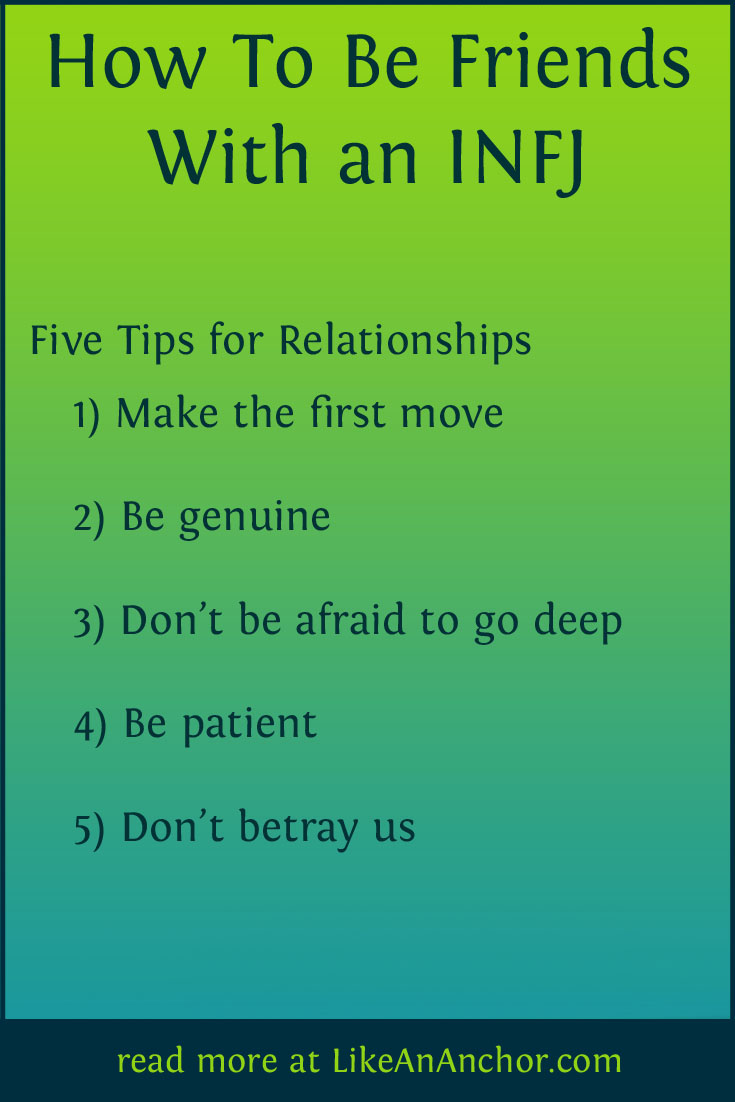
While trying to decide on my next topic, I saw that “how to be friends with an INFJ” was one of the top searches on my blog this past week. I’ve addressed the issue of friendship in some of my other posts about INFJs, but never written an entire post about it. It’s also something that has been on my mind recently, and it is a not infrequent topic of discussion between me and some close friends.
If you want to make friends with an INFJ, or get to know one better, there are a few key points to keep in mind. Some of these are true for all friendships, and especially friendships with INFJs, and others are more INF-specific. They are also a good first-step if you are romantically interested in an INFJ and want them to notice you.
INFJs use extroverted feeling (Fe) to relate to the outside world. This means that we can draw energy from emotional interactions, and may appear more extroverted than other introverts. This is also true of ISFJs, who are often considered the most “extroverted” introverts since they love people so much.
Still, we are introverts, and we’re most comfortable talking with people we already know. If you want to get to know an INFJ, you’ll probably have to be the one who initiates a conversation. That lets us know you are interested in talking with us, which puts us at ease since we aren’t worried about whether or not we’re imposing on your time when you’d rather be doing something else.
Pairing Introverted Intuition (Ni) with Fe gives INFJs an almost super-human empathy. Many INFJs literally feel other people’s emotions, and we’re quick to pick up on unspoken cues that don’t match spoken words. We might not be able to tell what you’re holding back or lying about, but we can tell you’re not being genuine and that’s a huge turn off.
If an INFJ suspects you of being less than genuine, they loose interest very quickly. If you’re a new acquaintance, they might simply avoid seeing you again. If you’re someone they can’t avoid, then they will keep conversations civil but superficial. We don’t trust our true selves with people when we can’t get a read on what their true selves are like.
3) Don’t Be Afraid to Go Deep
INFJs have little interest in shallow conversations. We would rather have a few close friends than many casual acquaintances. The way the word “friend” is used has always bothered me as being imprecise. I have acquaintances, friends, and then close friends, but I just refer to them all as “friends” to avoid offending anyone who thinks they are a friend and then finds out I think of them as an acquaintance. People who meet INFJs often think that they know them well, while the INFJ thinks “they really don’t know me at all.”
If you want to be one of an INFJs close friends, then you have to make an effort to get beyond the superficial. INFJs respond very well to this, so once you indicate that you are interested in going beyond small-talk the sharing will go both ways. We like conversation, and we will talk as well as listen if we feel safe and interested. Here’s a great article called How To Turn Small Talk Into Smart Conversation. When I read this as an INFJ, my reaction was, “I wish more people would introduce themselves like this. I would be so much more interested in talking to them.”
Even if you’ve taken the first step to initiate a friendship, been completely honest, and encouraged deep conversation it can take quite a while for an INFJ to really open up. We have many layers, and the longer we are in a stable friendship with you, the more layers we’ll let you see. INFJs form instant perceptions of whether or not we can trust people, so first-impressions are important, but we also modify our impression based on how we observe your behavior over time. A bad first impression can be reversed if we see you making an effort to be friendly and trust-worthy, and a good first impression can be deepened as we see that what we’ve already shared with you stays safe.
Patience also comes into play during conversations. INFJs have trouble getting all their thoughts out into words. If the topic of conversation is something they’ve already thought about, they can speak readily and coherently. If it’s new and unfamiliar we typically do one of two things: 1) nod and make some general comments while our brains frantically race to come up with something to say. Usually that “something” shows up a week later in the shower. 2) start putting our thoughts into words, and sorting through ideas verbally. The final idea might take some time to emerge.
The second reaction is the one you’re going for in a friendship with INFJs. If we’re comfortable enough to think out-loud, it means we trust you. As long as you give us time to come up with an answer rather than look at us like we’re crazy, then we’ll relax and the conversation can continue to move forward. If you cut us off or jump to conclusions about what we think before we’ve had time to express outselves, we feel like you aren’t really interested in what we’re thinking and be hesitant to share with you later.
5) Don’t Betray Us
INFJs hold grudges. We might forgive readily (depending on the circumstances), but we don’t forget. It’s not something I’m proud of, but it is my automatic response. The closer you get to an INFJ, the harder it is to bounce-back to a close friendship after you’ve hurt us. The more we like you and the more we have invested in you, the more chances we’ll give you, but there’s a point at which we just give up and shut you out.
An INFJ might not completely sever ties with someone who has hurt them (depending on the nature of that betrayal), but they will withdraw. For example, if you give an INFJ the impression that you want to carry on a regular correspondence filled with deep discussion and then ignore her for 3 months and forget to answer any of her questions when you do reply, she will have no interest in continuing the correspondence.
Why Bother?
So why go to all this effort? What do you get out of a relationship with an INFJ?
For one thing, INFJs are surprisingly good fun to be around. We have a great sense of humor, delight in occasional spontaneity, and can talk about pretty much anything you like. But you don’t see all that until you make the effort to become friends. Until then, INFJs will hover in the background (away from other people) or blend in like a chameleon (with other people) to avoid stressful, superficial interactions.
INFJs are also good listeners, and we love to offer counsel. Sometimes we feel like our friends’ therapist, but we rarely mind. We want to help, and we’re good at suspending judgement. Since we’re so empathic, we aren’t often surprised by anything you tell us even if you thought you were doing a good job of keeping it hidden. Once it’s out in the open, we are sympathetic listeners who ask questions and want to fully understand what’s going on before we offer suggestions or any kind of judgements.
We’re also fiercely loyal. We don’t let many people get close, and we want to hold on to the very few that do become our true friends. We’ll do just about anything to keep the people we love in our lives. INFJs take the time to build-up their relationships, cultivate deepening friendships, and keep in touch with what’s going on in the lives of people we care about. We’re supportive, encouraging, and willing to adapt ourselves to make others happy as long as it doesn’t conflict with our core values. So get out there and start making friendships with INFJs. I don’t think you’ll regret it!
Some of you probably noticed there wasn’t a recipe post last week. There’s not one today, either. I want to start to focus this blog a bit more narrowly, and spend more time writing e-books and fiction. I’ll probably still post recipes as I find some that I want to share, but there will no longer be one every Wednesday.
I want to make this blog more helpful to my readers. Most feedback I receive has been on my posts about personality psychology and Christianity. With that in mind, the Christian-themed posts will continue every Saturday, and my immediate goal is to finish and release the INFJ e-book I announced a few months ago (it’s mostly finished, but you still have time to contribute if you like. Click the link for more information).
I’ve also been working for a couple years on a high school English curriculum for homeschoolers. My younger brother is working through it now (it’s great — I get someone to test my curriculum, and I’m being paid in books for teaching his English class). My goal is to make it flexible enough that parents can tailor the assignments for different students’ learning styles and personalities. If all goes well, the freshman course will be out in a year or so.
If you have any thoughts, comments, or suggestions, please share. My goal is to write things that you want to read, and I like to know if I’m on the right track 🙂
I’m usually focused on serious stuff when discussing INFJs, but today I wanted something more lighthearted. We INFJs are deep thinking and often come across as serious, but we can also be fun-loving and positive. Many of us also like art and creative things, so you end up with doodles, comics, and cartoons describing us that range from screenshots with a caption to the elaborate “Care and Feeding of INFJs” Prezi. Here are a few of my favorites, but before we go any farther in this post …
A reminder
… I just wanted to remind you all that you’re invited to a Live Facebook event this Thursday evening (August 7th) at 8:00 pm EST for a company called Trades of Hope. Their mission is to give women around the world a chance to provide for themselves and their families by selling beautiful handmade items. The artists are from all over the world, and you’ll learn more about them if you join us Thursday (you will need to friend me to access the event). There’s no pressure to buy, and I really do think you’ll find this company interesting and inspiring, as I do.
INFJ Images
I’m not sure this one was put together by an INFJ, but it was posted on the Introvert, Dear Facebook page, which is focused toward INFJs along with other introverts and HSPs.
It’s so true. People would tell me I should talk more in class, and one of the reasons I didn’t was because there’s so many ideas to sort through before you can decide what to actually say.
Love these “Type Heads.” They made some for each personality type.
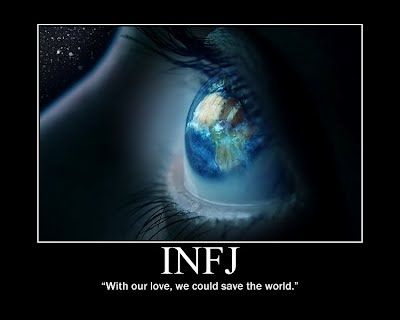
There’s a whole collection of those ubiquitous motivational posters made by and for INFJs. I found most on Pinterest and don’t know who originally put each one together.
Just in case you were wondering, “No, we don’t see anything incompatible between the appreciation of love and beauty and that dangerous prairie dog.”
INFJoe Comics
The artist for these little comics is INFJoe. On his wordpress, he describes himself as “an INFJ joe amid extroverts, sensors, thinkers, and perceivers, and still trying to come to terms with it on a daily basis.”
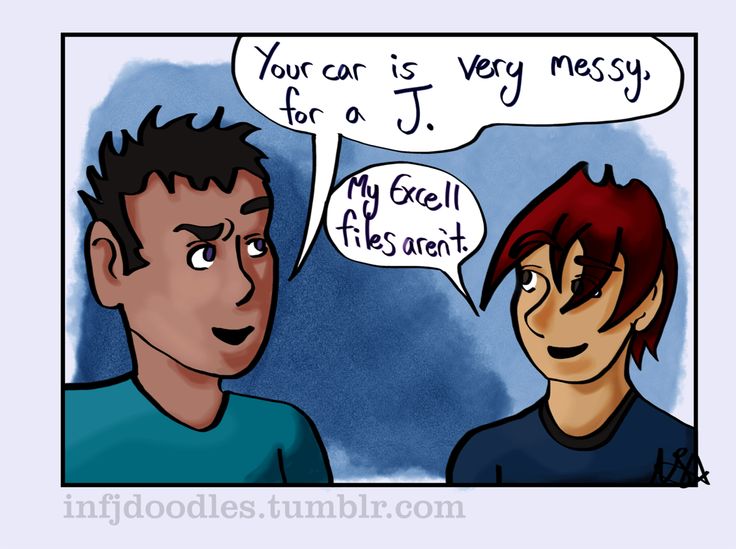
In my completely subjective opinion, I saved the best for last. The artist at Introvert Doodles posts one of these every day.
from INFJ Doodles. The artist said, “To enjoy any entertainment (book, movie, video game, tv show) I have to feel connected to the characters. That feeling of closeness lets me get lost in fictional worlds.”from INFJ Doodles. I love this one. I can be obsessive about organizing some things, and others look like a tornado went through them.from INFJ Doodles
It’s been more than 7 months since Disney’s Frozen hit theaters, but the conversation about it shows little signs of dying down. There are still people on my Facebook feed warning about how the insidious messages of “Let It Go” are damaging our little girls, as well as people finally giving into peer-pressure to see the film and subsequently describing “Let It Go” as the most empowering song ever. I’ve seen articles calling Frozen “the most Christian movie that I have seen this year,” and articles describing “Let It Go” as an occult anthem. What is it about this film that catches people’s attention so strongly, and results in such polarized viewpoints?
Contextualizing “Let It Go”
There are plenty of articles talking about how “Let It Go” fits into the context of the film Frozen. I particularly like NaClhv’s articles An analysis of “Let It Go” in Disney’s “Frozen” and Elsa’s facial expressions during “Let It Go”, in Disney’s “Frozen”, which talk about how “Let It Go” is more of a running-away song than an empowerment song. In this analysis, Elsa’s song represents a turning point for her character. We see her both depressed and happy, with the potential to grow and become a good ruler or to become an evil Ice Queen. It is a dangerous moment for her, but she is also a deeply sympathetic character. Who hasn’t wished that running away could make things all better?
Even people who hate “Let It Go” will sometimes admit there’s no problem with the song in the context of the film. But they then argue that the context doesn’t matter because it is being sung and played out of context. Joseph Clarkson writes that “when removed from the context of the movie, the song concludes that rebellion and relativism lead to freedom.” And I will admit that I can see how people think that, particularly in connection to the “no right, no wrong, no rules for me” line. Still, several people who are advocating examining this song out of context are also speculating about the motives of the writers. Remember that article I mentioned about the occult in my intro? That blogger states, “This is hardcore occultism. But we didn’t catch it did we. The language does appeal to those who are familiar with the terms though, and if you don’t know the jargon it goes over your head.” The implication is that the writers of Frozen know the jargon and are purposefully slipping these occult references in.
Now, I don’t know anything about the writers of Frozen. That may have been their intent. (For an argument from that point of view, I do encourage you to read the article I’ve been quoting. The writer is very sincere, and reading this will give you context for her statements as well.) But when we’re talking about a writer’s intention, we can’t take the song out of context because it was written to fit within the film’s entire plot. And the overall film shows that “Let It Go” isn’t Elsa’s end point. The very next scene Elsa appears in shows that she hasn’t actually been freed from her fears, and that running away hasn’t protected people from the powers she started embracing in “Let It Go.” The blogger I’ve been referencing connects the phrase “let it go” with the fact that “the greatest command of occult is ‘Do what thou wilt shall be the whole of the law’ (The Law of Thelema, Crowley).” What the writers connect “Let It Go” to is the fact that Elsa needs to find a way to fit who she is into the larger context of society. “Let it go” isn’t a cure-all or the intended message of the film. Elsa tried making her will the only law, and discovered it didn’t work. The real answer was love, which is actually more of a Christian message.
There is no fear in love; but perfect love casts out fear, because fear involves torment. But he who fears has not been made perfect in love. (1 John 4:18)
Christian Themes?
I do not consider Frozen a Chrisian film. I wouldn’t even go so far as to say there are overtly Christian overtones. I do, however, think it’s a decent film which contains good messages that can be associated with Christianity because of their positivity. The film also has some less-positive content which can send a wrong message, like That Weird Sexy-Makeover Moment at the Heart of Frozen’s “Let It Go” or possibly the homosexual overtones that a few people who haven’t even seen the movie are talking about. Still, overall, I agree with Plugged-In reviewer Paul Asay’s response that Frozen “actually offers a ‘responsible and family friendly’ message.” One other thing I take issue with is that so many writers who are talking about the potential Christian themes in this film hate Elsa and love Anna. Why does a 21-year-old expressing some independence for the first time in her life mean she should be compared to Satan, but an 18-year-old who becomes engaged to a man she just met and irresponsibly leaves the kingdom in his hands gets labeled as a Christ-figure? In this view, Elsa’s the sinner and Anna’s the redeeming saint, never mind that Anna’s act of love thaws her own frozen heart (thus saving herself more than her sister, who could have easily stopped Hans) and Elsa independently chooses to use an act of love to save her kingdom.
Elsa’s Rare Personality
I think one of the reasons Elsa is misread by so many people is because she is an INFJ. Hovering around 1% of the population, the INFJ is the rarest Myers-Briggs type. On top of that, the effects of her childhood stress means Elsa’s type isn’t immediately recognizable even to other INFJs.
Even stable INFJs with a normal childhood report feelings of alienation that comes from being different than the rest of the world (Read my post “Things You Should Know About INFJs” for more on that). The thing about Elsa is that she didn’t have a normal childhood. She learned to use her introverted side — intuition — but was told to”conceal, don’t feel,” which made her try to suppress her feeling side. INFJs use “their second function, Extraverted Feeling (Fe), which can serve as a useful extroverted tool for navigating the outside world” (from Personality Junkie’s INFJ profile). This effectively crippled her for dealing with other people in a healthy way (it would have been much better to send her to Xavier’s School For Gifted Youngsters, but sadly that isn’t an option outside of HISHE). Elsa’s Fe is why you might see her mistyped as an ISFJ duty-fulfiller, since young Fe types try to fit in with the expectations of people they look up to (in this case, Elsa’s parents) and typically try their best not to hurt anyone. But once you see Elsa run away and reveal the introverted side she’s been nurturing in her prison, you see Introverted Intuition (Ni) surface rather than Introverted Sensing (Si). Si is experiential and fact based, and enjoys rhythm and reliability. Ni is more like this description from Personality Pathways.
Introverted Intuition reflects on patterns, relationships, symbols, meanings, and perspectives on matters from complex phenomena to magical connections to practical problems. The Introverted Intuitive mind typically creates a unique vision and arrives at unique insights about things, phenomena, or people. It strives to discover the essence of things and fill in the missing pieces of a puzzle. Introverted Intuitive types frequently will have complex visions or perspectives that they are unable to explain with clarity to others.
The sentiments expressed in “Let It Go” are typical for INFJs as they mature and learn to embrace the aspects of their Ni that sets them apart from other people. From that perspective, Elsa progresses from a “kingdom of isolation” in the first verse, to breaking free of social rules (INFJs will stay within rules that make sense, but don’t want confined by ones that do not), and finally rising like the break of dawn to become who she is inside rather than the “perfect girl” image that other people have in their minds. It’s not really all that dissimilar to the songs “The Orphan” and “Sweet Liberty” from the musical Jane Eyre, which was written for another fictional INFJ. Elsa’s problems aren’t just specific to INFJs, though, as pointed out by One Dad’s Thoughts on Frozen’s Smash Hit “Let it Go.” Elsa’s song and character arc resonate with girls, particularly teen girls, who are struggling with swirling storms of emotions and feelings of alienation.
Frozen is a typical Disney children’s movie in as much as Anna’s story line is concerned, but Elsa’s storyline explores Young Adult novel themes like coming-of-age, self-discovery, and yes even that sexualized transformation at the end of “Let It Go” (which, seriously, isn’t that bad. She’s 21 years old for crying out loud and it’s a cute dress. I’d wear it).
 I won NaNoWriMo! I’m particularly pleased with myself for conquering the 50,000 words a day early in spite of having pneumonia in November. Anyway, back to INFJ writers.

 *, chapter 11, that “it seems only reasonable that the greater mutual understanding between couples with more likeness than difference should lead, on the whole, to greater mutual attraction and esteem.” This was supported by her study of 375 married couples who were most frequently “alike on three of their four preferences rather than on only two, as would be expected by chance.” However, Isabel Myer was an INFP woman happily married to an ISTJ man. According to her own personality theory, they “shouldn’t” have gotten along, especially since she thought that shared S-N preferences were the most important for predicting a couple’s happiness together and understanding of each other. Obviously type isn’t the only important ingredient for happiness.
 * agrees with Myers on the importance of S-N pairings, saying that his SP Artisan types are most compatible with SJ Guardians, and that NF Idealists are most compatible with NT rationals. His ideal pairing is someone who shares your S-N preference and is your opposite in the other three preferences. For example, he would pair an INFJ with an ENTP.



 … I just wanted to remind you all that you’re invited to








 I think one of the reasons Elsa is misread by so many people is because she is an INFJ. Hovering around 1% of the population, the INFJ is the rarest Myers-Briggs type. On top of that, the effects of her childhood stress means Elsa’s type isn’t immediately recognizable even to other INFJs.
 Like An Anchor