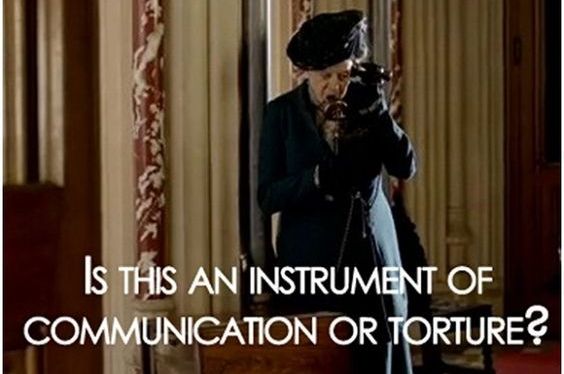
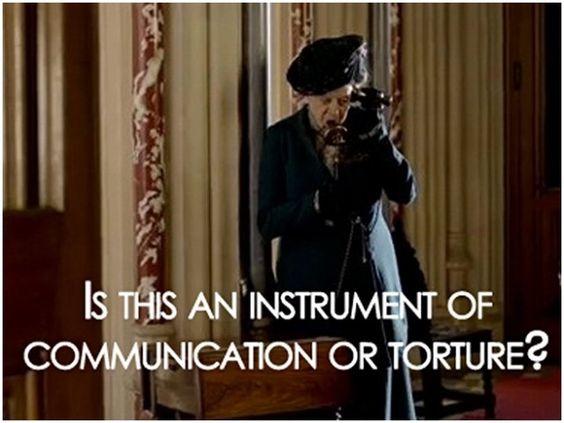
Some of you might think that title is strange, but my fellow introverts will understand. The hours of mental preparation that go into making a two minute phone call. The sense of dread when the phone rings and you aren’t ready to talk with someone. The pressure of sounding engaged and alert while thinking fast enough to avoid awkward silences. Most of us view the telephone in much the same way the Dowager Countess of Grantham does.
But I had a truly enjoyable phone conversation with a friend this weekend, and I realized this wasn’t an isolated incident. When he asked for my number my first instinct was panic, then I realized there wasn’t any reason to. I talk with my sister on the phone for hours almost every day. I chat with my dance team when we’re coordinating practice times. I enjoy the unexpected call from my cousin or a select group of friends. Chatting on the phone really isn’t all that scary.
Now, in the interest of full disclosure, I am in many ways a stereotypical introvert in regards to the telephone. We don’t have caller ID on the landline and the calls are rarely for me, so I refuse to answer when it rings unless I recognize the voice and want to talk with them now. My cell phone is set so it doesn’t even ring unless the number is in my contacts list and, in general, I much prefer written communication. There are times, however, when telephones are a preferable method of communication. Read more →
Congratulations on the procurement your new INFJ!* INFJs are highly sought after in the personality type collecting world given their extremely rare nature. INFJ spotting is a very difficult hobby, requiring forays into the deepest recesses of bookstores, yoga studios, and the internet. Keeping an INFJ in your life once you’ve found one can be even more of a challenge.
INFJs are widely considered one of the most amiable and empathetic personalities. Their minds offer a good balance of emotion and logic that helps them relate to most types of people, and they highly value commitment and relationships. As introverts, though, they have limited social energy and they don’t maintain relationships with most of the people they meet. Once you’ve found an INFJ, taking your acquaintance to the level or friendship, or relationship, isn’t simple. That is, unless you have this user guide.
Overview of the INFJ
The INFJ is a strange sort of creature, often compared to unicorns. Their uniqueness is a result of two things: the way their brains/personalities are hardwired and the rarity of their personality type. What’s perfectly normal for an INFJ seems unusual among humanity as a whole because so few people function this way. Understanding your INFJ’s basic functions is the first step towards successful interaction with the INFJ.
I just got back yesterday from an incredible service-themed Young Adult weekend. It didn’t start out all that well for me, though. The day before I left I started feeling nervous (which is normal for me going into social events) but then by the time I left on Friday I had a shaking-crying-hyperventilating panic attack (which is becoming less and less normal/frequent for me).
I was really caught off-guard by this. I knew several people there — not just as acquaintances, but as friends — and I’d been eagerly looking forward to this event for weeks. I chalked it up to my too-active imagination combined with uncertainty about Friday evening’s schedule, breathed deep, prayed, turned Fallout Boy up, and started driving …
… and hit heavy traffic and rain (my two least favorite things to drive in). That left me running 20 late to met the people I was supposed to be car pooling with to the house I didn’t have an address for. Thankfully, one of the people I was meeting is also one of only 2 out of 100+ people at the weekend with my phone number, and he texted me the address. I proceeded to enter said address in my GPS and it took me to a house with no cars in the driveway.
It is either a testament to my stupidity or my faith that I walked up and rang the doorbell. Turns out, my friend accidentally sent me to another church member’s home (whose name I recognized, though I’d never met them) and they fed me cheese, gave me the correct address, and sent me on my way. Oddly, that’s when I felt a sense of peace for the first time all day. I was late, I was temporarily lost and yet God showed me that these worries coming true weren’t anything He couldn’t handle.
Saturday brought a great round of seminars and an excellent sermon on foot washing and Passover. Nothing to worry about, until game night happened. I’m sure I’m in the minority judging by how many people said they had a wonderful time, but any sort of game that involves doing something in front of other people or in a group or on a team makes me intensely uncomfortable, especially if you add competition. The first two games were mixers where you asked someone a question and their name. I literally remember nothing from meeting people this way (does it even count as a “meeting” then?). Next was that game where you tie a balloon to your ankle and try to keep it from getting popped while popping everyone else’s balloon. I could have kissed whoever it was that popped my balloon the moment the game started.
That’s the last game I “played” (I stepped on my own balloon when they started round two) and I thoroughly enjoyed the rest of my evening talking with two other people who saw no appeal in participating. Give me a deep conversation with someone over competitive and/or rambunctious games any day. Now that’s how to meet new people. (Side-track back to the topic of social anxiety: game night continued throughout my conversations and there was a Bag of Doom from which they were drawing names to participate in a novelty challenge which you had to do while standing in the center of a room surrounded by 80-something people watching you. Can anyone say “introvert’s worst nightmare”?)
I think one of the biggest lessons I learned this weekend was that my fears were either 1) groundless or 2) didn’t have the power to hold me back. The fact that I had a panic attack before leaving turned into a blessing because it gave me the choice between either canceling my plans or praying through it and trusting God. I chose the later, and I kept encountering situations that could make me feel nervous and which reminded me to stay in prayer all weekend. Every single one of the things I was worried about worked out for the best, and the only part of that I can take credit for is that I took the step to go to the weekend and start a few conversations. The rest was all God.
This brings us in a very round-about way back to the topic of the weekend — service. Specifically, “Unlocking Your Desire To Serve.” As many of you know, I consider this blog a sort of ministry and it’s been growing in ways that amaze me and make me want to do more. One of the big things that holds me back is my own fears, including my fear of panicking when it’s important that I talk with people about my faith. So for me, blending this weekend’s focus on service with a need to rely on God for help working through my anxiety was a powerful experience.
If you gave up reading that long rambling post and started scrolling, here’s the e-book announcement:
Something I haven’t shared with many people is that in my local Messianic congregation I’ve been receiving words, prayers, and hints from brethren for the last several months along the lines of “God’s going to do something big in/with your life soon.” I even finally have a hint as to what that might involve after I came back from services a few weeks ago with a title for an e-book in my head which I promptly sat down and outlined. I’ve barely worked on it since, but this weekend was exactly what I needed to reconfirm that God wants me to be sharing my gifts through writing and that He’s more than capable of overcoming deficiencies on my part.
My first step is officially announcing the project here on this blog. The working title is “Rise Up, My Love” and the focus will be on reigniting the church’s passion for God (so, basically this blog in book form). I’m not committing to a release-date quite yet (it would be lovely to have it out by Sukkot/Feast of Tabernacles this fall, but I think a full year might be more realistic judging by how long it took to write The INFJ Handbook). I’ll keep you posted on details.
I’m staring out the backseat window watching unplanted fields roll by while having a conversation. It’s going pretty well — we’re exchanging ideas, sharing authentic feelings, clarifying anything that was unclear earlier — in short, it’s the kind of meaningful conversation I crave with people I care about. Only one problem: it’s all happening in my head and the guy I’m talking with has no clue we just had this conversation.
From talking with other INFJs and writing my INFJ Handbook, I know thinking through past and potential conversations is something my personality type does. We tend to favor the world inside our own heads and spend plenty of time there. We’re also interested in people, though, so it makes sense that many of our inner thoughts are about how others might respond to us and what they might think about our ideas.
But living inside your head isn’t just an INFJ thing — a preference for the inner world is one of the main ways we define introversion. With that in mind, I asked a group of introverts on Facebook if they related to this and got some interesting responses from several different personality types. I also mentioned that sometimes I forget which conversations I’ve actually had with people and which ones only took place in my head and that resonated with some but, everyone. Here’s a few of the comments I got (used with permission):
“That doesn’t sound like something limited to certain personality types, other than introversion itself. I find myself doing it from time to time. I don’t usually think about others’ feelings or intuit what they are thinking, but the conversations always play out in my head way more than they ever do in real life” (anonymous ISTJ)
“Yes, I do! It’s getting harder and harder to distinguish which is the “real” conversation. I know too well how you feel … I don’t think it’s limited to any particular personality type” (anonymous)
“Yep, all the time. It’s the really confrontational ones that will get me though. I get really angry at scenarios I have dreamed up in my head” (Charis Tippets Branson, INFJ)
“90% of the conversations I have are in my head” (anonymous)
“I do that. Though I remember if I’ve actually had those conversations because the imaginary ones were full of remarks I’d never actually say” (Mary Menard)
“I do this regularly. It’s especially helpful if it’s a hard conversation that needs to happen. The problem is that I have it all figured out and sometimes forget I didn’t actually have the conversation. Last week I told my husband, ‘So, do I really have to call and talk to her or could I just pray and ask God to tell her for me?’ He said I need to call. 😐 I wrote down what to cover or I get into listening mode and have no idea what I was planning to say” (anonymous INFJ)
I was nominated by PearlGirl of INFJ Ramblings. Thank you so much! I wish I could nominate you back — you’re one of the bloggers whose posts I actually read on a regular basis 🙂 I’m so glad we connected through our blogging about INFJ things.
The Rules
Post the award on your blog
Thank your nominator because they’re awesome
List 7 facts about yourself
Nominate 15 other blogs for their awesomeness
Post the rules so people know them
Seven Facts About Me:
I can’t decide whether my favorite color is rose-pink or grass-green. Or possibly plum-purple.
Even though my “to-read” list is humongous, there are a few books I take the time to re-read every year or so. Mara: Daughter of the Nile by Eloise Jarvis McGraw is at the top of that list. Seriously, drop everything and go read that book. There’s danger, love, intrigue, sacrifice and the only romantic attempted murder I’ve ever seen in fiction.
Much as I love Jane Austen, my favorite classic is actually Jane Eyre by Charlotte Bronte.
I love kayaking. It’s the only “sport” type of activity that I truly enjoy, even though it has been life-threatening twice (caught in bad weather on Lake George and knocked up-side-down in shallow, fast-moving water on the Mohican River).
I’m considered a “Garden Specialist” on eHow, and publish quite a few articles on that site.
Cheesecake is my favorite dessert, and since I started coming up with my own cheesecake recipes I’ve become something of a cheesecake snob.
My Nominees:
Yes, you’re supposed to nominate 15 other bloggers and I’ve only nominated 7. I’ll try and make up for that by telling you why I like each one.
2HelpfulGuys — I only recently started following them, but I like what I’ve read so far.
Baptism For Life — this is my dad’s blog, and while I know he won’t take the time to accept the nomination you really should check out his posts if you’re looking for inspiring bloggers.
Idle Wanderings — I always enjoy Charity’s posts and if you’re watching Grimm, I highly recommend her recent articles.
Introvert, Dear — a blog and Facebook group that is great to follow if you’re an introvert and/or HSP
Science and Faith — he’s a new blogger, and the first two posts are great. Looking forward to more!
See, there’s this thing called biology… — occasionally I disagree with this blogger. Usually, though, I’m bouncing up and down in my seat pointing at the screen and saying “That’s exactly what I think!”
SmileSupport313 — her posts are always encouraging. And she’s one of my very best friends, so of course her blog is worth reading.
People have been trying to use personality types to find their perfect romantic match since typology first became popular. In a previous posts about Myers-Briggs types and love languages, I talked about how falling in love — and staying in love — with someone is so much more complex than simply matching personality types. Sometimes when browsing personality type forums, I’ll come across posts from people asking how to find and attract a someone of a specific personality type (often it’s an ENTP asking for step-by-step instructions to win an INFJ, which I find hilarious). It’s like some of us think that if we can just find someone who is our ideal type-match, then we’ll be happy because we caught the mythical “compatibility” creature.
Disclaimer: some of the links in this post are affiliate links. This means that, at no additional cost to you, I will receive a commission if you click on the link and make a purchase on that website.
Now, I do have some personality types I find more attractive romantically than others, but it’s not always the types I’m “supposed” to like according to Myers-Briggs or Keirsey theories. Even Isabel Myers was happily married to a man who her theory said should have been incompatible. An understanding of love languages and a mutual willingness to understand and work with each other is one piece of the puzzle. Another is something I just learned this week from Personality Hacker.*
The “Genius System”
Personality Hacker was founded by Antonia Dodge and Joel Mark Witt, who use what they call the “Genius system” to divide Myers-Briggs types into four groups based on the last two letters in a person’s type. In terms of function stacks, this means they group types based on whether the type introverts or extroverts their Judging function. The groupings end up looking like this:
According to a new article on Personality Hacker, each of these groups look for and expressed love in a unique way. Most people would tell an INFJ to look for a relationship with an ENFP or an ENTP and avoid their opposite type, ESTP. This system stays that an ENFP and and ENTP express love in completely different ways, but ENTPs and ESTPs are actually very similar in how they love. That would explain why some INFJs find ENFPs really attractive, while others prefer ESTPs or ENTPs. It’s not so much about matching two specific types, as it is about finding types who express love in a way you relate to and understand. This Genius style take on the MBTI adds an intriguing aspect to the subject of personality types in relationships. You can check out the Personality Hacker podcast on how each type says “I Love You”* for a full explanation, but here’s my brief take on what this means:
Types of Love
“Harmony” types, who use Extroverted Feeling as their first or second function, feel loved when they are connected, safe, cared for, and accepted as their authentic selves. They express love in a similar way, by encouraging the people they love and keeping in touch with them. They are primarily concerned with harmonious relationships and emotional connection.
The types who use Introverted Feeling, “Authenticity” in the Genius System, highly value honesty in relationships. They feel loved when they know someone is being real with them and is supportive of their own authentic expressions. Authenticity types express love by giving people space to be themselves and being willing to work through problems in the relationship.
“Effectiveness” types, those who use Extroverted Thinking, value independence in relationship. They want to know that the person who loves them is supportive of their goals and can be trusted to function on their own. They are loyal and protective towards those they love, and give them room to be themselves.
Those who use Introverted Thinking, “Accuracy” types, feel loved when they are respected. They want to know that the person who is in love with them thinks they are impressive and that the relationship makes sense. In return, they are protective, non-judgmental, and strive to bring the best version of themselves to the relationship.
Matching Types
Ultimately, typology is simply a tool we can use to understand each other. When we understand ourselves and the people around us, we have a better idea of what we’re looking for in a romantic relationship. I think that’s really the best way to apply Myers-Briggs theory to romance. We can’t just say that all INFJs’ ideal match is an ENTP — people are far more nuanced than that, even within a type. But the better we understand how we’re wired and what makes us feel loved, the more likely we’ll be able to recognize whether a potential romantic partner would be a good or a bad match for us.
This is one of the things Debra Fileta talks about in her book and blog True Love Dates. You have to know yourself before you try to get to know other people in a romantic context, otherwise you have no idea what you’re looking for in a relationship. So maybe the first thing we should do when looking at the Genius System types is find which group we fit into. If we know who we are, we’re one step closer to knowing what we want.
 But I had a truly enjoyable phone conversation with a friend this weekend, and I realized this wasn’t an isolated incident. When he asked for my number my first instinct was panic, then I realized there wasn’t any reason to. I talk with my sister on the phone for hours almost every day. I chat with my dance team when we’re coordinating practice times. I enjoy the unexpected call from my cousin or a select group of friends. Chatting on the phone really isn’t all that scary.




 Like An Anchor