Finding Your Real Myers-Briggs® Type

It’s so easy to take a pseudo-Myers-Briggs® test on the internet. You can click through a quick quiz, get your result and think, “Wow, I guess that does sound like me.” A few weeks later, you might stumble across another short quiz and take it again. Maybe you get a different answer and the description still sounds like you. Now you’re wondering whether this whole Myers-Briggs thing is all it’s cracked up to be, and if it is, then why were your results different?

This is one of the reasons Myers-Briggs tests have come under fire from critics who don’t really understand how the Myers-Briggs Type Indicator (MBTI®) is supposed to work. They look at the short little quizzes with generic feel-good results, and say it’s too simple and unreliable. But if you dive into the theory behind Meyers-Briggs, and especially cognitive functions (click here for an introduction to type functions), you start to realize how helpful the MBTI can be as a tool for understanding yourself and other people.

One of the principles of Myers-Briggs theory is that people only have one type, which stays consistent throughout their lives. You grow and develop within your type, but you don’t change from an INFP to an ENFJ to an ISTP or any other combination of letters. So with that in mind, how can you find your true type with so many conflicting results floating around?Finding Your Real Myers-Briggs® Type | LikeAnAnchor.com

Take A Good Test

Disclaimer: some of the links in this post are affiliate links. This means that, at no additional cost to you, I will receive a commission if you click on the link and make a purchase on that website.

If you can’t take the official MBTI, there are a few decent substitutes out there on the internet. My favorite by far is Personality Hacker’s Genius Style test.* They ask for an e-mail address, but it is free. One of my favorite bloggers, Susan Storm, also recently released a test. You can click here to take that.

Similar Mind’s Jungian test is another I’ve recommended (note from May 2017: recent changes to the test questions may skew results. You might want to try HumanMetrics instead). Some people really like the test from 16Personalities, but it’s not my favorite. These tests all give you a series of questions which are designed to learn what cognitive functions you use, then give you a four-letter test result.

I’d recommend starting with the Personality Hacker test, and then taking one or both of the other tests to compare results. Try not to read the full results of one test before you take the others — you want to take each one as unbiased as you can. If they all give you the same result, that’s a pretty good indication you’ve found your personality type. If they’re different, though, it’s time to start reading.

Compare Results

Now that you have one or more personality type results, start reading descriptions of your potential personality type(s). Here are some excellent resources:

Read the descriptions for each of your type results. Even if you only got one result, it’s a good idea to look at similar types that use some of the same cognitive functions. Here are a few guidelines for which other types to look up based on your test results.

If you test as an …

  • Introvert, read about the type which is opposite you on the J/P scale. The J/P preference describes how we interact with the outer word through our extroverted function, so an IJ type actually leads with a perceiving process and an IP type leads with a judging process. This can affect test results.
  • EJ, take a look at the type opposite you on the S/N scale. The tests found that you lead with an extroverted judging/decision making process, but might not have accurately found your introverted secondary process.
  • EP, take a look at the type opposite you on the F/T scale. The tests found that you lead with an extroverted perceiving/learning process, but might not have accurately found your introverted secondary process.
  • SFJ or NFJ, read results from ENFJ, INFJ, ISFJ, and ESFJ. These types all use Extroverted Feeling, and can often be mistaken for each other. Shy ESFJs and ENFJs can be mis-typed as introverts, and outgoing ISFJs and INFJs can be mis-typed as extroverts.
  • NT types, read the type opposite you on the E/I preference. ENT- types, especially ENTJs, are among the most “introverted extroverts” and might mis-type.

Think About Stress

Most tests look at your primary and secondary function — the driver and co-pilot processes that lead in our personality. This makes sense, since other functions are less well developed and we don’t use them as much unless we’re stressed. When we’re trying  to discover our true type is, though, how we react under stress is a good indication of which type matches us best.

Good type descriptions will also talk about the inferior function. An excellent book on this topic is Was That Really Me? How Everyday Stress Brings Out Our Hidden Personality* by Naomi Quenk.

Keep In Mind …

No personality test result is going to be a 100% perfect match. You’re looking for the one that fits you best. You will find elements of other descriptions that sound like you, but there should be one that fits better than the others. Pay close attention to descriptions of how your type uses cognitive functions. Descriptions of INFJ and INFP types, for example, sound similar but they lead with very different mental processes.

Good luck on your journey of self discovery! There’s a plethora of resources out there that can help you, including type-based Facebook groups and forums where you can talk with people of different types to see how they think. And if there’s anything I can help with, just ask!

*indicates affiliate links

Featured image credit: StockSnap via Pixabayy

Save

The Myth of the Good Little INFJ

Last week, I stumbled across an article on Pinterest talking about female INFJs. Well, technically it was about INFj in the Socionics system, which is a bit different than the MBTI type and may include INFPs as well, but for purposes of this article we’ll just talk about INFJ types. The original article, written in 2011 by someone identified only as Beskova, paints a portrait of the INFJ type that is beautiful on the surface but doesn’t quite manage to reach their heart. It’s part of a disturbing trend in portrayals of INFJs, though this is the most extreme example I’ve seen.

Like many people who treat the INFJ type as quasi-mythical, this writer describes INFJs as flawless, naive, pure and submissive. They even describe a typical INFJ appearance: “Women of this type are very feminine and are delicate, modest and even shy. … They have a very ephemeral body, and sometimes lightly stooped posture.”

Reading on, it seems the INFJ has no faults. They never gossip or argue, meet adversity with mild gentleness, focus on humanitarian efforts, fit into any job, and submit themselves selflessly to helping the people in their lives. In short, the article says, “When a female INFj becomes your wife, know that in your home there lives a quiet angel” who “makes for one of the most obedient wives.”

The Myth of the Good Little INFJ | marissabaker.wordpress.com
photo credit: Cameron Nordholm

The biggest problem with this portrait of an INFJ isn’t just that it’s untrue; it’s the fact that INFJ women may try to fit into this mold if they end up in a relationship with someone who expects “their” INFJ to act like this. One thing that’s become clear in the months I’ve been reading things INFJs share online is that we’re one of the types most vulnerable to getting involved in unhealthy relationships with narcissists. And INFJ descriptions that make us out to be perfectly submissive and obedient aren’t helping discourage interest from unhealthy people.

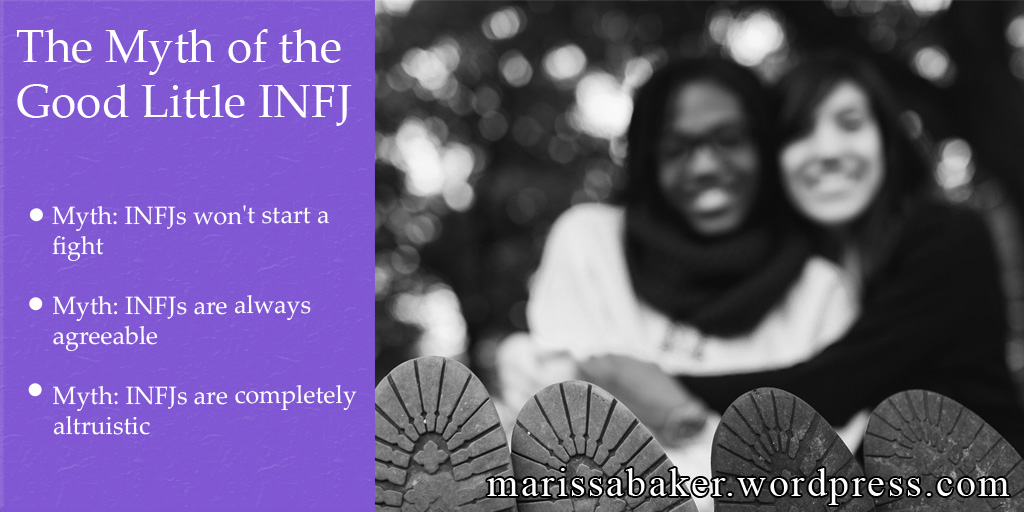
Myth: INFJs won’t start a fight

It’s true that INFJs are one of the most conflict-avoidant types. Until a person does something the INFJ can’t live with, we’ll often just nod and smile at most conversations and suggestions. This happens with casual acquaintances when we don’t want to wast energy on conflict, and in closer relationships when we don’t want to deal with the emotional fall-out of conflict unless there’s a very good reason. I talk about this at greater length in my INFJ Handbook.

But if you think INFJs can’t get angry or won’t take a stand when things aren’t as they should be, think again. INFJs tend to draw a line in their minds, and once it’s crossed we’ll make sure we let you know. Once we get started, we’ll probably tack on a list of every other way you’ve ever let us down as well. The closer we are to you, the better we’ll know how to tear you apart (note: we’re not proud of this fact, and many INFJs work hard at controlling their anger). The best way to avoid this in a relationship is to keep open lines of communication, which is the number one thing many INFJs are looking for in a relationship. INFJs prefer to keep our emotions out in the open, and if we feel safe and heard then there’s no need to bottle up our feelings until we explode.

Myth: INFJs are always agreeable

In this socionics article, the writer talks about how INFJ women often need/want other people to make decisions for them. They write, “If you are her husband take responsibility for making major decisions in development of your family and she will with pleasure obey you.” Now, I’ll be honest — sometimes I do want people to make decisions for me. But if an INFJ is consistently told she can’t be trusted with important decisions and is left out of the planning process, then she’s going to stop trusting you.

The other party might not even notice an INFJ doesn’t agree with him if he’s expecting her to be what the article says: “friendly and dutiful, never quarrel nor ask much for themselves.” We place a high value on trust and communication in relationships, and assuming we agree with you instead of really asking us what we think is a good way to experience the INFJ door slam.

The Myth of the Good Little INFJ | marissabaker.wordpress.comA tip for people who know INFJs: If we don’t actually agree with you, or simply don’t care, we’ll typically make non-committal sounds, nod our heads, and avoid eye contact. If pressured to commit to something we don’t want to do or think, but won’t openly disagree with, we’ll try to push it off to an unspecified future date. When an INFJ actually agrees with you, we’ll make eye contact, our face will light-up, and we’ll say things like “Oh, yes” instead of just nodding. Usually, we’ll also be able to explain why we agree with you in specific terms.

Myth: INFJs are completely altruistic

One last quote from the socionics article: “watch that her emotional resources aren’t spent on her girlfriends, who inadvertently will use your wife as a psychotherapist. She will never refuse them herself, of course. Out of compassion. Therefore, it will be best if you take the matter into your own hands and limit the flow of those desiring to obtain psychotherapeutic sessions and useful advice from her.” Excuse me! What gives someone else the right to limit an INFJ’s contact with her friends? That’s the sort of controlling behavior that’s a huge red-flag in any relationship.

In addition to being incapable of taking care of herself, INFJ wives are apparently so dutiful they’ll do all the housework without any complaint even though they hate cleaning and cooking. For the record, this INFJ loves cooking and the housework doesn’t always get done in a reasonable amount of time. Also, one reason INFJs will avoid conflict and try to help people is because of how it affects us. Sometimes I do what people ask just because I don’t want to stay awake for three hours that night re-hashing every word of the resulting argument. It’s a self-protecting mechanism. That’s not to say INFJs don’t care about people — we do, deeply, and we will support our friends and family whenever possible. It’s a good thing. We can stretch ourselves too thin at times, but INFJs value their introvert time and don’t usually need someone to step in an control their lives to keep them from burning out. We’re not that altruistic.

In conclusion …

I may have dispelled some of the “mystic unicorn” aura surrounding INFJs, but perhaps that’s a good thing. Our rarity doesn’t make us better than other types, and type portraits that make us out to be something ephemeral and idyllic really aren’t helpful. As my siblings (and no doubt other people who INFJs have let into their lives) can testify, we’re not perfect.


If you’d like to know more about the INFJ personality type, check out my book The INFJ Handbook. I just updated it with a ton of new information and resources. You can purchase it in ebook or paperback by clicking this link.

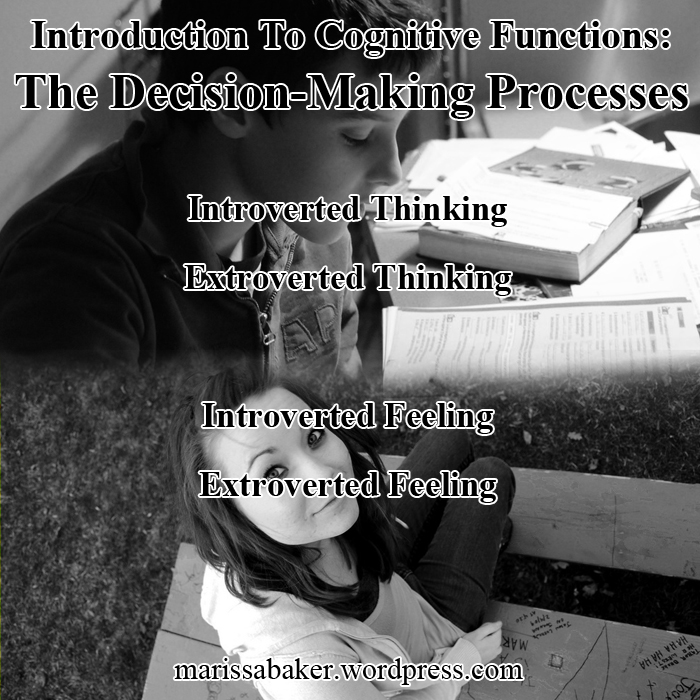
Introduction To Cognitive Functions: The Decision-Making Processes

Introduction To Cognitive Functions: The Decision-Making Processes | marissabaker.wordpress.com
image credits: Bailey Weaver, CC BY
Roberto Faccenda, CC BY-SA

If you’ve been hanging around Myers-Briggs enthusiasts for a while, you’ve probably heard about the Jungian cognitive functions. They are key to understanding Myers-Briggs theory, but they can also be very confusing. Basically, the four letters in a Myers-Briggs type tells you what type of mental processes you use most effectively in making judgements and decisions (Thinking or Feeling) and perceiving the world (Intuition or Sensing). It also tells you whether you are more oriented to the outer world or inner world (Extrovert or Introvert).

Everyone has and uses four functions (out of a possible eight). Your primary function is the one you’re most comfortable with and use most effectively. It’s supported by your secondary function, which acts as a sort of co-pilot. The third and fourth functions are less well developed, and while we have access to them they are not used as effectively. You can look up your type’s cognitive functions on several websites, including PersonalityJunkie.

Last week’s post focused on the four perceiving/learning functions, so this week we’ll cover the judging or decision-making functions. Everyone has an introverted or extroverted form of Thinking or Feeling in their function stack. We use one or the other most effectively when making decisions and thinking about what the world “should” be like. Most Myers-Briggs enthusiasts still refer to these functions by their full names or abbreviations, but I think the Personality Hacker labels are easier to use when first learning about cognitive functions so I’ll include those as well.

Thinking

Thinking types prefer to make decisions using an impersonal, logical approach. They value truth more than tact, prize accuracy, and want to make fair decisions.

Accuracy/Introverted Thinking (Ti)

Accuracy is mostly concerned with whether or not data, ideas, and observations make sense to the individual. Types with this function are less concerned with drawing conclusions from data, and more concerned with creating theories, questions, and insights that line up with their internal fact-checking system. Types who use Accuracy rely more on their own power of observation and thoughts on a given subject than on outside sources when making decisions.

This is the perceiving process used most effectively by ISTPs, INTPs, ESTPs, and ENTPs. The introverts use it as their primary function, the extroverts use it as a co-pilot to support their dominant learning function.

Effectiveness/Extroverted Thinking (Te)

As an outward-focused Thinking function, Effectiveness relies on facts and data gathered from outside sources when making decisions. These types want to experiment to find out what works and what doesn’t, and how they can be most efficient. It’s a practical function focused on finding solutions, discovering and classifying facts, and setting goals.

This is the perceiving process used most effectively by ESTJs, ENTJs, ISTJs, and INTJs. The extroverts use it as their primary functions, the introverts use it as a co-pilot to support their dominant function.

Feeling

Feeling types prefer to make decisions based on their personal values and how the decisions will affect other people. They want to maintain interpersonal harmony, and may soften truth in an effort to be tactful.

Authenticity/Introverted Feeling (Fi)

As an Introverted Feeling function, Authenticity wants to understand the self. These types make decisions based on what feels right, as influenced by abstract ideals. It is a focused, deep sort of way to experience emotion that many Authenticity types find hard to express to other people.

This is the perceiving process used most effectively by ISFPs, INFPs, ESFPs, and ENFPs. The introverts use it as their primary function, the extroverts use it as a co-pilot to support their dominant function.

Harmony/Extroverted Feeling (Fe)

When feeling is turned outward, Harmony focuses on getting everyone else’s needs met when making decisions. These types adapt themselves to given situations trying to fit in, and value the ideals and customs of their community. Harmony seeks true peace and understanding between people, and is adept at sharing feelings to create sympathy.

This is the perceiving process used most effectively by ESFJs, ENFJs, ISFJs, and INFJs. The extroverts use it as their primary functions, the introverts use it as a co-pilot to support their dominant function.

Introduction To Cognitive Functions: The Learning Processes

Introduction To Cognitive Functions: The Learning Processes | marissabaker.wordpress.com
image credits: martinak15, CC BY
ShellVacationsHospitality, CC BY

Understanding the Jungian cognitive functions is key to Myers-Briggs typing. Unfortunately, it can also be very confusing. Basically, the four letters in a Myers-Briggs type tells you what kind of mental processes you use most effectively in making judgements and decisions (Thinking or Feeling) and in perceiving the world (Intuition or Sensing). It also tells you whether you are more oriented to the outer world or inner world (Extrovert or Introvert).

Everyone has and uses four functions (out of a possible eight). Your primary function is the one you’re most comfortable with and use most effectively. It’s supported by your secondary function, which acts as a sort of co-pilot. The third and fourth functions are less developed, and while we have access to them they are not often used effectively. You can look up your type’s cognitive functions on a variety of websites, including PersonalityJunkie.

For this first post, we’ll focus on the perceiving or learning processes (there will be a part two next week for the decision-making processes). Everyone has an introverted or extroverted form of Sensing and Intuition in their function stack. We use one or the other most effectively when learning new things and interacting with new ideas. Most Myers-Briggs enthusiasts still refer to these functions by their full names or abbreviations, but I think the Personality Hacker labels are easier to use when first learning about cognitive functions so I’ll include those as well.

Sensing

Sensing types are primarily concerned with what exists in concrete, observable reality. They focus on either the past or the present, and would rather work with something tangible than something theoretical. They can enjoy life in the moment and appreciate sense-impressions like good food and attractive surroundings.

Memory/Introverted Sensing (Si)

Personality Hacker says “that people use this process to learn new information based on their memories.” Isabel Meyer said a person using Introverted Sensing “sees things highly colored by the subjective factor,” and develops an inner self that may appear eccentric because of their unique way to seeing the world. However you phrase it, the Memory process is concerned with collecting sensory information and taking the time to check it for reliability and see how it fits in with their other ideas.

This is the perceiving process used most effectively by ISFJs, ISTJs, ESFJs, and ESTJs. The introverts use it as their primary function; the extroverts use it as a co-pilot to support their dominant decision-making function.

Sensation/Extroverted Sensing (Se)

The difference between the introverted Memory process and the extroverted Sensation process is that Se types process their sensory impressions externally. They want to experience and interact with something when they encounter it, rather than after-the-fact. People who use Sensation as their primary or secondary process have a reputation as adrenaline junkies.

This is the perceiving process used most effectively by ESTPs, ESFPs, ISTPs, and ISFPs. The extroverts use it as their primary functions; the introverts use it as a co-pilot to support their dominant decision-making function.

Intuition

Intuitive types are primarily concerned with what could be. They focus on patterns and future possibilities, and would rather deal with theory and potential than something that’s already here. They are imaginative, original, and value achievement and inspiration.

Perspectives/Introverted Intuition (Ni)

When focused inward as the Perspectives process, an intuitive type is concerned with deep insights and understanding patterns that form inside their mind. Perspectives types are extremely creative, and analyze external data as well as internal thoughts and feelings to come to an understanding about how their minds work. We then use our self-insight to interpret life and promote understanding (as Isabel Myers puts it).

This is the perceiving process used most effectively by INFJs, INTJs, ENFJs, and ENTJs. The introverts use it as their primary functions; the extroverts use it as a co-pilot to support their dominant decision-making function.

Exploration/Extroverted Intuition (Ne)

Extroverted Intuition is also concerned with ideas, possibilities and a desire to understand, but it’s focus outward. Often, these types will perform experiments just to see what will happen. Personality Hacker calls this process Exploration because “the best pattern recognition system for the outer world is to mess with everything that can be messed with, and to explore, explore, explore.”

This is the perceiving process used most effectively by ENTPs, ENFPs, INTPs, and INFPs. The extroverts use it as their primary functions; the introverts use it as a co-pilot to support their dominant decision-making function.


The Second Greatest Commandment

Our relationship with God is the most important thing in our lives. How we stand in relationship with God determines whether or not we’re in His family and included as part of Christ’s church. It is not, however, the only important relationship.

Jesus said to him, “‘You shall love the Lord your God with all your heart, with all your soul, and with all your mind.’ This is the first and great commandment. And the second is like it: ‘You shall love your neighbor as yourself.’ On these two commandments hang all the Law and the Prophets.” (Matt. 22:37-40)

If we ignore the second commandment, then we’re not keeping the first one very well. Christ said, “If you love Me, keep My commandments” (John 14:15), so if we’re truly in a good relationship with God, we also have to be cultivating good relationships with other people.

From Death To Life

In the Greek, “neighbor” refers to anyone in your sphere of influence. If you know about them or are near them, they are your neighbor. For now, though, let’s focus on loving people we meet within the church. Sometimes it seems like they are the ones we have the hardest time getting along with, perhaps because we expect so much more from them than from people “out there” in the world. We’re less inclined to cut them some slack for being human.

A new commandment I give to you, that you love one another; as I have loved you, that you also love one another. By this all will know that you are My disciples, if you have love for one another.” (John 13:34-35)

If love is how people are supposed to identify Jesus’s followers, then I’m afraid there are far too may of us hiding our identities. I know many loving individuals who proclaim by their actions that they are true disciples, but loving churches seem few and far between.

The Second Greatest Commandment | marissabaker.wordpress.comChristian denominations are rife with division, disagreements, and fighting. It seems like there’s always someone with a new doctrine or a better way to run things, followed by arguments and people taking sides in a divided congregation. If we were all walking in the light, there would be love and not division (1 John 2:9-11). But we’re not always perfect, and it’s so easy to stumble right along with divisive people in an unloving reaction to their lack of love. We can’t control other people, but we are each responsible for how we respond to them, including those who really have done something wrong.

In this the children of God and the children of the devil are manifest: Whoever does not practice righteousness is not of God, nor is he who does not love his brother. For this is the message that you heard from the beginning, that we should love one another …. We know that we have passed from death to life, because we love the brethren. He who does not love his brother abides in death. Whoever hates his brother is a murderer, and you know that no murderer has eternal life abiding in him. (1 John 3:1-11, 14-15)

“We have passed from death to life because we love the brethren” — that’s how important love is. If we hate instead of love, we don’t get eternal life. Even brethren who have stumbled and fallen away from the faith still need and deserve our love, since they still come under the neighbor category or even “love your enemies” (Matt. 5:44).

Vital Friendships

We’ve talked about loving people because we have to, but there should also be people in our lives who we love because we want to — family and friends with whom we share common interests and who will be there for us as we go through life. We need other people, especially friends in the faith who will build us up and help us in our Christian walk. Jesus had 12 disciples who were closer than His other followers, as well as friends like Martha, Mary and Lazarus. When He sent people out to preach, He sent them in pairs (Luke 10:1). Paul also traveled with other believers, including Barnabus (Acts. 13:2), Silas (Acts 15:40) and Timothy (Acts 16:1-4).

And let us consider one another in order to stir up love and good works, not forsaking the assembling of ourselves together, as is the manner of some, but exhorting one another, and so much the more as you see the Day approaching. (Heb. 10:24-25)

“All you need is God” is true to a certain extent, but it is also true that God is the one who tells us it’s not good to lack human companionship. He is the source of our strength and our life, and He can sustain us through times when we have no friends or believers to fellowship with, but He also supplies our need for people around us because He knows friends and brethren are good for us.

Beloved, let us love one another, for love is of God; and everyone who loves is born of God and knows God. He who does not love does not know God, for God is love. (1 John 4:7-8)

The Second Greatest Commandment | marissabaker.wordpress.comI know people who say they don’t need friends because they have God, and people who stopped fellowshipping with brethren because no one agreed with their particular view of the sacred calendar. I am frightened for these people, because the God they say is all they need tells them in His Bible that they also need relationships with other believers.

If someone says, “I love God,” and hates his brother, he is a liar; for he who does not love his brother whom he has seen, how can he love God whom he has not seen? And this commandment we have from Him: that he who loves God must love his brother also. (1 John 4:20-21)

One of the ways we demonstrate our love for God is by loving other people, and we can’t do that if we deliberately isolate ourselves. It’s one thing to have no one else around who shares your faith, and if that’s the case I pray and believe that God will supply your need for fellowship. But it’s another thing entirely to avoid other people, no matter how tempting it might be for some of us introverts or for those of us who have been hurt by past associations with church goers. But if we aren’t around other people, then how can we keep the commandment to love our brethren? If we isolate ourselves, how will we keep the second greatest commandment?

What Is A “Shadow” In Myers-Briggs Theory?

When you’re browsing the internet reading about Myers-Briggs types, you’ll probably see people talking about “shadow functions.” This is a confusing concept, because people use the term “shadow” to refer to several different things related to personality types.

What Is A
background photo credit: Georgie Pauwels, CC BY 2.0, via Flickr

Inferior Function

Every type in the Myers-Briggs system has what we call a “function stack,” which describes how they interact with the outer world, process information, and make judgements. There are 8 possible functions (extroverted and introverted versions of Sensing, Intuition, Feeling, and Thinking), and each types uses four functions:

  1. Primary Function
  2. Auxiliary Function
  3. Tertiary Function
  4. Inferior Function

The primary and auxiliary functions are the ones we use most comfortably, the tertiary function develops as we mature, and the inferior function is largely outside our conscious control. Much of what makes one type distinct from another has to do with how we use our particular combination of four functions. I have a blog post explaining exactly how the four-letter type relates to function stacks. I won’t take the time to repeat that information here, but here are a couple examples:

  • INFJ function stack: 1) Introverted Intuition, 2) Extroverted Feeling, 3) Introverted Thinking, 4) Extroverted Sensing.
  • ESFP function stack: 1) Extroverted Sensing, 2) Introverted Feeling, 3) Extroverted Thinking, 4) Introverted Intuition.

Disclaimer: some of the links in this post are affiliate links. This means that, at no additional cost to you, I will receive a commission if you click on the link and make a purchase on that website.

Often when you’re reading about functions, the “shadow” is treated as just another name for the “inferior function.” I’ve done that myself in several posts. This is also what Isabel Briggs Meyers implies in her book Gifts Differing.* She describes the shadow as “the product of the least-developed part, which a person rejects and disowns. The shadow uses relatively childish and primitive kinds of judgements and perceptions, not intentionally in the service of conscious aims” (Meyers, 1995, p.84). She doesn’t spend much time talking about the shadow, but I get the sense reading her description that she thinks it can include both the tertiary and the inferior function if they are not well developed.

The Jungian Shadow

The best resource I’ve found for explaining the role of inferior functions is the book Was That Really Me? by Naomi L. Quenk. In her introductory chapters, she addresses the concept of the inferior function and the shadow.

Many people confuse the inferior function with the concept of the shadow and use the terms interchangeably (Quenk, 1982). In Jung’s system, the shadow is an archetype, one of our innate modes of responding to important universal psychological realities. The shadow includes those things people are unable or unwilling to acknowledge about themselves, such as undesirable character traits, weaknesses, fears, and lapses in morality, or desirable qualities such as intelligence, attractiveness, and leadership skills. The shadow is a key component of a person’s personal unconscious, a layer of the psyche that is more accessible than its much larger counterpart, the collective unconscious. (Quenk, 2002, Was That Really Me?* p.49)

Quenk draws a distinction between the inferior function as a sort of “doorway” to our unconscious, and the shadow. Our shadow informs our inferior functions, but is not the inferior function itself. Together, our inferior function and the shadow make up our personal unconscious (Jung, 1970, Mysterium coniunctionis).  This is made more confusing by the fact that Jung himself referred to the shadow as an “‘inferior’ personality.” He still draws a distinction between the fourth function and the shadow, though.

The individuation process is invariably started off by the patient’s becoming conscious of the shadow, a personality component usually with a negative sign. This ‘inferior’ personality is made up of everything that will not fit in with, and adapt to, the laws and regulations of conscious life. … Closer investigation shows that there is at least one function in it which ought to collaborate in orienting consciousness. Or rather, this function does collaborate, not for the benefit of conscious, purposive intentions, but in the interests of unconscious tendencies pursuing a different goal. It is this fourth, ‘inferior’ function which acts autonomously towards consciousness and cannot be harnessed to the latter’s intentions. (Jung, 1969, Psychology and Religion: West and East*

So, in Jungian psychology the shadow isn’t composed of any of our four functions. It is outside our conscious control, and shows up through our inferior function, which most of us don’t understand well or use effectively. It’s not necessarily bad but it often shows up as our “dark side,” the part of us that appears when we’re under stress. The shadow and inferior function are very much connected, but they are still different (even though we may use them interchangeably).

Four “Shadows”

One other explanation of shadow functions that you’ll occasionally see is a claim that each type uses all 8 functions. This theory describes the four functions that we just discussed as the “dominant processes” and the other 4 as the “shadow processes.” Using the same examples from before, it looks like this:

  • INFJ
    • dominant processes: 1) Introverted Intuition, 2) Extroverted Feeling, 3) Introverted Thinking, 4) Extroverted Sensing.
    • Shadow processes: 1) Extroverted Intuition, 2) Introverted Feeling, 3) Extroverted Thinking, 4) Introverted Sensing.
  • ESFP
    • dominant processes: 1) Extroverted Sensing, 2) Introverted Feeling, 3) Extroverted Thinking, 4) Introverted Intuition.
    • shadow processes: 1) Introverted Sensing, 2) Extroverted Feeling, 3) Introverted Thinking, 4) Extroverted Intuition.

It’s basically a way to quantify our unconscious and describe how it manifests through our inferior function. However, I don’t think Jung assigned “functions” within the shadow or thought the unconscious could be understood in that way, and I haven’t read support for this theory of 8 functions from psychologists discussing the MBTI.

Probably the best way to understand the idea of a “shadow” is to say that it is the part of our personal unconscious that we have the most limited access to. We experience our shadow through our inferior function, which is a part of the unconscious that we can access more easily because it is still on our function stack. Usually it shows up in a negative way under stress, but there’s also a good side to explore as well.

But the shadow is merely somewhat inferior, primitive, unadapted, and awkward; not wholly bad. It even contains childish or primitive qualities which would in a way vitalize and embellish human existence, but — convention forbids! (Jung, 1969, Psychology and Religion: West and East)

*indicates affiliate links