Shy Introverts

Last week, when I wrote about reasons to homeschool introverts, I touched on the difference between “shy” and “introverted.” I said that shyness and introversion are often confused, but introversion is an inherited preference for how you recharge (alone, rather than with other people), while shyness is a fear response. We talked about how introverted children can become shy and insecure if they are told there’s something wrong with their preference for introversion, which reinforces a low self-confidence and increases feelings of shyness.

But looking at shyness this way doesn’t give a complete picture. It still assumes shyness is “bad,” while in reality the more mild forms of shyness might simply be traits of an introverted temperament. Also, for those of us who are both shy and introverted, being told that shyness and introversion aren’t the same thing is not very helpful. I agree with people who argue that introversion needs to be understood rather than overcome — introverts shouldn’t feet guilty for not being extroverts. But I’ve read articles that set out to prove introverts should be accepted just the way they are, and then turn around and start criticizing shy people for their fears and anxiety in social situations. It’s not very encouraging to be told that your introversion is okay, but you need to “get over” your shyness.

Is Shy Really So Bad?

While researching for this post, I cam across “A Quiet Rant About Introversion and Shyness” by Barbara Markway. Like this writer, I’m both an introvert and a highly sensitive person (HSP).  We’re also both shy, though not as “painfully shy” as we once were. Like her , I worry that we risk hurting shy introverts when we focus the conversation about shyness and introversion on the idea that introverts are not shy. Because some of us actually are.

Shyness is not necessarily a bad thing. It’s just viewed as bad in current American culture. Other cultures see shyness as a sign of modesty, and treat it as a virtue (Asian cultures are typically used as an example). So for those of us who are shy, quiet, and introverted, know that there’s not necessarily something “wrong” with you. Extreme shyness becomes a problem when your fear gets in the way of you choosing to move forward with things you want to do, but a little shyness  can be a positive trait depending on how you look at it.

“the shy and the introverted, for all their differences, have in common something profound. Neither type is perceived by society as alpha, and this gives both types the vision to see how alpha status is overrated, and how our reverence for it blinds us to things that are good and smart and wise.” — Susan Cain

Shyness vs. Social Anxiety

Social anxiety is where “shyness” becomes problematic. Both shyness and social anxiety disorder are motivated by a fear of social situations, but social anxiety is more of a phobia-level fear. It’s often accompanied by a physical response (nausea, sweating, heart racing), and a person with social anxiety disorder might not appear shy all the time. It’s much more complex than simply an exaggerated form of shyness, as illustrated in the essay “Social anxiety is not the same as excessive shyness” by Chris Alaimo. I recommend clicking over there and reading what he wrote if you’re interested in this topic.

“Many people are a little bit shy. If you’re shy, you might be somewhat uncomfortable in situations such as going to a party where you don’t know anyone, but you do it. You give yourself a push, you go to the party, after a while you relax and talk to people. The social phobic person, at the prospect of the same party, would be overwhelmed by such anxiety that [he or she] would have a physical reaction — perhaps nausea, sweating, heart racing, dizziness — and would avoid it if at all possible. It’s a matter of degree.” Rudolf Hoehn-Saric, MD, head of the Anxiety Disorders Clinic at Johns Hopkins University School of Medicine (as quoted on WebMD).

I actually didn’t know about this distinction until someone asked what the difference was and I did some research. Now, I’m not sure anymore whether I qualify as shy or socially anxious. Using the above example, I do experience the the heart-racing, nausea, and panic-attack reaction to going to an event, but I usually go anyway (often because a family member pushes me out of the house. Literally, sometimes). So do I have mild social anxiety, or extreme occasional shyness? I suppose it doesn’t really matter, since WebMD says the typical treatment is anti-depressants and I’m not going to do that for something that’s not having a more drastic impact on my life.

I think it’s something worth thinking about, though, for people who are very shy. One of the reasons I like type psychology is because when you know yourself, you are better able to plan for and cope with your weaknesses, as well as utilize your strengths. Along the same lines, wven if you don’t plan on seeking medical help for shyness or social anxiety, knowing there’s a name for what you’re dealing with can help make it seem more manageable, and it helps you track down information like Must-Have Coping Strategies for Social Anxiety.


Why Homeschool Introverts?

One of the big things that introverts want people to know is that “introversion is not the same as shyness.” And it isn’t — just because someone is introverted doesn’t mean they are shy, and there are plenty of shy extroverts as well (Susan Cain has an article about this). People tend to assume shyness is the same thing as introversion, but that’s just not true. Introversion refers to a preference for how someone gathers energy — they are energized by alone time rather than by being around groups of people. Shyness is fear.

But how is it that we become shy? If it’s not inborn, then we must learn it at some point, usually quite early in our lives. You might see an outgoing child become shy, but it’s rare that a socially confident adult suddenly develops traits of shyness. So what happens to turn introverted children shy?

Confusing “Shy” and “Introverted”

found on sparkpeople.com

The confusion between “shy” and “introverted” has a long history. Jung, whose work the Myers-Briggs test is based on, wrote that “the introverted attitude includes a tendency to be shy.” While extroverts can be shy (and it might actually be more difficult for them since shyness conflicts with their need to be energized by other people), shyness is more likely in introverts. A certain level of shyness might simply be part of the introverted temperament, but more extreme shyness and social anxiety is not an unavoidable part of introversion.

In his article “Are You Motivated by Your Fear or Your Preference?” Andy Mort says that understanding why introverts are believed to be shy and how that belief impacts society is important. Since introversion is so often confused for shyness, introverted children are often told that they are shy by well-meaning adults who think they need to “fix things.”

When I believed I was shy I adopted that label and acted shy; I feared certain social interactions because I didn’t want my ‘shyness’ to be picked up on, and so often withdrew. Shyness as an identity was reinforced by virtue of the fact that I believed my introverted tendencies were in fact me being shy. And the more I fought them by trying to be more extraverted, the more I withdrew (and more shy I believed I was) because I was using so much social energy. – Andy Mort

Rather than recognizing introverted children and teaching them how to be stable, confident introverts, we tell them they’re shy and try to turn them into extroverts. Someone once said, “Everybody is a genius. But if you judge a fish by its ability to climb a tree, it will live its whole life believing that it is stupid” (this quote is often attributed to Einstein, but I can’t find out if that’s accurate). Similarly, when we judge introverted children by their ability to be extroverts, we send them the message that there is something wrong with them, and we label that something shyness.

What Next?

It’s obvious that a solution to this problem has to include a flexibility that allows for people to actually be individuals. It’s one of the great ironies of today’s society that we’re obsessed with individualism, but only if it fits neatly within a certain standard. This is one of the many reasons parents choose to homeschool — to tailor the learning experience to each child’s needs.

One of the most common arguments leveled against homeschooling is that it creates shy, socially awkward children. In reality, homeschoolers are no more likely to be shy than public schooled children. In her book Introvert Power, Laurie Helgoe suggests that homeschooling is actually the best way for introverted children to learn, at least until school reforms like the ones Susan Cain discusses in this interview can be implemented.

from INFJoe

For an introverted child, homeschooling offers a chance for them to learn in their preferred environment — alone or in small groups of people they know well. Since they’re not stressed by the constant over-stimulation and energy drain of being around large groups, they’ll have more social energy available when they do interact with other children, which will help them develop stronger social skills and more confidence in social situations.

These social situations could be church gatherings, homeschool co-ops, field trips, play dates — pretty much any social activity with other children and with older or younger people. Since parents spend so much time with homeschooled children, they’ll usually know them well enough to tell when the child should be encouraged to get outside their comfort zone and make friends, and when to back-off and give them “introvert time.”

Best INFJ Images and Cartoons

I’m usually focused on serious stuff when discussing INFJs, but today I wanted something more lighthearted. We INFJs are deep thinking and often come across as serious, but we can also be fun-loving and positive. Many of us also like art and creative things, so you end up with doodles, comics, and cartoons describing us that range from screenshots with a caption to the elaborate “Care and Feeding of INFJs” Prezi. Here are a few of my favorites, but before we go any farther in this post …

A reminder

… I just wanted to remind you all that you’re invited to a Live Facebook event this Thursday evening (August 7th) at 8:00 pm EST for a company called Trades of Hope. Their mission is to give women around the world a chance to provide for themselves and their families by selling beautiful handmade items. The artists are from all over the world, and  you’ll learn more about them if you join us Thursday (you will need to friend me to access the event). There’s no pressure to buy, and I really do think you’ll find this company interesting and inspiring, as I do.

INFJ Images

I’m not sure this one was put together by an INFJ, but it was posted on the Introvert, Dear Facebook page, which is focused toward INFJs along with other introverts and HSPs.

It’s so true. People would tell me I should talk more in class, and one of the reasons I didn’t was because there’s so many ideas to sort through before you can decide what to actually say.

Love these “Type Heads.” They made some for each personality type.

click for more type heads

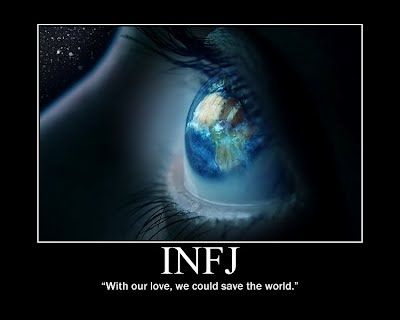
INFJ “Motivational Posters”

There’s a whole collection of those ubiquitous motivational posters made by and for INFJs. I found most on Pinterest and don’t know who originally put each one together.

Pin link
pin link
pin link

Just in case you were wondering, “No, we don’t see anything incompatible between the appreciation of love and beauty and that dangerous prairie dog.”

INFJoe Comics

The artist for these little comics is INFJoe. On his wordpress, he describes himself as “an INFJ joe amid extroverts, sensors, thinkers, and perceivers, and still trying to come to terms with it on a daily basis.”

from INFJoe
original post from INFJoe

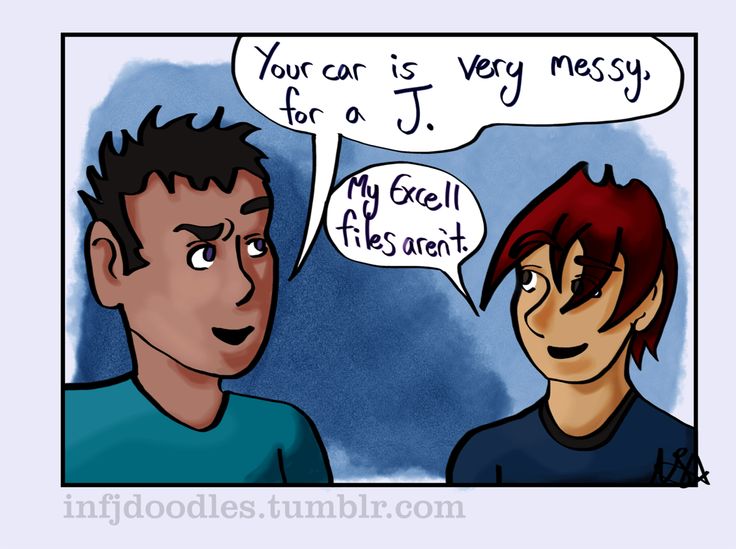
INFJ Doodles

In my completely subjective opinion, I saved the best for last. The artist at Introvert Doodles posts one of these every day.

from INFJ Doodles. The artist said, “To enjoy any entertainment (book, movie, video game, tv show) I have to feel connected to the characters. That feeling of closeness lets me get lost in fictional worlds.”
from INFJ Doodles. I love this one. I can be obsessive about organizing some things, and others look like a tornado went through them.
from INFJ Doodles

Why I Still Believe In Soul Mates

There seems to be a movement in some of the Christian relationship blogs I read to debunk the “myth” of soul mates. The argument can be summed up in this quote from Boundless.org’s article Myths About Soul Mates: “Believing that ‘the one’ is out there, waiting to ‘complete you,’ inevitably leads to discontentment and maybe even divorce.” Another of their articles, Hoping for a Soul Mate, quotes Atlanta psychiatrist Frank Pittman as saying, “Nothing has produced more unhappiness than the concept of a soul mate.” If you’re not familiar with these arguments, I encourage you to glance at one or both links before reading on.

click to read article, "Why I Still Believe In Soul Mates" | marissabaker.wordpress.com
Photo Credit: Anne Edgar via StockSnap

Defining “Soul Mate”

Just so we’re all starting out on the same page, here’s a composite definition of what the articles I referenced above seem to mean when they use the term “soul mate”:

A soul mate is your perfect match, who complements all your weaknesses and strengths and loves you unreservedly for who you are. There is only one soul mate for each person, and you’re on a search to find them so they can “complete you.”

These articles say this is an impossible ideal and it becomes dangerous when we start holding the person we’re in a relationship with to impossible and unrealistic expectations. And I do acknowledge this is a danger if we’re focused on the idea of finding one perfect mate (see this scene in Ever After for a humorous example of a few problems which can result).

Given these compelling arguments about the dangers of having an expectation like this in dating, you might be wondering why I’m writing a post about believing in soul mates. I have a slightly different take on the idea of soul mates, though.

My Idea of a Soul Mate

I imagine there are several people out there who have the potential to be our “soul mates.” For me, I think this would look like a relationship where I feel safe sharing my inner thoughts, feelings, and emotions. Someone who can understand, relate to, or at least appreciate the parts of my mind which I so rarely share, and with whom I can connect on a “kindred spirits” level. It almost goes without staying that this kind of connection must have a spiritual/religious component as well — I doubt I could be in this kind of relationship with someone who does not share my faith. I think there’s also a bit of truth in the idea of finding a mate who “completes” you, not in the way that most people might think of it but in the way that God meant when He created a husband and wife to be two parts of a whole.

As I mentioned, in this theory there are multiple people with whom the potential exists for forming a soul mate connection. You might meet several, but your goal should be that your relationships only reach a “soul mate level” with one of these people. I suspect that there’s a point in a good relationship where the other potential soul mates no longer matter because a “sole soul mate” relationship has been forged.

This is where the idea of commitment comes in. Once you choose to marry someone, you’re also choosing to cultivate  a soul mate relationship only with them (the first article I linked to actually touches on this point). This is also why can be dangerous to form deep emotional intimacies with someone of the opposite sex who you don’t intend to marry (or whom you’re not sure yet if you will marry) — sharing your heart without the promise of commitment to a sole soul mate relationship seems like a good way to get your heart broken.

click to read article, "Why I Still Believe In Soul Mates" | marissabaker.wordpress.com
Photo Credit: Andrew Welch via StockSnap

Personality Theory

I’m sure not everyone will agree with this idea, and really I don’t expect them to. There’s so much variation in our individual personalities, tastes and ideas that it seems ridiculous to expect everyone to want and expect the same thing from a romantic relationship.

Jane Eyre (INFJ) and Edward Rochester (ENTP or ENTJ)

When David Keirsey wrote his personality theories based on Myers-Briggs, he suggested that each of his four personality groups would be looking for, and be, a different kind of romantic partner. He describes the Artisans (Myers’ SP types) as Playmates, who are “exciting and fun” and usually end up married to Guardians (SJ types), who are looking to fill a Helpmate role. Rationals (NT types) want a Mindmate with whom they can have intellectual discussions and explore “abstract rather than concrete” ideas. They often marry the Idealists (NF types, like my INFJ personality), who are searching for Soulmates.

What Idealists wish for in their spouse is a Soulmate, a spouse who knows their feelings without being told of them, and who spontaneously expresses words of endearment, words that acknowledge their mate’s unique identity. Idealists want the marital relationship to be, as they put it, “deep and meaningful,” Other types will settle for much less than this.  … suffice it to say that Idealists are asking their spouses for something most of them do no understand and do not know how to give. (Please Understand Me II, p.146)

Well, that sounds depressingly unattainable. Honestly, when I was reading this book the first time the beginning of this paragraph had me nodding and thinking it sounded exactly just right, but that final sentence is really discouraging. Still, I don’t think I have such unrealistic expectations as Keirsey describes Idealists as having in other parts of his book (though it does sound idyllic). Maybe he’s right and 80-85% of the population will tell me I’m crazy to hope for a “soul mate.” But hopefully someday I’ll be able to say, like the bride in Song of Songs, “I found him whom my soul loves” (Song. 3:4, WEB).


Click here to check out my e-book, The INFJ Handbook, for more information and insight into the INFJ personality type
Available in the Amazon Kindle Store

Save

Save

Save

In Defense of Frozen’s Queen

In Defense of Frozen's Queen | marissabaker.wordpress.comIt’s been more than 7 months since Disney’s Frozen hit theaters, but the conversation about it shows little signs of dying down. There are still people on my Facebook feed warning about how the insidious messages of “Let It Go” are damaging our little girls, as well as people finally giving into peer-pressure to see the film and subsequently describing “Let It Go” as the most empowering song ever. I’ve seen articles calling Frozen “the most Christian movie that I have seen this year,” and articles describing “Let It Go” as an occult anthem. What is it about this film that catches people’s attention so strongly, and results in such polarized viewpoints?

Contextualizing “Let It Go”

There are plenty of articles talking about how “Let It Go” fits into the context of the film Frozen. I particularly like NaClhv’s articles An analysis of “Let It Go” in Disney’s “Frozen” and Elsa’s facial expressions during “Let It Go”, in Disney’s “Frozen”, which talk about how “Let It Go” is more of a running-away song than an empowerment song. In this analysis, Elsa’s song represents a turning point for her character. We see her both depressed and happy, with the potential to grow and become a good ruler or to become an evil Ice Queen. It is a dangerous moment for her, but she is also a deeply sympathetic character. Who hasn’t wished that running away could make things all better?

Even people who hate “Let It Go” will sometimes admit there’s no problem with the song in the context of the film. But they then argue that the context doesn’t matter because it is being sung and played out of context. Joseph Clarkson writes that “when removed from the context of the movie, the song concludes that rebellion and relativism lead to freedom.” And I will admit that I can see how people think that, particularly in connection to the “no right, no wrong, no rules for me” line. Still, several people who are advocating examining this song out of context are also speculating about the motives of the writers. Remember that article I mentioned about the occult in my intro? That blogger states, “This is hardcore occultism. But we didn’t catch it did we. The language does appeal to those who are familiar with the terms though, and if you don’t know the jargon it goes over your head.” The implication is that the writers of Frozen know the jargon and are purposefully slipping these occult references in. In Defense of Frozen's Queen | marissabaker.wordpress.com

Now, I don’t know anything about the writers of Frozen. That may have been their intent. (For an argument from that point of view, I do encourage you to read the article I’ve been quoting. The writer is very sincere, and reading this will give you context for her statements as well.) But when we’re talking about a writer’s intention, we can’t take the song out of context because it was written to fit within the film’s entire plot. And the overall film shows that “Let It Go” isn’t Elsa’s end point. The very next scene Elsa appears in shows that she hasn’t actually been freed from her fears, and that running away hasn’t protected people from the powers she started embracing in “Let It Go.” The blogger I’ve been referencing connects the phrase “let it go” with the fact that “the greatest command of occult is ‘Do what thou wilt shall be the whole of the law’ (The Law of Thelema, Crowley).” What the writers connect “Let It Go” to is the fact that Elsa needs to find a way to fit who she is into the larger context of society. “Let it go” isn’t a cure-all or the intended message of the film. Elsa tried making her will the only law, and discovered it didn’t work. The real answer was love, which is actually more of a Christian message.

There is no fear in love; but perfect love casts out fear, because fear involves torment. But he who fears has not been made perfect in love. (1 John 4:18)

Christian Themes?

I do not consider Frozen a Chrisian film. I wouldn’t even go so far as to say there are overtly Christian overtones. I do, however, think it’s a decent film which contains good messages that can be associated with Christianity because of their positivity. The film also has some less-positive content which can send a wrong message, like That Weird Sexy-Makeover Moment at the Heart of Frozen’s “Let It Go” or possibly the homosexual overtones that a few people who haven’t even seen the movie are talking about. Still, overall, I agree with Plugged-In reviewer Paul Asay’s response that Frozen “actually offers a ‘responsible and family friendly’ message.” One other thing I take issue with is that so many writers who are talking about the potential Christian themes in this film hate Elsa and love Anna. Why does a 21-year-old expressing some independence for the first time in her life mean she should be compared to Satan, but an 18-year-old who becomes engaged to a man she just met and irresponsibly leaves the kingdom in his hands gets labeled as a Christ-figure? In this view, Elsa’s the sinner and Anna’s the redeeming saint, never mind that Anna’s act of love thaws her own frozen heart (thus saving herself more than her sister, who could have easily stopped Hans) and Elsa independently chooses to use an act of love to save her kingdom.

Elsa’s Rare Personality

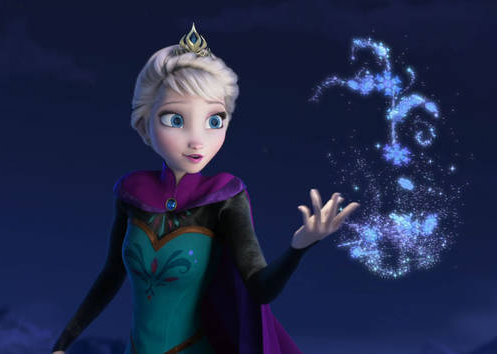
click to read article "In Defense of Frozen's Queen" by marissabaker.wordpress.comI think one of the reasons Elsa is misread by so many people is because she is an INFJ. Hovering around 1% of the population, the INFJ is the rarest Myers-Briggs type. On top of that, the effects of her childhood stress means Elsa’s type isn’t immediately recognizable even to other INFJs.

Even stable INFJs with a normal childhood report feelings of alienation that comes from being different than the rest of the world (Read my post “Things You Should Know About INFJs” for more on that). The thing about Elsa is that she didn’t have a normal childhood. She learned to use her introverted side — intuition — but was told to”conceal, don’t feel,” which made her try to suppress her feeling side. INFJs use “their second function, Extraverted Feeling (Fe), which can serve as a useful extroverted tool for navigating the outside world” (from Personality Junkie’s INFJ profile). This effectively crippled her for dealing with other people in a healthy way (it would have been much better to send her to Xavier’s School For Gifted Youngsters, but sadly that isn’t an option outside of HISHE). Elsa’s Fe is why you might see her mistyped as an ISFJ duty-fulfiller, since young Fe types try to fit in with the expectations of people they look up to (in this case, Elsa’s parents) and typically try their best not to hurt anyone. But once you see Elsa run away and reveal the introverted side she’s been nurturing in her prison, you see Introverted Intuition (Ni) surface rather than Introverted Sensing (Si). Si is experiential and fact based, and enjoys rhythm and reliability. Ni is more like this description from Personality Pathways.

Introverted Intuition reflects on patterns, relationships, symbols, meanings, and perspectives on matters from complex phenomena to magical connections to practical problems. The Introverted Intuitive mind typically creates a unique vision and arrives at unique insights about things, phenomena, or people. It strives to discover the essence of things and fill in the missing pieces of a puzzle. Introverted Intuitive types frequently will have complex visions or perspectives that they are unable to explain with clarity to others.

The sentiments expressed in “Let It Go” are typical for INFJs as they mature and learn to embrace the aspects of their Ni that sets them apart from other people. From that perspective, Elsa progresses from a “kingdom of isolation” in the first verse, to breaking free of social rules (INFJs will stay within rules that make sense, but don’t want confined by ones that do not), and finally rising like the break of dawn to become who she is inside rather than the “perfect girl” image that other people have in their minds. It’s not really all that dissimilar to the songs “The Orphan” and “Sweet Liberty” from the musical Jane Eyre, which was written for another fictional INFJ. Elsa’s problems aren’t just specific to INFJs, though, as pointed out by One Dad’s Thoughts on Frozen’s Smash Hit “Let it Go.” Elsa’s song and character arc resonate with girls, particularly teen girls, who are struggling with swirling storms of emotions and feelings of alienation.

Frozen is a typical Disney children’s movie in as much as Anna’s story line is concerned, but Elsa’s storyline explores Young Adult novel themes like coming-of-age, self-discovery, and yes even that sexualized transformation at the end of “Let It Go” (which, seriously, isn’t that bad. She’s 21 years old for crying out loud and it’s a cute dress. I’d wear it).


Click here to check out my e-book, The INFJ Handbook, for more information and insight into the INFJ personality type
Available in the Amazon Kindle Store

Save

Save

INFJ — Finding Our Label

INFJ -- Finding Our Label marissabaker.wordpress.com
my mind is an interesting place

One of the things you’ll notice if you read things written by INFJs (including the comments under web articles and blogs) is how much those four little letters mean to us. There are other Myers-Briggs types who couldn’t care less what label someone else  “slaps on them” and certainly make no effort to search out a description of their personality type. They simply don’t see the need (which is, somewhat ironically, usually typical of their personality type).

INFJs are not like that. We’re on a search for what David Keirsey calls “self-actualization” even before we realize it. We know we’re different than most other people (about 99% of other people, in fact), but we don’t know why. Many INFJs grow up thinking there’s something wrong with them, either because they are flat-out told that or because they notice they are so different.

I discovered my personality type through an Internet quiz when I was in high school. These quizzes are not always accurate, but the one I happened to stumble across was close enough to recognize me as an INFJ. Everything I read in those results, and in the INFJ profiles that I hunted down next, sounded so familiar. Suddenly I wasn’t the only person with vivid dreams that seemed to blur lines between real and imaginary, or the only person who felt everything deeply and yet couldn’t seem to connect with someone in a conversation. My helplessness with numbers and difficulty working with facts might be inconvenient, but wasn’t abnormal any more. I didn’t have to try and ignore my intuition or try to come up with a logical reason for everything – I could simply accept the fact that intuition is how my mind works.

Other INFJs have similar stories, stories which I’d love to hear. In fact, I’m interested in any stories you INFJs out there would like to share. I’m writing an e-book, and think it would be so much more meaningful if I could include personal stories from other INFJs as well. If you think you might like to contribute, check out this post for details.