Running After Jesus With Joy

I’ve been having a tough month in terms of mental health. Things are going well in my life but I feel anxious, stressed, and glum.

One of the things I’ve learned is that even with all the tools I have for working through emotionally tough times the things I’m struggling with don’t just go away once you slap a little prayer and therapy on them (at least not all the time). You’ve just got to keep doing things that are healthy for you, allow yourself some time to rest, ask for and give yourself grace when you make mistakes, and keep moving forward. Patience, perseverance, and asking trusted people for help are key to getting through mental health struggles just as they are with any other trials we face.

The Bible talks about our Christian life as running a race. There are times when running this race that people get off track. For example, Paul wrote to the Galatians, “You were running well! Who interfered with you that you should not obey the truth? This persuasion is not from him who calls you” (Gal. 5:7-10, NET). Usually when the Bible speaks of getting off-track it’s talking about sin. But I think we can also apply part of what Paul says here more broadly–the things that hinder us from running are not coming from the God who calls us to follow Him. They’re coming from an adversary who wants to see us fail; one that we can resist with God’s help.

Running Away Isn’t Going to Help

Everyone deals with emotional struggles and mental health issues differently, and those struggles trigger different responses in different people. I tend to withdraw, and I often feel like I want to hide or run away from something. I need to be very careful that this doesn’t make me want to run from God as well.

We’re engaged in spiritual warfare. When we choose to follow Jesus, we’re picking a side in a battle. One of the lies that the enemy tries to tell us is that if you do something God might not like it’s better to run away from Him than run to Him and ask for forgiveness and/or help. Adam and Eve tried hiding in the garden and we’ve been using the same trick ever since. It doesn’t work any better now than it did then.

We human beings are always heading on a path toward either death or life, and it’s far better to run down the path to God rather than the path toward the devil. The only people who should feel like they need to flee God are those that hate him (Psalm 68:1). He’s frightening if you’re setting yourself in opposition to Him, and people who are doing things God hates might feel the need to run when He rises up to take action (Prov. 6:16-19; Is. 59:7). Even then, though He’s astonishingly merciful to people who stop running in the wrong direction and run toward Him instead.

The times when we feel most like running away from God are often the times when we most need to run to Him for help. Whether we’ve actually done something wrong or if we’re beset by groundless fears, heading toward God is the solution. In the first situation we can ask for forgiveness and receive His grace, and in the other we can ask for His peace and receive reassurance.

Running With a Free Heart

God’s people are supposed to do the opposite of what people who hate him or don’t know Him do. Jesus’s sheep run from a stranger’s voice, not taking the risk of being led away from their real shepherd (John 10:4-5). We no longer run alongside people in the world toward “lewdness, lusts, drunken binges, orgies, carousings, and abominable idolatries” (1 Peter 4:3-4, WEB). Many of us used to do those things (and if we didn’t do those we committed other sins) and God forgave us, but now He wants us to flee from sexual immorality, idolatry, and all other evil desires (1 Cor. 6:18; 10:14; 2 Tim. 2:22).

People who follow God know it’s safe to run to Him. We run to God for protection (Ps. 143:9; Prov. 18:10; Jer. 16:19). We run in the straight and narrow path lit by God’s word that keeps our feet from stumbling (Ps. 119:105; Prov. 4:11-12; Matt. 7:13-14). We run to Godly things and “follow after righteousness, godliness, faith, love, perseverance, and gentleness” (1 Tim. 6:11, WEB). We run like our Christian life is a marathon that we’ll finish with Jesus running right alongside us.

I run in the path of your commandments, for you have set my heart free.

Psalm 119:32, WEB

I don’t think I’d ever noticed this verse before even though I’ve read Psalm 119 countless times. It might be the translation, since the Hebrew more literally reads “for you make wide my heart,” which can be translated as something like “thou shalt enlarge my heart” (KJV) or “you have broadened my understanding” (NIV). I like this “set my heart free” translation, though. It makes me think of running across a sunlit summer meadow laughing and full of joy. That’s the emotional landscape provided by running in the path of God’s commandments. While we’re not guaranteed happiness 100% of the time, we can be full of joy. Having a heart set free accompanies God’s spirit filling us with “love, joy, peace, patience, kindness, goodness, faithfulness, gentleness, and self-control” (Gal. 5:22-23, NET).

Running Well With God’s Help

We can’t do any of this joyful running without God’s help. Our success doesn’t depend on our will to run, but on God’s mercy (Rom. 9:15-16). That’s a reassuring thing, especially when our will doesn’t feel up to the task of getting out of bed in the morning much less fighting an epic spiritual battle. We can’t win this race using our own strength, but we don’t have to. We don’t even need to try; we can just ask Jesus for His strength.

That does not, however, mean we shouldn’t strive to run well. We can’t finish the race without God compassionately setting us on the right path in the first place, but we also won’t win if we sit down and give up. God’s mercy and grace should motivate us to run with endurance toward the goal He sets for us.

Do you not know that all the runners in a stadium compete, but only one receives the prize? So run to win. Each competitor must exercise self-control in everything. They do it to receive a perishable crown, but we an imperishable one. So I do not run uncertainly or box like one who hits only air. Instead I subdue my body and make it my slave, so that after preaching to others I myself will not be disqualified.

1 Corinthians 9:24-29, NET

There isn’t just one winner in the race that’s our Christian life, but we should still imitate the high motivation of a runner who wants to achieve victory. Here, Paul highlights the self-control and discipline with which he lives his life because he knows he can’t coast into the kingdom resting on his past accomplishments (Gal. 2:1-2; Phil. 2:15-16). He was highly motivated to stick with this way of life and keep moving forward with Jesus’s strength (2 Cor. 12:7-10; Phil 4:13).

Therefore, since we are surrounded by such a great cloud of witnesses, we must get rid of every weight and the sin that clings so closely, and run with endurance the race set out for us, keeping our eyes fixed on Jesus, the pioneer and perfecter of our faith.

Hebrews 12:1-2, NET

When struggling with anxiety or other mental and emotional concerns, it helps to remember that our life is a long-term race with ups and downs. We’re not facing anything that faithful people before us haven’t dealt with as well (1 Cor. 10:13; Heb. 11:1-40). And we’re certainly not dealing with anything that’s too tough for our God. As we run toward Him asking for help, He will strengthen us to get through the tough patches and run the race set before us with resilience and joy.

Featured image by PublicDomainPictures from Pixabay

Continuing to Grow and Change for Jesus our Passover

We’re getting closer and closer to Passover. Based on Paul’s instructions in 1 Corinthians, these months leading up to Passover (Pesach) and the Day of Unleavened Bread (Chag HaMatzot) are a time of self-examination for New Covenant Christians. We spend time in prayer and study, asking God to share what He sees in us and help us grow and change to become more like Him. We take time to try and figure out what things in us still don’t look like God, repent of them, and seek His aid in changing our lives to align more and more with His ways.

A couple weeks ago, I kept ending up in Ephesians 5 as I read my daily devotional and worked through a month-long scripture writing study on deception (you can find similar scripture writing plans by clicking here). There’s a lot to think about in this chapter. It comes near the end of a fairly long letter where Paul writes to believers about the blessings and spiritual inheritance that we have through Christ, and says he gives thanks for the faith and love they’re already showing (Eph. 1). Paul reminds them of their transgressions/offenses and sins which God and Christ saved them from when He took those who were once outside God’s family and made them wholly part of His people (Eph. 2). As the letter goes on, Paul implores his readers to value the great and wonderful mysteries God grants us, not to lose heart when some of us suffer, and to fully commit to our relationship with Jesus Christ (Eph. 3). Based on all this, Paul calls his readers to unity with their fellow believers and insists they live holy, spiritual lives (Eph. 4).

Throughout the letter, Paul makes some brutal statements about our spiritual condition before we entered a relationship with God. “You were dead in your offenses and sins” and “were by nature children of wrath” (Eph. 2:1, 3, NET). In our lives before meeting Jesus, we were “corrupted in accordance with deceitful desires” (4:22). Paul even says, “you were at one time darkness” (5:8). This sinful state is where we all started out, desperately in need of Jesus to save us. We want to move on from that as quickly as possible and embrace all the good things God tells us about our new identities in Him. And while it is good and right to fully embrace who we are in God, we also need to remember how bad things were without Him. If we don’t keep that perspective, then it’ll be easy to slip back into worldly things because we don’t think of them as being “that bad.”

Slipping Back is Idolatry

Humans have a tendency for self-justification. Even when we’re beating ourselves up about something, we might also be making excuses for ourselves. Or maybe we read through the Bible and see our conduct in some of the things God says not to do, then tell ourselves that it’s not really all that bad. We make mistakes, but we’re human. No big deal.

It is true that God can remove our sins and He has abundant mercy for our mistakes. But it’s not because they’re “no big deal.” Sin results in death, and the reason God can forgive us so freely is because Jesus died in our place. That’s a really big deal. We need to understand the magnitude of what Jesus did for us, and the level of offense we cause if we turn back to wicked ways and brush it off as something that doesn’t really matter. In his one-year Worship the King devotional, Chris Tiegreen sums it up like this:

“we were idolaters. False worshipers. People who gave glory and honor to things that were not worthy, while neglecting the glory and honor that should go to the One who is. That hurts.

“It’s a brutal assessment, but we have to own up to it. We don’t like to think of our flirtation with impurity or materialism as idol worship, but it is.”

Chris Tiegreen, Worship the King, p. 51

Going back to Ephesians, Paul says that flirting with things like “sexual immorality, impurity of any kind, or greed … vulgar speech, foolish talk, or coarse jesting” is “not fitting for the saints” and “out of character” for those saying they want to imitate Jesus’s way of life (Eph. 5:1-4, NET). If we tell ourselves that things God calls sins are okay for us, then it turns into idolatry. We’re putting our desires for sinful things higher than our desire for God and saying our ideas of morality are more accurate than His.

Moving Into the Light

Emphasizing our need to change and grow as we follow Jesus Christ does not downplay God’s mercy or grace in any way. Grace is something we can’t do anything to earn, but once we accept God’s grace we enter a covenant with Him and agree to live in a spiritual way. He expects certain things of people who promise to follow Him, including that we won’t run off after things which have nothing to do with godliness.

For you can be confident of this one thing: that no person who is immoral, impure, or greedy (such a person is an idolater) has any inheritance in the kingdom of Christ and God. Let nobody deceive you with empty words, for because of these things God’s wrath comes on the sons of disobedience. Therefore do not be sharers with them, for you were at one time darkness, but now you are light in the Lord. Live like children of light—for the fruit of the light consists in all goodness, righteousness, and truth—trying to learn what is pleasing to the Lord.

Eph. 5:5-10, NET

God’s connection with Light is something we’ve explored in other Bible study posts. We’re supposed to shine with Jesus’s light in our lives, to be like lamps burning with bright fire as we imitate the Light of our Messiah. There’s a sharp divide in the world that’s been there since the fall of mankind. On the one hand, there is darkness and death. On the other, there is light and life. Jesus calling us out of darkness gives us the option to choose light. It’s an incredible gift. And unless we don’t really value that gift of Light, we’ll be doing our best to “live like children of light.”

Living With Wisdom

Therefore consider carefully how you live—not as unwise but as wise, taking advantage of every opportunity, because the days are evil. For this reason do not be foolish, but be wise by understanding what the Lord’s will is. And do not get drunk with wine, which is debauchery, but be filled by the Spirit, speaking to one another in psalms, hymns, and spiritual songs, singing and making music in your hearts to the Lord, always giving thanks to God the Father for all things in the name of our Lord Jesus Christ, and submitting to one another out of reverence for Christ.

Ephesians 5:15-21, NET

Because of everything Paul talked about before–particularly the way our dark pasts contrast with the light we’re supposed to live in now–he urges us to “consider carefully how you live.” We ought to do this careful consideration throughout the year, but Passover is a particularly fitting time for a check-in. How wise are we in how we live our lives? Are we letting God fill us with His spirit, then letting that pour out through our lips as praise, worship, and thanks? Do we demonstrate our reverence for Christ by submitting to each other in love?

I doubt we can fully answer “yes” to all these questions (I know I can’t), and this isn’t even a full list of everything we’re supposed to do as we imitate Christ. But remember that as long as you’re on the path toward perfection, God treats you as if you’re already perfect. When we trust Him and do our best to follow His example of holiness, He’ll keep filling us with His spirit and light. We’ll be able to stay on track following Him instead of slipping back into idolatry. He’ll empower us to grow and change, becoming more and more like Him each year.

Featured image by Corey David Robinson from Lightstock

Song Recommendation: “Immanuel” by Joshua Aaron

Dwelling With God in the Fire

If you do a study on the “God is” statements in scripture, it gives you an overview of His character and helps reveal some of the things that are most important to Him. It also gives us an idea for how we’re to live as Christians since we’re supposed to become like God. God is love, light, faithful, merciful, righteous, and slow to anger, and we’re to work on becoming those things as well (Ps. 116:5; Neh. 9:17; 1 John 1:5; 4:8).

One of the “God is” statements that might seem unusual is this one: “Yahweh your God is a devouring fire, a jealous God” (Deut. 4:24, WEB). I suspect when most people think of fire and the Bible, they think of sinners going to a type of fiery hell that’s based a little more on pop-culture and classic literature than scripture. Clearly none of that is happening in this verse–the fire here is associated with God Himself as part of His nature. It’s presented as a fact of His character that ancient Israel would have to deal with if they “forget the covenant of Yahweh your God” (Deut. 4:23, WEB).

This isn’t the only place that fire is associated with God. It’s often linked to His indignation and wrath when people turn away from Him and do truly horrible things. It’s also associated with purification and holiness. There are positive associations with fire as well as devouring, “jealous” ones. There are even verses that talk about us being in the fire as a good thing rather than a punishment.

Righteous, Jealous Fire

In Deuteronomy, fire is linked with God’s jealousy. Israel was warned to guard against being unfaithful to God’s covenant because He does not take covenant-breaking lightly. He also meets out punishment on nations who didn’t make covenants with Him because as Creator, Lord, and Lawgiver He has the right to punish wrongdoing. God tends to judge people less harshly when they don’t know any better, but even without special revelation there are still general principles available to all people which He can reasonably expect us to follow (e.g. most cultures agree with God that murder is wrong). Paul talks about that in more detail at the beginning of Romans, but for today’s post our focus in this section is on how fire is linked with God’s righteousness and anger.

Yahweh is a jealous God and avenges. Yahweh avenges and is full of wrath. Yahweh takes vengeance on his adversaries, and he maintains wrath against his enemies. Yahweh is slow to anger, and great in power, and will by no means leave the guilty unpunished. Yahweh has his way in the whirlwind and in the storm, and the clouds are the dust of his feet. … Who can stand before his indignation? Who can endure the fierceness of his anger? His wrath is poured out like fire, and the rocks are broken apart by him

Nahum 1:2-3, 6, WEB

Treating God with respect involves acknowledging this side of His nature. There are consequences that we shouldn’t want to face if we “go after other gods” and break covenant with our Creator (Deut. 6.14-15; 29:18-20; Heb. 12:25-29). There is also mercy, though. Fire isn’t simply a destructive force. It’s also used for purifying; it’s something that can help get people back on track. God take no pleasure in the death of wicked people; He wants every single one of us to turn away from sin and accept the eternal life that He offers us (Ezekiel 18:23; 33:11; 1 Tim. 2:4; 2 Pet. 3:9).

Purifying Fire

In the book of Numbers, Yahweh tells Moses to have Israel purify the spoils they took after battling Midian using fire. All the metal and “everything that may withstand the fire, you shall make to go through the fire, and it shall be clean” (Num. 31:23, WEB). This is the only place I’ve found where fire was used for purification like this, but it’s still an intriguing moment that connects with later verses about refining fire. And even though fire wasn’t regularly used for purification in Old Covenant worship, it was associated with holiness. The fire on the altar was never supposed to go out, sacrifices for God were routinely burned, and God sent fire down from heaven when Solomon dedicated the temple (Ex. 20:24; Lev. 6:12).

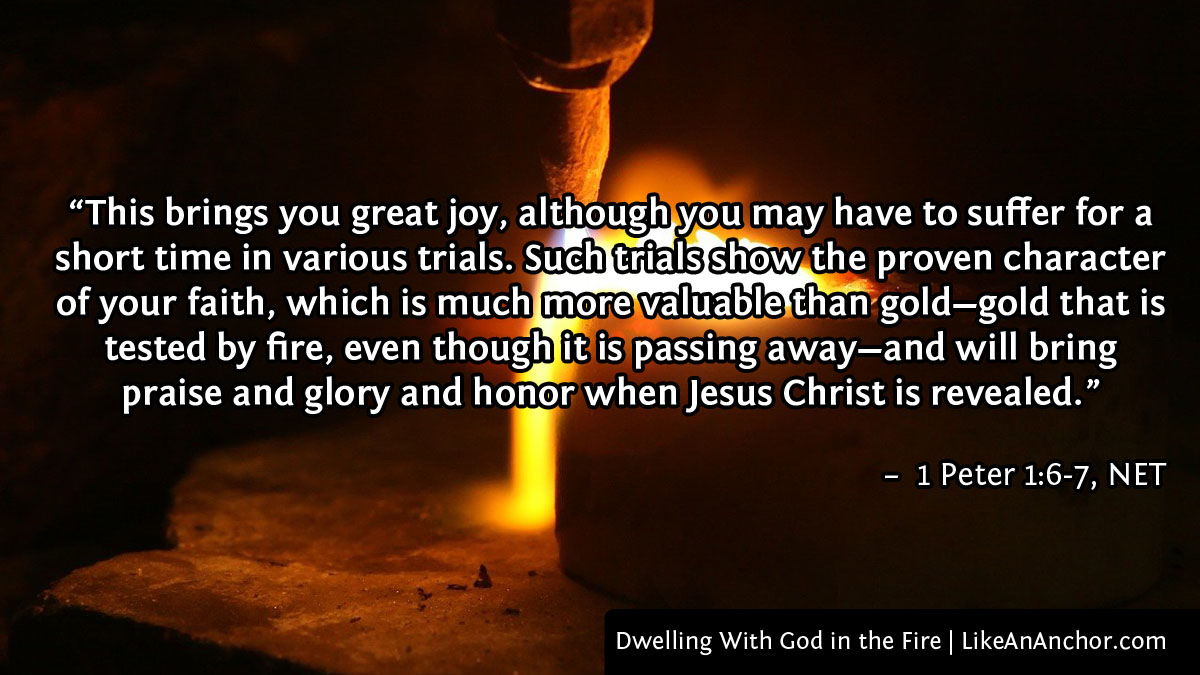
Today, we ourselves (as a collective church body) make up the temple of God. We don’t offer sacrifices on a burning altar; we now offer all of ourselves to living God’s way of life (Rom. 12:1). It shouldn’t be any surprise, then, that as living sacrifices we also go through a sort of fire. It’s a metaphor for the things that make people holy by testing and refining us (Is 48.10; Mal. 3:2-3; 1 Peter 1:6-8).

“I will bring the third part into the fire,
    and will refine them as silver is refined,
    and will test them like gold is tested.
They will call on my name, and I will hear them.
    I will say, ‘It is my people;’
    and they will say, ‘Yahweh is my God.’”

Zechariah 13:9, WEB

For no one can lay any foundation other than what is being laid, which is Jesus Christ. If anyone builds on the foundation with gold, silver, precious stones, wood, hay, or straw, each builder’s work will be plainly seen, for the Day will make it clear, because it will be revealed by fire. And the fire will test what kind of work each has done. If what someone has built survives, he will receive a reward. If someone’s work is burned up, he will suffer loss. He himself will be saved, but only as through fire.

1 Corinthians 3:11-15, NET

Fire provides testing and purification. When something goes into fire like this, the unholy things get burned off leaving only the holy behind. As the writer of Hebrews says, we who are “receiving a Kingdom that can’t be shaken” should “serve God acceptably, with reverence and awe, for our God is a consuming fire” (Heb. 12:28-29, WEB). We want to be like God and to dwell with God, which means we need to become something capable of surviving this fire. We need to be holy as He is holy.

Living In Fire

The sinners in Zion are afraid.
Trembling has seized the godless ones.
Who among us can live with the devouring fire?
Who among us can live with everlasting burning?
He who walks righteously
and speaks blamelessly,
he who despises the gain of oppressions,
who gestures with his hands, refusing to take a bribe,
who stops his ears from hearing of blood,
and shuts his eyes from looking at evil—
he will dwell on high.
His place of defense will be the fortress of rocks.
His bread will be supplied.
His waters will be sure.

Isiaiah 33:14-16, WEB

Sinners look at God and ask how anyone could “live with the devouring fire” and “everlasting burning?” We wonder that, too. There’s a list here in Isaiah of things the sort of people who can live in God’s fire do. They’re righteous, blameless, oppose oppression, don’t take bribes or pay attention to evil. Those are things we should strive for, but we also know we don’t do these things perfectly. We have all sinned and an encounter with pure holiness would be terrifying. If we saw God right now, we’d likely have a similar reaction to Isaiah when he said, “Woe is me! For I am undone, because I am a man of unclean lips, and I dwell among a people of unclean lips: for my eyes have seen the King, Yahweh of Armies!” (Isaiah 6:1-5, WEB). The more clearly you see God, the more you realize how poorly you measure up. But God has a fiery solution.

Then one of the seraphim flew to me, having a live coal in his hand, which he had taken with the tongs from off the altar. He touched my mouth with it, and said, “Behold, this has touched your lips; and your iniquity is taken away, and your sin forgiven.”

Isaiah 6:6-7, WEB

Isaiah’s lips, as a stand-in for his whole life, were purified with holy fire. Similarly, Jesus Christ baptizes each believer “with the Holy Spirit and with fire” (Luke 3:15-17, NET). The “fire” part of the three baptisms of Christianity makes us more and more like God, refining us until we look just like Jesus. This process continues our whole lives.

Our God is a devouring, jealous fire who will not tolerate unfaithfulness. He does not want to punish us with His fire, though. He wants to use fire to refine us and make us holy like Him. Even the fiery trials we face serve a purpose when we give ourselves up to Him as living sacrifices to do His will. This perspective helps us contextualize our sufferings and trust God when He chooses to help us through trials rather than immediately take us out of them. When we’re dwelling with God, fire can be a good thing.

Featured image by Pexels from Pixabay

Quests and Challenges Before the Happily-Ever-After

The words “happily-ever-after” typically put us in mind of fairy tales, usually of the Disney variety, and stories that end with weddings. People often have a lot of complicated emotions about the idea of weddings (both in real-life and how they’re portrayed in stories). We might feel hopeful and happy, sure the couple at the end of the story really will live happily-ever-after. Or we might feel more cynical, saying that’s not how it works in real life.

Even in Disney’s fairly tales, though, the path to happily-ever-after isn’t easy. There are quests, battles, danger, and heartbreak before the end. The danger and challenges are even more pronounced in original versions of fairy tales. We see this trend in most of the oldest myths, legends, and epic tales. The best endings come to those who get there through struggle–who overcome adversity, outwit their enemies, and endure hardship to the end.

God’s love story is like that too. The story that He’s writing with our lives will end in a happily-ever-after, but there’s a lot going on before we get there. There’s love and courting, an engagement promise, then unfaithfulness on the part of the bride, wars fought over her, and then the bridegroom’s death and resurrection. Pretty dramatic stuff, and that’s all before we even enter the picture. And the story isn’t done yet. There is still coming a time when heaven will cry out, “Hallelujah! For the Lord our God, the Almighty, reigns! Let’s rejoice and be exceedingly glad, and let’s give the glory to him. For the wedding of the Lamb has come, and his wife has made herself ready” (Rev. 19:6-7, WEB).

That end goal is a good thing to focus on. It helps keep us on-track and hopeful during the challenging times facing the Lamb’s wife as she makes herself ready. We also need to beware of and expect those obstacles. Our journey to this wedding is full of challenges. Our Bridegroom and His Father have an adversary who’d like nothing better than to tear the bride apart and ruin this upcoming marriage.

Attacked when Looking for our Lover

I opened to my beloved;
but my beloved left, and had gone away.
My heart went out when he spoke.
I looked for him, but I didn’t find him.
I called him, but he didn’t answer.
The watchmen who go about the city found me.
They beat me.
They bruised me.
The keepers of the walls took my cloak away from me.

Song 5:6-7, WEB

There are a lot of people in today’s world who staunchly oppose those who go looking for Jesus, much as the watchmen attacked the beloved in Song of Songs when she went looking for her lover. We need to expect this sort of opposition so it doesn’t surprise us, and also keep it in perspective so that it doesn’t discourage us. We don’t want to be someone who “has no root in himself” and stumbles “when oppression or persecution arises because of the word” (Matt. 13:21, WEB). This is something that Jesus and the apostles taught first-century Christian converts, and it’s still important for us today.

They strengthened the souls of the disciples and encouraged them to continue in the faith, saying, “We must enter the kingdom of God through many persecutions.”

Acts 14:22, NET

The world hates people who love Jesus (John 15:19). Part of our love story involves enemies that want to keep us apart. Those enemies won’t win, though. All the opposition to the marriage of the Lamb and His Bride is motivated by the Adversary, Satan the Devil, and Jesus has already won the key victory in this battle. Our Bridegroom died for our sins and conquered death–there’s nothing that can stop Him from putting “all his enemies under his feet” (1 Cor. 15:20-25).

Running Away from the One Who Loves Us

Opposition that comes from other people and external trials or challenges is pretty easy to spot. There’s also opposition that can come from within ourselves, and that’s often harder to notice. We may think we’d never be like the people of ancient Israel who forsook God over and over, running after idols like an unfaithful wife running after lovers. But Paul tells us that the things which happened with Israel are written down so we can learn from them. They’re a warning that we need because we could do the same things they did.

So let the one who thinks he is standing be careful that he does not fall. No trial has overtaken you that is not faced by others. And God is faithful: He will not let you be tried beyond what you are able to bear, but with the trial will also provide a way out so that you may be able to endure it. So then, my dear friends, flee from idolatry.

1 Corinthians 10:12014, NET

All too often, we slip into patterns of disinterest or distraction. We get caught up in our own interests, worries, and goals and let our relationship with God slip into the background. There’s no such thing as leaving a relationship like this in neutral, though. Either we’re getting closer to Him, or we’re going to start slipping away. We must not let that happen. We want to make sure that we’re running away from idolatry (anything we might prioritize over God); not running away from God.

Hearing our Lover’s Voice

We need to be on guard against the common trials that all human beings face. If we lose touch with a godly perspective and start to think we’re alone in our trials they’ll quickly discourage us. The best way to counter that discouragement is to stay close to Jesus. The closer our relationship is with our Beloved, the more comfort He can give us and the better we’ll be able to recognize His voice.

“Most certainly, I tell you, one who doesn’t enter by the door into the sheep fold, but climbs up some other way, is a thief and a robber. But one who enters in by the door is the shepherd of the sheep. The gatekeeper opens the gate for him, and the sheep listen to his voice. He calls his own sheep by name, and leads them out. Whenever he brings out his own sheep, he goes before them, and the sheep follow him, for they know his voice. They will by no means follow a stranger, but will flee from him; for they don’t know the voice of strangers.”

John 4:1-5, WEB

We miss part of this picture unless we know how shepherding worked in ancient Israel. When shepherds took their sheep to water, the flocks would mingle together. It was a noisy place with lots of voices calling out for sheep to come follow them. Sheep with a good, attentive shepherd would know their shepherd so well they’d easily discern his voice and come when he called for him (Chris Tiegreen, Worship the King, p. 46). Likewise, our world is full of things that vie for our attention, including everything from pleasant-seeming distractions to the trials we’d rather not deal with. Through it all, we need to listen for the voice of our Beloved Shepherd as He leads, restores, and loves us (Ps. 23).

Faithful to the End

Paul wrote to the Corinthians, “I promised you in marriage to one husband, to present you as a pure virgin to Christ” (2 Cor. 11:2, NET). The same is true of us today. We’re all part of the affianced bride of Jesus Christ. That knowledge ought to contextualize all the stuff that happens in our lives today. We approach life differently when we know that someone wonderful loves us and that God Himself backs up the promise of a happily-ever-after in our future.

So then, brothers and sisters, we are under obligation, not to the flesh, to live according to the flesh (for if you live according to the flesh, you will die), but if by the Spirit you put to death the deeds of the body you will live. … For I consider that our present sufferings cannot even be compared to the coming glory that will be revealed to us.

Romans 8:12-13, 18, NET

We belong to God the Father and Jesus Christ. Jesus ransomed us with His own blood (1 Cor 6:19-20; 1 Pet. 1:18-19; Rev. 5:9). That places us “under obligation” to live a certain way. There’s so much love wrapped up in all this that it doesn’t burden us the way we typically think of “obligations” doing. People getting married don’t (usually) make vows because they have to, but because they want to. Same with us and Jesus. When we love Him, we’ll want to commit to Him like He’s committed to us. We’ll want to stick with Him to the end, no matter how many dragons try to keep us apart and spoil our happily-ever-after.

Featured image by Pexels from Pixabay

Women Who Speak In Scripture

One of the things I hoped for when I began a Master’s degree in Rhetoric and Writing at a Christian-founded university was that I’d get a chance to study some Biblical rhetoric. This semester, I’m taking classes on Classic and Contemporary rhetoric. In one of them, we read texts by women written during the Renaissance where they used rhetorical strategies to prove that women have a role in teaching scripture.

It was both fascinating (and a little discouraging) to read Sor Juana Inés de la Cruz using the exact same arguments to defend her ability to teach the scriptures in 1691 that I’ve used in the 21st century. I agree with her that when Paul calls for women to remain quite in church (1 Cor 14:34; 1Tim 2:12), his “prohibition applied only to public speech from the pulpit” not to writing or even to teaching (The Rhetorical Tradition, 2nd ed., p. 788). It’s absurd to think that Paul meant women should never speak or teach when he also gives instructions for how and when it’s appropriate for women to pray and prophecy in church (1 Cor. 11:1-16) and since he directly instructs women to teach other women (Titus 2:3).

Stepping away from Paul’s writings for a moment, we see examples of women speaking, leading, and teaching throughout scripture. Deborah, the Queen of Sheba, Abigail, Ester, Rahab, and Hannah are all mentioned by de la Cruz, and she could have added Miriam, Ruth, Huldah, Anna, Philip’s daughters, and Priscilla as well. We also read another text in my class from 1666 written by Margaret Fell–one of the earliest Quakers and a highly influential teacher. She points out that there’s no indication in scripture that the apostles despised or rebuked women like Priscilla for teaching (The Rhetorical Tradition, 3rd ed., p. 860). Furthermore, God Himself said that His daughters would prophesy (Acts 2:14-18), so who are human beings to say women should not speak when they’re inspired by the Lord?

Fell also points out something I hadn’t thought of before. Women’s words are recorded throughout scripture and men often base sermons on their words. Fell accused men in the churches of her day of hypocrisy in this area, saying, “you will make a Trade of Women’s words to get money by, and take Texts, and Preach Sermons upon Womens words; and still cry out, Women must not speak, Women must be silent; so you are far from the minds of the Elders of Israel” (The Rhetorical Tradition, 3rd ed., p.865). Even if ministers today aren’t profiting off their work the same way the priests Fell criticizes were, many will still use Biblical women’s words as a sound foundation for teaching while telling modern women not to teach.

Last week, I wrote about a woman from the Bible named Hannah in my post “What Potential Does God See In You?” She’s one of the women whose example and words–including her recorded prayer–are still used to teach people today. God saw her and regarded her with favor though she was initially judged harshly by the priest. And Hannah is far from being the only example of women whom God takes notice of and whom He gives a key role in His plan. Let’s look at some others today.

Huldah

King Josiah was one of the very few righteous kings in the years following David’s reign over Israel. He became king at just eight years old, and when he was 26 he asked his scribe to make sure the priests had the funds needed to repair the temple in Jerusalem (2 Kings 22; 2 Chr. 34). While working in the temple, the priests found a book of the Law. They read it to Josiah, and he tore his clothes in grief when he realized how badly his nation had strayed from following God. He told his advisers, “Go inquire of Yahweh for me, and for the people, and for all Judah, concerning the words of this book that is found.”

So Hilkiah the priest, Ahikam, Achbor, Shaphan, and Asaiah, went to Huldah the prophetess, the wife of Shallum the son of Tikvah, the son of Harhas, keeper of the wardrobe (now she lived in Jerusalem in the second quarter); and they talked with her.

She said to them, “Yahweh the God of Israel says, ‘Tell the man who sent you to me, “Yahweh says, ‘Behold, I will bring evil on this place, and on its inhabitants, even all the words of the book which the king of Judah has read. Because they have forsaken me, and have burned incense to other gods, that they might provoke me to anger with all the work of their hands, therefore my wrath shall be kindled against this place, and it will not be quenched.’” But to the king of Judah, who sent you to inquire of Yahweh, tell him, “Yahweh the God of Israel says, ‘Concerning the words which you have heard, because your heart was tender, and you humbled yourself before Yahweh, when you heard what I spoke against this place, and against its inhabitants, that they should become a desolation and a curse, and have torn your clothes, and wept before me; I also have heard you,’ says Yahweh. ‘Therefore behold, I will gather you to your fathers, and you will be gathered to your grave in peace. Your eyes will not see all the evil which I will bring on this place.’”

2 Kings 22:14-20, WEB

Though this group included the high priest, he didn’t ask God for advice directly. Prophets and priests had different roles–the priests served in the temple and a prophet or prophetess delivered God’s messages to people. At this time, the go-to person for making inquiries of God was a prophetess named Huldah. She delivered God’s message, and King Josiah listened (2 Kings 23:1-30). There was no question of whether or not God could speak through her because she was a woman; He simply did, and that was that.

Priscilla

The first time in the Bible that we hear of Priscilla and her husband Aquilia is when Paul went to Corinth (Acts 18). They were tentmakers like Paul, and so he stayed with them to practice his trade while he preached Jesus Christ. When Paul left, Priscilla and Aquilia went with him to Caesarea. They stayed in that region while Paul went on to preach in Galatia, and they were there in the city of Ephesus when Apollos showed up.

Now a certain Jew named Apollos, an Alexandrian by race, an eloquent man, came to Ephesus. He was mighty in the Scriptures. This man had been instructed in the way of the Lord; and being fervent in spirit, he spoke and taught accurately the things concerning Jesus, although he knew only the baptism of John. He began to speak boldly in the synagogue. But when Priscilla and Aquila heard him, they took him aside, and explained to him the way of God more accurately.

Acts 18:24-26, WEB

Here, both Priscilla and Aquilia explained the way of God. She was teaching alongside her husband. In his letters, Paul sends greetings to them both and describes them as his “fellow workers” (Rom. 16:3-4; 1 Co. 16:19-20; 2 Tim. 4:19). Not once does he tell Priscilla to stay silent or stop teaching and let her husband do all the talking. That’s particularly worth noting because sometimes people will argue that Paul’s instruction for women to be silent applies only to wives (the Greek word could be translated either way), but both Priscilla and Huldah were married when they acted as teacher and prophetess. The more evidence we look at, the clearer it becomes that silence for women is situational (e.g. they shouldn’t disrupt church services, and typically don’t hold public/authority roles in the church).

Thoughts for Further Study

There are so many more examples we could look at. We could go to Exodus 15 where Moses’s sister Miriam is called a prophetess. We could turn to Judges 4-5 and read about Deborah the prophetess, a judge and leader of Israel. We can read in 1 Samuel 25 of how Abigail’s words and actions turned King David away from vengeance. Or we could travel in the New Testament to Luke 2 where Anna the prophetess proclaims Jesus to those looking for redemption. Then we could go to Acts and read about Philip’s four daughters who prophesied. We can also look at the end of Paul’s letter to the Romans and see how many women he mentions helping forward the gospel including Junia, who is “notable among the apostles,” and Phoebe who is “a servant of the church in Cenchrea” (the word translated “servant” is the same as the one translated “deacon” in 1 Tim. 3).

One of the things I appreciated about both Sor Juana’s and Margaret Fell’s writings is that they were careful about how they used scripture. Rather than saying Paul was wrong or that his words could be dismissed as outdated, they argued from scriptures that Paul’s letters were misinterpreted. That misinterpretation led to hundreds of years of women needing to fight for the roles in modern churches which God already gave us in His Bible. Thankfully, women are far more fully involved churches today than they were several centuries ago. Even so, I still occasionally hear things like, “Is it okay for you to have a blog where you’re teaching? Women shouldn’t do that, you know.”

There are ways that God has different roles for men and women to play (see, for example, Paul’s words on how marriage pictures Christ and the church). This includes some differences in how they serve in the church. Women in the Old Testament didn’t serve as priests in the temple, but they did serve as prophetesses and they continued that role into the New Testament. And while we don’t see women spoken of as pastors or church leaders in the New Testament, they are clearly serving in the congregations and sharing the gospel. It makes sense that there’d be plenty of areas where our serving roles overlap. We’re all children of God and we’re all one in Christ Jesus (Gal. 3:26-28). God pours out His spirit on all of us alike, and gives us gifts and roles to serve and build up the church congregations (Acts 2:17; 1 Cor. 12).

Women have always been closely involved in God’s church and in His plan. They prayed, taught, sang, preached, and followed Jesus. In His time here on earth, He interacted with women as equals in a way that shocked His disciples (John 4:27). He included women in the gospel and pointed out that their actions should be recorded (Mark 14:3-9, for example). Women traveled with Him during His ministry, and they’re the ones He appeared to first after His resurrection and entrusted with taking the news to His disciples (click here to read that account across gospels). In Acts, women and men both received the gospel, got baptized, and endured persecutions together (Acts 5:14; 8:3, 12; 9:1-2; 17:4, 12). God even uses feminine imagery for the church as a whole, calling it calling it a Bride fully involved in serving alongside her Bridegroom, Jesus Christ. He doesn’t have a problem with women being fully involved in His church; He thinks it’s a good thing.


Want to study this subject further?

Download my free month-long scripture writing program, “Women Who Speak.”


Featured image by Ben White from Lightstock

What Potential Does God See In You?

We know God’s mind works differently than human minds do. He knows more fully, sees the big picture, and understands motives in a way that we can’t. His thoughts aren’t like our thoughts nor His ways like our ways (Is. 55:8). This means that when He looks at human beings, He often sees something different than others see, or even something different than the person sees about themselves.

Yahweh, you have searched me,
and you know me.
You know my sitting down and my rising up.
You perceive my thoughts from afar.
You search out my path and my lying down,
and are acquainted with all my ways.
For there is not a word on my tongue,
but, behold, Yahweh, you know it altogether.

Psalm 139:1-4, WEB

There’s a comfort as well as a nervousness that can go along with being known this well. We may long for someone to really know the truest version of us, but the idea of being fully seen can also be frightening. It’s reassuring, then, to look at what God shares in His word about how He sees the people He works with. In many cases, He has a higher opinion of us than others do and a greater belief in our potential than we do ourselves.

Gideon

In the book of Judges we see a pattern emerge in Israel’s history. After the death of Joshua, the people would rebel against God, God would punish them using their enemies, they’d turn back to God, and He’d raise up a judge to deliver them and guide them back toward righteousness. This went on for many years. At one point, “The children of Israel did that which was evil in Yahweh’s sight, so Yahweh delivered them into the hand of Midian seven years” (Judges 6:1, WEB). When they cried out to God for help, God called Gideon as the next judge.

Yahweh’s angel came and sat under the oak which was in Ophrah, that belonged to Joash the Abiezrite. His son Gideon was beating out wheat in the wine press, to hide it from the Midianites. Yahweh’s angel appeared to him, and said to him, “Yahweh is with you, you mighty man of valor!”

Judges 6:11-12, WEB

Gideon is hiding in a winepress trying to thresh wheat when the angel shows up with this greeting. Then a little later, when Yahweh tells Gideon to tear down the altar to Baal that Gideon’s father had created, Gideon “did as Yahweh had spoken to him. Because he feared his father’s household and the men of the city, he could not do it by day, but he did it by night” (Jug. 6:27, WEB). Again, he hid what he was doing because he was afraid. Gideon is also the one who famously asked Yahweh for a sign twice before he could muster the courage to go and do as Yahweh commanded in order to drive out the Midianites (Jug. 6:36-40).

That doesn’t sound much like a “mighty man of valor” to us. It sounds like someone with low self-confidence and a lot of fears and worries to overcome. But God saw something different, and He used Gideon in mighty ways (Judges 6-7). Gideon’s fear, second-guessing, and his statement that “my family is the poorest in Manasseh, and I am the least in my father’s house” (Jug. 6:15) didn’t stop God from doing something mighty with him.

David

King David is the most well-known example of God looking past the outward appearance. In this story, God sent Samuel to Jesse’s house with instructions to anoint one of his sons as the next king of Israel. When Samuel sees the first son he’s so impressed he says, “Surely Yahweh’s anointed is before him.” God has a different perspective (1 Samuel 16).

But Yahweh said to Samuel, “Don’t look on his face, or on the height of his stature, because I have rejected him; for I don’t see as man sees. For man looks at the outward appearance, but Yahweh looks at the heart.”

1 Samuel 16:7, WEB

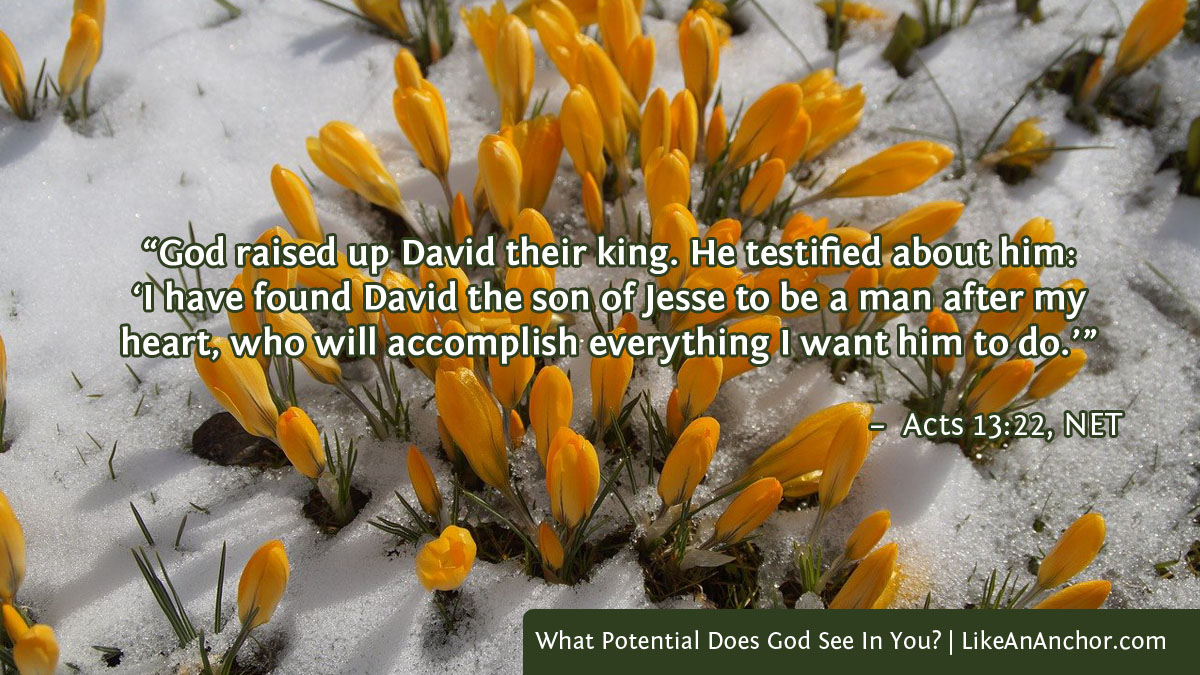
They go through seven sons before finally running out of the ones that are close at hand. Brining in David is an afterthought; he’s just the youngest boy, out tending the sheep. He wasn’t important enough for his dad to call him to the sacrifice earlier in this narrative and he certainly wasn’t one of the options for being the next king of Israel. God turns that expectation up-side-down. David becomes the greatest king of Israel. God even calls him “a man after my heart” (Acts 13:22, WEB). Once again, God sees potential for greatness in someone others overlooked.

Hannah

At the beginning of 1 Samuel we’re introduced to Hannah. She was one of two wives of an Ephramite named Elkanah. Her husband loved her, but she had no children and the other wife teased her mercilessly for it, especially when her family went to Shiloh to worship at Yahweh’s temple. One year, grieving Hannah goes off alone to beg Yahweh for a son. She was “in bitterness of soul, and prayed to Yahweh, weeping bitterly.”

Now Eli the priest was sitting on his seat by the doorpost of Yahweh’s temple. … As she continued praying before Yahweh, Eli saw her mouth. Now Hannah spoke in her heart. Only her lips moved, but her voice was not heard. Therefore Eli thought she was drunk. Eli said to her, “How long will you be drunk? Get rid of your wine!”

1 Sam. 1:9, 12-14 WEB

The priest thought she was drunk and accused her without knowing all the facts. Eli softened toward her when he heard her story, but God already saw her heart and heard the prayer she spoke in His temple. The next time “Elkanah knew Hannah his wife,” we’re told “Yahweh remembered her. When the time had come, Hannah conceived, and bore a son; and she named him Samuel” (1 Sam. 1:19-20, WEB). It’s not just the kings and great leaders that God sees with compassion and clarity. It’s also those longing for specific blessings and desiring good things in line with His will.

Moses

Moses grew up as a prince of Egypt, then fled after murdering an Egyptian. He spent 40 years as a shepherd before God showed up in the burning bush and told Moses that he’d be the one God used to deliver Egypt (Exodus 3-4). Moses was understandably shocked by this.

Moses said to God, “Who am I, that I should go to Pharaoh, and that I should bring the children of Israel out of Egypt?” …

Moses answered, “But, behold, they will not believe me, nor listen to my voice; for they will say, ‘Yahweh has not appeared to you.’” …

Moses said to Yahweh, “O Lord, I am not eloquent, neither before now, nor since you have spoken to your servant; for I am slow of speech, and of a slow tongue.” …

Moses said, “Oh, Lord, please send someone else.”

Exodus 3: 11; 4: 1, 10, 13

Moses saw himself as unable to speak, utterly unqualified, and unwilling to do something so dangerous and so great. God had an answer for each of these protests, promising Moses could do what needed to be done because God would be there providing guidance and power. They finally reach a sort of compromise, with God letting Moses’s bother Aaron act as spokesman. Despite this rocky start, God helped Moses live up to the potential He saw in him. Moses even became one of God’s closest friends (Ex. 33:11; Num. 12:6-8).

What About Us?

Those are just four of many examples in the Bible of God seeing something in people that no one else did. Gideon was hiding and uncertain, David was overlooked by his family, Hannah was misinterpreted and rebuked by a priest, and Moses was convinced he couldn’t do the things God called him to do. But God looked at those situations and saw great potential for valor, kingship, motherhood, and leadership.

“For I know the thoughts that I think toward you,” says Yahweh, “thoughts of peace, and not of evil, to give you hope and a future.”

Jeremiah 29:11, WEB

I’ve written before about how God defines our identities in Him. God sees you as someone worth dying for (Rom. 5:8). He says you belong to Him (1 Cor. 6:19-21). He sees you as salt and light in this earth (Matt. 5:13-14). He says you are called, holy, and chosen (1 Pet. 2:9). You are friends and siblings of Jesus Christ (John 15:14, Rom. 8:16-17). You are greatly loved and highly valued by both the Father and the Son (John 3:16; 15:13-14). We’re precious to God and He sees a glorious future for us where we’re part of His family, partaking in His divine nature. In Him, we can be courageous overcomers, recipients of abundant blessings, and eventually kings and priests in His kingdom (1 Pet. 2:9; Rev. 5:7-10). That’s the potential God sees in each of us.

Featured image by Manfred Richter from Pixabay

Song Recommendation: “You Say” by Lauren Daigle