Servants of God Forever

Servants of God Forever | marissabaker.wordpress.comLast week we talked about the future, and what the people of God might be doing in the tribulation leading up to Christ’s return. Today, let’s go a bit father into the future. In Revelation 20, we’re told that the devil will be locked away for 1,000 years while the faithful live and reign with Christ (20:4). At the end of the Millennium, he is released and those who join his rebellion against God are destroyed, and Satan is locked away (20:7-10). This is followed by the second resurrection and final judgement of the dead who were not counted among the firstfruits.

From this point on, we have very little detail. Revelation 21 and 22 gives descriptions of the New Jerusalem and the new heaven and new earth, and we’re told there will be “nations of those who are saved” (21:24). We know “the Lord God Almighty and the Lamb are its temple” giving light to the entire world (21:22; 22:5). One thing we don’t know is exactly what we’ll be doing there. Most speculation I’ve heard assumes we’ll be helping Christ re-build the world and counsel survivors of the tribulation through the Millennium. Some have suggested we might spread out and colonize other planets after that. But we really don’t know. I’ve always thought that if it was really important for us to know, God would have told us. A message I heard a couple weeks ago, though, has me wondering if He did give us some clues after all.

Servants

The Rabbi at my Messianic group was talking a couple weeks ago about patterns that God sets up in how He runs things. In ancient Israel, the Levites were a tribe set apart for God, which this speaker connected to our role today as God’s called-out people. The Rabbi’s focus was on how that affects us today, but I wondered if it might carry over into the future as well, with God re-using this pattern.

Thus you shall separate the Levites from among the children of Israel, and the Levites shall be Mine. After that the Levites shall go in to service the tabernacle of meeting. So you shall cleanse them and offer them like a wave offering. (Num. 8:14-15)

The Levites — 1 tribe out of 12 — were specifically set aside for God to serve in His tabernacle. Verse 11, here in Numbers 8, calls them “a wave offering from the children of Israel, that they may perform the work of the Lord.” Similar wording is used today, as we’re called to present ourselves to God as an offering.

I beseech you therefore, brethren, by the mercies of God, that you present your bodies a living sacrifice, holy, acceptable to God, which is your reasonable service. (Rom. 12:1)

Our lives aren’t our own. When we commit to following God, we pledge everything we are to His service. We are His, and just as He said the Levites “shall be Mine,” so He can call each of us His because He redeemed us.

For they are wholly given to Me from among the children of Israel; I have taken them for Myself instead of all who open the womb, the firstborn of all the children of Israel. For all the firstborn among the children of Israel are Mine, both man and beast; on the day that I struck all the firstborn in the land of Egypt I sanctified them to Myself. I have taken the Levites instead of all the firstborn of the children of Israel. (Num. 8:16-18)

Servants of God Forever | marissabaker.wordpress.comBecause of the events that happened on Passover, when the Lord rescued Israel from Egypt, all the firstborn were holy to Him. Instead of having all the firstborn sent to serve in the tabernacle, though, He set aside one tribe for that role. In much the same way, Jesus Christ’s sacrifice made redemption possible for all people, but right now He’s only working with the firstfruits.

Or do you not know that your body is the temple of the Holy Spirit which is in you, which you have from God, and you are not your own? For you were bought at a price; therefore glorify God in your body and in your spirit, which are God’s. (1 Cor. 6:19-20)

We are purchased with Christ’s blood, bought-back from our enslavement to sin so we can serve God (Rom. 6:15-23). That’s not a role that’s going away any time soon.

And there shall be no more curse, but the throne of God and of the Lamb shall be in it, and His servants shall serve Him. They shall see His face, and His name shall be on their foreheads. There shall be no night there: They need no lamp nor light of the sun, for the Lord God gives them light. And they shall reign forever and ever. (Rev. 22:3-5)

This is in the description of the New Jerusalem. Right before this, it talks about “the nations” who walk in God’s light and are healed by the tree of life (Rev. 21:24-22:2). Then, we see God’s servants mentioned as a separate group. Could that be those who were firstfruits, continuing in their role as servants especially chosen for God’s holy use?

Priests

Not all the Levites served as priests. Even within the tabernacle service there were different roles and responsibilities. Most notable was the fact that there was only one high priest at any given time. Today, the role of High Priest is held by Jesus Christ (Heb. 8:1-6), whose perfect sacrifice fulfilled the sacrifices offered by the Old Covenant high priests. So, where did the rest of the Levites fit in?

And I have given the Levites as a gift to Aaron and his sons from among the children of Israel, to do the work for the children of Israel in the tabernacle of meeting, and to make atonement for the children of Israel, that there be no plague among the children of Israel when the children of Israel come near the sanctuary. (Num. 8:19)

Here, the Levites are described as a gift given to the high priest for service in the tabernacle. This is repeated several chapters later.

 Behold, I Myself have taken your brethren the Levites from among the children of Israel; they are a gift to you, given by the Lord, to do the work of the tabernacle of meeting. (Num. 18:6)

This sounds a lot like Jesus’ prayer on the night in which He was betrayed.

I pray for them. I do not pray for the world but for those whom You have given Me, for they are Yours. And all Mine are Yours, and Yours are Mine, and I am glorified in them. (John 17:9-10)
Servants of God Forever | marissabaker.wordpress.comGod has given us to His Son, our High Priest, to serve and glorify Him. As quoted earlier, we are God’s temple today. That’s where priests serve — in the temple (or the tabernacle, at the time when Numbers was written). Jesus is in His church as the High Priest in His temple, and we’re right there serving with Him.

But you are a chosen generation, a royal priesthood, a holy nation, His own special people, that you may proclaim the praises of Him who called you out of darkness into His marvelous light (1 Pet. 2:9)

Even today, God’s people are described as a priesthood. That role continues into the future — definitely into the Millennium, and quite probably beyond.

Blessed and holy is he who has part in the first resurrection. Over such the second death has no power, but they shall be priests of God and of Christ, and shall reign with Him a thousand years. (Rev. 20:6)

When you look back at the book of Numbers, both passages we quoted about the Levites’ role as helpers to the high priest emphasized service. That’s also the common thread uniting the two descriptions of God’s people in the future as servants and priests. If we want to work on something that will carry over into the future, serving God by serving His people seems a good place to start. There is an aspect of our future that involves ruling, but to learn to rule with Christ, we must first learn to serve. That’s what Christ did and does (Phil. 2:5-9), it’s what Paul did (Phil. 2:17-18), and that’s what we should be doing.


The Day of the Lord (Lessons from Amos)

The Day of the Lord | marissabaker.wordpress.comAs I was reading Amos in my quest to write about more verses I don’t often study, some verses about the Day of the Lord caught my eye. It got me thinking about two doctrines I’ve encountered related to what the church will be doing during the great tribulation that precedes Christ’s second coming.

One doctrine, the one taught in the churches where I grew up, says that some believers will be taken to a “place of safety” where God keeps them from the tribulation. The other, taught in most Evangelical and some Messianic churches, says that a “rapture” occurs where Christ catches believers up to heaven before the tribulation starts.

Both these ideas acknowledge that Jesus is coming back in the future to set up His kingdom on earth, and there will be great tribulation throughout the earth before that happens. Rapture doctrine (at least, the pre-trib version) teaches that He will come back twice — once to gather up believers pre-tribulation and once again to set up His millennial reign. The Place of Safety doctrine teaches that some, not all, believers will be taken to a physical place of safety on earth to wait-out the tribulation until Christ’s return. Today, I want to re-think the idea that believers are going to get-out of the tribulation, and what that might mean for our faith.

A Day of Darkness

If you believe that those who are faithful to God are taken out of the world before the great tribulation starts, then praying “thy kingdom come” is easy. We’ll get out of the worst of it and bypass all this judgement stuff so we can finally get to that reward we’ve been promised. But what if it doesn’t work out that way?

What if Revelation 12:13-17 really does mean the church will be taken to a safe place, but you’re part of the commandment-keeping remnant still in the earth and persecuted by the dragon? What if there is a rapture, but it’s mid- or post-tribulation instead of pre-trib?

Woe to you who desire the day of the Lord! For what good is the day of the Lord to you? It will be darkness, and not light. It will be as though a man fled from a lion, and a bear met him! Or as though he went into the house, leaned his hand on the wall, and a serpent bit him! Is not the day of the Lord darkness, and not light? Is it not very dark, with no brightness in it? (Amos 5:18-20)

There’s a note on this passage in my study Bible that says, “The people were taking for granted that the ‘Day of the Lord’ would be their day of triumph. Amos reminded them, however, that because of their unbelief and wickedness, it would be a day of judgement for them as well as the other nations.”

This made me think of us in the church, hoping for the end of the world because we know it has to come before Christ’s return, while thinking we might get out of the accompanying tribulation. Well, maybe we will, but I wouldn’t count on it. Matthew 24 clearly states Christ “will gather together His elect” “immediately after the tribulation” (Matt. 24:29-31). We have to be ready to stay faithful to God even if we go through the worst tribulation mankind has ever faced. If our faith is contingent upon being raptured away or taken to a place of safety, we could be in trouble.

Our Safe Place

I know this sounds bleak, but one thing we do know is that God’s people will suffer because our Messiah suffered (1 Pet. 2:18-25). If we really are living in the last days (as so many people think) and that includes having to go through the tribulation, I pray we’ll be those who can say “Thy will be done” rather than those who turn away because they were expecting something else.The Hiding Place by Corrie ten Boom

I recently read The Hiding Place by Corrie ten Boom. She was a Christian working with the Dutch underground in World War II who was caught and sent to several German concentration camps. At first, I thought the title refered to the secret room where she and her family hid Jews, but I soon found out she meant something else.

You are my hiding place and my shield; I hope in Your word. (Ps. 119:114)

Corrie quotes this verse near the beginning of the book, and again near the end.  Her sister just died, she’s trapped in the medical ward waiting for release from the third camp she’s been held in, and she writes this: “His timing is perfect. His will is our hiding place. Lord Jesus, keep me in Your will! Don’t let me go mad by poking about outside it.” We don’t need to go anywhere for God to keep us safe. We just need to stay in His will. Our safety doesn’t depend on anything other than our relationship with Him.

He who dwells in the secret place of the Most High shall abide under the shadow of the Almighty. I will say of the Lord, “He is my refuge and my fortress; My God, in Him I will trust.” (Ps. 91:1-2)

The New Living Translation has “place of safety” here instead of “fortress.” Reading on in this Psalm, we read of people living with “terror by night” and arrows by day (verse 5) in a place where pestilence and destruction are rampant (verse 6), and people fall dead all around you (verse 7). That’s not a physically safe location, but it doesn’t matter when you are dwelling in God.

Because you have made the Lord, who is my refuge, even the Most High, your dwelling place, no evil shall befall you, nor shall any plague come near your dwelling (Ps. 91:9-10)

We’ve all known Christians who’ve suffered — and we’ve probably been a suffering Christian. Clearly, this isn’t a promise for complete physical protection for every follower of God. It is a promise, though, that God won’t let anything happen to us that can’t work out for good (Rom. 8:28).

Keep Watch

We have to constantly work on developing a close relationship with God, and learning to follow Him the way He commands. That’s what’s important — not trying to figure out when He’s returning or if we’ll be raptured or where the place of safety might be. God is our focus, and if we keep our eyes on Him He will work things out.

Watch therefore, for you do not know what hour your Lord is coming. But know this, that if the master of the house had known what hour the thief would come, he would have watched and not allowed his house to be broken into. Therefore you also be ready, for the Son of Man is coming at an hour you do not expect. (Matt 24:42-44)

If we knew exactly when and how God’s plan would unfold, there’d be little need for trust or faith as the “evidence of things not seen” (Heb. 11:1). We could have everything planned out and controlled and feel assured in our own efforts. but that’s not what God wants. He wants to see what we’ll do when we have to rely on Him completely.

The Day of the Lord | marissabaker.wordpress.comWho then is a faithful and wise servant, whom his master made ruler over his household, to give them food in due season? Blessed is that servant whom his master, when he comes, will find so doing. Assuredly, I say to you that he will make him ruler over all his goods. But if that evil servant says in his heart, ‘My master is delaying his coming,’ and begins to beat his fellow servants, and to eat and drink with the drunkards, the master of that servant will come on a day when he is not looking for him and at an hour that he is not aware of, and will cut him in two and appoint him his portion with the hypocrites. There shall be weeping and gnashing of teeth. (Matt. 24:45-51)

There has been far too much smiting of fellow servants in the churches by people who don’t live like they could find themselves face-to-face with Jesus at any moment. We can’t let our faith slip because we think we have time or that we’ll get a warning. I’ve lost far too many friends to sudden, unexpected causes of death to think there are guarantees in this life.

God doesn’t call us to a life of comfort. He does promise He’ll never leave us and that, if we stay faithful, we will triumph with His son at the end. He doesn’t give us all the answers, but He gives us the only one we need. Grow closer to Him, stay vigilant, and trust Him as your place of safety.

Sins As Scarlet

Sins As Scarlet | marissabaker.wordpress.com
bg image credit: Nevil Zaveri

When we were in Joel last week, the final verse started me thinking on the subject of God’s power to cleanse sin. We know God forgives sin, but do we believe that He will really forgive us? Our sins have separated us from God (Is. 59:2) — will He really take us back? Or if we don’t think that about ourselves, maybe we think someone else’s sins are too big for God to forgive.

And Jesus answered and said to him, “Simon, I have something to say to you.”

So he said, “Teacher, say it.”

“There was a certain creditor who had two debtors. One owed five hundred denarii, and the other fifty. And when they had nothing with which to repay, he freely forgave them both. Tell Me, therefore, which of them will love him more?”

Simon answered and said, “I suppose the one whom he forgave more.”

And He said to him, “You have rightly judged.” (Luke 7:40-43)

This isn’t to say we should commit sins so we can love God more, but when we have sinned God delights in forgiving those who turn to Him. He wants to turn seemingly impossible situations and seemingly irredeemable people into something good. (As a side note, this is the verse that always pops into my head when I hear people say they doubt God could forgive someone like Hitler).

Invitation to Forgiveness

God’s goal is for all the people He created to repent and be saved. There will be some who out-right reject Him (Rev. 20), and they will be punished, but what he wants is a restored relationship with all men.

“Come now, and let us reason together,” says the Lord, “Though your sins are like scarlet, they shall be as white as snow; though they are red like crimson, they shall be as wool. If you are willing and obedient, you shall eat the good of the land; but if you refuse and rebel, you shall be devoured by the sword;” for the mouth of the Lord has spoken. (Is. 1:18-20)

This is an amazing passage. It’s like God is inviting His people to sit down and talk things over with Him. That’s one thing I love about Isaiah — the honesty and genuineness of God revealed in His messages to Israel. He really bares His heart, telling them how much He cares and how much He wants them to come back to Him so He can forgive and bless them.

I, even I, am He who blots out your transgressions for My own sake; and I will not remember your sins. Put Me in remembrance; let us contend together; state your case, that you may be acquitted.” (Is. 43:25-26)

He doesn’t cleanse us because we deserve it, but because He is love and because He’s in the business of restoration.

Asking For Purity

Probably the most famous prayer for spiritual cleansing is David’s Psalm 51. This records how David asked for forgiveness after he committed adultery and murder, and because of his truly repentant heart God continued working with him even after these horrible sins.

Purge me with hyssop, and I shall be clean; wash me, and I shall be whiter than snow. (Ps. 51:7)

Hyssop is an interesting herb in the Bible. It’s used ritualistically as a cleansing or purifying symbol (Lev. 14:1-7, 33-53; Num. 19:1-6), likely because it was literally used as a cleaning agent. Today, we’re finding out that hyssop oil has measurable antibacterial, antimicrobial, and antifungal properties. Perhaps this connection with purification is why it was used at the first Passover.

 Then Moses called for all the elders of Israel and said to them, “Pick out and take lambs for yourselves according to your families, and kill the Passover lamb. And you shall take a bunch of hyssop, dip it in the blood that is in the basin, and strike the lintel and the two doorposts with the blood that is in the basin. And none of you shall go out of the door of his house until morning. For the Lord will pass through to strike the Egyptians; and when He sees the blood on the lintel and on the two doorposts, the Lord will pass over the door and not allow the destroyer to come into your houses to strike you.” (Ex. 12:21-23)

Sins As Scarlet | marissabaker.wordpress.com
bg image credit: Nevil Zaveri

With the Passover picturing Christ’s death, the hyssop (John 19:29) and blood signify not just “passing over” sins, but also removing them completely. The means by which our “red as scarlet” sins are made “white as snow” is washing in the blood of the Lamb (Rev. 7:14).

It makes sense, then, that the only sins we’re told God will not pardon involve rejecting Christ’s sacrifice (Heb. 6:4-6) and blaspheming God’s spiritual, redemptive Power (Matt. 12:31-32). You can’t be forgiven if you reject and hate the way to forgiveness. But that’s the only thing God can’t forgive. All those things we humans think of as the “worst” sins — the kinds of things David did, for example — those God can work with if we repent and ask Him to help us change.

Cycles of Judgement, Repentance, and Blessing (Lessons from Joel)

I recently heard that pastors tend to use the same set of scriptures over and over when speaking. It’s probably not even on purpose — you just naturally go to the verses you know well and are comfortable with when writing about a given topic. I wondered if I do that in this blog, and started trying to think of scriptures that I don’t regularly quote. The minor prophets came to mind. I spend time in Hosea, but not really any of the others. And so I though, why not start a study on these 12 books and see what the Lord might have to teach me.

Repent From the Heart …

Joel begins with prophecies of destruction. First, he warns Israel that locusts will sweep through and destroy the food crops. There wouldn’t even be enough harvest to supply the offerings in the temple (Joel 1:9).

Consecrate a fast, call a sacred assembly; gather the elders and all the inhabitants of the land into the house of the Lord your God, and cry out to the Lord. Alas for the day! For the day of the Lord is at hand; it shall come as destruction from the Almighty. (Joel 1:14-15)

Mercy triumphs over judgement (James 2:13), but that doesn’t mean God won’t punish sin. Sometimes, that’s the only way to get our attention and save us by turning us back to Him.

In chapter 2, the prophecy shifts to what is still for us future events (at least, that’s what it looks like to me. Zodhiates’ study Bible says there is some disagreement among scholars). It sounds a lot more like Revelation, though, than a famine caused by locusts. Regardless of the timing, the conclusion of both prophesies is the same — an immediate call to repentance.

“Now, therefore,” says the Lord, “Turn to Me with all your heart, with fasting, with weeping, and with mourning.” So rend your heart, and not your garments; return to the Lord your God, for He is gracious and merciful, slow to anger, and of great kindness; and He relents from doing harm. Who knows if He will turn and relent, and leave a blessing behind Him — a grain offering and a drink offering for the Lord your God? (Joel 2:12-14)

We should stay close to God through both good times and bad, but if we have drifted away He is still ready to hear us as individuals and as a nation. Genuine repentance from the heart will always get God’s attention.

… And There Will Be Blessings

Joel tells us that when all the people — including the elders, youth and ministry (Joel 2:16-17) —  come to God with tears and a request for mercy, He will hear.

Then the Lord will be zealous for His land, and pity His people. The Lord will answer and say to His people, “Behold, I will send you grain and new wine and oil, and you will be satisfied by them; I will no longer make you a reproach among the nations.” … Fear not, O land; be glad and rejoice, for the Lord has done marvelous things! (Joel 2:18-19, 21)

Lessons From Joel | marissabaker.wordpress.comGod promises to send so many blessings that they will make up for everything that was lost in the plagues described earlier (Joel 2:25). This makes me think of  a passage in Romans, where Paul writes, “I consider that the sufferings of this present time are not worthy to be compared with the glory which shall be revealed in us” (Rom. 8:18). There’s certainly no reason Christians can’t be happy and joyful in their lives today, but often our walks are marked by trials and touched by sorrow. Either way, we have a magnificent future to look forward to, and focusing on that can help us endure as we follow in Christ’s footsteps (Heb. 12:1-3).

Then you shall know that I am in the midst of Israel: I am the Lord your God and there is no other. My people shall never be put to shame. And it shall come to pass afterward that I will pour out My Spirit on all flesh; your sons and your daughters shall prophesy, your old men shall dream dreams, your young men shall see visions. And also on My menservants and on My maidservants I will pour out My Spirit in those days. (Joel 2:27-29)

Fulfillment of this prophecy began on the Pentecost where the disciples were given the Holy Spirit, which Peter points out as he quotes Joel 2:28-32 when he explains what’s going on (Acts 2:14-21). The remainder of the prophecy, and Joel chapter 3, relate to future judgement.

In Joel, we’ve already seen cycles of judgement, repentance, and blessing. Now, the subject turns back to the tribulation and wars before the coming of Jesus Christ. Though things look extremely bleak, once again it will ultimately result in blessing for the people who stay faithful to God (Joel 3:16-21)

The Lord also will roar from Zion, and utter His voice from Jerusalem; the heavens and earth will shake; but the Lord will be a shelter for His people, and the strength of the children of Israel. (Joel 3:16)

There is hope and help for us now, and in the future if we whole-heartedly draw near to God. That’s a main message of the book of Joel — bad things are going to happen because of sin, and therefore we need to draw near to God and repent so good things can happen to us in the end.

There Remains A Sabbath

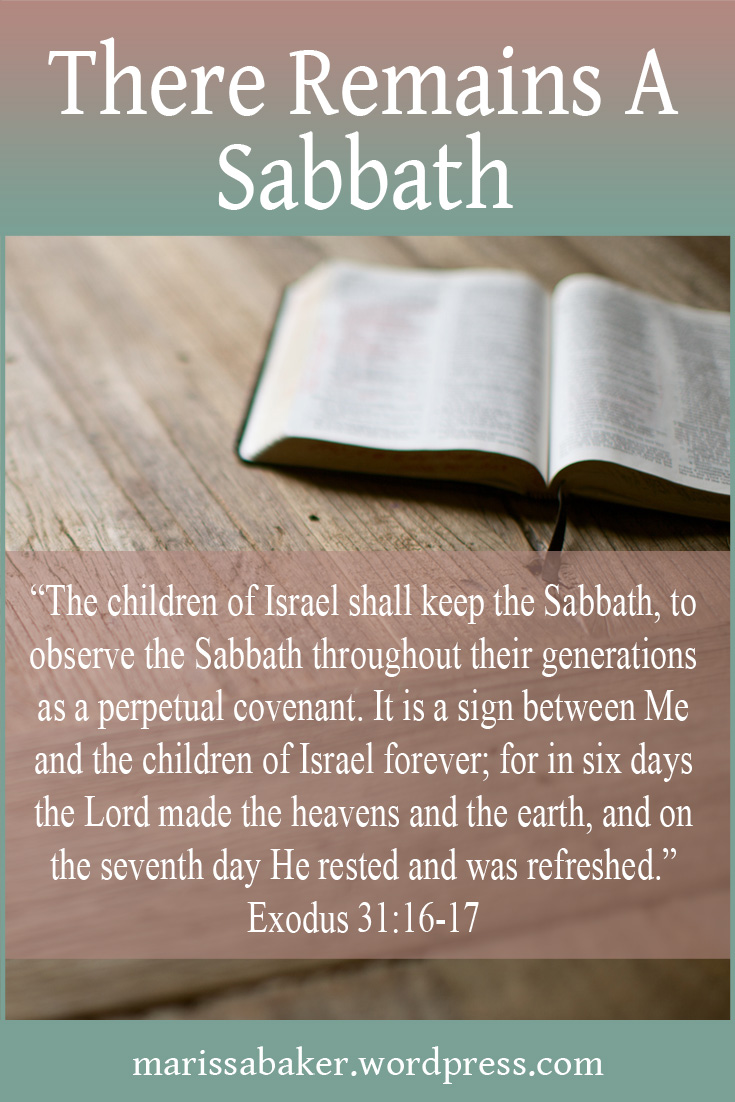
I’ve mentioned before that I keep Saturday as a Sabbath rest, but I don’t think I’ve talked about why. Not every Christian is convicted of this, but I’m seeing more and more acknowledging the value of “sabbathing.” It’s just a small step from realizing that God’s command to rest is good, to resting on the day He set aside from the beginning of creation.

Thus the heavens and the earth, and all the host of them, were finished. And on the seventh day God ended His work which He had done, and He rested on the seventh day from all His work which He had done. Then God blessed the seventh day and sanctified it, because in it He rested from all His work which God had created and made. (Gen. 2:1-3)

There Remains A Sabbath | marissabaker.wordpress.com

This verse tells us God chose a certain day, the seventh, as a day of rest. He gave this day a special blessing, and set it apart for sacred use. “Sanctified” in the Hebrew carries the sense of separating something from “the common or profane” and placing it in “the sphere of the sacred” (Theological Wordbook of the Old Testament, p.1989). That’s what God did with the Sabbath day from the beginning of the world. Read more

Thoughts on John 9

I don’t often spend most of a week studying just one chapter of the Bible, but John 9 captured my attention and didn’t let go. It is the story of Jesus healing a blind man, and unlike many miracles which are recorded in just a few short verses, this story takes up an entire 41-verse chapter.

This chapter is packed full of interesting things to learn. I focused on three main points that I noticed for this post, but I’m sure there’s more. If anyone else feels moved to study John 9, I’d love to hear your thoughts!

A Reason For Suffering

Now as Jesus passed by, He saw a man who was blind from birth. And His disciples asked Him, saying, “Rabbi, who sinned, this man or his parents, that he was born blind?”

Jesus answered, “Neither this man nor his parents sinned, but that the works of God should be revealed in him. (John 9:1-3)

The assumption the disciples made is all too common, even today — that the bad things which happen to us and others are a kind of punishment. Sometimes, however, God allows trials of various sorts to affect us because they fit into His plan for doing good. In this particular case, the man’s blindness was used to introduce him to Jesus and demonstrate to other people that Jesus is the Son of God.

It worked, too. This healing caused a huge stir in the Jewish community. This was partly because of the spectacular nature of the miracle, and partly because Jesus healed on the Sabbath. As the Word of God, Jesus was the One who told Israel about the Sabbath in the first place — He knew how to keep it holy. Doing good on the Sabbath wasn’t a sin, but it did anger the Pharisees because it violated some rules they’d added.

 Therefore some of the Pharisees said, “This Man is not from God, because He does not keep the Sabbath.” Others said, “How can a man who is a sinner do such signs?” And there was a division among them. (John 9:16)

Though they publicly condemned Jesus, they weren’t so sure behind the scenes. This miracle made them think, and I wonder if some of them eventually became believers. Nicodemus couldn’t have been the only Pharisee wondering if maybe, just maybe, Jesus really was the Christ (John 3:1-2).

A Simple Testimony

After he was healed, the man who’d been blind doesn’t leap, shout, and tell everyone what happened. He didn’t do anything to call attention to himself, and only talked about the miracle when people started asking him what happened.

He answered and said, “A Man called Jesus made clay and anointed my eyes and said to me, ‘Go to the pool of Siloam and wash.’ So I went and washed, and I received sight.” (John 9:11)

After hearing this, the people took him to the Pharisees and he repeated his story again (verse 15). Not believing him, they called in his parents, who were scared of being excommunicated and wouldn’t say anything except to affirm that he had, indeed, been blind (verse 18-23).

So they again called the man who was blind, and said to him, “Give God the glory! We know that this Man is a sinner.”

He answered and said, “Whether He is a sinner or not I do not know. One thing I know: that though I was blind, now I see.” (John 9:24-25)

I think what the Pharisees were trying to do was convince this guy to say God healed him, and leave Jesus out of it. That never works — for “whoever denies the Son does not have the Father either” (1 John 2:23). When the Pharisees kept pressuring him, this man delivered a very simple testimony that enraged the Pharisees, who prided themselves on their intellect and knowledge of God.

The man answered and said to them, “Why, this is a marvelous thing, that you do not know where He is from; yet He has opened my eyes! Now we know that God does not hear sinners; but if anyone is a worshiper of God and does His will, He hears him. Since the world began it has been unheard of that anyone opened the eyes of one who was born blind. If this Man were not from God, He could do nothing.” (J0hn 9:30-33)

There’s something to be said for paying attention to “the simplicity that is in Christ” (2 Cor. 11:3). The man who went with the simple, obvious explanation — that Jesus is a good man who performed a miracle — was much closer to God than the thoroughly educated church leaders.

A Personal Connection

After testifying to Jesus’ work in his life, the Pharisees excomunicated the formerly blind man (verse 34). This relates back to an earlier verse, which tells us “the Jews had agreed already that if anyone confessed that He was Christ, he would be put out of the synagogue” (John 9:22). This doesn’t sound so bad to us today — if we get kicked out of one church there are plenty more right down the street. In the Jewish culture of Jesus’ time, though, it meant banishment from religious life.

In his definition of aposunagogos (G656), Zodhiates notes that the highest degree of “casting out” (there were three) is “an exclusion from all the rights and privileges of the Jewish people, both civil and religious. The offender was considered as dead.” Jesus warned His followers about this possibility in John 16:2. Following Jesus was a huge, dangerous step for Jews. It meant risking isolation from other people and, if you believed the Pharisees, from God.

Jesus heard that they had cast him out; and when He had found him, He said to him, “Do you believe in the Son of God?”

He answered and said, “Who is He, Lord, that I may believe in Him?”

And Jesus said to him, “You have both seen Him and it is He who is talking with you.”

Then he said, “Lord, I believe!” And he worshiped Him. (John 9:35-38)

We don’t often see examples of Jesus making follow-up visits with people He healed, but it is clear from these verses that He was keeping track of what happened with this man. As soon as He heard about the Jews excommunicating the formerly blind man, Jesus tracked him down to encourage him and confirm his faith. This man was cast out by the Jews, but he was welcomed by the Messiah.

I’m touched by the personal attention Jesus gave this individual, and the parallels with our own calling. Jesus healed him, apparently without being asked to, and changed his whole life. In much the same way, God may call us when we’re not even looking for Him and don’t know how desperately we need His life-changing power.

This healing opened the blind man’s spiritual as well as physical eyes. Many of us today can relate the rejection he experienced when he started to share the story of how Jesus touched his life. I hope we can also relate to the comfort of having a personal connection with this great Being, who doesn’t leave people alone to navigate their new-found faith.