A few weeks ago I observed something curious in one of the personality type groups I frequent on Facebook. One member started a discussion about what kind of villain different personality types would be and there were a few types they didn’t even list. Their assumption was that most Feeling types wouldn’t become villains and especially not NF or FP types.
Rather than bask in the knowledge that we’re the lest villainous type a surprisingly high number of NFs jumped into the comments to defend our ability to turn evil. Most of their comments went something like this: “Well, I wouldn’t personally be a villain, but I could be because *insert reasons.* And on top of that, *insert fictional or real name* is a villain of my type.” I laughed at the number of INFJs who reminded people that Hitler was an INFJ while at the same time reassuring people they don’t feel Hitler-ish tendencies themselves.
Who Gets To Be The Villain?
I dare say when most people think about villains, they think of a detached mastermind. There’s a ridiculously high percentage of NT type villains (and correspondingly few NT heroes; it’s even harder to find heroic INTJs in fiction than it is to find NF villains). In real life, of course, people of any personality type can lean more towards the best version or the worst version of their type. No one personality type is inherently “better” than any other. However, society does stereotype certain characteristics associated with types as better or worse.
Prioritizing other’s safety over your own, a characteristic most commonly associated with FJ types, is often seen as a heroic trait. Hence, we see characters like Captain America with an ISFJ personality type. But what if you have an ISFJ character who decides only a certain group of people (or even just one person) is more valuable and it’s their duty to protect them? Suddenly the heroic trait doesn’t seem so safe any more. Especially when you consider the prime example of a villainous ISFJ is Norman Bates from Psycho. Read more →
This is my third post in a series about Christians of different Myers-Briggs types. When you start talking with people in the churches, it quickly becomes clear that while we share a common faith there is quite a variety among us as well. Some of that has to do with background, some with the denomination we’re part (or not part) of, and some with personality. And if we want our churches to be a welcoming place for all people who seek to know Jesus, it’s a good idea for us to understand how different personality types relate to their faith.
Our walks with God don’t all look the same. We’re influenced by our backgrounds, variations in beliefs, and individual personalities. And even though the goal is for us all to become “like God,” that doesn’t mean we become indistinguishable from each other. God created great variety in people and I believe He did that for a reason. So let’s spend today’s post hearing from and talking about the unique perspectives of INFP Christians.
I heard from five INFPs who responded to most of the questions I asked. In general, INFPs are private people and I’m not surprised that the response rate was lower than what I saw for the INFJ post and the ENFP post I wrote earlier. One INFP who I talked with in-person said she wouldn’t feel comfortable submitting even an anonymous response. Still, I hope any INFP Christians reading this post will feel safe commenting and adding their thoughts to the conversation. I’d love to hear from more of you! Read more →
Because INFJs and INTJs both use Introverted Intuition as their favorite mental process, the two types can appear very similar. Quite a few people who take a Myers-Briggs test and get either of these results (or both on different tests) are left wondering, how can I tell whether I’m an INFJ and INTJ?
My personality type is INFJ and my sister’s is INTJ. It would be well-nigh impossible to assume we share a personality type, but if you don’t have that contrast living with you (or if you’re a little less extreme on your T/F preference) I can see how deciding which type is your best fit could be a challenge. INFJs and INTJs lead with the same mental process and they react in very similar ways when stressed out. The main differences between the two types have to do with how they handle their Thinking/Feeling preference.
INFJs use auxiliary Extroverted Feeling as their copilot and support it with tertiary Introverted Thinking. INTJs use auxiliary Extroverted Thinking as their copilot and support it with tertiary Introverted Feeling. The auxiliary process is how they prefer to make decisions and interact with the outer world, but they can slip into their tertiary quite easily. It’s not as well developed or as reliable, but it can seem comfortable since it’s introverted (just like their dominant intuitive function).
How comfortable each INFJ/INTJ is with their thinking and feeling processes depends on a number of factors, including age, environment, and past experiences. You can find INFJs who are very people-oriented and social, or INFJs that seem distant and logical. Similarly, you’ll meet INTJs who are stereotypically blunt and calculating, and INTJs who are comfortable experiencing their own emotions. Even so, the way these functions shows up looks different for each type.
My Cup of T
An INTJ’s Thinking side is focused on the outer world. It’s also the function they’re most comfortable using when making decisions. While mature, well-balanced INTJs will take the human side of a question into consideration, it’s typically secondary to finding the most logical, fact-based solution. Personality Hacker calls this mental process “Effectiveness” and says it “focuses on impersonal criteria for making decisions” and prioritizes efficient problem solving.
INFJs, on the other hand, use an inward-focused Thinking process and they’re not usually as comfortable with it as they are with their Feeling side. Personality Hacker calls Introverted Thinking “Accuracy” and says this function gives users “the ability to reason through a subject or concept within one own’s understanding, even if it doesn’t match ‘outer world’ data.” Basically, this process is trying to work through things until they make sense.
INTJs are much more likely to express their Thinking judgements externally than an INFJ. They’ll often seem more blunt and direct because efficient communication is more important to them than worrying another person’s feelings. INTJs are also more likely to draw on objective, external facts to support their ideas. They want their ideas to work and they want outer world validation for their problem solving. That’s not nearly as important to INFJs, who need things to make sense personally more than to the people around them.
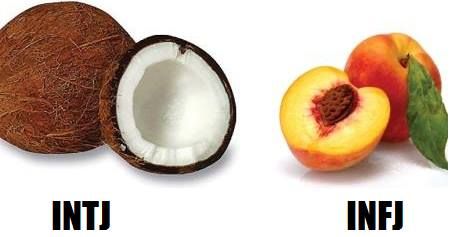
spotted this on Pinterest and I love it
Feeling The Feels
An INFJ’s Feeling side, like INTJ Thinking, is the function they use most comfortably when making decisions. It’s also outward focused, but it’s primarily people-oriented. Personality Hacker nicknames this function “Harmony” because it “makes decisions based on how things are impacting people on an emotional level.” The key thing to remember about this function is that it’s outward focused. INFJs are more in touch with other people’s feelings than they are their own.
INTJs use a Feeling process that’s introverted, which Personality Hacker calls “Authenticity.” While it’s also concerned with how decisions impact on an emotional level, it’s focused on one’s own emotions rather than other people’s. To again quote Personality Hacker, “Introverted Feeling is about checking in with all those inner parts and voices to determine what feels the most in alignment with oneself.” Somewhat ironically, the stereotypically cold and logical INTJs are often much more in-tune with their own feelings than the stereotypically emotional INFJs.
INFJs are more comfortable expressing feelings in the outer world and also more likely to pick-up on what other people are feeling. They’ll typically seem much more empathic and expressive than an INTJ. An INFJ who’s comfortable with their Extroverted Feeling side will also appear more social and “extroverted” than a typical INTJ. But INTJs are far more in-tune with their own emotions than most people (and many type descriptions) will give them credit for.
Even after you know about the technical differences between the ways INFJs and INTJs use thinking and feeling, you might still wonder they show up in real life. Let me give you some quick examples.
When making an everyday decision — an INFJ’s first impulse will be finding what makes as many people as possible happy, while an INTJ’s first impulse will be quickly finding the most logical answer. For me and my sister at least, the INTJ has a much easier time making simple decisions without overthinking them than the INFJ does.
In a stressful/emergency situation — I’m the one who’s in logic mode and my INTJ sister is the one indecisive and unsure. We’re talking something that calls for quick action and is stressful enough to push you out of your most comfortable mental processes (such as deciding to take someone to the hospital), Might not hold true for every INFJ or INTJ, but it’s an interesting observation I’ve made.
If asked to change their minds — an INTJ is most likely going to stick with what they’ve already decided because they know their idea is based on logic and that it feels right to them. To change their mind, you’ll need to present a fact-based counterargument that matches their deeply held beliefs about what’s right. A confronted INFJ will second-guess themselves because now they know someone isn’t happy with what they chose but they’ll also be reluctant to abandon something that makes sense to them. To change their mind, you’ll need to present an argument that hits emotion as well as logic.
I hope this helps you with telling the difference between these two types If you can’t tell if you’re an INFJ or and INTJ, looking at the differences in Thinking and Feeling functions is a good place to start figuring out your type. You’re not going to be a perfect 100% fit for every description of any one personality type, but there should be one that’s a “best fit” for your personality.
Your Turn: What are some differences and similarities you’ve noticed between INFJ and INTJ types?
Our walks with God don’t all look the same. We’re influenced by our backgrounds, variations in beliefs, and individual personalities. And even though the goal is for us all to become “like God,” that doesn’t mean we become indistinguishable from each other. God created great variety in people and I believe He did that for a reason. So let’s spend today’s post hearing from and talking about the unique perspectives of ENFP Christians.
Identifying With The Bible
While some ENFPs have a favorite Bible character, others couldn’t pick just one. Charity said, “I don’t really ‘identify’ with any of them, since we’re different people who have had different experiences, but my inner feminist always liked Mary sitting at the feet of Jesus, and Jesus telling Martha that she was where she should be (instead of preparing food in the kitchen!).” Dorien said he couldn’t choose just one and identified more with some during different seasons, “But I love the characters who experience the Love of God very deep: The woman trapped in idolatry. John – with his intimate relationship with Jesus. David – which name means The Beloved and was still chosen, even when He made mistakes.”
Personally, I’ve always found Peter very relatable and wonder if he might have been an ExFP type. I was glad to see two ENFPs list him as one of the characters they relate. Rielle elaborated on Peter the most, saying, “I can relate to him often not thinking (or seeming like it at least) before he speaks.” She also likes the way he “gets so involved in everything and is just so interested in what Jesus says.” Read more →
INFJ and INTJ personality types are known for being able to see multiple sides to a given situation. Both these types lead with a mental process called Introverted Intuition (Ni). Personality Hacker nickames this process “Perspectives.” It functions as an advanced pattern recognition process that analyzes what’s going on inside the human mind. But it’s not just focused on an individual’s take on how the world works. To quote Personality Hacker’s Antonia Dodge, “users of Introverted Intuition aren’t married to their own perspectives. They can take a meta-perspective and understand the ways in which we’re the same and different on a cerebral level.”
So what does this look like in real life? Let’s take politics as an example.
Most of the people I’m around in real life are strong conservatives, but I’m also in contact with quite a few liberals online. I get to see arguments, news articles, and personal perspectives from both sides of the ideological divide.
I see people who were vocalizing hate for Obama up in arms about how the liberals are treating Trump. I see people who told conservatives to get over it and be happy with Obama as their duly elected president protesting Trump in droves. I’ve seen conservative news articles vilifying Obama for his expensive vacations replaced by liberal news articles condemning Trump for the exact same thing. It just goes on and on and and both sides seem completely blind to the fact that they’re reacting in such similar ways.
My Introverted Intuition lets me notice patterns like this. More than that, I can understand people on both sides without really feeling like I identify 100% with either (except on a very few individual issues). And that makes it hard to discuss politics with most of the people who want to talk about politics. If you’re trying to find some middle ground and encourage others to step outside their own perspectives, you might find both sides fighting you as strongly as they’d been fighting each other.
The Few, The Frustrated, The Misunderstood
There aren’t all that many people operating with Ni as their dominant mental process. According to the Center for Applications of Psychological Type, combined they only make up 3 to 7 % of the total population. Our minds don’t work the same way as most other people. That’s one reason we often feel misunderstood. On top of that, our ability to climb inside other peoples’ perspectives gives us insight into others’ minds that not many people can match in return or even fully understand (though some ENFJs and ENTJs who’ve developed their auxiliary Ni, and maybe some ISTPs and ISFPs who use tertiary Ni, might come close).
Our rather unique way of looking at the world can make us feel lonely and frustrated. We might feel like we don’t fit in with certain groups because we can also understand the perspective of the people they disagree with. We might have people reject us because we can only agree with them 75% instead of 100%. We might hide our true opinions or the questions we think about from the people we care for so they won’t feel like we’re attacking them.
Most Ni dominant types are curious about how the world works. They want to ask questions to see where other people stand and understand different viewpoints. We like to throw out “what if …?” questions and see what happens. We’ll also play “devil’s advocate” in arguments to refine our thoughts on a given topic and help the person we’re talking with refine their’s. Other people can misinterpret these things as threatening to their own convictions or as an attempt to sabotage the status quo.
Another Perspective: Ni As A Superpower
I actually love this side of my INFJ personality. At least, I do now. When I was younger, I felt odd because I didn’t feel as firmly convicted about most issues as the people around me seemed. I felt that sharing my questions and voicing alternate opinions wasn’t encouraged. But my second quarter of college, I met a professor who actually encouraged me to write my questionings and unpopular viewpoints into my essays even when I completely disagreed with him. And he, and others, kept doing that for the next four years.
Some time after that is when I started getting interested in studying Myers-Briggs types, so I discovered this ability to adopt a meta-perspective is a natural part of my personality. Studying personality types also helped me understand why so many people see intuitive idea generation as threatening. Once I understood that, I could start phrasing my shared thoughts in a way that appealed to other personality types more.
One of the great strengths of the Ni types is that we bring alternative perspectives to the table and we can learn to present these perspectives in a way that appeals to the different personalities. We have a gift that can help build bridges between people on intellectual and emotional levels. And that’s a pretty cool superpower.
Our walks with God don’t all look the same. We’re influenced by our backgrounds, variations in beliefs, and individual personalities. And even though the goal is for us all to become “like God,” that doesn’t mean we become indistinguishable from each other. God created great variety in people and I believe He did that for a reason.
This is the first post in a series looking at Christians with different personality types. Today, we’re focusing on my personality type — INFJ. When you start talking with people of faith who fall into different personality type groups, you notice not all the personalities feel equally valued and understood by Christian churches. And churches on the whole seem skewed toward attracting Sensing and/or Feeling types. If Christianity is a faith meant for all people then why aren’t we doing a better job of connecting with all personality types?
Empathy For All
I asked INFJs which Bible characters they identified most with and received a flood of responses. It seems we can’t pick just one favorite character. Several INFJs mentioned that our empathy makes it easy to identify with Bible characters. Rachel writes, “My personality pushes me to strive to understand everyone, so I can identify with all the characters in the Bible in some way.” We do have favorites, though, (mine is the apostle John) and the INFJs who did get into details about their favorite characters were very specific.
I identify with David the most. His emotion portrayed through the Psalms and some OT stories resonate in my heart, especially that of love for God, the Scriptures, and pains of stress under sin and oppression. The way in which he responds to certain situations are very similar to how I’ve responded to mine relate as well. – Sarah H
I identify most with Rahab because she was an idolater who was saved when she trusted God. Not only that, but because of that decision, she was given a place in the line of Christ. I, too, was an idolater, but when I trusted Christ, God adopted me into His household. Now I’m a princess in the royal house of God. – Lillith
There wasn’t a whole lot of overlap, but multiple INFJs specifically mentioned King David, the Apostle Paul, and Jesus Christ. In our favorite characters, as in many other things, INFJs seek connection. They’re identifying with Bible characters who share aspects of their own personality traits and who inspire them to connect with God. And we do that with multiple characters. Take a look at some of what an INFJ named Alexandria wrote me:
I am Mary and Martha. I love Mary for the way she valued Yahweh and sat attentively, listening to all His wisdom. I identify with Martha and always love to think that I am treating my guests like royalty by having everything organized and prepared.
I love David…oh how I love him. I love that he was so gracious to Saul, even though Saul treated him so badly, trying to kill him! I love that David was a flagrant sinner and yet God called him a man after His own heart. I am so moved at how gracious the Lord was with David every time, and I remember that when I feel like my failings are stacking up!! I like his passion for life and the depth of his soul and all that he felt so poignantly. …
And last of all, my heart beats with Paul. I love his drive to get others to really live by the teachings of the scriptures. His quest for spiritual excellence is so awesome and it is so moving how dedicated he is to those he serves and he loves them so authentically and I feel like I really “get” him. He is a person who is passionate in living the Christian life the right way with integrity and love.
Using Our Gifts
INFJs who talked about serving in their church felt their contributions were appreciated. These INFJs are leading Bible studies, cooking dinners for small groups, participating in youth/teen ministry, using their artistic skills, teaching, and contributing musically. Many INFJs also expressed the desire to help more, but said they either haven’t had the opportunity or were actively discouraged. Read more →






 Like An Anchor