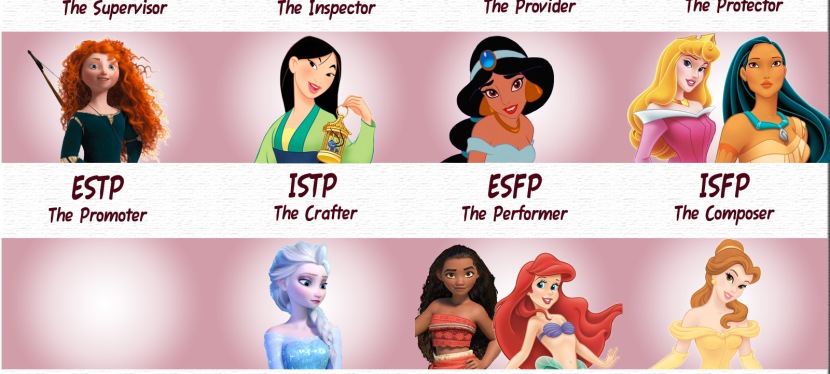
Updated Disney Princesses MBTI Chart

A couple years ago, I made a Myers-Briggs chart called The Missing Disney Princesses that quickly became one of the more popular posts on my blog. Now (finally!!!) I get to update it to include our new princess, Moana.

But I’m not just adding Moana to my chart. I’m also moving around a few of the other princesses. Last time, my focus was on showing that we don’t see all the personality types represented by the Disney princesses. Both Intuitive and Thinking types are under represented among Disney’s ladies. That’s still the case, but this time my focus is on explaining why I typed each princess the way I did.

In the two years since publishing the last chart, I’ve learned more about Myers-Briggs typing. I’ve also re-watched several of these movies, considered comments from readers on the previous post, and asked advice from fellow personality type and Disney enthusiasts. In response, I’ve re-typed several characters (which is noted and explained in the individual character discussions).Updated Disney Princesses MBTI Chart | marissabaker.wordpress.com

Note: I type using cogitative functions. If you’re not familiar with that aspect of Myers-Briggs theory, click here and here for a two-part introduction. Read on for detailed explanations for why I chose these types for each character. Read more

The Problem of Being Too Agreeable

INFJs place a high value on interpersonal harmony. Often, that manifests (especially in less mature/confident INFJs) as an unwillingness to just flat-out turn someone down. We’d much rather use “maybe,” “someday,” and “that might be nice” rather than “no,” “never,” and “I don’t think so.”

But that can back-fire on us and create discord in friendships. Other types can interpret our “maybes” as commitments, then get upset at us for breaking our word. Or they might recognize that we’re brushing them off and become frustrated by our refusal to give them a direct answer. Our attempts to avoid conflict can actually make things worse.

click to read article, "The Problem of Being Too Agreeable" | marissabaker.wordpress.com
Photo credit: “Smile Harder” by Kevin Galens, CC BY-SA via Flickr

Last week, we talked about one problem that can plague INFJ friendships — the fact that we have a tendency drop out of contact with our friends. It’s fairly easily explained from the INFJ’s perspective, but it can have an unintentional affect of hurting the people around us. Another similar (and in some ways related) problem is our temptation to noncommittally agree with what we think people want to hear, then ignore them and hope they forget about it. Read more

The Vanishing INFJ

I’ve written before about how other types can be friends with an INFJ. But there’s another side to that dynamic: what INFJs are like as friends. We can be fantastic friends — fun, engaging, good listeners, intensely loyal. But sometimes we’re not the best sort of friends and often, that’s the INFJ’s fault.

There are some things I love about being an INFJ personality type. And then there are other aspects which aren’t so nice, and some of those can negatively impact our friendships if we’re not careful. Today, I’m speaking of our tendency to drop out of contact with people.

click to read article, "The Vanishing INFJ?" | marissabaker.wordpress.com
photo credit: Tony Lam Hoang via StockSnap

Unique Mental Wiring

INFJs are a curious mix of mental processes. We’re most comfortable using Introverted Intuition (also called “Perspectives”). This is focused on collecting information about how the world works, processing it internally, and making speculative leaps about what it means. Basically, it’s advanced pattern recognition.

That’s paired with Extroverted Feeling (aka “Harmony”). This mental process is in-tune with other people’s feelings and wants to make sure their needs get met. It’s generally the first mental place INFJs go when trying to make a decision, asking, “How will this affect other people and my relationship with them?” When well-developed in an INFJ, they can be so outgoing and social that they seem like extroverts.

But we might also skip this process and spend more time in our tertiary Introverted Thinking (aka “Accuracy”). That one’s more about analyzing of facts, trying to make things “make sense to me.” It’s also impersonal. When INFJs spend more time inside their heads than on developing our extroverted side, we can stay in an introverted Intuition-Thinking loop.

Distracted By The Inner World

Using our Intuitive and Thinking process together isn’t always a bad thing for the INFJ. Our Extroverted Feeling side is important to develop so we can make decisions more easily, maintain friendships, and experience personal growth. But we to also need alone time to re-charge and it can be a good way to process data. It only becomes a problem sometimes when we get “stuck” in our introverted side. Read more

Religion and the INFJ

I’ve often seen INFJs described as an intensely spiritual type. Yet a little while ago, in an online INFJ group, someone posted that most INFJs are atheist or agnostic. Being a type that appreciates truth, someone else set up a poll trying to see if that was really the case.

It’s a small, volunteer sample group, but the results were interesting. 36% identified as atheist, agnostic or non-religious. That’s the same percentage that identified with a Christian religious sect. The remaining 28% identified as “spiritual” or with a non-Christian religion.

click to read article, "Religion and the INFJ" | marissabaker.wordpress.com
image credit: Amanda Jordan via StockSnap

INFJs approach religion much like we approach everything else: with an open, inquisitive mind looking for patterns, especially those relating to people. Our relationship with spirituality largely depends on how we were raised and the direction our lives took from there. But it also depends on our journeys of personal growth, how the religions we encounter line-up with our convictions, and whether or not faith “makes sense” to us.

The Hypocrisy Factor

Many INFJs I’ve seen talking about being non-religious started out in a church of some sort and then left. As with many people who leave churches, hypocrisy is often cited as the reason. INFJs are exceptionally good at detecting deception. We can read people well and pick up on inconsistencies in their patterns of behavior very quickly. At the same time, we want to believe the best of people and it can take a long time for us to admit someone who we value would betray us. Read more

How Do You Know When To “Door Slam” Someone?

Have you ever cut someone out of your life because you were 100% done with that relationship? Then you’ve done a door slam. Anyone can door slam someone else, but it’s INFJs who are most “famous” (infamous?) for it in personality type circles. The INFJ Door Slam involves deciding not to invest any more time or emotional energy into another person. It’s also pretty final.

When you’re struggling with a hurtful and/or decaying relationship it’s always hard to know how to handle things. Do I slam the door on them and avoid more hurt? Do I try to address the problem and patch things up? The more self-aware I become, the more I realize that I have the capability to emotionally hurt those close to me and that I don’t want to do that. Sometimes relationships have to end, but perhaps it’s worth taking a little extra time to step back and ask how you can protect yourself while minimizing the damage you do to the other person.

While the door slam can be a healthy defense mechanism (like if you need to get out of a relationship with a narcissistic personality that’s controlling and manipulating you), it can also be a way of avoiding conflict. Much as we hate conflict, it’s sometimes necessary to rebuild a friendship that might actually be valuable if you’d put time and effort into fixing things. But how can you tell the difference between relationships you should fight for and ones you need to let go?

Are You Being Hurt?

That’s the first question. For a type known for their lie-detecting skills, INFJs are surprisingly prone to ending up in relationships with people who are not trustworthy. We can be far too inclined toward initially giving people the benefit of the doubt and then holding on to people who aren’t healthy for us. This might be because we feel that we need to help them, or because we see the person they want to be rather than who they are, or because we don’t feel that we have the energy to get out of the relationship. Read more

Finding Community In Variety

There’s something magical about meeting a person who “gets” you. It’s like your minds work on the same wavelength and you’re instantly talking as if you’re old friends. The two of you think so much alike that there’s no struggle to explain yourself.

This sort of connection often has to do with personality type. Our Myers-Briggs types describe the way our minds work (click here for tips on finding your true Myers-Briggs type). When we meet someone else whose brain processes the word in a similar way, we’re likely to experience a connection with them, especially if we have overlapping interests.

click to read article, "Finding Community In Variety" | marissabaker.wordpress.com
photo credit: “Camp Photo 1” by Matthew Hurst, CC BY-SA via Flickr

In contrast, when we seem to clash with someone for no reason it often has to do with differences in how we process the world. To use a fictional example from the Marvel Cinematic Universe, Steve Rogers and Tony Stark don’t just conflict ideologically. Their ISFJ and ENTP types are exact opposites, which means the mental process Steve is most comfortable using is the one Tony finds most stressful (and vice versa).

Many of us seek to surround ourselves with people who think like us. They’re the people we’re most comfortable with, the ones who identify with us, the ones with similar priorities and goals. Often this type of community is based around interests, such as spending time with people in your church, joining a bird watching club, or hanging out with friends at a ballgame. Personality similarities in these groups are typically accidental.

For those with rare personality types, though, it’s hard to find communities of like-minded people. Only about 30% of the population is made up of Intuitive types, and among those INTJ and INFJ are the rarest. How do you find community when only 1-4% of the world’s population thinks like you? Read more