
In Defense of Frozen’s Queen

In Defense of Frozen's Queen | marissabaker.wordpress.comIt’s been more than 7 months since Disney’s Frozen hit theaters, but the conversation about it shows little signs of dying down. There are still people on my Facebook feed warning about how the insidious messages of “Let It Go” are damaging our little girls, as well as people finally giving into peer-pressure to see the film and subsequently describing “Let It Go” as the most empowering song ever. I’ve seen articles calling Frozen “the most Christian movie that I have seen this year,” and articles describing “Let It Go” as an occult anthem. What is it about this film that catches people’s attention so strongly, and results in such polarized viewpoints?

Contextualizing “Let It Go”

There are plenty of articles talking about how “Let It Go” fits into the context of the film Frozen. I particularly like NaClhv’s articles An analysis of “Let It Go” in Disney’s “Frozen” and Elsa’s facial expressions during “Let It Go”, in Disney’s “Frozen”, which talk about how “Let It Go” is more of a running-away song than an empowerment song. In this analysis, Elsa’s song represents a turning point for her character. We see her both depressed and happy, with the potential to grow and become a good ruler or to become an evil Ice Queen. It is a dangerous moment for her, but she is also a deeply sympathetic character. Who hasn’t wished that running away could make things all better?

Even people who hate “Let It Go” will sometimes admit there’s no problem with the song in the context of the film. But they then argue that the context doesn’t matter because it is being sung and played out of context. Joseph Clarkson writes that “when removed from the context of the movie, the song concludes that rebellion and relativism lead to freedom.” And I will admit that I can see how people think that, particularly in connection to the “no right, no wrong, no rules for me” line. Still, several people who are advocating examining this song out of context are also speculating about the motives of the writers. Remember that article I mentioned about the occult in my intro? That blogger states, “This is hardcore occultism. But we didn’t catch it did we. The language does appeal to those who are familiar with the terms though, and if you don’t know the jargon it goes over your head.” The implication is that the writers of Frozen know the jargon and are purposefully slipping these occult references in. In Defense of Frozen's Queen | marissabaker.wordpress.com

Now, I don’t know anything about the writers of Frozen. That may have been their intent. (For an argument from that point of view, I do encourage you to read the article I’ve been quoting. The writer is very sincere, and reading this will give you context for her statements as well.) But when we’re talking about a writer’s intention, we can’t take the song out of context because it was written to fit within the film’s entire plot. And the overall film shows that “Let It Go” isn’t Elsa’s end point. The very next scene Elsa appears in shows that she hasn’t actually been freed from her fears, and that running away hasn’t protected people from the powers she started embracing in “Let It Go.” The blogger I’ve been referencing connects the phrase “let it go” with the fact that “the greatest command of occult is ‘Do what thou wilt shall be the whole of the law’ (The Law of Thelema, Crowley).” What the writers connect “Let It Go” to is the fact that Elsa needs to find a way to fit who she is into the larger context of society. “Let it go” isn’t a cure-all or the intended message of the film. Elsa tried making her will the only law, and discovered it didn’t work. The real answer was love, which is actually more of a Christian message.

There is no fear in love; but perfect love casts out fear, because fear involves torment. But he who fears has not been made perfect in love. (1 John 4:18)

Christian Themes?

I do not consider Frozen a Chrisian film. I wouldn’t even go so far as to say there are overtly Christian overtones. I do, however, think it’s a decent film which contains good messages that can be associated with Christianity because of their positivity. The film also has some less-positive content which can send a wrong message, like That Weird Sexy-Makeover Moment at the Heart of Frozen’s “Let It Go” or possibly the homosexual overtones that a few people who haven’t even seen the movie are talking about. Still, overall, I agree with Plugged-In reviewer Paul Asay’s response that Frozen “actually offers a ‘responsible and family friendly’ message.” One other thing I take issue with is that so many writers who are talking about the potential Christian themes in this film hate Elsa and love Anna. Why does a 21-year-old expressing some independence for the first time in her life mean she should be compared to Satan, but an 18-year-old who becomes engaged to a man she just met and irresponsibly leaves the kingdom in his hands gets labeled as a Christ-figure? In this view, Elsa’s the sinner and Anna’s the redeeming saint, never mind that Anna’s act of love thaws her own frozen heart (thus saving herself more than her sister, who could have easily stopped Hans) and Elsa independently chooses to use an act of love to save her kingdom.

Elsa’s Rare Personality

click to read article "In Defense of Frozen's Queen" by marissabaker.wordpress.comI think one of the reasons Elsa is misread by so many people is because she is an INFJ. Hovering around 1% of the population, the INFJ is the rarest Myers-Briggs type. On top of that, the effects of her childhood stress means Elsa’s type isn’t immediately recognizable even to other INFJs.

Even stable INFJs with a normal childhood report feelings of alienation that comes from being different than the rest of the world (Read my post “Things You Should Know About INFJs” for more on that). The thing about Elsa is that she didn’t have a normal childhood. She learned to use her introverted side — intuition — but was told to”conceal, don’t feel,” which made her try to suppress her feeling side. INFJs use “their second function, Extraverted Feeling (Fe), which can serve as a useful extroverted tool for navigating the outside world” (from Personality Junkie’s INFJ profile). This effectively crippled her for dealing with other people in a healthy way (it would have been much better to send her to Xavier’s School For Gifted Youngsters, but sadly that isn’t an option outside of HISHE). Elsa’s Fe is why you might see her mistyped as an ISFJ duty-fulfiller, since young Fe types try to fit in with the expectations of people they look up to (in this case, Elsa’s parents) and typically try their best not to hurt anyone. But once you see Elsa run away and reveal the introverted side she’s been nurturing in her prison, you see Introverted Intuition (Ni) surface rather than Introverted Sensing (Si). Si is experiential and fact based, and enjoys rhythm and reliability. Ni is more like this description from Personality Pathways.

Introverted Intuition reflects on patterns, relationships, symbols, meanings, and perspectives on matters from complex phenomena to magical connections to practical problems. The Introverted Intuitive mind typically creates a unique vision and arrives at unique insights about things, phenomena, or people. It strives to discover the essence of things and fill in the missing pieces of a puzzle. Introverted Intuitive types frequently will have complex visions or perspectives that they are unable to explain with clarity to others.

The sentiments expressed in “Let It Go” are typical for INFJs as they mature and learn to embrace the aspects of their Ni that sets them apart from other people. From that perspective, Elsa progresses from a “kingdom of isolation” in the first verse, to breaking free of social rules (INFJs will stay within rules that make sense, but don’t want confined by ones that do not), and finally rising like the break of dawn to become who she is inside rather than the “perfect girl” image that other people have in their minds. It’s not really all that dissimilar to the songs “The Orphan” and “Sweet Liberty” from the musical Jane Eyre, which was written for another fictional INFJ. Elsa’s problems aren’t just specific to INFJs, though, as pointed out by One Dad’s Thoughts on Frozen’s Smash Hit “Let it Go.” Elsa’s song and character arc resonate with girls, particularly teen girls, who are struggling with swirling storms of emotions and feelings of alienation.

Frozen is a typical Disney children’s movie in as much as Anna’s story line is concerned, but Elsa’s storyline explores Young Adult novel themes like coming-of-age, self-discovery, and yes even that sexualized transformation at the end of “Let It Go” (which, seriously, isn’t that bad. She’s 21 years old for crying out loud and it’s a cute dress. I’d wear it).
 

Click here to check out my e-book, The INFJ Handbook, for more information and insight into the INFJ personality type
Available in the Amazon Kindle Store

Save

Save

INFJ — Finding Our Label

INFJ -- Finding Our Label marissabaker.wordpress.com
my mind is an interesting place

One of the things you’ll notice if you read things written by INFJs (including the comments under web articles and blogs) is how much those four little letters mean to us. There are other Myers-Briggs types who couldn’t care less what label someone else  “slaps on them” and certainly make no effort to search out a description of their personality type. They simply don’t see the need (which is, somewhat ironically, usually typical of their personality type).

INFJs are not like that. We’re on a search for what David Keirsey calls “self-actualization” even before we realize it. We know we’re different than most other people (about 99% of other people, in fact), but we don’t know why. Many INFJs grow up thinking there’s something wrong with them, either because they are flat-out told that or because they notice they are so different.

I discovered my personality type through an Internet quiz when I was in high school. These quizzes are not always accurate, but the one I happened to stumble across was close enough to recognize me as an INFJ. Everything I read in those results, and in the INFJ profiles that I hunted down next, sounded so familiar. Suddenly I wasn’t the only person with vivid dreams that seemed to blur lines between real and imaginary, or the only person who felt everything deeply and yet couldn’t seem to connect with someone in a conversation. My helplessness with numbers and difficulty working with facts might be inconvenient, but wasn’t abnormal any more. I didn’t have to try and ignore my intuition or try to come up with a logical reason for everything – I could simply accept the fact that intuition is how my mind works.

Other INFJs have similar stories, stories which I’d love to hear. In fact, I’m interested in any stories you INFJs out there would like to share. I’m writing an e-book, and think it would be so much more meaningful if I could include personal stories from other INFJs as well. If you think you might like to contribute, check out this post for details.

INFJs — please share your stories

Update: The book is finished, and you can download the final version here. Thank you so much for your interest!

I’ve started work on an INFJ e-book, and would like to ask you – my fellow INFJs – to share some of your personal experiences. I don’t want this to just be another description of the INFJ personality type. I want real stories that INFJ readers can relate to, and which will give non-INFJ readers insight into how we think. Specifically, I’m looking for short first-hand accounts of what life is like as an INFJ. You can share anything you like, but here are a few prompts:

  • How did you first discover your type, and what was your reaction?
  • In what ways do you feel different from non-INFJs?
  • What role does intuition play in your life?
  • How would you describe the way you feel emotions as an INFJ?
  • Are there any areas of your life or specific situation where you rely on thinking more than feeling?
  • How does an INFJ’s inferior function (Extroverted Sensing) show up for you when you’re stressed?
  • What do you wish other people knew about INFJs?

You would be credited by first-name only to protect your privacy, or I can give you a pseudonym if you prefer to remain completely anonymous. Alternately, if you want your full name used or me to direct readers to your blog I could do that as well. Everyone whose stories are used in the book will receive a free copy once it is finished. If you want to contribute, you can post responses as comments here, or get in touch through my contact form.

Fictional MBTI – Steve Rogers (ISFJ)

This was requested in the comments on Fictional MBTI – Loki, and since I went to see Captain America: The Winter Soldier on Friday it seemed a good time to write a post about Steve Rogers/Captain America. Incidentally, I will reference Winter Soldier in this post but will try to keep it spoiler-free. If you don’t want to know anything about the plot, though, go watch the film and then come back 🙂

In support of typing Steve as an ISFJ, I’ll be citing quotes from Captain America, The Winter Soldier, Gifts Differing* by Isabel Myers, and Was That Really Me?* by Naomi L. Quenk.

  • Disclaimer: links marked with an * are affiliate links. This means that, at no additional cost to you, I will receive a commission if you click on the link and make a purchase on that website.

Introverted Sensing

Isabel Myers describes the Introverted Sensing (Si) types – both ISFJ and ISTJ — as “remarkably dependable … they base their ideas on a deep, solid accumulation of stored impressions, which gives them some almost unshakable ideas” (102). For Steve Rogers, this resulted in the attitude that earned him consideration in Dr. Abraham Erskine’s experiment — “I don’t want to kill anyone. I don’t like bullies; I don’t care where they’re from” (Captain America). The same deeply rooted ideas that form his character also gave Steve the conviction to stand-up to Nick Fury when asked to compromise his values to create a “safe” world — “This isn’t freedom; it’s fear” (Winter Soldier).

In the right person, the traits of Si are perfect for military command. Si types are extremely stable, not entering “into things impulsively” and, “once in, they are very hard to distract, discourage, or stop” (Myers 102). When convinced he is in the right, Captain America is an unstoppable force, whether he is performing a one-man rescue mission in WWII or leading a team against Hydra.

Since Si is an introverted function, there are aspects of their private reactions that ISFJs usually keep to themselves. Only when they feel “off duty” and are around people they trust will they share insights into their unique way of viewing the world. These impressions “may be absurd, irreverent, touching, or hilarious, but never predictable, because their way of sensing life is intensely individual” (Myers 103). Steve tends to joke before going on missions, such as his dialog with Peggy Carter before he parachutes behind enemy lines in Captain America, and that scene from the beginning of Winter Soldier (which is also in the trailer) when he says he doesn’t anything to do on Saturday night because his barbershop quartet is dead.

Extroverted Feeling

Fictional MBTI - Steve Rogers. Captain America is an ISFJ. marissabaker.wordpress.com

Though an auxilary function, Extroverted Feeling (Fe) is the most easily visible aspect of an ISFJ. Heavily informed by dominant Si, this manifests in ISFJs as an emphasis on “loyalty, consideration, and the common welfare” (Myers 104). Myers also says that a well-balanced ISFJ will be very hard working and more practical than a typical introvert. They also “carry responsibility well,” though they do not necessarily enjoy leadership (102).

Fe is a social function, to the point that some introverts who use Fe may be mistaken for extroverts (this explains why you’ll sometimes see Steve typed as an ESFJ). It adapts to situations and strives to act in a way that is acceptable to as many people as possible. An ISTJ probably wouldn’t have agreed to become the “star-spangled man with a plan,” but ISFJ Steve was convinced that was how he could best serve his country. He stuck with that role up until it conflicted with his deeply held Si convictions. In this aspect, ISFJs resemble INFJS, in that both will try to please others for as long as possible without compromising their ideas.

Thinking

Psychologists disagree about whether or not the tertiary function should be described as “introverted” or “extroverted” (so it’s opposite of the auxiliary function), or simply listed by itself. Whichever the case, Jung says that this third function is under conscious control to some degree as it supports the auxiliary function (Quenk 33, 51). For an ISFJ, tertiary thinking helps with clarity in crisis situations, strategy and logic, and suspending feeling to evaluate other people’s actions. We can see this any time Captain America is planning something strategic, as he sorts through sensing data and comes up with a plan.

Extroverted Intuition

Fictional MBTI - Steve Rogers. Captain America is an ISFJ. marissabaker.wordpress.com

All dominant sensing type are uncomfortable with intuition, and highly skeptical of unverified facts. They can’t consciously access their inferior, or shadow, function of Extroverted Intuition (Ne) and are made uneasy by it. In every day life, this comes out as a general sense of worry and a skepticism about new ideas. This can be useful for detecting flaws in new proposals and warning about negative possibilities, which Steve does quite often in The Avengers. For ISFJs to become comfortable with something new and unexpected, they need time alone to process, such as Steve hiding from the world in The Avengers until he feel needed again and has had time to come to terms with his time displacement.

Anger is a typical response for ISFJs, particularly ISFJ men, when stressed. Stress can also cause ISFJs to become more outspoken, “irritable, and pessimistic” (Quenk 220). They are likely to feel a “loss of control over facts and data,” become more impulsive, and focus on worst-case scenarios (Quenk 221).

Stress triggers for inferior Ne include people whose types use intuition as a dominant function (such as Tony Stark/Iron Man), noisy and disorganized environments, unsubstantiated statements from authority figures, “not having sufficient information to do a good job,” and delays in goal achievement (Quenk 219). These last three triggers play a major role in the opening events of Winter Soldier, when Steve becomes angry that Nick Fury didn’t give him all the information about a rescue mission.


If you enjoyed this post, check out my other MCU typings:

Bucky Barns – ESTP

Loki – INFJ

Scott Lang -ISFP

T’Challa – ISFP

Thor – ESTP

Tony Stark – ENTP

Save

Save

Save

Save

INFJ Dark Side

Descriptions of the INFJ personality type often emphasize our peaceful natures and ignore any hint of a “dark side.” For example, one commenter on my INFJ Loki post argued my typing is inaccurate because he couldn’t imagin an INFJ “carrying on a constant fight with everyone around you for the majority of your existence.” He knows INFJs are generally peaceful and conflict-avoidant, and couldn’t buy an INFJ as this type of villain.

People also describe INFJs as disconnected from the world, and unlikely to feel involved in the reality of what’s going on around us. All too often, people incorrectly assume this means we don’t care about what other people do or things that happen. This isn’t true. As Amelia Brown points out in her post The Dark Side Of The INFJ Personality Type, INFJs can be stubborn, judge others harshly, and abruptly cut people out of their lives. We do notice, and care, what’s going on enough to have a pretty decisive reaction in some cases.

Though INFJs are generally peaceful, gentle, and dislike engaging in confrontations, we’re not completely harmless (just ask my siblings). Every personality type has a dark side, and INFJs can be just as scary as anyone else.

INFJ Dark Side | LikeAnAnchor.com
Photo by Karen_Nadine on Pixabay

Read more

So That’s What All Those Letters Mean — An Introduction to the MBTI

After many years of being intrigued by personality types, and Myers-Briggs in particular, I am finally reading Isabel Briggs Myers’ book, Gifts Differing. I wish I’d read it sooner — aspects of the theory that it took me years to learn about through casual reading are all explained in chapter 1. I wish I’d stumbled across an article talking about what all those letters actually mean earlier, or that I’d thought to read the book.

Since the best way to really learn something is to teach it, and in order to write the article I wish I’d read years ago, here is my own version of an introduction to the Myers-Briggs Type Indicator (MBTI).

Disclaimer: some of the links in this post are affiliate links. This means that, at no additional cost to you, I will receive a commission if you click on the link and make a purchase on that website.

Note: All quotations are from the 1995 reprint of Gifts Differing.*

Judging and Perceiving.

As Isabel Myers explains it, the principle behind typology is to understand how and why other people’s minds work differently from our own. In chapter one, she says, “the theory is that much seemingly chance variation in human behavior is not due to chance; it in in fact the logical result of a few basic, observable differences in mental functioning.”

Myers-Briggs typology, and Jungian psychology, say that people have two main psychological “functions” which they develop and use to understand the world and interact with other people. The perceiving function includes “the process of becoming aware of things, people, occurrences, and ideas.” Intuition (N) and sensing (S) are two different ways of perceiving. The judging function “includes the process of coming to conclusions about what has been perceived.” Thinking (T) and feeling (F) are two different ways of judging.

So That's What All Those Letters Mean -- An Introduction to the MBTI by marissabaker.wordpress.com

As children grow, they start to use one way of perceiving (sensing or intuition) and one way of judging (thinking or feeling) more than the other. They become comfortable with the preferred perceiving and judging functions, and learn to use them much more effectively than the neglected function. This results in four possible combinations: sensing plus thinking (ST), sensing plus feeling (SF), intuition plus feeling (NF), and intuition plus thinking (NT).

Finding Dominant Functions

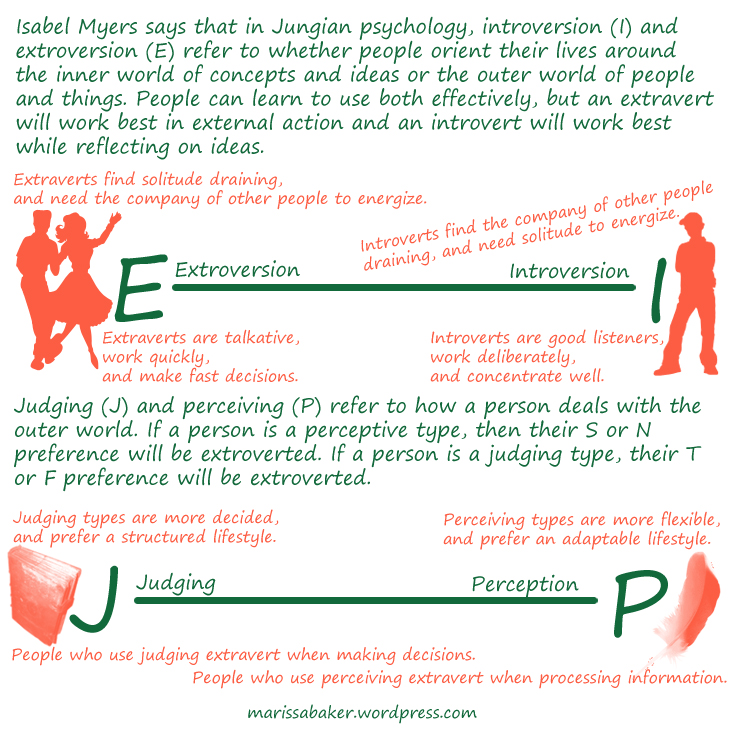
Isabel Myers says that in Jungian psychology, introversion (I) and extroversion (E) refers to whether people orient their lives around the inner world of concepts and ideas or the outer world of people and things. Every healthy person uses both introversion and extroversion, but there will be one with which they are most comfortable. This relates to the Sensing-Intuition and Thinking-Feeling functions by dictating whether a person’s dominant function is introverted or extroverted (more on that in a moment).

So That's What All Those Letters Mean -- An Introduction to the MBTI by marissabaker.wordpress.com

The last letter in a Myers-Briggs type refers to whether a person uses a perceptive (P) or a judging (J) “attitude as a way of life, a method of dealing with the world around us.” People use both a perceiving and a judging function; one extroverted and one introverted. If a person is a perceptive type, then their perceiving preference (S or N) will be extroverted. If a person is a judging type, their judging preference (T or F) will be extroverted.

Since the Judging-Perceiving preference only refers to outer behavior, it most easily observed in Extraverts. For example, an ENFJ will extrovert their judging function and use extroverted feeling (Fe) to interact with the outer world. Because they are an extrovert, this also makes Fe their dominant function. It is supported by an auxiliary perceiving function: introverted intuition (Ni). Dominant and auxiliary functions are a bit more complicated for introverts. An ISTP type will extrovert their perceiving function and use extroverted sensing (Se). However, since they are an introverted type, their dominant function is introverted thinking (Ti) and Se is their auxiliary function . The function they use the most is a judging one, but when they interact with the outer world they use perception.

Putting The Letters Together

It is far too simplistic to take each individual letter in a Myers-Briggs type separately. To say an INFJ is an introvert/intuitive/feeler/judger misses what the MBTI can tell us about how they look at the world with Ni and how they formulate judgements with Fe, and which of those they do most easily. It also passes over the fact that introverts sometimes use extroversion and that extraverts sometimes use introversion. That’s why the short Myers-Briggs style tests you might find online that line-up descriptions of Extravert-Introvert, Sensing-Intuition, Thinking-Feeling, and Judging-Perceiving and then have people choose which one is most “like them” can be an incorrect assessment of a person’s type.

One other thing to add about Myers-Briggs types is that Isabel Briggs Myers never intended for these types to be used to make people feel “boxed in” to their personality type or to infringe on a person’s right to self-determination. An ENTP, for example has “already exercised this right by preferring E and N and T and P.” Myers-Briggs type is a tool for better understanding who we have already chosen to be, and for learning to relate to and better understand people who think differently than us.

*indicates affiliate links

Learn More …

Introduction To Cognitive Functions: The Learning Processes

Introduction To Cognitive Functions: The Decision-Making Processes

Save