10 Things That INFPs Find Extremely Annoying

Have you ever wondered why something you thought wasn’t a big deal annoyed your INFP friend? Or why you, as an INFP, find certain things other people don’t even seem to notice the most irritating part of your day?

The Myers-Briggs® types are a tool for talking about how our minds work. They describe the mental processes that we use most comfortably, and these “functions” come together in unique ways for each personality type. Because of the special way our brains operate, each personality type has different things that they typically find annoying.

Of course, even if a group of people share a personality type there will still be plenty of individual differences. For example, some INFPs might not have a big problem with people who make assumptions about them or others. In general, though, most INFPs are going to find the 10 things on this list extremely irritating.
10 Things That INFPs Find Extremely Annoying | LikeAnAnchor.com
Photo credit: Mash Babkova via Pexels

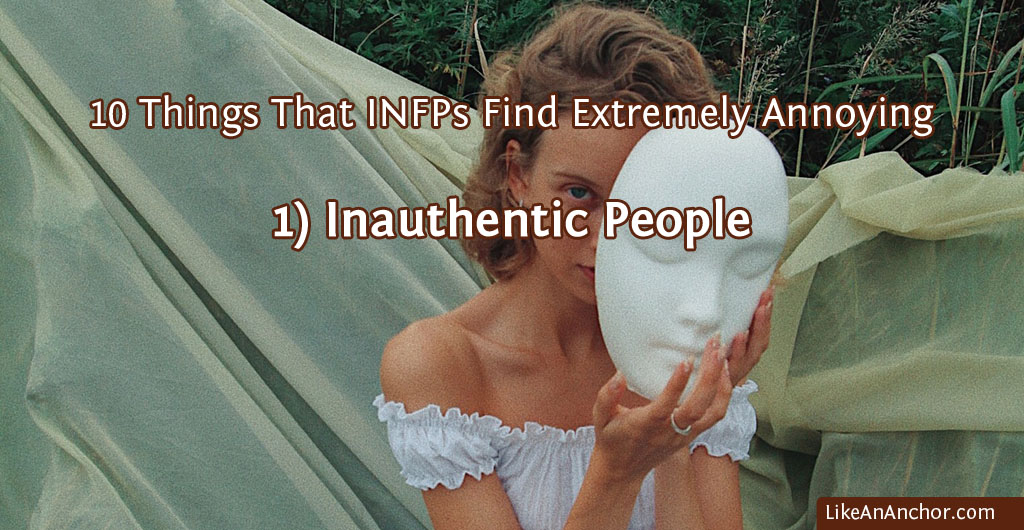
1) Inauthentic People

This is the first point mentioned in a video made by an INFP from the UK titled “Things That Really Annoy INFPs.” It’d be a good video to watch if you’re interested in the subject of this post. Because INFPs place such a high value on authenticity in themselves they also find  a lack of authenticity annoying in others. In fact, Personality Hacker’s nickname for an INFP’s preferred cognitive function of Introverted Feeling is “Authenticity.”

INFPs tend to approach the world from the inside-out (as do introverts in general). One thing I found very interesting about this video is the INFP who made it said that she thinks INFPs are annoyed when they see in other people things that they fear or don’t like in themselves. It’s not just that INFPs are annoyed with people who are inauthentic and hypocritical (though that’s definitely the case). They’re also annoyed when the inauthenticity of others forces them to confront something inside them that doesn’t match-up with the authentic version of themselves that they want to be. Read more

10 Things That INTPs Find Extremely Annoying

Have you ever noticed that something you thought wasn’t a big deal annoyed your INTP friend? Or maybe you, as an INTP, have realized that you find certain things that don’t seem to bother other people incredibly irritating?

The Myers-Briggs® personality types are a tool for talking about how peoples’ minds work. They describe the mental processes that we use most comfortably, and these “functions” come together in unique ways for each personality type. Because of the special way our brains operate, each type has different things that they typically find annoying.

Of course, even if a group of people share a personality type there will still be plenty of individual differences between them. Some INTPs might, for example, see social norms as a necessary evil rather than something that really annoys them. In general, though, most INTPs are going to find the 10 things on this list extremely irritating.

10 Things That INTPs Find Extremely Annoying | LikeAnAnchor.com
Photo credit: Autri Taheri via Unsplash

1) Beliefs That Don’t Make Sense

INTPs have a deeply rooted desire for things to make sense to them. If they have to spend much time around people who hold beliefs that the INTP thinks are nonsensical it’s going to quickly become annoying. An INTP’s favorite mental function is called Introverted Thinking, and they spend most of their lives honing it to sort new information by what does and doesn’t make sense within their framework for how the world works. While they may delight in pointing out an idea’s logical errors, they’ll still be annoyed by people stubbornly clinging to beliefs that make no logical sense.

10 Things That INTPs Find Extremely Annoying | LikeAnAnchor.com
Photo credit: Free-Photos via Pixabay

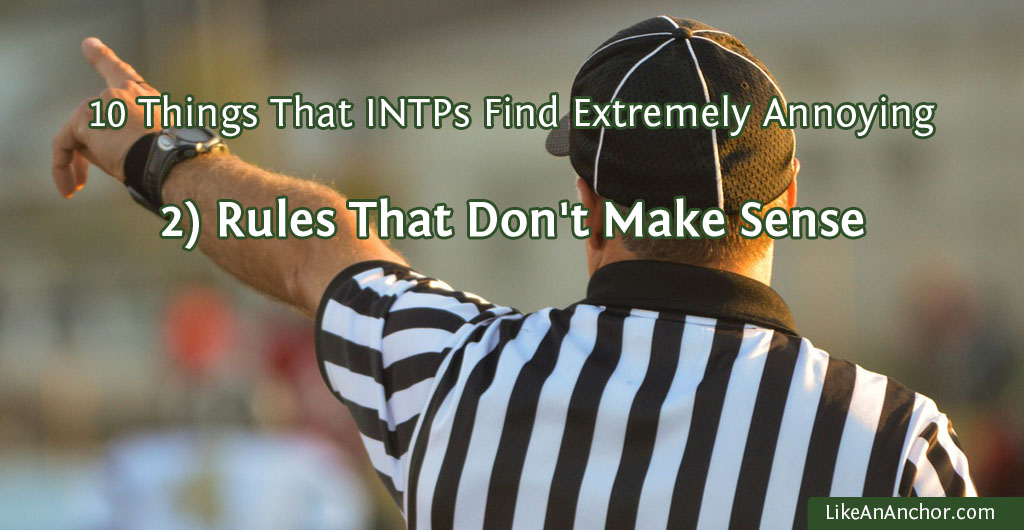
2) Rules That Don’t Make Sense

I imagine INTPs are the sort of people who, as children, asked “Why?” often enough to exasperate every adult they knew. Even as adults, INTPs want to know the reason behind rules, traditions, and social expectations. And if there is no reason (or if the reason is something like, “we’ve just always done it this way”) then don’t expect INTPs to be happy about being told they need to follow those rules. Read more

10 Things That INFJs Find Extremely Annoying

Have you wondered why something you thought was perfectly innocent annoyed your INFJ friend? Or why you, as an INFJ, find certain things that other people either like or don’t care about the most vexing part of your day?

Myers-Briggs® personality types are a tool for talking about how our minds work. It’s a description of the mental processes that we use most comfortably, which come together in unique ways for each personality type. Because of the special way our brains are “hardwired” to function, each type has different things that they typically find annoying.

Of course, even if a group of people share a personality type there are going to be plenty of individual differences between them. Some INFJs might, for example, might have an easy time adapting to change or won’t care that much if someone interrupts them. In general, though, most INFJs are going to find the 10 things on this list extremely irritating.

10 Things That INFJs Find Extremely Annoying | LikeAnAnchor.com
Photo credit: Tim Gouw via Pexels

1) Deceit and Hypocrisy

One of the top reasons INFJs leave relationships or organizations (like churches) is because they get fed up with lying and hypocrisy. I put these two things together because they effect INFJs in very similar ways. Whether someone is directly lying to them or putting on a show of being something they’re not, an INFJ is likely to pick up on on the deceitful attitude quickly. It’s irritating, it breaks trust, and it drives INFJs away from the people who do it. Read more

10 Things That INTJs Find Extremely Annoying

Ever wonder why something you thought was perfectly innocent annoyed your INTJ friend? Or why you, as an INTJ, find certain things that other people don’t worry about the most vexing part of your day?

Our Myers-Briggs® personality types describe how our minds work. It’s a description of the mental processes that we use most comfortably, which come together in unique ways for each personality type. Because of the special way our brains are “hardwired” to function, each type has different things that they typically find very annoying.

Of course, even if a group of people share a personality type there are going to be plenty of individual differences between them. Some INTJs might, for example, enjoy being hugged or not find emotional conversations all that annoying. In general, though, most INTJs will find the 10 things on this list extremely vexing.

10 Things That INTJs Find Extremely Annoying | LikeAnAnchor.com
Photo credit: Pexels via Pixabay

1) Anything Illogical

INTJs approach the outer world using a mental function called Extroverted Thinking. It’s a highly logical way of making decisions and evaluating information. If something doesn’t make sense, can’t be measured, doesn’t work, and isn’t based on impersonal criteria then it’s clearly not the right choice. But other people don’t always see things that way, which can be frustrating and annoying for INTJs.

10 Things That INTJs Find Extremely Annoying | LikeAnAnchor.com
Photo credit: mediamonk via Pixabay

2) Inefficiency They Can’t Fix

INTJs aren’t just interested in arriving at decisions that make sense. They also want to come up with solutions that work long-term. Something that isn’t efficient irritates them as being out of place and ineffective. This annoyance can make them very productive when they’re driven to streamline processes and bring order to chaos. If for some reason they can’t fix the inefficiency, however, it becomes a continual source of annoyance. Read more

No Life for the Wicked: Looking at Redemption in The Rise of Skywalker

As many of you know, I’m an avid Star Wars fan. As such, you can imagine my excitement going to see The Rise of Skywalker last month wearing my ’50s style Anakin-inspired dress. I’ve seen the film twice now, and both times left the theater in tears. I hated the ending, for reasons I’ll discuss in a moment, and found it a heartbreaking, hopeless conclusion to the Skywalker story that I’ve been following my whole life.

Many people love this film and I don’t want to take away from their enjoyment of it or criticize them for disagreeing with me. I’m glad for those who could enjoy it, and saddened that I cannot since it’s the first Star Wars film that I haven’t loved despite whatever flaws it might have. I do, however, want to talk about a choice made regarding one character’s fate. And since I’m a Christian blogger, I want to talk about how much it relates to some Bible scriptures I happened to read the night I saw The Rise of Skywalker for the first time.

Warning: major spoilers follow for Star Wars: The Rise of Skywalker.

Read more

Personality Type Myth-Busting: Is It True That Only Intuitive Can See The Big Picture?

One of the ways that we often talk about the difference between Sensing and Intuitive types in the Myers-Briggs®system is by saying that Intuitives are big-picture thinkers who recognize patterns and think abstractly, while Sensors are detail-oriented thinkers who rely on sensory information and think concretely. Those descriptions are, broadly speaking, true. But it’s also important to note that this does not mean Intuitives always ignore details or that Sensors are incapable of seeing the big picture.

Your Myers-Briggs® personality type describes your preferred mental processes. If you’re an Intuitive type, that means you prefer to take in new information and perceive the world using an Intuitive mental function. Sensing types prefer to use a Sensing function when they’re learning and conceptualizing the world. Intuitives also have access to Sensing and Sensors can also use Intuition, just not as comfortably. (If you’re not familiar with Myers-Briggs® functions or want a quick refresher, click here.)

As with most of my myth-busting posts, this article is basically about not judging people based on stereotypes. Preferring a certain function doesn’t mean you use it exclusively. Having skills in one area doesn’t make you incompetent in others. Personality types describe how our minds work — they don’t limit what we’re capable of. Read more