Focusing On Authority Misses the Point (How Do Women Serve in the Church?)

I recently read a social media discussion centered on the issue of women in ministry. Without going into too much detail, the original post criticized the idea of “women pastors,” and subsequent comments went in the direction of debating whether or not women had any authority roles in the church. As I read these comments, I started feeling uncomfortable. It’s not as if I’m unfamiliar with this topic or I don’t have my own ideas on whether women are “allowed” to teach, speak, pray, prophecy, or lead in churches (one example: my post “Women Who Speak in Scripture”). But the focus on who gets to have authority struck me as wrong. If we focus discussions like this on who is in charge, I think we’re missing one of the New Testament’s big points about how all Christians are supposed to relate to one another.

Jesus’s Take on Authority

Authority is not a bad thing. Jesus taught with authority, used the authority His father gave Him for good (such as to forgive sins), and currently has “all authority in heaven and on earth” (Matt. 7:29; 9:6; 28:18; John 5:27; 10:18). He also clarifies that His authority comes from God–it’s legitimate authority conferred upon Him by the highest authority (John 12:49). As someone with authority, He could and did give His disciples certain authority, such as over unclean spirits (Matt. 10:1).

In these verses, the Greek word translated “authority” is exousia (G1849). Thayer’s dictionary lists several primary meanings: “1. power of choice, liberty of doing as one pleases … 2. physical or mental power … 3. the power of authority (influence) or right (privilege) 4. the power of rule or government.” Like the English word “authority,” it can refer to legitimate, well-wielded authority or it can have a darker side. We see that in a discussion Jesus had with His disciples at least twice: once after James and John asked for authority in His kingdom and once at the Passover when all the disciples debated who would be the greatest after Jesus died.

Now when the other ten heard this, they were angry with the two brothers.  But Jesus called them and said, “You know that the rulers of the Gentiles lord it over them, and those in high positions use their authority over them. It must not be this way among you! Instead whoever wants to be great among you must be your servant, and whoever wants to be first among you must be your slave—just as the Son of Man did not come to be served but to serve, and to give his life as a ransom for many.”

Matthew 20:24-28, NET

 A dispute also started among them over which of them was to be regarded as the greatest. So Jesus said to them, “The kings of the Gentiles lord it over them, and those in authority over them are called ‘benefactors.’ Not so with you; instead the one who is greatest among you must become like the youngest, and the leader like the one who serves. For who is greater, the one who is seated at the table, or the one who serves? Is it not the one who is seated at the table? But I am among you as one who serves.

Luke 22:24-27, NET

“Authority” in these verses is exousia (or it is in Luke 22; Matthew 20 uses katexousiazo, a derivative meaning “to exercise authority, wield power” [G2715, Thayer]). In this case, it’s talking about people among the nations who have worldly authority. The phrase “lord it over” is another word: kurieuo in Luke 22, which means “to be lord of, to rule, have dominion over” (G2961, Thayer) and katakurieu in Matthew, a related word meaning “to bring under one’s power … to hold in subjection to be master of, exercise lordship over” (G2634, Thayer). It’s definitely not a good thing in this context, and Jesus clearly tells his disciples not to act this way. If you want to be great in His church, then you serve.

When I saw people arguing things like, “How dare women try to get authority over men?” or “I can’t stand that only men get authority, why can’t women like me be in charge?” I thought about these verses. There are certain kinds of authority given to people in the church (and legitimate roles instituted by Jesus or those He taught directly, such as apostle, pastor, and deacon), but if we’re concerned about who gets to lord it over other people then we’re missing the point. No one is supposed to be lording it over other people or coveting a position where they could do that. We’re supposed to be humble and focus on service.
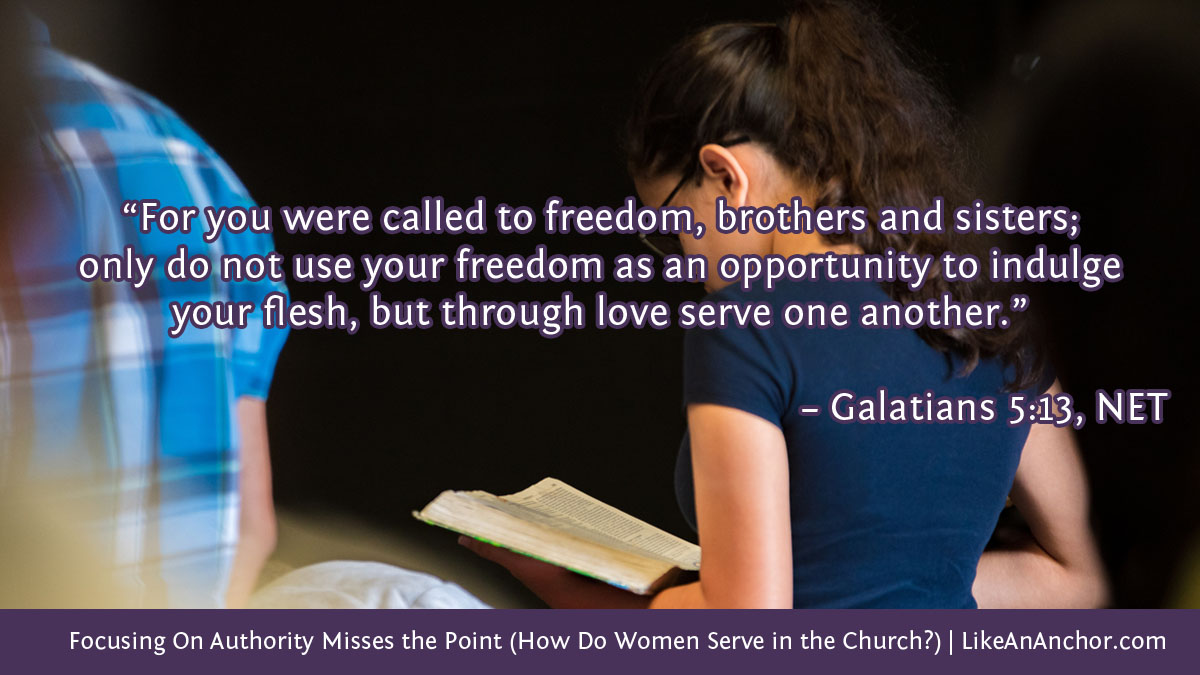
Image of a young woman standing in church reading the Bible overlaid with text from Gal. 5:13, NET version:  “For you were called to freedom, brothers and sisters; only do not use your freedom as an opportunity to indulge your flesh, but through love serve one another.”
Image by José Roberto Roquel from Lightstock

Who Can Serve and How?

Maybe instead of asking, “Can women have authority in the church?” we should ask, “Can women serve in the church?” The answer to that is a resounding “Yes!” supported by the examples of many women in the Old and New Testaments. What gets more to the heart of the original debate, though, is the question, “How do women serve in the church?” We have examples to answer that question as well. We know for certain that women in the Bible served God’s people in these ways:

There may even have been a woman apostle, Junia (Rom. 16:7), but her exact role is so hotly debated that I didn’t put “apostle” on my list (scholars pretty much agree that she was a woman, but not on whether the phrase used in this verse indicates she could have been an apostle). Clearly, women were heavily involved in the church, both in what we think of as “behind the scenes” roles and (apparently more rarely, though female prophets are relatively common) in the more public leading, serving, teaching, preaching roles. When God uses a woman to do something in scripture, we really can’t argue that the church shouldn’t allow women to do those same things today.

Things Women (Probably) Don’t Do

It’s worth noting some of the roles that we don’t see examples of women in. If we look at the lists of ministry gifts/roles in 1 Corinthians 12:28 and Ephesians 4:11, we see “first apostles, second prophets, third teachers, then miracles, gifts of healing, helps, gifts of leadership, different kinds of tongues” (1 Cor. 12:28, NET) and “some as apostles, some as prophets, some as evangelists, and some as pastors and teachers” (Eph. 4:11). Let’s use those lists as a guide for examining women’s possible roles in the church.

We might have one possible example of a woman as an apostle, but no specific examples of them as pastors (from the same Greek word translated “shepherd”) or evangelists (Greek word only used 3 times). However, “evangelist” is a title that comes from the Greek verb euaggelizo (G2097), “to bring good news” or preach the gospel (Thayer). It is likely that women did participate in that activity (Acts 8:1-4; Phil 4:2-3). We also don’t have specific examples of women performing miracles or healings. But we know for certain that women can be prophets, that women teach even if not called “teacher” as a title, that they fill helper roles, that they can have leadership-related gifts, and that those at Pentecost spoke in different languages just like the apostles and other men (Acts 1:14; 2:1-4).

It seems, then, that we can say women did not serve as pastors/shepherds in the Bible and that they were not typically apostles or evangelists. The only other church “authority” roles I can think of in the New Testament are elder, bishop/overseer, and deacon/servant. We have a concrete example of a woman as a deaconess/servant, but no women in the overseer role. “Elder” seems to refer to men most of the time, but the feminine version of the Greek word is used in 1 Tim. 5:2. I suspect that when “elder” is used to refer to respected older people in the church it often includes men and women, but when it’s used to refer to an ordained role in the church it typically or exclusively refers to men. That said, we also don’t have any verses directly saying, “women cannot be pastors.”

You might be uncomfortable with how ambiguous I’m being here, but it is deliberate. The need to have hard rules defining what women and men can and cannot do is a product of Western cultural mindset being applied to the Biblical text. We want specific and inflexible rules for things, but Eastern cultures (like those of Biblical writers) see rules differently: “rules apply except when the one in charge says otherwise. Westerners might consider this arbitrary; many non-Western Christians consider this grace” (Misreading Scripture With Western Eyes, Richards & O’Brien, p. 174). As an example, one of the authors of this book recounts a time when he was invited to speak to a group of pastors in Indonesia. He was shocked, knowing the group’s bylaws say pastors must be male, to see a few women in the audience. When he asked about it, he was calmly told, “Yes, and most of them are [male]” (p. 169). The Indonesian man he spoke with saw nothing strange about an exception to the rule. Perhaps Christians at the time Paul wrote Romans would have heard us say, “Women can’t be apostles,” and responded by saying, “That’s right, except for the times when they are apostles.”
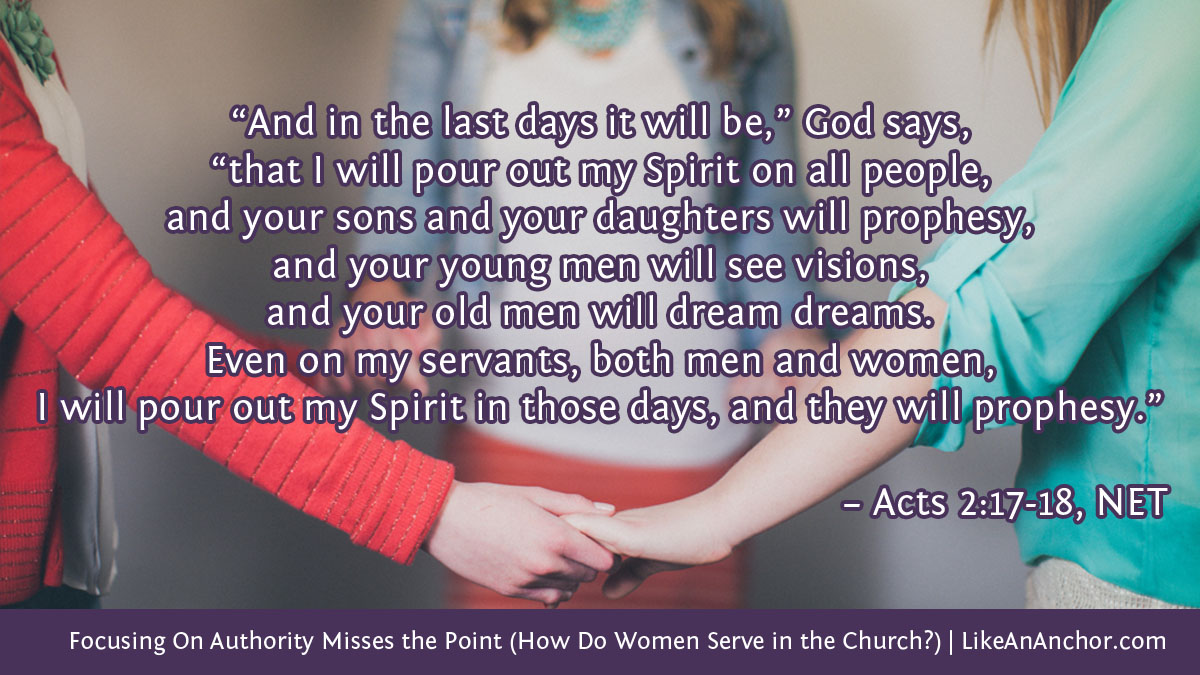
Image of three women holding hands to form a circle and pray, overlaid with text from Acts 2:17-18, NET version: “And in the last days it will be,” God says, “that I will pour out my Spirit on all people, and your sons and your daughters will prophesy,
and your young men will see visions, and your old men will dream dreams. Even on my servants, both men and women, I will pour out my Spirit in those days, and they will prophesy.”
Image by Pearl from Lightstock

But What About 1 Timothy 2?

Because we’ve been talking about authority, we need to address 1 Timothy 2:12, where Paul wrote, “I don’t permit a woman to teach, nor to exercise authority over a man” (WEB). Seems straightforward enough, until we start looking at the context and Greek words. Paul doesn’t use any of the typical words for authority here, but rather the incredibly rare word authenteō. This word may refer to wrongly used authority and/or could be connected to astrology practiced by some pagan women at the time, but it’s hard to say for sure since this is the only time it’s used in the Bible and it’s rarely used in contemporary writings (“The Strangeness of 1 Timothy 2:12,” Andrew Bartlett). Paul also uses a different phrase, “I don’t permit,” than he typically uses when laying down rules for the churches.

We also should take note of the fact that Timothy was in Ephesus when he received this letter, a church that Paul specifically brought Priscilla and Aquilla into and where he left them to serve (including teaching Apollos when they arrived [Acts 18:18-28]). It makes a whole lot more sense to interpret this as a prohibition against women usurping (KJV), dominating (ASV), or lording it over (TLB) a man (note that “man” is singular in the Greek, not the plural “men”) rather than a general rule that women never speak or have any authority, particularly given how involved some women were in ministry in the New Testament.

This analysis might seem pedantic or as if we’re trying to “get around” this scripture, but when you come across something in Paul’s writings that is hard to understand (and a lot of things are [2 Pet. 3:16-17]) we need to look at how it fits with the rest of scripture. Our interpretation of what he says has to match other things in the Bible. In this case, if scripture shows women consistently involved in various types of ministry work–including, occasionally, what we’d think of as “authority” roles like prophet or church host–then Paul’s words here can’t be a prohibition on women serving in the body of believers. It would go against precedent in the entire Bible–including Jesus’s radical treatment of women as equals and Paul’s own writings about how God views converted men and women on a cosmic scale (1 Cor. 11:11-12; Gal. 3:28)–if Paul were making a blanket declaration against women serving in the church. It is much more likely that he is telling Timothy not to let women in Ephesus do things that men wouldn’t be allowed to do either (e.g. lord it over others in the church or teach things related to astrology).

It seems very strange to me that we pull out a few isolated phrases Paul uses (1 Cor. 11:3; 14:34; 1 Tim. 2:12) and come up with this whole doctrine that women can’t ever teach, speak, or have public roles in the church. What about the whole rest of the Bible? What about how Jesus treated women? It seems just as misguided to me as those who take Paul’s statement, “you are not under law but under grace” (Rom. 6:14, NET) to mean that New Covenant Christians don’t have to obey God. We need to be careful about things like this, and test our assumptions (even if they’ve been assumptions for centuries of church history) to make sure they actually fit what God teaches through His word.

Motivated by Service and Humility
Image of two clasped hands, overlaid with blog's title text and the words, "When God uses a woman to do something in scripture, we really can't argue that the church shouldn't allow women to do those same things today. It’s not about who has authority; it’s about serving where God wants us to."
Image by Anggie from Lightstock

As we look at the roles we see women in the Bible filling or not filling, we need to be careful how we conceptualize authority related to those roles. The point isn’t to figure out who is most important (e.g. is it the male pastor or the female prophet?) but to serve God with the gifts He provides in the role He supplies. If God calls a woman to host the church in her home, that’s what she does. If He gives a woman the gift of prophecy, then she’s supposed to prophecy.

Likewise, if He chooses not to place women in the role of ordained pastor, elder, or overseer, that is God’s choice and the New Testament makes it seem like this is indeed the case (at least most of the time). Most men don’t fill those roles either; other roles are more commonly needed in the church. We’re not supposed to be jealous of or resent people who have roles that we think of as more authoritative than us any more than Jesus resents His Father for being greater than Him (to be clear, there is no resentment or competition between Jesus and the Father [John 10:29-30; Phil. 2:5-11]).

 Instead of being motivated by selfish ambition or vanity, each of you should, in humility, be moved to treat one another as more important than yourself. Each of you should be concerned not only about your own interests, but about the interests of others as well. You should have the same attitude toward one another that Christ Jesus had,

who though he existed in the form of God
did not regard equality with God
as something to be grasped,
but emptied himself
by taking on the form of a slave

Philippians 2:3-7, NET

No one in God’s church is supposed to seek authority roles for the prestige or the power. We should seek to serve with humility, the same way that Jesus modeled. In a healthy church following God’s lead, we’ll filter into the roles most suited to the gifts He has given us (ideally without doctrinal misinterpretation or other people’s “selfish ambition or vanity” blocking someone from what they’re supposed to be doing). It doesn’t always work that way because the church is composed of people–redeemed people working on becoming more like God, but still people who can make mistakes. We need to have patience with each other in that. For example, it is not wrong for me to want churches I’m involved with to let me exercise my teaching gifts (and other women to exercise their gifts), but it is wrong when I feel as if I deserve more recognition and responsibility than I get or when I resent other people who have the opportunity to use their gifts differently than I do.

Two of the things that we’re called to do is submit “to one another out of reverence for Christ” (Eph. 5:21, NET) and “through love serve one another” (Gal. 5:13, NET). We’re not called to seek authority or argue about who gets to be in charge. Ultimately, Jesus is the one in charge as head of the church (Eph. 1:22; Col. 1:18). The rest of us are here to serve in a variety of different capacities, but all of them characterized by encouragement, love, and humility (see, for example, John 13:35; 2 Cor. 1:24; Eph. 4:1-3; Col. 3:12-13). If we think any of this is about being in charge, claiming authority over others, or getting what we think we’re owed, then we’ve missed the whole point.


Featured image by Shaun Menary via Lightstock

Song Recommendation: “Way Maker” by Mandisa

5 Ways That We’re Just Like Old Testament Believers

A lot of times, I think we assume that Christianity is a New Testament religion and the Old Testament (OT) is just history or a book that the Jewish people use as their religious text. But if you read a translation of the New Testament (NT) like the New English Translation (NET) that highlights the times when Jesus and the NT writers quote the OT, you’ll see that the believers writing the NT were deeply connected to the OT.

When Jesus died and rose again, He didn’t invent a new religion and name it “Christianity.” He was there as the next step in God’s plan that stretches from Genesis to Revelation and beyond. Our faith is a continuation of what came before. Because of that, we have much more in common with Old Testament believers than we might initially assume. For one thing, we serve the same God. There are some major differences between the Old and New Testaments, but those differences have to do with updates and changes that God made to His relationship with people (and which He prophesied in the OT). God didn’t change, and His basic expectations for people as well as His preferred type of relationship with us didn’t change either.

Image of an open Bible with sunlight shining on it overlaid with text from Romans 15:4, NET version:  “For everything that was written in former times was written for our instruction, so that through endurance and through encouragement of the scriptures we may have hope.”
Image by Lamppost Collective from Lightstock

1) We Are In Covenant With God

If you want to understand how God relates to human beings, you have to study covenants. That’s the structure that God uses for His relationships with people in the Old and New Testaments. They are binding agreements with expectations for both parties. Those expectations–the terms of the relationship agreement, if you will–are established by God. We get to decide if we agree to enter the covenant with Him or not, but we don’t get the option to change how the covenant works.

There are multiple covenants in the OT, but the ones we discuss most often are the Abrahamic Covenant and the Sinai Covenant. The “Old Covenant” usually refers to the Sinai Covenant. The laws given alongside that covenant are part of that covenant agreement, but in many cases also pre-date it (e.g. Noah knew about clean and unclean meats and how to build an altar to Yahweh [Gen. 7:2; 8:20]; Abraham and Jacob knew about tithing [Gen. 14:19-20; 28:20-22]; Joseph knew sleeping with Potiphar’s wife was a sin against God [Gen. 39:7-9]).

Just like us today, Old Testament believers were in covenant with God. Some were in multiple covenants (David, for example, was under the Old Covenant and he received a kingship covenant we call the Davidic Covenant). They couldn’t perfectly keep the covenants, though. God always holds up His side of covenants perfectly, but human beings aren’t that reliable and He knows it. That’s why He promised the Messiah would come, end the Old Covenant, die to free everyone from their sins by taking the penalty for them on Himself, and establish a New Covenant (Jer. 31:31-34; Heb. 8). We’re part of that New Covenant, which was one of the promises contained in the Old Covenant.

2) We Fall Short of God’s Standards

Like Old Covenant believers, the covenant agreement we’ve made with God includes expectations for our behavior and the way we properly relate to Him (Rom. 6; Gal. 5). But we’re human, and we all fall short of God’s perfect standards. The only human being who ever perfectly kept covenant with God is Jesus Christ. We might look back at ancient Israel’s example and think we’d never be as unfaithful and ungrateful as them, but NT writers have some stern warnings against such an assumption.

For I do not want you to be unaware, brothers and sisters, that our fathers … were all drinking from the spiritual rock that followed them, and the rock was Christ. But God was not pleased with most of them, for they were cut down in the wilderness. These things happened as examples for us, so that we will not crave evil things as they did. …  These things happened to them as examples and were written for our instruction, on whom the ends of the ages have come. So let the one who thinks he is standing be careful that he does not fall.

1 Corinthians 10:1, 4-6, 11-12, NET

By and large, Old Covenant believers didn’t have the holy spirit or a personal relationship with God like we do (though there were exceptions, like David). But they weren’t unaware of God’s law or the covenant agreement they made. Two NT writers even go so far as to say they had the gospel preached to them just like we did (Heb. 4:1-2; 1 Pet. 4:5-6). Yet they still fell short. We have the same human tendencies, and we need to be on guard against making the same mistakes. And when we do sin (“miss the mark,” in Hebrew), we need to repent and ask for forgiveness.

Image of an open Bible and notebook overlaid with text from Deut. 10:12-13, WEB version:  “Now, Israel, what does Yahweh your God require of you, but to fear Yahweh your God, to walk in all his ways, to love him, and to serve Yahweh your God with all your heart and with all your soul, to keep Yahweh’s commandments and statutes, which I command you today for your good?”
Image by Alyssa Marie from Lightstock

3) Our Sins Are Purified by Blood

In the Old Covenant, God’s law commanded blood sacrifices of animals to atone for sins. God had very specific requirements for these sacrifices, and they needed to be repeated every time someone became aware of their own sin (see, for example, Leviticus 4:22-35). There was also a yearly sacrifice offered by the high priest on the Day of Atonement (Yom Kippur) to cleanse the people. God promised that if they did these things as commanded, “You shall be clean from all your sins before Yahweh” (Lev. 16:30, WEB).

The writer of Hebrews tells us that those sacrifices were not actually capable of perfecting the people worshiping God in the OT (Heb. 9:9; 10:1). In fact, “it is impossible for the blood of bulls and goats to take away sins” (Heb. 10:4, WEB). That does not mean God was lying when He told OT believers that He would forgive them. It means their forgiveness depended on something other than the animal sacrifices. Some of the OT believers even knew that; David wrote that sacrifices weren’t what God really desired (Ps. 40:6; 51:16-17) and Job knew that the Lord was his redeemer, not sacrificial offerings (Job 19:25-26).

For if the blood of goats and bulls and the ashes of a young cow sprinkled on those who are defiled consecrated them and provided ritual purity, how much more will the blood of Christ, who through the eternal Spirit offered himself without blemish to God, purify our consciences from dead works to worship the living God.

And so he is the mediator of a new covenant, so that those who are called may receive the eternal inheritance he has promised, since he died to set them free from the violations committed under the first covenant.

Hebrews 9:13-15, NET

The NT writers often treat us New Covenant believers as if we were once under the Old Covenant and are now free from it to live under the New Covenant. Paul in particular often talks about us previously living under that Old Covenant law even when he’s writing to Gentiles. He’s including us in the story of the plan of God, like we personally participate in the narrative of making a covenant with God, breaking it, needing redemption, being freed from sin by Christ, and entering a New Covenant with Him (e.g. Rom. 7:1-6). This connects us with the whole plan of God, and indicates that those who died in faith before Christ’s sacrifice are also set “free from the violations committed under the first covenant” by His redemptive work even though it happened after they’d lived and died.

But when this priest had offered one sacrifice for sins for all time, he sat down at the right hand of God, where he is now waiting until his enemies are made a footstool for his feet. For by one offering he has perfected for all time those who are made holy.

Hebrews 10:12-14, NET (italics mark allusion to Ps 110:1)

In Greek, “for all time” is translated from the phrase eis to dianekes. Eis (G1519) is a preposition meaning “into, unto, to, towards, for, among” (Thayer). To is the definite article (i.e. “the,” not always translated because Greek uses it more often than English). Dianekes (G1336) is an adjective meaning “continuously, continuous” (Thayer). The phrase only appears in Hebrews 10:12, 14 and it highlights that Jesus’s sacrifice is “continual, perpetual, protracted” (Zodhiates). Most certainly it covers from Jesus sacrifice onward into the future, but His sacrifice also covered those in the past to whom God had promised forgiveness.

4) We’re Called Out to be Different

We’re likely familiar with the New Testament instruction that Christians should be different from the world around us. We’re supposed to stand out like lights in a world of darkness (Matt. 5:13-16; Phil. 2:15). We’ve been chosen by God to belong to Him, to be different from the world, and to be visible examples of His way of life.

But you are a chosen racea royal priesthooda holy nationa people of his own, so that you may proclaim the virtues of the one who called you out of darkness into his marvelous light. You once were not a people, but now you are God’s people. You were shown no mercy, but now you have received mercy.

1 Peter 2:9-10, NET

The NET Bible marks allusions to OT passages with italics and direct quotes with bold italics. Here, Peter uses “various allusions and quotations from Exod 19:5-623:22 (LXX); Isa 43:20-21; and Mal 3:17” and quotes “from Hos 1:6, 9; 2:23” (NET footnotes). He’s making the point that New Covenant believers are called out as God’s special people who belong to Him, and he’s doing that using Old Testament passages like this one:

For you are a holy people to Yahweh your God. Yahweh your God has chosen you to be a people for his own possession, above all peoples who are on the face of the earth.

Deuteronomy 7:6, WEB

In addition to being chosen as God’s own special people, OT believers were also intended to shine as lights in the world. The OT just uses different phrasing to make that point.

Behold, I have taught you statutes and ordinances, even as Yahweh my God commanded me, that you should do so in the middle of the land where you go in to possess it. Keep therefore and do them; for this is your wisdom and your understanding in the sight of the peoples who shall hear all these statutes and say, “Surely this great nation is a wise and understanding people.” For what great nation is there that has a god so near to them as Yahweh our God is whenever we call on him? What great nation is there that has statutes and ordinances so righteous as all this law which I set before you today?

Deuteronomy 4:5-8, WEB

People were supposed to be able to look at ancient Israel living in covenant with God and marvel at their wisdom, understanding, and greatness. We see this happening only very occasionally in Israel’s history (the reign of Solomon is the only example I can think of [1 Kings 4:34]). God’s not giving up on this goal, though (Isa. 62:1-2). People should be able to recognize us as God’s people. Jesus specifically says they’ll know we’re His disciples by the love we have for each other, and Paul says the same thing can happen when someone witnesses us prophesying in church (John 13:34-35; 1 Cor. 14:24-25).

5) The Greatest Thing We Can Do

Image of on open Bible with sunlight shining on it, overlaid with blog's title text and the words, "Modern Christians might not think we have much in common with Old Testament believers, but the New Testament writers had a different perspective."
Image by Lamppost Collective from Lightstock

God’s expectation and purpose for us haven’t changed that much since the time of His very first interactions with human beings. Jesus highlights this by pointing back to the Old Covenant when someone asked Him about the greatest commandment.

Now one of the experts in the law came and heard them debating. When he saw that Jesus answered them well, he asked him, “Which commandment is the most important of all?” Jesus answered, “The most important is: ‘Listen, Israel, the Lord our God, the Lord is oneLove the Lord your God with all your heart, with all your soul, with all your mind, and with all your strength.’ The second is: ‘Love your neighbor as yourself.’ There is no other commandment greater than these.” 

The expert in the law said to him, “That is true, Teacher; you are right to say that he is one, and there is no one else besides him. And to love him with all your heart, with all your mind, and with all your strength and to love your neighbor as yourself is more important than all burnt offerings and sacrifices.” When Jesus saw that he had answered thoughtfully, he said to him, “You are not far from the kingdom of God.” Then no one dared any longer to question him.

Mark 12:28-34, NET

The NET footnotes on these verses say they’re quoting Deuteronomy 4:35; 6:4-5; Leviticus 19:18, and Joshua 22:5. Because the expert in the law properly understood these commands from the Old Testament, Jesus told him he wasn’t “far from the kingdom of God.” That kingdom is what we’re striving toward as NT believers. We might not think that looking back to God’s commands from the Old Testament would help with that, but Jesus says that they do.

In the Old Testament and the New, God wants a relationship with human beings. Since the very beginning, He’s been working with groups of people that He chose and called out from the world. He welcomes them into covenant with Him, makes provision for when they fall short of His expectations, purifies them from their sins through sacrifice, and asks them to follow Him with their whole hearts. Many of the things that He asks of us today are the same things He wanted in His relationships with people in the Old Testament. Indeed, one of the reasons for the change of covenant was so that He could get closer to achieving that relationship (Eze. 11:17-20; 36:22-28; Jer. 31:31-34; 2 Cor. 6:16-18). Now, just as back then, He wants to be our God and He wants us to be His people, His sons and daughters.


Featured image by Dakota from Lightstock

Witnesses in the Book of Acts

Last week, in a post titled “Witness,” I walked through a word study of the Greek word martus and its derivatives. One of my readers extended that study with a fascinating comment he shared on Facebook (click here to read it). He pointed out that, like in Greek, the word for “witness” and “martyr” in Arabic are the same and have layers of meaning. He also suggested that the witness-martyr connection may have originated with Stephen being killed after his witness (Acts 6-7).

Today, I’d like to continue our study of “witness” by looking more closely at Acts. I also want to dig into the Hebrew uses of “witness” in the Old Testament at some point, but we closed on a new house last Monday, I have to be moved out of my apartment halfway through next week, and then I’m getting married so time hasn’t been an abundant commodity right now. Hopefully we can keep digging into that in the weeks to come.

If you’re reading this post on the Saturday it went live, then tomorrow is Pentecost. “Witness” is used in connection with that holy day, so coupled with the comment on last week’s post I had two reasons for focusing on the book of Acts in today’s study.

Witnessing to Jesus

The book of Acts picks up near the end of the 40 days that Jesus spent on earth with His disciples after His resurrection. When He ascended to heaven, there were still 10 days left in the 50-day count from the wave sheaf day (first Sunday after Passover) until Pentecost.

While he was with them, he declared, “Do not leave Jerusalem, but wait there for what my Father promised, which you heard about from me. For John baptized with water, but you will be baptized with the Holy Spirit not many days from now.”

So when they had gathered together, they began to ask him, “Lord, is this the time when you are restoring the kingdom to Israel?” He told them, “You are not permitted to know the times or periods that the Father has set by his own authority. But you will receive power when the Holy Spirit has come upon you, and you will be my witnesses in Jerusalem, and in all Judea and Samaria, and to the farthest parts of the earth.” After he had said this, while they were watching, he was lifted up and a cloud hid him from their sight.

Acts 1:4-9, NET

There are a few key things Jesus told them here. First, He told them to stay in Jerusalem for the baptism of the Holy Spirit. Next, He told them they don’t need to (and indeed aren’t permitted to) know the Father’s timeline for His plan. Rather, they’re going to receive power and then act as “my witnesses.”

Being a witness to Jesus was a vital part of this commission. When the disciples “proposed two candidates” to replace Judas Iscariot as a 12th apostle, the key qualification was that he be “one of the men who have accompanied us during all the time the Lord Jesus associated with us, beginning from his baptism by John until the day he was taken up from us—one of these must become a witness of his resurrection together with us” (Acts 1:15-26, NET). In this case, “witness” was very literal. To be counted among the 12 apostles, the chosen man had to be able to give eye-witness testimony to Jesus’s life, death, and resurrection.

Peter’s Pentecost Witness

You can read all about the pivotal Pentecost after Jesus’s resurrection in Acts 2. The Holy Spirit rushed in like a violent wind, settling on each of the gathered believers as tongues of fire. The sound drew a crowd, who marveled at the spirit-filled disciples speaking in all the native languages represented in the crowd. As the crowd wondered what was going on, Peter spoke to the people.

But Peter stood up with the eleven, raised his voice, and addressed them: “You men of Judea and all you who live in Jerusalem, know this and listen carefully to what I say. …

“Men of Israel, listen to these words: Jesus the Nazarene, a man clearly attested to you by God with powerful deeds, wonders, and miraculous signs that God performed among you through him, just as you yourselves know—this man, who was handed over by the predetermined plan and foreknowledge of God, you executed by nailing him to a cross at the hands of Gentiles. But God raised him up, having released him from the pains of death, because it was not possible for him to be held in its power. …

“This Jesus God raised up, and we are all witnesses of it. So then, exalted to the right hand of God, and having received the promise of the Holy Spirit from the Father, he has poured out what you both see and hear. … Therefore let all the house of Israel know beyond a doubt that God has made this Jesus whom you crucified both Lord and Christ.”

Acts 2:14, 22-24, 32-33, 36, NET

I know I said at the beginning that we weren’t going to have time to get into the Old Testament in this post, but I would like to reference one of God’s laws regarding witnesses: “A single witness may not testify against another person for any trespass or sin that he commits. A matter may be legally established only on the testimony of two or three witnesses” (Deut. 19:15, NET).

God set up a system where one witness’s testimony couldn’t be used as the basis for a court case, but if two or three witnesses agreed that meant something significant. Here in Acts, Peter is standing up not as a single eyewitness, but as one of 12 men who defined themselves as witnesses of Jesus’s life, death, and resurrection. And they weren’t the only ones there. As we discussed in our post about “The Women At Pentecost,” it seems there were at least 120 believers gathered–60 times the number of witnesses legally required to treat a matter seriously.

Image of people holding hands as they pray overlaid with text from Acts 4:31, 33, NET version:  “When they had prayed, the place was shaken where they were gathered together. They were all filled with the Holy Spirit, and they spoke the word of God with boldness. ... With great power, the apostles gave their testimony of the resurrection of the Lord Jesus. Great grace was on them all.”
Image by Claudine Chaussé from Lightstock

Stephen’s Witness

As the book of Acts goes on, we see the disciples continuing to share their eye-witness testimony (Acts 3:11-15; 4:33; 5:27-32; 10:34-43; 13:29-31). They spoke to crowds of people, before Jewish courts, and to gentile converts. Later, God added Paul as another apostle and witness (Acts 23:11; 26:16). The single most well-known story of witness in Acts doesn’t come from any of the apostles, though. It comes from a man named Stephen.

Up until this point, the witnesses mentioned in Acts are all numbered among the 12 disciples/apostles. Then here’s Stephen, one of seven men chosen to make sure that both the Greek-speaking and Hebraic widows received support. These seven men “were well-attested” (literally, they received a good witness from others) and full of God’s spirit (Acts 6:1-5, NET).

If you read my book review for Relational Faith, you might remember that the same Greek word translated “faith” is also translated “persuasion” in the context of Aristotle’s Rhetoric. Given that Stephen’s well-spoken words were what people went after him for, I find it interesting that we’re told he was “a man full of faith and of the Holy Spirit.” He’s going to be using his faith as the basis for persuasive rhetoric when he gives his witness before the council.

Now Stephen, full of grace and power, was performing great wonders and miraculous signs among the people. But some men from the Synagogue of the Freedmen (as it was called), both Cyrenians and Alexandrians, as well as some from Cilicia and the province of Asia, stood up and argued with Stephen. Yet they were not able to resist the wisdom and the Spirit with which he spoke.

Acts 6:8-10, NET

These people couldn’t handle the fact that Stephen was speaking so boldly and wisely or that he was so full of God’s power that he was performing wonders and miracles. So they conspired against him, brought him before the council, and even had false witnesses testify against him.

They brought forward false witnesses who said, “This man does not stop saying things against this holy place and the law. For we have heard him saying that Jesus the Nazarene will destroy this place and change the customs that Moses handed down to us.”

Acts 6:14-15, NET

The false witnesses say one thing, and now the high priest invites Stephen to answer the question, “Are these things true?” (Acts 7:1, NET). Stephen replies by summarizing God’s plan in a powerful sermon. He starts with God calling Abraham and making a covenant with him, reminds his listeners of how the Israelites ended up in Egypt, and finally comes to Moses.

When he saw one of them being hurt unfairly, Moses came to his defense and avenged the person who was mistreated by striking down the Egyptian. He thought his own people would understand that God was delivering them through him, but they did not understand.

Acts 7:24-25, NET

The phrasing Stephen uses here is very similar to how John describes Jesus Christ: He came to His own people as savior but most didn’t recognize or receive Him (John 1:10-12). Stephen is going to circle back to this connection as well. He continues with the story of Moses fleeing Egypt, then returning when God told him to lead the people out of slavery. He recaps the Exodus story, then reminds his hearers of a quote they no doubt recognized: “This is the Moses who said to the Israelites, ‘God will raise up for you a prophet like me from among your brothers” (Acts 7:37, quoting Deut. 18:15).

As Stephen continues, he reminds his listeners that despite the powerful Exodus deliverance, their ancestors didn’t faithfully obey God. They even “had the tabernacle of testimony in the wilderness” and they still weren’t faithful (Acts 7:44, NET; “testimony” is the same Greek word as “witness”). At this point, Stephen shifts from history to explication. He reminds the people that even though “Solomon built a house for him … the Most High does not live in houses made by human hands” (Acts 7:47-48, NET). And just like their ancestors tried to put God in a box and go about their lives without really following him, so Stephen’s listeners are doing by rejecting Jesus as the Messiah.

“You stubborn people, with uncircumcised hearts and ears! You are always resisting the Holy Spirit, like your ancestors did! Which of the prophets did your ancestors not persecute? They killed those who foretold long ago the coming of the Righteous One, whose betrayers and murderers you have now become! You received the law by decrees given by angels, but you did not obey it.”

When they heard these things, they became furious and ground their teeth at him. 

But Stephen, full of the Holy Spirit, looked intently toward heaven and saw the glory of God, and Jesus standing at the right hand of God. “Look!” he said. “I see the heavens opened, and the Son of Man standing at the right hand of God!” 

But they covered their ears, shouting out with a loud voice, and rushed at him with one intent.  When they had driven him out of the city, they began to stone him, and the witnesses laid their cloaks at the feet of a young man named Saul. 

They continued to stone Stephen while he prayed, “Lord Jesus, receive my spirit!”  Then he fell to his knees and cried out with a loud voice, “Lord, do not hold this sin against them!” When he had said this, he died. 

Acts 7:51-60, NET

The false witnesses claimed that Stephen was preaching against the temple and the law, saying Jesus would change Moses’s commands. Stephen says no, what’s actually happening is that his accusers were rejecting salvation and God’s sovereignty just as Israel did in the past when they rejected Moses and refused to stay faithful to God. What a powerful, convicting message for Stephen to deliver. What an incredible gift for him to be able to witness “the glory of God, and Jesus standing at the right hand of God.” And what violent, hideous backlash when his true witness exposed not only the lies of the false witnesses but the hypocrisy of every Jewish person who claimed to know God yet rejected Jesus.

An Example for Us

Image of a man praying with an open Bible with the blog's title text and the words "In the book of Acts, we see examples 
of Jesus’s followers acting as witnesses to His life, death, resurrection, and teachings. What can we learn from that example today?"
Image by Jantanee from Lightstock

When I read Stephen’s story, I can’t help but think of Jesus’s words when His disciples asked Him about the signs of the end times.

“You must watch out for yourselves. You will be handed over to councils and beaten in the synagogues. You will stand before governors and kings because of me, as a witness to them. First the gospel must be preached to all nations. When they arrest you and hand you over for trial, do not worry about what to speak. But say whatever is given you at that time, for it is not you speaking, but the Holy Spirit. Brother will hand over brother to death, and a father his child. Children will rise against parents and have them put to death. You will be hated by everyone because of my name. But the one who endures to the end will be saved.” 

Mark 13:9-13, NET

What happened to Stephen was just the first in a long history of this exact thing that Jesus warned about. It’s happened to people throughout history who were dragged before secular and religious courts to answer for their faith. It’s happening today to Christians around the world who are hated and persecuted. And it could happen to us as well.

As sobering and even frightening as this warning is, there is also a key piece of encouragement. Jesus says that if we’re ever in a position where we need to witness the way He talked about in the gospels or the way Stephen did in Acts, we don’t need to worry about what to say. The powerful, eloquent sermon that Stephen preached which was exactly what his listeners needed to hear (though they refused to admit it) didn’t just come from Stephen; it was a product of the Holy Spirit inside him. We who follow God faithfully have that same spirit today and we can also trust that Jesus will help us and guide us in whatever circumstances that we’re called to witness about Him.


Featured image by WhoisliketheLord Studio from Lightstock

Song Recommendation: “I Refuse” by Josh Wilson

Witness

What does “witness” mean for Christians?

Most of my life has been spent in churches that don’t talk much about witnessing or sharing your testimony. I remember thinking it was so strange the first time I was in a congregation where they paused halfway through the service for people to talk about what God had done in their lives the previous week. It was strange, but also encouraging to hear how God protected, blessed, and answered prayers.

When I started attending a Messianic congregation, sharing your witness seemed a part of many people’s everyday lives. If someone had a testimony to share, there was time during most services to do that. Sometimes, those testimonies were about opportunities someone had during the week to pray with a police officer, share their faith with a neighbor, or a similar encounter. I liked hearing these stories, and it seemed a good thing to include in church.

At that point, I started to wonder why we don’t do this in my other congregations. So I asked. It seemed the consensus was that we should share the work that God is doing in our lives, but the middle of church services isn’t the place to do that; it disrupts the format and, depending on the person sharing, it can take quite a bit of time. We should share in conversations, people said, rather than as part of the service. And this seemed a reasonable response, particularly since there were a few times when the congregations I attended that did offer time to share your testimony had to take the mic away from someone and get things back on track.

After pondering the question, it seemed these were just two different ways of doing something. One didn’t seem better or worse than the other; rather, it came down to how the leadership in that congregation decided to manage church service format. I’m ashamed to say I’d never thought to study into this topic in all the years I’ve been noticing the different ways people talk about witness/testimony. I’m only just now looking into it after hearing someone say that “witness” in the New Testament is translated from a noun (person, place, or thing) rather than a verb (action). I’d been studying and teaching English grammar at the time, and it made me curious about how the word is used.

Image of a man reading the Bible overlaid with text from 2 Tim. 1:6-8, NET version:  “Because of this I remind you to rekindle God’s gift that you possess through the laying on of my hands. For God did not give us a Spirit of fear but of power and love and 
self-control. So do not be ashamed of the testimony about our Lord or of me, a prisoner for his sake, but by God’s power accept your share of suffering for the gospel.”
Image by Creative Clicks Photography from Lightstock

Background Definitions

When you think about Christian witness today, you probably think about things like telling the person next to you on the airplane about Jesus, or about the people who go door-to-door and leave books and pamphlets about their churches. You might also think about living your life as a witness or about the type of testimony-sharing I talked about in the introduction to this post. If you do a Google search for “what does Christian witness mean” you get results like this:

  • “For Christians, witnessing is sharing your personal experience with Jesus.” (Jesus Film Project)
  • “To be a witness to Christ is to demonstrate by our words, actions and attitude the sacred mystery that we have ‘seen’, heard and believe in our hearts about the Lord who has forgiven us of our sins and offered us eternal life.” (Diocese of Bridgeport)
  • “as Christians, we are called to be witnesses for Christ who present a testimony about the truth that we have experienced and heard.” (Raising Everyday Disciples)
  • “Christian witnessing is merely sharing our heartfelt faith in Christ – what He’s personally done to change our individual lives! We’re not called to argue or debate anyone into heaven. We’re merely called to share!” (All About GOD).

There are several things emphasized in definitions like this. Christians are described as “witnesses to Christ” (noun) who engaged in the act of witnessing (verb) by sharing their experiences and faith. If you read the full articles linked, you’d see several link this idea to courtroom witnesses who testify (which is why you’ll also hear people talk about giving their Christian testimony).

That same Google search also turned up an article from Olive Tree Blog, where they walk through a word study on the Greek word translated “witness” using the Olive Tree app. In Greek, the word is martus. It is translated “witness,” “martyr,” or “record.” Which is kind of surprising, since in English we think of a witness and a martyr as two completely different things. If they’re the same, though, that indicates a much more serious and involved thing than “merely sharing our heartfelt faith in Christ.”

A Linguistic Rabbit Hole

As I mentioned, I started this study after hearing that “witness” in the Bible is translated from a noun (person, place, or thing) rather than a verb (action). That led me down a rabbit hole as linguistically complicated as the grammar class I had to take as part of my master’s in rhetoric and writing degree.

In Greek, the root word for “witness” is a noun. Other nouns derive from that, such as the ones for “false witness” and masculine and feminine forms of “witness.” It’s also the root for several verbs, including “to be a witness,” “to testify emphatically,” and “to witness against.” I had to draw a chart to keep them all straight, and so I decided to make a more polished version to share here and hopefully help you visualize these related words as well.

The image shows a mind map chart showing the Greek word "martus" (Strong's number G3144) and related derivative words.

Part of the reason there are so many is because Strong’s numbering system treats different genders of the same noun as separate words, but it’s also because there are so many variations of the word forms. In English, for example, we have “false” and “witness” as separate words, but in Greek they’re a compound word, “falsewitness” and so that gets its own number.

That was a very meandering way to answer the question, “Are there Greek verbs for the word ‘witness’?” And the short version of the answer is, yes there are. But the context for the statement that prompted this study is that Christians are told in the Bible to “be a witness” rather than to go around “witnessing.” I still want to dive into that topic a little more, because depending on how the noun and verb forms of “witness” are used, that statement could still be correct.

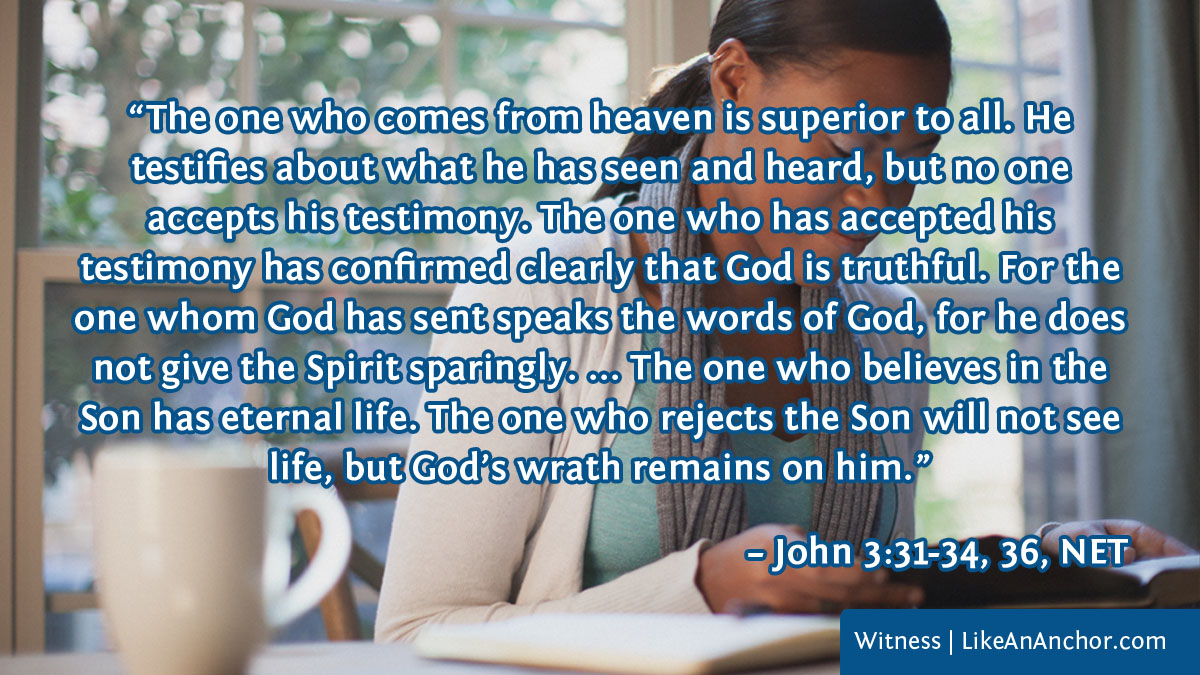
Image of a woman reading the Bible overlaid with text from John 3:31-34, 36, NET version:  “The one who comes from heaven is superior to all. He
testifies about what he has seen and heard, but no one 
accepts his testimony. The one who has accepted his 
testimony has confirmed clearly that God is truthful. For the one whom God has sent speaks the words of God, for he does not give the Spirit sparingly. ... The one who believes in the Son has eternal life. The one who rejects the Son will not see life, but God’s wrath remains on him.”
Image by Pearl from Lightstock

A Witness (noun)

The noun forms of martus and its derivatives are used 97 times in the New Testament (eSword search of KJV+Strong’s numbers for G3141, G3142, G3144, G5571, and G5575). Obviously that’s too many to go through them all individually, but here’s a summary of how martus is used in its noun forms (excluding “false witnesses” since I want to focus on understanding what we’re supposed to do):

Though I sorted these into bullet points, there’s a lot of overlap. It’s often hard to tell if the writer is talking about followers of Jesus sharing the gospel or of receiving Jesus’s testimony (e.g. ” When he opened the fifth seal, I saw underneath the altar the souls of those who had been killed for the Word of God, and for the testimony of the Lamb which they had” [Rev 6:9]). John the Baptist indicates that Jesus’s testimony is something that we receive from Him; he said, “The one who has accepted his testimony has confirmed clearly that God is truthful” (John 3:33, NET). In Revelation especially, witness/testimony is spoken of as something that we have.

We also have verses explicitly linking “the testimony of our Lord” with “the Good News” or “gospel” (Matt. 24:14; 2 Tim. 1:8, WEB). If you go through all the uses of these martus-linked words, you’ll notice they’re often used in connection to Jesus. “Faithful and True Witness” is even one of Jesus’s titles (Rev. 1:15; 3:14). The focus when using these words is often on “the testimony of Jesus” or the “witness of the Lord.” If you’re going to act as a witness in the Christian sense, you’re talking about your first-hand experiences with Jesus. If you’re going to share the testimony of the Lord, you’re passing on the Good News that He brought.

Stephen’s and Paul’s story also help illustrate the many ways “witness” can be used. During the sermon he preached, Stephen linked the word witness with the tabernacle, saying, “Our fathers had the tabernacle of the testimony in the wilderness” (Acts 7:44, WEB). The legal witnesses against Stephen, who stoned him, laid their cloaks down at Paul’s feet (Acts 7:58). Later, God calls Paul and sends Ananias to say, “you will be a witness for him [Jesus] to all men of what you have seen and heard” (Acts 22:15, WEB). Paul reminds God that, “When the blood of Stephen, your witness, was shed, I also was standing by, and consenting to his death, and guarding the cloaks of those who killed him” (Acts 22:20, WEB), but God still chose Paul to share “testimony concerning me” (Acts 22: 18, WEB). Just in this one story, we have witness in the legal sense, in a holy sense linked with the tabernacle where God’s presence appeared, and in reference to someone called to act as a witness sharing the testimony of Jesus.

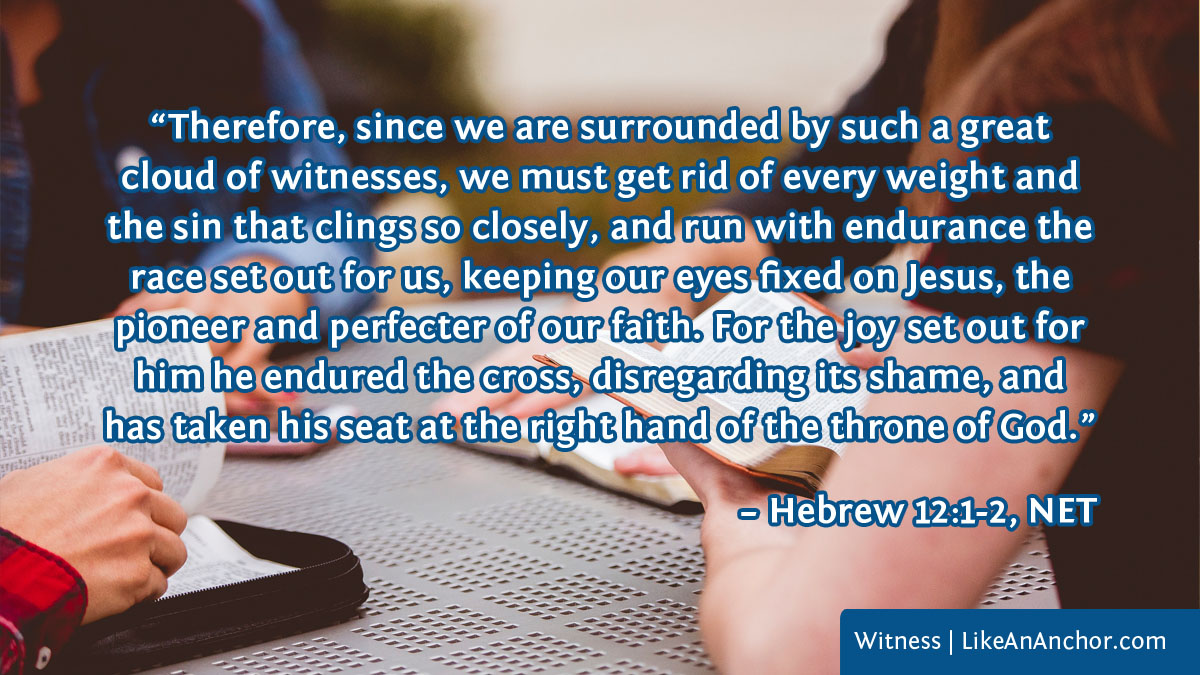
Image of four people studying the Bible overlaid with text from Heb. 12:1-2, NET version:  “Therefore, since we are surrounded by such a great cloud of witnesses, we must get rid of every weight and the sin that clings so closely, and run with endurance the race set out for us, keeping our eyes fixed on Jesus, the pioneer and perfecter of our faith. For the joy set out for him he endured the cross, disregarding its shame, and has taken his seat at the right hand of the throne of God.”
Image by Ben White from Lightstock

Witnessing (verb)

The verb forms of martus and its derivatives are used 98 times in the New Testament (eSword search of KJV+Strong’s numbers for G1957, G2649, G3140, G3143, G4828, G4901, and G5576). Here’s a summary of the ways it appears as a verb in the New Testament:

Witnessing is something that people do. It’s linked with teaching and sharing God’s words, but more often it’s connected to witnessing about Jesus. Also, if you cross-reference the noun and verb lists, you’ll see that there’s a lot of overlap. For example, our conscience has a testimony (2 Cor. 1:12) and our conscience/spirit can testify (Rom. 2:15; 8:16; 9:1). There was a lot of emphasis on being a witness of Jesus and having His testimony in the noun verses, and now here in the verb verses we see Jesus testifying and people witnessing about Jesus. Nothing really shocking here; it works a lot like the noun and verb forms of witness or testimony/testify in English.

What I would like to make note of here is the way testify/witness is used in Hebrews 11. This section on faith opens with these words: “Now faith is assurance of things hoped for, proof of things not seen. For by this, the elders obtained testimony” (Heb. 11:1-2, WEB). “Obtained testimony” is translated from one word, martureo. As we go through the chapter, we see that the faithful actions people took gave testimony about them.

By faith, Abel offered to God a more excellent sacrifice than Cain, through which he had testimony given to him that he was righteous, God testifying with respect to his gifts; and through it he, being dead, still speaks.

By faith, Enoch was taken away, so that he wouldn’t see death, and he was not found, because God translated him. For he has had testimony given to him that before his translation he had been well pleasing to God. …

These all, having had testimony given to them through their faith, didn’t receive the promise, God having provided some better thing concerning us, so that apart from us they should not be made perfect.

Therefore let’s also, seeing we are surrounded by so great a cloud of witnesses, lay aside every weight and the sin which so easily entangles us, and let’s run with perseverance the race that is set before us, looking to Jesus, the author and perfecter of faith, who for the joy that was set before him endured the cross, despising its shame, and has sat down at the right hand of the throne of God.

Hebrews 11:4-5, 39-40; 12:1-2 WEB

When the Bible writers discuss testimony, it’s often in the context of how other people would testify about us and what sort of testimony God would give about our lives. Are we living with integrity? Have we heard and taken seriously the testimony we “hear” from and about Jesus in the scriptures? Does our own conscience testify well of us? Are we prepared to give witness/testimony about Jesus when we can/should?

Wrapping Up

Image of three women talking and holding Bibles, with the blog's title text and the words "What does the New Testament say about “witness” both as something that are are and as something that we do?"
Image by Shaun Menary from Lightstock

Earlier, I mentioned an article about the Greek root word for witness (martus) from the Olive Tree Blog. In this analysis, they show how martus is linked with both seeing and speaking, as well as the course of our lives. I like how that writer sums it up:

From what I gathered from the above verses, we as Christians must:

  1. Open our eyes and martus (see) the workings of God around us.
  2. Open our mouths and martus (attest) the Good News to our neighbor.
  3. Open our hearts to the possibility of becoming a martus (martyr), socially, financially, or physically.
Olive Tree Blog, “What Does it Mean to be Christ’s Witness?”

Interestingly, there aren’t direct commands for Christians in general to go out and witness (though a few people, like the original 12 disciples and Paul are instructed to share the testimony of Jesus). Most of the time, if someone in the New Testament is a witness or they are witnessing, then it’s talking about the apostles who were eye-witnesses of Jesus or it’s Paul.

For those of us who aren’t apostles, we might all be called on to act as a witness or martyr if we’re facing persecution (Luke 21:10-19). We also act as witnesses to each other, attesting to what we’ve seen God do in our lives and showing a positive example of living in the faith. Paul also talks about Christians testifying to the character they see in fellow believers (note that the times when Paul calls on people to witness to other people, it’s in a positive sense rather than testifying against each other).

Circling back to where we began, it seems that I was right that it doesn’t really matter whether we share a witness/testimony with our fellow Christians during formal church services or in personal conversations. The Bible doesn’t come down on that either way. What matters more is that we are involved enough in each others lives to be witnesses to and for each other. We also want to make sure the emphasis stays on God and Jesus when we witness, rather than getting focused on our personal stories. “Witness” in the Bible isn’t sharing your personal story; it’s sharing the testimony of Jesus–the words that He spoke and the Good News that He came to share. I don’t think there’s anything necessarily wrong with sharing your story, but we need to make sure it doesn’t become about us (i.e. it’s not “my testimony” that’s the focus, but “the testimony of our Lord”).


Featured image by Shaun Menary from Lightstock

What’s Up With the Word “Teacher”?

One of the verses in the gospels that puzzles me is in Matthew 23. Here, Jesus instructs His disciples not to call anyone Rabbi, Father, or Teacher. However, Paul later refers to people as teachers in his epistles. I don’t think he would have so blatantly contradicted a command straight from Jesus (that is, I think, one of the chief principals to keep in mind when trying to interpret Paul’s writings). Maybe Paul knew something about this instruction that isn’t readily apparent to us. Let’s start by looking at the context for Jesus’s remarks.

Then Jesus said to the crowds and to his disciples, “The experts in the law and the Pharisees sit on Moses’ seat. Therefore pay attention to what they tell you and do it. But do not do what they do, for they do not practice what they teach. They tie up heavy loads, hard to carry, and put them on men’s shoulders, but they themselves are not willing even to lift a finger to move them. They do all their deeds to be seen by people, for they make their phylacteries wide and their tassels long. They love the place of honor at banquets and the best seats in the synagogues and elaborate greetings in the marketplaces, and to have people call them ‘Rabbi.’ But you are not to be called ‘Rabbi,’ for you have one Teacher and you are all brothers. And call no one your ‘father’ on earth, for you have one Father, who is in heaven. Nor are you to be called ‘teacher,’ for you have one teacher, the Christ. The greatest among you will be your servant.  And whoever exalts himself will be humbled, and whoever humbles himself will be exalted.

Matthew 23:1-12, NET

Reading this, we see the context is instructing us to avoide self-exaltation and not take on yourself titles/honors meant for God the Father and Jesus Christ alone. You are not to be called Rabbi (G4461, rhabbi, the Hebrew word used to refer to Jewish teachers) because Jesus is our Teacher (G2519, kathegetes, master, guide, teacher). You’re not to be called Father (G3962, pater, male ancestor, originator) because God is our Father (this would likely be an interesting study as well, but today we’ll just focus on “teacher”). Then the next verse warns against being called Teacher (kathegetes) again. Finally, this conversation wraps up with a warning against pride and an instruction to humble the self and serve.

Image of two people across from each other at a table with books, overlaid with text from 2 Timothy 2:24-25, NET version:  “And the Lord’s servant must not be quarrelsome but must be kind to everyone, able to teach, not resentful. Opponents must be gently instructed, in the hope that God will grant them repentance leading them to a knowledge of the truth”
Image by Claudine Chaussé from Lightstock

What Type of Teacher Ought You To Be?

Matthew 23 is the only place the word kathegetes appears in scripture. Rabbi doesn’t appear outside the gospel accounts. When we see other writers talking about teachers in the New Testament church, they use a different word. It seems that the New Testament writers were careful about this warning not to be called “rabbi” or “teacher” even though that’s not apparent in the English translations.

The word Paul uses for “teacher” is didaskalos (G1320). It’s a more widely used, general term for “instructor, master, teacher” (Zodhiates, The Complete Word Study Dictionary, entry G2519). While it is listed as a synonym for kathegetes, that word for teacher, master, or guide seems to have more to do with authority; Zodhiates also lists kathegetes as a synonym for lord, master, and overseer (entry G2519).

Both didaskalos and kathegetes are used as a synonym/translation for rhabbi (didaskalos in John 1:38 and kathegetes in Matt. 23:8) (Zodhiates entry G4461). It may be that using “rabbi” as a general Hebrew word for teacher is okay in modern use because it could be synonymous with either of these Greek words. However, Spiros Zodhiates thinks the didaskalos teacher would more commonly be seen in the NT times as an equivalent role to Jewish scribes, who are “acquainted with and interpreters of God’s salvation.” He also considers pastors a sub-set of teachers, and says that teaching can be a gift or an office within the church (entry G1320).

Didaskalos is a role linked with apostles, prophets, pastors, and other roles in the church (Acts 13:1; 1 Cor. 12:28-29; Eph. 4:11; 1 Tim. 2:7; 2 Tim. 1:11). Hebrews implies that all mature Christians should be teachers, though James warns it’s a great deal of responsibility and is paired with stricter judgement (Heb. 5:12; James 3:1). There’s also a very specific focus to this version of teacher and related roles, which links back to Jesus’s warning.

And he himself gave some as apostles, some as prophets, some as evangelists, and some as pastors and teachers, to equip the saints for the work of ministry, that is, to build up the body of Christ, until we all attain to the unity of the faith and of the knowledge of the Son of God—a mature person, attaining to the measure of Christ’s full stature

Ephesians 4:11-13, NET

Remember that when Jesus warned not to be called teachers (kathegetes), it was in the context of not exalting the self or taking His titles for yourself. Here, the role of teachers (didaskalos) has to do with serving and building up the whole body/church. I think that Jesus’s warning in Matthew 23 and the choice of NT writers to use didaskalos to describe their roles has to do with the way authority is supposed to work in the church of God.

Image of an open Bible with the blog's title text and the words, Why does Paul talk about the role of "teachers" in the church when Jesus said not to be called "teacher"?
Image by Lamppost Collective from Lightstock

A dispute also started among them over which of them was to be regarded as the greatest. So Jesus said to them, “The kings of the Gentiles lord it over them, and those in authority over them are called ‘benefactors.’ Not so with you; instead the one who is greatest among you must become like the youngest, and the leader like the one who serves. For who is greater, the one who is seated at the table, or the one who serves? Is it not the one who is seated at the table? But I am among you as one who serves.”

Luke 22:24-27, NET

Jesus didn’t want His followers lording it over people the way that the corrupt Jewish religious authorities did. That’s the main point in Matthew 23–their teachings were solid when they came from the Law of God, but many of the scribes, experts in the law, and Pharisees had a heart issue. They were not right with God and kept the letter rather than the spirit of the law (see the rest of Matt. 23). In contrast, teachers under the authority of Jesus serve the people they teach with humility.

We don’t have different words for “teacher” with different nuances of meaning in our English translations of the Bible. But I think we all have enough experience with people to know the difference between teachers who want recognition and power, and teachers who want their students to learn and thrive. We don’t need to obsess about not calling someone “teacher” (particularly since English doesn’t have two words like we saw in Greek), but we do need to be careful which teachers we listen to and even more careful about the types of teachers we are.


Featured image by Inbetween from Lightstock

Women Who Speak In Scripture

One of the things I hoped for when I began a Master’s degree in Rhetoric and Writing at a Christian-founded university was that I’d get a chance to study some Biblical rhetoric. This semester, I’m taking classes on Classic and Contemporary rhetoric. In one of them, we read texts by women written during the Renaissance where they used rhetorical strategies to prove that women have a role in teaching scripture.

It was both fascinating (and a little discouraging) to read Sor Juana Inés de la Cruz using the exact same arguments to defend her ability to teach the scriptures in 1691 that I’ve used in the 21st century. I agree with her that when Paul calls for women to remain quite in church (1 Cor 14:34; 1Tim 2:12), his “prohibition applied only to public speech from the pulpit” not to writing or even to teaching (The Rhetorical Tradition, 2nd ed., p. 788). It’s absurd to think that Paul meant women should never speak or teach when he also gives instructions for how and when it’s appropriate for women to pray and prophecy in church (1 Cor. 11:1-16) and since he directly instructs women to teach other women (Titus 2:3).

Stepping away from Paul’s writings for a moment, we see examples of women speaking, leading, and teaching throughout scripture. Deborah, the Queen of Sheba, Abigail, Ester, Rahab, and Hannah are all mentioned by de la Cruz, and she could have added Miriam, Ruth, Huldah, Anna, Philip’s daughters, and Priscilla as well. We also read another text in my class from 1666 written by Margaret Fell–one of the earliest Quakers and a highly influential teacher. She points out that there’s no indication in scripture that the apostles despised or rebuked women like Priscilla for teaching (The Rhetorical Tradition, 3rd ed., p. 860). Furthermore, God Himself said that His daughters would prophesy (Acts 2:14-18), so who are human beings to say women should not speak when they’re inspired by the Lord?

Fell also points out something I hadn’t thought of before. Women’s words are recorded throughout scripture and men often base sermons on their words. Fell accused men in the churches of her day of hypocrisy in this area, saying, “you will make a Trade of Women’s words to get money by, and take Texts, and Preach Sermons upon Womens words; and still cry out, Women must not speak, Women must be silent; so you are far from the minds of the Elders of Israel” (The Rhetorical Tradition, 3rd ed., p.865). Even if ministers today aren’t profiting off their work the same way the priests Fell criticizes were, many will still use Biblical women’s words as a sound foundation for teaching while telling modern women not to teach.

Last week, I wrote about a woman from the Bible named Hannah in my post “What Potential Does God See In You?” She’s one of the women whose example and words–including her recorded prayer–are still used to teach people today. God saw her and regarded her with favor though she was initially judged harshly by the priest. And Hannah is far from being the only example of women whom God takes notice of and whom He gives a key role in His plan. Let’s look at some others today.

Huldah

King Josiah was one of the very few righteous kings in the years following David’s reign over Israel. He became king at just eight years old, and when he was 26 he asked his scribe to make sure the priests had the funds needed to repair the temple in Jerusalem (2 Kings 22; 2 Chr. 34). While working in the temple, the priests found a book of the Law. They read it to Josiah, and he tore his clothes in grief when he realized how badly his nation had strayed from following God. He told his advisers, “Go inquire of Yahweh for me, and for the people, and for all Judah, concerning the words of this book that is found.”

So Hilkiah the priest, Ahikam, Achbor, Shaphan, and Asaiah, went to Huldah the prophetess, the wife of Shallum the son of Tikvah, the son of Harhas, keeper of the wardrobe (now she lived in Jerusalem in the second quarter); and they talked with her.

She said to them, “Yahweh the God of Israel says, ‘Tell the man who sent you to me, “Yahweh says, ‘Behold, I will bring evil on this place, and on its inhabitants, even all the words of the book which the king of Judah has read. Because they have forsaken me, and have burned incense to other gods, that they might provoke me to anger with all the work of their hands, therefore my wrath shall be kindled against this place, and it will not be quenched.’” But to the king of Judah, who sent you to inquire of Yahweh, tell him, “Yahweh the God of Israel says, ‘Concerning the words which you have heard, because your heart was tender, and you humbled yourself before Yahweh, when you heard what I spoke against this place, and against its inhabitants, that they should become a desolation and a curse, and have torn your clothes, and wept before me; I also have heard you,’ says Yahweh. ‘Therefore behold, I will gather you to your fathers, and you will be gathered to your grave in peace. Your eyes will not see all the evil which I will bring on this place.’”

2 Kings 22:14-20, WEB

Though this group included the high priest, he didn’t ask God for advice directly. Prophets and priests had different roles–the priests served in the temple and a prophet or prophetess delivered God’s messages to people. At this time, the go-to person for making inquiries of God was a prophetess named Huldah. She delivered God’s message, and King Josiah listened (2 Kings 23:1-30). There was no question of whether or not God could speak through her because she was a woman; He simply did, and that was that.

Priscilla

The first time in the Bible that we hear of Priscilla and her husband Aquilia is when Paul went to Corinth (Acts 18). They were tentmakers like Paul, and so he stayed with them to practice his trade while he preached Jesus Christ. When Paul left, Priscilla and Aquilia went with him to Caesarea. They stayed in that region while Paul went on to preach in Galatia, and they were there in the city of Ephesus when Apollos showed up.

Now a certain Jew named Apollos, an Alexandrian by race, an eloquent man, came to Ephesus. He was mighty in the Scriptures. This man had been instructed in the way of the Lord; and being fervent in spirit, he spoke and taught accurately the things concerning Jesus, although he knew only the baptism of John. He began to speak boldly in the synagogue. But when Priscilla and Aquila heard him, they took him aside, and explained to him the way of God more accurately.

Acts 18:24-26, WEB

Here, both Priscilla and Aquilia explained the way of God. She was teaching alongside her husband. In his letters, Paul sends greetings to them both and describes them as his “fellow workers” (Rom. 16:3-4; 1 Co. 16:19-20; 2 Tim. 4:19). Not once does he tell Priscilla to stay silent or stop teaching and let her husband do all the talking. That’s particularly worth noting because sometimes people will argue that Paul’s instruction for women to be silent applies only to wives (the Greek word could be translated either way), but both Priscilla and Huldah were married when they acted as teacher and prophetess. The more evidence we look at, the clearer it becomes that silence for women is situational (e.g. they shouldn’t disrupt church services, and typically don’t hold public/authority roles in the church).

Thoughts for Further Study

There are so many more examples we could look at. We could go to Exodus 15 where Moses’s sister Miriam is called a prophetess. We could turn to Judges 4-5 and read about Deborah the prophetess, a judge and leader of Israel. We can read in 1 Samuel 25 of how Abigail’s words and actions turned King David away from vengeance. Or we could travel in the New Testament to Luke 2 where Anna the prophetess proclaims Jesus to those looking for redemption. Then we could go to Acts and read about Philip’s four daughters who prophesied. We can also look at the end of Paul’s letter to the Romans and see how many women he mentions helping forward the gospel including Junia, who is “notable among the apostles,” and Phoebe who is “a servant of the church in Cenchrea” (the word translated “servant” is the same as the one translated “deacon” in 1 Tim. 3).

One of the things I appreciated about both Sor Juana’s and Margaret Fell’s writings is that they were careful about how they used scripture. Rather than saying Paul was wrong or that his words could be dismissed as outdated, they argued from scriptures that Paul’s letters were misinterpreted. That misinterpretation led to hundreds of years of women needing to fight for the roles in modern churches which God already gave us in His Bible. Thankfully, women are far more fully involved churches today than they were several centuries ago. Even so, I still occasionally hear things like, “Is it okay for you to have a blog where you’re teaching? Women shouldn’t do that, you know.”

There are ways that God has different roles for men and women to play (see, for example, Paul’s words on how marriage pictures Christ and the church). This includes some differences in how they serve in the church. Women in the Old Testament didn’t serve as priests in the temple, but they did serve as prophetesses and they continued that role into the New Testament. And while we don’t see women spoken of as pastors or church leaders in the New Testament, they are clearly serving in the congregations and sharing the gospel. It makes sense that there’d be plenty of areas where our serving roles overlap. We’re all children of God and we’re all one in Christ Jesus (Gal. 3:26-28). God pours out His spirit on all of us alike, and gives us gifts and roles to serve and build up the church congregations (Acts 2:17; 1 Cor. 12).

Women have always been closely involved in God’s church and in His plan. They prayed, taught, sang, preached, and followed Jesus. In His time here on earth, He interacted with women as equals in a way that shocked His disciples (John 4:27). He included women in the gospel and pointed out that their actions should be recorded (Mark 14:3-9, for example). Women traveled with Him during His ministry, and they’re the ones He appeared to first after His resurrection and entrusted with taking the news to His disciples (click here to read that account across gospels). In Acts, women and men both received the gospel, got baptized, and endured persecutions together (Acts 5:14; 8:3, 12; 9:1-2; 17:4, 12). God even uses feminine imagery for the church as a whole, calling it calling it a Bride fully involved in serving alongside her Bridegroom, Jesus Christ. He doesn’t have a problem with women being fully involved in His church; He thinks it’s a good thing.


Want to study this subject further?

Download my free month-long scripture writing program, “Women Who Speak.”


Featured image by Ben White from Lightstock