The Passover commemorates Jesus’ sacrifice. He told us to continue keeping it in remembrance of Him, and that’s what we did just a couple days ago. And now we’re beginning the holy week following Passover — the Days of Unleavened Bread. It’s the perfect time to reflect on the meaning of His sacrifice.
When Jesus gave His life to save sinners, that was God choosing to die for us. The being John calls “the Word” whom we now know as Jesus was God along with the Father throughout the Old Testament. He gave up that glory to live as a human and sacrificed His life on our behalf; the Creator dying for His creation.
Such a sacrifice as half the original Godhead dying shook the world, both literally and figuratively. In the moment Jesus died the temple veil tore from top to bottom, the earth quaked, rocks split, and dead people rose from their graves (Matt. 27:50-53). And as time passed, the Christian believers learned more about what that moment meant on a spiritual level as well.
Covenants are the basis of God’s relationships with people. In the first covenant, God included a revelation of His laws, statutes, and judgements which Ancient Israel agreed to follow (Ex. 24:7). But the people fell short of the Divine standard and that brought on them a death penalty. Someone had to pay for the broken covenant.
In the Greek language of the New Testament, the word used for “covenant” is the same as “testament.” The writer of Hebrews was inspired to use this comparison in explaining what effect Jesus’ death had on the Old Covenant.
For this reason he is the mediator of a new covenant, since a death has occurred for the redemption of the transgressions that were under the first covenant, that those who have been called may receive the promise of the eternal inheritance. For where a last will and testament is, there must of necessity be the death of him who made it. (Heb. 9:15-16, WEB)
Jesus’ sacrifice paid the penalty for human transgression of the covenant. Since He was the God who made this covenant, His death also ended its claim on our lives. And it made way for a new and better covenant. Read more →
When we start talking about the relationship between God’s law and New Testament Christians, everyone wants to jump right into Paul’s writings. It’s easy to pluck verses from his epistles out of context and use them to argue that God’s law went away along with the Old Covenant and that you don’t have to keep the commandments. But is that really the best explanation for passages like Romans 7 and Colossians 2 in light of the rest of the Bible?
I’ve written quite a bit about Romans but never Colossians, even though some commenters have asked. But a short time ago I was re-reading Paul’s letter to Colossae and felt a nudge in my spirit to “study this” as I read chapter two.
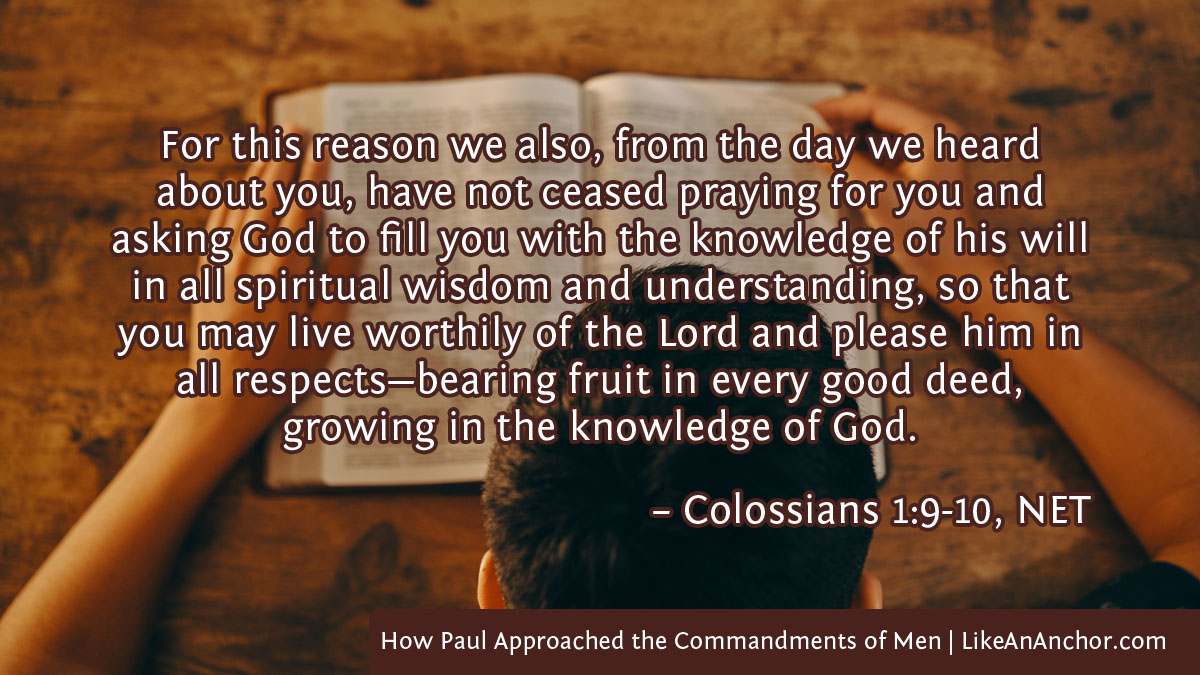
I say this so that no one will deceive you through arguments that sound reasonable. …
Therefore, just as you received Christ Jesus as Lord, continue to live your lives in him, rooted and built up in him and firm in your faith just as you were taught, and overflowing with thankfulness. Be careful not to allow anyone to captivate you through an empty, deceitful philosophy that is according to human traditions and the elemental spirits of the world, and not according to Christ.
Colossians 2:4, 6-8, NET
This verse provides context for what’s to follow. Paul is going to discuss the difference between following traditions invented by men and following Christ. The following scriptures won’t be about whether or not the Old Testament law matters since Jesus came in the flesh. It’s about following Jesus the way Jesus and His Father want us to rather than the way humans come up with.
Image by Matt Vasquez from Lightstock
Jesus’s Take On God’s Law
Before going any farther in Paul’s writings, let’s look at what Jesus says. During His ministry, Jesus and His disciples were accused of things like Sabbath breaking, defiling themselves with sinners’ company, and unclean hygienic practices. We know that Jesus lived a sinless life and never broke His Father’s commands. But He did reject the additions humans made.
He said to them, “Isaiah prophesied correctly about you hypocrites, as it is written:
‘This people honors me with their lips, but their heartis far from me. They worship me in vain, teaching as doctrine the commandments of men.’
Having no regard for the command of God, you hold fast to human tradition.”
Mark 7:6-8, NET (bold italics mark a quotation from Isa 29:13)
He’s not saying to stop following God’s commandments. He’s berating them for elevating their traditions to the same level as God’s law. The leading Jews of the time had things really mixed up. Even when they followed God’s law, they focused on the wrong things, emphasizing minute details and neglecting the “weightier matters.” That’s something Jesus criticized, but He speaks very differently about the law that came directly from God.
“Do not think that I have come to abolish the law or the prophets. I have not come to abolish these things but to fulfill them. I tell you the truth, until heaven and earth pass away not the smallest letter or stroke of a letter will pass from the law until everything takes place. So anyone who breaks one of the least of these commands and teaches others to do so will be called least in the kingdom of heaven, but whoever obeys them and teaches others to do so will be called great in the kingdom of heaven. For I tell you, unless your righteousness goes beyond that of the experts in the law and the Pharisees, you will never enter the kingdom of heaven!”
Matthew 5:17-20, NET
Jesus clearly stated He had no intention of doing away with God’s law. Rather, He was there to fill it to the fullest extent. He also upheld God’s commands when giving practical advice to individuals. When a rich young man came to Jesus and asked, “What shall I do that I may inherit eternal life?” Jesus responded, “keep the commandments.” After the young man said he was already doing that, Jesus told him the only thing still lacking was a commitment to follow Jesus unconditionally (Matt. 19:16-21; Mark 10:17-21; Luke 18:18-22). Keeping God’s commands and following Jesus go hand-in-hand.
Image by MarrCreative from Lightstock
Not Judged For Following Jesus
With that understanding, we can go back to Paul’s writings. Knowing he would never contradict Jesus’s teachings gives us framework for understanding difficult passages like Colossians 2. Here, his focus is on following Jesus rather than human beings. One example Paul uses is the issue of circumcision. There was a faction in the early church that believed new male converts had to be circumcised according to the Abrahamic covenant before they could receive salvation. But that was an aspect of the Old Covenants that pertained to the flesh and didn’t carry over. Rather, the emphasis is now on “circumcision not made with hands” on a spiritual level (Col. 2:11-12, WEB).
Interestingly, the focus on spiritual circumcision was already part of the Old Testament (Deut. 10:16; 30:6; Jer. 4:4). It’s just now brought to the forefront as Jesus fills the law to its fullest. We’re to “serve in newness of the spirit, and not in oldness of the letter” (Rom. 7:6, WEB) now that Christ has taken away our condemnation for breaking the law (Col. 2:14-15).
Therefore do not let anyone judge you with reference to eating or drinking or participation in a feast or a new moon or a Sabbath, which are a shadow of what is to come, but the reality is Christ.
Colossians 2:16-17, LEB
Some take this to mean no one should judge you for rejecting God’s dietary laws and holy day commands. But the focus in this chapter isn’t on moving away from keeping God’s commandments. It’s about following Jesus instead of human beings, and we have direct evidence of Jesus keeping Passover, the Feast of Unleavened Bread, and the Feast of Tabernacles. Also, the holy days weren’t something man came up with; they belong to God. If God tells His people to observe days that belong to Him, Jesus Himself observed them as holy, and His followers continued to do that (see, for example, 1 Cor. 5:6-8; 11:23-26), then one verse in a chapter that talks about rejecting human regulations doesn’t change that.
Follow Jesus. That’s It.
Image by Shaun Menary from Lightstock
We can learn even more about Paul’s intention when writing about feasts and sabbaths by continuing to read his letter. This part comes right after the verse we just looked at that mentions a feast, new moon, or Sabbath.
Let no one who delights in false humility and the worship of angels pass judgment on you. That person goes on at great lengths about what he has supposedly seen, but he is puffed up with empty notions by his fleshly mind.He has not held fast to the head from whom the whole body, supported and knit together through its ligaments and sinews, grows with a growth that is from God.
If you have died with Christ to the elemental spirits of the world, why do you submit to them as though you lived in the world? “Do not handle! Do not taste! Do not touch!” These are all destined to perish with use, founded as they are on human commands and teachings.Even though they have the appearance of wisdom with their self-imposed worship and humility achieved by an unsparing treatment of the body—a wisdom with no true value—they in reality result in fleshly indulgence.
Colossians 2:18-23, NET
Paul states that he’s talking about ordinances that are “human commands and teachings.” He’s not telling us to reject God’s commands! Rather, he’s saying to follow God the way God tells us to follow Him instead of the legalistic worship practices piled on by human beings.
Similarly, when writing to Titus, Paul warned not to pay “attention to Jewish myths and commandments of people who turn away from the truth” (Tit. 1:14, LEB). Instead, Titus was to “say the things which fit sound doctrine” (Tit. 2:1, WEB). The standard for “sound doctrine” is the entirety of scripture, not just the New Testament and cherry-picked parts of the Old (2 Tim. 3:16; Rom. 15:4). Our lives should be characterized by a commitment to follow God the way He commands. The doctrines or traditions of men, whether they take away from or add to the words of God, carry little weight.
There are physical parts of the Old Covenant law (e.g. hygienic practices for an encampment) that don’t apply to us today. There are parts that have been updated under the renewed covenant (e.g. we don’t stone people for death-penalty sins; they can be forgiven in Jesus Christ). But God never changes and the commandments He gave are still guides for helping us understand and develop His character. Obedience matters to God. Just look at how many times in John’s writings that loving and knowing God is linked to keeping His commandments (John 14:21; 15:10; 1 John 2:3-4; 5:2-3; 2 John 1:4-6).
God has never done away with His law or commandments and there’s no indication He’ll do so in the future (note: law is linked with covenants, but it’s not exactly the same thing as the Old Covenant). In fact, the closing parts of Revelation say, “Blessed are those who do his commandments, that they may have the right to the tree of life, and may enter in by the gates into the city” (Rev. 22:14, WEB). The city spoken of in this passage is new Jerusalem, which comes down to earth after the resurrections, Millennium, and final defeat of Satan. If God only intents to fellowship with those who keep His commandments at that point, why would we think He doesn’t want that now?
One of the biggest problems in modern Christianity is an extreme either-or mentality. We lack balance, straying from one ditch to the other. Consider the Christian’s relationship with the Law. Some will say we must keep the whole law slavishly and seek part of our salvation in it (legalism), while others reject it entirely and say God doesn’t care if we keep His commands as long as we have Jesus (license). Both views miss the point.
Most arguments that the Law isn’t relevant today start with Paul. But Paul’s letters contain things “hard to understand” which people who aren’t well-grounded in the entirety of scripture can “twist to their own destruction” (2 Pet. 3:15-16). When we’re going to study a complex subject like this, we have to start somewhere more straight-forward. I can think of nowhere better than words directly from Jesus’ own lips.
Using The Law Rightly
When Jesus came to this earth, He didn’t tell people He was done with the Law. Instead, He said, “I did not come to destroy but to fulfill” (Matt. 5:17). This word, pleroo (G4137), means to fill to the fullest extent. Or, as Thayer’s says, “to cause God’s will (as made known in the law) to be obeyed as it should be, and God’s promises (given through the prophets) to receive fulfillment.” Read more →
My renewed interest in studying covenants started with a Greek dictionary. Typically, I would define covenant as “a binding agreement between two parties,” which is a very basic description of the Hebrew word berith (H1285). For the New Testament, though, Spiros Zodhiates says diatheke (G1242) refers to “the disposition which a person makes of his property in prospect of death, i.e. his testament” and shows “a unilateral demonstration of the will of the testator.”
I’ve always been confused by the discussion about testaments in the book of Hebrews because it didn’t all line-up with my idea of covenants. Do we enter covenant with God as a mutual agreement, or are we benefactors of God’s unilateral will (whether we want it or not)? And how, exactly, do we become partakers of this covenant? After 3 weeks of study, I realized the answer is a little bit of both and that clarity for this question is found in Jesus Christ (that should have been obvious, right?) Read more →
I thought I had a pretty good grasp of covenants. Studying this subject for the past three weeks, though, has taught me the truth of Paul’s words: “if anyone thinks that he knows anything, he knows nothing yet as he ought to know” (1 Cor. 8:2). Covenants are so much deeper, so much more entwined with the plan of God than I’d previously realized. And so I went back to the beginning to review covenants (today’s post) before diving deeper into the subject (next weeks’ posts).
The relationships God establishes are consistently described through scripture as covenants, so to understand how God relates to people we have to study the principles of godly covenants. Hebraic understanding of covenants in the Old Testament forms the basis for understanding what a covenant between God and man involves. We need to understand that before we can even begin to get into the New Testament because Christ’s covenanting work (and the NT writers’ discussions of that) grew out of the covenants recorded in the Old Testament.
Signs of Covenant
If you read anything on covenant history in Biblical times, you’ll learn that covenant agreements involved the establishment of a relationship between two parties, an agreement on terms/promises, and sealing the covenant with some sort of sign. For the covenant with Noah, this sign was a rainbow (Gen 9:13). For most major covenants, though, the sign involved blood. Read more →
Happy New Year! Today is the first day of the Hebrew month Nisan (also called Abib), and the first day of the sacred year on the Hebrew calendar (Rosh Hashana starts the civil year). This means Passover is exactly 14 days away. As we draw nearer this important holy day, I wanted to shift our focus onto why Passover is so important for Christians today.
As I started thinking about reasons to keep Passover, I realized I’d either have to make this a series of posts or be much more concise than the subject deserves. Instead of a series (though there will be other Passover posts coming up), I decided to just write a brief overview of some reason to keep Passover and then invite you to join me in exploring them further. If this post inspires any of you to study Passover, I hope you’ll share your thoughts in the comments. And if you write a blog post about Passover, please share a link here so we can all read it.
Exodus chapter 12 describes the events of the first Passover in Egypt, when the children of Israel were protected from the plague that killed all Egyptian firstborn. After delivering instructions specific to that Passover, the Lord reveals that Passover celebration will continue forever among His people. Read more →







 Like An Anchor