Personality Type Myth-Busting: Does Personality Type Change Over Time?

Whether or not your personality type can change is quite a point of debate in the Myers-Briggs® community. Officially, Myers-Briggs® theory holds that your personality type is inborn and does not change. In other words, you cannot start out as an ISFP and then transform into an ESFJ (or any other types) over the course of your life.

Practically, though, we know that people take personality tests all the time and get different results. It’s one of the big arguments leveled against Myers-Briggs® theory — that the tests don’t deliver consistent results and are therefore not valid, repeatable, or scientific. On top of all that, you might have seen articles about new research over the last few years that indicates your personality can change over your lifetime. How do we make sense of all that in relation to type theory?

Personality Traits vs. Personality Type

On the surface, it seems that Myers-Briggs® disagrees with psychology studies that say personality can and does change. But when you take a closer look, you’ll see there’s not really a disconnect. There’s a big difference between personality traits and personality type. The personality model that most psychologists favor today is called Big Five. It includes five key traits — extroversion, agreeableness, neuroticism, contentiousness, and openness.

Where you fall on these traits can change, though they’re considered relatively stable. When change happens it tends to do so gradually over many years (change is more likely and more rapid when something significantly life-changing occurs, such as  a traumatic experience) . We also tend to be more stable in some traits and less stable in others. You can read more about this in the following articles: Read more

“I Feel There Is Something Missing in Me” — The Wounding Message of Enneagram 4s

I’ve been trying to study the Enneagram for several years now. I’ve read highly recommended books by Helen Palmer, Don Richard Riso, and Russ Hudson but for some reason none of them really made sense. I mean, I got what they were saying and it seemed like a useful system but I didn’t feel like I understood it well enough to actually use it in my life and especially not in relating to other people.

This latest Enneagram book I’ve tried is one that my first counselor recommended over a year ago. I’ve finally been able to get it through a digital library (didn’t want to buy it if it would just sit unused on the shelf like all my other Enneagram books). I haven’t quite finished it yet, but what I’ve read is enough to know The Road Back to You: An Enneagram Journey to Self-Discovery by Ian Morgan Cron and Suzanne Stabile is the best Enneagram book I’ve read (please note this is an affiliate link, which means if you click on the book title and make a purchase I’ll receive a small commission at no additional cost to you).

I’ll be talking in more general terms about the Enneagram in later posts, but today I wanted to share a personal story. I know my enneatype is 4w5, but until now that knowledge as been more depressing than helpful. Myers-Briggs® types tell you how your mind works. We can talk about healthy and unhealthy versions of each type, but overall it’s usually a fairly neutral description. Your Enneagram tells you how you’re broken. It talks about your deadly sin, your childhood wounding message, and your core fears. To me, it seemed overwhelmingly negative. Read more

Great Changes Begin Great Stories

Think about your favorite novel, movie, or TV show. It probably begins with the main characters going about their ordinary lives. Bilbo Baggins lives peacefully in his hobbit hole (The Hobbit). Elizabeth Bennet is socializing with her sisters and putting up with a mother eager to marry her off (Pride and Prejudice). Luke Skywalker is moisture farming on Tatooine (Star Wars). A pastor is sailing with his family to a colony in the South Pacific (The Swiss Family Robinson).

Then Gandalf arrives with a party of dwarves. Mr. Bingley moves to Netherfield. Droids arrive carrying secret plans that must be delivered to the Rebellion. The ship crashes on an uncharted island. Something changes, acting as an inciting incident to push the main character out of their normal life and into the events of the story.

We’re currently living in a time of great change. People are talking about what the “new normal” will look like and speculating about how much things will change now that there’s Covid-19 in the world. There have been many other times of great change throughout history — pandemics, the industrial revolution, natural disasters, colonization by European powers, terrorist attacks, the falls of empires, the birth of Jesus Christ. Some are terrible, some depend on your point of view, and a very few are spectacularly good.

We have very little control over how the world changes. But we do have some control over if and how we change in response to those changes. In many ways, we get to decide whether the effects of this pandemic will be an inciting incident for personal growth, a speed bump as we continue on much the same as before, or something that derails our path.

Great Changes Begin Great Stories | LikeAnAnchor.com
Photo credit: RÜŞTÜ BOZKUŞ via Pixabay

We would not have had a story if Bilbo stayed home, Elizabeth refused to speak with Darcy a second time, Luke didn’t follow R2-D2 into the desert, or the Swiss family had been rescued after only a week on the island. Now, I’m not saying you should ignore social distancing guidelines and go running off on a grand adventure. For us today I’m talking more about an internal adventure and a commitment to positive change.

Some of the greatest journeys we can go on are those of self-discovery, and they’re often prompted by change. The biggest moments that stand-out in my mind as times that sparked personal growth were starting college, beginning a dating relationship with a man I’d been friends with for years, and then the breakup which ended that relationship. Maybe this pandemic will be another one for me, and for many other people.

Whether you’re stuck at home and have some extra time on your hands or not, the changes in the world around us can serve as a reminder to look inwards and evaluate ourselves. We might ask questions like, “What impact am I having on the people around me for good or ill?” or “How can I become a healthier individual mentally, emotionally, and physically?” or “What do I want the next part of my story to look like?”

We can’t control when quarantine restrictions lift, who gets sick, or most other things associate with this pandemic. But we can control how we respond to the changes that are happening in our lives and the world around us. Let’s commit to making sure the great changes we’re going through now spark great next chapters in the stories of our own lives.


If you’re looking for some ideas for where to start working on personal growth, I’ve finally found an Enneagram book that I like. It’s called The Road Back to You: An Enneagram Journey to Self-Discovery by Ian Morgan Cron and Suzanne Stabile (please note this is an affiliate link, which means if you click and make a purchase I’ll receive a small commission at no additional cost to you).

I haven’t quite finished it yet, but even just reading the introduction and chapter on my enneatype has given me some additional clarity on a couple issues I’ve been struggling with for a while. You might want to check this book out if you’ve been curious about the Enneagram or want some ideas for personal growth. I borrowed it from a digital library, so that might be an option for those who (like me) prefer to try out a book before buying it.


Featured image credit: js j via Pixabay

Don’t Settle for Less Than the Best You

I recently reread one of my favorite books, Mere Christianity by C.S. Lewis. And I found that he spends quite a bit of time talking about the theme of my blog—finding our true selves in the people God created us to be. I didn’t purposefully have Lewis in mind when I wrote that tagline, but I’d read Mere Christianity before and I’m sure that’s partly where the idea came from.

Yesterday, I was struggling to come up with an idea for today’s post. It’s hard to go wrong talking about C.S. Lewis, so I thought I’d share some of what he has to say about finding the truest versions of ourselves. Of course, given the sort of man that he was, it is impossible for him to talk about such a topic without pointing readers to God.

“The more we get what we now call ‘ourselves’ out of the way and let Him take us over, the more truly ourselves we become. There is so much of Him that millions and millions of ‘little Christs,’ all different, will still be too few to express Him fully. He made them all. He invented—as an author invents characters in a novel—all the different men that you and I were intended to be. In that sense our real selves are all waiting for us in Him. It is no good trying to ‘be myself’ without Him. The more I resist Him and try to live on my own, the more I become dominated by my own heredity and upbringing and surroundings and natural desires. … I am not, in my natural state, nearly so much of a person as I like to believe: most of what I call ‘me’ can be very easily explained. It is when I turn to Christ, when I give myself up to His Personality, that I first begin to have a real personality of my own.”

Mere Christianity, C.S. Lewis

It’s an interesting concept to think that that no matter how hard we might try on our own to be an individual, authentic self we will actually be moving away from our real personalities if we are not moving toward God. As the inventor of personality, God is the one best qualified to tell us what we are meant to be. It’s the potter and clay analogy—that God is the potter who decides what sort of vessel He is making us to be (Is. 29:15-16; Jer. 18:1-6).

A choice to be different

Perhaps the idea of needing to turn to God to find ourselves sounds like it goes against free will. It does not. The very fact that we can reject God and try to be something other than what He intends attests to Him giving us a choice. But choosing anything other than Him just means we’re crippling our self-expression and rejecting the greatest path to personal growth. Finding ourselves shouldn’t be our focus, though. In fact, getting too caught-up in the self is a good way to lose track of our truest personality.

“At the beginning I said there were Personalities in God. I will go further now. There are no real personalities anywhere else. Until you have given up your self to Him you will not have a real self. Sameness is to be found most among the most ‘natural’ men, not among those who surrender to Christ. How monotonously alike all the great tyrants and conquerors have been; how gloriously different are the saints.”

Mere Christianity, C.S. Lewis

There’s so much fullness in Christ that becoming like Him does not mean we all turn into little carbon-copies of each other. He made us to be gloriously different, and we learn exactly how to do that when we lose ourselves in Him. As Jesus said, “He who seeks his life will lose it; and he who loses his life for my sake will find it” (Matt. 10:39, WEB).

“But there must be a real giving up of the self. You must throw it away ‘blindly’ so to speak. Christ will indeed give you a real personality; but you must not go to Him for the sake of that. As long as your own personality is what you are bothering about you are not going to Him at all. The very first step is to try to forget about the self altogether. Your real, new self (which is Christ’s and also yours, and yours just because it is His) will not come as long as you are looking for it. It will come when you are looking for Him.”

Mere Christianity, C.S. Lewis

Transformation, not just improvement

Don't Settle for Less Than the Best You | LikeAnAnchor.com
Photo credit: Pexels via Pixabay

One of the points that Lewis makes quite eloquently is that the work Jesus is doing in us involves a whole lot more than simply making us better people. A lot of us come to Jesus and think we can basically stay as we are. We try to become “good” (well, good-ish) when in fact God as a much higher plan for us. He wants us to be perfect, and that means a deeper change.

“The terrible thing, the almost impossible thing, is to hand over your whole self—all your wishes and precautions—to Christ. But it is far easier than what we are all trying to do instead. For what we are trying to do is to remain what we call ‘ourselves,’ to keep personal happiness as our great aim in life, and yet at the same time be ‘good.’ We are all trying to let our mind and heart go their own way—centered on money or pleasure or ambition—and hoping, in spite of this, to behave honestly and chastely and humbly. And that is exactly what Christ warned us you could not do. As He said, a thistle cannot produce figs. If I am a field that contains nothing but grass-seed, I cannot produce wheat. Cutting the grass may keep it short: but I shall still produce grass and no wheat. If I want to produce wheat, the change must go deeper than the surface. I must be ploughed up and re-sown.” — Mere Christianity, C.S. Lewis

This sounds drastic, and it is. It may also sound impossible, but don’t despair. God knows what raw material you’re working with and He’s not worried about how far you are from perfection when you first come to Him. In fact, He does some of His best work with the people who the world would describe as the most hopeless (though of course He can work with anyone who is willing to let Him).

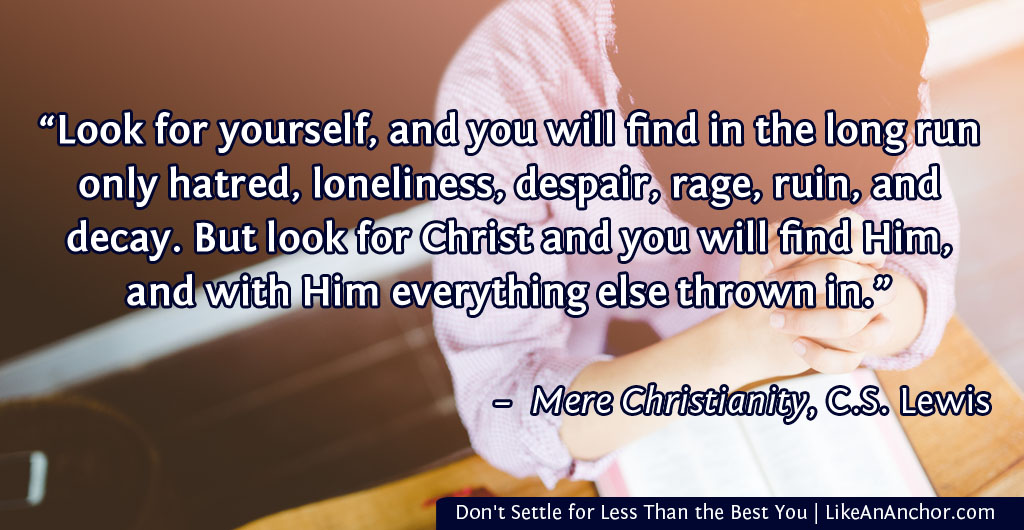
If we try to do things on our own, we’re settling for less than the best. That includes settling for a version of ourselves that is missing something essential from our Creator. If we go through life focused on self, even if that simply means trying to be good apart from God, we will not find happiness. But, to quote the final line of Mere Christianity, “look for Christ and you will find Him, and with Him everything else thrown in.”


The quotes I took from Mere Christianity are all found near the end of the book (several from the final chapter). If you’d like to read everything leading up to them, I highly recommend this book. Here’s a link where you can buy it. (Please not that this is an affiliate link, which means if you click and make a purchase I’ll receive a small commission at no additional cost to you.) If you’d like to read Mere Christianity without buying it, the full text is available online.

Featured image credit: Ruby-Rose via Lightstock
Do You Let People Change?

Most of us know that we can change. In fact, since you’re reading a blog where I talk about personal growth and development from a Christian perspective, I dare say most of you are actively trying to change for the better. We believe we can grow. We believe we can become better versions of ourselves. We believe in change and new beginnings.

But do we believe the same thing of other people? Do you think everyone you meet is capable of the same level of change that you are? Maybe you can say “yes” to these questions as an abstract idea. But if other people are changing and growing, do you suppose that you would notice?

I’m sure most of us would like to think that we hold space for others to grow. We probably also like to think we’d recognize change when we see it, but research indicates that most of us aren’t very good at this. To quote Psychology Today, “People tend to get attached to their initial impressions of others and find it very difficult to change their opinion, even when presented with lots of evidence to the contrary.” We tend to size people up quickly and then stick with our initial impressions even if we see proof that we were wrong. Read more

5 Tips for Dealing With Your Emotions in a Healthy Way Instead of Bottling Them Up

What do you do with your emotions? A lot of us bottle them up and pretend they don’t exist because we’ve grown up thinking it’s not okay to express problematic feelings like anger, or that strong people don’t cry, or that being too happy makes you look ridiculous. There are also people who swing to the opposite extreme and give all their emotions free reign, but that’s a different issue than the one we’re talking about in this article.

Emotions are a complicated subject. We all have them, but what are they really? And what’s the best way to deal with them? Those are questions typically answered by trial and error or by whatever messages regarding emotion we were targeted with as children. As such, we can make several mistakes when approaching emotions. We might see them as something that’s pesky and distracting rather than a core part of being human. We could make the mistake of thinking everyone has (or should have) the same emotional temperament as us. Or we might decide all emotions are negative and it’s better to hide our feelings than to process them.

As someone struggling with anxiety and depression, I often find myself stuck in negative emotions instead of working through them. In many cases, I also react to situations that could be positive in a negative way. But even people with great mental health can still struggle to process emotions effectively. And the more we bottle up emotions (particularly negative ones) without processing them, the greater the risk that we’ll reach a point where they’re released by something like a burst of out-of-place anger or by collapsing into tears for no apparent reason. So how do we avoid such problems and learn to process our emotions in a healthy way? Read more