Putting On Our Teacher’s Mind: How Christians Learn To Be Like Jesus

When we go to school or a lecture or seminar, we’re typically looking to find out what the teacher knows. And it’s rare for most of us to have a continuing relationship with a single teacher, unless you’re in an apprenticeship situation. We tend to think of teachers as people you get information from, not necessarily someone you mimic or have a relationship with (though it’s great when that does happen).

These assumptions color how we respond to the Bible’s description of Jesus as Teacher or Rabbi (Matt. 19:16; John 1:38, for example). Being a student of this type of teacher goes beyond just listening to what he has to say. The relationship between a rabbi and their disciples, or talmidim in Hebrew, went deeper.

those who leave family to study and follow the ways of their teacher [rabbi].  They study not only to learn what their teacher knows but to become the type of man their teacher is.” (Psalm 11918.org)

Being taught in this sense isn’t just about taking in knowledge. It’s about changing who you are and how you think.

Putting On Our Teacher's Mind: How Christians Learn To Be Like Jesus | marissabaker.wordpress.com
Image credit: Michal Jarmoluk via StockSnap

Our Two Great Teachers

We’re not just pulling this idea that disciples of Jesus should become like Him out of Jewish tradition. It comes straight out of the Bible. Jesus said, “A disciple is not above his teacher, but everyone when he is fully trained will be like his teacher” (Luke 6:40, WEB). That’s our goal — to become exactly like our Teacher. And while this title is usually applied to Christ, it also includes God the Father.

It is written in the prophets, ‘They will all be taught by God.’ Therefore everyone who hears from the Father, and has learned, comes to me. (John 6:45, WEB)

Both member of the God-family are closely involved with teaching us. And as we learn from them, we’re to become like them. The idea that we can become like God is so incredible it’s almost unbelievable, but that really is our ultimate goal (1 John 3:1-2). They mean for us to become part of their family and even share in their oneness (John 17:20-23).

Patterned After God

In his first letter to the Corinthians, Paul talks about how we need God’s spirit in us to learn the things God gives us. God’s truths don’t make sense to “the natural man … because they are spiritually discerned” (1 Cor. 2:9-15, WEB). We need God’s spirit to unlock our minds and transform them. And this process results in us developing “the mind of Christ” (1 Cor. 2:16, KJV).

Let this mind be in you, which was also in Christ Jesus (Phil. 2:5, KJV) Read more
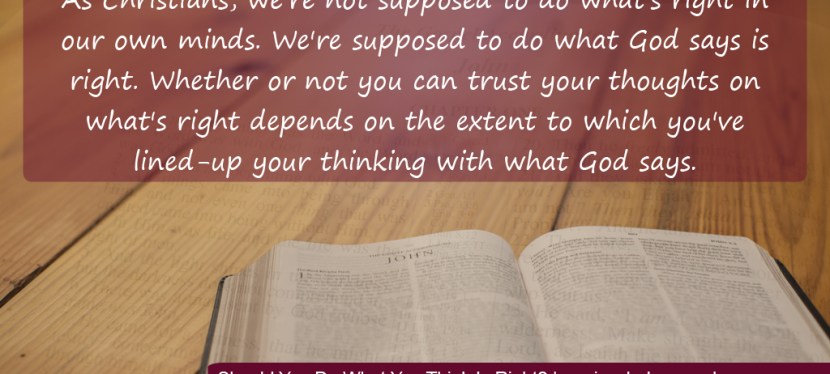
Should You Do What You Think Is Right?

“Always let your conscience be your guide.”

“Follow your heart.”

“Trust yourself.”

Those are the kinds of self-affirming advice we often hear. The basic argument is that most of us are pretty good people and if we listen really closely to our inner guiding light, then we’ll make good decisions.

But as Christians, we’re not supposed to do what’s right in our own minds. We’re supposed to do what God thinks is right. To some, this might just seem like a subtle shift in semantics. Of course what I think is right and God thinks is right are the same thing. Aren’t they?’

Not necessarily. While the holy spirit is transforming us to “have the mind of Christ,” we’re not all the way there yet. That’s one reason why it’s so important to spend time studying scripture — to make sure we know how God thinks and line-up with Him.Should You Do What You Think Is Right? | marissabaker.wordpress.com

What God Has To Say About Your Heart

When God made the choice to destroy everyone but Noah and his family in a flood, He did so after seeing “that every imagination of the thoughts of man’s heart was continually only evil” (Gen. 6:5, WEB). Even though we are made in God’s image, every single person has sinned and we’re corrupted by the fallen world we live in. And yet even in this state, human’s tend to trust that they know what’s right. But we’re often very wrong.

Yahweh says: Cursed is the man who trusts in man, and makes flesh his arm, and whose heart departs from Yahweh. … The heart is deceitful above all things, and it is exceedingly corrupt: who can know it? I, Yahweh, search the mind, I try the heart, even to give every man according to his ways, according to the fruit of his doings. (Jer. 17:5, 9-10, WEB)

Human being can’t trust their hearts. You might get some things right, but you can’t even really know yourself unless you ask God to share His perspective on you. But that verse in Jeremiah is addressed to the person who’s heart departs from the Lord. What about once you are in relationship with God and making Him the one your trust? What does that do to your heart? Read more

What Sort Of Relationship Does God Want Us To Have With His Bible?

When we’re trying to become more like God there are typically four scriptural tools people talk about using: prayer, study, meditation, and fasting. Today, let’s take a closer look at studying. Even though I do study my Bible (as these blog posts will attest), I don’t think I’ve ever studied the topic of studying.

So I ran a search for the word “study” in the New Testament and it didn’t show up in the WEB translation at all. The two uses in the KJV are both translated from different Greek words and neither means what we associate with the English word “study.” But just becasue that English word isn’t used much doesn’t mean the concept behind saying we should study God’s word isn’t correct. Miriam-Webster’s dictionary for students defines “study” as “the act of making an effort to learn by reading, practicing, or memorizing.”  So I guess our question for today become whether or not that’s the sort of relationship God wants us to have with His word.

What Sort Of Relationship Does God Want Us To Have With His Bible? | marissabaker.wordpress.com
Photo credit: Anggie via Lightstock

Scripture Tied To Salvation

In his second letter to Timothy, Paul tells him what knowing God’s holy writings can do in a person’s life. That seems a good place to start our study:

From infancy, you have known the holy Scriptures which are able to make you wise for salvation through faith, which is in Christ Jesus. Every Scripture is God-breathed and profitable for teaching, for reproof, for correction, and for instruction in righteousness, that the man of God may be complete, thoroughly equipped for every good work. (2 Tim. 3:15-17, WEB)

We could pretty much end this blog post right here. If you want to become “wise for salvation through faith” and be “complete, thoroughly equipped for every good work” then you need to get to know God’s word. Paul makes it very clear that a person who is committed to following God needs to make themselves familiar with the Scriptures that we now call the Bible.

This passage also establishes that scriptures comes straight from God, not human beings (see also 2 Pet. 1:19-21). As such, it’s profitable for us. These writings teach, reprove, correct, and instruct us in righteousness. And we need righteousness, becasue “the unrighteous will not inherit the kingdom of God” (1 cor. 6:9, WEB). Clearly, effort put toward learning, practicing, and memorizing God’s word is going to pay-off. And this isn’t the only scripture that says so. Read more

The Incredible Reasons God Gives Us For Not Being Afraid

It’s all well and good to say, “God doesn’t want you to be afraid,” like we did in last week’s post. But that doesn’t actually help much with getting rid of our fear. Even knowing He’s patient with our fearfulness doesn’t take the fear away.

Thankfully, God’s doesn’t just order, “Fear not,” and leave it at that. He offers specific promises that give us tangible reasons not to be afraid. And when we are fearful, those promises can help us overcome to act in faith despite our fears. This past week, I went through the Bible looking for all the reasons God gives for us not being afraid. There are many, but I’ve sorted them into four main categories:

The Incredible Reasons God Gives Us For Not Being Afraid Looking At Scriptural Mission Statements For People Following Jesus | marissabaker.wordpress.com
Photo credit: HarveyMade via Lightstock

God Is With You

Before Moses’s death, God inspired Him to share these words with Israel:

Be strong and courageous. Don’t be afraid or scared of them; for Yahweh your God himself is who goes with you. He will not fail you nor forsake you. (Deut. 31:6, WEB)

The number one reason we have for living without fear is that God Himself is with us. And not just as a church or a group of people. Individuals can also receive this promise, as did Isaac (Gen. 26:24), Joshua (Josh. 1:9), David (Ps. 23:4), Solomon (1 Chr. 28:20), and Jeremiah (Jer. 1:8).

Don’t you be afraid, for I am with you. Don’t be dismayed, for I am your God. I will strengthen you. Yes, I will help you. Yes, I will uphold you with the right hand of my righteousness. (Is. 41:10, WEB)

God promises not to let us down or leave us alone. That means the most powerful being in existence is at your side through everything. He doesn’t leave us to figure things out on our own nor abandon us in our struggles. Read more

What Does God Have To Say About Fear?

Is being afraid a sin? I think most of us, me included, would say it isn’t sinful in and of itself. Fear is often a natural gut reaction to things happening around us, and it serves a self-preservation role. It only becomes an issue if we act on it wrongly or let it paralyze us and prevent right action. But maybe I’m wrong. Maybe I’m letting my own fears cloud my perspective on this issue. Because it seems God takes our fearfulness more seriously.

He that overcometh shall inherit all things; and I will be his God, and he shall be my son. But the fearful, and unbelieving, and the abominable, and murderers, and whoremongers, and sorcerers, and idolaters, and all liars, shall have their part in the lake which burneth with fire and brimstone: which is the second death. (Rev. 21:7-8, KJV)

Some translations say “cowardly” instead of “fearful,” but the Greek deilos really does mean timid or afraid. Strong’s dictionary adds that it implies faithlessness. Hence Jesus’ question, “Why are you so afraid? How is it that you have no faith?” to the disciples in a storm (Mark 4:37-40, WEB). Is it really the case that God sees our fears and timidity as lack of faith?

What Does God Have To Say About Fear? | marissabaker.wordpress.com
Photo credit: HarveyMade via Lightstock

The Right Kinds of Fear

The Bible talks about fear in both positive and negative ways. The kind of fear that is connected with reverence and respect for God and His authority is good. In fact, it’s essential.

This is the end of the matter. All has been heard. Fear God, and keep his commandments; for this is the whole duty of man. For God will bring every work into judgment, with every hidden thing, whether it is good, or whether it is evil. (Ecc. 12:13-14, WEB)

Fear of God has long been a commanded part of following Him (Deut. 5:29; 6:2; 10:12). And in the New Testament, the apostles tell us to perfect “holiness in the fear of God” (2 Cor. 7:1, WEB), to “work out your own salvation with fear and trembling” (Phil. 2:12, WEB), and to live our lives on earth “in reverent fear” (1 Pet. 1:17, WEB). Read more

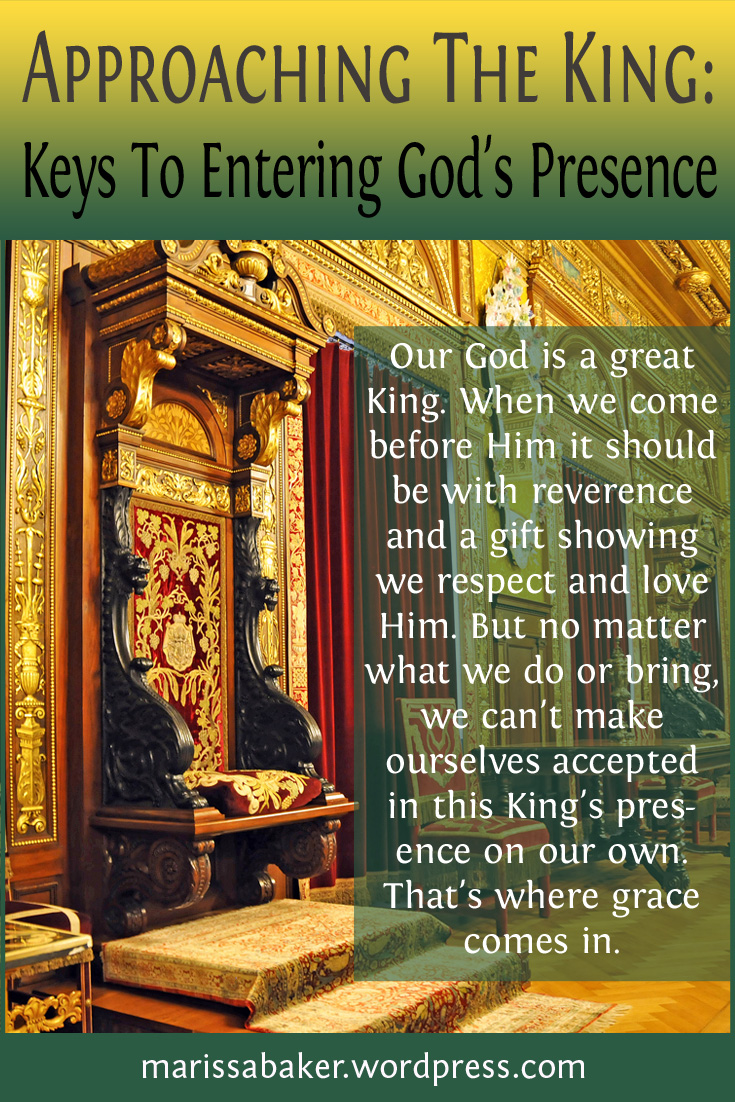
Approaching The King: Keys To Entering God’s Presence

Suppose you’ve been invited to meet the Queen of England. You don’t just walk in, wave, and say, “Hey there Elizabeth.” There are rules, protocol, and etiquette. You should bring a gift, remember to use the right form of address (“Your Majesty” first, then “ma’am”), and not turn reach out and touch her. These days, you won’t get in too much trouble for a slip in convention. But there have been many countries and many times throughout history that approaching royalty in the wrong way could get you killed.

Traditionally, people have recognized something special about royalty. Part of this was religious — rulers were seen as gods, or representatives of the gods, or appointed by God. It’s also a matter of recognizing and respecting an authority role.  Even in countries without a monarchy, we’ll still tend to recognize that some social positions command a certain amount of respect (i.e. you won’t talk with your boss the same way as a close friend and you’d probably show the President even more respect).

Approaching The King: Keys To Entering God's Presence | marissabaker.wordpress.com
Photo Credit: “Romania-1603,” by Dennis Jarvis, CC BY-SA via Flickr

A Question From God

The Bible applies several titles to God that demand respect, including Father, Master, Lord, and King. But do we take them seriously? Historically, God’s people have fallen short in this regard.

A son honors his father, and a servant his master. If I am a father, then where is my honor? And if I am a master, where is the respect due me? Says Yahweh of Armies to you, priests, who despise my name. (Mal. 1:6, WEB)

Yes, God loves you and He wants to be your friend. But we’re not to forget who He is and the respect due Him. “‘For I am a great King,’ says Yahweh of Armies, ‘and my name is awesome among the nations’.” (Mal. 1″14, WEB). God deserves more respect than worldly authority figures, but do we even give Him that much? Read more