What should your heart be set on once you give your life to the Lord? Is it keeping the commandments? going to church? an active prayer life? acts of service? Those are all good things, but they should be a side-effect of our primary focus. In other words, they’ll happen because we want to keep the Law, fellowship with other believers, pray, and serve when our hearts are in the right place.
In Christopher West’s book Fill these Hearts, he quotes mid-twentieth century artist and writer Caryll Houselander as saying, “If instead of using the expression ‘spiritual life’ we used ‘the seeking,’ we should set out from the beginning and go on to the end with a clearer idea of what our life with God will be on this earth” (56). Our conversion isn’t a static state. It’s a continuous search for closeness with God. Read more →
I’m staring out the backseat window watching unplanted fields roll by while having a conversation. It’s going pretty well — we’re exchanging ideas, sharing authentic feelings, clarifying anything that was unclear earlier — in short, it’s the kind of meaningful conversation I crave with people I care about. Only one problem: it’s all happening in my head and the guy I’m talking with has no clue we just had this conversation.
From talking with other INFJs and writing my INFJ Handbook, I know thinking through past and potential conversations is something my personality type does. We tend to favor the world inside our own heads and spend plenty of time there. We’re also interested in people, though, so it makes sense that many of our inner thoughts are about how others might respond to us and what they might think about our ideas.
But living inside your head isn’t just an INFJ thing — a preference for the inner world is one of the main ways we define introversion. With that in mind, I asked a group of introverts on Facebook if they related to this and got some interesting responses from several different personality types. I also mentioned that sometimes I forget which conversations I’ve actually had with people and which ones only took place in my head and that resonated with some but, everyone. Here’s a few of the comments I got (used with permission):
“That doesn’t sound like something limited to certain personality types, other than introversion itself. I find myself doing it from time to time. I don’t usually think about others’ feelings or intuit what they are thinking, but the conversations always play out in my head way more than they ever do in real life” (anonymous ISTJ)
“Yes, I do! It’s getting harder and harder to distinguish which is the “real” conversation. I know too well how you feel … I don’t think it’s limited to any particular personality type” (anonymous)
“Yep, all the time. It’s the really confrontational ones that will get me though. I get really angry at scenarios I have dreamed up in my head” (Charis Tippets Branson, INFJ)
“90% of the conversations I have are in my head” (anonymous)
“I do that. Though I remember if I’ve actually had those conversations because the imaginary ones were full of remarks I’d never actually say” (Mary Menard)
“I do this regularly. It’s especially helpful if it’s a hard conversation that needs to happen. The problem is that I have it all figured out and sometimes forget I didn’t actually have the conversation. Last week I told my husband, ‘So, do I really have to call and talk to her or could I just pray and ask God to tell her for me?’ He said I need to call. 😐 I wrote down what to cover or I get into listening mode and have no idea what I was planning to say” (anonymous INFJ)
I recently read a little book called Anam Cara: A Book of Celtic Wisdom by John O’Donohue. A blog reader mentioned the idea of an anam cara, or “soul friend,” in a message, and I simply had to look it up. You can usually tell how interesting I found a non-fiction book by the number of sticky notes poking out by the time I’m done reading. Case in point:
It’s not that I agreed with everything in the book, but rather that I found its musings on the nature of life and connection between people fascinating. The first quote I placed a note next to was also one that I’d read in the article that initially pointed me toward this book.
Anam is the Gaelic word for soul and cara is the word for friend. So anam cara in the Celtic world was the “soul friend.” In the early Celtic church, a person who acted as a teacher, companion, or spiritual guide was called an anam cara. It originally referred to someone to whom you confessed, revealing the hidden intimacies of your life. With the anam cara you could share your inner-most self, your mind and your heart. (p.13)
I love this idea, which comes from Chapter 1: The Mystery of Friendship. I’ve been toying with the idea of incorporating it into a new title for this blog. Perhaps “Soul Teacher”? I’m not sure yet.
A couple pages after this quote, the writer takes this discussion in a direction dear to my heart. He describes Jesus as “the secret anam cara of every individual” (p. 15). Isn’t that a beautiful picture? Jesus is our “soul friend,” our most intimate companion, teacher and spiritual guide, the One to whom you can reveal your most hidden self.
Consequently, love is anything but sentimental. In fact, it is the most real and creative form of human presence. Love is the threshold where divine and human presence ebb and flow into each other. (p.15)
Can We Heal Ourselves?
I loved the first chapter of this book. It was in later chapters that I became frustrated with aspects of O’Donahue’s ideology. In Chapter 3: Solitude Is Luminous, he talks about healing wounds in a way that really resonates with me, but I feel his solutions don’t go deep enough.
It’s true we often seem “destructively addicted to the negative” because confronting it seems to difficult. “If we maintain our misery at this surface level,”O’Donohue writes, “we hold off the initially threatening but ultimately redemptive and healing transfiguration that come through engaging with our inner contradiction.” I’d agree with this — we have to get to know ourselves before we can learn, grow and change ourselves. But O’Donohue isn’t advocating change so much as self-acceptance though befriending “the negative” and recognizing “that it is not destructive. It often seems that morality is the enemy of growth” (p. 115).
There are simply some things in our lives that shouldn’t be accepted. It’s not healthy or safe to befriend the dark side, and we can’t always turn negatives into something benign just by being nice to them. I have to believe it’s possible to grow and remain moral at the same time.
And yet, O’Donohue has a point that we must beware going to the other extreme of spending too much time analyzing and dragging up our pasts. Searching for your problems over and over again won’t help you overcome them, and self-knowledge is only useful if you can act on it in some way to heal and grow. He compares people who go through endless cycles of self-analysis to gardeners who dig up their potatoes every day and replant them a different way.
People in our hungry modern world are always scraping at the clay of their hearts. They have a new thought, a new plan, a new syndrome, that now explains why they are the way they are. …. Negative introspection damages the soul. It holds many people trapped for years and years, and ironically, it never allows them to change (p. 122).
The very next line is where he lost me: “It is wise to allow the soul to carry on its secret work in the night side of your life” (p. 122). Much like he suggests befriending our negativity is the best way of dealing with it, he believes our wounds can heal themselves if we give our souls space and approach our ” hurt indirectly and kindly” (123). But our souls aren’t designed to heal themselves. They’re healed by God.
I feel this idea of self-healing is connected to the writer’s idea of the divine residing inside our souls. Though he references Christianity heavily, that’s not the only theology O’Donohue draws on — the theology of this book is a mishmash of Irish Catholicism, Celtic paganism, and mysticism. He’s not comfortable with the idea of a “faraway divinity,” and so adopts the idea that the divine is within us. He’s missing a third option, though.
Biblicaly, the divine is outside us, but He’s not far away. “The word is very near you, in your mouth and in your heart,” and the living Word wants to dwell inside us (Deut. 30:14; Rom. 10:8). I suppose you could say the divine resides inside us after we submit ourselves to Christ, but we have to ask Him in — not start out looking inside our own souls for the answers.
You Have A Purpose
I want to share with you a passage in this book that I found hugely encouraging. It’s also from Chapter Three.
To be born is to be chosen. No one is here by accident. … Your identity was not offered for your choosing. In other words, a special destiny was prepared for you. But you were also given freedom and creativity to go beyond the given, to make a new set of relationships and to forge an ever new identity, inclusive of the old but not limited to it. … Destiny sets the outer frame of experience and life; freedom finds and fills its inner form. …
You were sent to a shape of destiny in which you would be able to express the special gift you bring to the world. Sometimes this gift may involve suffering and pain that can neither be accounted for nor explained. There is a unique destiny for each person. Each one of us has something to do here that can be done by no one else. If someone else could fulfill your destiny, then they would be in your place and you would not be here. … When you begin to decipher this, your gift and giftedness come alive. Your heart quickens and the urgency of living rekindles your creativity. (83-84)
This past Shabbat, the speaker at my Messianic congregation talked about Leah. She was not as pretty as her younger sister Rachel and she was unloved by her husband. She probably thought she didn’t make much of an impact on the world. And yet, her example of faith is recorded in the Bible for everyone to read, and her children founded the priestly lineage of Levi and the royal lineage of Judah, among other nations. She’s a direct ancestor of notable personages like Moses, David and Jesus Christ Himself. Her life matters more than she ever knew.
You also have a purpose in this world, even if you can’t see it. This isn’t to perpetuate an idea that you’re a “special unicorn” who is better than other people. Rather, it’s to say that of us has a unique gift that’s of real value, and you have a hand in shaping how it impacts the world.
Sometimes, Bible study ideas can come from an unexpected source. One of the speakers at our Feast of Tabernacles site last month was a man whose messages rarely catch my attention, but he gave an excellent sermonette about falling in “true love” with God.
Though the holy days for this year are several weeks in the past, these subjects are relevant year-round. Since the Feast, or Sukkot, pictures Christ’s millennial reign, it’s also connected with the marriage to His church, which takes place a little earlier. We will be living and reigning with Jesus as His bride, teaching and serving alongside Him (Rev. 20:4). But first, we have to get there.
God is love. it’s not just something God has like a person can have feelings of happiness or a sense of humor. Love (and the word is agape) is God. All real love — that selfless seeking of another’s good because you care about them so much — is of God.
And we have known and believed the love that God has for us. God is love, and he who abides in love abides in God, and God in him. (1 John 4:16)
When we’re filled with love, we’re filled with God’s essential character. “If we love one another, God abides in us, and His love has been perfected in us” (1 John 4:12). The opposite is true as well: it’s impossible to love God or abide in Him while harboring an attitude of hate (1 John. 4:20).
He who has My commandments and keeps them, it is he who loves Me. And he who loves Me will be loved by My Father, and I will love him and manifest Myself to him. … If anyone loves Me, he will keep My word; and My Father will love him, and We will come to him and make Our home with him. (John 14:21, 23)
Love creates relationship with God. It’s also inseparably connected to commandment keeping — if we love God, we’ll live as He said to, thereby showing love for God. This results in a relationship Jesus described as “abiding in” Him and His Father, and Them in us.
As the Father loved Me, I also have loved you; abide in My love. If you keep My commandments, you will abide in My love, just as I have kept My Father’s commandments and abide in His love. (John 15:9-10)
Perfect love results in perfect unity — mutual indwelling like the Father and Jesus have together and want to share with us (John 17:21-23). God’s love is the only love that can build the kind of relationship that leads to eternity, and that’s why we have to keep sharing the same love we’re being given (John 13:34; 15:12).
Burning Love
We’ve spent quite a lot of time on this blog, and in my God’s Love Story ebook (which you can download free), talking about what God’s love is like. Our love for God and each other is supposed to be exactly like God’s love for us. It’s selfless, sacrificial love. it’s unabashed seeking of what is best for the beloved. It’s love shared between the best of friends. It’s the highest form of romantic love (non-sexual; we’re talking about agape, not eros).
Set me as a seal upon your heart, as a seal upon your arm; for love is as strong as death, jealousy as cruel as the grave; its flames are flames of fire, a flame of YAH. Many waters cannot quench love, nor can the floods drown it. If a man would give for love all the wealth of his house, it would be utterly despised. (Song 8:6-7)
You might say these lovely verses from the Song of Songs are the Old Testament companion scripture to 1 Corinthians 13. Love is a fire fueled by YAH (which is a poetic form of YHWH usually hidden in English translations of this verse). Love like that can’t be put-out by anything the world throws at it, and it can’t be bought anymore than you can buy the holy spirit (Acts 8:18-21).
After Jesus’ resurrection, He appeared to two disciples on the road to Emmaus (Luke 24). He walked with them incognito and “expounded to them in all the Scriptures the things concerning Himself.” After they were allowed to recognize Him over dinner and He “vanished out of their sight” these disciples make an interesting observation (which I’m indebted to the aforementioned sermonette for connecting with the subject of God’s love).
And they said to one another, “Did not our heart burn within us while He talked with us on the road, and while He opened the Scriptures to us?”(Luke 24:32)
They recognized that “burning hearts” was a sign of Jesus being alongside them. When we’re abiding in Him and walking in obedience, we will be filled with the unquenchable love of God like a burning fire.
The Greek word translated “burn” in Luke 24 can refer to a literal flame, but there are several other places in scripture where it’s used to describe a condition inside people (G2545, kaio). John the baptist was described as “the burning and shining lamp” (John 5:35). We’re told to be watchful servants and ordered, “Let your waist be girded and your lamps burning (Luke 12:35). Kaio is also the word used when Jesus talks about us letting our lights shine like a burning lamp in the world (Matt. 5:14-16).
We need to let our lights, fueled by God’s love, burn so they can be seen. As we walk in the love of God, keeping His commandments and abiding in Him, unquenchable love should flow out from us to our brethren and neighbors.
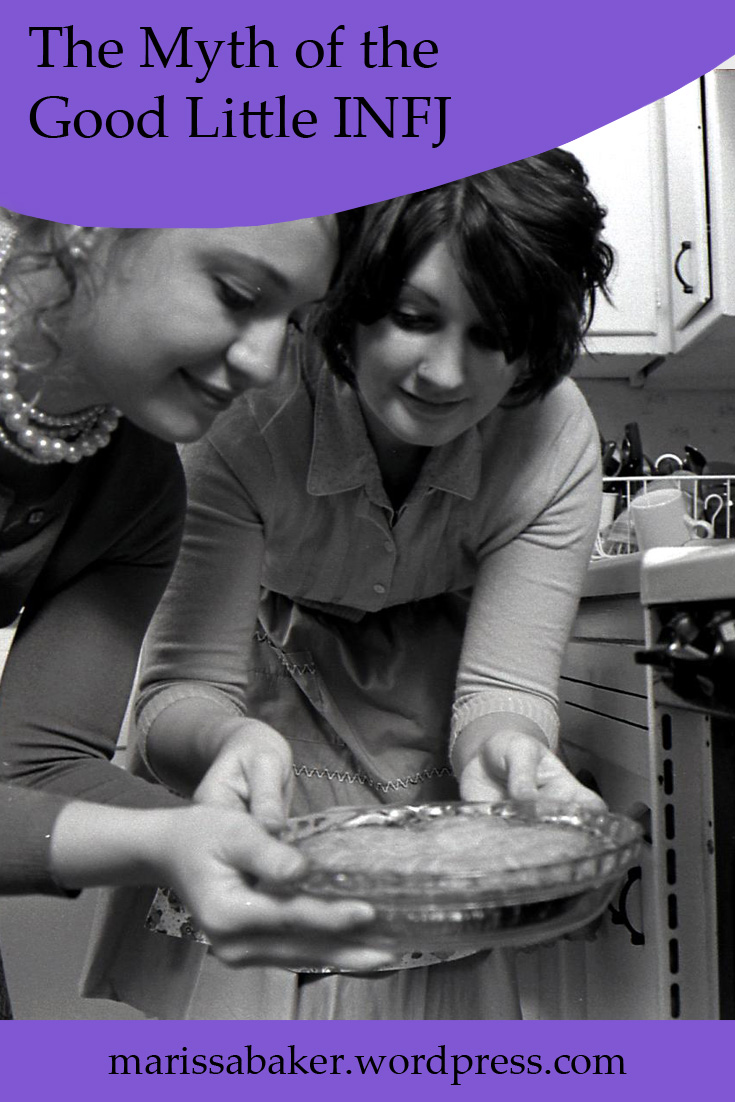
Last week, I stumbled across an article on Pinterest talking about female INFJs. Well, technically it was about INFj in the Socionics system, which is a bit different than the MBTI type and may include INFPs as well, but for purposes of this article we’ll just talk about INFJ types. The original article, written in 2011 by someone identified only as Beskova, paints a portrait of the INFJ type that is beautiful on the surface but doesn’t quite manage to reach their heart. It’s part of a disturbing trend in portrayals of INFJs, though this is the most extreme example I’ve seen.
Like many people who treat the INFJ type as quasi-mythical, this writer describes INFJs as flawless, naive, pure and submissive. They even describe a typical INFJ appearance: “Women of this type are very feminine and are delicate, modest and even shy. … They have a very ephemeral body, and sometimes lightly stooped posture.”
Reading on, it seems the INFJ has no faults. They never gossip or argue, meet adversity with mild gentleness, focus on humanitarian efforts, fit into any job, and submit themselves selflessly to helping the people in their lives. In short, the article says, “When a female INFj becomes your wife, know that in your home there lives a quiet angel” who “makes for one of the most obedient wives.”
The biggest problem with this portrait of an INFJ isn’t just that it’s untrue; it’s the fact that INFJ women may try to fit into this mold if they end up in a relationship with someone who expects “their” INFJ to act like this. One thing that’s become clear in the months I’ve been reading things INFJs share online is that we’re one of the types most vulnerable to getting involved in unhealthy relationships with narcissists. And INFJ descriptions that make us out to be perfectly submissive and obedient aren’t helping discourage interest from unhealthy people.
Myth: INFJs won’t start a fight
It’s true that INFJs are one of the most conflict-avoidant types. Until a person does something the INFJ can’t live with, we’ll often just nod and smile at most conversations and suggestions. This happens with casual acquaintances when we don’t want to wast energy on conflict, and in closer relationships when we don’t want to deal with the emotional fall-out of conflict unless there’s a very good reason. I talk about this at greater length in my INFJ Handbook.
But if you think INFJs can’t get angry or won’t take a stand when things aren’t as they should be, think again. INFJs tend to draw a line in their minds, and once it’s crossed we’ll make sure we let you know. Once we get started, we’ll probably tack on a list of every other way you’ve ever let us down as well. The closer we are to you, the better we’ll know how to tear you apart (note: we’re not proud of this fact, and many INFJs work hard at controlling their anger). The best way to avoid this in a relationship is to keep open lines of communication, which is the number one thing many INFJs are looking for in a relationship. INFJs prefer to keep our emotions out in the open, and if we feel safe and heard then there’s no need to bottle up our feelings until we explode.
Myth: INFJs are always agreeable
In this socionics article, the writer talks about how INFJ women often need/want other people to make decisions for them. They write, “If you are her husband take responsibility for making major decisions in development of your family and she will with pleasure obey you.” Now, I’ll be honest — sometimes I do want people to make decisions for me. But if an INFJ is consistently told she can’t be trusted with important decisions and is left out of the planning process, then she’s going to stop trusting you.
The other party might not even notice an INFJ doesn’t agree with him if he’s expecting her to be what the article says: “friendly and dutiful, never quarrel nor ask much for themselves.” We place a high value on trust and communication in relationships, and assuming we agree with you instead of really asking us what we think is a good way to experience the INFJ door slam.
A tip for people who know INFJs: If we don’t actually agree with you, or simply don’t care, we’ll typically make non-committal sounds, nod our heads, and avoid eye contact. If pressured to commit to something we don’t want to do or think, but won’t openly disagree with, we’ll try to push it off to an unspecified future date. When an INFJ actually agrees with you, we’ll make eye contact, our face will light-up, and we’ll say things like “Oh, yes” instead of just nodding. Usually, we’ll also be able to explain why we agree with you in specific terms.
Myth: INFJs are completely altruistic
One last quote from the socionics article: “watch that her emotional resources aren’t spent on her girlfriends, who inadvertently will use your wife as a psychotherapist. She will never refuse them herself, of course. Out of compassion. Therefore, it will be best if you take the matter into your own hands and limit the flow of those desiring to obtain psychotherapeutic sessions and useful advice from her.” Excuse me! What gives someone else the right to limit an INFJ’s contact with her friends? That’s the sort of controlling behavior that’s a huge red-flag in any relationship.
In addition to being incapable of taking care of herself, INFJ wives are apparently so dutiful they’ll do all the housework without any complaint even though they hate cleaning and cooking. For the record, this INFJ loves cooking and the housework doesn’t always get done in a reasonable amount of time. Also, one reason INFJs will avoid conflict and try to help people is because of how it affects us. Sometimes I do what people ask just because I don’t want to stay awake for three hours that night re-hashing every word of the resulting argument. It’s a self-protecting mechanism. That’s not to say INFJs don’t care about people — we do, deeply, and we will support our friends and family whenever possible. It’s a good thing. We can stretch ourselves too thin at times, but INFJs value their introvert time and don’t usually need someone to step in an control their lives to keep them from burning out. We’re not that altruistic.
In conclusion …
I may have dispelled some of the “mystic unicorn” aura surrounding INFJs, but perhaps that’s a good thing. Our rarity doesn’t make us better than other types, and type portraits that make us out to be something ephemeral and idyllic really aren’t helpful. As my siblings (and no doubt other people who INFJs have let into their lives) can testify, we’re not perfect.
How many people do you really open up to? Even if you’re an “open book,” there are probably things you don’t share with everyone. There are secrets, aspects of our personality, and thoughts that we only show closest friends, family or a spouse. You may have parts of you hidden so deep no one sees them.
What about in your relationship with God? Even though He knows everything about us, we can still chose to hold things back from Him. We can tell Him to stay away, keeping Him at arms length and refusing to let go and surrender to His work in us.
Opening up and letting myself be seen is a challenge I face in human relationships, and in this fall holy day season I’ve been thinking about whether I try to do the same thing with God. I think that I’m more open with Him than with anyone else, but are there still things that I’m trying to hold back or hide?
Open To Me
Jesus is supposed to be our friend and lover. He wants to know you more thoroughly than anyone else ever will, but He wants you to chose that relationship. He won’t force Himself into your life, though He will knock.
I sleep, but my heart is awake; it is the voice of my beloved! He knocks, saying, “Open for me, my sister, my love, my dove, my perfect one; for my head is covered with dew, my locks with the drops of the night.” (Song 5:2)
The woman in this part of the Song of Songs has “slumbered and slept,” and now Christ is outside asking to come in. “He sues for entrance who may demand it; he knocks who could easily knock the door down” (Matthew Henry’s Commentary). He doesn’t upbraid her for shutting Him out — He just wants her to let Him in. Have we also locked Him out? perhaps through carelessness if not deliberately?
she did not say, I will not open, but, How shall I? Note, Frivolous excuses are the language of prevailing slothfulness in religion; Christ calls to us to open to him, but we pretend we have no mind, or we have no strength, or we have no time (Matthew Henry)
Matthew Henry talks about this as “The slights which careless souls put upon Jesus Christ,” and which actually demonstrate “a great contempt” for their savior. When we ignore Jesus’ request to come into our lives, we reject His work in us.
Here, in the Song, the woman finally opens the door when she sees His hand at the door. Unfortunately, she waited too long for welcoming Christ in to be easy.
I opened for my beloved, but my beloved had turned away and was gone. My heart leaped up when he spoke. I sought him, but I could not find him; I called him, but he gave me no answer. The watchmen who went about the city found me. They struck me, they wounded me; the keepers of the walls took my veil away from me. (Song 5:6-7)
If we aren’t willing to open ourselves up to Christ when He knocks, He will be harder to find. If we don’t unveil ourselves to Him, we might find ourselves lost, alone and stripped of our covering pretenses before we find Him again. This can happen multiple times in a Christian’s life, just as this pattern is repeated in the Song (Song 3:1-4). Our lives are often a dance of drifting away and coming back to Christ.
Torn Veils
Veils keep us from fully experiencing God. The veil in the temple separated the Holy of Holies — where God’s spirit appeared — from the rest of the temple complex. Prior to Christ’s sacrifice, only the High Priest could enter, and only once a year (Heb. 9:1-8). The moment Jesus died, “the veil of the temple was torn in two from top to bottom” (Matt. 27:51). His death removed the most visible separation between God and His people.
There was another veil mentioned in the Old Testament that Paul talks about in the New. After Moses spoke to God, he shone so much with God’s reflected glory that Israel feared him. Moses wore a veil to hide his shining face before everyone but God (Ex. 34:29-35). Paul wrote about this veil in his second letter to Corinth.
But their minds were blinded. For until this day the same veil remains unlifted in the reading of the Old Testament, because the veil is taken away in Christ. But even to this day, when Moses is read, a veil lies on their heart. Nevertheless when one turns to the Lord, the veil is taken away. (2 Cor. 3:14-16)
Christ has torn away all the veils between the Lord and His people. The temple veil which tore at His death opened the way into His sanctuary, and when we turn our hearts to Him He takes away the veil shielding true understanding of the Torah.
But we all, with unveiled face, beholding as in a mirror the glory of the Lord, are being transformed into the same image from glory to glory, just as by the Spirit of the Lord. (2 Cor. 3:18)
We have to unveil our faces if we want to see His unvelied face. To know Him, we must want to be known. He took the first step — will we be equally open with Him?
Being Seen
Psalm 139 talks about God knowing us thoroughly — all our thoughts, every part of our personality. It also includes a very important line where David invites God into this deep, intimate relationship.
Search me, O God, and know my heart; try me, and know my anxieties; and see if there is any wicked way in me, and lead me in the way everlasting. (Ps. 139:23-24)
David’s willingness to be seen by God, and his request that God know him, are key to the sort of closeness described earlier in Psalm 139. Today, we can have that same sort of intimacy with our Lord if we let Him in.
Behold, I stand at the door and knock. If anyone hears My voice and opens the door, I will come in to him and dine with him, and he with Me. (Rev. 3:20)
Our Beloved is knocking on our doors, asking us to let Him in. Turn your face to Him, take off the barriers you’re putting up between you and Jesus. See, and be seen.




 This past Shabbat, the speaker at my Messianic congregation talked






 Like An Anchor