Adoption

Come out from among them,  and be ye separate, saith the Lord,  and touch not the unclean thing;  and I will receive you,  and will be a Father unto you,  and ye shall be my sons and daughters,  saith the Lord Almighty.  2 Corinthians 6:17-18About two years ago I read a booklet that claimed it is a “misunderstanding” to describe Christians as “adopted” children of God “rather than His actual begotten sons.” The bulk of the booklet was excellent and had nothing to do with this topic, but I wanted to bring this up by way of introduction. If I had not felt uncomfortable with the way this part of the booklet was phrased, I probably never would have looked into the concept of “adoption” in the New Testament.

Once I began studying it, I started to think that adoption as presented in the NT is a way of describing the process by which we become God’s children. We were once separated from God by our sins, but because of Christ’s sacrifice we have been brought into God’s family (Col. 1:21-22; 1 Jn. 3:1-2). They are calling people who were once outside Their family and making them children. Sounds like adoption to me.

Romans 8

For as many as are led by the Spirit of God, they are the sons of God. For ye have not received the spirit of bondage again to fear; but ye have received the Spirit of adoption, whereby we cry, Abba, Father. The Spirit itself beareth witness with our spirit, that we are the children of God: and if children, then heirs; heirs of God, and joint-heirs with Christ; if so be that we suffer with Him, that we may be also glorified together (Rom 8:14-17)

The word “adoption” used here comes from the Greek word huiothesia (G5206). When looking at the history of this word, there is no question that its intended meaning is adoption. Spiros Zodhiates says it is used “of the state of those whom God through Christ adopts as His sons and thus makes heirs of His covenanted salvation.” He goes on to explain that,

Paul in these passages is alluding to a Greek and Roman custom rather than a Hebrew one. Since huiothesia was a technical term in Roman law for an act that had specific legal and social effects, there is much probability that Paul had some reference to that in his use of the word. Adoption, when thus legally performed, put a man in every respect in the position of a son by birth to him who had adopted him, so that he possessed the same rights and owed the same obligations. Being a huios, a son, involves the conformity of the child that has the life of God in him to the image, purposes, and interests of God and that spiritual family into which he is born.

Several verses later in Romans 8, the same word is used again.

For we know that the whole creation groaneth and travaileth in pain together until now. And not only they, but ourselves also, which have the firstfruits of the Spirit, even we ourselves groan within ourselves, waiting for the adoption, to wit, the redemption of our body (Rom.8:22-23)

Adoption as Redemption

In Romans 8:23, “adoption” is so important to this process of becoming God’s sons that it is equated with “redemption.” This is not an isolated comparison.

Even so we, when we were children, were in bondage under the elements of the world: but when the fulness of the time was come, God sent forth His Son, made of a woman, made under the law, to redeem them that were under the law, that we might receive the adoption of sons. And because ye are sons, God hath sent forth the Spirit of His Son into your hearts, crying, Abba, Father. Wherefore thou art no more a servant, but a son; and if a son, then an heir of God through Christ (Gal. 4:3-7)

These verses tell us that Jesus Christ came with the purpose of redeeming us in order that “we might receive the adoption.” In such a context, adoption sounds like a description of the process by which God takes people who were not part of His family and makes us His children.

Blessed be the God and Father of our Lord Jesus Christ, who hath blessed us with all spiritual blessings in heavenly places in Christ: according as He hath chosen us in Him before the foundation of the world, that we should be holy and without blame before Him in love: having predestinated us unto the adoption of children by Jesus Christ to Himself, according to the good pleasure of His will, to the praise of the glory of His grace, wherein He hath made us accepted in the beloved (Eph. 1:3-6)

Adoption — being redeemed from sin and placed in God’s family — is something we were predestined to “according to the good pleasure of His will.” Another usage of huiothesia underscores the importance of this concept. In Romans 9:4, adoption is listed alongside “the glory,” “the covenants, “the giving of the law,” “the service,” and “the promises” as something which God gave to Israel (Rom. 9:1-5).

No Longer Orphans

Though Paul is the only New Testament writer to use the Greek word huiothesia in his writings, the concept of adoption is not isolated to his letters. When Jesus Christ promises in John 14:18 “I will not leave you comfortless: I will come to you,” the word “comfortless” is translated from orphanos (G3737). In the Septuagint, this same word is used in Psalm 68:5 to describe God as “A father of the fatherless.”

Zodhiates says this word is derived from “an adjective not found in the NT meaning obscure, dark, because the orphan is often little esteemed and neglected and thus forced, as it were, to wander in obscurity and darkness. Orphaned, bereved, spoken particularly of children bereaved of parents (James 1:27).” This darkness and obscurity perfectly describes the state we were in before Jesus Christ rescued us to be His adopted brothers and sisters.

From examining these verses, it seems clear that use of the word “adoption” in no way indicates we are anything less than God’s own children. Like the Roman custom Paul was likely referencing, this adoption takes someone previously not in the position of son and makes them a child in every sense of the word.

Things You Should Know About INFJs

It might be terribly self-centered to devote an entire post to my Myers-Briggs personality type, but I’m going to do it anyway (think of it as a birthday present to myself). As the rarest personality type, we INFJs often feel misunderstood and alone. Most estimates say that less than 1-2% of the population have this type. That’s one reason discovering our label is so important to us (as I’ve written about before). It lets us know that we are not abnormal, flawed humans. We’re perfectly normal INFJs. This isn’t going to be the first list of it’s type. There’s a Top 10 Things Every INFJ Wants You To Know list and one titled How to love your INFJ? This last one is written mostly for romantic relationships, but it’s funny and true so I linked to it anyway. Though these two lists, and others like them, are excellent, I still wanted to add my voice to the mix. Which brings us to the first point:

Always daydreaming
image found on Pinterest
  • INFJ spend a lot of time thinking, and we like to share our thoughts. The problem is, we have a hard time putting them into words when we’re speaking, which can make us appear inarticulate or even unintelligent. That’s why so many of us become writers — it gives us the time we need to put our thoughts in order before we present them to other people. When we do talk with and listen to others, we crave depth and sincerity rather than small talk.
  • In keeping with all the time we spend inside our own minds, you’ll sometimes notice us staring off into space. There’s nothing wrong with me when I do this and there is certainly no need to wave your hand in front of my face, shout at, or poke me (you know who you are).
  • We really do need people. While some introverts can thrive in solitude for quite some time, INFJs love being around people. They might terrify us sometimes, and we do need alone time to recharge, but life without people makes us depressed. This doesn’t mean you’re likely to find us at parties, however. We prefer a few close friendships. And when we find those friendships, we want them to last forever and tend to work hard at being a good friend.
  • The flip side of this relationship thing is that it’s hard for us to make these deep friendships because we’re reluctant to share our true selves with others. It’s taken years for me to share bits of my inner world with my closest friends. In addition, INFJs have a horror of conflict, and will avoid it as long as possible even when something needs to be addressed in a relationship.
  • C.S. Lewis made for another world
    image found on Pinterest

    We’re often feel like we belong in other worlds. For me, this fits quite well into my Christian faith and my fantasy writing. For other INFJs, it can mean feeling disconnected from the physical to such an extent that they’ll forget to eat (something I’ve never struggled with).

  • INFJs tend to be romantic idealists. We do dream of finding true love, but I mean this in the sense given in the fourth Oxford English Dictionary definition. We are fascinated by what might be, what could be, and what should be. We want to bring order and peace to the world.

    4. Characterized or marked by, or invested with, a sense of romance (romance n. 5a); arising from, suggestive of, or appealing to, an idealized, fantastic, or sentimental view of life or reality …

  • INFJs are known in personality circles for being deeply intuitive. We just seem to know things without being able to explain them. This frustrates our more logical friends, but we find it very useful. It helps us see situations and arguments from both sides and appreciate different people’s perspectives even when we don’t agree with them. In spite of a strong sense of right and wrong and strict adherence to an inner value system, INFJs are very open minded and want to see the best in people.


If you’d like to know more about the INFJ personality type, check out my book The INFJ Handbook. I just updated it with a ton of new information and resources. You can purchase it in ebook or paperback by clicking this link.

Praying For You

I’ve written about prayer before, but I want to shift the focus this time from praying for everyone (1 Tim. 2:1, 8) to praying for our brethren. There are numerous examples of praying for those close to us and who share our faith. Jesus prayed for His disciples and “for them also which shall believe on Me through their word” (John 17:20). Paul mentions that he prays for the brethren (Rom. 1:9; 2 Cor. 13:7; Eph. 1:16; Php. 1:4, 9; Col. 1:3, 9; 1 Thes. 1:2, 3:10; 2 Thes. 1:11; 2 Tim 1:3; Phm. 1:4 ) and instructs his readers to pray for each other, for him, and for others in ministry (Rom. 15:30; 2 Cor. 1:11; Eph. 6:18; Col. 4:2-3, 12; 1 Thes. 5:25; 2 Thes. 3:1; Heb. 13:18). James tells us to “pray one for another, that ye may be healed” (Jas. 5:16).

Each time Paul says that he is praying for the brethren, he mentions specific things he is praying. In Romans, it is that he will be able to visit them shortly. In 2 Corinthians, he prays that they would “do no evil.” In Ephesians, he asks “That the God of our Lord Jesus Christ, the Father of glory, may give unto you the spirit of wisdom and revelation in the knowledge of Him”. Philippians, 1 Thessalonians, 2 Timothy, and Philemon record general requests made on someone’s behalf.

In Colossians and 2 Thessalonians, Paul gives more extensive lists of specific things he was praying for. These can serve as a model when we are praying for each other. The focus is on spiritual matters, praying for a person to increase in knowledge and develop a closer relationship with God.

For this cause we also, since the day we heard it, do not cease to pray for you, and to desire that ye might be filled with the knowledge of His will in all wisdom and spiritual understanding; that ye might walk worthy of the Lord unto all pleasing, being fruitful in every good work, and increasing in the knowledge of God; strengthened with all might, according to His glorious power, unto all patience and longsuffering with joyfulness (Col 1:9-11)

Wherefore also we pray always for you, that our God would count you worthy of this calling, and fulfil all the good pleasure of his goodness, and the work of faith with power: that the name of our Lord Jesus Christ may be glorified in you, and ye in Him, according to the grace of our God and the Lord Jesus Christ. (2 Thes. 1:11-12)

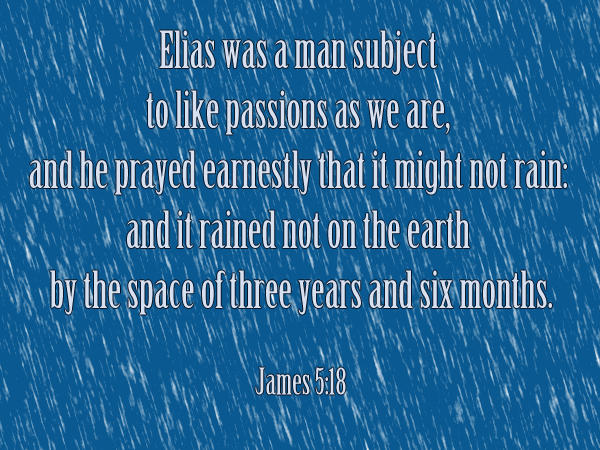
Jas 5:16  Confess your faults one to another, and pray one for another, that ye may be healed. The effectual fervent prayer of a righteous man availeth much.  Jas 5:17  Elias was a man subject to like passions as we are, and he prayed earnestly that it might not rain: and it rained not on the earth by the space of three years and six months.  Jas 5:18  And he prayed again, and the heaven gave rain, and the earth brought forth her fruit. From James 5:16, we know that “The effectual fervent prayer of a righteous man availeth much.” Prayer is one of the most helpful things we can do for another person. We should never feel like, “I just don’t know what I can do to help” as long as we are able to pray.

I’m going to end this post with a lovely prayer recorded in Psalm 20 as translated in The Holy Bible in its Original Order. Usually I prefer the King James for Psalms, but the translation for this psalm makes the prayer seem more personal, and God’s help nearer.

May the Lord answer you in the day of trouble, the name of the God of Jacob set you on high, may He send you help from the sanctuary, and strengthen you out of Zion. May He remember all your offerings and accept your burnt sacrifice. Selah. May He grant you according to your own heart and fulfill all your plans.

We will shout for joy in your victory, and in the name of our God we will set up banners; may the Lord fulfill all your prayers. Now I know that the Lord saves His anointed; He will answer him from His holy heaven with the saving strength of His right hand.

Some trust in chariots and some in horses, but we will remember the name of the Lord our God. They are brought down and fallen, but we have risen and stand upright. Save, O Lord; let the King hear us when we call.

Sabbath In The Woods

One of the trails by Pugh Cabin

This Sabbath is our local church group’s bi-annual meeting in a log cabin (it’s a very nice cabin made out of old pine electric poles with meeting room and a kitchen). We have a potluck (I baked blond brownies) and, if the weather holds, we’ll have a chance to go walking on some lovely hiking trails.

I don’t think there’s any better place to spend the Sabbath than surrounded by the beauty of God’s creation. “The heavens declare the glory of God; and the firmament sheweth His handywork,” and the same can be said of the earth (Ps. 19:1).

For the invisible things of Him from the creation of the world are clearly seen, being understood by the things that are made, even His eternal power and Godhead; so that they are without excuse (Rom 1:20).

This passage always amazes me. It seems to be saying that even if we didn’t have the Bible, there’s enough evidence in the world around us to reveal God. And yet, the people who spend their lives studying the world come up with some pretty bizzar theories to explain away God. For example, here’s a passage from Michio Kaku’s Physics of the Impossible:

There are scores of “accidents” involving the constants of nature that allow for life. Apparently, our universe lives in a “Goldilocks zone” of many parameters, all of which are “fine-tuned” to allow for life. So either we are left with the conclusion that there is a God of some sort who has chosen our universe to be “just right” to allow for life, or there are billions of parallel universes, many of them dead. (page 240-241)

What amazes me is that when confronted with the option to believe in God or the multiverse, so many people would rather believe “there are trillions upon trillions of possible universes” (page 239). If this version of string theory were correct, these universes are like soap bubbles floating in “eleven-dimensional hyperspace. These bubbles can join with other bubbles, split apart, and even pop into existence and disappear” (page 239). And apparently this makes more sense than believing in God.

Perhaps Dr. J Budziszewski was right when he said, “Though it always comes as a surprise to intellectuals, there are some forms of stupidity that one must be highly intelligent and educated to commit” (Escape from Nihilism).

Weddings

I’m about to leave to attend a friend’s wedding, and it has me thinking of that future wedding day the Church will share with Jesus Christ.

Rev 19:6 And I heard as it were the voice of a great multitude, and as the voice of many waters, and as the voice of mighty thunderings, saying, Alleluia: for the Lord God omnipotent reigneth.

Rev 19:7 Let us be glad and rejoice, and give honour to him: for the marriage of the Lamb is come, and his wife hath made herself ready.

Rev 19:8 And to her was granted that she should be arrayed in fine linen, clean and white: for the fine linen is the righteousness of saints.

Rev 19:9 And he saith unto me, Write, Blessed are they which are called unto the marriage supper of the Lamb. And he saith unto me, These are the true sayings of God.

‘Wedding Day” by Casting Crowns has become my favorite contemporary Christian song. I hope you enjoy it, too. Happy Sabbath, and God bless.

God’s Love Story — PDF online

For this cause shall a man leave his father and mother, and shall be joined unto his wife, and they two shall be one flesh. This is a great mystery: but I speak concerning Christ and the church. - Ephesians 5:31-32The final version of what I’m going to call an “e-booklet” is now online. You can download “God’s Love Story” and read a chapter outline at this link.

Here are a couple excerpts. This first is from the introduction.

One reason we gravitate towards tales of heroism, rescue, and love is that there is a basic need in our souls for a relationship with God and His Son. Stories where the handsome prince rides up and rescues the fair princess speak to our longing to know the Prince of Peace, Who laid His life down to rescue His bride from captivity to sin. Jesus Christ is the most powerful, most loving, and most perfect hero-lover to ever exist, far surpassing even the most ambitious human attempts to fashion a story’s hero. The Bible is a living, dynamic book that includes instruction, history, prophecy, and a revelation of the plan of God which reads like a story. My personal theory as to why the Bible reads like a story is because our idea of what makes a good story comes from the sequential narrative God uses to reveal His plan.

This paragraph is from a discussion in Chapter 5 about the Greek words translated “love.”

While agape is a higher kind of love, I think there is something amazing in recognizing that it is not the only love God has towards us. Before His crucifixion, Jesus told His disciples that after His resurrection, “ye shall ask in My name: and I say not unto you, that I will pray the Father for you: for the Father Himself loveth you, because ye have loved Me, and have believed that I came out from God.” (Joh. 16:26-27). The Father has phileo for those who have phileo for His son. This means the Father Himself has common interests and friendship with those who love and believe in His Son. In this context, it is certainly not a lesser love than agape. Philos is an incredible kind of love to share with the creator of the universe.

I hope those of you who choose to download and read the full e-booklet find it edifying and encouraging. I would love to hear your feedback.