Last weekend at a Young Adult retreat, I gave my first seminar. And it went so well! Praise the Lord — I know anything good I write comes from Him and the fact that I delivered a spoken message in front of people without looking nervous or having a panic attack is a clear “God thing.” Since people liked it in-person, I’ve adapted my notes for a blog post to share with you today.
When someone asked Jesus which was the greatest commandment in the law, He gave a two part answer. 1) “You shall love the Lord your God with all your heart, and with all your soul, and with all your mind, and with all your strength.” And 2) “You shall love your neighbor as yourself” (Mark 12:29-31, WEB). The theme for the retreat I spoke at was connecting with God and others, and that’s what these two great commandments are all about. The first tells us how to love God, which is the foundation for building a relationship with Him. And the second tells us how to love our neighbors. Jesus says to love them the same way we love ourselves.
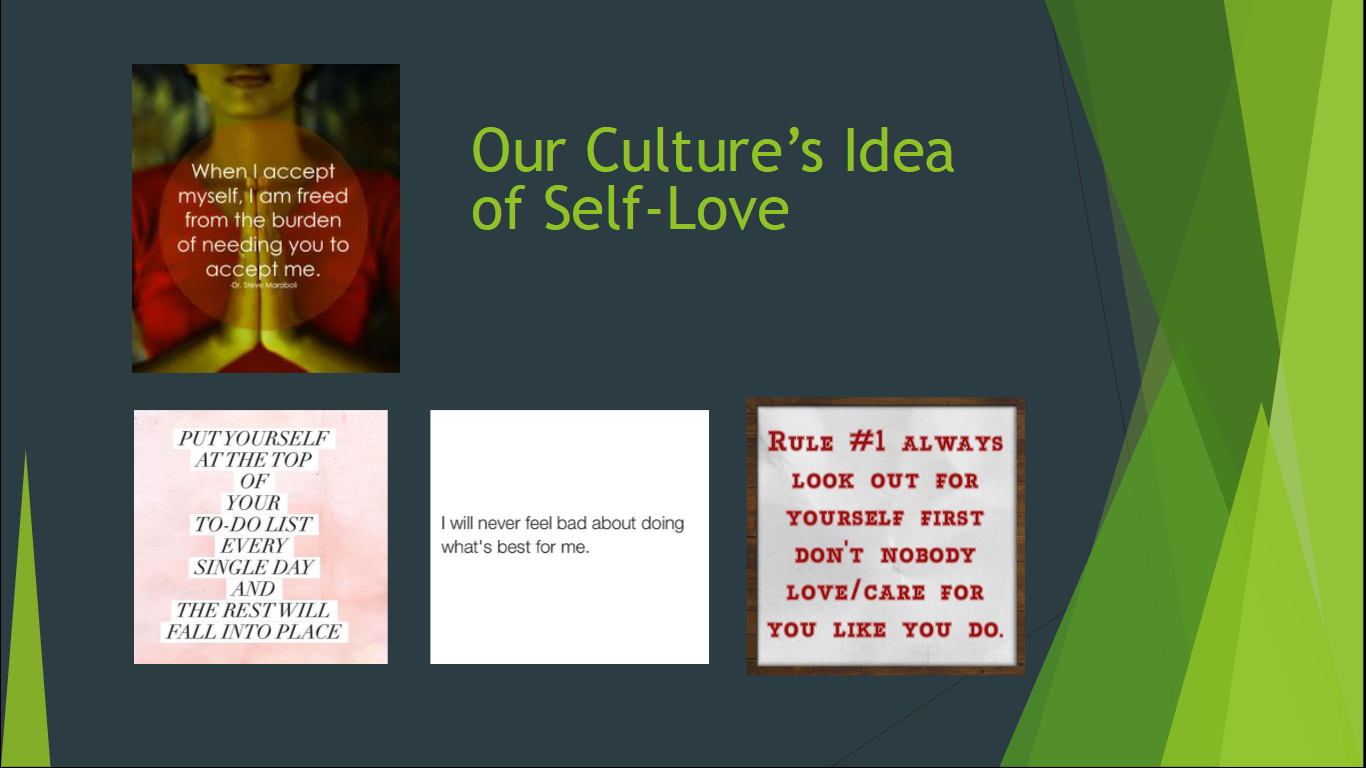
But loving yourself isn’t something we talk about very much in Christianity. We focus on the “love your neighbor” side of this command. If we talk about the “as yourself” part, it’s often assumed that you already know how to love yourself. That’s part of our culture, right? We have a self-acceptance movement and a focus on looking out for “number one.” If anything, I think most Christians would say we love ourselves too much. So we don’t talk about it, just assuming we know how to show love towards ourselves and that we can use this as a guide for how to love others. But do we really know how to love ourselves the way God wants us to?
The word “love” in the verse we just looked at is translated from a agape. This is a benevolent love that always seeks good things for the person who you’re loving. While it does involve feelings, it’s not what you would call an emotion driven kind of love. For example, if you’re giving a friend advice and one option is going to make them happy and your life easier, but the other option is clearly better for their long-term good, agape is always going to pick the better one even though it’s harder.
Agape is an incredibly important concept in the Bible. Of the 356 times the words “love” or “charity” appear in the King James Version of the New Testament, 320 are translated from a form of agape (that’s just shy of 90%). It’s so important that the Bible gives us a full definition in 1 Corinthians 13.
“Love is patient and is kind; love doesn’t envy. Love doesn’t brag, is not proud, doesn’t behave itself inappropriately, doesn’t seek its own way, is not provoked, takes no account of evil; doesn’t rejoice in unrighteousness, but rejoices with the truth; bears all things, believes all things, hopes all things, endures all things. Love never fails.” (1 Cor. 13:4-8, WEB)
Let’s ask some questions based on this verse:
- Are you patient and kind with yourself?
- Do you let yourself get eaten up with envy, bragging, or pride?
- Are you treating yourself in a way you’d consider inappropriate if you were doing it to others?
- Do you get unreasonably angry with yourself?
- Do you keep an account of the bad things you’ve done so you can use it to beat yourself up?
- Are you dwelling on the unrighteous things you’ve done or rejoicing in the ways you follow God’s truth?
- Do you stick by yourself, believe in your ability to do better, and hope good things for your future?
When I asked how many people could honestly say they’re loving and kind toward themselves in this way, only one person raised their hand. But when I asked, “How many of you feel guilty about the idea of showing love toward yourself?” about half the group raised their hands. That included me, which is why I actually felt kinda weird talking about the subject of love like this. It sounds a little selfish, doesn’t it? And we know selfishness is bad. So let’s take a moment to clarify a few things.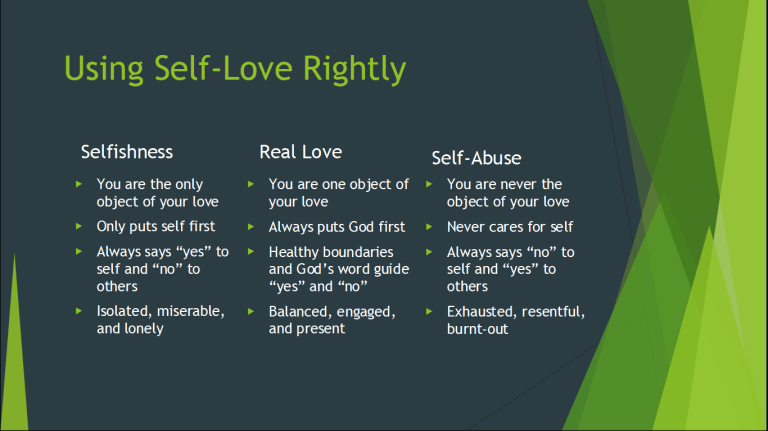
Real love never stops with yourself. If you’re the only object of your love and you always put yourself first, then you have a problem. That’s what it means to be selfish and self-centered. But avoiding selfishness doesn’t mean you refuse to take care of yourself. We’re to offer ourselves to God as a living sacrifice, not abuse ourselves. If you never meet your own needs or do those loving things mentioned in 1 Corinthians 13 for yourself, then you’re going to burn-out. And God loves you way too much to want that.
To see ourselves and care for ourselves and others properly, we need to understand how God sees and cares for us. Most of the time when I hear people talk about asking God to let you see yourself the way He sees you, they’re talking about discovering hidden faults. And that is important, because we all know the verses that talk about our inability to know our own hearts. We need God’s perspective to show us where we should change and grow as we keep moving toward perfection. But if we want a more complete picture of how He sees us, then we also need to understand how much He values us.
The reason the two most important commands are about loving God and loving others is because God Himself is love. Agape is the key element of His essential character. But sometimes, even if it’s not something we’d say out loud, we think that God loves us more when we’re being good. We treat ourselves as if God’s love is conditional on our having already achieved perfection. But it’s not. Remember Romans 5:8 says, “God demonstrates His own love toward us, in that while we were still sinners, Christ died for us” (LEB). The Father and Jesus Christ thought you were worth the price of Jesus’ life even before you were saved. So don’t you dare say you’re not worth loving now.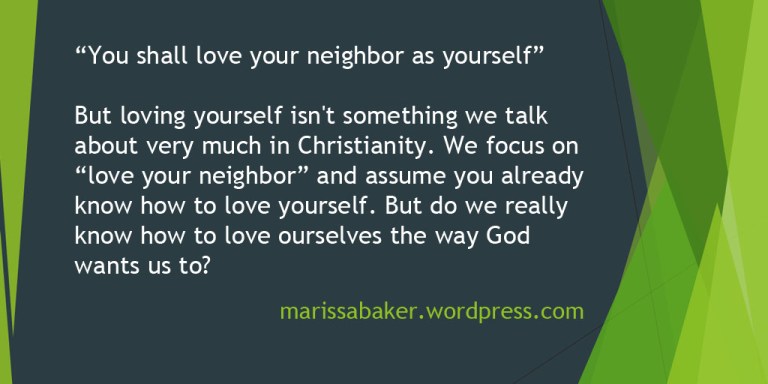
One of the most interesting studies I’ve ever done was about how God uses the word “perfect” in the Bible. He describes Job as “a perfect and an upright man” twice at the beginning of the story (Job 1:8 and 2:3). We know Job learned and grew as a result of the trials he went through, and yet God could describe him as “perfect” with complete honesty before that growth happened. We tend to think of perfect as the best that you can get, but from this example we see that’s not really how God uses the word.
The Hebrew word translated “perfect” is tam (H8535). The word refers to completeness and entirety, but doesn’t necessarily mean finished. Rather, the Theological Wordbook of the Old Testament says the root of tam (H8552; tamam) refers to someone moving “naturally toward that which is ethically sound.” Thus, followers of God can be described as “perfect” while still on the path toward perfection. God will take care of perfecting you – He just needs you to keep moving forward. God loves us even with all our flaws and weaknesses and ways we fall short. He also wants us to grow toward being the best people we can be in Him because that’s what leads to the best outcome we can get – having a relationship with Him that lasts into eternity.
Becoming part of God’s family is made possible because He is love. Having God’s agape directed toward you is amazing. The strength of that love has literally shaped the way the entire universe functions. It’s what motivated the Father to send His Son to this earth to live in a human body and become our sympathetic High Priest as well as the sacrifice that makes salvation possible. If that was the only kind of love God had toward us it would be more than enough and more than we ever had a right to hope for. But it’s actually not the only way God the Father and Jesus Christ love us.
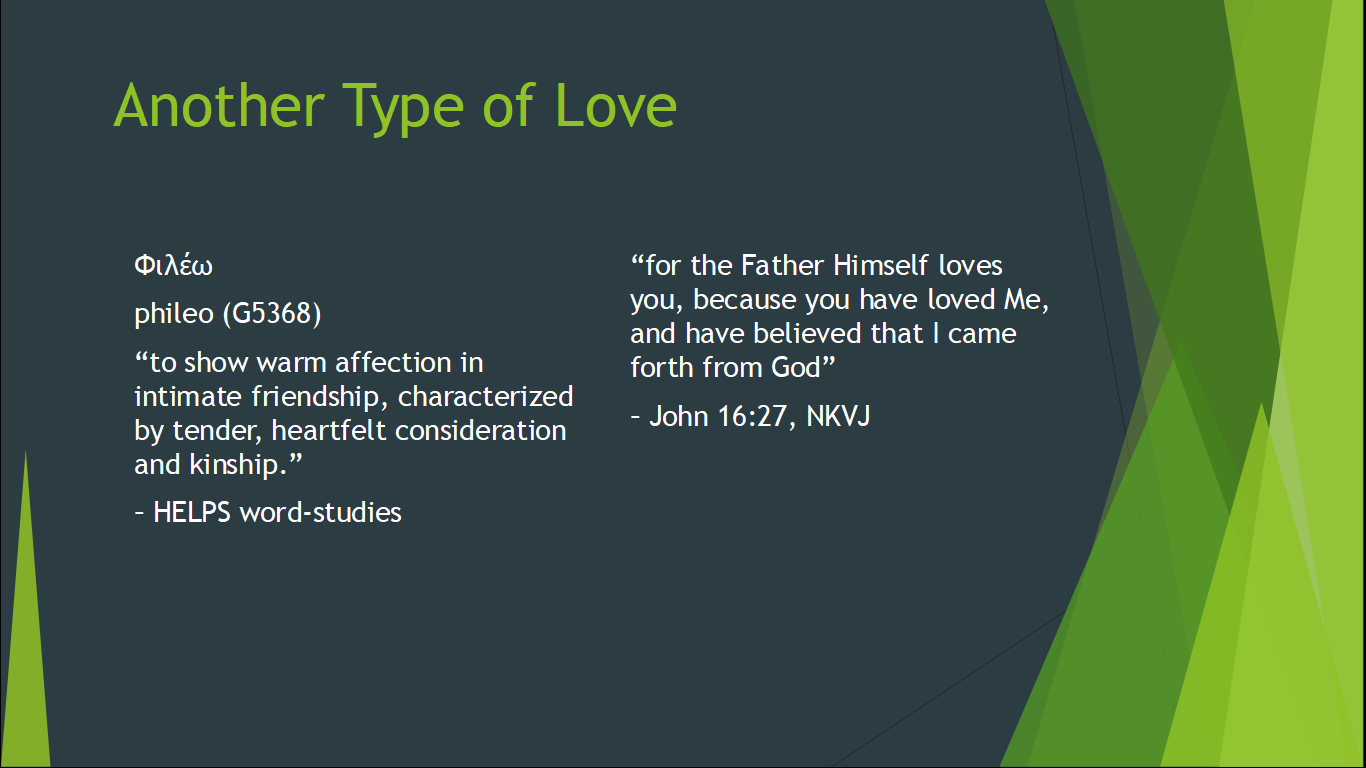
One of my favorite Bible verses reads, “for the Father himself loves you, because you have loved me, and have believed that I came from God” (John 16:27. WEB). Seems simple enough, but this word is not agape. It’s translated from phileo (G5368). According to Spiros Zodhiates’ Greek dictionary, the word phileo means “to have affection for someone.” HELPs word studies adds that it is “characterized by tender, heartfelt consideration and kinship.” Phileo implies having common interests or friendship with the object of one’s love. This type of love is one we can readily identify with because it’s what we feel for our closest friends.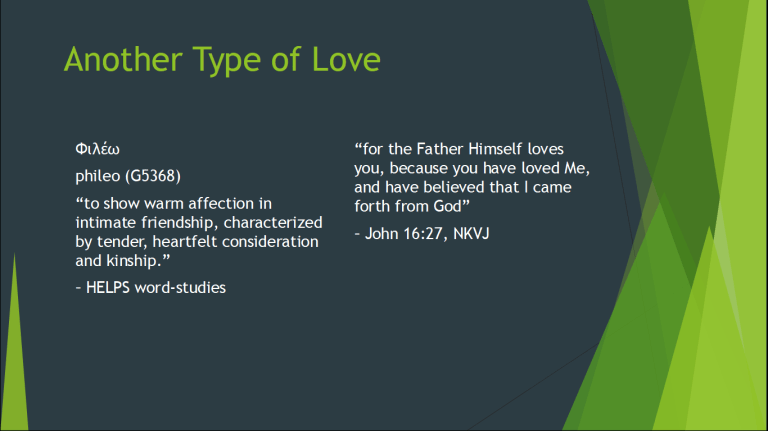
Have you ever thought about God loving you like that? In the context of John 16, Jesus is assuring His disciples that the Father personally listens to our prayers because of His friendly, affectionate love for us and because of our belief on His Son Jesus. If you can honestly say you love Jesus and believe that He’s the son of God, then God Himself wants to be your friend. God is agape and He has that love for every person in the world. God’s phileo, on the other hand, is reserved for those He’s in relationship with – the ones who share His interests, believe in His word, and enter a covenant with Him.
All this love that God has poured into our lives shows us how we’re to relate to ourselves and to others. As John says, “We love, because he first loved us” (1 John 4:19, LEB). The love God has poured into our lives shows us how to love ourselves as well as how to love others because we learn to see ourselves and others the way He sees us. C.S. Lewis touches on this in The Screwtape Letters. This book is composed of a series of fictional letters written from one demon to another teaching them how to seduce human beings away from God, whom they refer to as “The Enemy.” (I know that sounds a bit strange, but it’s a fantastic book that puts a different perspective on talking about what God wants for us.)
The Enemy wants him, in the end, to be so free from any bias in his own favor that he can rejoice in his own talents as frankly and gratefully as in his neighbor’s talents—or in a sunrise, an elephant, or a waterfall. He wants each man, in the long run, to be able to recognize all creatures (even himself) as glorious and excellent things. He wants to kill their animal self-love as soon as possible; but it is His long- term policy, I fear, to restore to them a new kind of self-love—a charity and gratitude for all selves, including their own; when they have really learned to love their neighbors as themselves, they will be allowed to love themselves as their neighbors. For we must never forget what is the most repellent and inexplicable trait in our Enemy; He really loves the hairless bipeds He has created and always gives back to them with His right hand what He has taken away with His left.
The thing Screwtape finds disgusting is a facet of Christianity that gives us great cause for rejoicing. God does not want you to hate yourself. He wants you to love Him, and your neighbors, and yourself all in a right and proper way. So, now that we’ve talked about what love is and how God shows love toward us, let’s go back and fill in some answers to our first question.
Here’s the list I came up with when prepping for the seminar.
- accept the love God is giving you
- take time for yourself to read the Bible, meditate, and pray
- understand and find ways Godly to meet your needs
- work through your stressful emotions instead of burying them
- be kind to your shortcomings
- turn the things that cause you anxiety over to God
- push yourself to improve and develop your strengths
- remember God made you human and gave you limits
- Accept God’s gifts of rest, good food, and exercise
- build good boundaries
Now here’s your homework. Make sure you’re doing these things for the people around you as well as yourself. For example, you could help your roommate with the housework so they aren’t worried about finding time to study and pray. You can be patient with the shortcomings of the people you go to church with and encourage them keep trying. While you’re taking care of yourself as a person who is incredibly valuable to God, remember the people around you hold the same value in his eyes.
In closing, I want to quote C.S. Lewis again. This is from an article titled “The Weight of Glory” (click to read the full text). Here, Lewis talks about the potential for each human being to enter the family of God.
“It is a serious thing to live in a society of possible gods and goddesses, to remember that the dullest and most uninteresting person you talk to may one day be a creature which, if you saw it now, you would be strongly tempted to worship. … It is in the light of these overwhelming possibilities, it is with the awe and the circumspection proper to them, that we should conduct all our dealings with one another, all friendships, all loves, all play, all politics. There are no ordinary people. You have never talked to a mere mortal.”
In 2 Peter 3:9, it says the Lord is “not willing that any should perish but that all should come to repentance” (KJV). God sees the potential of every human being He has created to become something wonderful. And He wants us to see that, too. That’s what Lewis is getting at in these passages. As part of our expression of agape, we need to start seeing our neighbors as candidates for eternal life and valuing their potential as highly as we know God values ours.
A couple years ago, I was a funeral and the speaker said the man we were there to remember “lived his life as though it had eternal consequences.” That’s what God intends us to do as well. How we view and treat ourselves and others will have consequences that stretch far beyond this life. We need to keep our eternal potential in mind when we make decisions about how we treat ourselves and by extension how we interact with others. Jesus said, “You shall love your neighbor as yourself.” I hope we now have a better idea of exactly how to do that.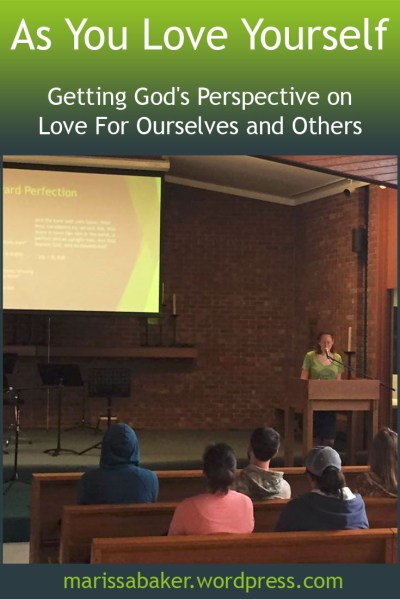
Save
Save
Save
Save
Save











 Like An Anchor